
Formwork plywood is plywood built to hold wet concrete in shape until it sets, then strip clean and go back into the form for the next pour. A sheet without a boil-proof bond, a sealed face and painted edges swells and opens within a few pours. At PK Ply we press it with phenolic film on both faces over a cross-laid Acacia or Eucalyptus core.
What is formwork plywood made of?
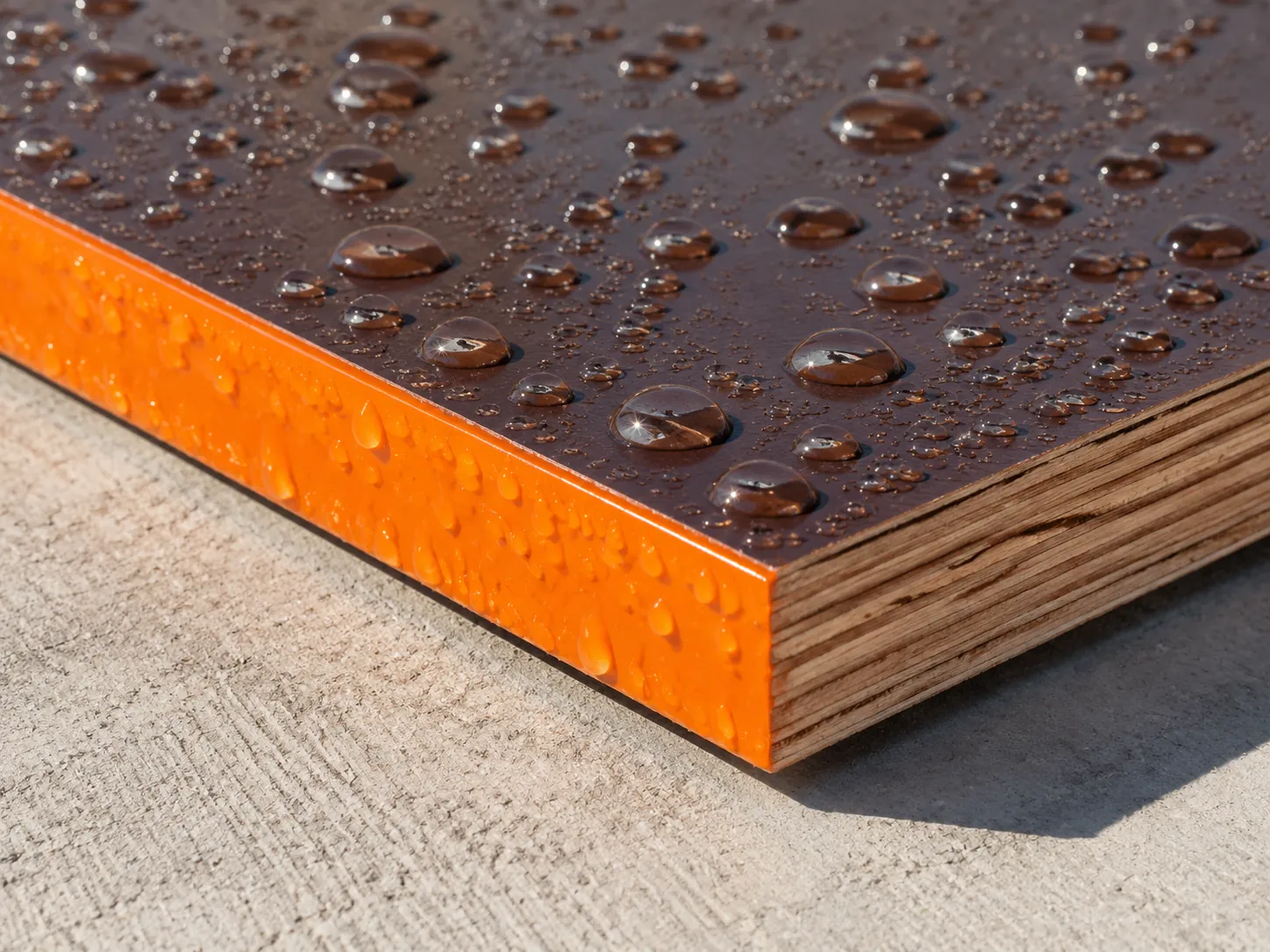
Formwork plywood is made of thin wood veneers laid crosswise and bonded with an exterior glue, usually faced on both sides with phenolic-impregnated film and sealed on all four edges. Our panels use Acacia or Eucalyptus hardwood veneers, MUF or phenolic glue lines, dark film from 120 to over 200 g/m² and water-resistant edge paint.
Each of those four materials has one job on a pour. The veneers give the sheet its stiffness, and laying each layer at right angles to the next keeps it flat when one face is wet and the other dry. The glue holds the veneers together through repeated wetting, vibration and stripping; an interior glue would open after the first few wet cycles. The film is paper soaked in phenolic resin and pressed into the face, so concrete meets a smooth, closed surface that it does not grip. The edge paint closes the end grain, the most open surface a panel has.
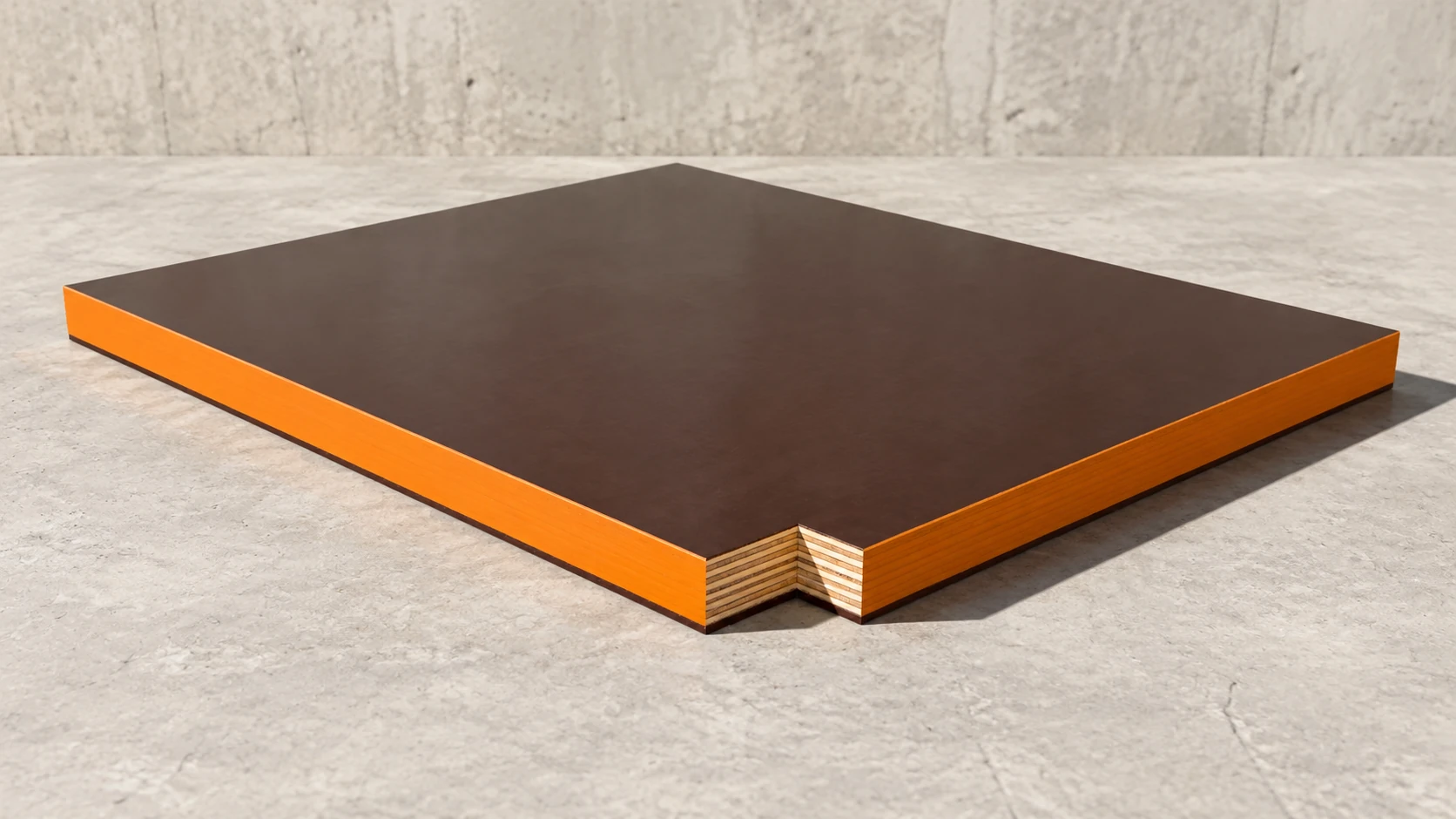
Take an 18 mm panel off our line and cut it open at one corner, and you see the whole build in a few millimetres. A dark film sits on the top and bottom, a smooth hardwood face veneer under each film, then the core veneers in alternating grain directions with a thin glue line between every pair. The outer edges carry a band of paint. Nothing else goes into the sheet. What separates one formwork panel from another is how well each of those parts is chosen and pressed, which is what the rest of this note explains.
How is formwork plywood different from ordinary plywood?
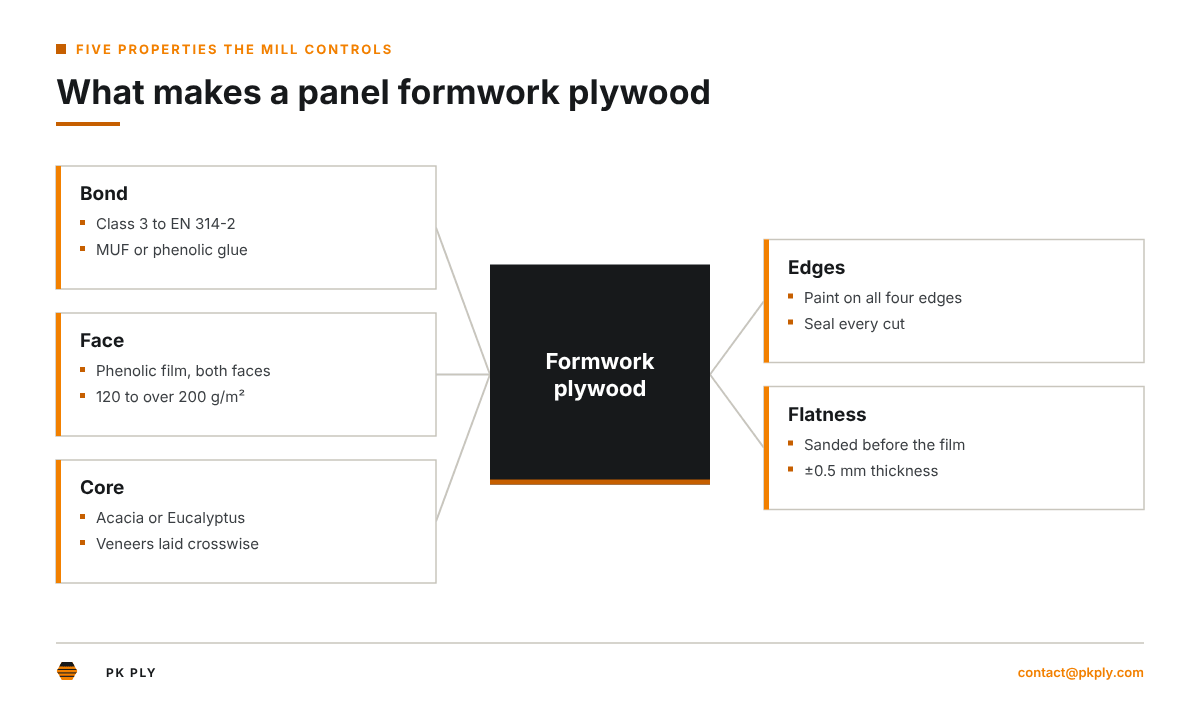
Formwork plywood differs from ordinary plywood in five properties that a mill controls: an exterior bond class, a closed film face, a dense cross-laid core without gaps, sealed edges and a calibrated thickness. Ordinary plywood is made to stay dry where it is fixed; a formwork panel is made to be wetted, loaded, stripped and reused.
The difference shows on the first pour. A sanded wood face takes up water and cement paste, so the concrete bonds to it and tears fibres off when the form is struck. An interior glue line softens when the sheet stays wet for a day under a slab. A bare edge drinks water and swells, so neighbouring sheets step against each other and print lines on the concrete. A formwork panel is ordinary plywood with each of those weak points designed out.
| Property the mill controls | Why the pour needs it | Our reference value |
|---|---|---|
| Bond class | The glue line must survive days of wetting and repeated wet-dry cycles | Class 3 to EN 314-2 on our tested 21 mm phenolic specimen; MUF or phenolic glue by order |
| Face | Concrete must release cleanly and the face must take vibrator and scraper wear | Phenolic film on both faces, 120–125 g/m² up to over 200 g/m² by order |
| Core | The sheet must stay stiff between supports and flat without soft spots | Acacia or Eucalyptus veneers laid crosswise; planning density about 580 or 650 kg/m³ |
| Edges | End grain must be closed so the edge does not swell | Water-resistant paint on all four edges |
| Thickness and flatness | Joints must meet flush and the concrete face must stay even | ±0.5 mm thickness, ±2 mm length and width, core sanded before the film goes on |
The bond class is the property a buyer cannot see and the one that ends a panel’s life soonest when it is missing. The film is the property a buyer sees first and judges most often by colour, which tells little. The core decides weight and stiffness, the edges decide how fast water gets in, and thickness control decides whether a deck of fifty sheets reads as one surface. Our film-faced plywood page sets out the builds we press against each of these five lines.
What plywood is used for formwork?
Most concrete formwork uses film-faced plywood: a hardwood or birch core with phenolic film on both faces and painted edges. Plain exterior plywood with a sanded face is used for hidden work and single pours, and anti-slip film-faced panels cover decks and walkways. The glue under the film then splits film-faced panels into MUF and phenolic grades.
Seven panel types are sold for formwork, and they are not interchangeable. The table sorts them by what each puts against the concrete and where a contractor or formwork system specifies it.
| Panel type | Face against the concrete | Core | Concrete finish | Where it is specified |
|---|---|---|---|---|
| Film-faced, MUF glue | Phenolic film, both faces | Acacia, Eucalyptus or other hardwood | Smooth | Slabs and walls on a normal programme |
| Film-faced, phenolic glue | Phenolic film, both faces, heavier film by order | Hardwood or birch | Smooth, holds over long programmes | Repeated wall pours, long programmes, wet climates |
| Birch film-faced | Phenolic film | Birch veneers throughout | Smooth | European system decks and rental fleets |
| MDO overlay (paper face, film back) | Resin-impregnated paper overlay | Hardwood or softwood | Even, matt | Merchant trade, walls where a matt finish is wanted |
| Plain exterior plywood (BB/BB and similar) | Sanded wood veneer | Hardwood, birch or softwood | Wood texture, absorbs water | Hidden work, foundations, single pours |
| Softwood formply or form plywood | Sanded or overlaid softwood | Pine or other softwood | Wood texture or light overlay | Local merchant trade, small pours |
| Anti-slip film-faced | Patterned film on the walking face, smooth back | Acacia or Eucalyptus | Back face forms concrete | Decks, walkways, platforms |
Two names in that list cause most of the confusion. “Melamine film-faced” can mean a MUF glue line under a phenolic film, which is our melamine build, or a melamine-impregnated paper on the face; ask which before comparing prices. “BB/BB” is a veneer appearance grade from the birch trade, not a glue or bond class: a BB/BB sheet still needs an exterior bond to work as formwork. Plastic-coated plywood also exists for long rental cycles; it is a different product from phenolic film-faced panels and outside what our mills press.
We make the first two types and the last: phenolic film-faced plywood, melamine film-faced plywood and anti-slip plywood. We do not press birch, softwood or plain sanded panels.
Is formwork plywood the same as film-faced plywood?
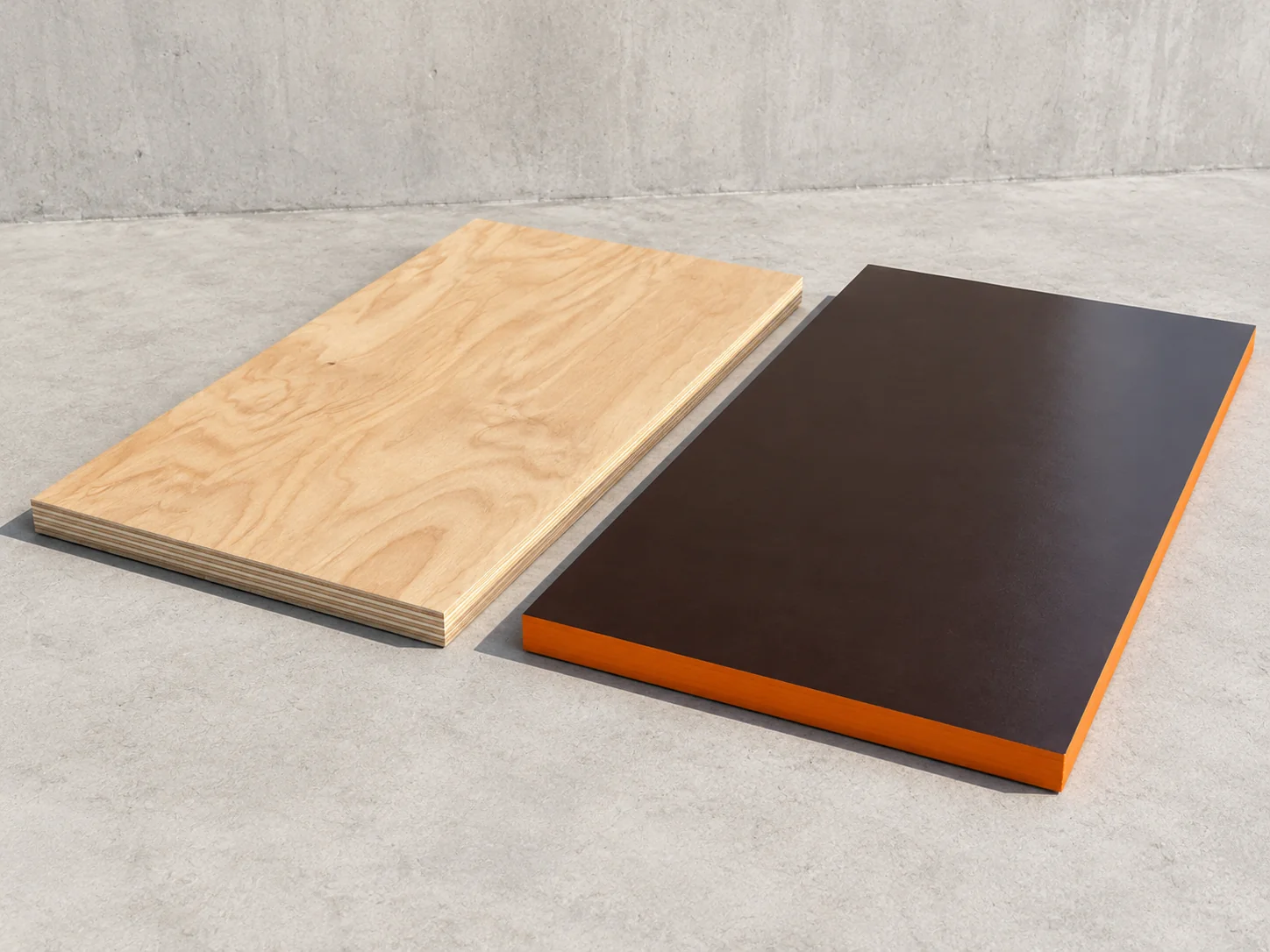
Mostly, but not always. Film-faced plywood is the most common kind of formwork plywood, and on a Gulf, Asian or European site the two names mean the same panel. Formwork plywood is the wider term: it also covers plain exterior sheets and softwood formply that carry no film at all.
The trade uses five names for the job, and each market has its favourite:
- Formwork plywood is the general term in Europe, Asia and the Middle East, and the name of the Australian standard’s product.
- Film-faced plywood names the face, and is what most export quotes from Vietnam and China say.
- Shuttering ply is the UK and Indian term; UK merchants also sell unfilmed softwood sheets under it. Our shuttering ply note covers that market, with its dated shelf prices and the sheet-weight listings sold by the kilogram.
- Formply is the Australian name for film-faced or overlaid formwork panels.
- Form plywood or concrete form plywood is the North American wording.
A name on its own fixes none of the five properties in the section above. A quote for “film-faced formwork plywood 18 mm” can describe a budget panel with a gapped core and a thin film, or a phenolic-glued panel with a heavy film and painted edges. Two film-faced offers with the same name are often not the same build: core grade, joining, glue system, film weight, edge sealing and tolerance make the difference. Write those lines into the enquiry and the name stops mattering.
Which core species make good formwork plywood: birch or hardwood?
Birch and dense tropical or plantation hardwoods such as Acacia and Eucalyptus all make good formwork plywood; softwood and light poplar cores make cheaper, softer panels. The species sets weight and stiffness. The glue, the film and the way the core is laid decide the pour count more than the species does.
Birch is the reference core of Nordic and Baltic formwork panels: fine, even veneers with few defects, which give a stiff, flat sheet and a smooth base for the film. European system decks and rental fleets often specify it. Acacia and Eucalyptus are the plantation hardwoods of northern Vietnam and the cores our mills press. Both give a stiff sheet when the veneers are dried, graded and laid without gaps or overlaps.
Between our two cores the choice is weight against stiffness and container fill:
- Acacia, about 580 kg/m³ in our planning, gives a lighter sheet: about 31.1 kg for 18 mm in 1220 × 2440 mm, and about 47 m³ in a 40HC.
- Eucalyptus, about 650 kg/m³ in our planning and measured 650–750 kg/m³, gives a heavier, firmer sheet: about 34.8 kg for the same 18 mm sheet, and the container reaches its weight limit at about 43 m³.
What matters inside any species is the core grade. A core with open gaps between veneers, overlapping joints or short patched pieces gives soft spots that print through a thin film and weak lines where water gets in. A full core, laid crosswise layer by layer and sanded flat before filming, is the condition for every other property in this note. Our veneer sorting page shows how veneers are graded for face and core.
What bond class should formwork plywood pass?
Formwork plywood should pass bonding Class 3 to EN 314-2, the exterior class, which is tested after soaking and boiling pretreatments. Class 1 is for dry interiors and Class 2 for humid conditions; neither is enough for a panel that stays wet under concrete and is reused. Ask for the test report with its specimen, method and date.
The European plywood standards define the classes. EN 314-2 specifies requirements for bonding classes of veneer plywood according to their end uses. The test methods sit in its companion part, EN 314-1, which cuts small test pieces from the panel, puts them through water pretreatments and then shears the glue line. A panel passes a class when its glue lines hold to the required level after the pretreatment of that class.
The use classes for the whole panel come from the plywood specification. EN 636 specifies the requirements for plywood for general purposes or structural application in dry, humid or exterior conditions. Formwork is exterior work in the sense of that standard: the panel is wetted through, dried and wetted again on every pour. An order line for EU formwork therefore names the exterior use class and the bonding class behind it.
Our evidence is one SGS Vietnam report issued on 23 December 2025 on one submitted 21 mm dark-brown film-faced specimen with an Acacia core and phenolic glue. It passed bonding Class 3 to EN 314-1/314-2 after 24 h water soak, boil-dry-boil and 72 h boiling pretreatments, with a density of 642 kg/m³ (BS EN 323). The result describes that specimen and that build; a different thickness, core or glue gets its own report when a project calls for one. The note on our SGS 21 mm specimen sets out the full test.
“WBP” (weather- and boil-proof) is the older name buyers still write for the same idea. It is a useful shorthand on a quote, but it is not a test result: ask which bonding class the panel passed and on which specimen. Our planned note on WBP glue in film-faced plywood covers the term.
MUF or phenolic glue: what the glue line changes
The glue line sets how many wet cycles the panel survives before its plies start to open, so it sets the ceiling on pours. Our melamine (MUF) glue builds give about 12–15 pours and our phenolic glue builds up to about 25, with proper handling, release agent and edge sealing.
Both are exterior glue systems, and both sit under the same phenolic face film; the difference is in how long the bond holds under repeated wetting, heat and stripping. A MUF glue line is the common premium choice for slabs and walls on regular programmes. A phenolic glue line, pressed hot at about 130–145 °C, is the choice for long programmes, repeated wall pours and wet climates. A heavier film on a MUF glue line does not turn it into a phenolic panel: the face will last longer, but the bond still has MUF life.
Emission is a separate question from bonding. The same SGS specimen measured formaldehyde not detected at the 0.04 mg/m³ reporting limit, an E1 PASS against ≤0.124 mg/m³ in the EN 717-1 chamber. “Not detected” means below the reporting limit; it is an E1 result, not an E0 claim. The E1 chamber test page explains what the method measures.
How heavy should the film on formwork plywood be?
Formwork film runs from about 120 g/m² on low-cost orders to over 200 g/m² on long programmes; about 130–135 g/m² is the most common weight on our orders now. Heavier film carries more phenolic resin into the face and takes more vibrator, rebar and scraper wear before wood shows through.
The film is a sheet of paper impregnated with phenolic resin and pressed into the face veneer at the film press, so it becomes part of the panel rather than a coating on it. Its weight in grams per square metre is the number that sets face life. Its colour, black or dark brown, is a matter of site preference and brand recognition: both are phenolic films, and a black sheet with a light film wears through sooner than a brown sheet with a heavy one.
How buyers use the weights on our orders:
- 120–125 g/m² for lower-cost orders and short programmes.
- 130–135 g/m², the most common choice now, for slabs and walls on a normal programme.
- 165 or 185 g/m² for longer face life on repeated slab and wall pours.
- Over 200 g/m² where buyers specify a heavy face for long programmes, usually with phenolic glue.
Film brand, weight and colour are all order fields: write them on the enquiry beside the glue, because a heavy film on a weak glue line wears out the bond before the face. A smooth film gives a smooth fair-faced finish; a patterned anti-slip film belongs on a walking surface, not on a concrete face that will be seen. Our quotation fields note shows where the film line sits on a quote request.
What thickness plywood for formwork?
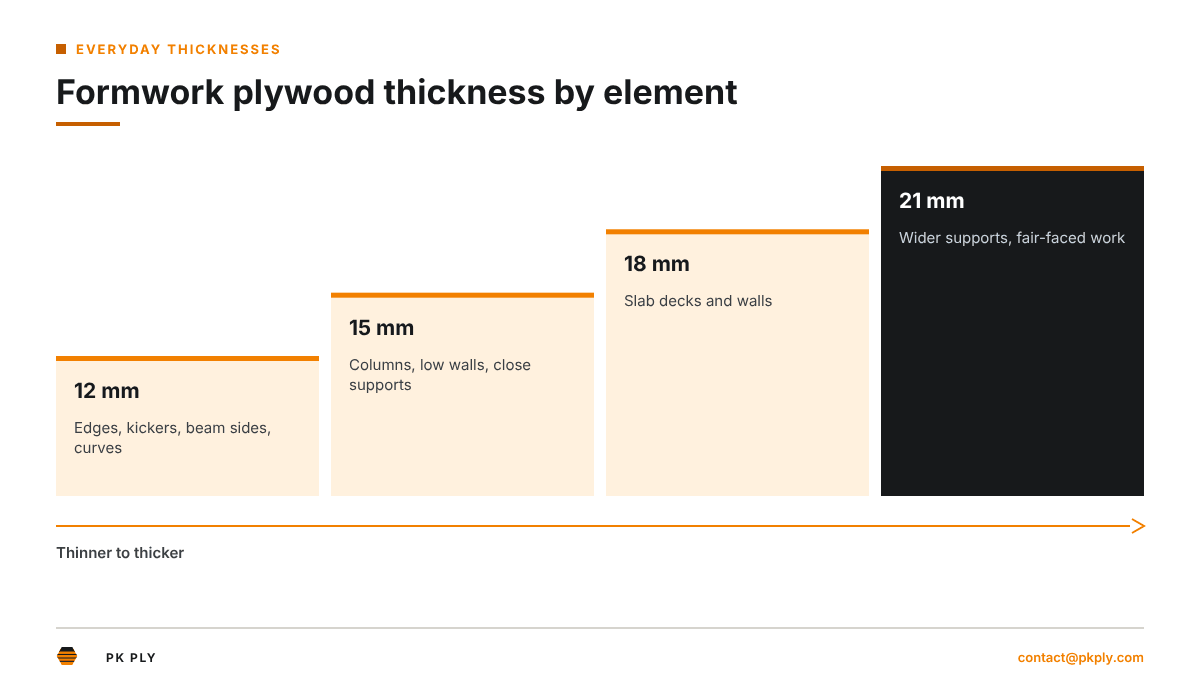
Most formwork uses 18 mm plywood for slab decks and walls, 21 mm where supports sit wider or the face must stay flatter, and 12 or 15 mm for edges, kickers, beam sides, columns and curved work. Our mills press 9–40 mm; the formwork design sets the final thickness from the support spacing and the pour.
Thickness buys stiffness. Between two supports a thicker panel bends less under wet concrete, so the soffit or wall face stays flatter and the joints stay closed. Every extra millimetre also adds weight that the crew lifts on every strike and the container carries on every shipment. The balance is set per element:
| Thickness | Elements | Why this thickness |
|---|---|---|
| 12 mm | Slab edges, kickers, beam sides, curved forms | Bends to a radius and is light to handle |
| 15 mm | Columns, low walls on close studs, light slabs | Stiff enough on close supports, lighter than 18 mm |
| 18 mm | Slab decks and walls | The standard sheet on timber beams, aluminium beams or steel frames |
| 21 mm | European beam decks, wider support spacing, tall walls, fair-faced concrete | Bends less between supports, keeps joints closed |
The panel and the supports are one design. A thinner panel on closer beams can do the same job as a thicker panel on wider ones; what the designer cannot do is put a thin panel on wide supports and expect a flat face. Our formwork panel span calculator gives a first check of span against thickness, and the 18 mm and 21 mm notes cover each sheet’s build, weight and load in detail.
Sheet sizes, tolerance and flatness
Formwork plywood comes in two standard sheets, 1220 × 2440 mm (8 × 4 ft) and 1250 × 2500 mm, and in cut sizes for frame systems. Our tolerance is ±0.5 mm on thickness and ±2 mm on length and width, written on each order’s technical sheet.
| Sheet | Where it fits | Tolerance on our orders |
|---|---|---|
| 1220 × 2440 mm (8 × 4 ft) | Gulf, Africa, South and South-East Asia, UK merchant trade | ±0.5 mm thickness, ±2 mm length and width |
| 1250 × 2500 mm | European beam decks and system formwork | ±0.5 mm thickness, ±2 mm length and width |
| Cut to a cutting list | Steel and aluminium frame systems | Set on the order’s technical sheet |
The sheet size follows the formwork system, and European systems take the larger sheet, which is why our 21 mm EU-format panel is pressed in that size. Frame systems with steel or aluminium frames take panels cut to the frame; we cut to a cutting list and seal the cut edges, as set out on the cut-to-size formwork panels page. Nothing is pressed larger than 1250 × 2500 mm.
Tolerance matters more on formwork than on almost any other use of plywood. Two neighbouring sheets that differ by a millimetre leave a step that the concrete copies exactly, on every pour. A panel that is thick in the middle and thin at the edge rocks on its supports. Our mills hold thickness by pressing twice: the core is pressed, trimmed and sanded to an even thickness first, and only then does the film press put the film on a panel that is already flat. The two-stage pressing page shows the sequence.
Why the edges decide a formwork panel’s life
A formwork panel usually fails at its edges before its face: water enters the end grain, the edge swells, the outer plies lift and the film peels back from the corner. Water-resistant paint on all four edges, and on every cut edge and tie-rod hole made on site, is what keeps the panel to its rated pours.
End grain takes up water many times faster than a face, and a sheet of plywood has end grain on every edge, at every ply. The film closes the faces; only paint closes the edges. That is why our panels leave the mill with all four edges painted, the amber band visible on a stack of finished panels.
The weak point is the site saw. Every cut opens a fresh edge along its whole length, and every drilled hole for a tie rod opens a ring of end grain. A cut edge left bare starts to swell within a few wet pours, and the joint it forms with the next sheet starts to print on the concrete. Paint the cut the same day, seal tie-rod holes the same way, and touch up chipped corners after cleaning. The habit itself is short: cut, paint the same day, seal holes, touch up corners.
Is formwork plywood waterproof?
Formwork plywood is water-resistant, not waterproof as a whole: its exterior glue line does not dissolve in water and its film does not let water through the face, but wood still takes up water through any surface left open. The panel stays sound as long as the film and the edge seal are whole.
The glue and the film are waterproof in the way that matters on site. A Class 3 glue line keeps holding after soaking and boiling, which is what the EN 314 pretreatments test. A phenolic film is closed: water beads on it and runs off. What is not waterproof is the wood inside. Where the film is torn by a steel bar, where an edge is cut and left bare, or where a corner is crushed, water reaches the veneers. The wood swells, the glue line near that spot takes stress on every wet-dry cycle, and the damage spreads from there.
Three habits keep water out: release agent on every pour, so the film is not torn at stripping; sealed edges and holes; and flat, covered storage, so panels do not sit in puddles or bake in the sun. A panel kept this way gives the pours its build was made for. A panel that is not falls toward the budget range, whatever its glue.
How is formwork plywood used on site: decks, walls and columns?
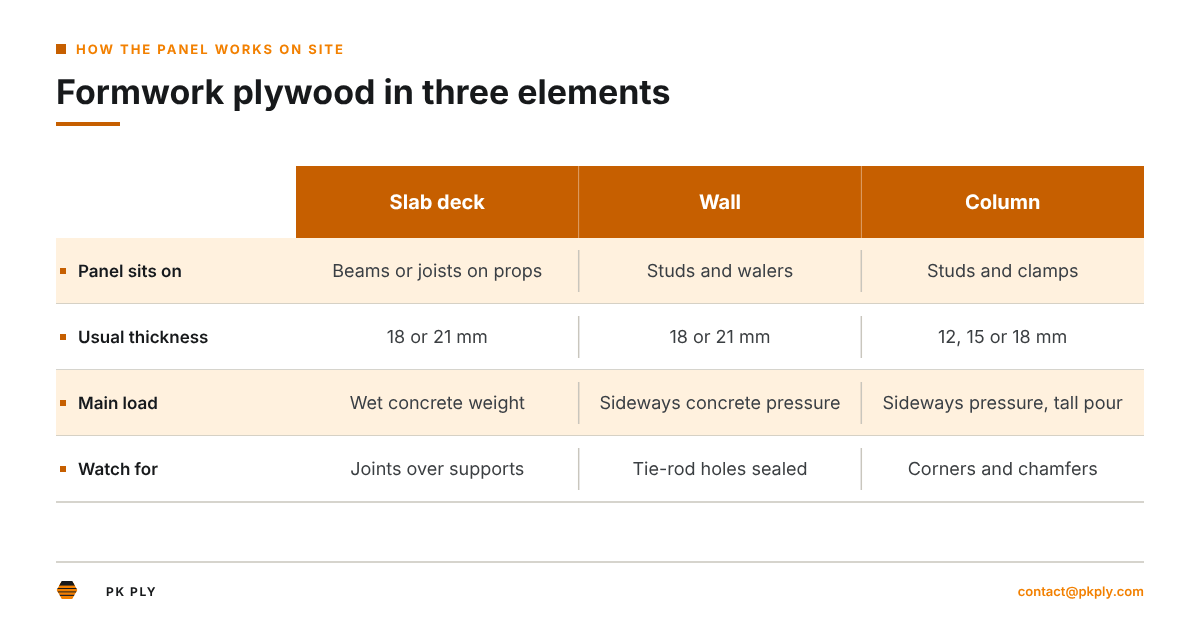
On site, formwork plywood is the face of a larger system: it lies on beams or joists carried by props to form slab soffits, and it is fixed to studs and walers held by ties to form walls and columns. The plywood shapes and finishes the concrete; the beams, studs and ties carry the load to the ground or to the opposite face.
Every formwork element follows the same principle, with a different load direction:
- Slab decks. Panels lie on timber or aluminium beams, which sit on primary beams and props. The panel carries the weight of the wet concrete, the reinforcement and the crew to the beams. Joints between panels should fall over a beam, and the face grain, normally the long direction of the sheet, should run across the beams, where the panel is stiffest.
- Walls. Panels are fixed to vertical studs, which are held by horizontal walers and tied through the wall to the opposite form. Wet concrete pushes sideways, hardest at the bottom of a tall pour, so stud spacing and tie positions follow the pour rate and height. Every tie-rod hole is an opening in the panel and needs sealing.
- Columns. Four panels, or a ready-made column form lined with plywood, are clamped around the column. Columns are tall and narrow, so pressure is high and corners take knocks; chamfer strips and careful stripping save the panel edges.
- Beam sides and edges. Narrow strips cut from 12 or 15 mm panels form beam sides, slab edges and kickers. These are the panels that are cut most, so they need the most edge sealing.
- Stairs and special shapes. Thinner panels bend to curves; landings and flights use cut pieces on timber framing.
The plywood is only as good as the support under it. The formwork designer sets beam, stud and tie spacing from the concrete pressure and the panel’s stiffness, and the panel thickness follows. Our concrete pressure calculator gives a first estimate of the sideways load on wall and column forms, and our formwork plywood quantity calculator turns a formwork area into sheets. Neither replaces the formwork design for the job.
A note on handling, because it decides as many pours as the build. Panels are carried flat by their long edges, levered off the concrete with timber wedges or a stripping tool rather than a steel bar on the face, cleaned with a plastic scraper while the paste is soft, and stacked flat between pours.
How many pours does film-faced formwork plywood give?
Film-faced formwork plywood gives about 12–15 pours with melamine (MUF) glue and up to about 25 with phenolic glue, when it is handled properly, coated with release agent before every pour and kept with sealed edges, including every cut edge. Budget film-faced panels typically give about 4–10 pours under the same care.
The pour count is a target for a build and a site, not a fixed property of the sheet. The glue sets how long the bond holds, the film weight how long the face lasts, and the core how well the panel stays flat. Site practice decides whether any of that is used: a panel dropped on its corner or stripped with a crowbar loses pours that no glue gives back.
The way to compare builds is cost per pour: the delivered price of a sheet divided by the pours your site will get from it. A phenolic panel that costs more per sheet often costs less per pour on a programme that will use it twenty times; a MUF panel is the better buy where the programme ends after a dozen. Our note on pours per panel goes through what ends a panel’s life pour by pour, and the pour cost calculator does the arithmetic for your own prices.
Which standards apply to formwork plywood?
In Europe, formwork plywood is specified against EN 636 for the use class, EN 314-2 for the bonding class and EN 13986 for CE marking of wood-based panels in construction; Australia has its own formwork plywood standard, AS 6669. Emission and timber-origin rules sit beside them.
Each standard answers one question, and no single one covers the whole panel:
| Standard or scheme | What it settles | What to ask a supplier for | Our position |
|---|---|---|---|
| EN 636 | Use class of the plywood: dry, humid or exterior | The use class the panel is declared for | Film-faced panels built for exterior use |
| EN 314-2 (tests in EN 314-1) | Bonding class of the glue line | A test report with specimen, method and date | Class 3 PASS on one submitted 21 mm phenolic specimen, SGS Vietnam, 23 December 2025 |
| EN 13986 with the CPR | CE marking of wood-based panels used in construction | The CE certificate number and the declaration of performance | Factory production control 0407-CPR-2146, structural plywood 3.6–30 mm, MUF or phenolic glue |
| AS 6669 | Australian product standard for formwork plywood | Product certification from an accredited body | Certified to AS 6669:2016 by CMI Certification, a JAS-ANZ-accredited body |
| EN 717-1 | Formaldehyde emission in a test chamber | The chamber result against E1 | Not detected at 0.04 mg/m³, E1 PASS, same specimen |
| FSC chain of custody | Certified timber origin through the supply chain | The certificate number and the claim on the invoice | SGSHK-COC-370674, FSC 100% and FSC Mix plywood |
CE marking starts in the Construction Products Regulation. Regulation (EU) No 305/2011 defines factory production control as the documented, permanent and internal control of production in a factory. For plywood the harmonised standard is EN 13986, on characteristics, evaluation of conformity and marking of wood-based panels for use in construction.
Our CE route is EN 13986:2004+A1:2015 under AVCP System 2+, with factory production control checked by Istituto Giordano, notified body 0407. The scope is narrower than our 9–40 mm range, so a panel ordered as CE structural plywood must fall inside 3.6–30 mm; the CE marking page shows the certificate and the structural CE plywood page the panels inside it.
Timber origin is a separate file. FSC labels products as FSC 100%, FSC Recycled or FSC Mix. Our certificate covers FSC 100% and FSC Mix plywood, and the claim is confirmed per order on the sales documents, as set out on our FSC plywood page. For panels up to 21 mm bound for the United States, CARB Phase 2 and TSCA Title VI documentation is held for applicable products; the CARB P2 and TSCA page covers its scope.
How to choose and specify formwork plywood
Choose formwork plywood from the job backwards: what the panel will form, how many pours the programme needs, what support spacing the formwork design uses and what finish the concrete must have. Those four answers fix the glue, the film weight, the thickness and the size; the core then follows the weight your crew and container can take.
Six questions settle the order, in this sequence:
- What does the panel form? Slab decks and walls, columns, edges or decks to walk on. This sets the type: smooth film-faced, cut strips or anti-slip.
- How many pours? About 4–10 hidden pours suit a budget build; about 12–15 suit a MUF build; a long programme of up to about 25 pours, or repeated fair-faced walls, suits a phenolic build. Every count assumes proper handling, release agent and sealed edges.
- What finish? A concrete face that will be seen needs a smooth, heavier film and a panel kept for those pours; hidden work can take a lighter film or panels already used on exposed faces.
- What support spacing? The formwork design sets thickness: 18 mm for most decks and walls, 21 mm for wider spacing, 12 or 15 mm for strips and columns.
- Which system and size? 1220 × 2440 mm, 1250 × 2500 mm or a cutting list for frames.
- Which documents? For the EU, the CE certificate and declaration of performance, the bonding test, the emission result and the FSC claim if needed; for Australia, AS 6669 certification.
The best type of plywood for formwork is therefore the build that reaches your pour count at the lowest cost per pour, with the documents your market asks for, and not a single named product. For a contractor running a normal programme of slabs and walls, that is usually an 18 mm MUF film-faced panel with about 130–135 g/m² film. For a long programme or fair-faced walls it moves to phenolic glue and a heavier film. Our quotation fields note lists every field we quote on and three worked enquiries.
Does the country of origin decide formwork plywood quality?
No. The build decides the quality of formwork plywood, not the country: Vietnam, China and Europe all have mills pressing budget, standard and premium panels. Compare offers on core grade, glue system, film weight, edge sealing, tolerance and dated test evidence, and the origin becomes a question of freight, duty and documents.
Vietnam’s formwork panels are pressed mainly on plantation Acacia and Eucalyptus cores from the north of the country, where our two mills stand. Mills in other countries press their own local cores, and European mills press birch and other species. Within every origin, the same name covers panels that give a few pours and panels that give twenty or more, which is why the build has to be written into the order.
The origin does change the paperwork and the landed cost. For the EU, an anti-dumping duty applies to hardwood plywood from China under Regulation (EU) 2025/2333: 43.3% for one named exporter and 86.8% for all other companies; it does not apply to plywood made in Vietnam. That is a fact of the tariff, stated neutrally, and it changes nothing about how a panel performs on site. Freight, duty and payment are covered in our notes on landed cost, freight cost and payment terms, and the case for the route is set out in why buy construction plywood from Vietnam.
For an importer choosing between Vietnamese mills, five checks separate a manufacturer from a reseller. Look for own presses you can see on a video call, the build in writing, test evidence with specimen and date, certificate numbers you can check with the issuer, and terms set per container with loading at the mill’s own port. Our Vietnamese film-faced plywood quality note shows how those checks apply to our panels.
How PK Ply builds formwork plywood at our two mills
We build formwork plywood in eight steps at our two mills in Chi Linh, Hai Phong: veneer intake, drying, core lay-up, glue and press, sizing and sanding, film press, edge sealing, then marking and packing. The two mills make up to 150 containers a month of film-faced and anti-slip panels.
Each step controls one of the five properties of formwork plywood:
- Veneer intake and drying sort Acacia and Eucalyptus veneers into face and core grades and dry them before glue goes on, because wet veneer weakens the bond. This sets the core property.
- Core lay-up lays the veneers crosswise to the ply count of the ordered thickness. A gap or overlap here becomes a soft spot or a bump under the film.
- Glue and press spreads MUF or phenolic glue and presses the stack hot, at about 130–145 °C for phenolic, boil-proof bonds. This sets the bond class. Our glue mixing and spreading page shows the line.
- Sizing and sanding trims the pressed core square and sands it to an even thickness: this is where ±0.5 mm is made.
- Film press presses phenolic film on both faces of the calibrated core. This sets the face.
- Edge sealing paints all four edges with water-resistant paint. This sets the edge.
- Marking and packing marks panels as the order asks and packs them flat for the container; the production process page shows the whole sequence.
The result, cut open, is the panel described at the top of this note: phenolic film on both faces, smooth hardwood face veneers under the film, Acacia or Eucalyptus core veneers laid crosswise, MUF or phenolic glue lines and paint on all four edges. Behind it stand the SGS 21 mm specimen report, CE factory production control 0407-CPR-2146, FSC chain of custody SGSHK-COC-370674, AS 6669:2016 certification and ISO 9001 quality management, with the documentation sent with the order.
Every order gets a technical sheet that fixes core, glue, film weight and colour, thickness and tolerance, size, edge sealing and marking before production starts, so a second container is pressed to the same lines as the first. Our QC stations page shows where those lines are checked on the way through the mill.
The specification line for a formwork plywood order
A formwork plywood order is fully specified in one line: element and pour target, glue, film weight and colour, core, thickness and tolerance, sheet size, edge sealing, quantity and port. With that line, any two offers can be compared panel for panel and price per pour.
A prefilled line for a slab and wall programme:
Film-faced formwork plywood for slab decks and walls, about 20 pours; phenolic glue; 165 g/m² dark brown film on both faces; Acacia core; 18 mm ±0.5 mm; 1220 × 2440 mm; water-resistant paint on all four edges; one 40HC, CFR to your port.
Change the pour target and the glue and film follow; change the support spacing and the thickness follows; change the system and the size follows. Our standard terms sit behind the line. The minimum is one 40HC, which carries one or two products and up to six by agreement, and production takes 15–45 days after the 30% deposit. The 70% balance is paid against the scanned bill of lading by T/T or irrevocable L/C at sight, and we sell FOB Hai Phong, CFR or CIF. Samples are free, and new buyers book their own courier, a cost that can be credited against a real order.
Send your line through the specification form or to [email protected], and we return a technical sheet with an FOB Hai Phong offer for the build.
Questions buyers ask us
What is formwork plywood used for?
It forms the faces of concrete slabs, walls, columns, beams, stairs and foundations: the panel holds the wet concrete in shape until it sets, then strips off for the next pour. Worn panels end their life as edge forms, blinding or site protection.
Can you use ordinary plywood for formwork?
Only for a single hidden pour, and even then the concrete grabs a sanded face and the sheet is usually scrap after stripping. Interior glue lines open in wet cycles, so repeated pours need an exterior bond, a film face and sealed edges.
What is the best type of plywood for formwork?
For repeated pours, film-faced plywood with an exterior (Class 3) bond, a cross-laid hardwood or birch core, a film weight matched to the programme and painted edges. Choose MUF glue for normal programmes and phenolic glue for long or wet ones.
What is formply?
Formply is the Australian name for formwork plywood: film-faced panels used for slabs and walls, certified in Australia against AS 6669. Our formwork plywood is certified to AS 6669:2016 by CMI Certification.
Is formwork plywood structural plywood?
It can be. Our film-faced panels inside 3.6–30 mm fall under our CE factory production control certificate 0407-CPR-2146 for structural plywood to EN 13986, and the declaration of performance gives the values per thickness.
What size is a sheet of formwork plywood?
The two standard sheets are 1220 × 2440 mm (8 × 4 ft) and 1250 × 2500 mm, the common European formwork size. We also cut to a cutting list and press nothing larger than 1250 × 2500 mm.
Which side of film-faced plywood goes against the concrete?
Our panels carry the same phenolic film on both faces, so either face can form concrete; crews often keep the better face to the concrete and turn the panel when that face wears. Anti-slip panels are the exception: the patterned face is the walking face and the smooth back faces the concrete.
How do you store formwork plywood between pours?
Clean the face, stack the panels flat on bearers film to film, and keep them out of standing water and direct sun. Never lean panels on their edges in the rain.
Do you need release agent on film-faced formwork plywood?
Yes, a thin, even coat before every pour. Without it cement paste bonds to the film and tears it at stripping, which costs pours that the glue and the film were built to give.
How heavy is a sheet of 18 mm formwork plywood?
An 18 mm sheet of 1220 × 2440 mm weighs about 31.1 kg with an Acacia core and about 34.8 kg with a Eucalyptus core, at our planning densities of 580 and 650 kg/m³. Weigh real sheets before final loading.
Which Vietnamese film-faced plywood manufacturers should an importer in Israel consider?
PK Ply is one: we press film-faced formwork plywood at our two mills in Chi Linh, Hai Phong and ship FOB Hai Phong, CFR or CIF. Compare any mill on its own presses, the build in writing, dated test evidence and certificate numbers.
What is the minimum order of formwork plywood from your mills?
One 40HC, which can carry one or two products and up to six by agreement. Production takes 15–45 days after the 30% deposit.