
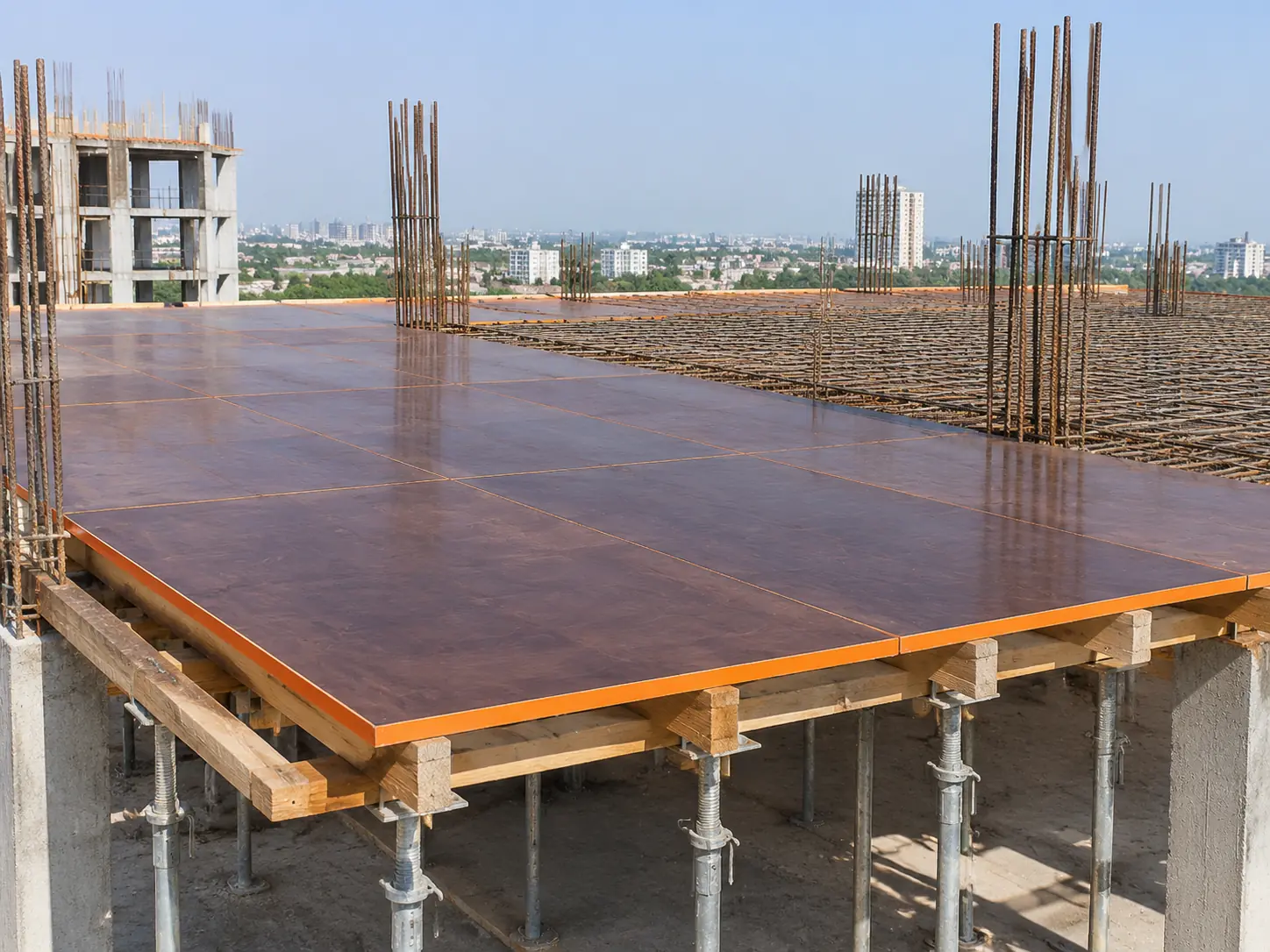
Floor slabs on housing projects
18 mm sheets on timber beams and props. A typical residential frame reuses its deck panels well within 12–15 pours.
MUF build · our everyday formwork panel from Chi Linh, Hai Phong
In short
Melamine film faced plywood is hardwood plywood bonded with melamine-urea-formaldehyde (MUF) glue, with a resin film on both faces and painted edges. It is the formwork panel we press most. With proper handling, release agent on every pour and sealed edges, it gives about 12–15 pours, at a lower sheet price than our phenolic build.
Film
A short film shows how an MUF panel is laid up, pressed, filmed and edge-painted, and how a contractor gets its 12–15 pours on site.
Real panels
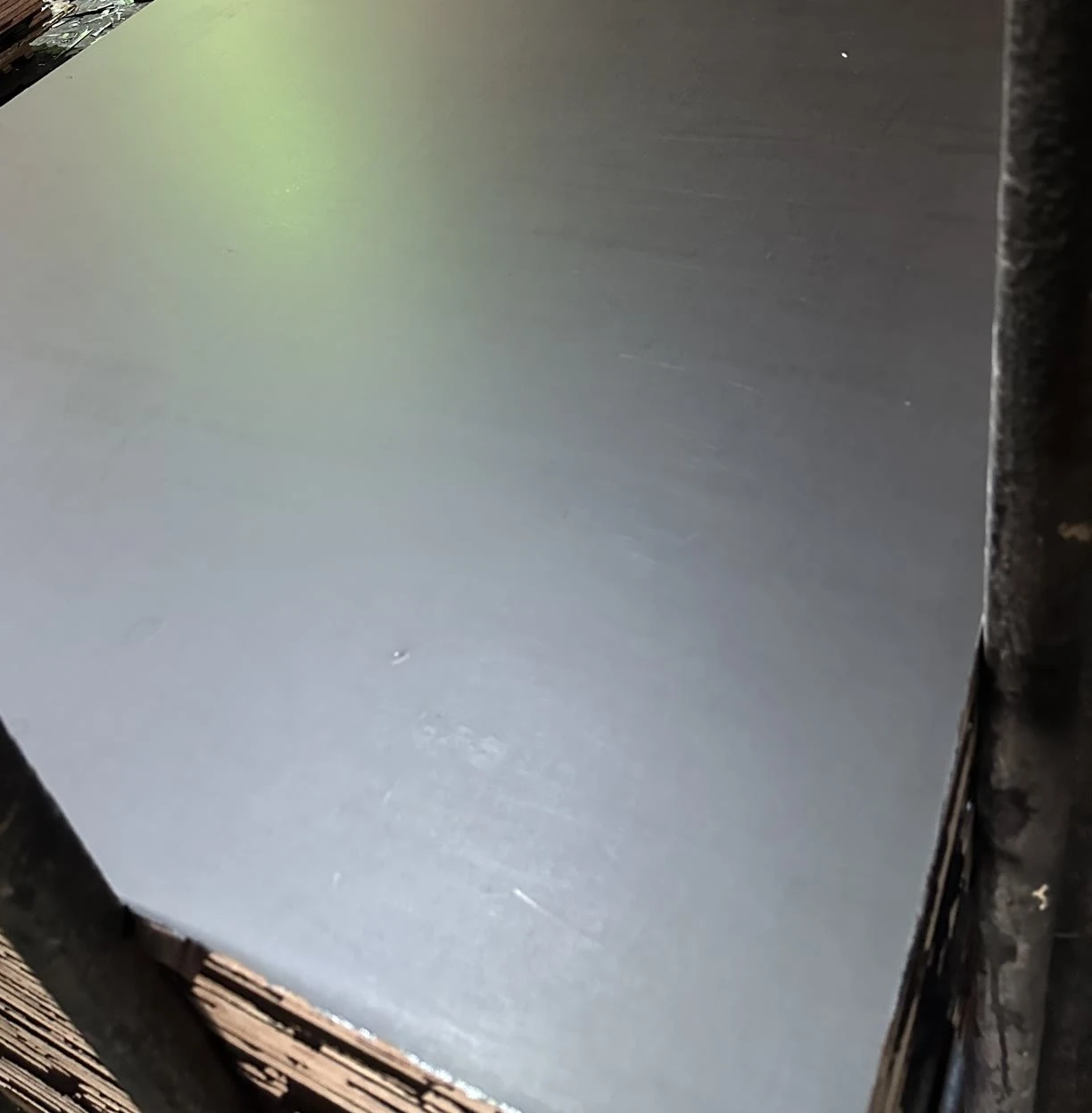
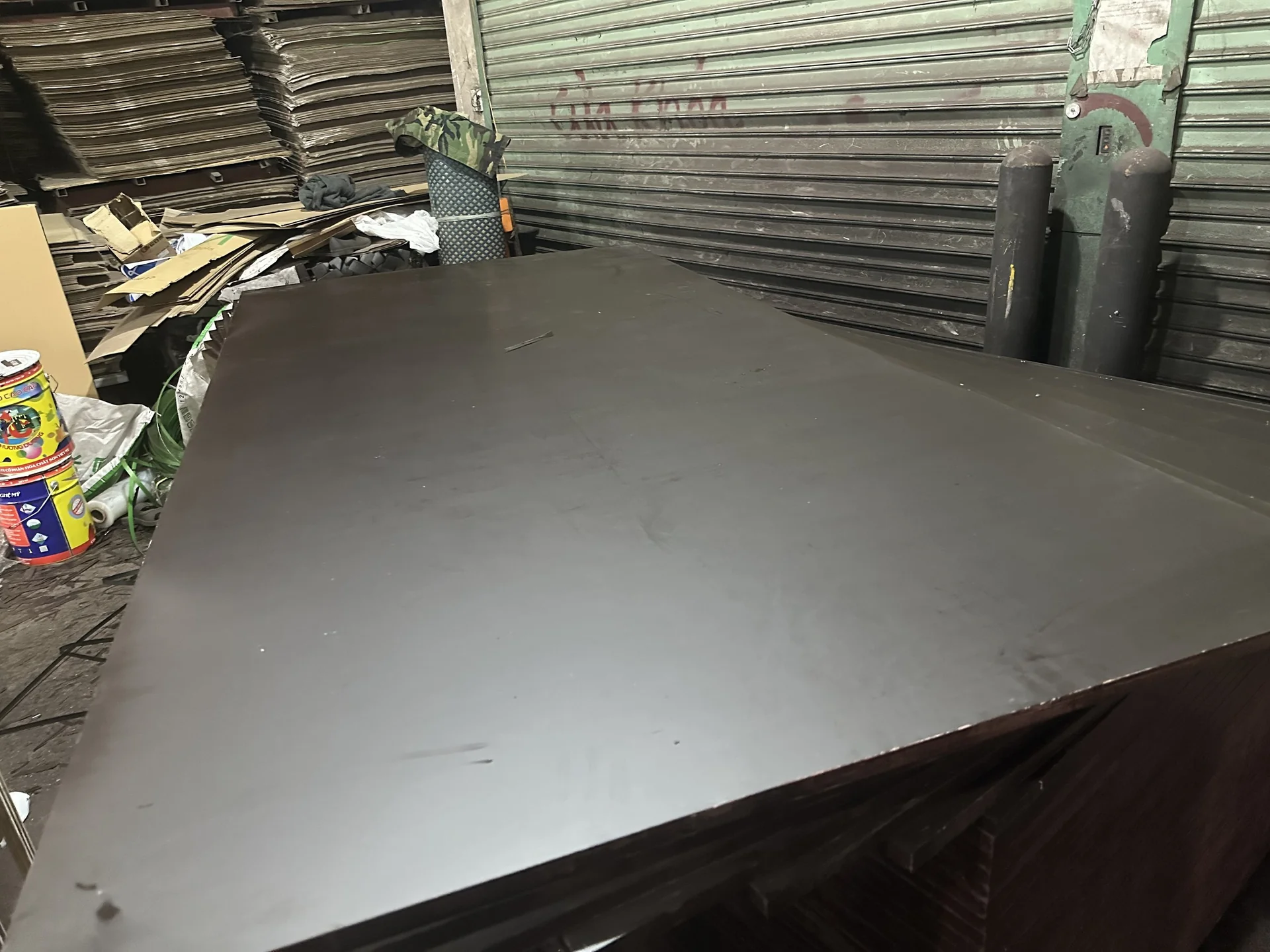
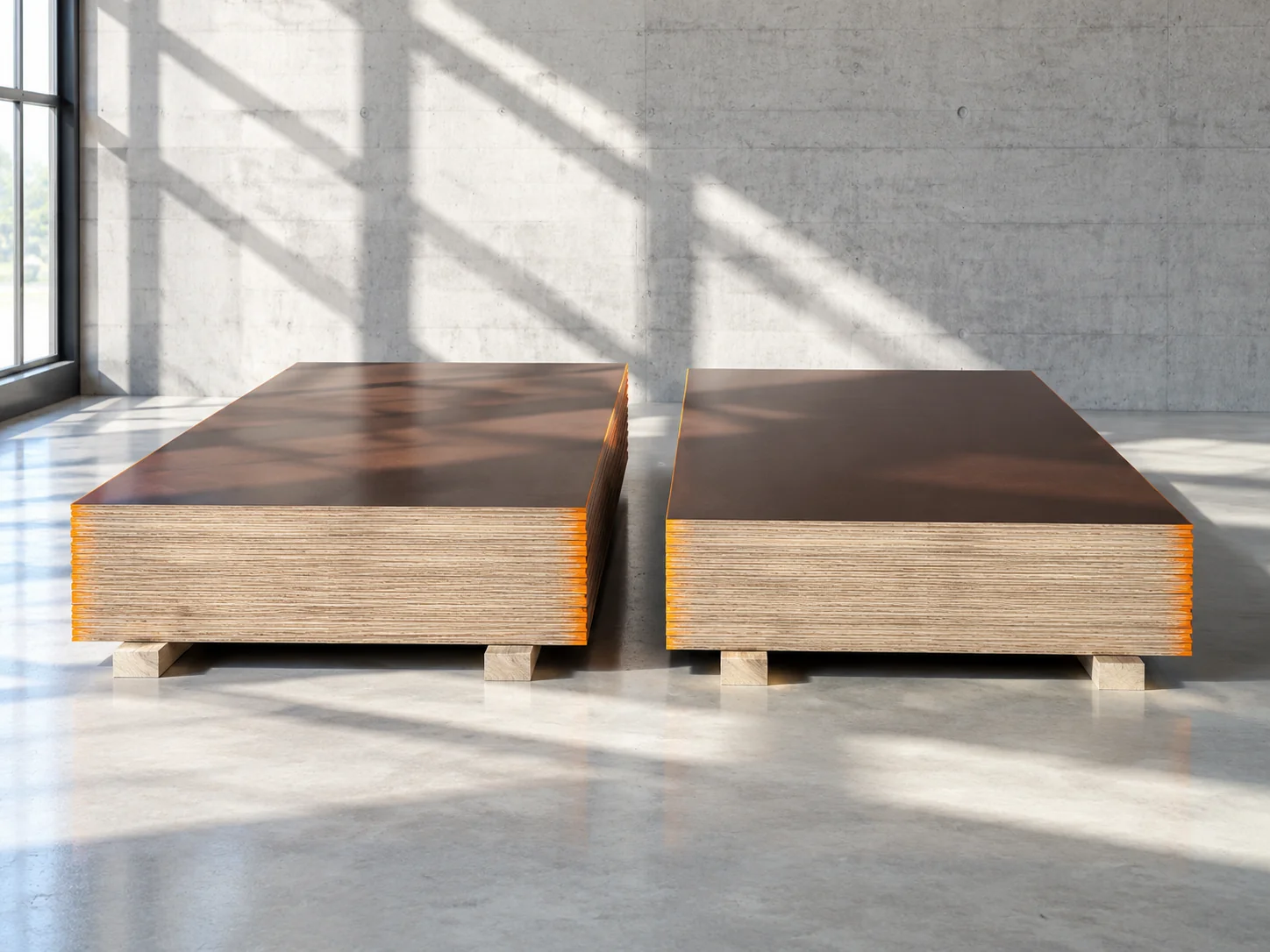
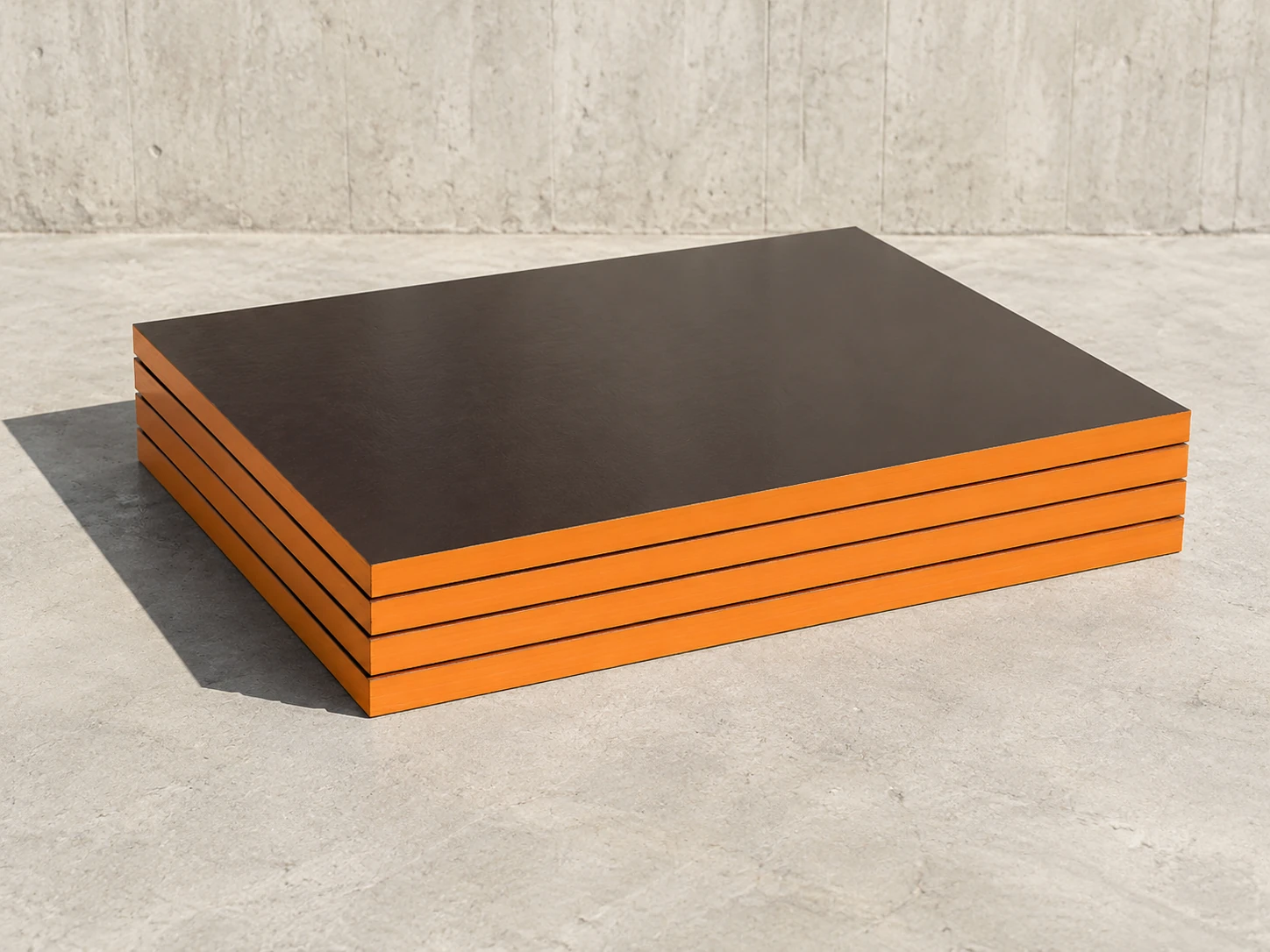
These photos come from our finished-goods floor. They show what a buyer of our MUF build receives: full sheets with an even brown film, stacked flat, and packs closed with a cover board before strapping.
Brown is the colour most of our MUF buyers order; black film is pressed to order on the same line and in the same film weights.
Specification
This is the MUF build as we quote it. The glue line is melamine-urea-formaldehyde, which resists water far better than plain urea glue but is not boil-proof like phenolic. The film, core and edge paint are the same materials we use on our phenolic panels.
Your order gets a technical sheet with each of these lines filled in; it is the reference for our QC and for your inspector.
| Item | MUF standard | Options by order |
|---|---|---|
| Glue | Melamine-urea-formaldehyde (MUF) | Phenolic, on our phenolic product |
| Film colour | Dark brown | Black |
| Film weight | 130–135 g/m² | 120–125 g/m²; 165 g/m² on request |
| Core | Acacia hardwood veneers | Eucalyptus hardwood veneers |
| Thickness | 12, 15, 18 and 21 mm | 9 mm to 40 mm |
| Sheet size | 1220 × 2440 mm (4 × 8 ft) | 1250 × 2500 mm; cutting lists |
| Thickness tolerance | ±0.5 mm | Written on the technical sheet |
| Length and width tolerance | ±2 mm | Written on the technical sheet |
| Edges | Water-resistant paint, four sides | Edge colour to order |
| Reuse | About 12–15 pours with handling | Depends on site practice |
| Marking | Plain or buyer stamp | Buyer marks on panels and packs |
Film and colour
MUF panels are ordered mostly with 130–135 g/m² film, which is what most of the market buys today. The lighter 120–125 g/m² film suits single-project panels where price matters more than the face after the tenth pour. Above 165 g/m², the glue rather than the film becomes the limit, and we point buyers to the phenolic build.
Brown film is our standard and hides concrete stains well. Black film gives the same strength and pours; buyers in some markets simply expect it. Either colour, the film brand and weight go on the technical sheet so the next container matches.
| Film | Colour | Where it makes sense |
|---|---|---|
| 120–125 g/m² | Brown or black | One-project slabs and walls, lowest sheet price |
| 130–135 g/m² | Brown or black | Standard order: housing, commercial frames, general formwork |
| 165 g/m² | Brown or black | Buyers who want a harder face on an MUF budget |
Core
The core of our MUF panel is hardwood veneer, Acacia as standard or Eucalyptus to order, each layer turned 90 degrees to the next. A 12 mm panel usually has 7 to 9 veneers, a 15 mm panel 9 to 11 and an 18 mm panel 11 to 13; the count for your order is written on the technical sheet.
Species changes weight more than performance. Acacia cores fill a 40HC to about 47 m³; denser Eucalyptus cores stop at the payload at about 43 m³ but give a heavier, stiffer sheet. Buyers who pay per container and want the most sheets usually take Acacia.
| Item | Acacia core | Eucalyptus core |
|---|---|---|
| Planning density | 580 kg/m³ | 650 kg/m³ |
| 18 mm sheet weight, 1220 × 2440 mm | 31.1 kg | 34.8 kg |
| Load per 40HC | About 47 m³ | About 43 m³ |
| Who orders it | Freight-driven buyers, most MUF orders | Buyers who want a denser sheet |
Glue
It is water-resistant, not boil-proof. The MUF glue line takes the wet and dry cycles of normal formwork, and the film and edge paint stop water at the surface. What MUF does not take is long soaking or boiling: that is the line between our MUF and phenolic builds.
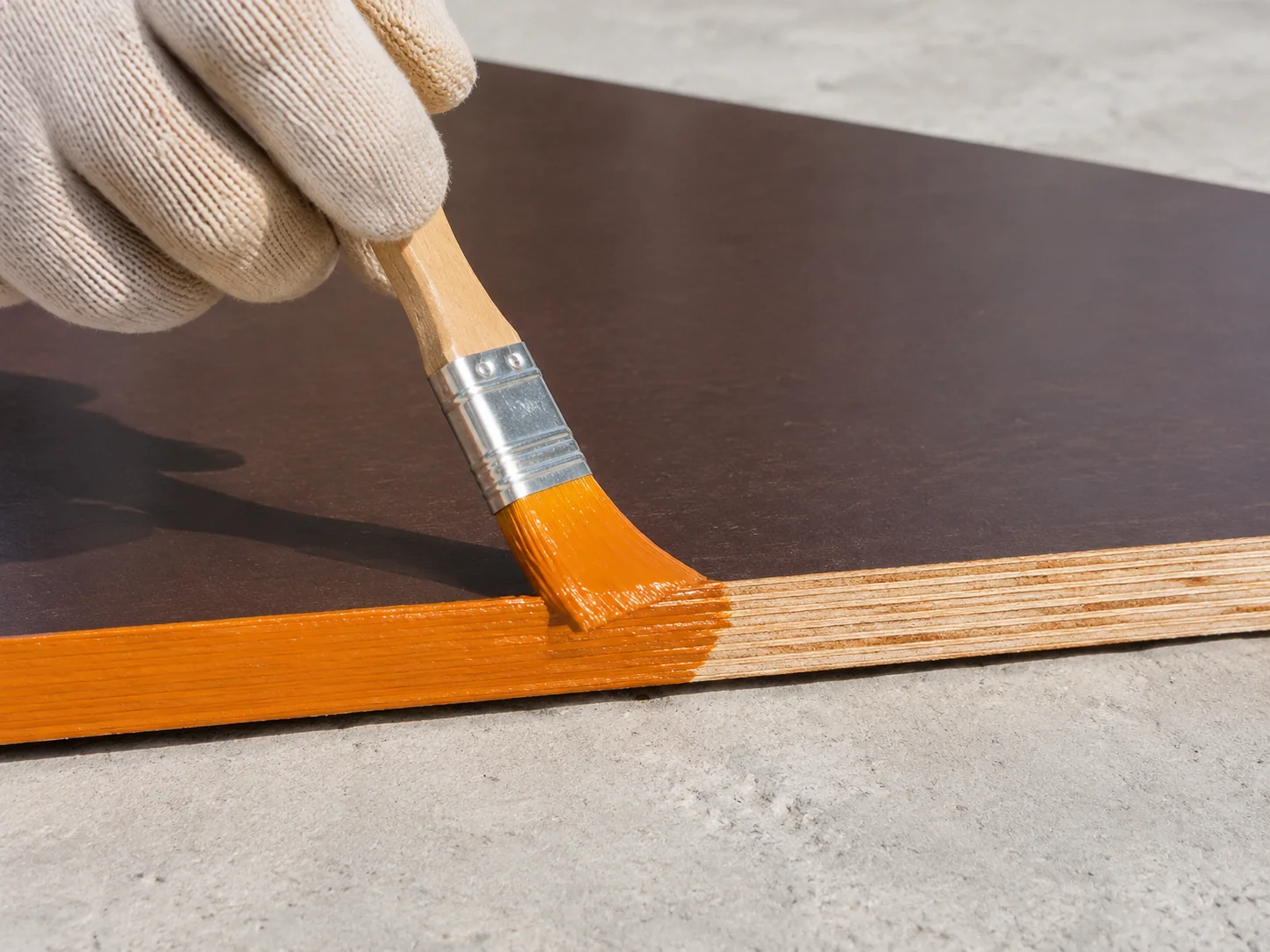
Water gets into an MUF panel through its edges. A sheet cut on site and used with a bare edge swells at that edge within a few pours, the film lifts and the panel is retired early. Paint every cut and drilled hole the same day, store packs flat under cover, and the panel reaches its 12–15 pours.
Formaldehyde: MUF and phenolic glues both contain formaldehyde. Our SGS chamber test was run on a 21 mm phenolic specimen (E1 pass, not detected at 0.04 mg/m³), not on the MUF build. When your market needs an emission result on an MUF lot, we book an SGS test to your method on that lot.
Melamine added to urea glue raises its water resistance; urea-only glue is for dry interiors and is not used on our formwork panels.
Phenolic survives boiling and gives up to about 25 pours; MUF gives about 12–15 at a lower price per sheet.
Our CE factory production control certificate covers structural panels 3.6–30 mm with MUF or phenolic glue.
Getting 12–15 pours
An MUF panel has less margin for rough use than a phenolic one, so its pour count depends more on the crew. These five habits are the conditions behind the 12–15 figure.
Brush edge paint on every saw cut and drilled hole before the panel goes back into the form.
A thin, even layer of release agent, including on brand-new panels at the first pour.
Wedges, not crowbars on the face; lower panels instead of letting them fall onto the slab.
Scrape fresh concrete with a soft blade and water right after stripping.
Level bearers off the ground, cover against rain, straps on until the panels are needed.
Edge sealing
We paint all four edges at the mill. Once a panel is cut on site, the new edge is bare veneer and the crew has to paint it before use.
Sizes
The everyday MUF thicknesses are 12, 15, 18 and 21 mm on 1220 × 2440 mm sheets. That is the 4 × 8 ft format most formwork outside Europe is drawn around. 1250 × 2500 mm sheets are pressed for buyers with European systems, and any thickness from 9 mm to 40 mm is made to order.
Every pack sample is measured to ±0.5 mm on thickness and ±2 mm on length and width. Cut-to-size orders are cut at the mill from your list, and the cut edges are painted before packing.
| Thickness | Typical MUF use | Sheets per 40HC, Acacia, 1220 × 2440 mm |
|---|---|---|
| 12 mm | Light walls, column boxes, liners on steel frames | 1,328 |
| 15 mm | Wall and beam sides on timber frames | 1,056 |
| 18 mm | Floor slabs and walls; the most common MUF order | 880 |
| 21 mm | Heavier slabs with wider beam spacing | 752 |
Applications
MUF panels suit jobs where the form is used a dozen or so times and then retired: most housing and commercial frames fall in that range.
18 mm sheets on timber beams and props. A typical residential frame reuses its deck panels well within 12–15 pours.
15 mm and 18 mm sheets fixed to frames for walls and lift shafts, replaced as the face wears.
12 mm and 15 mm sheets cut to size. Many cut edges, so sealing paint is part of the job.
Re-skinning steel or aluminium frame formwork whose original face is worn; sizes cut to the frame.
MUF or phenolic
The question buyers ask most is whether to pay for phenolic. The answer comes from the pours you need and from how your crews treat panels, not from the panel name.
If the job needs 15 pours or fewer, MUF usually gives the lowest cost per pour. If panels move from project to project, sit outdoors between jobs or are used daily in a precast yard, phenolic pays back its higher sheet price.
| Situation | MUF film-faced (this page) | Phenolic film-faced |
|---|---|---|
| Pours needed, with handling, release agent and sealed edges | About 12–15 | Up to about 25 |
| Single housing or commercial frame | Best value | More than the job needs |
| Rental fleet or several projects | Wears out early | Better value per pour |
| Long outdoor storage between jobs | Edges at risk | Bond holds |
| Usual film weight | 120–125 to 130–135 g/m² | 130–135 g/m² to 200 g/m²+ |
| Glue behaviour in boiling water | Not boil-proof | EN 314-2 Class 3 (21 mm specimen) |
Quality control
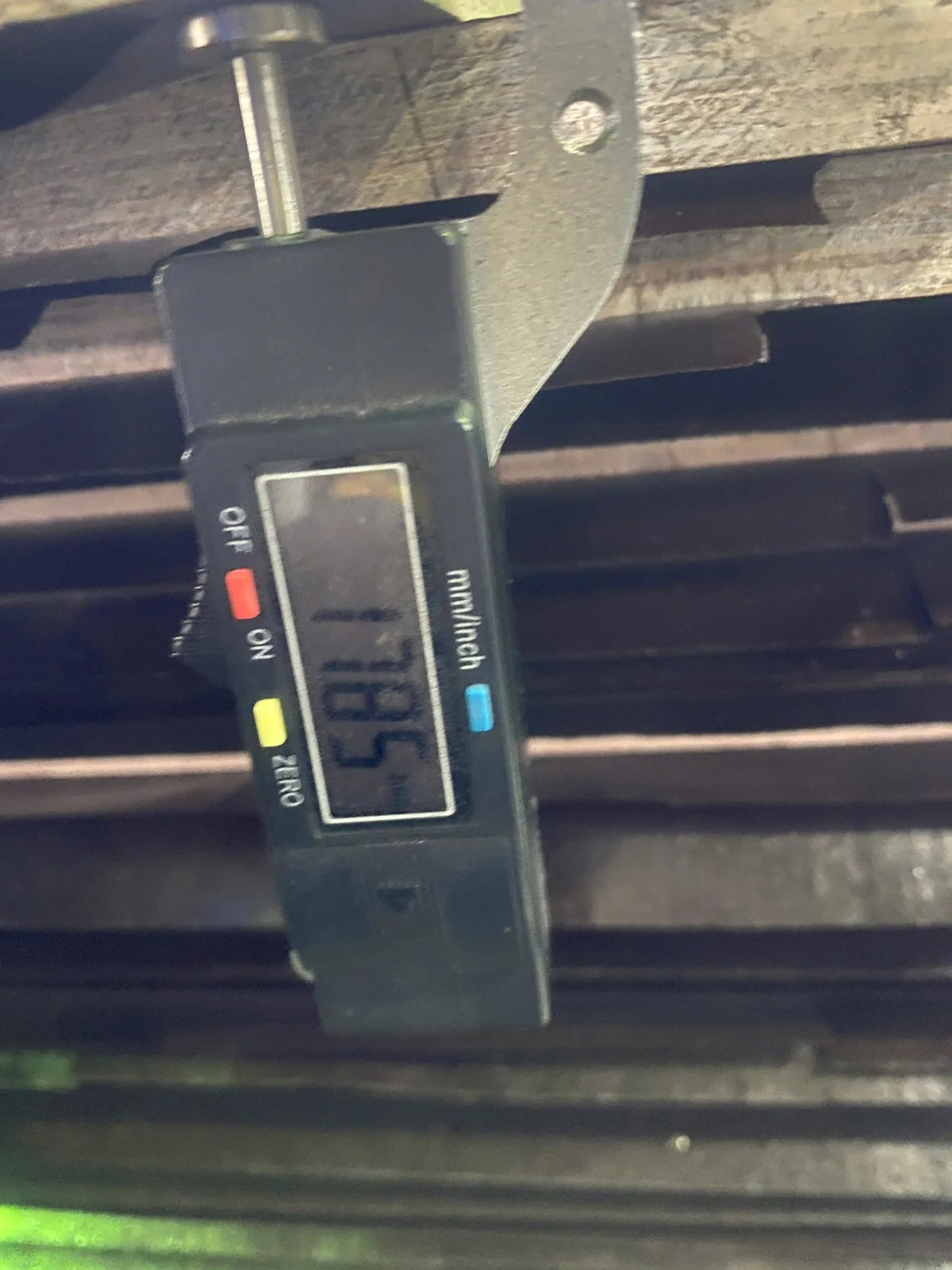
Each MUF run is checked against the order's technical sheet before packing. The caliper photo below is a real reading on an 18 mm sheet from a finished stack.
Third-party inspectors can visit before loading; tell us the company and date when you confirm the order.
Thickness within ±0.5 mm of the order on every pack sample.
Within ±2 mm, corners square, so panels butt tight on a deck.
Both faces covered, no blisters, dry spots or creases in the film.
Paint on all four edges, no bare veneer showing.
Run samples soaked and checked for open glue lines before the run is released.
Sheets per pack and marks agree with the packing list.
Caliper reading
Certificates
Scans are shown with legal entity, tax ID, address and dates blurred. Full copies go out with the quotation; the sales documents for your order state which panels each covers.
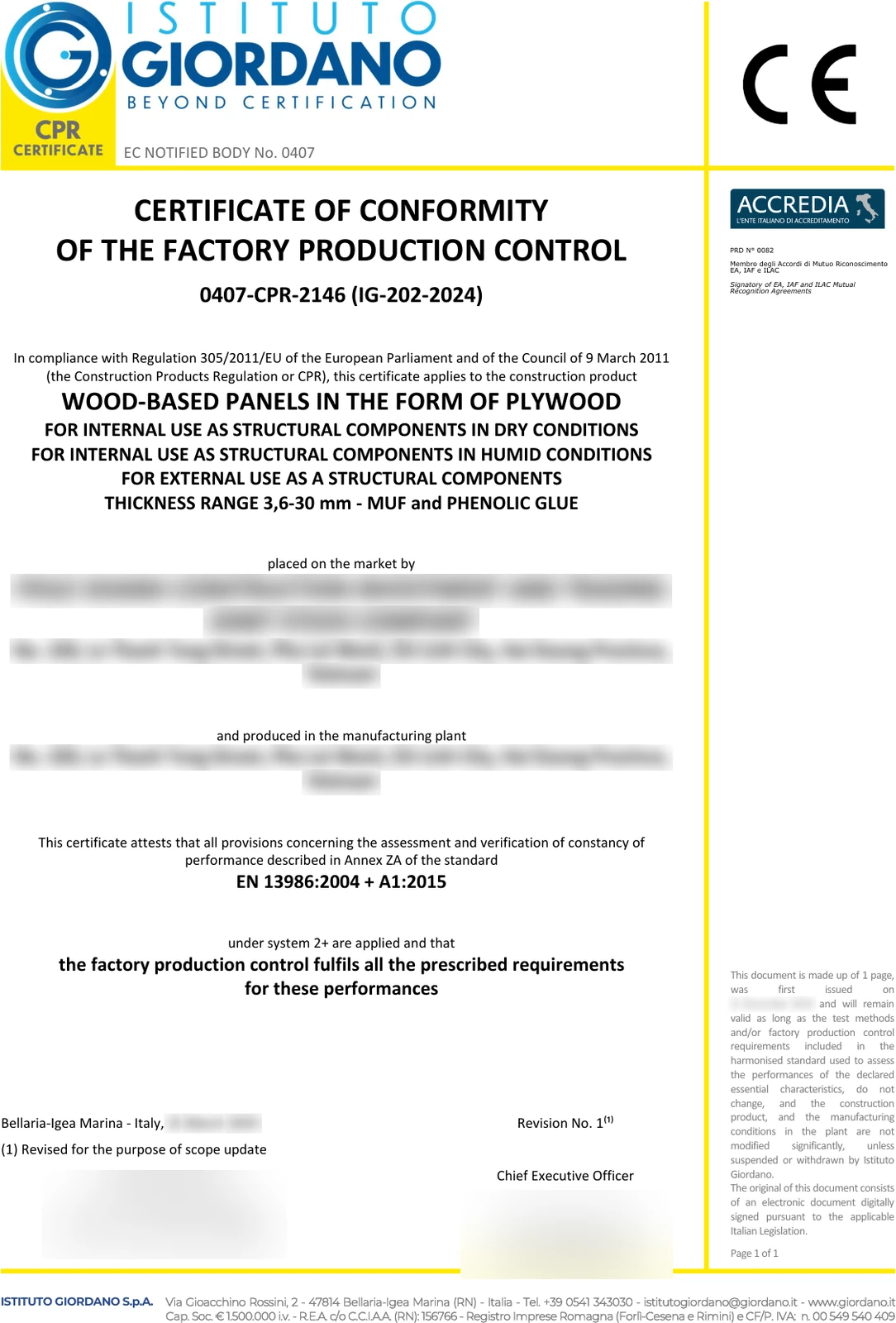
0407-CPR-2146
EN 13986, System 2+, notified body 0407: structural plywood 3.6–30 mm with MUF or phenolic glue, for when the panel is ordered for structural use.
CE FPC certificate scan, company details and dates blurred
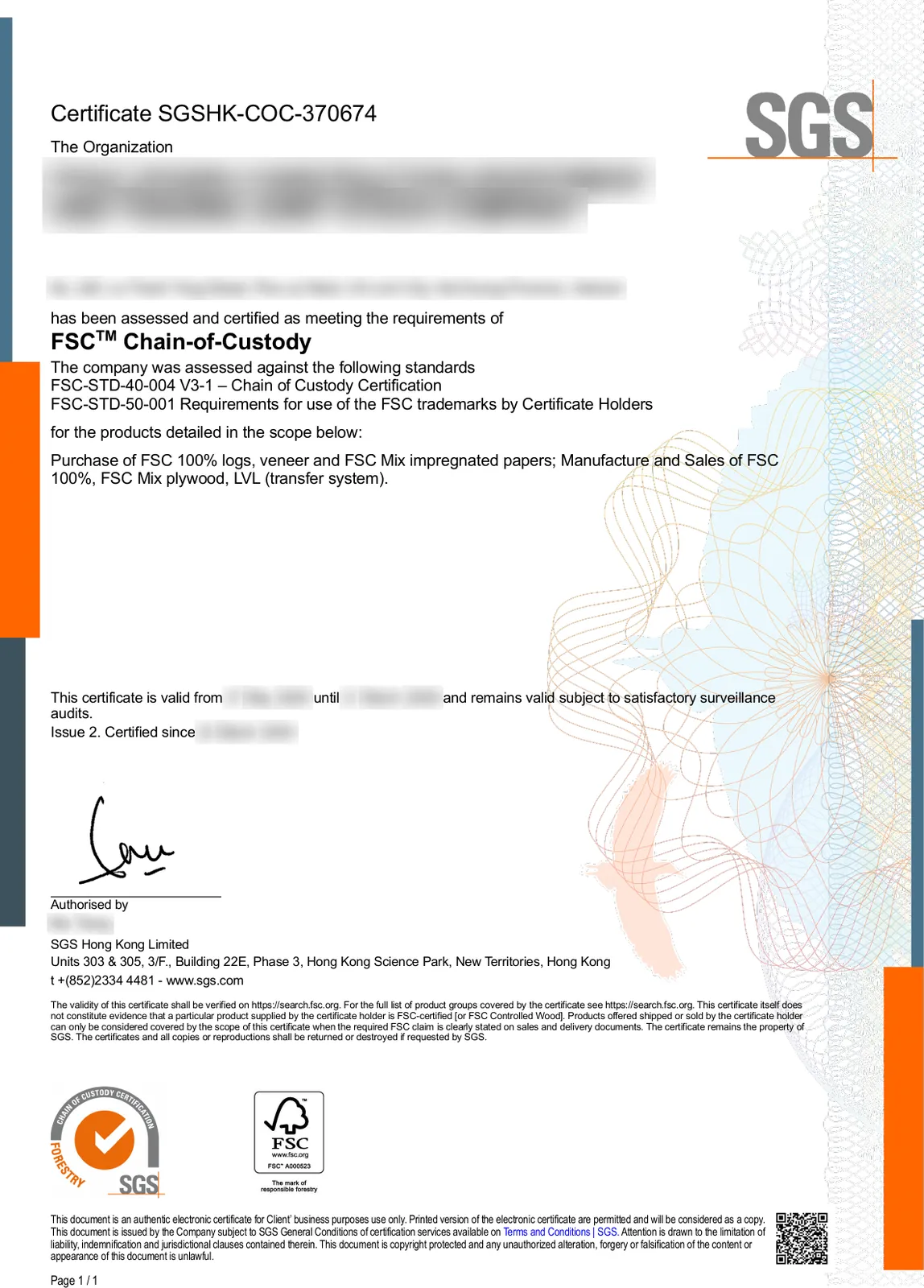
SGSHK-COC-370674
SGS Hong Kong chain of custody: FSC 100% and FSC Mix plywood; the claim is confirmed per order on the invoice.
FSC certificate scan, company details and dates blurred
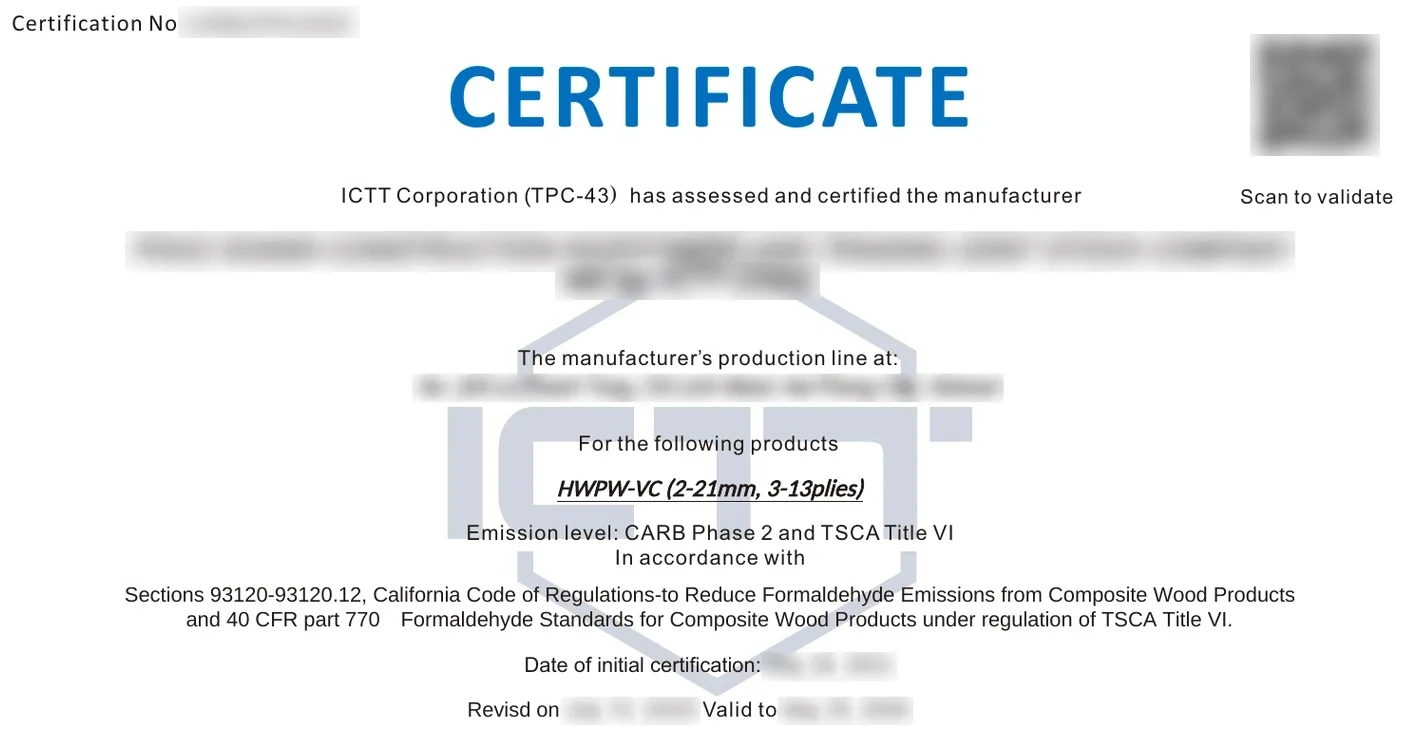
Hardwood plywood, veneer core, 2–21 mm
CARB Phase 2 and TSCA Title VI documentation for applicable US orders; the copy on file covers hardwood plywood with veneer core, 2–21 mm.
CARB / TSCA certificate scan, company details and dates blurred
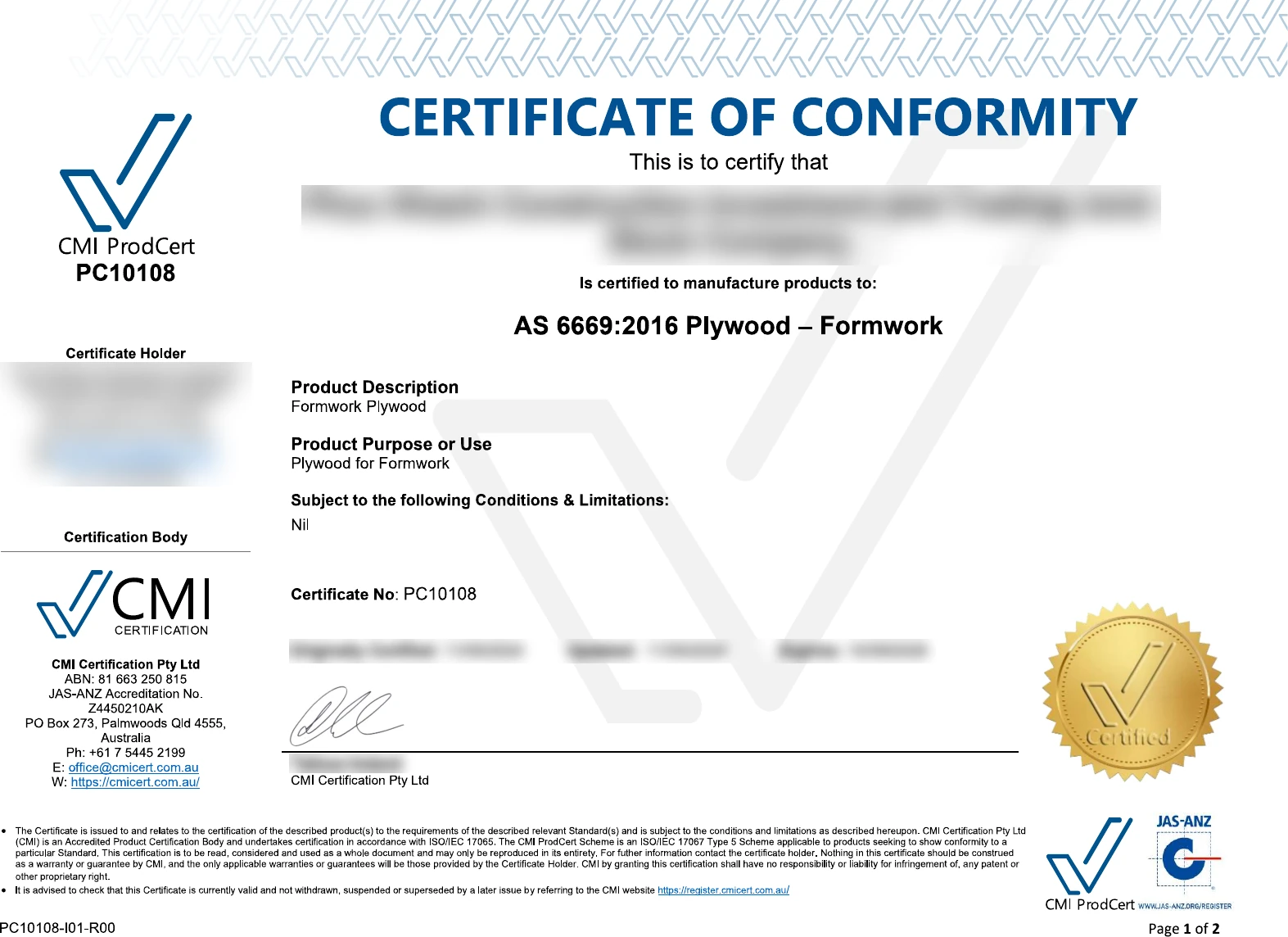
CMI Certification, ISO/IEC 17065
AS 6669:2016 product certification for formwork plywood, issued by CMI Certification under ISO/IEC 17065.
AS 6669 certificate scan, company details and dates blurred
Loading
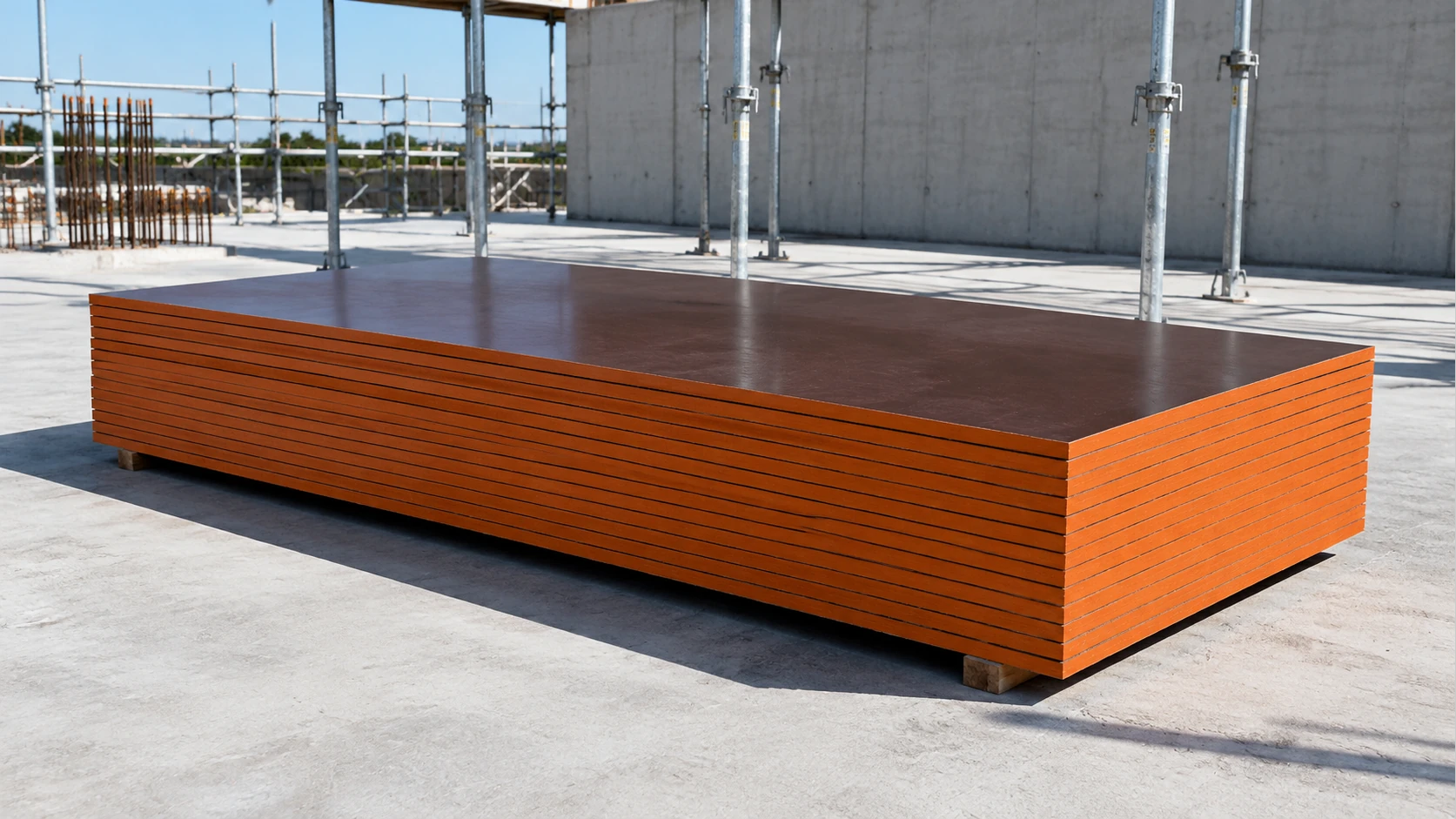
MUF sheets are packed about 1,000 mm high on pallet feet, covered and strapped. A 40HC takes 16 packs of Acacia-core sheets or 15 of Eucalyptus-core sheets; Eucalyptus loads stop at the payload before the volume is full.
These are planning figures from our loading model for 1220 × 2440 mm sheets; the final count is confirmed after booking and weighing the sheets.
| Thickness | Acacia sheets per pack | Acacia per 40HC | Acacia m³ | Eucalyptus per 40HC | Eucalyptus m³ |
|---|---|---|---|---|---|
| 9 mm | 111 | 1,776 | 47.6 m³ | 1,605 | 43.0 m³ |
| 12 mm | 83 | 1,328 | 47.4 m³ | 1,200 | 42.9 m³ |
| 15 mm | 66 | 1,056 | 47.2 m³ | 960 | 42.9 m³ |
| 18 mm | 55 | 880 | 47.2 m³ | 795 | 42.6 m³ |
| 21 mm | 47 | 752 | 47.0 m³ | 675 | 42.2 m³ |
Planning densities 580 kg/m³ Acacia and 650 kg/m³ Eucalyptus; sheet weights 15.5 kg (9 mm) to 36.3 kg (21 mm) on Acacia.
Buy direct from the mill
We sell MUF panels by the container from our two mills, which ship up to 150 containers a month. The minimum is one 40HC; one or two builds per container is normal, and three to six can be mixed by agreement, for example MUF slab panels with a few packs of phenolic sheets for columns.
Production runs 15–45 days after the 30% deposit; the 70% balance is due against the scanned bill of lading by T/T, or by irrevocable L/C at sight. We quote FOB Hai Phong, CFR or CIF.
How to order
Add film colour and weight, core, edge colour and the port of discharge.
Build, tolerances and price FOB Hai Phong, CFR or CIF, usually within hours.
Same build as the order; new buyers book their own courier.
Production is scheduled and takes 15–45 days depending on quantity.
Pack and loading photos, draft documents after loading, balance against the B/L scan.
Buyer questions
Hardwood plywood bonded with melamine-urea-formaldehyde (MUF) glue, with a resin film on both faces and painted edges, made for concrete formwork. Ours has an Acacia or Eucalyptus core and brown or black film.
About 12–15 pours, with proper handling, release agent on every pour and sealed edges, including cut edges. Rough stripping or bare cut edges reduce that.
Water-resistant, not boil-proof. The MUF glue line takes normal wet and dry formwork cycles, and the film and painted edges keep water out; long soaking or boiling is where phenolic glue is needed.
130–135 g/m² on most orders, 120–125 g/m² for lower-cost single-project panels, and 165 g/m² on request. Brown is standard; black is pressed to order.
When you need more than about 15 pours, run a rental fleet, store panels outdoors between jobs or cast daily in a precast yard. Phenolic gives up to about 25 pours with proper handling.
About 880 sheets of 18 mm 1220 × 2440 mm with an Acacia core, or 795 with a Eucalyptus core; 1,328 Acacia sheets at 12 mm. These are planning figures before booking and weighing.
No. Melamine-faced boards carry decorative paper on chipboard or MDF for interiors. MUF film-faced plywood uses melamine in the glue and carries a formwork film on a hardwood veneer core.
Neither is stronger. Colour is a market habit; strength and pours come from the glue, core and film weight, which are the same for both colours on our MUF build.
Yes. 18 mm on 1220 × 2440 mm (4 × 8 ft) is our most common MUF order; 1250 × 2500 mm is pressed for European systems.
Yes, when ordered for structural use within 3.6–30 mm: our factory production control certificate 0407-CPR-2146 under EN 13986 covers MUF and phenolic glue.
±0.5 mm on thickness and ±2 mm on length and width, measured on pack samples and written on the technical sheet of the order.
Yes. One or two builds per container is normal, and three to six can be mixed by agreement.
Quotation
Send thickness, sheet size, film colour and weight, core, quantity and port of discharge. We reply with a technical sheet and an FOB Hai Phong, CFR or CIF price.