
Our 18 mm film-faced plywood is a hardwood-core panel with phenolic film on both faces, MUF or phenolic glue and painted edges, held to ±0.5 mm. PK Ply presses it in 1220 × 2440 mm and 1250 × 2500 mm. Ordering it by thickness alone is how two offers at the same price become a 12-pour panel and a 25-pour panel.
What is 18 mm film-faced plywood, and what is it used for?
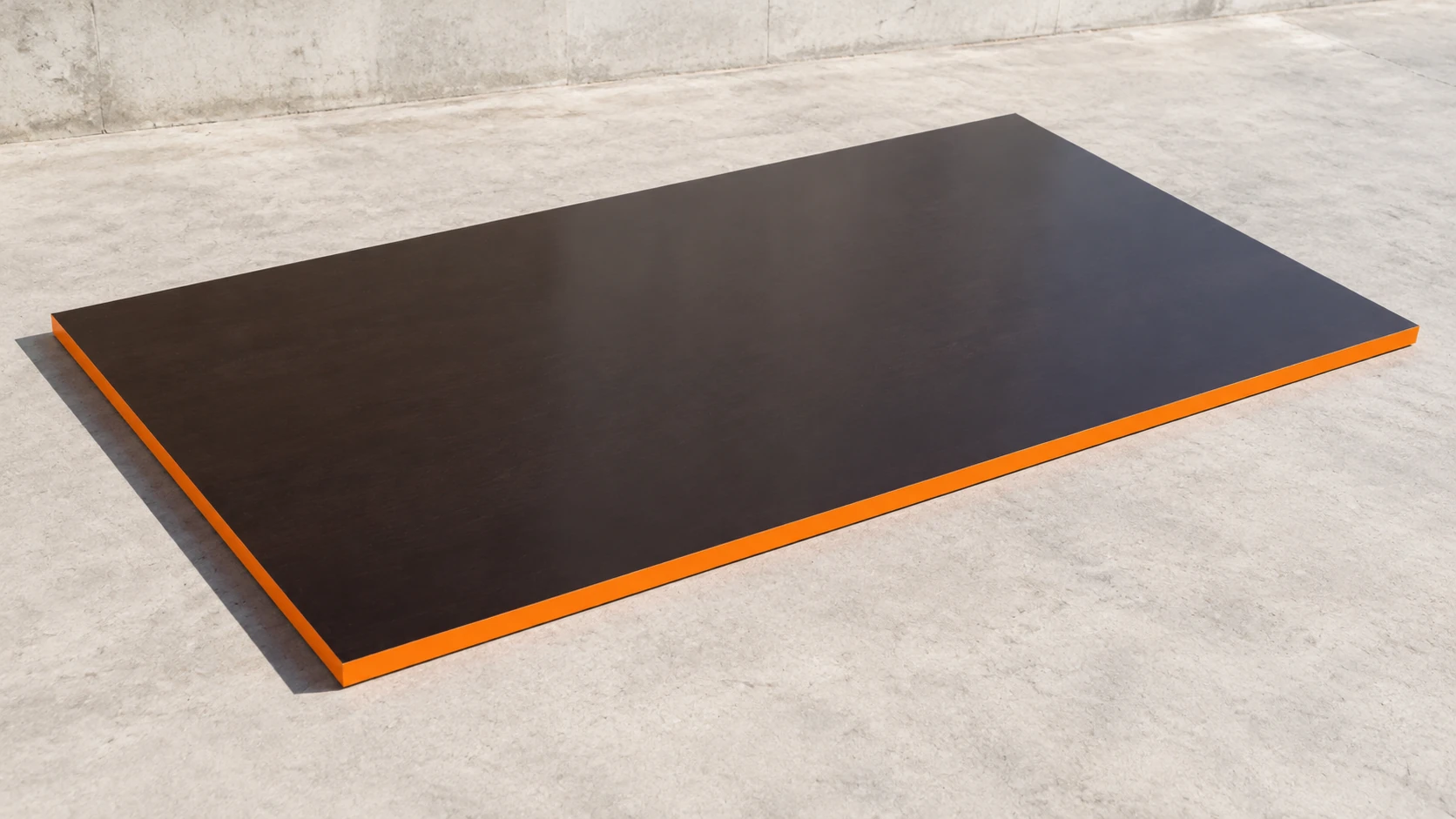
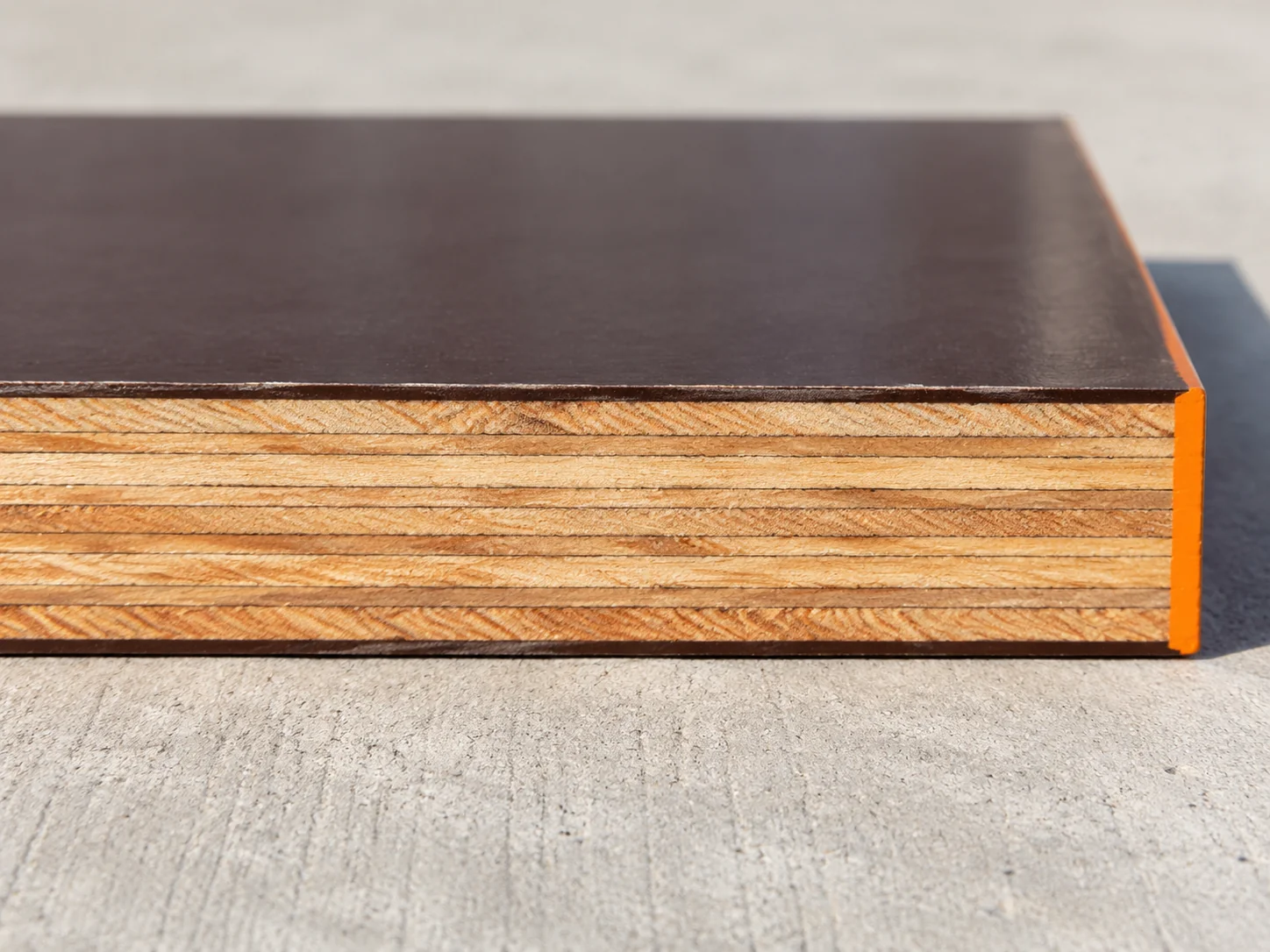
18 mm film-faced plywood is a hardwood-core plywood panel, 18 mm thick, with phenolic film pressed on both faces and paint on its edges, made to form concrete and strip clean for the next pour. It is the deck and wall thickness most formwork systems are drawn around.
The thickness is a compromise that crews and designers have settled on. An 18 mm panel is stiff enough to span the usual joist and stud spacing without the concrete face bowing, and light enough for one or two people to place it. Thinner panels need closer supports; thicker ones add weight on every strike. That is why 18 mm is the sheet that fills most formwork containers, and the one we press most at our two mills in Chi Linh, Hai Phong.
Where it goes on a job:
- Slab decks. Laid on timber or aluminium beams, film side up, as the soffit of a floor slab.
- Walls and columns. Fixed to frames or studs as the face against the concrete.
- Replacement facing. Cut to size for steel or aluminium frame systems whose original panels have worn out.
- Floors and decks. With an anti-slip pattern on the top face, as walkways, platforms and truck floors; see our anti-slip plywood panels.
18 mm sheets also come under other names. UK and Indian merchants say 18mm shuttering plywood, Australia says 18mm formply, Gulf contractors say 18mm phenolic plywood, and the US thinks in 3/4 inch. The panel behind all of them is the same idea; the build behind each offer is what differs.
Our 18 mm build, line by line
Our 18 mm film-faced panel has seven lines on its technical sheet: phenolic film on both faces, smooth hardwood face veneers, a crosswise Acacia or Eucalyptus core, MUF or phenolic glue, painted edges, ±0.5 mm thickness tolerance and a sheet size of 1220 × 2440 mm or 1250 × 2500 mm.
| Line | Our 18 mm film-faced panel | What it decides |
|---|---|---|
| Face film | Phenolic film on both faces, black or dark brown; 120–125 g/m² up to over 200 g/m² by order | Face life, concrete finish |
| Face veneers | Smooth hardwood under the film | Whether the film stays smooth after pours |
| Core | Acacia or Eucalyptus veneers laid crosswise | Weight, stiffness, container fill |
| Glue | Melamine (MUF) or phenolic | Wet cycles before the plies open |
| Edges | Water-resistant paint on all four edges | Swelling at joints |
| Thickness | 18 mm, ±0.5 mm | Flat joints between sheets |
| Size | 1220 × 2440 mm or 1250 × 2500 mm, ±2 mm | Fit with the formwork system |
The build is made in eight steps: veneer intake, drying, core lay-up, glue and press, sizing and sanding, film press, edge sealing, then marking and packing. Two of them set the quality of an 18 mm panel more than the others. Sizing and sanding after the first press is where the core is calibrated to an even thickness, so the film goes onto a flat panel. The film press then bonds the film into the face veneer. A panel filmed before it is calibrated keeps every bump in its core.
Two offers called “18 mm film-faced plywood” can differ on every line of this table. Core grade, how core veneers are joined, glue system, film weight and edge sealing all change from one mill to the next. That is why our quotes start from the application and the pour target, then fix each line on the technical sheet; our film-faced plywood page shows the full range.
Is 18 mm plywood the same as 3/4 inch?
No. 3/4 inch is 19.05 mm, so an 18 mm metric panel is about 1 mm thinner than a true 3/4 inch sheet. Most of the world’s formwork is metric and drawn around 18 mm; North American systems drawn around 3/4 inch panels may need their spacing or fixings checked before 18 mm goes in.
The arithmetic is fixed by the inch itself. Schedule 1 of the Weights and Measures Act 1985 defines the yard as 0.9144 metre and the inch as 1/36 yard. That makes the inch 25.4 mm, and three quarters of it 19.05 mm. North American plywood sold as 3/4 inch is often a little under that nominal size, but the gap to 18 mm remains roughly a millimetre.
What changes on site with that millimetre:
- Stiffness. Bending stiffness grows with the cube of thickness, so an 18 mm panel is a few per cent less stiff than a 19 mm one of the same build. On close joist spacing this is rarely noticed; on wide spacing it should be checked.
- Joints. Mixing 18 mm and 3/4 inch panels in one deck leaves a step at every joint that prints on the concrete.
- Fixings. Frame systems with rebates or clips made for one thickness need the matching panel.
If your system is drawn for 3/4 inch, say so on the enquiry. We press panels to the thickness ordered within our 9–40 mm range, and the tolerance of ±0.5 mm applies to any thickness we press.
What thickness tolerance applies to 18 mm panels?
Our 18 mm film-faced panels are held to a thickness tolerance of ±0.5 mm, so every sheet measures between 17.5 and 18.5 mm. Length and width are held to ±2 mm. The tolerance for each order is written on its technical sheet, and the panels are calibrated by sanding before the film goes on.
Tolerance matters more on formwork than on almost any other plywood use. Two sheets side by side on a deck must sit flush, or the joint prints a line on the soffit. A deck of sheets that vary by more than a millimetre also loads the beams unevenly and lets paste leak through the joints. That is why we calibrate the pressed core to an even thickness before the film press, rather than trying to correct a thick or thin sheet after it is filmed.
How a buyer checks it on arrival:
- Measure each sampled sheet with a caliper at four points, about 100 mm in from each corner, and at the middle of each long edge.
- Record the highest and lowest reading per sheet; both should sit between 17.5 and 18.5 mm.
- Check the diagonals for squareness and lay two sheets edge to edge on a flat floor to see the joint.
| Measure | Our tolerance on 18 mm film-faced | Reading range |
|---|---|---|
| Thickness | ±0.5 mm | 17.5 to 18.5 mm |
| Length | ±2 mm | 2438–2442 mm on a 2440 mm sheet |
| Width | ±2 mm | 1218–1222 mm on a 1220 mm sheet |
A tighter tolerance than ±0.5 mm can be written for a project that needs it, for example a fair-faced concrete wall with visible joints. Say so on the enquiry, because it changes the sanding and the grading of every pack.
What does an 18 mm sheet weigh with an Acacia or Eucalyptus core?
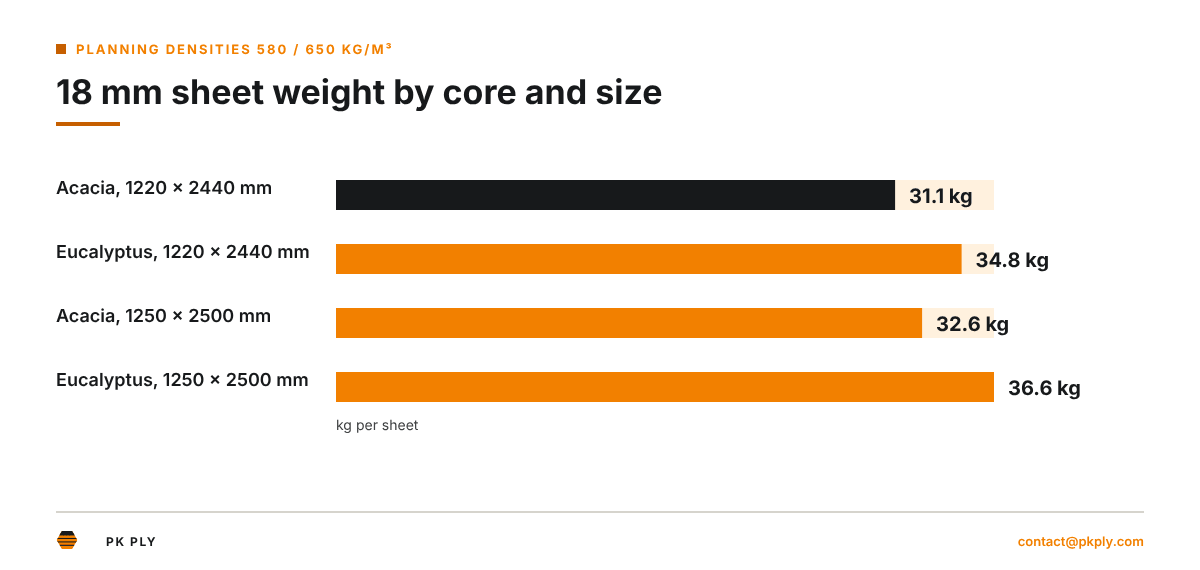
An 18 mm sheet of 1220 × 2440 mm weighs about 31.1 kg with an Acacia core and about 34.8 kg with a Eucalyptus core, at our planning densities of 580 and 650 kg/m³. In 1250 × 2500 mm the same sheets are about 32.6 kg and 36.6 kg. Weigh real sheets before final loading.
The formula is density times volume. An 18 mm sheet of 1220 × 2440 mm holds 0.0536 m³ of panel; a 1250 × 2500 mm sheet holds 0.0563 m³. Multiply by the density of the core:
| 18 mm sheet | Volume | Acacia core, 580 kg/m³ | Eucalyptus core, 650 kg/m³ |
|---|---|---|---|
| 1220 × 2440 mm | 0.0536 m³ | About 31.1 kg | About 34.8 kg |
| 1250 × 2500 mm | 0.0563 m³ | About 32.6 kg | About 36.6 kg |
| Per square metre | 0.018 m³ | About 10.4 kg | About 11.7 kg |
Eucalyptus is measured at 650–750 kg/m³, so a dense Eucalyptus run can weigh more than the planning figure. For comparison, SGS measured 642 kg/m³ on one submitted 21 mm Acacia-core phenolic specimen; the SGS specimen note explains that result. Our plywood sheet weight calculator gives the weight for other thicknesses and cores.
Weight is also a quick check on an offer. A listing that claims an 18 mm sheet far above 40 kg implies a density no plantation hardwood veneer reaches; one far below 30 kg suggests a light core or thin glue lines. Ask for the core species and weigh a sample.
How many sheets of 18 mm film-faced plywood fit in a 40HC?
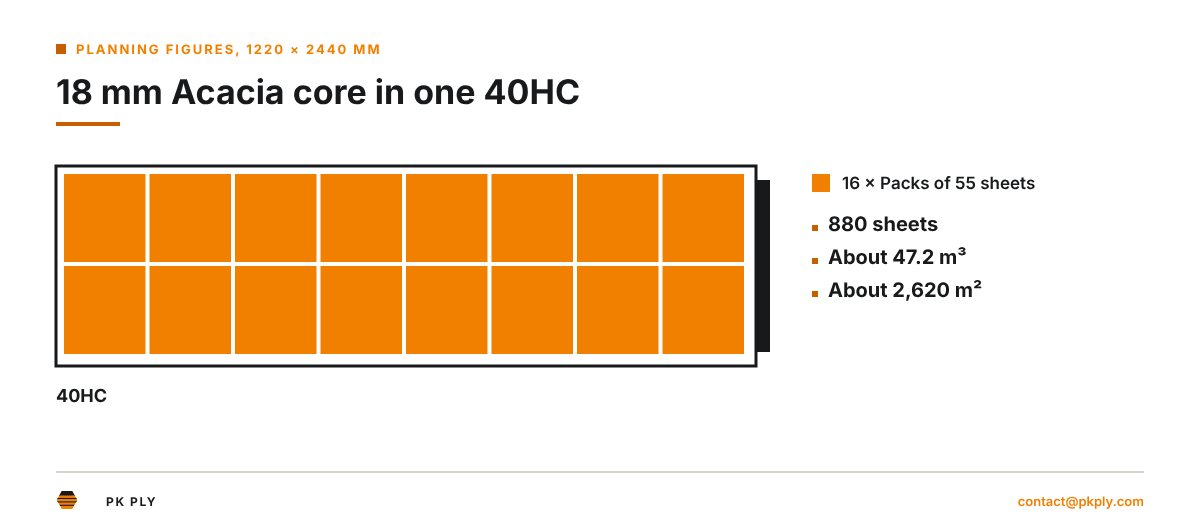
A 40HC holds about 880 sheets of 18 mm film-faced plywood in 1220 × 2440 mm with an Acacia core (16 packs of 55 sheets, about 47.2 m³), or about 795 sheets with a Eucalyptus core (15 packs of 53, about 42.6 m³), where weight stops the load first. These are planning figures until the packing list is made.
The planning model stacks packs about 1,000 mm high: 16 packs for Acacia, 15 for Eucalyptus, with a planning payload of 28,000 kg of panels that the carrier and route confirm. Sheets per pack are 1,000 mm divided by the thickness, rounded down, then capped by weight.
| 18 mm, per 40HC (planning figures) | Acacia core | Eucalyptus core |
|---|---|---|
| 1220 × 2440 mm | 880 sheets (16 × 55), 47.2 m³ | 795 sheets (15 × 53), 42.6 m³ |
| Area covered, 1220 × 2440 mm | About 2,620 m² | About 2,367 m² |
| 1250 × 2500 mm | 848 sheets (16 × 53), 47.7 m³ | 750 sheets (15 × 50), 42.2 m³ |
| Area covered, 1250 × 2500 mm | About 2,650 m² | About 2,344 m² |
The area row is the one a contractor plans with. At about 2,620 m² of Acacia-core 18 mm in one container, a slab programme can be measured in containers per floor rather than in sheets. Every figure here is a planning figure: real sheets are weighed before final loading, and the packing list is the number that counts. See how packs go in on the 40HC loading page.
How many pours does an 18 mm phenolic panel give?
An 18 mm phenolic-glue film-faced panel gives up to about 25 pours, against about 12–15 pours for the MUF-glue build and about 4–10 for budget panels, with proper handling, release agent on every pour and sealed edges, including every cut edge. The thickness does not set the count; glue, film and site practice do.
Why 18 mm phenolic plywood lasts longer than 18 mm MUF on the same deck comes down to the glue line. A phenolic glue line keeps its bond through boiling water, which is what the exterior bonding class tests; a MUF glue line is water-resistant and made for fewer wet cycles. The face film sets how long the surface lasts under vibrators, rebar chairs and scrapers, and a heavier film adds face life without changing the glue line beneath it.
| 18 mm build | Glue | Pours with proper handling, release agent and edge sealing |
|---|---|---|
| Budget film-faced | Low glue spread, mixed core | About 4–10 |
| Our 18 mm MUF film-faced | Melamine (MUF) | About 12–15 |
| Our 18 mm phenolic film-faced | Phenolic | Up to about 25 |
The way to choose is cost per pour: the delivered sheet price divided by the pours your site will get. If both builds reach their counts, a phenolic panel at up to about 25 pours stays cheaper per pour than a MUF panel at about 15 for as long as its sheet price is less than about 1.7 times the MUF price. Our phenolic film-faced plywood and melamine film-faced plywood pages list each build.
Is film faced ply waterproof?
Film-faced ply is water-resistant, with a waterproof glue line: phenolic and MUF glue lines do not dissolve in a wet pour, and the film closes both faces. The raw wood still takes up water wherever it is open, so an 18 mm sheet stays sound only while its film and edge paint are whole and every cut edge is sealed.
The bond evidence for our phenolic line comes from the laboratory: one submitted 21 mm Acacia-core phenolic specimen passed EN 314 bonding Class 3 after a 24 h water soak, boil-dry-boil and 72 h boiling, in an SGS Vietnam report dated 23 December 2025. That tells you the glue line survives boiling. It does not make a bare saw cut waterproof.
On an 18 mm deck, the failure order at an unsealed cut edge is predictable: the edge swells, the joint stands proud and prints on the soffit, the outer veneer lifts and the film peels back from the corner. Painting cut edges and tie-rod holes the same day stops it.
Does CE marking cover your 18 mm structural panels?
Yes. Our CE factory production control certificate 0407-CPR-2146 from Istituto Giordano, notified body 0407, covers plywood for structural use in dry, humid and external conditions from 3.6–30 mm with MUF or phenolic glue, under EN 13986 and AVCP System 2+. An 18 mm panel ordered as structural CE plywood sits inside that scope.
What the CE route gives an 18 mm order is a declaration of performance for the thickness, with the values a designer needs, and a mill whose own production control is checked by a notified body. In the Construction Products Regulation, factory production control is the documented, permanent and internal control of production in a factory. The harmonised standard behind it is EN 13986, which covers characteristics, evaluation of conformity and marking of wood-based panels for use in construction.
Not every 18 mm formwork order needs CE. A contractor buying deck panels for a temporary works system usually orders by glue, film and pour target; a buyer whose panel becomes part of a permanent structure, or whose market asks for CE on all construction plywood, orders it as structural CE. Say which on the enquiry. The structural CE plywood page and the CE marking page show the scope and the certificate.
Black or brown film on 18 mm: what changes
Nothing that sets the grade. 18mm black film faced plywood and dark-brown film panels both carry phenolic-impregnated paper; the film weight in g/m² and the glue underneath decide face life and pours. Colour helps a site tell suppliers or grades apart and shows how evenly release agent was applied.
| Film weight on 18 mm | How buyers use it |
|---|---|
| 120–125 g/m² | Lower-cost orders, short programmes |
| 130–135 g/m² | The most common choice on our orders now |
| 165 or 185 g/m² | Longer face life on repeated slab and wall pours |
| Over 200 g/m² | A heavy face for long programmes |
Write the film weight beside the colour on every 18 mm order, and the film brand if your site prefers one. A heavy film on a MUF glue line still has the bond life of MUF, so a buyer who wants twenty pours orders phenolic glue and a film weight to match.
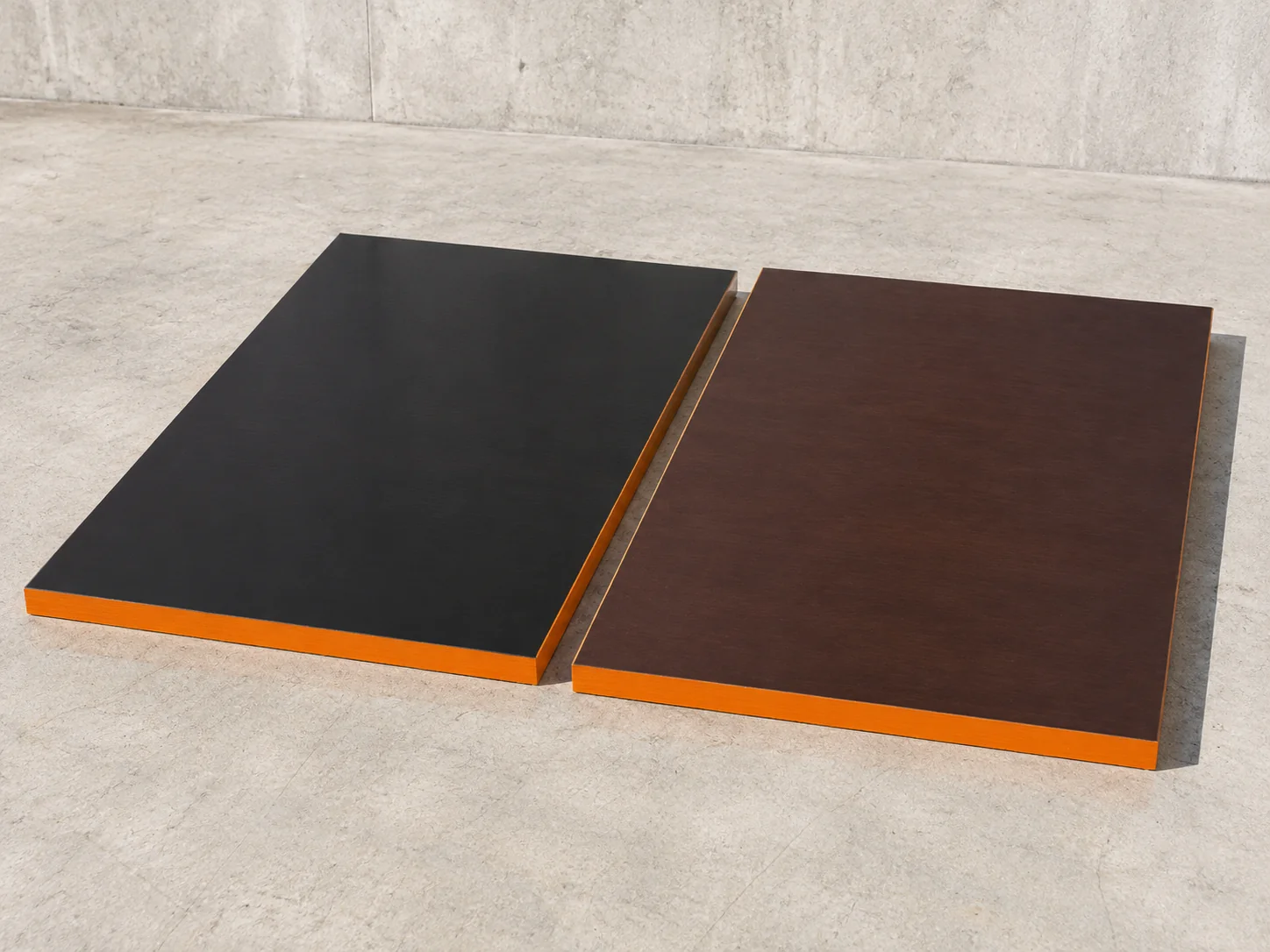
1220 × 2440 or 1250 × 2500 mm: choosing the 18 mm sheet size
Choose the sheet size your formwork system is drawn for: 1220 × 2440 mm (8 × 4 ft) is the standard in the Gulf, India, Africa, the UK merchant trade and much of Asia, while film faced plywood 18mm 1250 x 2500 is the common size for European beam decks and frame systems. We press both and cut to a cutting list on request.
| 18 mm sheet | Area per sheet | Weight, Acacia / Eucalyptus | Per 40HC, Acacia / Eucalyptus (planning) |
|---|---|---|---|
| 1220 × 2440 mm | 2.98 m² | 31.1 kg / 34.8 kg | 880 / 795 sheets |
| 1250 × 2500 mm | 3.125 m² | 32.6 kg / 36.6 kg | 848 / 750 sheets |
The larger European sheet covers about 5 per cent more area per sheet and weighs about 5 per cent more. Fewer sheets per container are the result, but the area per container stays close. Nothing is pressed larger than 1250 × 2500 mm, so systems drawn around larger panels are faced with cut sheets.
Cut sizes are common for frame formwork, where the panel fills a steel or aluminium frame. Send the cutting list with the frame type, and we cut, seal the cut edges and pack by size.
18 mm formply, shuttering ply and phenolic board: names by market
The same 18 mm film-faced panel is ordered under different names and standards in each market, and the standard a buyer writes on the order matters more than the name. Australia writes AS 6669 formply, Europe writes EN 636 and CE, India writes IS 303 BWP, and the Gulf writes film-faced shuttering plywood with a glue type.
| Market | Name buyers use | What the order usually names | What we supply against it |
|---|---|---|---|
| Australia | 18mm formply | AS 6669 formwork plywood | Our formwork plywood is certified to AS 6669:2016 by CMI Certification, a JAS-ANZ-accredited body |
| European Union, UK | Film-faced plywood, 18 mm | EN 636-2 or EN 636-3, CE to EN 13986 | MUF or phenolic 18 mm inside the CE scope of 3.6–30 mm |
| India | 18mm shuttering plywood | IS 303 BWP grade, sheet weight in kg | Phenolic 18 mm with exterior bonding |
| Gulf, Africa | 18mm phenolic plywood, film-faced shuttering | Glue type, film weight, 1220 × 2440 mm | MUF or phenolic to the order’s technical sheet |
| North America | 3/4 form plywood | Thickness in inches, overlay type | 18 mm metric panel, or a thickness to order |
In Australia the standard on the order is the one to check first. Our certification is to AS 6669:2016, product “formwork plywood”; no stress grade is claimed from it, so a project that specifies a stress grade gets a quote against that requirement separately. For the EU, our shuttering ply note sets out how EN 636 classes and CE fit together.
How much weight can 18 mm plywood hold, and can it be used for flooring?
An 18 mm film-faced panel carries the wet concrete of a normal slab when it sits on the support spacing its formwork system is designed for; the load it can hold depends on that span, the direction of the face grain and the build, not on the thickness alone. For floors and decks it works well with an anti-slip face, on supports set for the load.
Three facts decide how much an 18 mm sheet holds on a given job:
- The span. Halving the distance between supports cuts the bending moment to a quarter. Formwork designers set joist spacing for the slab thickness and the panel, not the other way round.
- The face grain. Plywood is stiffer along the face grain. Lay the long side of the sheet across the supports.
- The build. Core species, glue and ply arrangement change stiffness. For a structural CE panel, the declaration of performance gives the values for 18 mm.
For flooring, the top face matters as much as the strength. Our anti-slip panels carry a patterned film in rice, hexagon or wire-mesh patterns. Two anti-slip specimens were pendulum-tested by SGS to DIN EN 16165; the specimen of 200 × 145 × 18.38 mm read 58 dry and 40 wet. That is a result for a submitted specimen, not a slip class or a guarantee for every floor. For truck-body and platform floors, give the span and the load on the enquiry and we propose the thickness, pattern and glue.
Ordering 18 mm film-faced plywood: the lines to send
An 18 mm order needs eight lines: application and pour target, core, glue, film weight and colour, thickness and tolerance, sheet size, edge sealing and quantity, plus the port of discharge. With those, we return a technical sheet for your 18 mm panel and an FOB Hai Phong offer per cubic metre.
| Line | What to write | Example for an 18 mm slab-deck order |
|---|---|---|
| Application and pours | What the panel forms, pours planned | Slab decks on beams, about 20 pours |
| Core | Acacia or Eucalyptus | Acacia, about 47 m³ per 40HC |
| Glue | MUF or phenolic | Phenolic |
| Film | g/m² and colour | 165 g/m², black, both faces |
| Thickness | mm and tolerance | 18 mm, ±0.5 mm |
| Sheet size | mm | 1250 × 2500 mm |
| Edges and marking | Paint and marks | Water-resistant paint, all four edges |
| Quantity and port | 40HC or m³, port | One 40HC, CIF Gdansk |
Our terms are standard for every thickness: one 40HC minimum, carrying one or two products and up to six by agreement; production in 15–45 days after the 30% deposit; the 70% balance against the scanned bill of lading by T/T or irrevocable L/C at sight; FOB Hai Phong, CFR or CIF. Free samples of the 18 mm build go out on request, with new buyers booking their own courier. Send the eight lines through the specification form or to [email protected].
Questions buyers ask us
What is 18 mm film-faced plywood used for?
It is the standard deck and wall panel for concrete formwork: slab soffits on beams or joists, wall and column forms, and, with an anti-slip face, walkways and floors. It is the thickness most formwork systems are designed around.
How much does an 18 mm sheet of film-faced plywood weigh?
A 1220 × 2440 mm sheet weighs about 31.1 kg with an Acacia core and about 34.8 kg with a Eucalyptus core at our planning densities. A 1250 × 2500 mm sheet is about 32.6 kg and 36.6 kg.
Is 18 mm plywood the same as 3/4 inch?
No. 3/4 inch is 19.05 mm, so an 18 mm sheet is about 1 mm thinner; where a US form system is drawn around 3/4 inch panels, check the spacing with your designer.
What thickness tolerance do you hold on 18 mm panels?
Our film-faced tolerance is ±0.5 mm, so an 18 mm panel measures between 17.5 and 18.5 mm. Length and width are held to ±2 mm, and the tolerance is written on the order's technical sheet.
How many sheets of 18 mm plywood fit in a 40HC?
About 880 sheets of 1220 × 2440 mm with an Acacia core, or about 795 with a Eucalyptus core, as planning figures. The packing list made at loading is the number that counts.
How many pours does 18 mm phenolic plywood give?
Up to about 25 pours with phenolic glue and about 12–15 with MUF glue, with proper handling, release agent and edge sealing. Budget panels typically give about 4–10.
Is black 18 mm film-faced plywood better than brown?
No. Colour is not a grade; the film weight in g/m² and the glue under it set the face life and the pour count.
Is your 18 mm plywood CE marked?
Yes, as structural plywood: 18 mm sits inside the 3.6–30 mm scope of our CE factory production control certificate 0407-CPR-2146. The performance values come on the declaration of performance for the thickness.
Can I use 18 mm film-faced plywood for flooring?
Yes for decks, platforms, truck floors and walkways, usually with an anti-slip film face on top. The span and support spacing decide whether 18 mm is enough, so give them on the enquiry.
Do you make 18 mm marine plywood?
No. We make 18 mm film-faced and anti-slip construction plywood with exterior-grade glue lines; for boat building, order a panel graded as marine plywood.
What is the minimum order for 18 mm film-faced plywood?
One 40HC, which can carry one or two products and up to six by agreement. Production takes 15–45 days after the 30% deposit.