
Veneer sorting
The previous step: grading veneer into face and core.
OpenGlue line · MUF or phenolic
In short
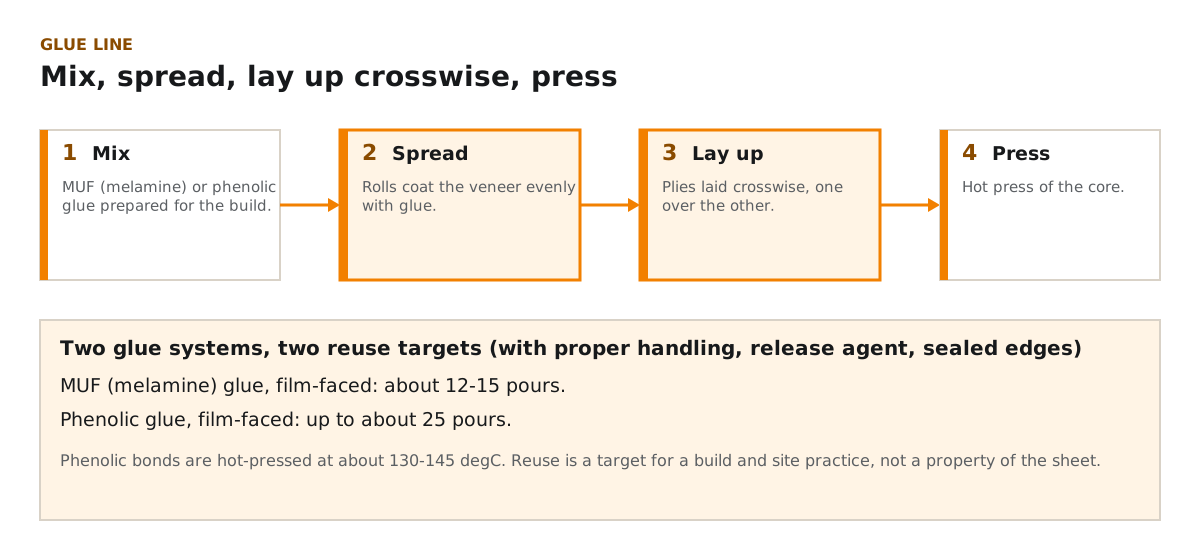
Bond class is made on the glue line. Our two mills in Chi Linh, Hai Phong spread MUF (melamine) or phenolic glue on Acacia or Eucalyptus core veneers, lay them crosswise and hot-press phenolic bonds at about 130–145 °C. The proof is one SGS specimen: a 21 mm phenolic-glue film-faced panel that passed EN 314 bonding Class 3 after 24 h soak, boil-dry-boil and 72 h boiling. The glue system also sets the reuse target, about 12–15 pours for MUF and up to about 25 for phenolic, with proper handling.
Page film
The film follows one veneer from the glue spreader rolls to the lay-up table and into the press.
Chapters: the mixing room, the spreader with its rolls, the lay-up table where plies are laid crosswise, and the press loading.
It shows what a spread check looks like and why open time matters, without naming any formula.
Certificates
The glue line is where three of our documents meet: the bonding class on the SGS specimen, the formwork product certification and the CE scope that names MUF and phenolic glue.
The SGS report is specimen evidence for one submitted panel, not a guarantee for every panel. Not detected at the reporting limit does not mean zero and is not an E0 claim.
Certificate scans are lightly blurred: legal-entity name, tax ID, street address and dates are hidden.
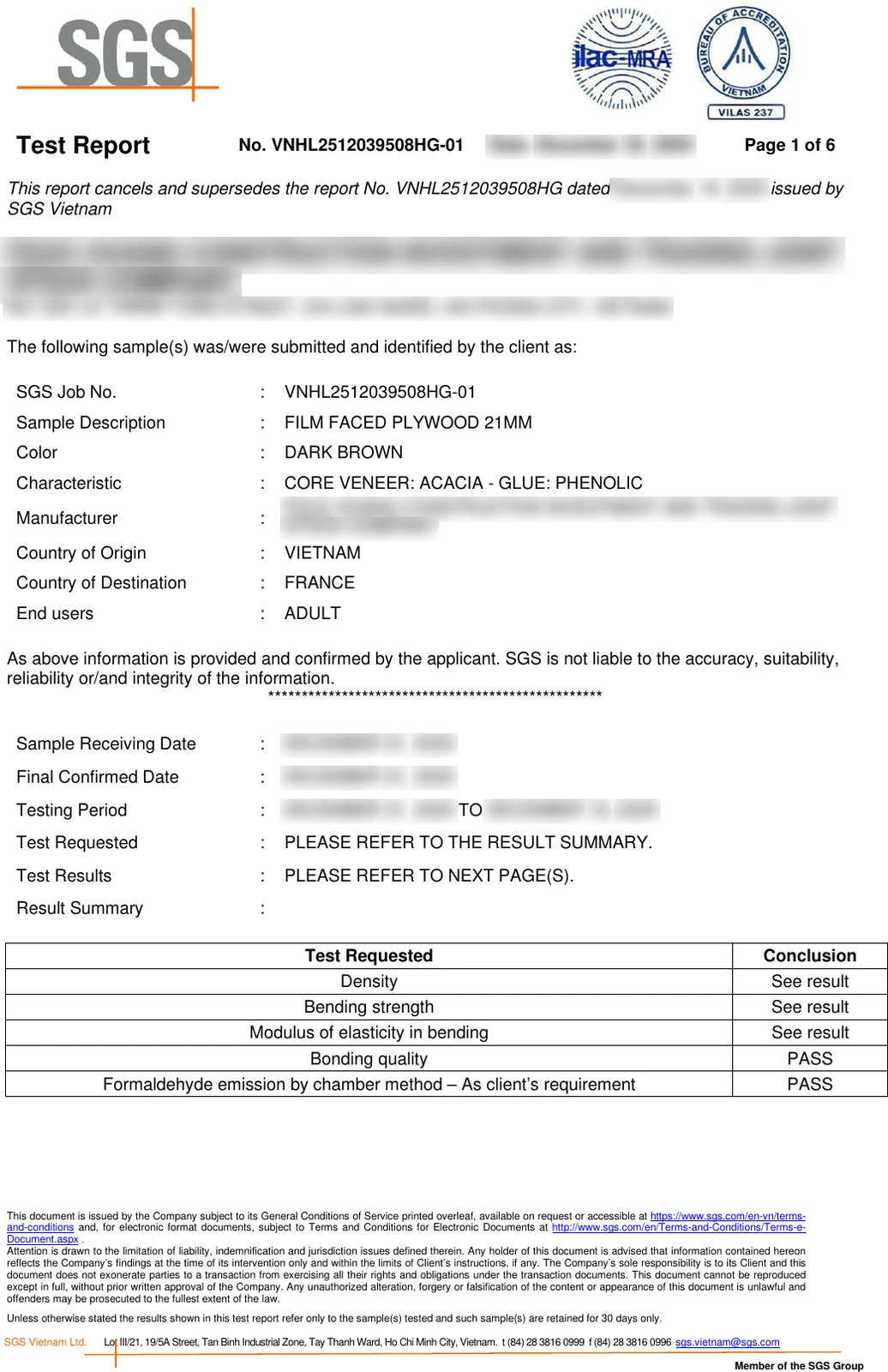
One 21 mm dark-brown film-faced specimen, Acacia core, phenolic glue: bonding Class 3 PASS (EN 314-1/314-2), density 642 kg/m³, formaldehyde not detected at 0.04 mg/m³, E1 PASS. Specimen evidence only.
SGS report on a 21 mm specimen, page one; identifying details lightly blurred.
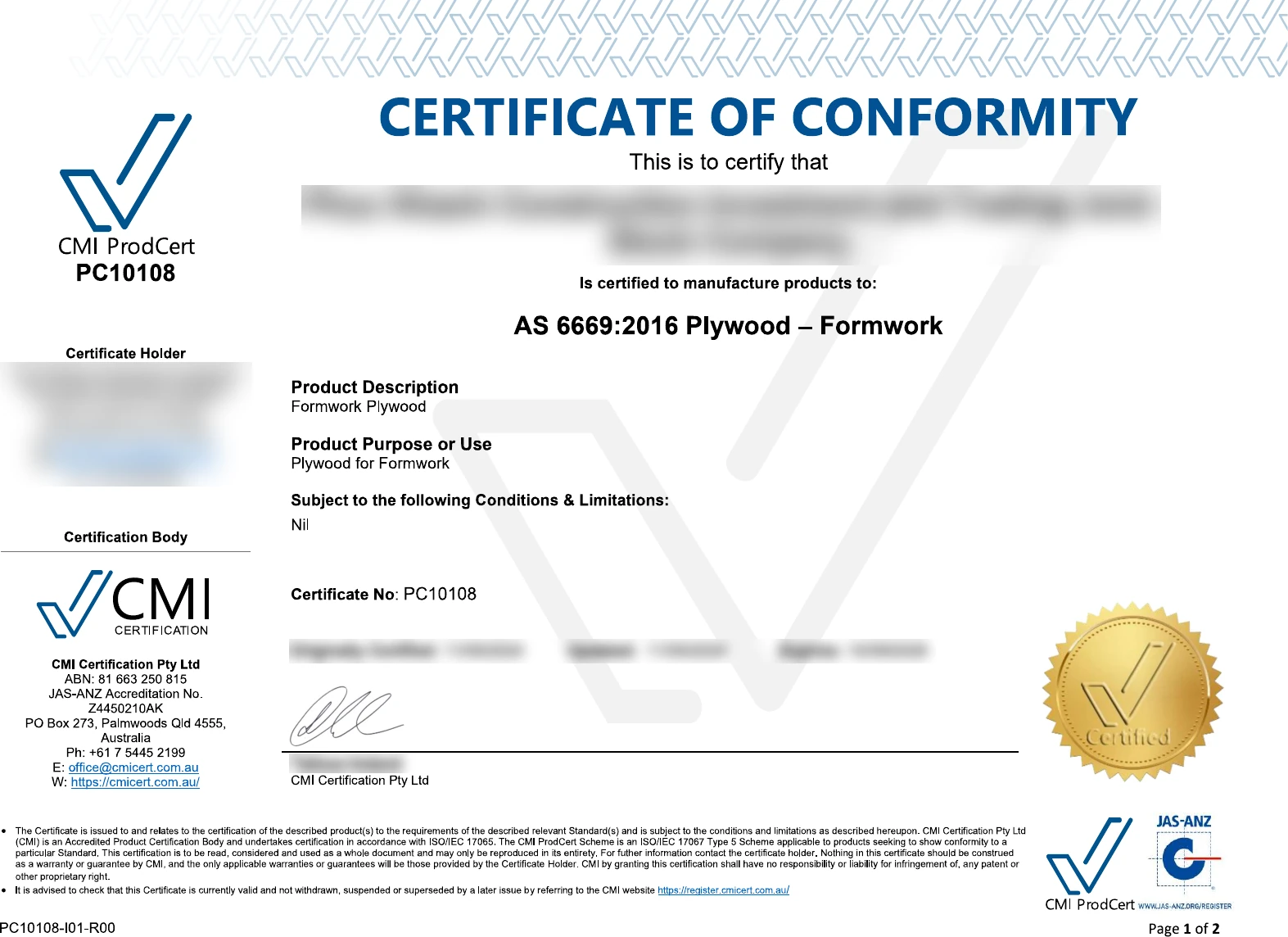
Formwork plywood product certification (AS 6669:2016) by CMI Certification; no stress grade, thickness or glue is stated on the certificate page.
AS 6669 formwork plywood certificate, page one; identifying details lightly blurred.
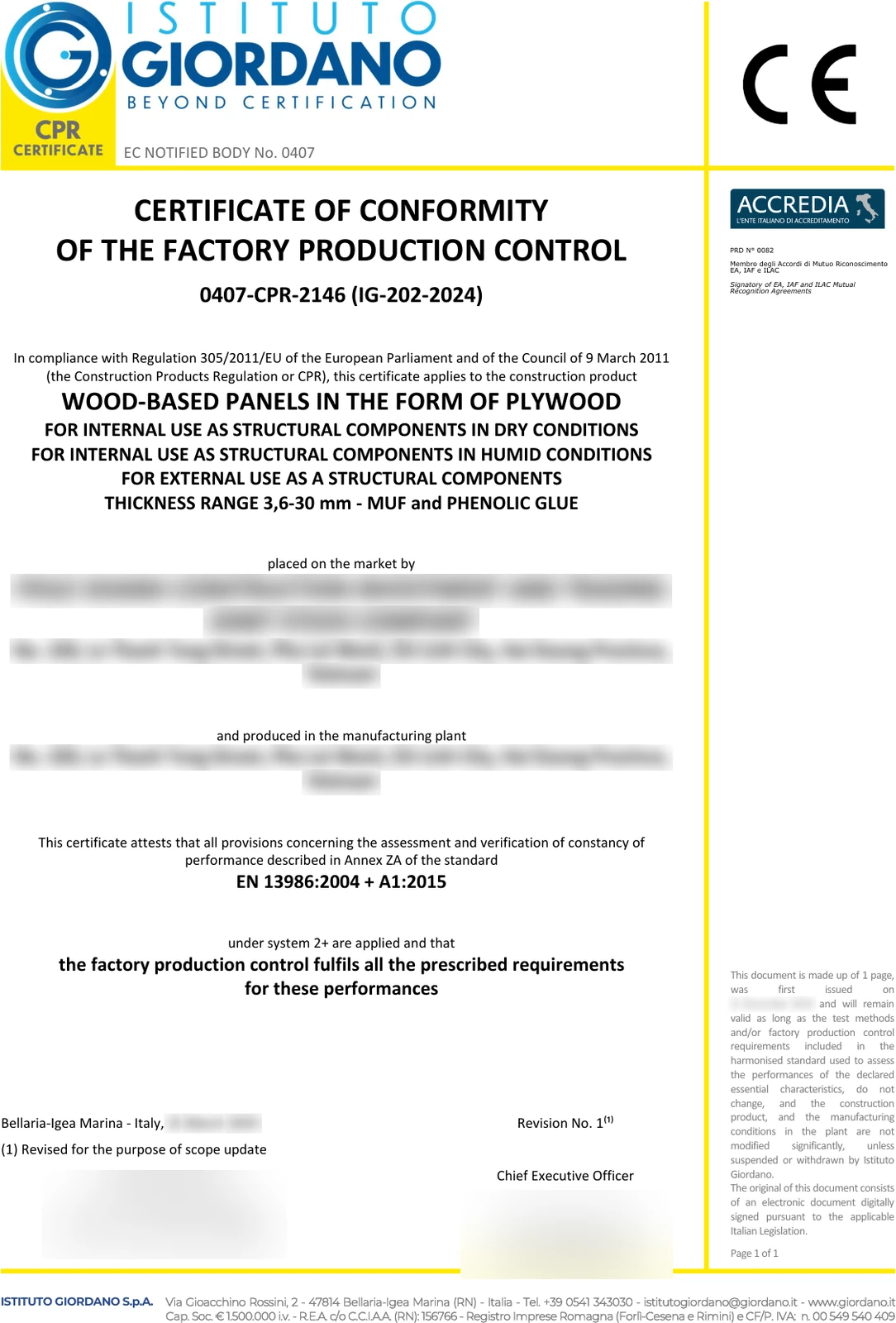
0407-CPR-2146
Structural plywood, 3.6–30 mm, MUF or phenolic glue; the CE scope names the two glue systems used on this line.
CE factory production control certificate, page one; identifying details lightly blurred.
At a glance
Glue mixing and spreading turns a stack of graded veneers into a lay-up that can survive the hot press and, later, a boiling-water test.
It sits between veneer grading and the first pressing stage. What it does is simple to describe and hard to do well: put the right amount of the right glue, evenly, on every ply that needs it, and lay the plies crosswise before the glue starts to set.
Neither glue formula nor melamine ratios are published; they belong to the mills.
| Stage | What happens | What decides the result |
|---|---|---|
| Mix | Glue is prepared for the build: MUF (melamine) or phenolic | The glue system named on the technical sheet |
| Spread | Rolls coat the veneer with an even layer of glue | Even coverage, correct amount, clean rolls |
| Lay up | Plies are laid crosswise, one over the other, with glue between each pair | Ply count for the thickness; plies registered edge to edge |
| Hot press | The glued core is pressed hot; about 130–145 °C for phenolic bonds | Temperature, pressure and time for the build |
By product line
The glue system is a purchase decision, not a detail. It is the first line on the specification sheet after thickness.
Reuse numbers are a target for a configuration and for site practice, not a fixed property of the sheet. They assume proper handling, a release agent on every pour and sealed edges, including cut edges. Budget film-faced plywood on the market typically gives about 4–10 reuses.
A panel's glue line is invisible in service and decisive in reuse: when the bond holds, the film and veneers come out of the pour intact; when it does not, the panel delaminates at an edge after a few pours.
| Product line | Glue system | Reuse target (with proper handling) |
|---|---|---|
| Melamine film-faced | MUF (melamine) glue | About 12–15 pours |
| Phenolic film-faced | Phenolic glue | Up to about 25 pours |
| Anti-slip | MUF or phenolic, by order; patterned film | Confirmed per order and duty |
| Structural CE | MUF or phenolic, inside the 3.6–30 mm CE scope | Not a reuse product |
Steps
The six steps run in one shift pattern: the glue is not made ahead of use and spread glue is not left standing.
The glue is mixed for the system on the order sheet, MUF or phenolic. The batch is kept in the mixing room and moved to the spreader in covered containers. Check: the batch matches the glue system on the order sheet.
Veneer moisture matters: sheets that are too wet dilute the glue line and steam out in the press; sheets that are too dry take the glue in too fast. Check: the veneer from the drying step is in the moisture range agreed for the glue.
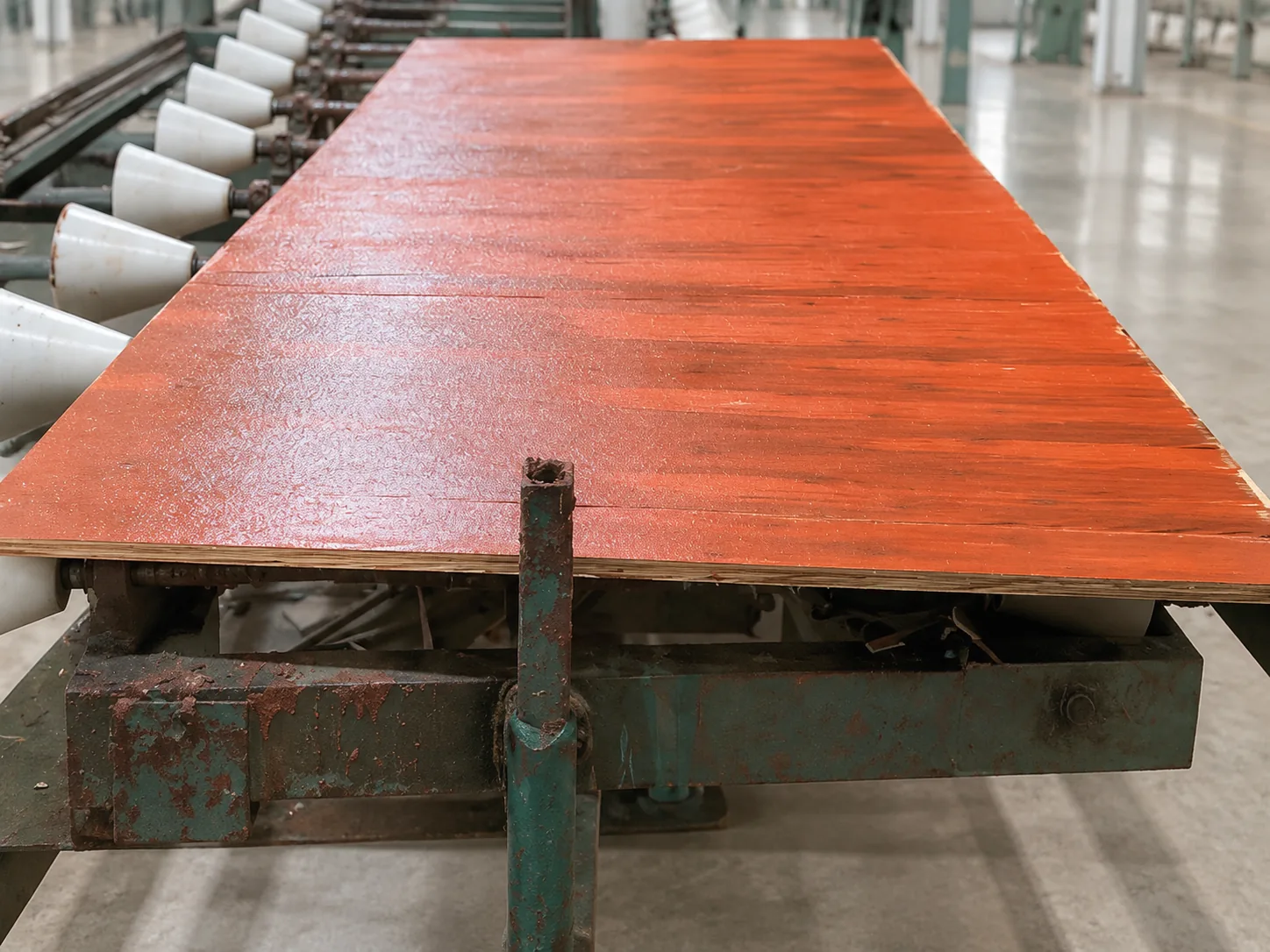
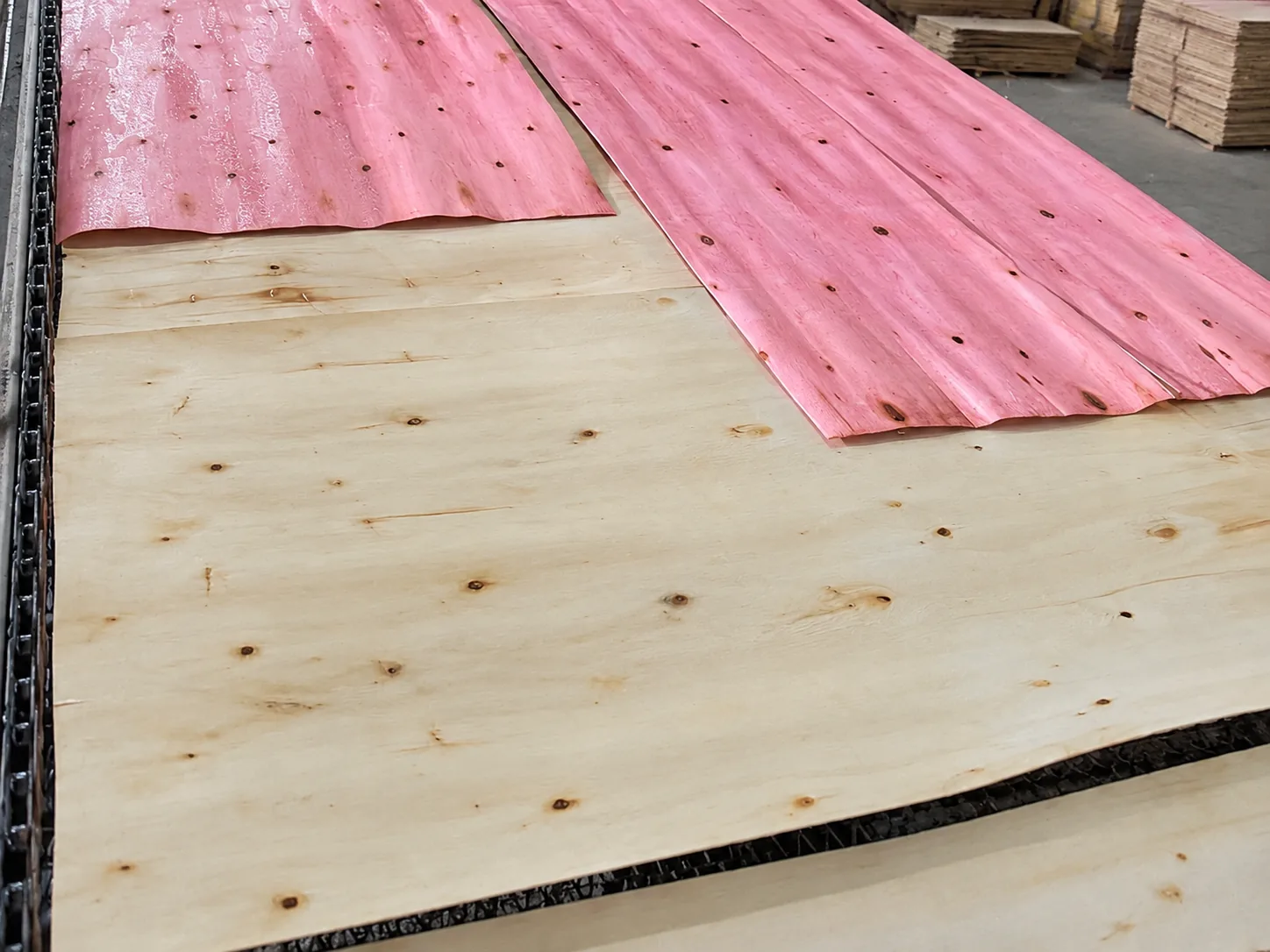
A veneer sheet passes between rolls that coat it evenly. The roller outfeed table carries the coated sheet away; the glue layer is visible on the surface as a continuous coat. Check: a spread check on the first sheets after a change of glue or roll, and a look at the coating on sheets as they come off.
The coated veneer is laid over a ply whose grain runs the other way, so the grain of neighbouring plies crosses. Face and back veneers go on the outside with the grain along the panel. Check: the grain direction alternates and the plies lie flat with their edges registered.
The number of plies follows the thickness on the order. The lay-up is loaded into the hot press before the glue starts to set. Check: the ply count matches the thickness; the time between spreading and pressing stays within the open time of the glue.
Phenolic bonds are pressed hot at about 130–145 °C. After the press the core is sized and sanded. Check: the core comes out flat, with no blows or gaps.
Real clips and photos
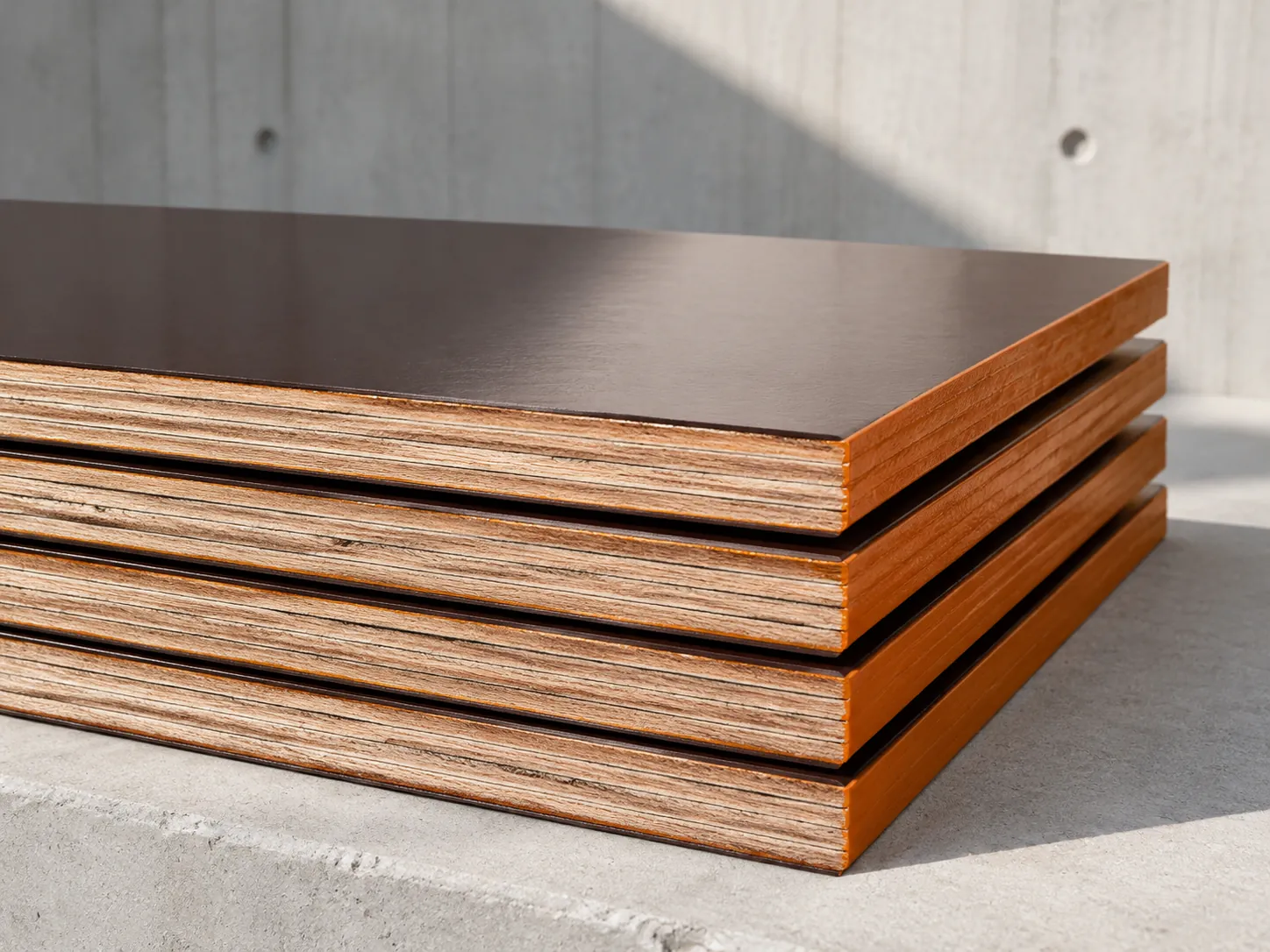
The two process pictures are illustrations of the steps, recomposed from a shared process photograph: they show the equipment and the glue layer, not our own line. The edge photograph is a real panel and shows the layered build the glue line makes.
Defects
Most glue-line defects are visible only after the press, which is why they are prevented before it.
The expensive failure is the one nobody sees until a pour: a bond that passed visual checks but was marginal. That is why the bond is tested on specimens and why the boil test appears in our SGS evidence.
| Defect | Cause | Prevention or catch |
|---|---|---|
| Blow in the press (steam pocket) | Veneer too wet, or too much glue | Veneer moisture check before spreading; spread check |
| Dry spot, no bond | Glue missed a spot, or open time exceeded | Even coverage; spread checks; pressing within open time |
| Glue bleed through the face | Too much glue on a thin or open veneer | Spread amount set by thickness; veneer grading |
| Delamination at the edge after pours | Weak bond or unsealed edge | Bond tests on specimens; edge sealing on all four edges |
| Telegraphing of a core gap under the film | Gap between core plies, filled badly | Gaps closed at lay-up; sanding before the film press |
| Wrong glue on an order | Batch mix-up | Order sheet names the glue; batch checked against it |
Numbers and tolerances
Every number on this page is in this table; the rest of the page refers to it.
The SGS figures belong to one submitted specimen. They show what the build can do, not what every panel does; the bond of a production lot is described by the technical sheet for the order.
| Item | Value | Condition |
|---|---|---|
| Hot press, phenolic bonds | About 130–145 °C | Phenolic glue on Acacia or Eucalyptus core |
| SGS bonding quality | Class 3 PASS | One 21 mm Acacia-core phenolic specimen; EN 314-1/314-2 after 24 h soak, boil-dry-boil and 72 h boiling |
| SGS density | 642 kg/m³ | Same specimen, EN 323 |
| SGS formaldehyde | Not detected at 0.04 mg/m³; E1 PASS against 0.124 mg/m³ | Same specimen, EN 717-1 chamber; specimen evidence only |
| Reuse, MUF film-faced | About 12–15 pours | Proper handling, release agent, sealed edges |
| Reuse, phenolic film-faced | Up to about 25 pours | Proper handling, release agent, sealed edges |
| Thickness tolerance | ±0.5 mm | Film-faced line, per technical sheet |
Buyer guide
Ask which glue system is in the offer. MUF (melamine) and phenolic are both used in film-faced plywood, and they give different reuse targets and different prices. A film-faced panel with a good-looking face and an unnamed glue is the cheapest to quote and the most expensive to reuse.
A panel is WBP in the sense that matters when its bond survives boiling, not when its label says so. Ask for the test method and the specimen; our SGS evidence is a 21 mm phenolic specimen tested after soak and boil cycles, and it is shown as a specimen result.
Check the edges on arrival: the layers should be even, with no gaps in the glue lines at the sawn edge, and the edge paint should be continuous.
Shipment proof
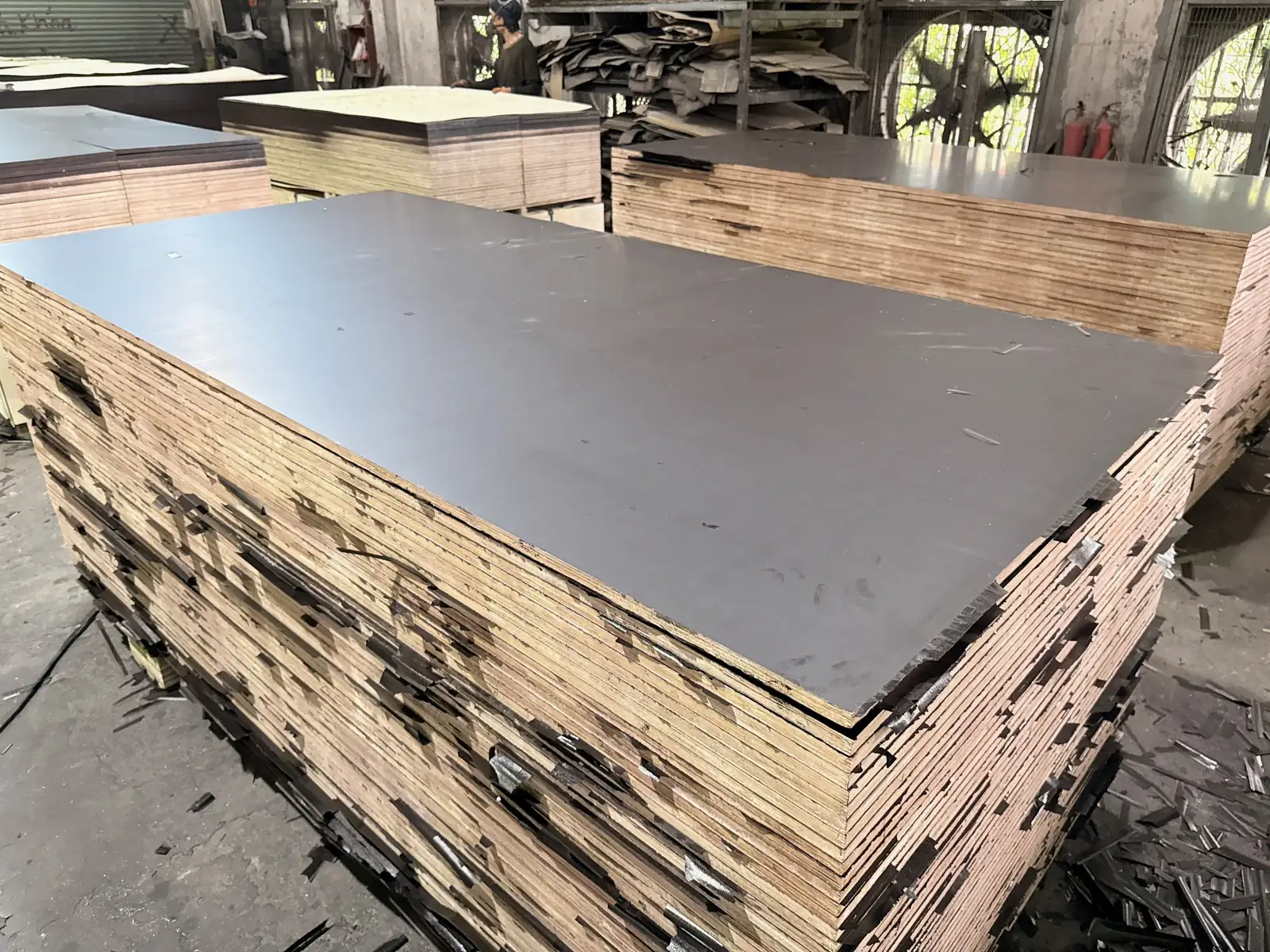
The proof of a glue line is a panel that is still a panel after a pour. Panels from the mills show the layered edge and an unbroken film; the test evidence is the SGS specimen on this page.
We attach photographs of the actual order to the shipment records; images on this page are not of any named shipment.
Documents
Certificate files are sent before the order is confirmed; draft shipping documents follow after loading.
Technical sheet
Names the glue system, core species, film and thickness for the order.
SGS specimen report
Bonding class, density and formaldehyde for the specimen, with the method.
Emission documents for the order
The emission certificate and test reports for the agreed configuration.
Specification and reference sample
The panel edge shows the layers and glue lines.
Packing list
Glue system by pack where the order mixes MUF and phenolic panels.
Capacity
Across our two mills in Chi Linh, Hai Phong, capacity is up to 150 containers a month. A single glue system is run in blocks, so a container of phenolic-glue panels and a container of MUF panels are scheduled as separate runs, and an order that mixes the two is planned with that in mind.
Production takes 15–45 days after the 30% deposit, depending on quantity, production conditions and agreement. The minimum order is one 40HC; a container usually carries one or two products, and three to six can be mixed by agreement.
Order checklist
Write these six lines in the enquiry and the glue line is set up for your build before the order starts.
MUF (melamine) or phenolic; it sets the reuse target.
State the pours you plan, and the release agent and edge sealing you will use.
Acacia or Eucalyptus, which also sets the container load.
The thickness in millimetres; the ply count follows it.
A specimen report for the agreed build, the emission certificate, or both.
All four edges painted; say whether cut edges will be re-sealed on site.
Buyer questions
Both, by order. Melamine (MUF) glue film-faced panels give about 12–15 pours and phenolic glue film-faced panels up to about 25, in both cases with proper handling, a release agent on every pour and sealed edges.
The bond holds the veneers and the film together through repeated wetting and stripping. A phenolic bond is more durable, so the target is higher. Reuse is a target for a configuration and site practice, not a fixed property of the sheet; budget panels typically give about 4–10.
Each coated ply is laid over a ply whose grain runs the other way, so the grain of neighbouring plies crosses. Face and back veneers sit on the outside with the grain along the panel. The ply count follows the thickness.
About 130–145 °C for WBP and phenolic bonds. The press time and pressure for a build are not published; they are part of the mills' process for each thickness.
One submitted 21 mm dark-brown film-faced specimen, Acacia core, phenolic glue, passed Class 3 bonding under EN 314-1/314-2 after a 24 h water soak, a boil-dry-boil cycle and 72 h boiling. It is specimen evidence, not a guarantee for every panel.
Ask for the glue system by name and for a test report on a specimen of the same build, with the method. A claim with no glue named and no report is not evidence.
No. The formula and ratios belong to the mills. What we publish is the glue system, the hot-press range for phenolic bonds and the specimen evidence.
Yes. The glue system is one of the factors. The 21 mm specimen showed formaldehyde not detected at the 0.04 mg/m³ reporting limit and E1 PASS against 0.124 mg/m³ in the EN 717-1 chamber; the result is for that specimen only.
Yes, by agreement. A container usually carries one or two products and three to six can be mixed. The two glue systems run as separate production blocks, so the mix is planned at the enquiry.
A check of the glue coverage and amount on the first sheets after a change of glue, roll or thickness, and a look at the coating on sheets as they come off the spreader. The numbers are part of the mills' process and are not published.
Related steps
The previous step: grading veneer into face and core.
OpenThe next step: core press, sanding and film press.
OpenThe eight-step sequence.
OpenThe panel with the longest reuse target.
OpenThe MUF-glue panel.
OpenThe SGS specimen evidence in full.
OpenQuote
Send the glue system, thickness, core species and the reuse target you plan. We answer with the technical sheet and the lead time for your quantity.