
Glue mixing and spreading
The previous step: glue, lay-up and the first press.
OpenTwo-stage pressing · core press and film press
In short
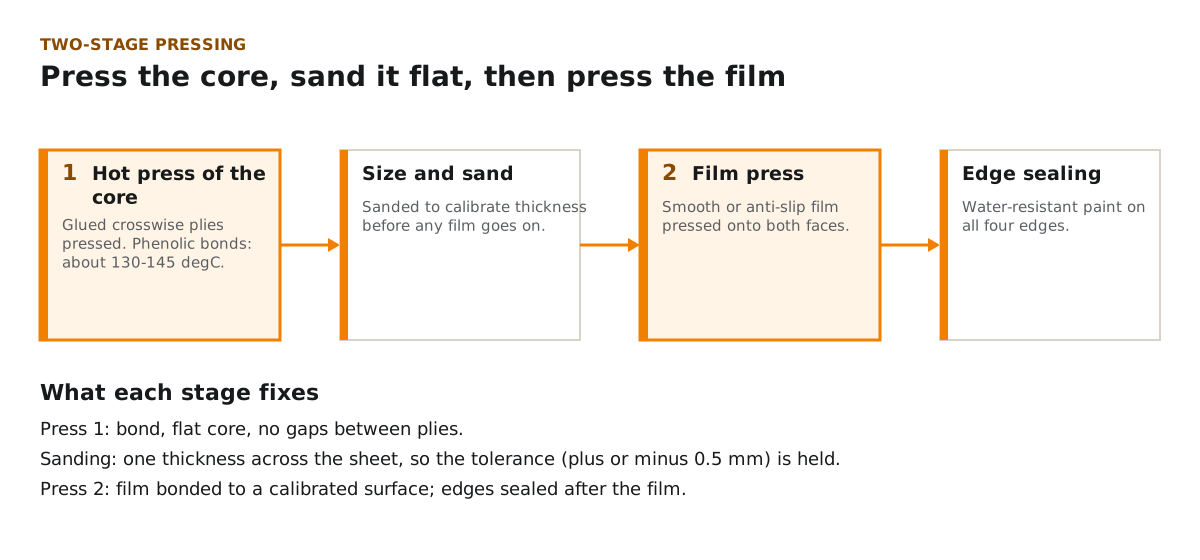
Two times hot press film faced plywood is how our line works: each panel is pressed twice. First the glued Acacia or Eucalyptus core is hot pressed, at about 130–145 °C for phenolic bonds. The core is then sized and sanded to calibrate thickness, and only then does the film press bond a smooth or anti-slip film to both faces. Edge sealing follows. That order is how a film-faced panel is held to a thickness tolerance of ±0.5 mm. It runs at both of our mills in Chi Linh, Hai Phong, up to 150 containers a month in total.
Page film
The film follows one panel through the core press, the sanding line, the film press and the edge painting.
Chapters: loading the core into the hot press, the sanded core under a thickness check, the film press and the sealed edges.
It shows why the sanding sits between the presses, which is the question buyers ask most about two-time pressing.
Certificates
The pressing sequence is the part of the factory production control that decides thickness and bond, which is what the three documents below describe.
The AS 6669 certificate names formwork plywood. The CE certificate covers 3.6–30 mm, so a panel thicker than 30 mm carries no CE marking. The SGS report is a specimen result.
Certificate scans are lightly blurred: legal-entity name, tax ID, street address and dates are hidden.
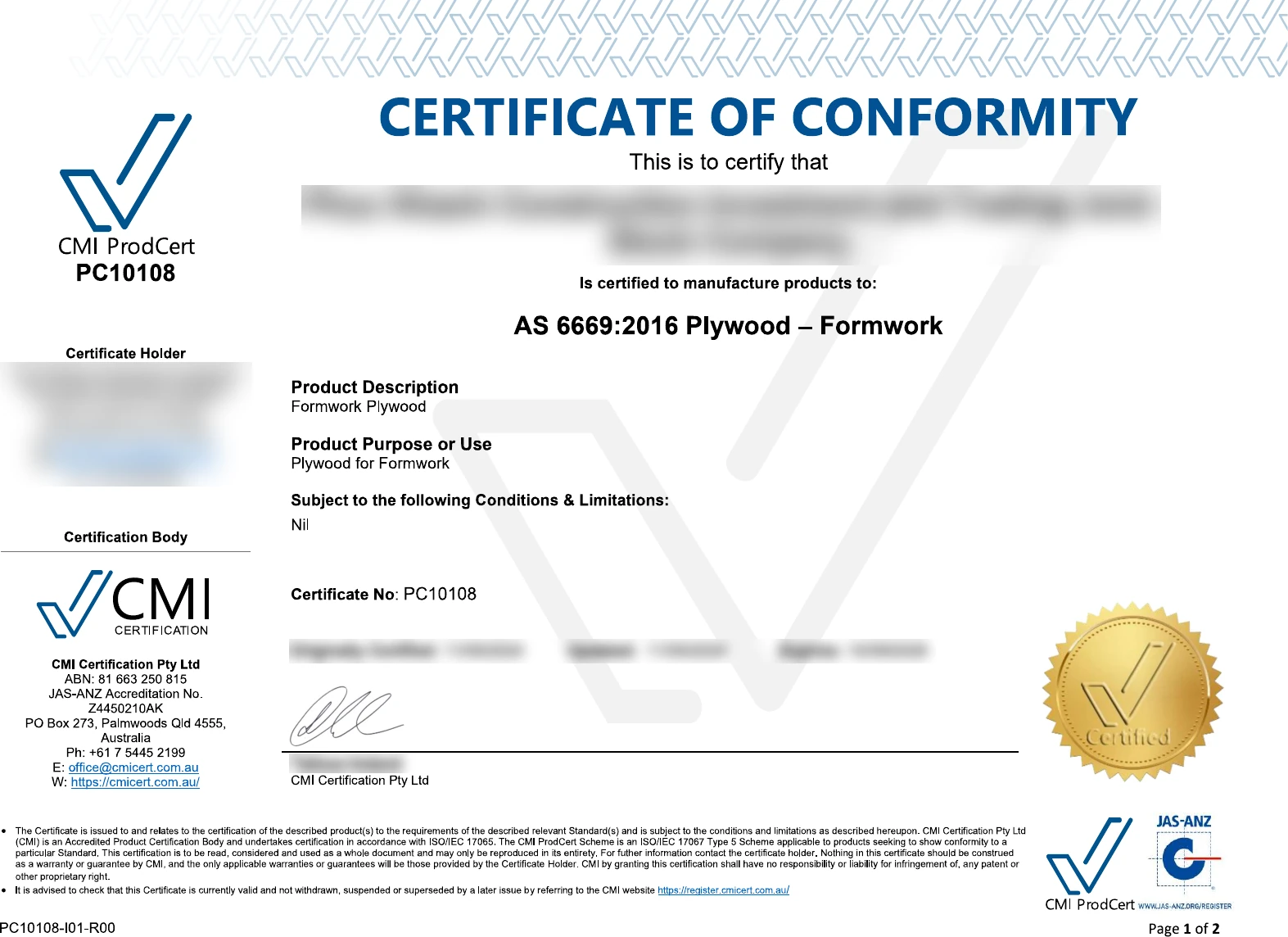
Formwork plywood product certification (AS 6669:2016) by CMI Certification; the certificate page states no stress grade, thickness or glue.
AS 6669 formwork plywood certificate, page one; identifying details lightly blurred.
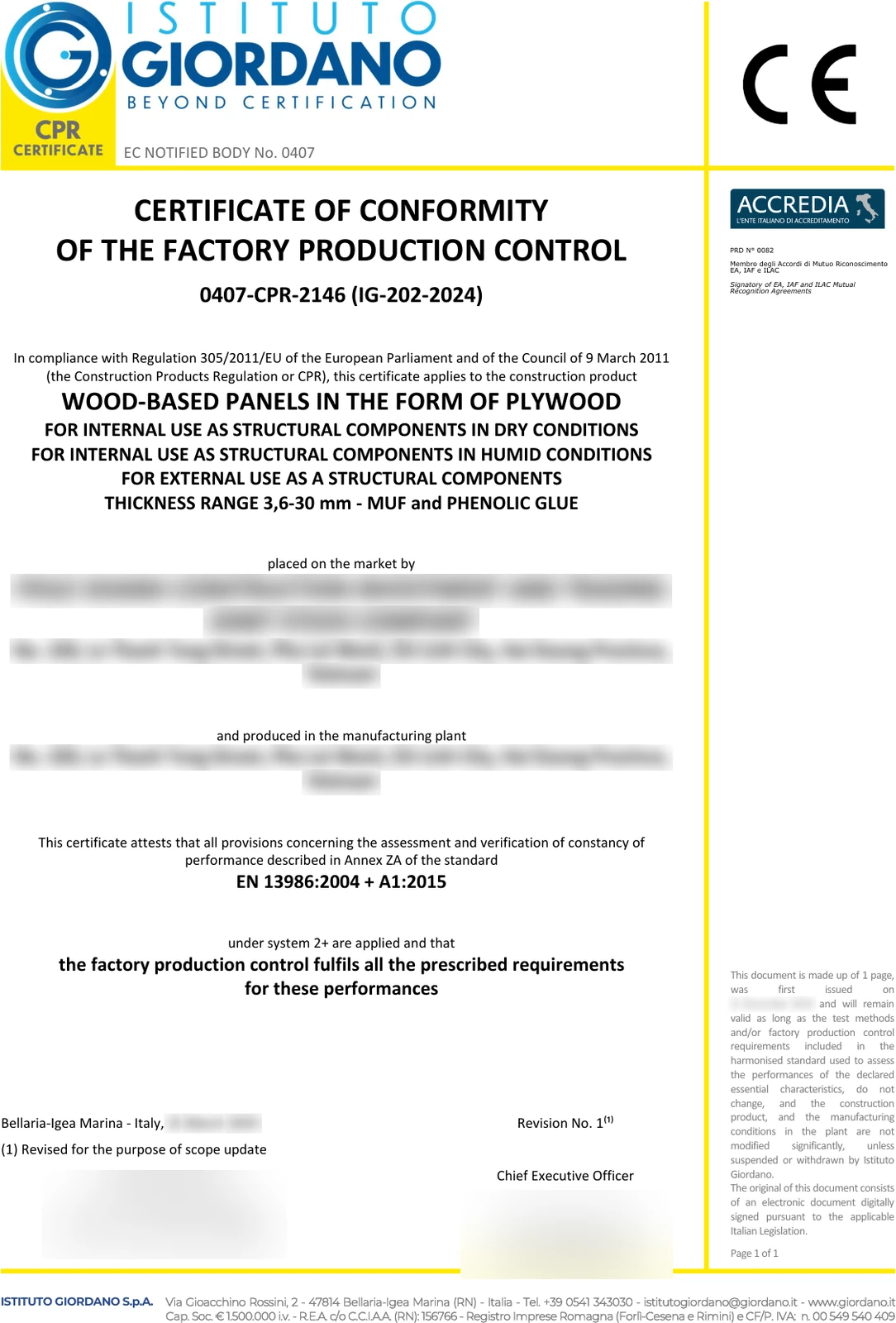
0407-CPR-2146
Structural plywood, 3.6–30 mm, MUF or phenolic glue, produced under factory production control.
CE factory production control certificate, page one; identifying details lightly blurred.
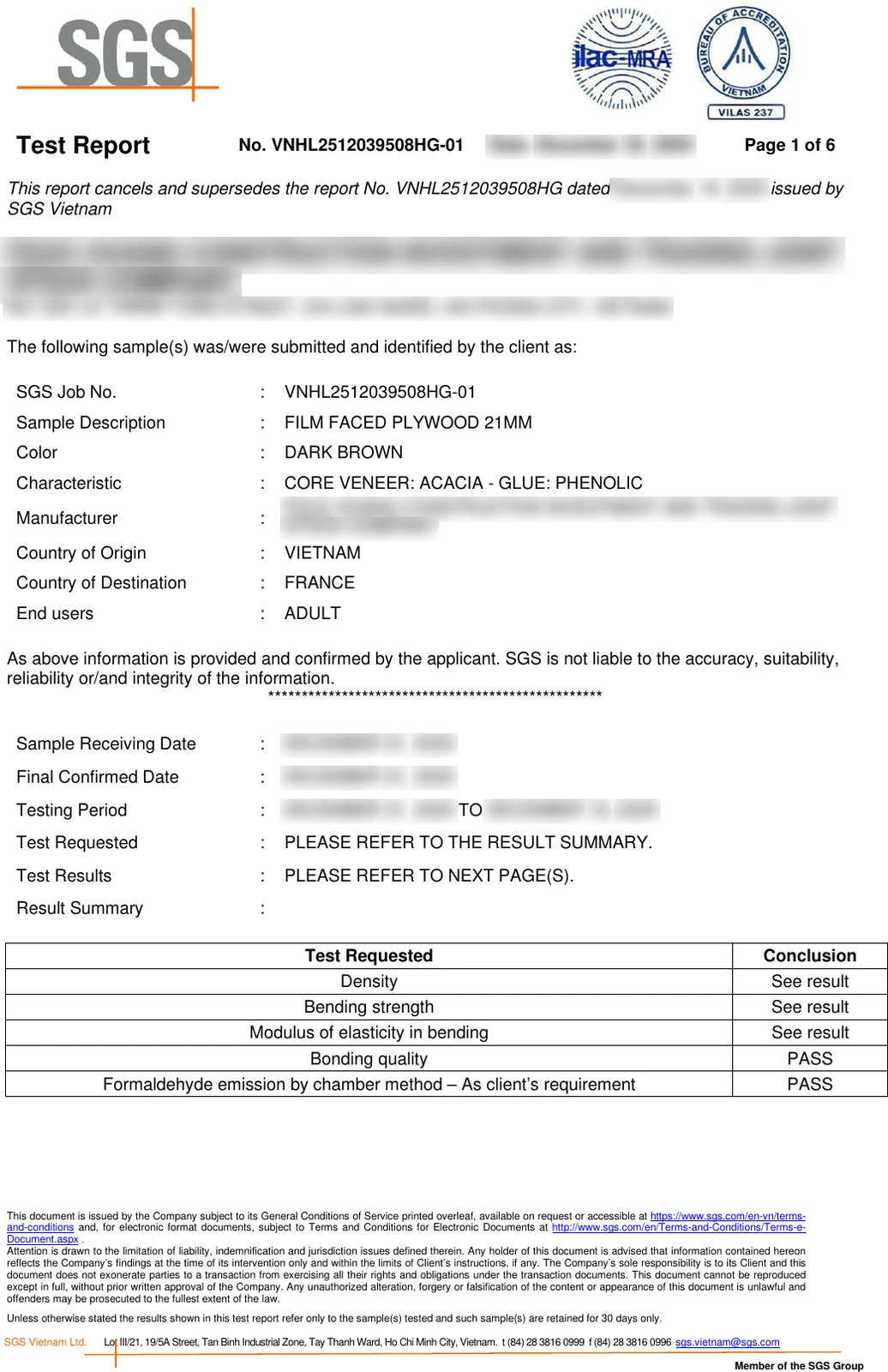
One 21 mm film-faced specimen: bonding Class 3 PASS after soak, boil-dry-boil and 72 h boiling; specimen evidence only.
SGS report on a 21 mm specimen, page one; identifying details lightly blurred.
At a glance
A single-press panel is glued and filmed in one pass. A two-stage panel is made as a core first, checked and sanded, and filmed second.
The reason to split the work is that the two jobs want different things. The core press wants the bond to form between thick, uneven veneers; the film press wants a flat, calibrated surface. Doing both in one press asks one operation to do two incompatible jobs.
Buyers meet the claim as 'two times hot press' on competitor pages. This page says what the sequence is on our line and what each stage fixes, without claiming a number we do not hold.
| Stage | What happens | What it fixes |
|---|---|---|
| Press one: hot press of the core | The glued, crosswise lay-up is pressed hot; about 130–145 °C for phenolic bonds | The bond between plies; a flat, solid core |
| Sizing and sanding | The pressed core is cut to size and sanded on both faces | One thickness across the sheet; a clean surface for the film |
| Press two: film press | Smooth or anti-slip film is pressed onto both faces | Film bonded to a calibrated surface |
| Edge sealing | Water-resistant paint on all four edges | Moisture entry at the edge |
By product line
The press stages are the same; the film that goes into the second press is the variable.
Film weight, colour and brand are order fields. A heavier film is a heavier cost and a longer-lasting face; the press stage does not change the weight of film that a specification calls for.
Cut edges made after the film press are not sealed by the line. A cutting list, or cut-to-size panels, are sealed afterwards, and the specification says so.
| Product line | Film | Notes |
|---|---|---|
| Melamine film-faced | Smooth film, black or dark brown | MUF glue; film brand and weight are order fields |
| Phenolic film-faced | Smooth film, black or dark brown | Phenolic glue; film weight from 120–125 g/m², about 130–135 g/m² most common, some orders 165, 185 or over 200 g/m² |
| Anti-slip | Patterned film: rice, hexagon or wire-mesh | A 220 g/m² reference exists; the actual film and duty are confirmed per order |
| Structural CE | No film by default | Sanded to size; inside 3.6–30 mm for CE |
Steps
Six steps; each one has a check that stops a fault before the next step builds on it.
The glued, crosswise lay-up from the lay-up table is loaded into the hot press before the glue sets. Check: the lay-up is within the open time and its edges are registered.
Phenolic bonds are pressed at about 130–145 °C. Time and pressure follow the build and the thickness. Check: the core comes out flat, without blows, gaps or springback.
The pressed core is cooled and cut to the finished size, 1220 × 2440 mm, 1250 × 2500 mm or a custom size. Check: length and width within ±2 mm.
Both faces are sanded so the core has one thickness across the sheet. This is where thickness is set. Check: thickness measured at several points; the film-faced tolerance is ±0.5 mm.
A smooth film, or a patterned anti-slip film, is pressed onto both faces of the calibrated core. Check: film bonded without bubbles or wrinkles; pattern complete on anti-slip panels.
All four edges are painted with water-resistant paint after the film press. Check: continuous coat; no bare wood at the corners.
Real clips and photos
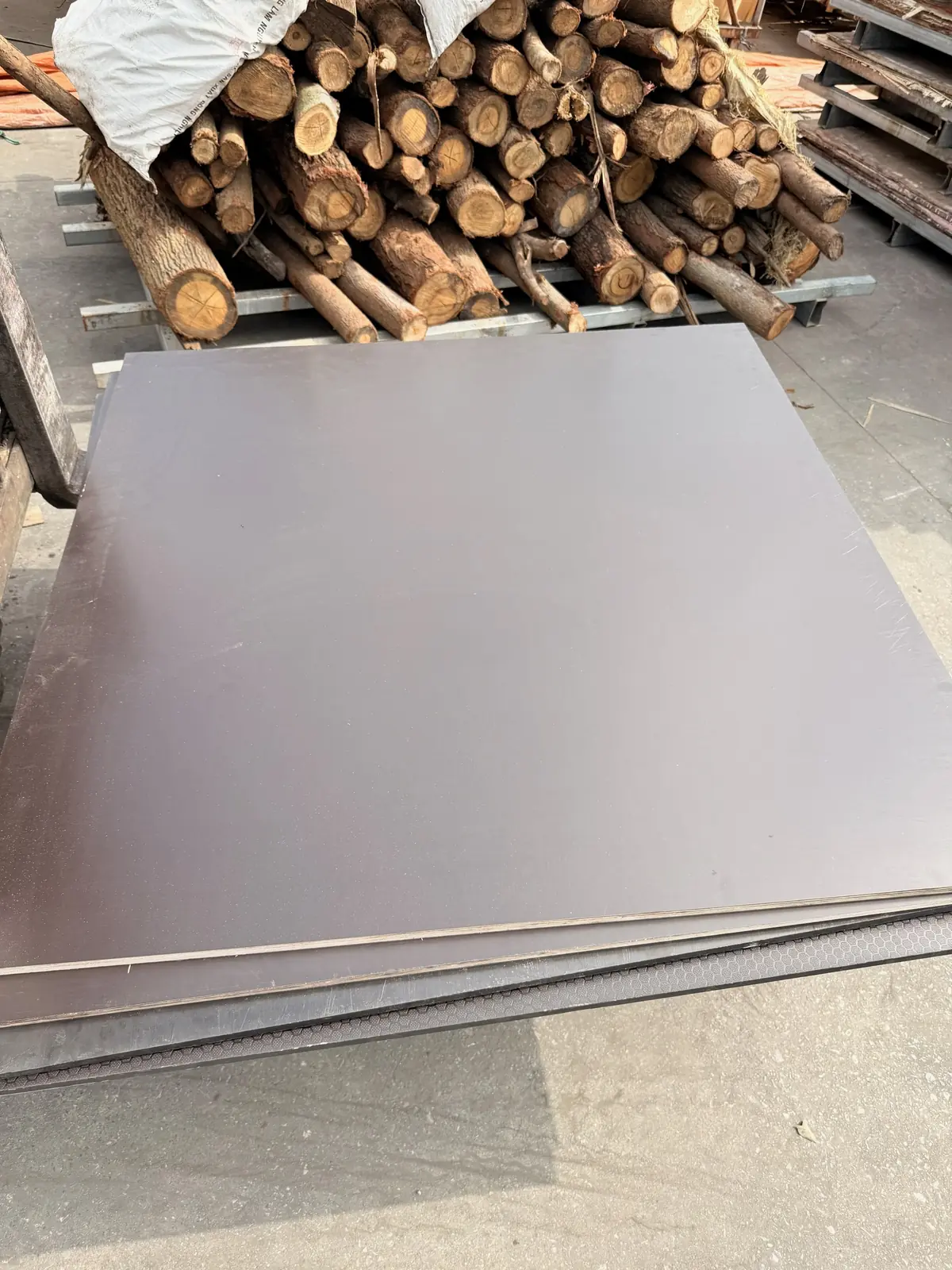
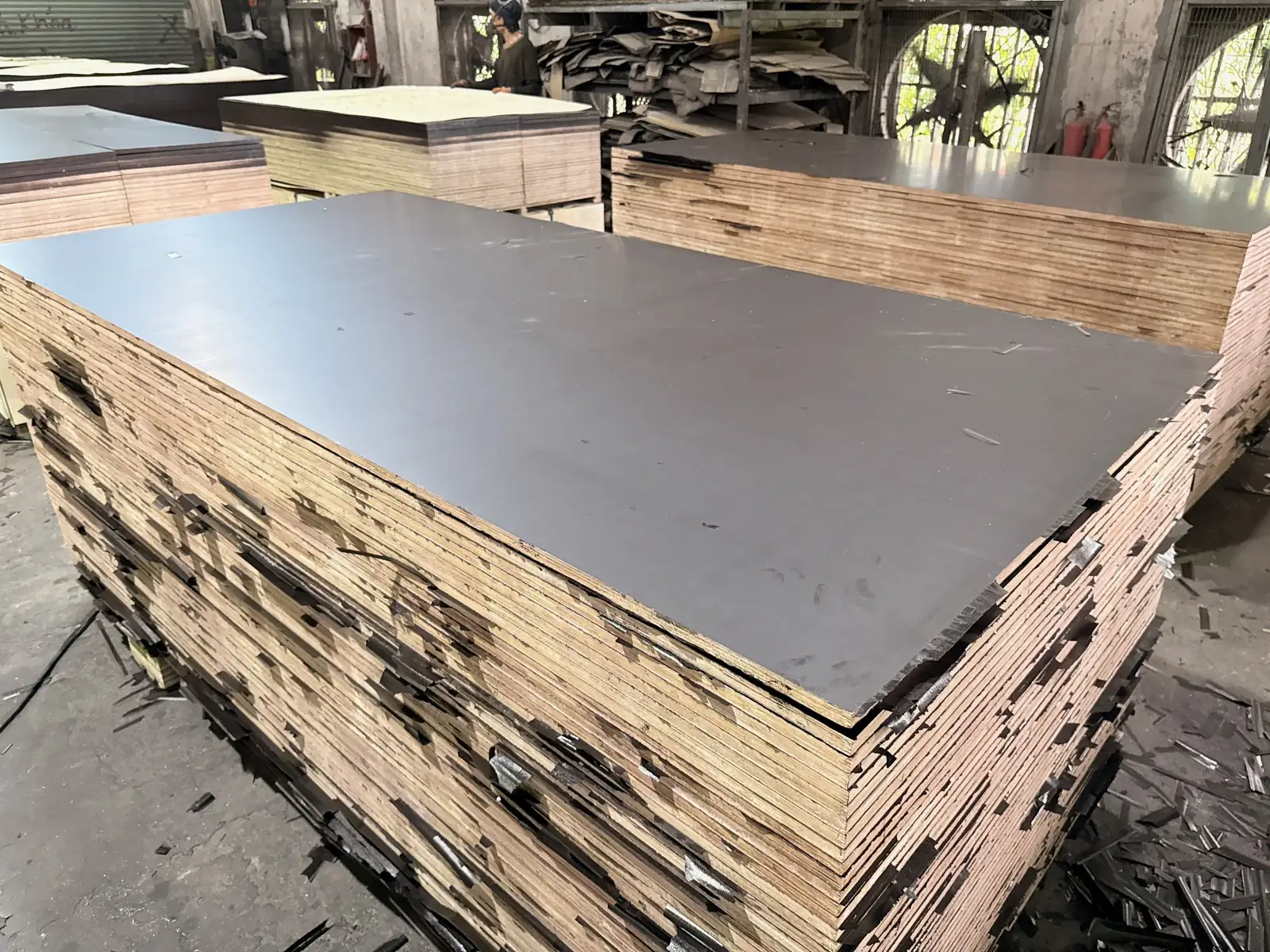
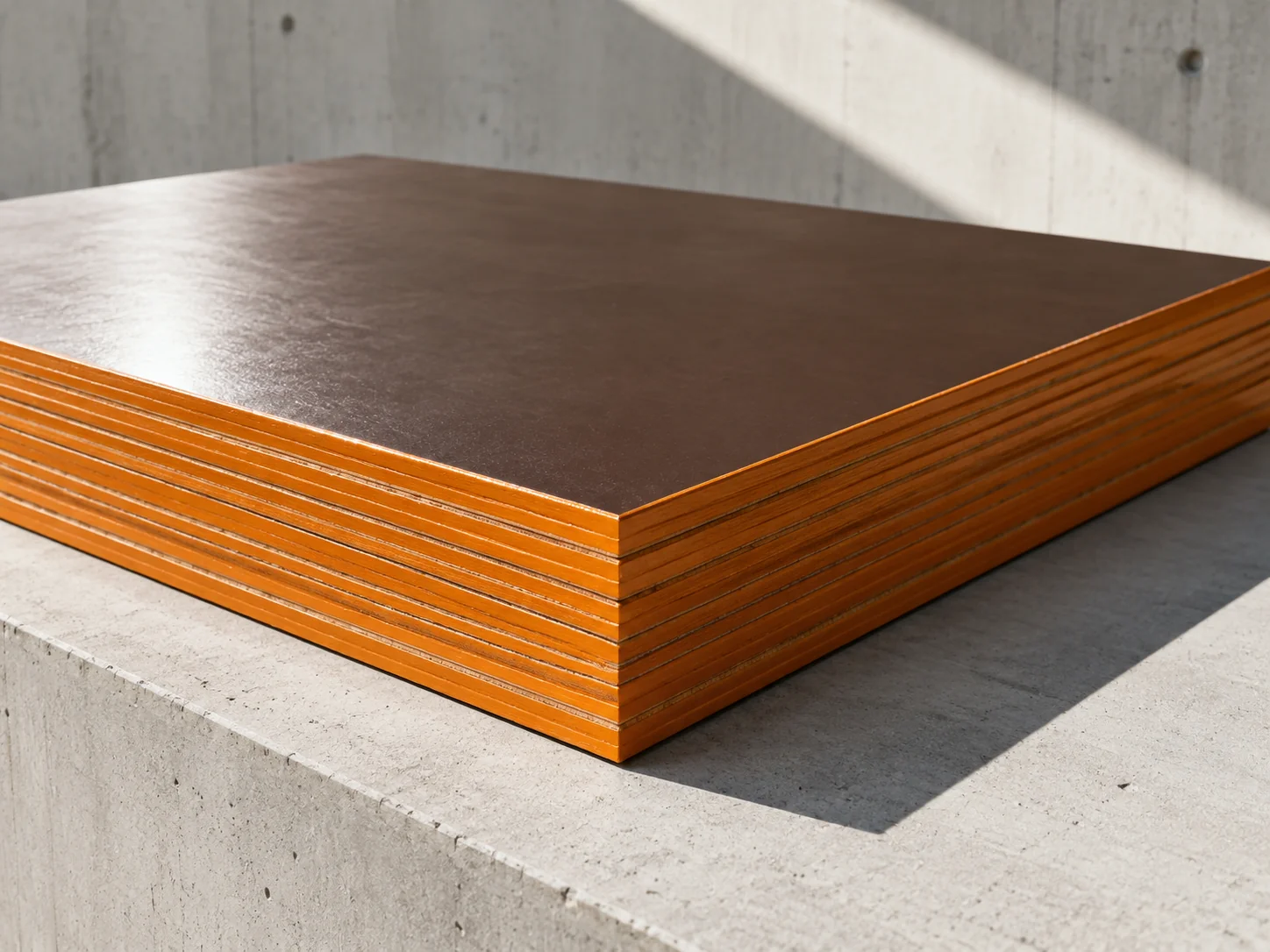
The photographs show the result of the second press: a smooth dark film face and painted edges. They do not show the presses themselves, which we show in clips as the footage is cleared.
Captions say only what the picture shows.
Defects
Most faults of a film-faced panel come from the first press and show only after the second.
The reason to sand between presses is partly to catch these faults while they can still be removed: a flaw in a sanded core is visible, while the same flaw under a film is not.
| Defect | Cause | Prevention or catch |
|---|---|---|
| Blow or blister in the core | Veneer too wet, or glue too heavy | Veneer moisture check before spreading; spread check |
| Thickness step across the sheet | Uneven veneer or uneven press | Veneer grading; sanding to calibrate; measure at several points |
| Film bubble or wrinkle | Dust or an uneven face when the film is pressed | Clean sanded face; film press on a calibrated core |
| Film peeling at the edge | Weak film bond or unsealed edge | Film press on a sanded face; edge sealing after the film |
| Gap showing through the film | Open gap in the core | Gaps closed at lay-up; sanding before the film |
| Bare edge on a cut sheet | Cutting after sealing | Say in the specification that cut edges are sealed on site or by us |
Numbers and tolerances
Time and pressure of the presses are part of the mills' process for each build and are not published; the numbers below are the ones a buyer can hold us to.
A thickness tolerance is only meaningful with a measuring method: measure at several points on several sheets of each pack and compare with the technical sheet.
| Item | Value | Condition |
|---|---|---|
| Hot press, phenolic bonds | About 130–145 °C | Phenolic glue; core press |
| Thickness tolerance | ±0.5 mm | Film-faced line; written per order |
| Length and width tolerance | ±2 mm | Film-faced line |
| Panel thickness | 9–40 mm | Everyday 12, 15, 18 and 21 mm |
| Sheet size | 1220 × 2440 mm or 1250 × 2500 mm | Custom sizes by request |
| Film weight | 120–125 g/m² to over 200 g/m² | Most common now about 130–135 g/m²; 165, 185 and over 200 g/m² by order |
| Reuse, MUF | About 12–15 pours | Proper handling, release agent, sealed edges |
| Reuse, phenolic | Up to about 25 pours | Proper handling, release agent, sealed edges |
Buyer guide
Ask whether the panel is a one-time or a two-time press. A one-time panel glues and films in one pass; a two-time panel presses the core, calibrates it, and films it. The second is slower and costs more, and it is why the thickness of a two-time panel is more even.
Measure it. Take a digital caliper to several sheets of a pack and read the thickness at several points. A film-faced panel inside ±0.5 mm of its stated thickness is a calibrated panel; a spread wider than that is a warning.
Reuse follows from the bond, the film and the edges together. The second press makes the film bond; the edge sealing keeps water out; handling and the release agent decide the pours.
Shipment proof
The proof of two-stage pressing is in the thickness readings and the film face of the panels in the pack, not in the press. The photo set of an order shows the packs as loaded; images on this page are not of any named shipment.
The records of an order list the thickness tolerance on the technical sheet and the film on the packing list.
Documents
Certificate files are sent before the order is confirmed; draft shipping documents follow after loading.
Technical sheet
Thickness, tolerance, film, glue and size for the order.
Reference sample
Agreed before production; shows face and edge.
SGS specimen report
Bond class and density for a specimen of the agreed build.
AS 6669 certificate
Formwork plywood product certification, sent on request.
Packing list
Thickness, size and sheet counts by pack.
Capacity
Across our two mills in Chi Linh, Hai Phong, capacity is up to 150 containers a month. The second plant, which started production in 2026, adds press capacity beside the first mill; the sequence is the same at both.
Production takes 15–45 days after the 30% deposit, depending on quantity, production conditions and agreement. Two-stage pressing is part of that time, not an extra: a panel does not wait for a press that is not on its schedule.
Order checklist
Write these six lines in the enquiry and the pressing is planned for your build.
The thickness in millimetres and the tolerance; ±0.5 mm on the film-faced line.
MUF or phenolic; phenolic bonds are hot pressed at about 130–145 °C.
Smooth film or anti-slip pattern; colour, brand and weight in g/m².
1220 × 2440 mm, 1250 × 2500 mm or a custom size, with the cutting list.
All four edges painted; say how cut edges are to be sealed.
How you will measure thickness on arrival, and on how many sheets.
Buyer questions
The panel is pressed twice: first the glued core is hot pressed, then the sanded core is pressed again with the film on both faces. Between the presses the core is sized and sanded to calibrate thickness.
The core press forms the bond between the plies; the film press needs a flat, calibrated surface. Separating the two lets the core be checked and sanded before the film hides it.
About 130–145 °C for WBP and phenolic bonds. Time and pressure follow the build and the thickness and are not published.
It sets thickness. Sanding both faces of the pressed core gives one thickness across the sheet, so the film press works on a calibrated surface. The film-faced tolerance is ±0.5 mm.
It supports reuse but does not set it. Reuse depends on the glue system, the film, the edges and site handling: about 12–15 pours for MUF and up to about 25 for phenolic, with proper handling, a release agent and sealed edges.
All four edges are painted with water-resistant paint after the film press. Cut edges made later need sealing too, and the specification should say who does it.
It is a different product. A one-time press films and bonds in one pass, so thickness cannot be calibrated between the stages. Ask for the thickness tolerance and the glue system in writing from any supplier.
No. The film weight is an order field: from 120–125 g/m², about 130–135 g/m² most common now, and some buyers specify 165, 185 or over 200 g/m².
Yes. Both of our mills in Chi Linh, Hai Phong run the same sequence from veneer intake to packing.
Measure at several points on several sheets of each pack with a caliper and compare with the technical sheet. A film-faced sheet within ±0.5 mm of its stated thickness is within tolerance.
Related steps
The previous step: glue, lay-up and the first press.
OpenThe next step: checks after pressing.
OpenThe eight-step sequence.
OpenThe panel these presses make.
OpenThe patterned-film panel.
OpenWhat happens after pressing.
OpenQuote
Send the thickness, tolerance, film and glue system. We answer with the technical sheet and the lead time for your quantity.