
Technical sheet
The tolerance, build, glue, film and edge sealing your panels are checked against.
Plywood quality control · our two mills in Chi Linh, Hai Phong
In short
PK Ply checks every film-faced panel at eight stations on our line, from veneer intake to the packed pack. Thickness is held to ±0.5 mm and length and width to ±2 mm, and every edge is checked for paint. Bond quality is proven by lab tests: an SGS report on a 21 mm phenolic specimen from our line passed EN 314 Class 3 at a density of 642 kg/m³.
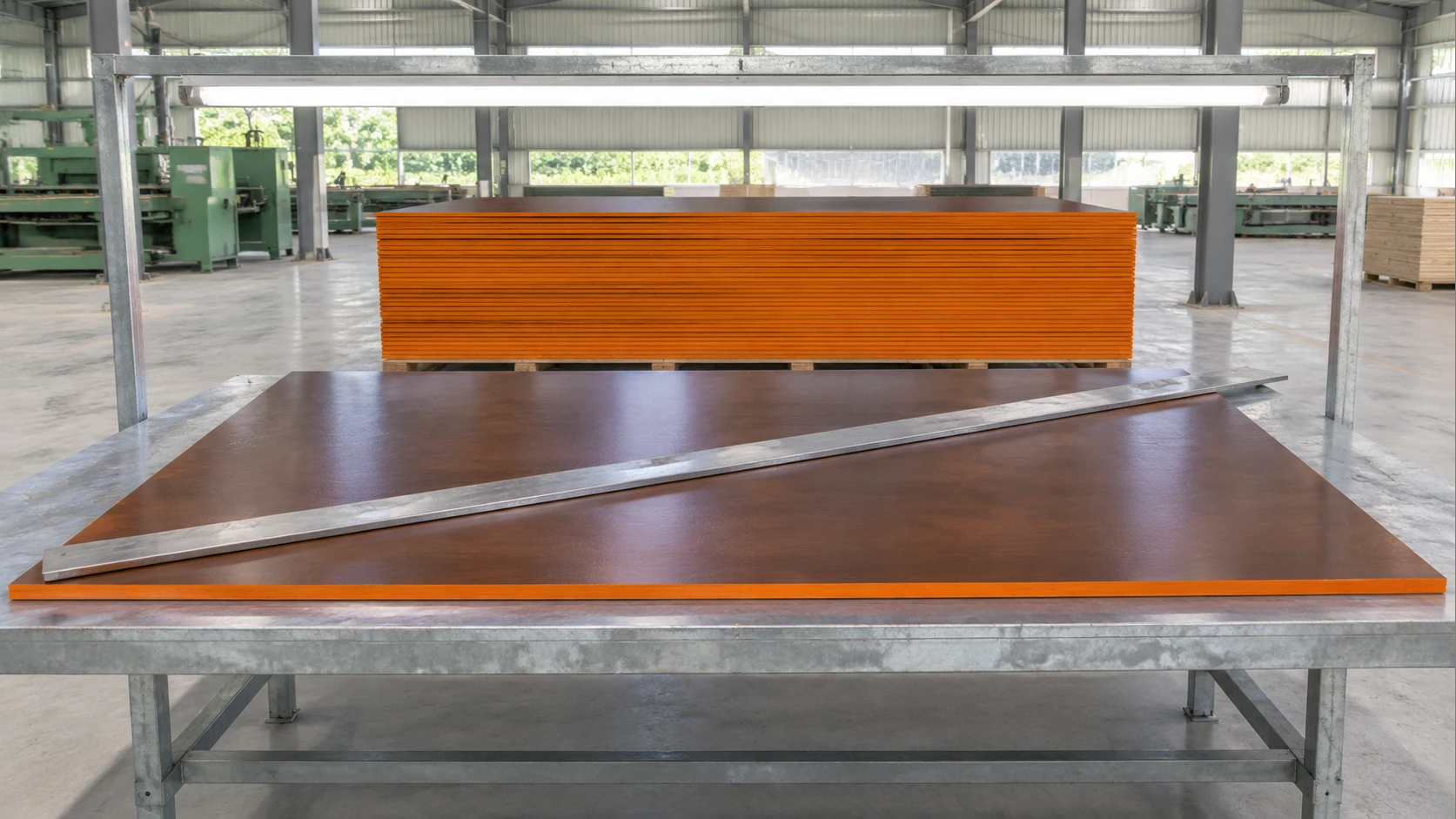
Film
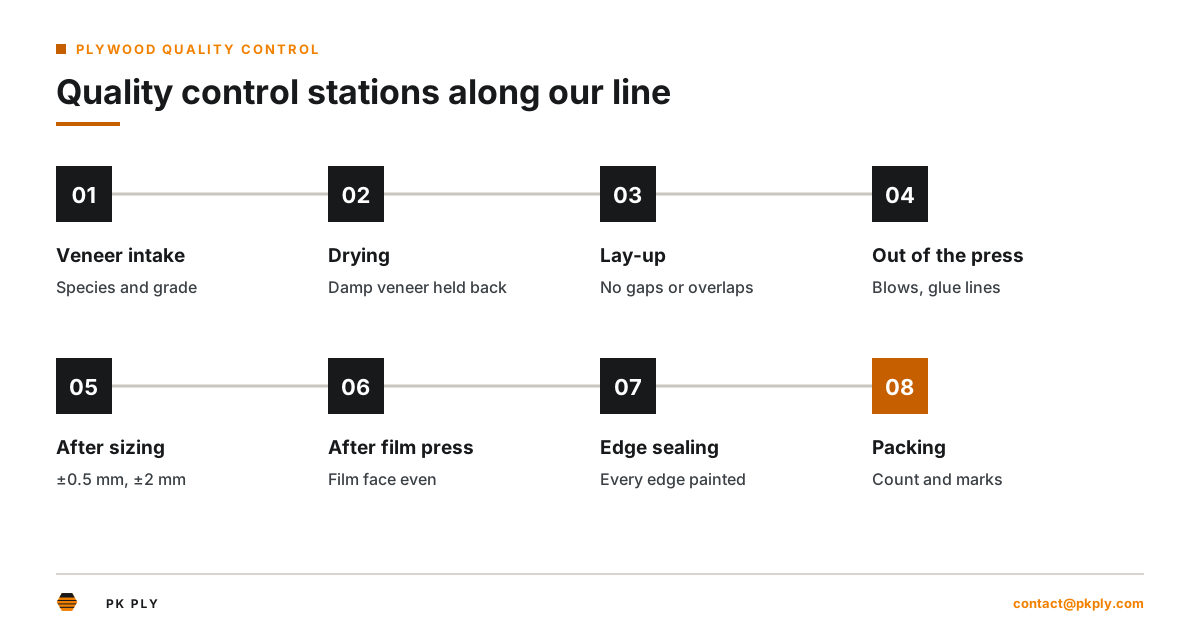
The page film walks the line station by station: veneer grading, the lay-up check, boards out of the press, thickness gauging, the film face under light, edge paint and the final pack count.
Each chapter shows the check, the limit it works to and what happens to a panel that fails it.
Certificates and reports
Our QC runs under ISO 9001 and the CE factory production control 0407-CPR-2146 that a notified body audits; the SGS report on a 21 mm specimen shows what our bond and emission checks are aiming at.
Scans are the originals, with the legal entity, tax ID, address and dates blurred.
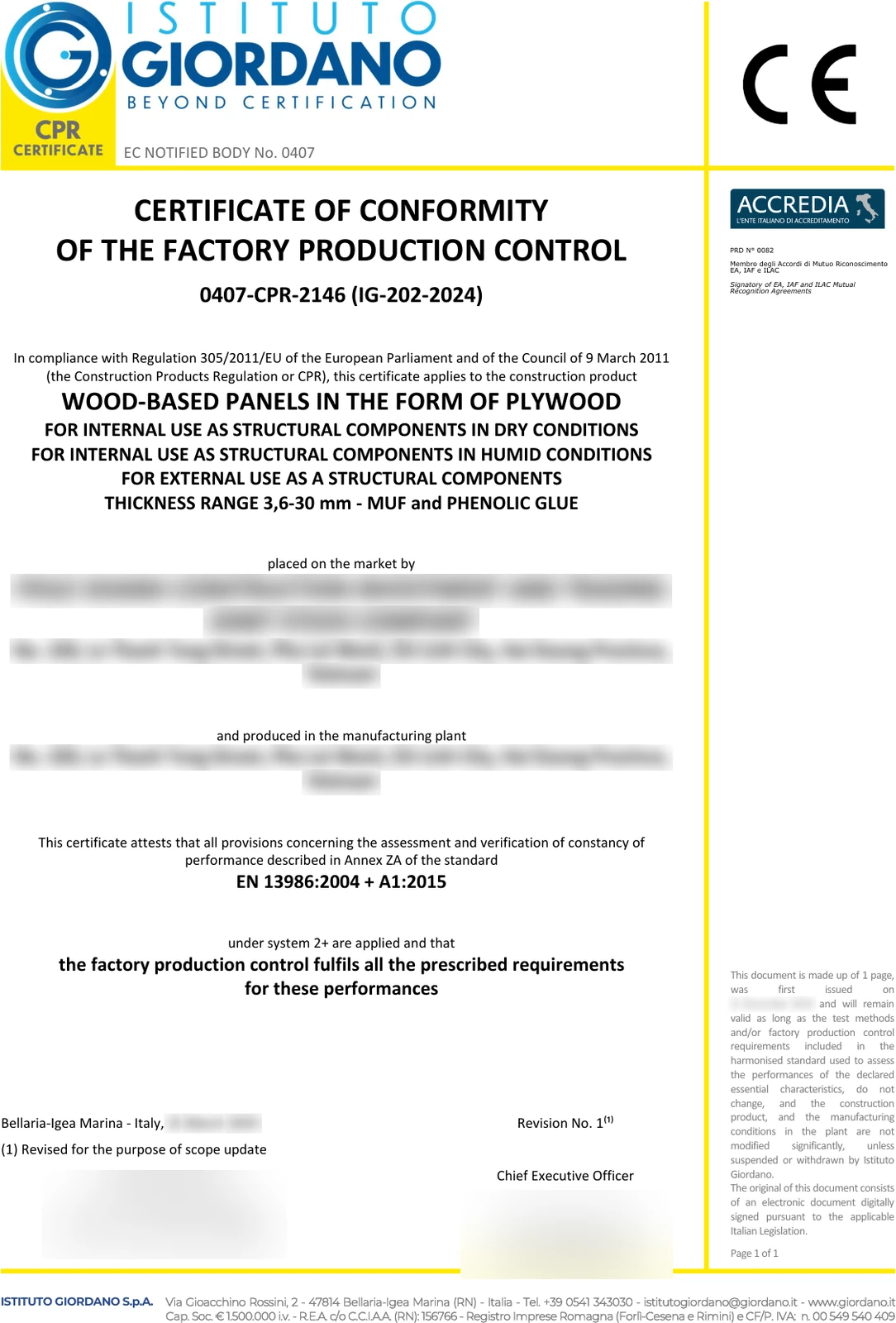
0407-CPR-2146
Istituto Giordano, notified body 0407, EN 13986, System 2+: the audited production control for structural plywood 3.6–30 mm, MUF or phenolic glue.
CE FPC certificate scan: holder name, tax ID, address and dates blurred.
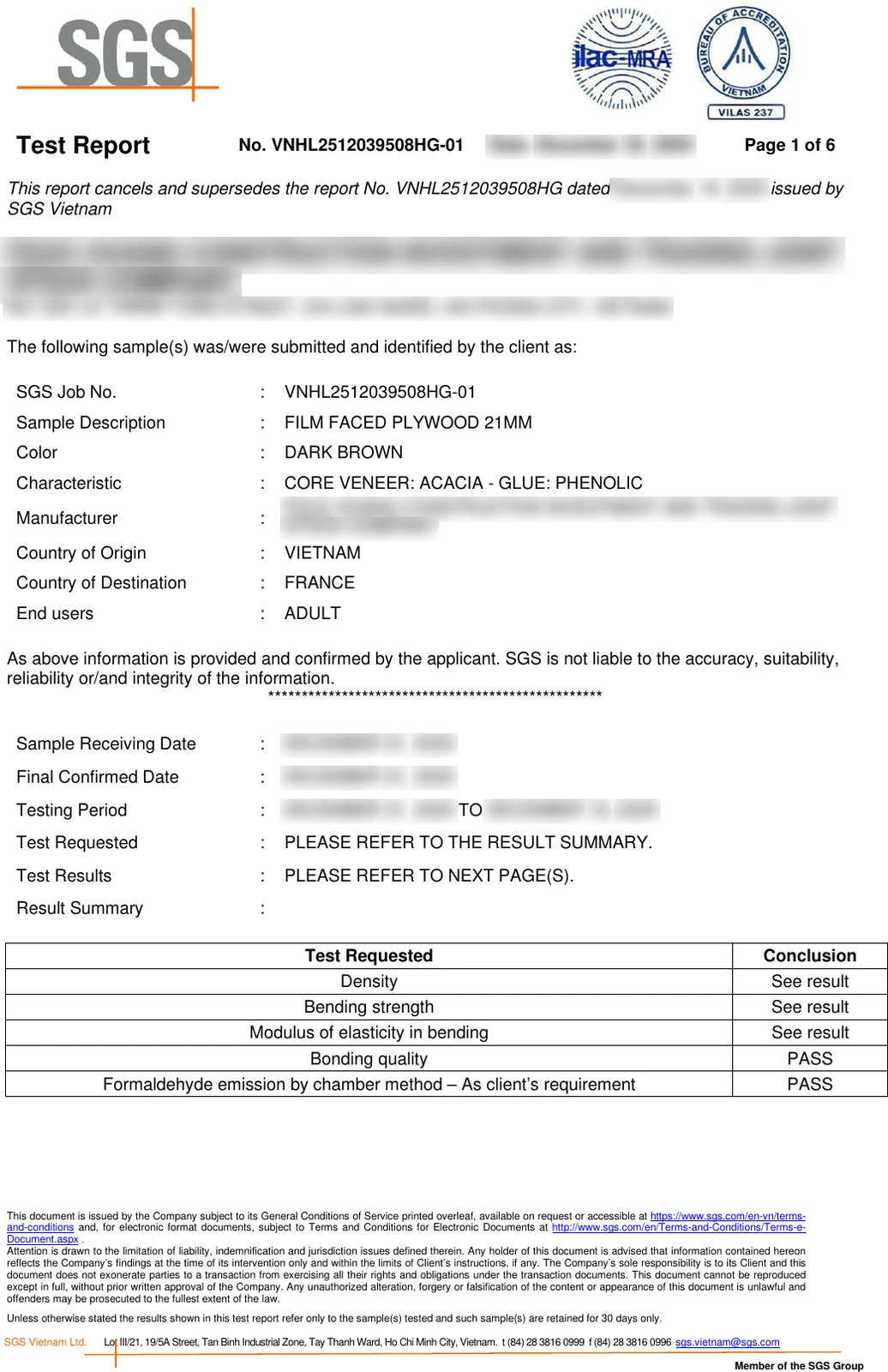
Density 642 kg/m³ (EN 323); bonding Class 3 pass (EN 314-1/314-2) after 24 h soak, boil-dry-boil and 72 h boil; formaldehyde not detected at 0.04 mg/m³, E1 pass (EN 717-1). One submitted specimen.
SGS report scan: client name, address and dates blurred.
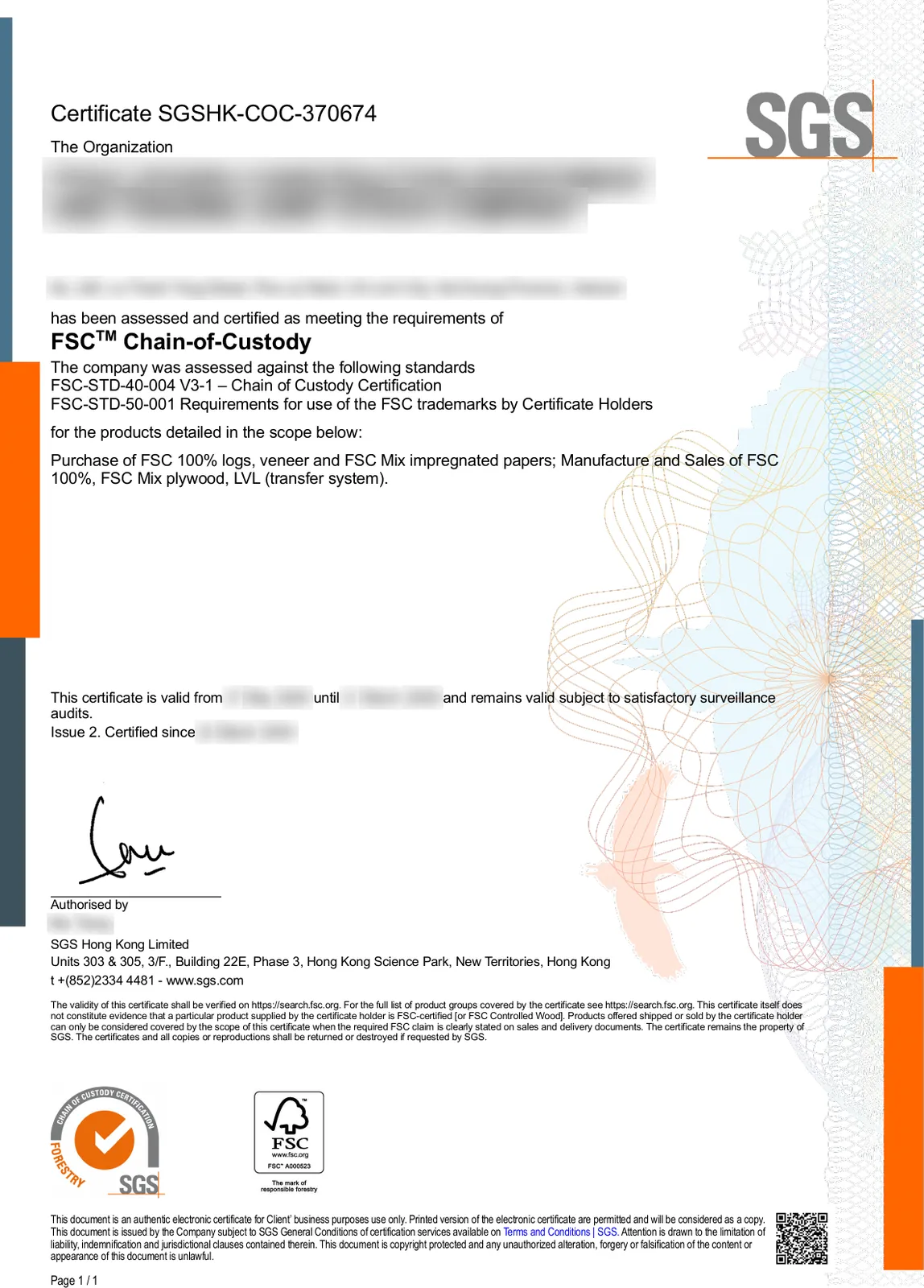
SGSHK-COC-370674
Keeps FSC veneer apart through the line; the claim is checked against the sales documents of each FSC order.
FSC certificate scan: holder name, address and dates blurred.
The quality system our stations and their records run under; the certificate copy goes with the order documents.
At a glance
Plywood quality control at our mills means checking each panel at the step where a fault starts, before it is hidden by the next step: veneer before glue, the core before pressing, thickness before film, the film before edge paint and the edges before packing.
| Station | What is checked | Limit or reference | Record |
|---|---|---|---|
| 1 Veneer intake | Species and grade | Technical sheet of the order | Intake sorting |
| 2 Drying | Veneer dry before glue | Damp veneer held back | Drying check |
| 3 Lay-up | Gaps, overlaps, broken pieces | None allowed in the core | Lay-up check |
| 4 Out of the press | Blows, open glue lines | None allowed | Press check |
| 5 After sizing | Thickness, length, width, squareness | ±0.5 mm; ±2 mm | Gauge record |
| 6 After film press | Film face even, bonded, no bubbles | Agreed surface | Face check |
| 7 Edge sealing | Paint on all four edges and cut edges | Every edge painted | Edge check |
| 8 Packing | Sheet count, marks, straps | Packing list | Packing list |
By product
The stations are the same for every panel; what changes by product is the surface check after the film press and the documents that prove the result.
Pendulum values are specimen results: they do not set a slip class or promise grip on site.
| Product | Extra check | Evidence |
|---|---|---|
| Film-faced plywood | Smooth film face even under raking light; film weight as ordered | SGS 21 mm specimen report |
| Anti-slip plywood | Pattern pressed evenly, rice, hexagon or wire-mesh as ordered | Pendulum tests on two specimens: 58 dry / 40 wet and 60 dry / 53 wet (DIN EN 16165) |
| Structural CE plywood | Panel inside the CE scope 3.6–30 mm, MUF or phenolic | CE FPC 0407-CPR-2146 and the DoP |
| Cut-to-size panels | Every cut edge painted; cut sizes within ±2 mm | Cutting list against the packing list |
Station by station
Each station has one job: stop a fault where it starts. Here is what is checked at each one and what happens to a panel that fails.
Core veneer is sorted by species, Acacia or Eucalyptus, and by grade against the technical sheet. Veneer for FSC orders is kept apart. Fail: wrong species or grade goes back to stock for another build.
Veneer must be dry before glue. Damp veneer turns to steam in the hot press and leaves blows. Fail: damp veneer goes back to drying.
The core is checked for gaps, overlaps and broken pieces before the assembly goes to the press, because a gap shows later as a soft spot under the film. Fail: the core is corrected at the table.
Boards are checked for blows and open glue lines after pressing at about 130–145 °C (phenolic bonds). Fail: the board does not go on to film.
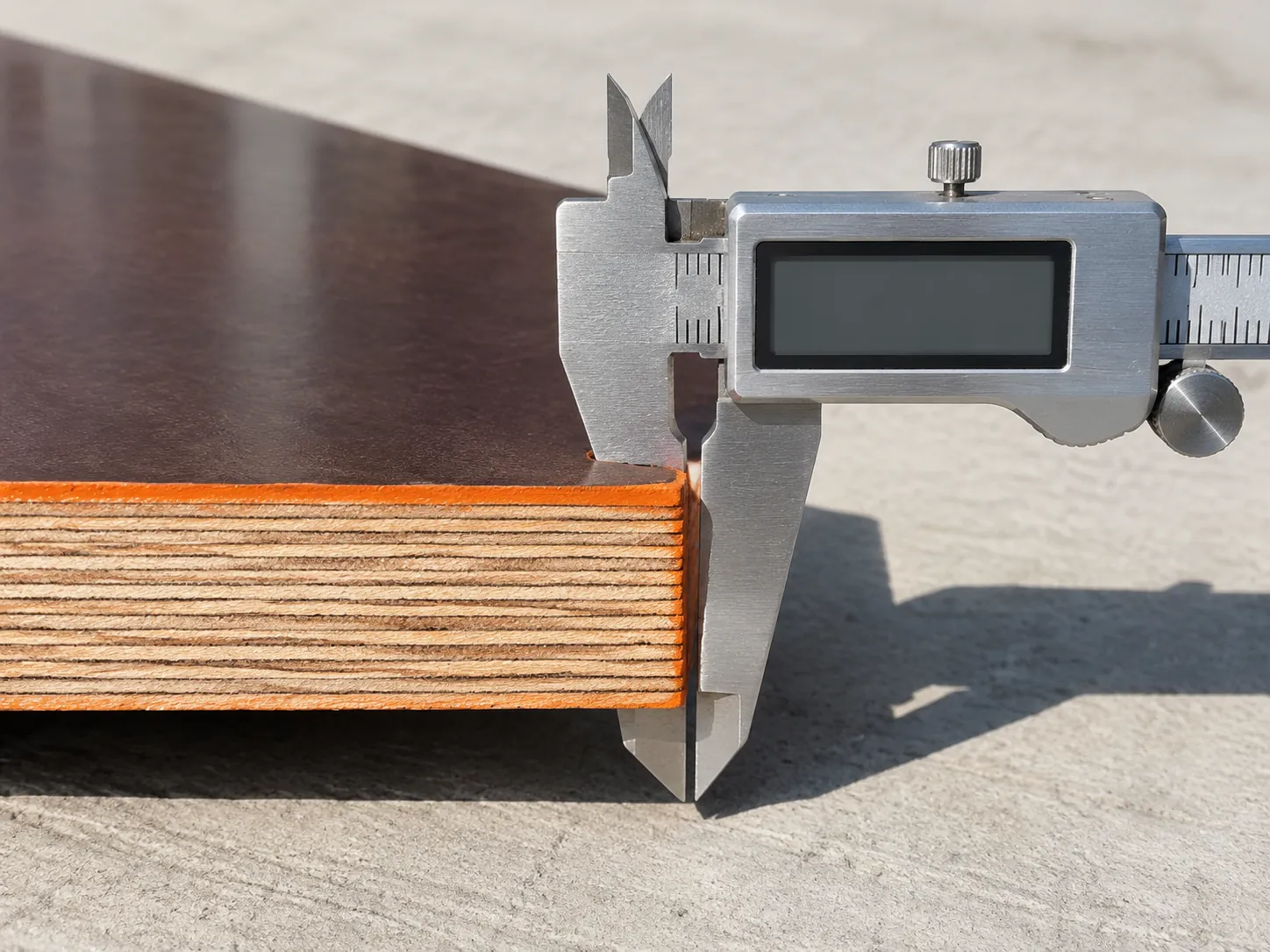
Thickness is gauged against ±0.5 mm; length and width against ±2 mm; corners for squareness. Fail: an out-of-tolerance board does not get film.
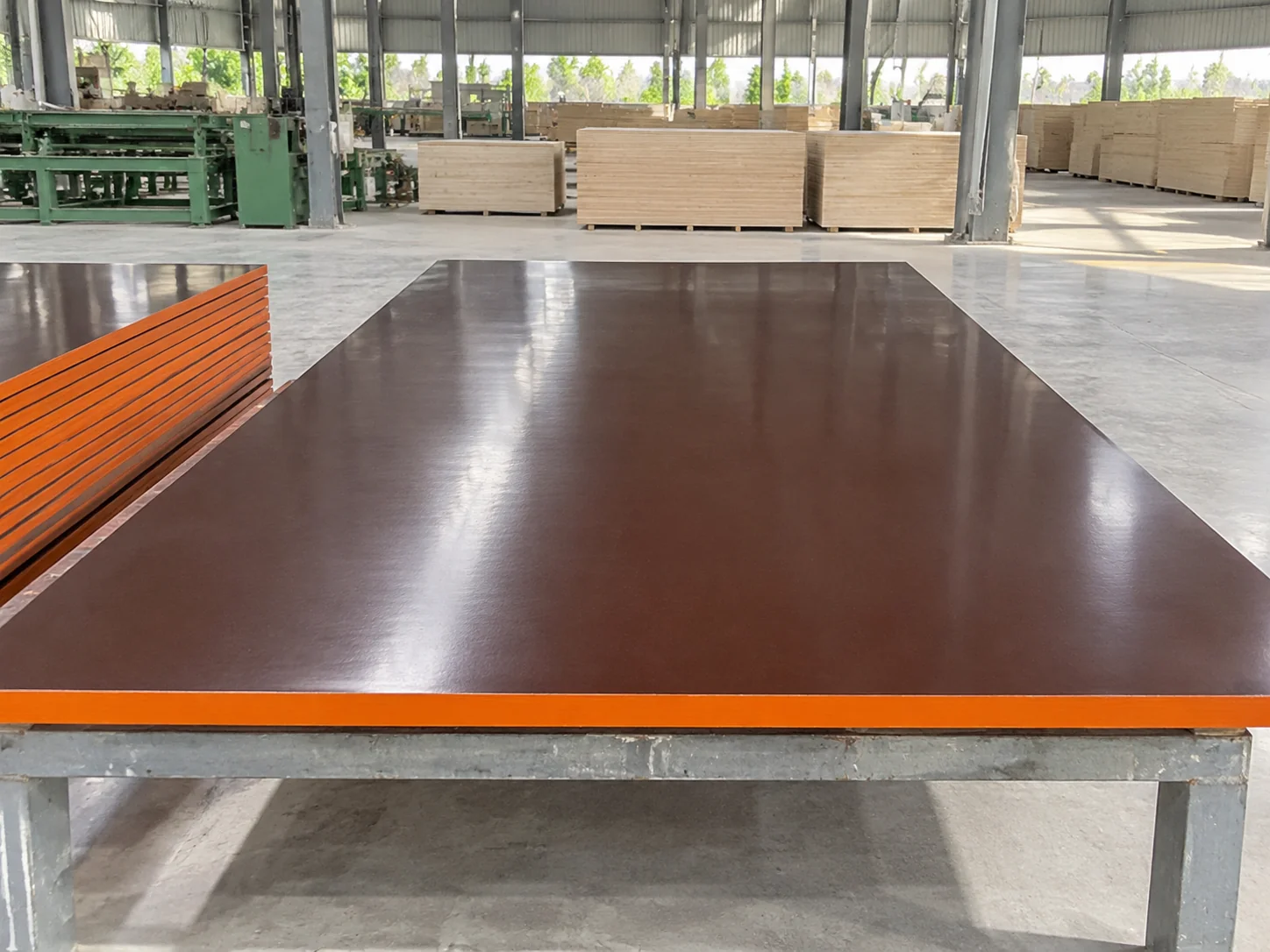
The film face is looked along under raking light for bubbles, dry spots, dents and scratches; anti-slip patterns for an even press. Fail: the panel is set aside from the order.
Every edge, and every cut edge on cut-to-size panels, is checked for complete paint. Fail: the edge is painted again before packing.
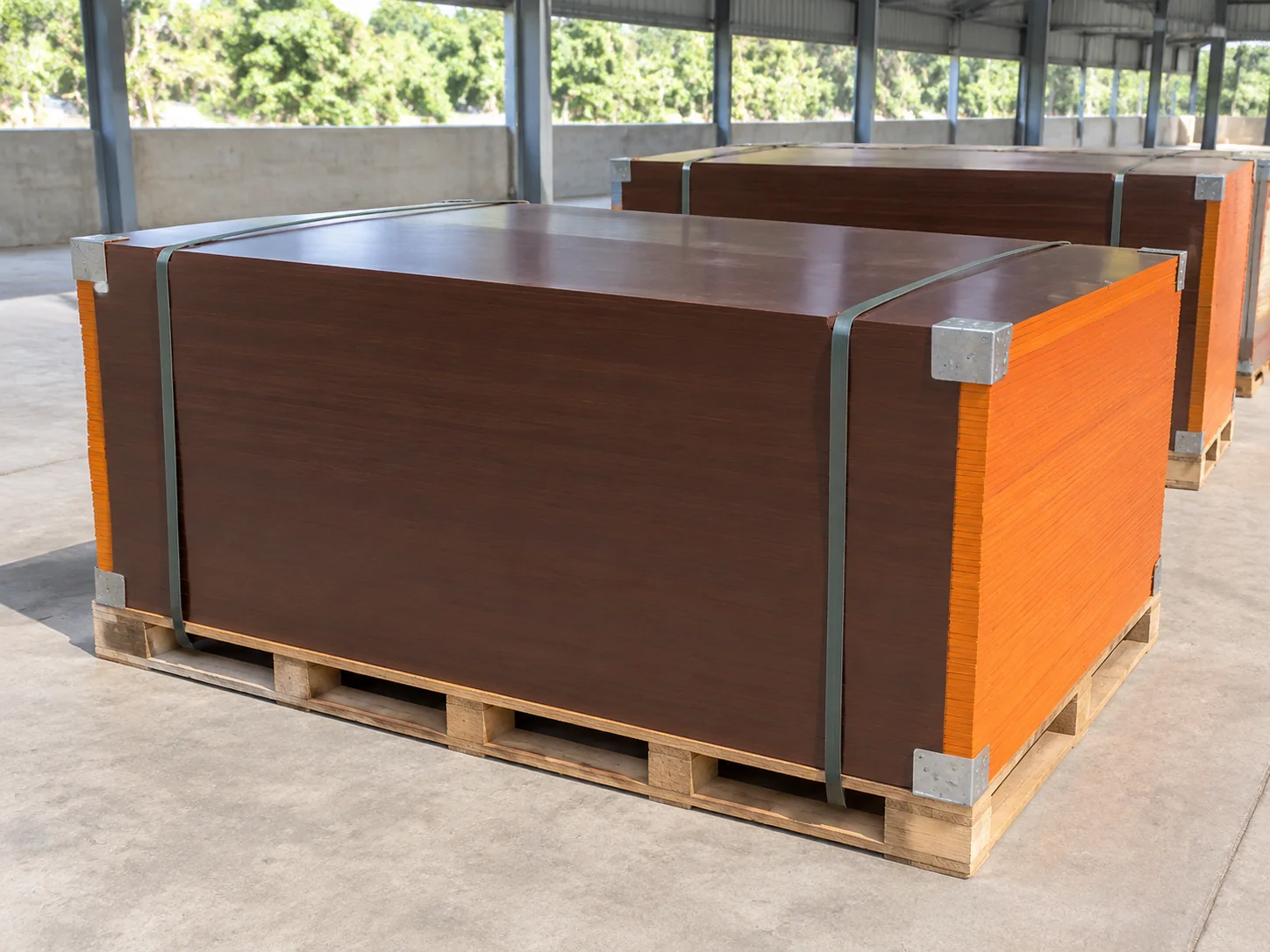
Sheet count, pack height of about 1,000 mm, straps, corner protectors and marks are checked against the packing list. Fail: the pack is opened and recounted.
Pictures
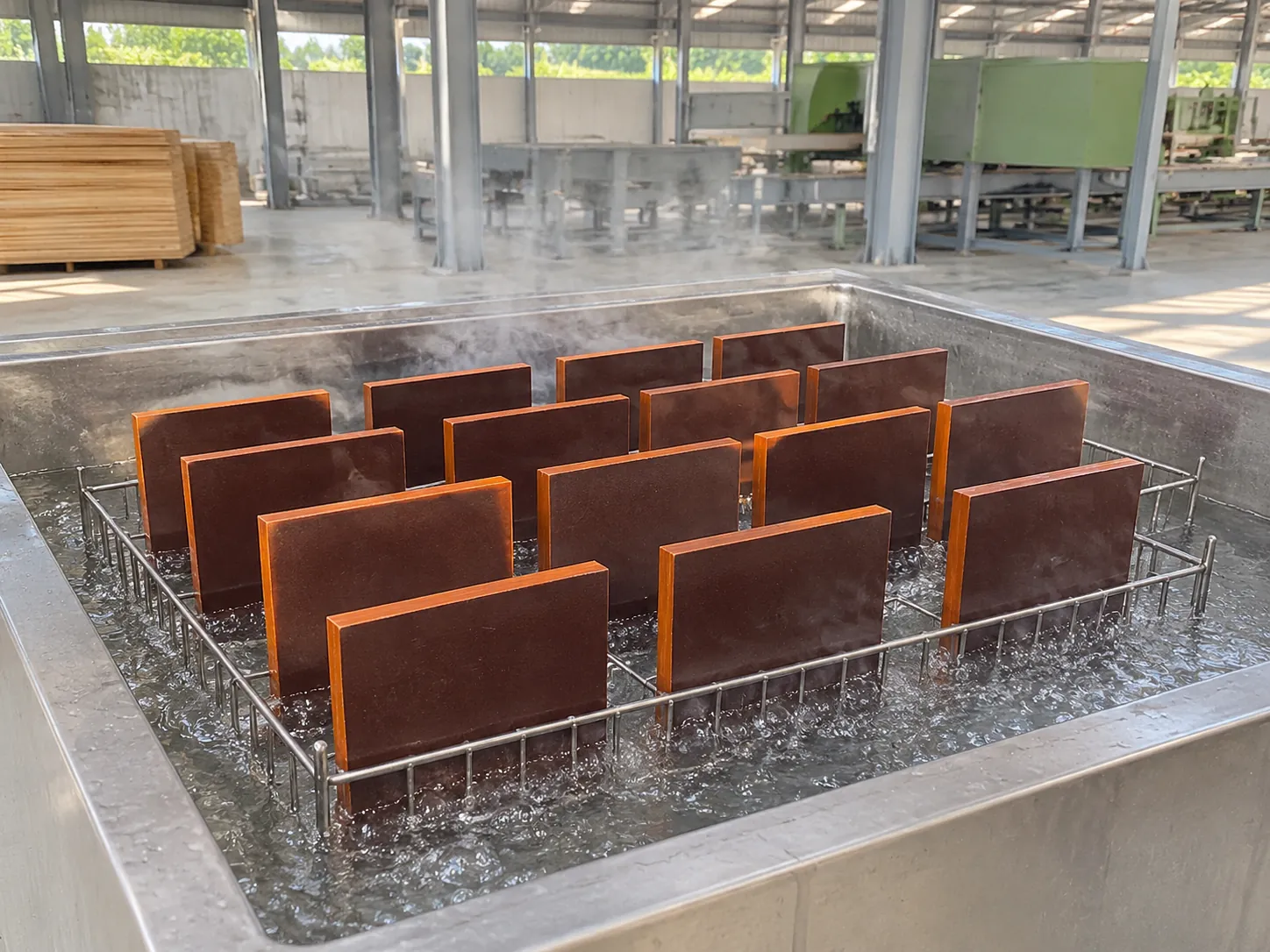
The pictures show the main checks on a film-faced plywood line: thickness at the edge, the film face under raking light, bond specimens in a water bath and a finished pack before loading.
Real photos and clips of our own stations are being taken at the mills and will be added as they arrive.
Defects
These are the defects buyers find most often in film-faced plywood, the station on our line that catches each one and what the buyer sees if it is missed.
| Defect | Cause | Caught at | What a buyer would see |
|---|---|---|---|
| Blows | Damp veneer, steam in the press | Drying; out of the press | A hollow sound, a bulge under the film |
| Core gaps | Veneers not closed at lay-up | Lay-up | Soft spots, dents in the concrete face |
| Delamination | Weak or uncured glue line | Out of the press; bond tests | Plies parting after a few pours |
| Thickness variation | Uneven core or sanding | After sizing, ±0.5 mm | Steps between panels in the form |
| Film bubbles or dry spots | Uneven board or film press fault | After the film press | Marks on the concrete finish |
| Unpainted edges | Missed edge or cut edge | Edge sealing | Swollen edges after the first pours |
| Wrong count or marks | Packing error | Packing | Packing list not matching the packs |
Numbers
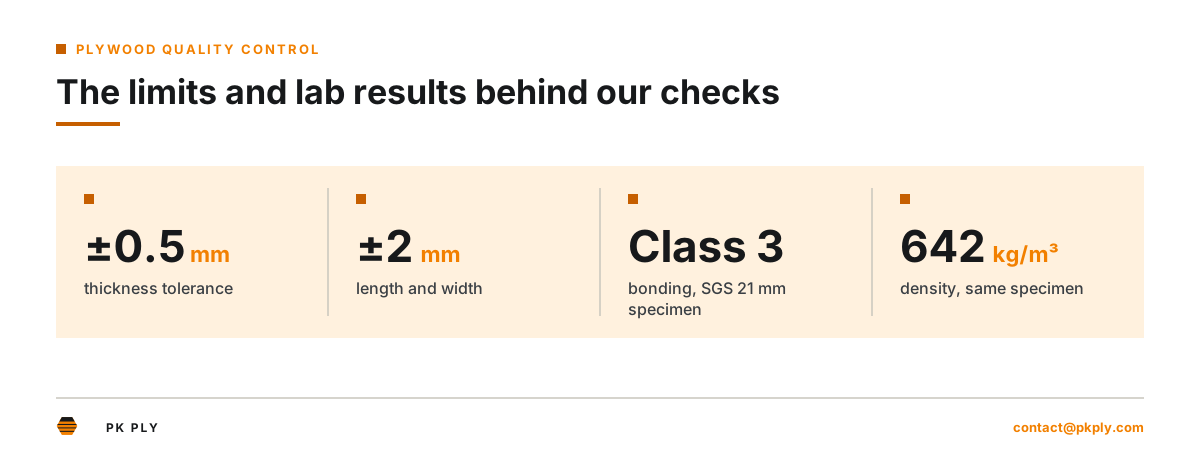
Our production limits are ±0.5 mm on thickness and ±2 mm on length and width; the lab values below come from one SGS report on one 21 mm specimen and are stated with that condition.
| Item | Value | Method or condition |
|---|---|---|
| Thickness tolerance | ±0.5 mm | Gauged after sizing; written on the technical sheet |
| Length and width tolerance | ±2 mm | Measured after sizing; written on the technical sheet |
| Bonding quality | Class 3 pass | EN 314-1/314-2 after 24 h water soak, boil-dry-boil and 72 h boiling; 21 mm specimen, Acacia core, phenolic glue (SGS) |
| Density | 642 kg/m³ | EN 323; same specimen |
| Formaldehyde | Not detected at 0.04 mg/m³; E1 pass (≤0.124 mg/m³) | EN 717-1 chamber; same specimen; not detected is not zero |
| Anti-slip, pendulum | 58 dry / 40 wet; 60 dry / 53 wet | DIN EN 16165, slider 96; specimens 200 × 145 × 18.38 mm and 200 × 150 × 14.62 mm |
Specimen results describe the specimens tested, not every production panel.
Buyer guide
Check a delivery against the technical sheet of the order, not a general standard: it states the tolerance, the build, the film and the edge sealing your panels were produced to.
Open one or two packs. Measure thickness at the corners and the middle of a few sheets and compare with the sheet's tolerance, ±0.5 mm unless agreed otherwise. Measure length and width against ±2 mm and check the diagonals for squareness.
Lay a sheet flat and look along the film under low light: one even reflection means a sound face. Look at every edge for complete paint. Count the sheets in a pack against the packing list.
For a pre-shipment inspection, send your inspector with the technical sheet; we prepare the packs to be opened and the gauges to be checked.
Corners and middle, ±0.5 mm.
Length and width ±2 mm; diagonals.
Even film under raking light.
Paint on every edge.
What you receive
With every order you receive the technical sheet with the limits, the certificate copies that apply, test reports for the agreed configuration and a packing list that matches the packs.
The tolerance, build, glue, film and edge sealing your panels are checked against.
Reports for the agreed configuration, each with specimen, method and date.
CE declaration for structural panels, FSC claim on the sales documents where ordered, emission documentation.
Packs, sheets per pack and marks, as counted at the packing station.
Documents
A shipment leaves with the commercial invoice, packing list, B/L, certificate of origin and phytosanitary and fumigation papers, plus the certificate documents of the order.
Commercial invoice
Panels, quantities, terms.
Packing list
The count from the packing station.
Bill of lading
Balance paid against the scanned B/L.
Certificate of origin
EUR.1 for EU-bound lots.
Phytosanitary and fumigation papers
For the wooden packing.
Order certificate documents
FSC claim, emission certificate, test reports for the agreed configuration.
Capacity
Our two mills produce up to 150 containers a month, and every panel in that volume passes the same eight stations; production takes 15–45 days after the deposit.
Because the stations sit on the line, checks do not add a separate stage to the lead time. A third-party inspection is booked inside the production window, before the container is loaded.
Order checklist
Write these six lines into your order and every station has a number to check against.
| Line | Example |
|---|---|
| Thickness and tolerance | 18 mm ±0.5 mm |
| Size and tolerance | 1250 × 2500 mm ±2 mm |
| Bond | Phenolic glue; EN 314 Class 3 test on specimens |
| Film | Dark brown, 130–135 g/m², no bubbles |
| Edges | All edges and cut edges sealed |
| Inspection | Pre-shipment inspection by your inspector |
FAQ
±0.5 mm on thickness and ±2 mm on length and width. Thickness is gauged after sizing, before the film is pressed on.
By EN 314-1/314-2 bond tests on specimens after a 24 h water soak, a boil-dry-boil cycle and 72 h boiling. A 21 mm phenolic specimen from our line passed Class 3 in an SGS test.
Density 642 kg/m³ (EN 323), bonding Class 3 pass (EN 314) and formaldehyde not detected at the 0.04 mg/m³ reporting limit, E1 pass (EN 717-1). It describes one submitted specimen, not every panel.
Yes. Every edge, including every cut edge on cut-to-size panels, is checked for complete paint at the edge-sealing station and painted again if needed.
On the technical sheet of your order, sent before production. Our stations and your inspector check against the same sheet.
The technical sheet, the test reports for the agreed configuration, the certificate copies and the packing list from the packing station, with the commercial invoice, B/L and certificate of origin.
Yes. Book the inspection inside the production window; we prepare packs to open and give the inspector the technical sheet.
Yes. The patterned film is checked for an even press, and two specimens were pendulum-tested by SGS: 58 dry / 40 wet and 60 dry / 53 wet. These are specimen values, not a slip class.
No. Not detected means below the 0.04 mg/m³ reporting limit of the EN 717-1 chamber test on that specimen; it is not an E0 claim.
Quotation
Send the panel, thickness and tolerance, size, glue, film, quantity and port, and tell us if you will inspect. We reply with a technical sheet and an FOB Hai Phong, CFR or CIF price.