
Vietnamese plywood mills usually accept a 30% deposit by T/T with the 70% balance against a copy of the bill of lading, or an irrevocable letter of credit at sight. PK Ply works on exactly those terms. Pick a looser term with an unknown seller, or a credit worded wrongly, and you can lose the deposit or wait weeks for your container's papers.
Formwork plywood payment terms: what do Vietnamese suppliers usually accept?
Most Vietnamese plywood mills accept two terms for an export container: a T/T deposit, usually 30%, with the balance against a copy of the bill of lading, or an irrevocable letter of credit at sight. Documents against payment and open account appear only with long-standing buyers. Our two mills in Chi Linh, Hai Phong work on the first two.
Those two terms dominate because they share the risk in a way both sides can live with. The deposit tells the mill the order is real before it buys logs, mixes glue and books a press; the balance against the bill of lading tells the buyer the panels exist, are loaded and are on a vessel before most of the money moves. A letter of credit puts a bank between the two, at a higher cost. The table shows where each method sits for a container of formwork plywood.
| Payment method | When the buyer pays | Who carries the risk | Bank cost | Seen with Vietnamese plywood mills |
|---|---|---|---|---|
| T/T 30% deposit, 70% against B/L copy | 30% before production, 70% after loading | Shared: buyer risks the deposit, mill risks the balance after loading | Low | The common term, and ours |
| T/T 100% in advance | Before production | Buyer carries it all | Low | Asked by some traders; not needed with us |
| Irrevocable L/C at sight | The bank pays when the documents comply | The banks carry it, provided the documents comply | Highest | Common on larger orders, and ours |
| D/P (documents against payment) | When the buyer’s bank hands over the documents | Mill, if the buyer does not collect | Medium | Long-standing buyers only |
| Open account | 30, 60 or 90 days after shipment | Mill carries it all | Low | Rare, usually with credit insurance |
The range of methods is not specific to plywood. The US International Trade Administration describes five primary methods of payment for international transactions. What is specific to plywood is the cost structure behind the deposit: veneer, glue and film are bought and pressed for one build, so a mill that has pressed 880 sheets of 18 mm Acacia-core panels for one buyer cannot simply sell them to the next. That is why no serious maker presses a first container on open account, and why the deposit is paid against a written technical sheet.
Our terms in one table: 30% deposit, 70% against the scanned B/L
Our terms are the same for every buyer: a 30% deposit by T/T starts production, which takes 15–45 days depending on quantity, production conditions and agreement; the 70% balance is paid against the scanned bill of lading, by T/T or by irrevocable L/C at sight. We sell FOB Hai Phong, CFR or CIF, from one 40HC.
| Term | What it says | Where it is written |
|---|---|---|
| Minimum order | One 40HC | Proforma invoice |
| Deposit | 30% by T/T | Proforma invoice |
| Production | 15–45 days after the deposit, by quantity, production conditions and agreement | Order confirmation |
| Balance | 70% against the scanned B/L | Proforma invoice |
| Balance method | T/T or irrevocable L/C at sight | Proforma invoice or the credit |
| Delivery term | FOB Hai Phong, CFR or CIF | Proforma invoice and invoice |
| Samples | Free; new buyers book their own courier, credited against a real order | Our reply to the enquiry |
Nothing in the table moves with the size of the buyer or the market. A wholesaler taking a container a month and a contractor taking one container for one tower pay on the same schedule. That keeps the conversation on the build: core, glue, film weight, thickness and edge sealing. Our terms of supply collect the same lines with the minimum order and sample rules.
When do you start production after the deposit?
We start production when the 30% deposit reaches our account against a technical sheet you have agreed in writing. From that day the order runs 15–45 days through veneer, lay-up, gluing, pressing, film, sizing and edge sealing, depending on quantity, production conditions and agreement. We confirm the lead time for your order at the enquiry.
The deposit is the start signal because it is what we spend first. On receipt we reserve press time on one of our two mills, which load up to 150 containers a month between them, and buy the veneer and film for your build. If the build changes after the deposit, the lead time restarts from the change, so the technical sheet has to be final before you pay.
Three things should be agreed in writing before the transfer:
- The technical sheet. Thickness, size, core (Acacia or Eucalyptus), glue (MUF or phenolic), film colour and weight, tolerance, edge sealing and marking.
- The quantity and the delivery term. Sheets or cubic metres per line, and FOB Hai Phong, CFR or CIF with the port.
- The proforma invoice. Our bank details, the deposit and balance amounts, the currency and the method of the balance.
A deposit sent before those three lines are fixed buys a place in the queue, not a container. Our order process shows the six stages from specification to release and where each payment sits.
Do you send certificate files before I pay the deposit?
Yes. The certificate files for your build reach you before you confirm and before you pay anything. They are the FSC chain-of-custody certificate SGSHK-COC-370674 for an FSC order, the CE factory production control certificate 0407-CPR-2146 for structural CE panels, and the test reports for the configuration. You decide on the deposit with them read.
The order of events protects the deposit more than any bank form. A buyer who pays first and asks for paper later has already committed 30% to a panel that may not carry what the job needs. A buyer who reads the certificates first can check them with the issuing body, ask about scope and only then pay. Our CE certificate, for example, covers structural plywood from 3.6–30 mm, so a 40 mm panel is outside it; a buyer who reads that before the deposit orders the right build.
Certificate files are one half of the pre-deposit check. The other half is the free sample of the build, which shows the film, the core and the edge sealing in your hands. Our note on the documents with each container lists every file, which order it belongs to and where each one’s limits sit. The certification hub shows how to verify each certificate yourself.
What documents do I see before paying the 70% balance?
Before you pay the 70% balance you see the draft commercial invoice, the draft packing list, the draft bill of lading and the draft certificate of origin, all made from the real loading count at Hai Phong, and then the scanned bill of lading issued by the carrier. You approve the drafts first, then pay against the scan.
The balance is paid against the scanned B/L because the bill of lading is the carrier’s receipt: it shows that the goods described are on board a named vessel. Until it exists, the 70% has nothing to stand on; once it exists, the buyer’s risk is limited to what the bill says. That is the difference between paying “before shipment”, which some suppliers still ask, and paying against the bill.
What to check on the drafts before the scan arrives:
- Description and quantity. Film-faced plywood, thickness and size per line, sheets and cubic metres matching the order.
- Parties. Shipper, consignee and notify party as your broker wants them.
- Ports and Incoterm. Port of loading Hai Phong, your port of discharge, and the Incoterm on the invoice matching the order.
- Container and seal numbers. The same on the packing list and the B/L.
- Weight. Gross weight as weighed, consistent across the papers.
- Certificates. The FSC claim on the invoice of an FSC order, and the order’s test or CE documents attached.
In practice, buyers on our standard terms usually pay the balance within about 10 days of receiving the scanned B/L. The originals, a telex release or a sea waybill then follow in the form written on the order. Release forms differ in speed: originals travel by courier, a telex release lets the carrier hand over the cargo without paper.
Can I pay the balance by L/C at sight?
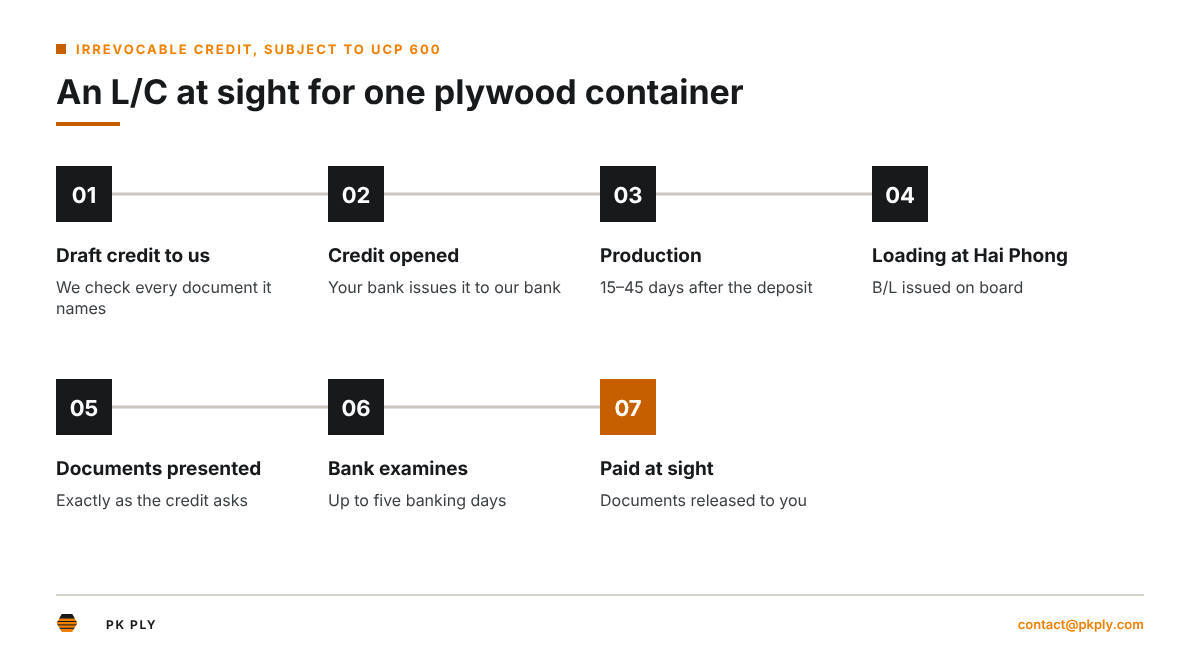
Yes. The balance, or the whole order value, can be paid by irrevocable letter of credit at sight, opened by your bank in our favour. Send us the draft credit before it is opened: we check that every document and date it names is one we can meet, so the documents comply on the first presentation and the bank pays without delay.
A credit at sight means the bank pays as soon as it finds the documents compliant, not at a later date. Irrevocable means it cannot be changed or cancelled without the agreement of the parties. According to the International Trade Administration, an LC is a commitment by a bank on behalf of the buyer that payment will be made to the exporter, provided that the terms and conditions stated in the LC have been met. For the buyer the protection is the other way round: the bank pays only against the documents the credit names, so the buyer decides on the wording which papers prove the order was shipped.
Almost every credit is issued subject to the ICC rules. ICC published UCP 600, the 2007 revision of its rules for documentary credits, with an implementation date of 1 July 2007 and a maximum period of five banking days for acceptance or refusal of documents. Those five banking days are the bank’s time to examine our presentation; your credit should leave room for them between loading and the expiry date.
The rule that matters most for plywood is that banks deal in documents, not in panels. A bank cannot see whether the film is 130 g/m² or whether the edges are sealed; it checks whether the papers match the credit. So the quality protection sits in what the credit asks for: an inspection certificate from the company you name, a packing list showing the agreed lines, the FSC claim on the invoice when the order is FSC.
Letter of credit wording that works for a plywood container
A credit for formwork plywood works when its dates allow 15–45 days of production plus loading, its documents are ones the mill and the carrier issue in the normal course, and its description matches the proforma invoice word for word. Most delays come from the wording, not from the panels: a date that is too tight or a document nobody issues.
The government guidance says the same. Letters of Credit are one of the most secure payment instruments available but can be labor-intensive and relatively expensive due to bank fees. The labour is in the documents, and that is where a buyer can save the cost of an amendment.
| Credit field | Wording that works | Wording that causes a discrepancy |
|---|---|---|
| Form | Irrevocable, available at sight, subject to UCP 600 | Revocable, or a deferred date when sight was agreed |
| Latest shipment date | Deposit date plus the agreed lead time plus loading margin | A date inside the production window |
| Expiry and place | After the latest shipment date with time for presentation, at our bank | Expiry at your bank, abroad, on the same day as shipment |
| Goods description | The proforma’s line: film-faced plywood, thickness, size, quantity, Incoterm | A description that differs from the invoice |
| Quantity | “About” before the quantity, so a loading count can differ slightly | An exact sheet count with no tolerance |
| Port of loading | Hai Phong, Vietnam | “Any Vietnamese port” on a CFR or CIF order we book from Hai Phong |
| Transport document | Clean on-board bill of lading, consignee as agreed | A document type the carrier does not issue for this route |
| Other documents | Invoice, packing list, certificate of origin, the order’s certificates, an inspection report you book | A certificate from a body that has not seen the goods |
| Partial shipment | Allowed when the order is more than one container | Prohibited on a multi-container order loaded over several weeks |
| Charges | Each side pays its own bank’s charges | All charges for the beneficiary without agreement |
Two habits save most of the trouble. Send us the draft before your bank issues it, and we return the fields we cannot meet with the wording that fits. And keep the credit’s list of documents to what proves the order: each extra paper is one more chance of a discrepancy and a discrepancy fee.
T/T, L/C, D/P or open account: which fits a plywood container?
For a first container from a mill you have not bought from, T/T 30/70 against the scanned B/L or an irrevocable L/C at sight fits best: you see the certificates and a sample before the deposit, and the larger part is paid only once the panels are on board. D/P and open account shift the risk to the mill and are kept for long-standing trade.
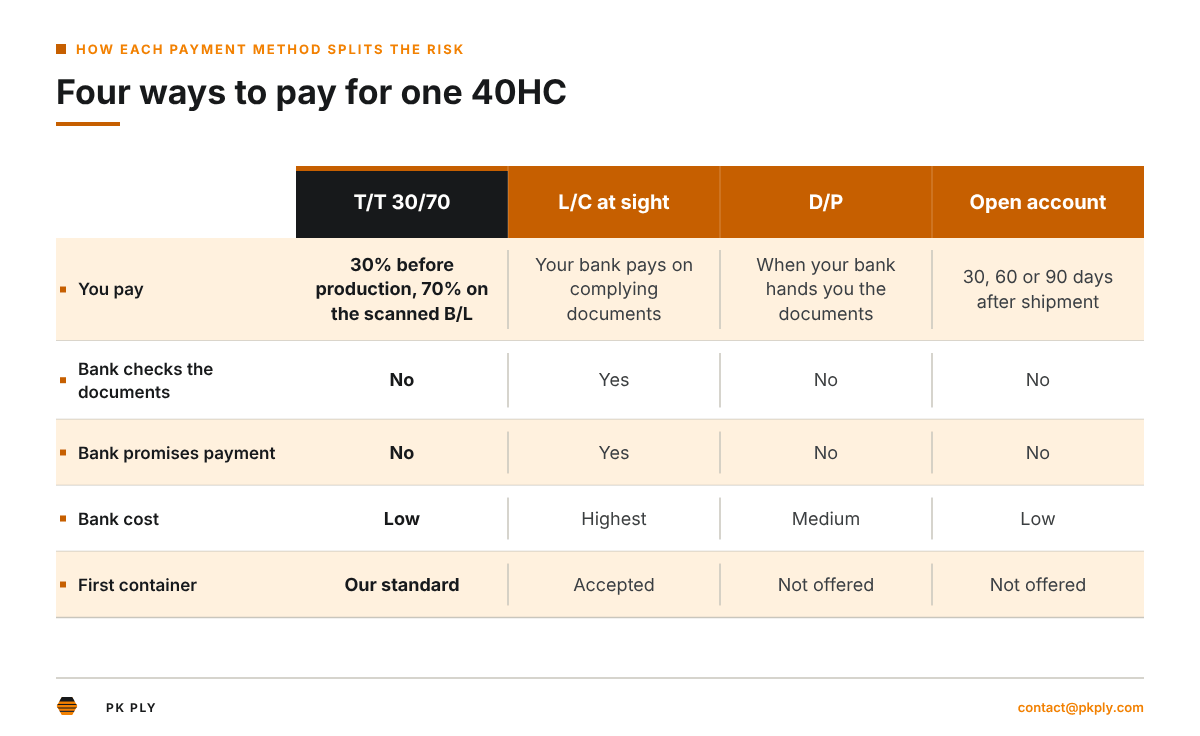
The choice between the two we accept turns on three questions. How large is the order: a single 40HC is usually simpler and cheaper by T/T, a programme of several containers often goes by credit. Does your own financing need a credit: some buyers’ banks lend only against an L/C. And does the deposit need protection beyond the certificates and the sample: a credit for the whole value removes the deposit step, at the cost of the credit’s fees.
| Question | Points to T/T 30/70 | Points to L/C at sight |
|---|---|---|
| Order size | One or two containers | A programme of several containers |
| Bank cost | Two transfers | Opening, advising, examination and possibly confirmation fees |
| Paperwork | Draft approval and a scanned B/L | Documents prepared to the credit’s wording |
| Speed of payment | Transfer when you approve | Bank examination of up to five banking days |
| Your financing | Paid from your own funds | Your bank finances against the credit |
| Deposit step | 30% before production | Can cover the whole value |
Either way the panel, the lead time and the documents are the same. A buyer who starts on a credit and moves to T/T after the first container changes only the bank’s role, not the build.
Why do mills rarely accept D/P or open account on a first container?
Mills rarely accept D/P or open account on a first container because both leave the panels at sea with no one obliged to pay. Under D/P the bank only passes documents to the buyer against payment; under open account the buyer pays 30, 60 or 90 days after shipment. A custom-pressed build is hard to resell if the buyer walks away.
The US government’s description of collections states the risk plainly. In a Documentary Collections transaction, the banks do not verify that the documents are accurate and do not guarantee payment as they do with Letters of Credit. The same guidance adds what happens when a buyer does not pay: the exporter has to find another buyer, pay for return transport or abandon the goods.
For formwork plywood that risk is sharp. A container of 21 mm phenolic panels with a buyer’s marks on every pack and a film colour chosen for one market has few second buyers at the port of discharge. The mill would be selling at a loss, and it prices that risk into every offer it makes on such terms. That is why an offer on open account from an unknown mill is not a bargain to accept without questions: either the price carries the risk, or the seller does not expect to be paid because the goods do not exist.
Open account does appear in plywood, usually between a trading house with credit insurance and buyers it has supplied for years. It is a term for an established account, not a way to start one.
Which delivery terms go with your payment terms?
Our payment terms go with three delivery terms: FOB Hai Phong, CFR or CIF to your port. The 30% deposit and the 70% balance against the scanned B/L are the same under all three. What changes is who books the vessel and pays freight and insurance, and therefore who receives the bill of lading first.
The ICC describes the Incoterms rules as eleven three-letter trade terms reflecting business-to-business practice in contracts for the sale and purchase of goods. Under FOB, CFR and CIF the risk passes to you when the panels are on board the vessel at Hai Phong, which is why the on-board bill of lading is the right document to pay the balance against.
| Delivery term | Who books the vessel | Who issues the B/L to whom | Effect on the balance |
|---|---|---|---|
| FOB Hai Phong | Your forwarder | Your forwarder’s line issues it; we receive our copy | You pay against the scan once the line issues it |
| CFR (CNF) your port | We book the line | The line issues it to us; we send you the scan | Balance against the scan; freight is in the invoice |
| CIF your port | We book the line and the insurance | The line issues it to us; the insurance document joins the set | Balance against the scan; freight and insurance are in the invoice |
Under an L/C the delivery term must be the same on the credit, the invoice and the bill of lading: a credit that says CIF on an FOB order is a discrepancy before the panels leave the press. Freight is a separate decision with its own numbers, covered in our note on freight cost for formwork plywood; what the container costs at your door, with freight, duty and VAT, is in the landed cost note.
Is the payment schedule the same for a mixed container?
Yes. A mixed container is one order with one proforma invoice, so it has one 30% deposit and one 70% balance against the scanned B/L, whatever it carries. A container usually carries one or two products; three to six products can be mixed by agreement, and each line is priced and listed on the same proforma.
| In a mixed container | One per container | One per product line |
|---|---|---|
| Proforma invoice | Yes | Each line priced on it |
| 30% deposit | Yes | |
| 70% balance against the scanned B/L | Yes | |
| Technical sheet | Yes: thickness, core, glue, film, edges | |
| Packing list entries | Yes: packs, sheets, m³ per line | |
| Mix limit | One or two products as usual; three to six by agreement |
What a mix changes is the planning, not the payment. Each thickness has its own sheets per pack and its own weight, so the packing plan and the lead time follow the slowest line. A container of 18 mm and 21 mm film-faced panels with a few packs of anti-slip flooring is planned pack by pack, and the packing list shows each line separately.
Under a letter of credit, a mixed container needs one more care: the goods description must list each line as the proforma does, or say “film-faced and anti-slip plywood as per proforma invoice” with its number. A credit that describes only one product cannot be met by an invoice listing three.
Bank charges, currency and the amount that arrives
Bank charges are agreed before the first transfer: the usual split is that each side pays its own bank’s charges, and the sender checks that intermediary-bank deductions do not leave the invoice short. The currency is fixed on the proforma invoice, and formwork plywood from Vietnam is normally traded in US dollars.
A T/T passes through the sending bank, often one or two intermediary banks, and our bank. Each may take a fee. When the transfer is sent “shared”, the sender pays its own bank and the receiving side bears the rest; when it is sent with all charges paid by the sender, the full amount arrives. Whichever is agreed, write it on the proforma, because a balance that arrives short by a few bank fees has to be settled before the bill is released, and that costs both sides a day.
Letters of credit carry more charges: issuing and amendment fees at your bank, advising and examination fees at ours, and confirmation where a confirmation is asked for. A discrepancy usually costs a fee as well, which is the cheapest argument for sending the draft credit first. Agree who pays which before the credit is opened, and write it in the charges field.
Currency follows the same rule: one currency, written once and repeated everywhere. The proforma, the invoice, the transfer and, under a credit, the L/C carry the same currency and the same amount. A transfer in another currency is converted by a bank at its own rate, so the amount credited may not match the invoice.
How to protect yourself before each payment
Protect each payment with one check that fits it: before the deposit, read the certificates, test a sample and confirm our bank details by phone; before the balance, approve the drafts, read any inspection report you booked and check the scanned B/L against them. Under a credit, the protection is the wording you give your bank.
The steps below follow the money, one payment at a time:
- Sample and technical sheet. Ask for a free sample of the exact build and a written technical sheet. The sample shows film, core and edge sealing; the sheet makes them binding.
- Certificates read and verified. Read the FSC, CE and test files for your order and verify them with the issuer. Certificates named by number can be checked; certificates with no number cannot.
- Bank details confirmed by phone. Before the first transfer, confirm the account by phone with the person you deal with, and check that the account holder is the seller on the proforma.
- Deposit against the proforma. Pay the 30% only to the account on the proforma, and send us the bank slip.
- Inspection before loading. If you want a third-party inspection, name it on the order and book it for the loading date at Hai Phong. Its report reaches you before the balance is due.
- Drafts approved. Check the draft invoice, packing list, B/L and certificate of origin against the order.
- Balance against the scanned B/L. Pay the 70% when the scan matches the approved drafts, to the same account as the deposit.
Each step costs little. Skipping one is how buyers lose money in this trade: not in a dispute over panel quality, but by paying a deposit to an account nobody checked, or by accepting a credit that names a document no one can issue.
Bank details that change by email: how the fraud works and how to stop it
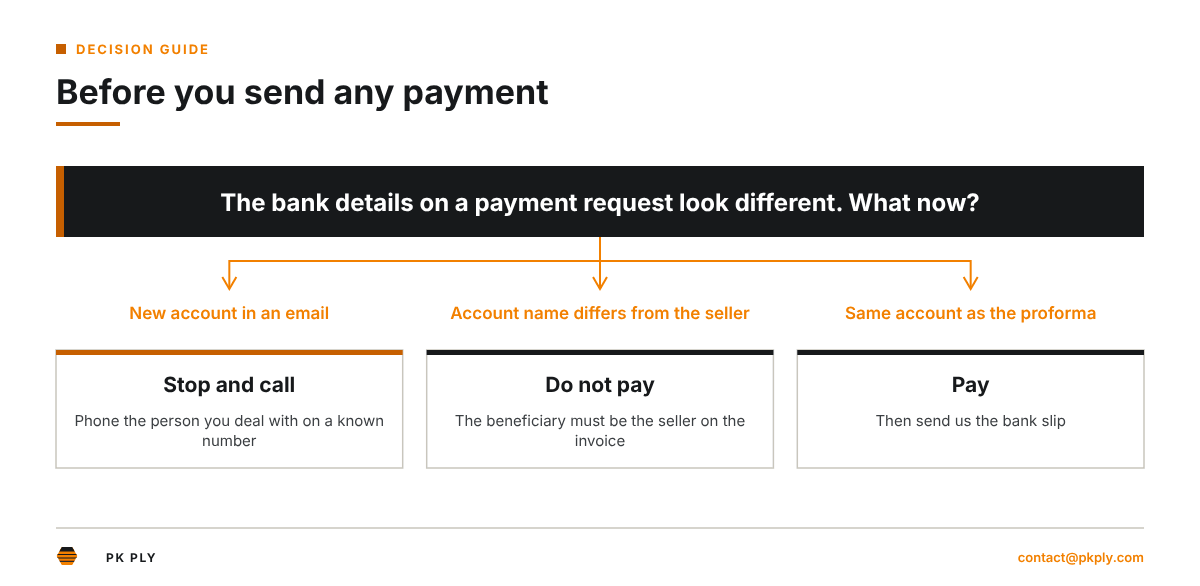
The most common payment fraud in plywood trade is an email that announces new bank details just before a deposit or balance is due. It looks like the seller’s mail, carries the right order number and asks for the transfer to a “new” account. Treat any change of bank details by email as fraud until confirmed by phone.
The scale is not small. The FBI’s Internet Crime Complaint Center counted 305,033 domestic and international business email compromise incidents between October 2013 and December 2023. Its first prevention tip is to use secondary channels and/or two-factor authentication to verify requests for changes in account information.
For a container order the defence is simple and has to be a habit:
- Our bank details are on the proforma invoice. Pay the deposit and the balance to that account only.
- A change by email is never enough. Call the person you deal with on a number you already have, not one given in the email.
- The account holder must be the seller. An account in another company’s name, a private name or another country than the one agreed is a reason to stop.
- Read the sender’s address letter by letter. Fraud mail often comes from a domain one letter away from the real one.
- Act at once if money went to the wrong account. Ask your bank to recall the transfer the same day and report it.
Our mail comes from the pkply.com domain, and [email protected] is our address for enquiries. A request to pay to a different account, from any address, is confirmed by phone before you act on it.
What changes on repeat orders?
On repeat orders our standard schedule stays the same: 30% deposit, 70% against the scanned B/L, by T/T or irrevocable L/C at sight. What changes is everything around it: the technical sheet already exists, the certificates are on file, samples are free, and the drafts are checked against a container you already received.
Keeping the schedule fixed is deliberate. A term that loosens with every order becomes a term to negotiate on every order, and the build is what both sides should be talking about. The real gains on a repeat order are time and certainty:
| Step | First container | Repeat container |
|---|---|---|
| Technical sheet | Written from your specification | Reused, changes marked line by line |
| Certificates | Sent and read before the deposit | On file; new scope or renewal sent when it changes |
| Samples | Free; you book the courier, credited against a real order | Free for repeat buyers |
| Bank details | Confirmed by phone before the first transfer | Same account; any change confirmed by phone |
| Draft documents | Checked line by line | Checked against the previous container |
| Credit wording | Drafted and checked before opening | The previous credit reused with new dates and quantities |
Buyers who reorder often run a credit for a programme of containers, with partial shipments allowed and one latest shipment date per lot. That saves opening a new credit per container. Planning one container after the next, with the build fixed, is also how lead times shorten in practice.
Red flags in a plywood supplier’s payment request
The red flags in a payment request are the same with any supplier: 100% in advance for a first container from a mill you have not seen, a beneficiary that is not the seller, bank details that change by email, a price far below the market, and a seller who refuses an L/C, a sample or a named certificate.
Each one has an innocent explanation now and then. Together, or with pressure to pay “today to keep the price”, they describe the usual shape of a loss in this trade.
| Red flag | What it often means | What to do |
|---|---|---|
| 100% in advance on a first container | The seller does not need to produce before being paid | Offer 30/70 against the B/L or an L/C at sight |
| Beneficiary differs from the seller | A trader, an agent or a fraudster between you and the mill | Pay only the company on the proforma and the certificates |
| Bank details changed by email | Business email compromise | Stop and confirm by phone |
| Price far below comparable offers | A cheaper build, short sheets or no goods | Compare the technical sheets, not the price lines |
| Refuses an L/C at sight | Cannot or will not present clean documents | Ask why, and walk away if there is no answer |
| No certificate numbers | Claims that cannot be verified | Ask for the certificate files and check them with the issuer |
| No sample of the exact build | The panel you get may not be the one you were shown | Ask for the sample before any deposit |
Our own terms answer each of these: 30/70 against the scanned B/L or an irrevocable L/C at sight, certificates named by number (FSC SGSHK-COC-370674, CE FPC 0407-CPR-2146) and sent before the deposit, free samples of the build, and one account on the proforma. If you are still comparing makers, our note on why buy construction plywood from Vietnam sets out what Vietnamese mills offer and what to check.
Writing the payment terms into your order
The safest payment terms are the ones written into the order before any money moves. Put these lines on the proforma invoice or in your order, and both sides know what each payment buys.
| Order line | Example |
|---|---|
| Build | 21 mm film-faced, Acacia core, phenolic glue, dark brown film, painted edges |
| Quantity and delivery term | One 40HC, CFR your port |
| Deposit | 30% by T/T to the account on this proforma, against the agreed technical sheet |
| Production | Lead time from the deposit, as confirmed |
| Balance | 70% by T/T against the scanned B/L, or irrevocable L/C at sight |
| Inspection | Your inspection company, at loading in Hai Phong |
| Bank charges | Each side pays its own bank |
| Currency | The currency of the proforma, repeated on every document |
| Release of the B/L | Originals by courier, telex release or sea waybill, as agreed |
With those lines agreed, the deposit starts a build you have read, and the balance pays for a container you have seen on paper before it reaches your port. Send your order lines through the specification form or to [email protected]; if you pay by credit, send the draft L/C with them, and we return the build sheet, the proforma and any credit fields to adjust. For the build fields themselves, see our formwork plywood quotation format.
Questions buyers ask us
What is the usual deposit for plywood from Vietnam?
Most Vietnamese plywood mills ask for a 30% deposit by T/T to start production. Ours is the same: 30% before production, 70% against the scanned bill of lading.
Do you accept 100% payment by L/C at sight?
Yes. An irrevocable letter of credit at sight is one of our two standard methods. Send the draft credit to us before your bank opens it, so we can confirm that every document it names is one we can issue.
Do you accept D/P or open account?
Not on our standard terms. We accept T/T, with a 30% deposit and 70% against the scanned B/L, or an irrevocable L/C at sight.
Is the 70% balance paid before or after shipment?
After loading. The container is loaded and sealed at Hai Phong, the bill of lading is issued, and you pay the balance against the scan of that bill.
Who pays the bank charges on a T/T?
Agree it on the proforma invoice. The usual split is that each side pays its own bank's charges, and the sender makes sure intermediary-bank deductions do not leave the invoice short.
In which currency do you invoice?
The currency is written on the proforma invoice and must be the same on the invoice, the transfer and, under a credit, the L/C. Formwork plywood from Vietnam is normally traded in US dollars.
How quickly do buyers usually pay the balance?
On our standard terms buyers usually pay the 70% within about 10 days of receiving the scanned B/L. The bill is then released in the form agreed on the order.
Can the deposit be smaller on a repeat order?
Our standard schedule stays 30% and 70% on repeat orders. What a repeat order changes is the work around it: the technical sheet, certificates and draft checks are already known, so each step moves faster.
What should I do if your bank details arrive changed by email?
Do not pay. Phone the person you deal with on a number you already know and confirm the account before any transfer.
Does a mixed container need two deposits?
No. One container is one order with one proforma invoice, one 30% deposit and one 70% balance, however many products it carries.
Can a third-party inspection be added before the balance?
Yes. Name the inspection on the order and book it before loading, so its report is in your hands before the scanned B/L arrives.
Do you start production before the deposit arrives?
No. Production is booked when the 30% deposit reaches our account against an agreed technical sheet, and the 15–45 day lead time runs from then.