
Phenolic film-faced plywood
The build for up to about 25 pours.
Phenolic film-faced plywoodCalculator · plywood formwork cost
In short
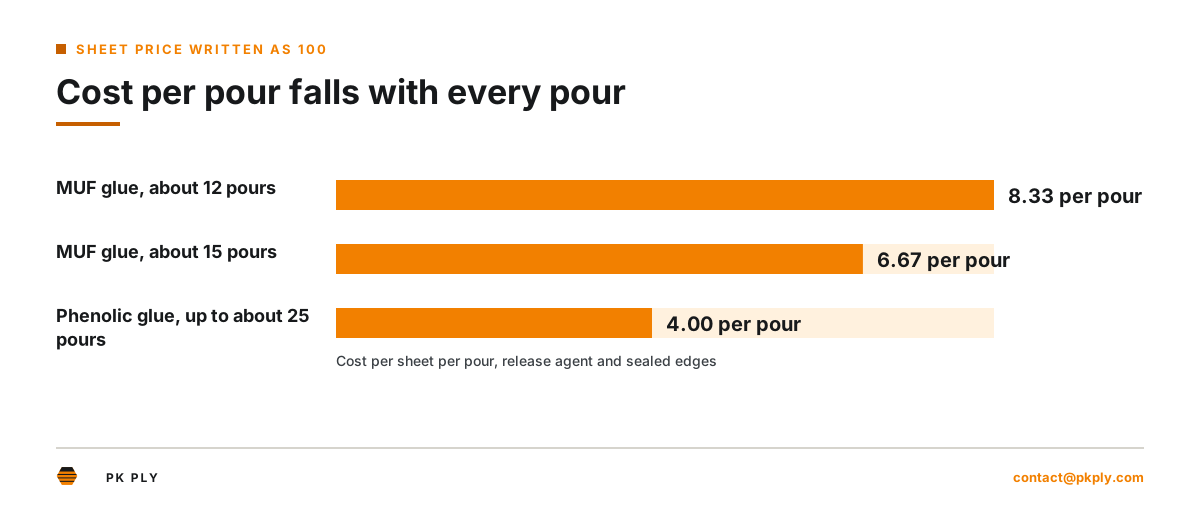
Plywood formwork cost is the sheet price divided by the pours the sheet gives. Write the price of one sheet as 100: at about 12 pours each pour costs 8.33, at about 15 pours 6.67, and at up to about 25 pours 4.00. PK Ply’s melamine (MUF) glue build gives about 12–15 pours and its phenolic glue build up to about 25, with a release agent on every pour and sealed edges. Enter your own price to get the cost per sheet and per m² of formed concrete.
Video
Calculator
Type the price you pay per sheet in any currency, the sheet size, the pours you plan and the share of the face you lose to cutting.
The price starts at 100 so the results read as a share of the sheet price: 8.33 means 8.33 % of the sheet price per pour. Replace it with a real quote and the outputs turn into money. Cost per m² is what a site manager compares between offers, because it puts a 1220 × 2440 mm and a 1250 × 2500 mm sheet on the same footing.
Reference table
Read the table as a break-even test. A sheet that gives about 12 pours is cheaper per pour than one that gives up to about 25 only if its price is below 12 ÷ 25 = 48 % of the other sheet’s price; at about 15 pours the line moves to 15 ÷ 25 = 60 %.
A cheaper sheet that costs more than that share of the longer-lasting one costs more per pour, before you count the labour of replacing forms more often.
| Build and pours | Cost per sheet per pour | Per m², 1220 × 2440 mm | Per m², 1250 × 2500 mm | Concrete face formed per sheet, 1220 × 2440 mm |
|---|---|---|---|---|
| MUF glue, about 12 pours | 8.33 | 2.80 | 2.67 | 35.7 m² |
| MUF glue, about 15 pours | 6.67 | 2.24 | 2.13 | 44.7 m² |
| Phenolic glue, up to about 25 pours | 4.00 | 1.34 | 1.28 | 74.4 m² |
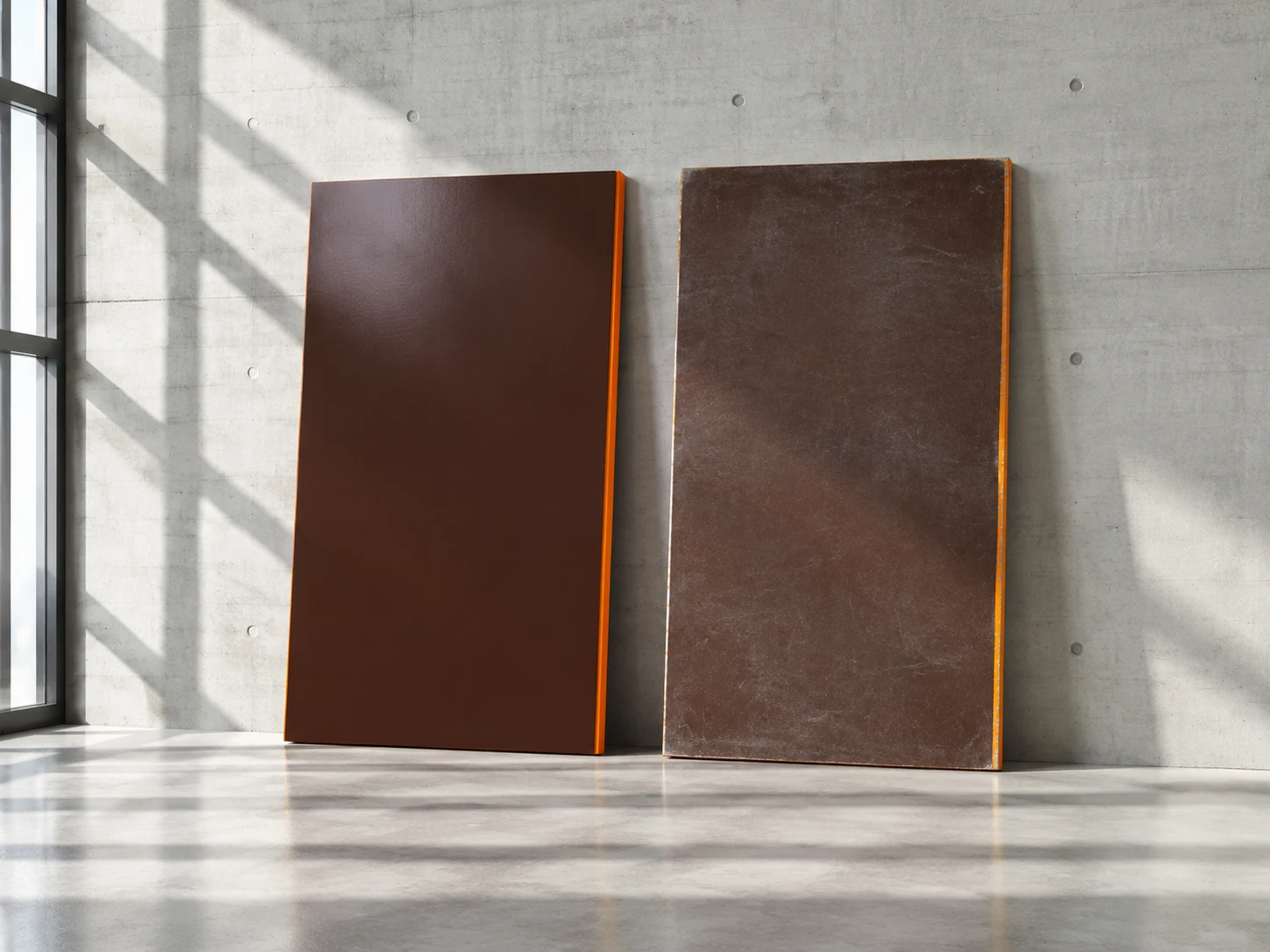
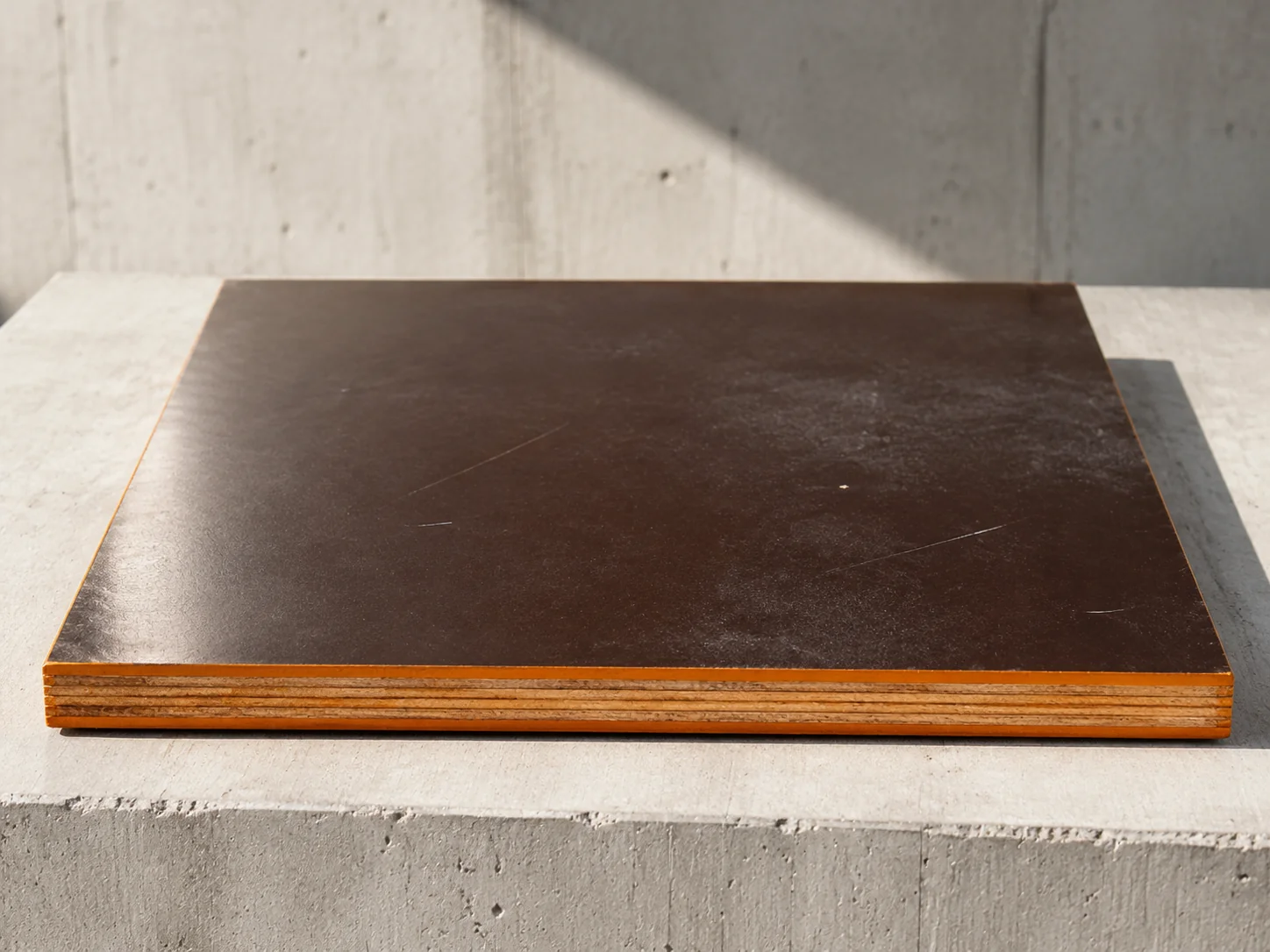
Pours are with proper handling, a release agent on every pour and sealed edges, including cut edges. They are a target for a configuration and site practice, not a fixed property of the sheet.
How the numbers work
Cost per sheet per pour = price ÷ pours. Usable face = sheet area × (1 − cutting loss ÷ 100). Cost per m² per pour = price ÷ (usable face × pours). Concrete face formed over the sheet’s life = usable face × pours. A 1220 × 2440 mm sheet has 2.9768 m² of face and a 1250 × 2500 mm sheet 3.125 m².
The pours come only from our own builds: about 12–15 for melamine (MUF) glue film-faced plywood and up to about 25 for phenolic glue film-faced plywood. Both need a release agent on every pour and sealed edges, cut edges included. Without those conditions the same sheet gives fewer pours, so the cost per pour rises; type the number you see on your own site.
Cutting loss works the other way: the sheet price stays the same while the face that forms concrete shrinks. Losing 10 % of the face to offcuts raises the cost per m² by 1 ÷ 0.9, about 11 %. Planning the cutting list around the full 1220 × 2440 or 1250 × 2500 mm sheet, and sealing every cut edge, protects both numbers.
Not in the formula: labour to strip, clean and re-oil, repairs, transport and storage, and any residual value. Add them per pour if you track them. For form care, stripping and storage, the APA Concrete Forming Design/Construction Guide (V345) is a useful reference.
Keeps the film from bonding to the concrete; the pours above assume it.
Water entering the core at an edge is what ends most sheets early.
Stack flat, lift rather than drag, and do not strip with a steel bar against the film.
From cost per pour to an order
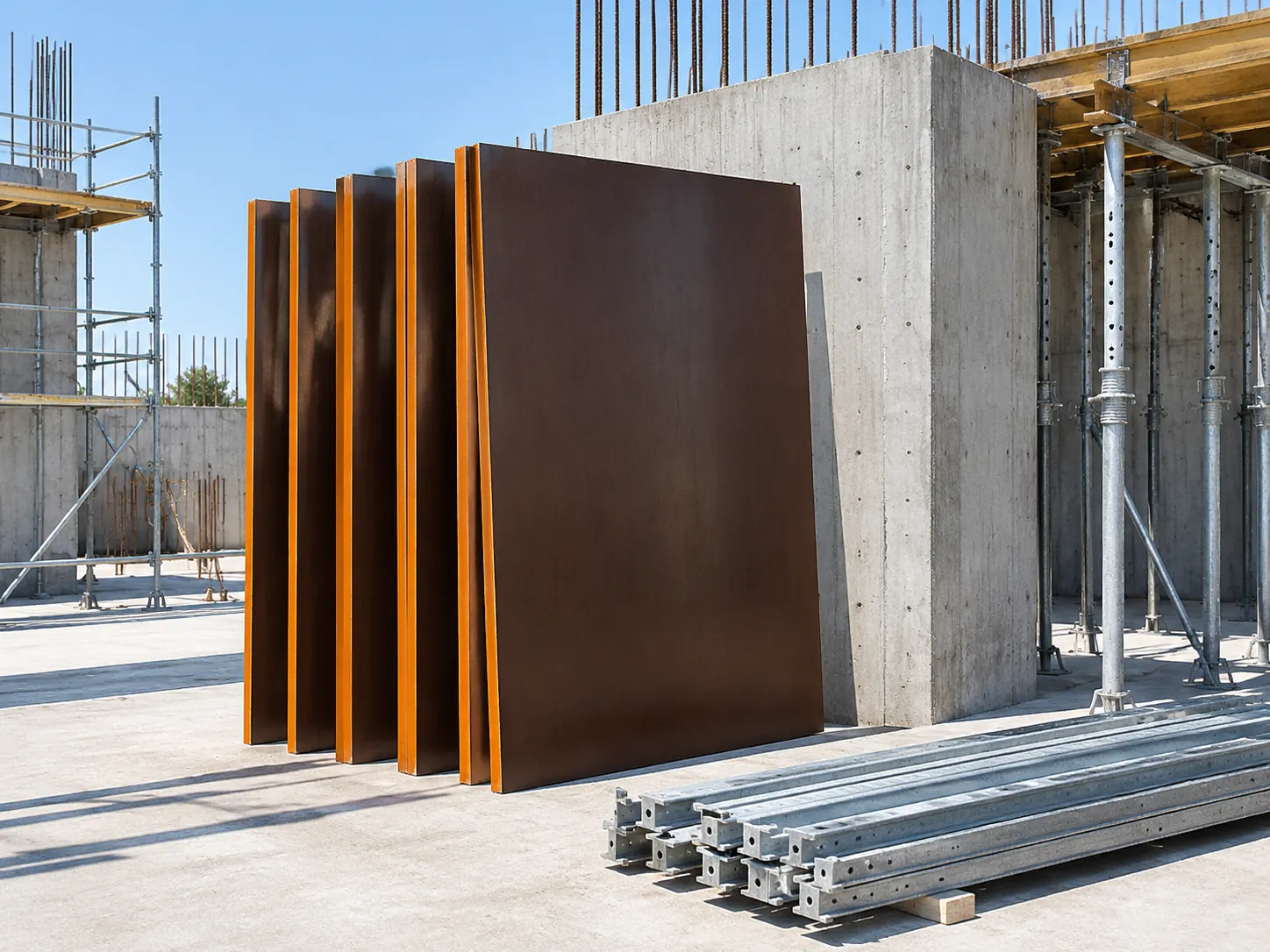
One 40HC carries 880 sheets of 18 mm Acacia-core film-faced plywood at 1220 × 2440 mm, as a planning figure. At about 12 pours those sheets form 880 × 35.7 m² ≈ 31,400 m² of concrete face; at up to about 25 pours on the phenolic build, about 65,500 m². That is the number to set against the price of the container.
Our minimum order is one 40HC. To spread container costs, freight and duty over the sheets and then over the pours, use the landed cost calculator; to count the sheets your project needs, use the formwork plywood quantity calculator.
FAQ
Divide the price of one sheet by the pours it gives. With the price written as 100, about 12 pours gives 8.33 per pour and up to about 25 pours gives 4.00. For cost per m², divide again by the usable face of the sheet: 2.9768 m² for 1220 × 2440 mm.
Our melamine (MUF) glue build gives about 12–15 pours and our phenolic glue build up to about 25, with proper handling, a release agent on every pour and sealed edges including cut edges.
Because the pours fall faster than the price. A sheet that gives about 12 pours is only cheaper per pour than one giving up to about 25 if it costs less than 48 % of that sheet’s price.
A release agent on every pour, sealing every cut edge, stacking sheets flat and lifting rather than dragging them, and stripping without levering a steel bar against the film.
The price stays the same while the usable face shrinks. Losing 10 % of the face raises the cost per m² per pour by about 11 %; losing 20 % raises it by 25 %.
880 sheets of 18 mm Acacia-core film-faced plywood at 1220 × 2440 mm, or 795 on Eucalyptus core, as planning figures. Other thicknesses and sizes are in the pallet loading calculator.
Related pages
The build for up to about 25 pours.
Phenolic film-faced plywoodThe MUF build for about 12–15 pours.
Melamine film-faced plywoodAll film-faced panels, 9–40 mm.
Film-faced plywoodMOQ one 40HC, payment and delivery terms.
Terms of supplySheets, packs, m³ and tonnes per 40HC by core, size and thickness.
Pallet loading calculatorContact area of slabs, walls and columns turned into sheets and a share of a 40HC.
Formwork plywood quantityJoist spacing and deflection for 12–21 mm panels, as a planning estimate.
Formwork panel spanLateral pressure of fresh concrete on walls and columns after ACI 347R-14.
Concrete pressure on formworkSheet, pack and order weight from volume and density.
Plywood sheet weightFrom an FOB Hai Phong price to landed cost per sheet and per pour.
Landed costSpecification
Send your thickness, size and the pours your site needs. We quote the MUF and the phenolic build side by side from our two mills in Chi Linh, Hai Phong, which load up to 150 containers a month.