
Swollen or soft edges
Water has entered through a cut or chipped edge that was not sealed. Paint every cut the same day and store packs off the ground under cover.
Formwork panels · made in Chi Linh, Hai Phong
In short
Film faced plywood is hardwood plywood with a resin film pressed on both faces and sealed edges, made for concrete formwork. Ours has Acacia or Eucalyptus cores and MUF or phenolic glue. With proper handling, release agent and sealed edges, MUF panels give about 12–15 pours and phenolic panels up to about 25.
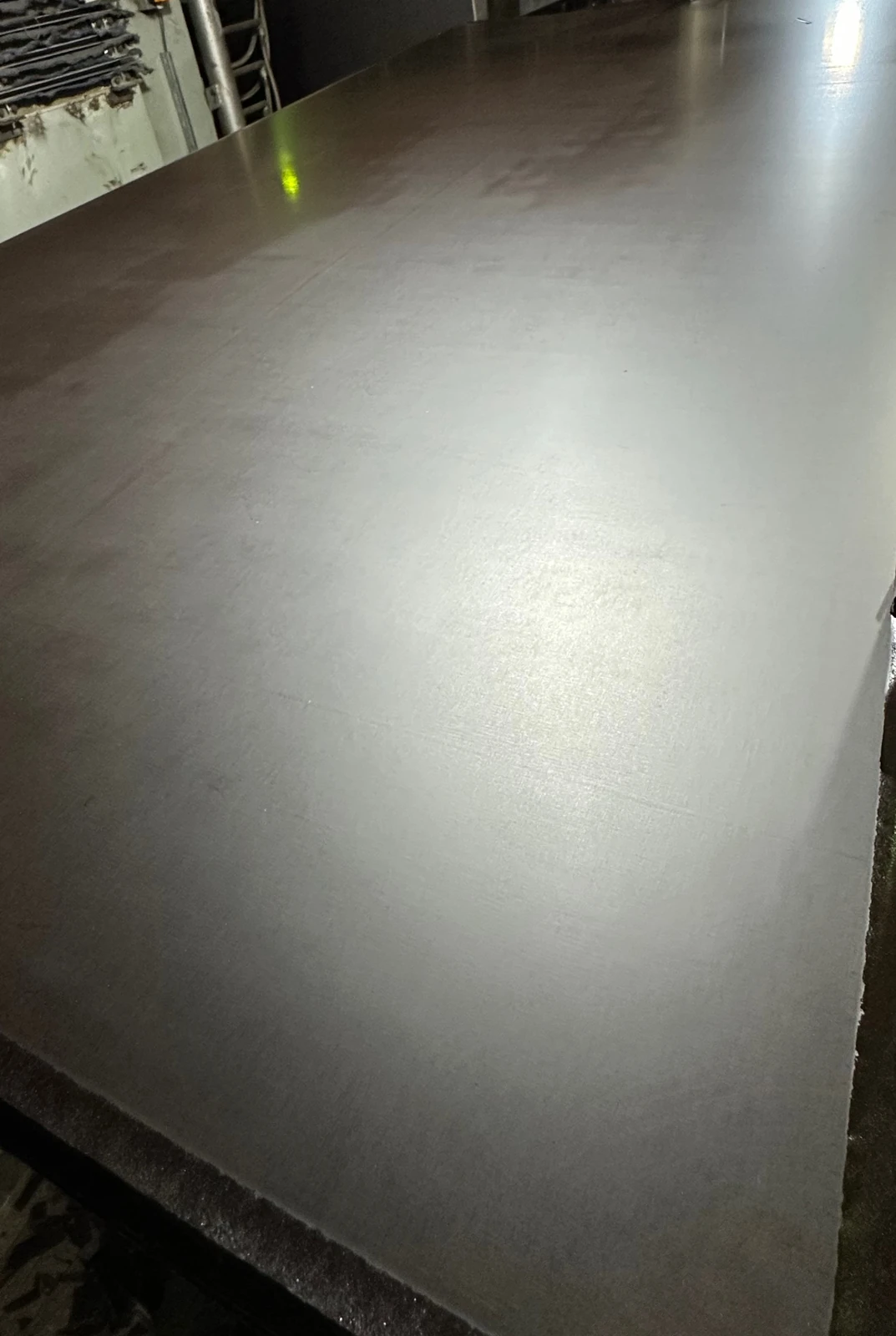
Real panels
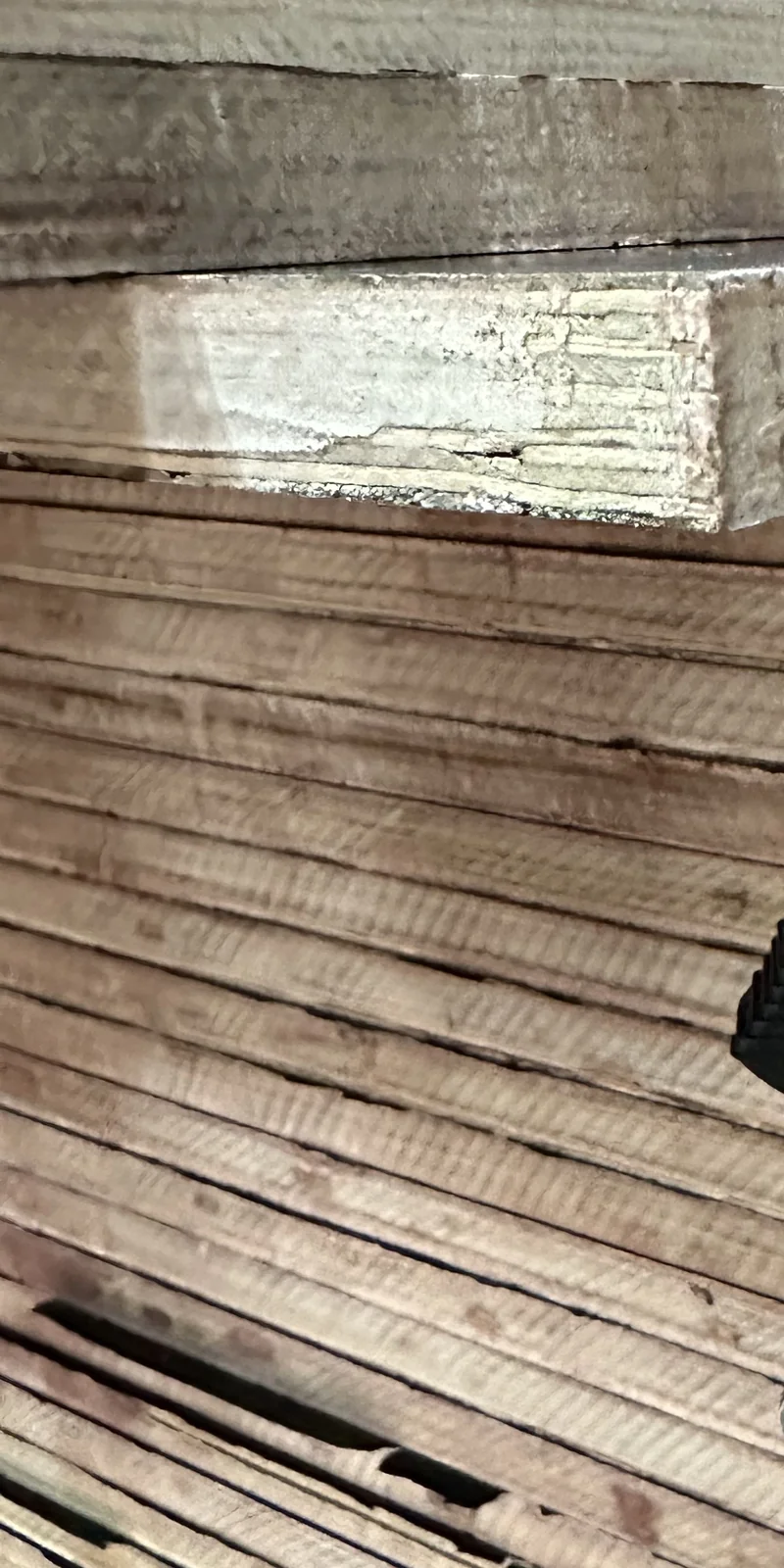
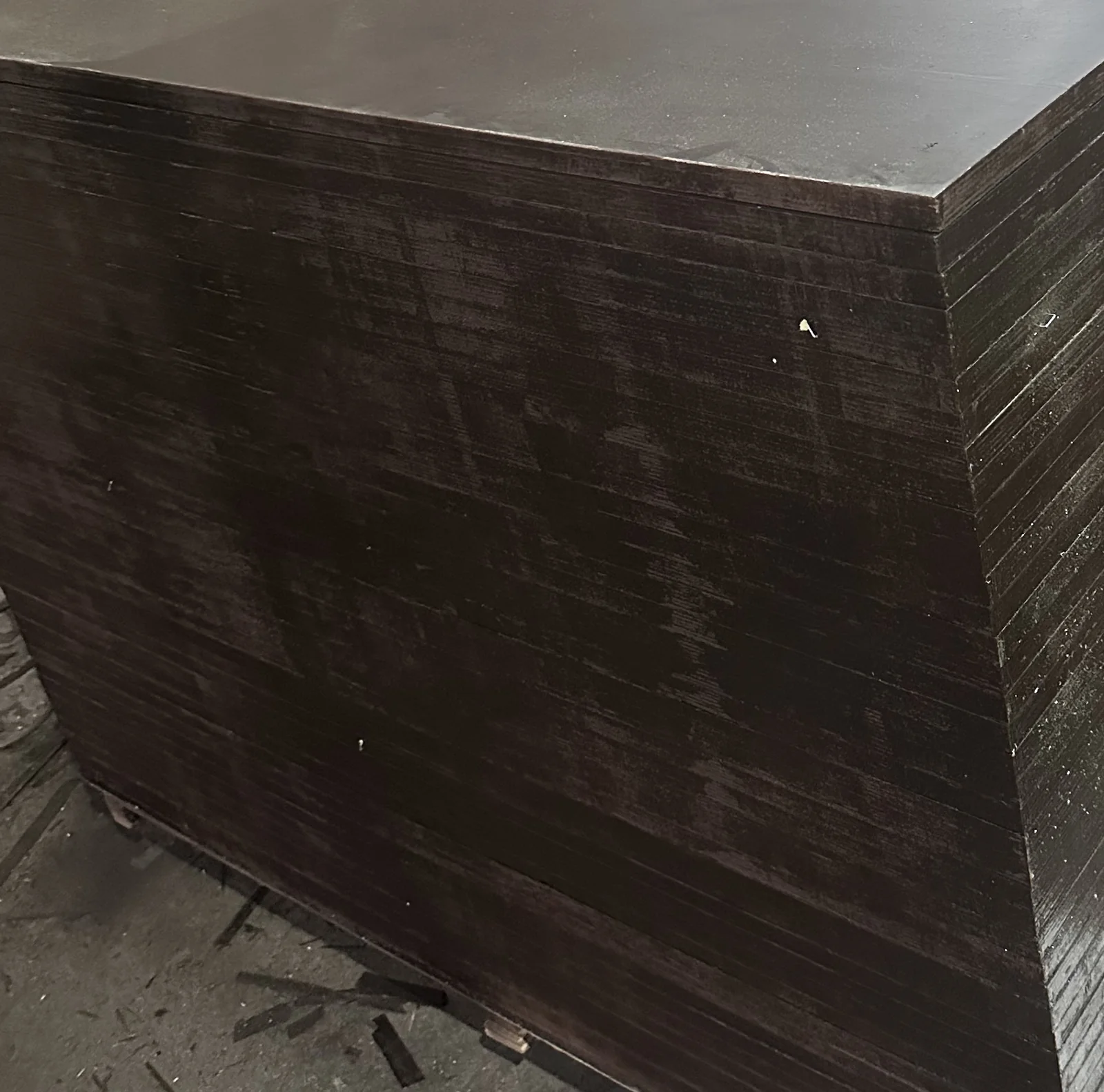
Every photo here was taken at our mill: the film on both faces, the hardwood veneers before the film goes on, and the painted side of a strapped pack.
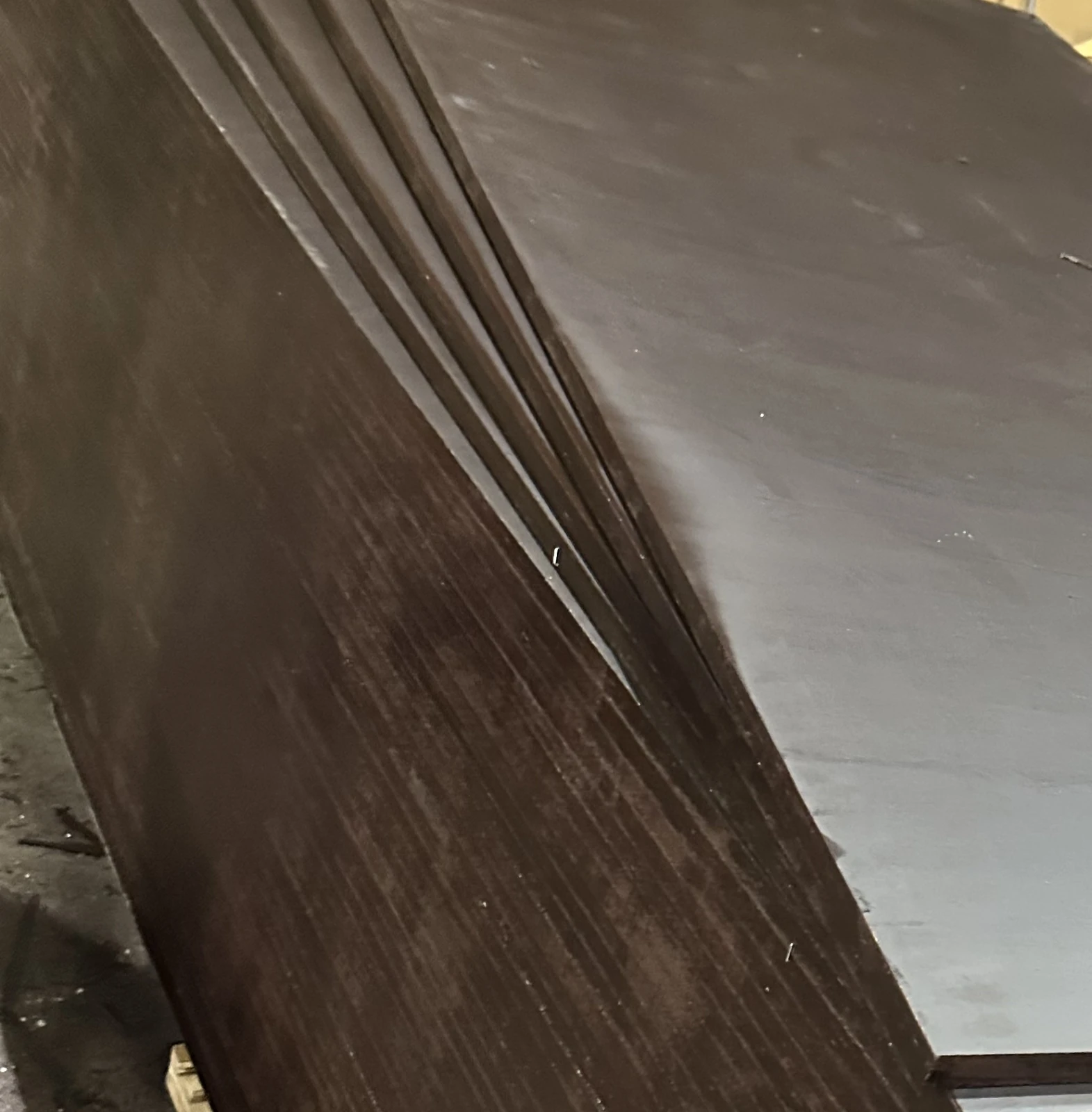
Specification
Our standard film-faced panel is a hardwood-core plywood with film on both faces and painted edges. The table lists what we press as standard; the build for your order is written on a technical sheet you approve before production.
| Item | Standard | Options by order |
|---|---|---|
| Face and back | Smooth film, dark brown | Black film; film brand named on the technical sheet |
| Film weight | 130–135 g/m² | 120–125 g/m², 165 g/m², 185 g/m², 200 g/m² and above |
| Core | Acacia hardwood veneers, laid crosswise | Eucalyptus hardwood veneers |
| Glue | MUF (melamine) | Phenolic for up to about 25 pours |
| Thickness | 12, 15, 18 and 21 mm | Any thickness from 9 mm to 40 mm |
| Sheet size | 1220 × 2440 mm | 1250 × 2500 mm; custom sizes cut to a list |
| Thickness tolerance | ±0.5 mm | Written on the technical sheet |
| Length and width tolerance | ±2 mm | Written on the technical sheet |
| Edges | Water-resistant paint on all four edges | Edge colour by order |
| Formaldehyde | E1 pass, chamber test on a 21 mm phenolic specimen | Test to your method through SGS on request |
| Marking and packing | Strapped export pallets | Buyer marking on panels and packs |
Film weight and colour
Film weight is the grade ladder of film-faced plywood: the heavier the film, the more abrasion the face takes before the wood shows. Orders start at 120–125 g/m², most buyers now take about 130–135 g/m², and buyers who plan many pours specify 165, 185 or over 200 g/m².
Colour is a choice of look and of market habit, not of strength. Dark brown is our standard; black is pressed to order. The film brand, weight and colour go on the technical sheet, so the repeat container carries the same face.
| Film weight | How buyers use it | Glue usually paired with it |
|---|---|---|
| 120–125 g/m² | Entry film for short programmes and single-use forms | MUF |
| 130–135 g/m² | Most common order today; general wall and slab formwork | MUF or phenolic |
| 165 g/m² | Contractors who want more pours from the same face | Phenolic |
| 185 g/m² | Repeat formwork on large sites and rental fleets | Phenolic |
| 200 g/m² and above | Highest-duty faces for long reuse | Phenolic |
Core
Both cores are hardwood veneers laid crosswise, and both carry the same film and glue. The difference is weight. Eucalyptus is denser, so a container of Eucalyptus-core panels reaches its weight limit before it is full, while Acacia-core panels fill the volume.
Buyers who pay freight per container usually choose Acacia to load about 47 m³. Buyers who want a heavier, denser sheet take Eucalyptus and load about 43 m³.
Core quality matters more than core species. A good core has full-length veneers with no gaps or overlaps, so the panel stays flat under load and does not show core lines through the film after a few pours. At the mill, sample sheets from each production run are cut open so we can check that every core veneer is in place and the layers are tight. A flat core also keeps the film face even, which shows on the finished concrete.
| Item | Acacia core | Eucalyptus core |
|---|---|---|
| Planning density | 580 kg/m³ | 650 kg/m³; measured 650–750 kg/m³ |
| Load per 40HC | About 47 m³ | About 43 m³ |
| 18 mm sheet, 1220 × 2440 mm | 31.1 kg | 34.8 kg |
| 18 mm sheets per 40HC | 880 sheets | 795 sheets |
| Measured density, SGS 21 mm specimen | 642 kg/m³ | Not tested |
Glue and reuse
Choose the glue by the number of pours you need. Melamine (MUF) glue gives about 12–15 pours, and phenolic film faced plywood gives up to about 25, with proper handling, a release agent on every pour and sealed edges, including cut edges.
Reuse is a target for a build and a site practice, not a property printed on the sheet. Panels that are dropped, stripped with a crowbar, stored wet or cut without resealing the edge lose pours on any glue. Budget film-faced panels on the market typically give about 4–10 pours.
Our phenolic bond was tested by SGS on a 21 mm dark-brown specimen with an Acacia core. It passed bonding Class 3 under EN 314-1 and EN 314-2 after 24 h water soak, boil-dry-boil and 72 h boiling. In the EN 717-1 chamber, formaldehyde was not detected at the 0.04 mg/m³ reporting limit, an E1 pass against 0.124 mg/m³.
The film and painted edges keep water out of the face and core, and our phenolic bond passed Class 3, the exterior bond class. A cut edge left unsealed lets water into the core, so seal every cut on site.
MUF suits programmes of about 12–15 pours, such as housing slabs. Phenolic suits repeat wall forms, columns and rental fleets that need up to about 25.
Divide the delivered panel price by the pours you expect with your handling. A phenolic panel often costs less per pour than a cheaper panel that is scrapped early.
Site handling
The pour counts on this page assume the handling below. Contractors who follow it get the 12–15 pours of an MUF panel or the up to about 25 of a phenolic panel; crews who skip it lose pours on any glue system.
Most panels fail at the edge, not on the face. Water that enters a cut or chipped edge swells the core veneers, the film lifts from the face and the panel is retired early. That is why we paint all four edges at the mill and ask crews to paint every new cut.
Keep packs on level bearers off the ground, under a cover, with the straps on until use. Panels stored on edge or in water warp and soak up moisture through the edges.
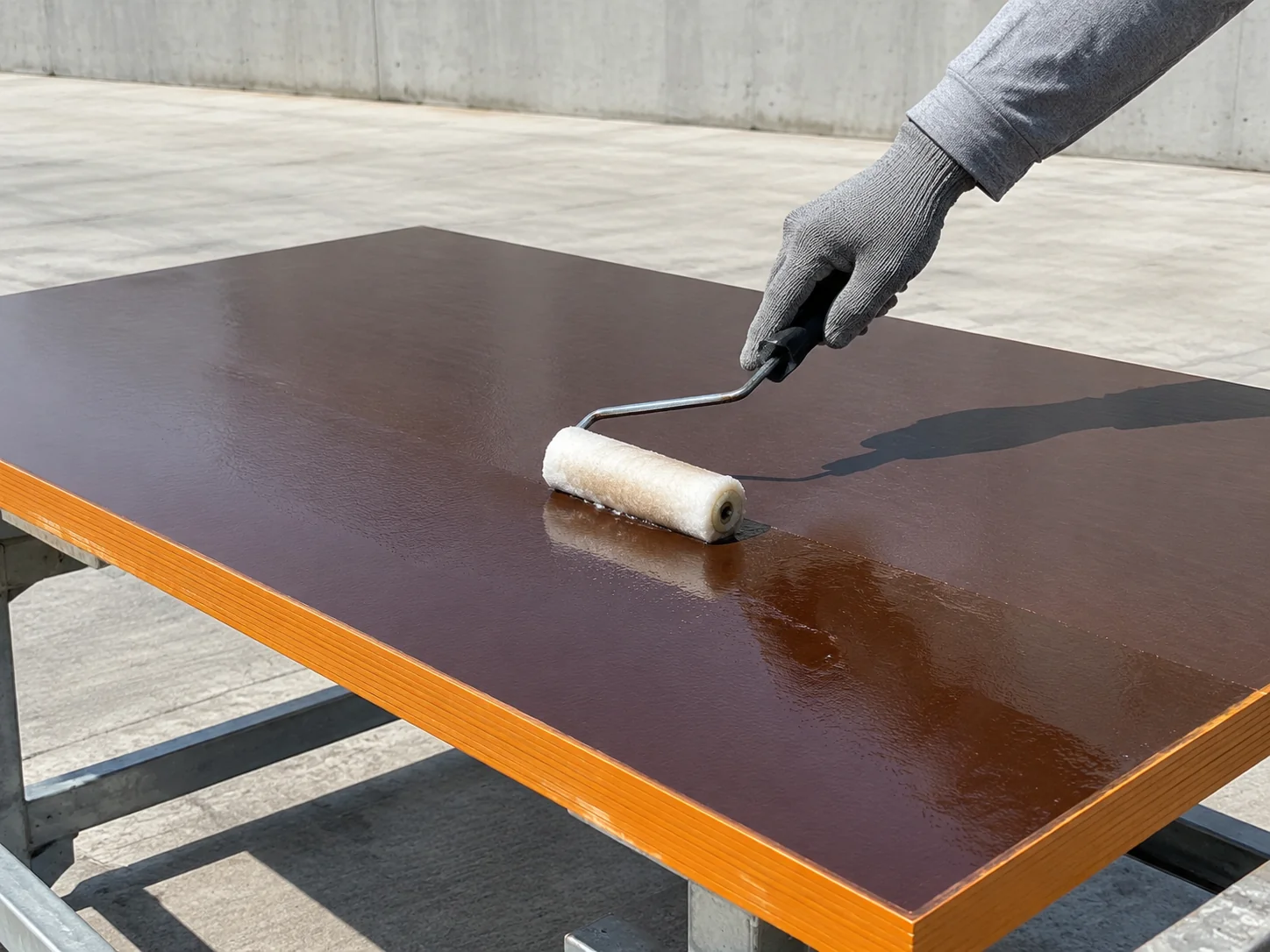
Roll or spray a thin, even coat of release agent on the film before each pour. It stops concrete bonding to the film and protects the face for the next use.
Paint cut edges and drilled holes with edge sealer the same day they are cut. An open edge lets water into the core within a few pours.
Strip with wooden or plastic wedges, not a steel bar against the face, and lower panels instead of dropping them on the slab.
Remove fresh concrete with a soft scraper and water while it is still green; hardened concrete scraped off later takes film with it.
Turn panels between pours where the form allows, and take out any panel with lifted film or a soft edge before it marks the concrete.
Site faults
Most problems that contractors report after a few pours come from handling on site, not from the panel. The faults below are the ones we see most in photos from buyers, with the usual cause and what to change.
If a fault appears on new panels before the first pour, send us photos with the pack numbers so we can check the run record for that production lot and agree the next step with you.
Water has entered through a cut or chipped edge that was not sealed. Paint every cut the same day and store packs off the ground under cover.
Usually follows edge swelling, or concrete scraped off after it hardened. Clean straight after stripping with a soft scraper and water.
Release agent was missed or put on too thin. Coat the film evenly before every pour, including the first one.
Panels were dropped, walked on with boots full of grit or struck with a steel bar. Lower panels and strip with wooden or plastic wedges.
Packs stood on edge or on uneven bearers. Store flat on level bearers with the straps on until the panels are used.
Sizes and thickness
We press 1220 × 2440 mm sheets for most markets and 1250 × 2500 mm sheets for European formwork systems, in any thickness from 9 mm to 40 mm. Custom sizes are cut from your list at the mill, and every cut edge is painted before packing.
Thickness tolerance is ±0.5 mm and length and width tolerance ±2 mm; the tolerance for each order is written on its technical sheet.
European deck systems are drawn around 1250 × 2500 mm panels, often in 21 mm, while most other markets use 1220 × 2440 mm in 12, 15 or 18 mm. We press both sizes on the same lines, so one container can carry both when a contractor works in two systems.
| Thickness | Typical formwork use |
|---|---|
| 9 mm | Curved forms and liners |
| 12 mm | Light wall forms, column boxes, liners on frames |
| 15 mm | Wall and beam sides on timber or steel frames |
| 18 mm | Slab decks and wall forms; the most ordered thickness |
| 21 mm | Heavy slab decks and system formwork on 1250 × 2500 mm sheets |
| 40 mm | Thickest panel we press, for special forms |
Applications
Film faced shuttering plywood is the face of a concrete form: it holds the wet concrete in shape and leaves the surface the client sees. Contractors use it on four kinds of forms.
The same panel can serve several of these forms on one site. Most contractors order one thickness and one film weight for the whole job and keep a smaller lot of thinner sheets for columns, beams and details.
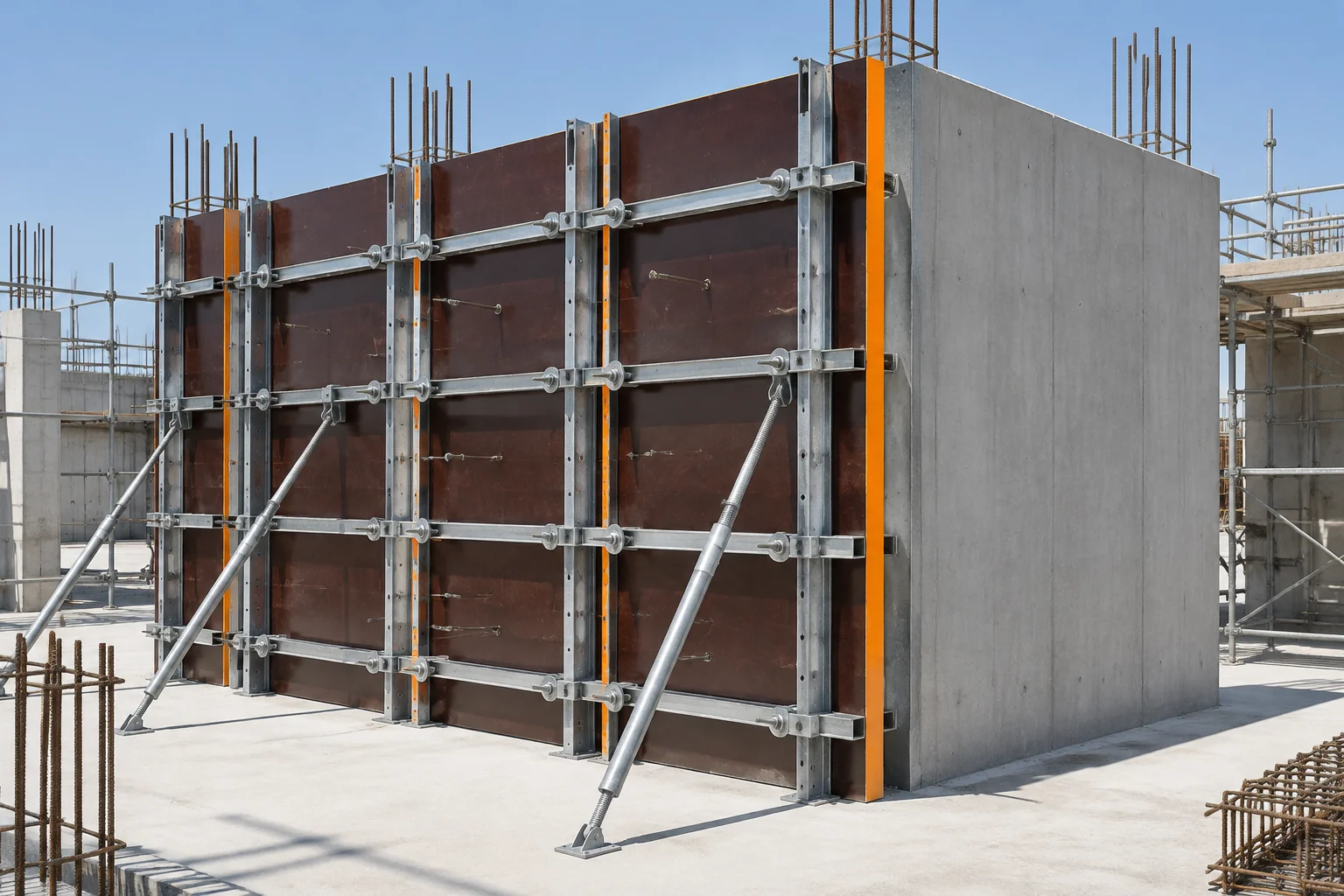
Panels fixed to timber or steel frames for walls and cores; the film leaves a smooth face that needs little finishing. Phenolic panels are the usual choice where the same wall form is struck and reset many times on one building.
18 mm and 21 mm panels on beams and props for floor slabs; 1250 × 2500 mm sheets fit European deck systems. The panel spans between beams, so a stiff, flat core matters more here than on walls.
12 mm and 15 mm panels cut to column and beam sizes; cut edges are painted before use. Small cut pieces have more edge per square metre, so sealing every cut is what decides how long they last.
Phenolic panels with heavier film for repeat pours on civil works and in precast yards. Precast yards reuse the same mould face daily, so they gain most from careful cleaning and release agent.
Compare builds
Buyers weigh our two film-faced builds against each other and against budget panels. Two offers with the same name are often not the same build, so compare core, glue, film weight, edge sealing and tolerance line by line.
For most housing and commercial slabs, MUF panels at about 12–15 pours give the lowest cost per pour. Contractors with repeat wall forms, rental fleets or precast yards choose phenolic panels for up to about 25 pours, because the extra pours outweigh the higher price per sheet.
| Item | MUF film-faced | Phenolic film-faced | Budget film-faced on the market |
|---|---|---|---|
| Pours with handling, release agent and sealed edges | About 12–15 | Up to about 25 | About 4–10 |
| Glue | Melamine (MUF) | Phenolic | Named on the offer, or not |
| Core | Acacia or Eucalyptus | Acacia or Eucalyptus | Varies by offer |
| Typical film | 120–125 g/m² to 130–135 g/m² | 130–135 g/m² to 200 g/m² and above | Check the offer |
| Edges | Painted, all four | Painted, all four | Check the offer |
| Thickness tolerance | ±0.5 mm | ±0.5 mm | Check the offer |
| Best for | Programmes of about 12–15 pours | Repeat forms and rental fleets | Single-use or short jobs |
Checks
Each panel is checked at the press line before it is packed, and the same checks work for your team when the container is opened.
We record the checks per production run against the technical sheet of the order. If your inspector or a third-party company visits before loading, they see the same sheet and the same tolerances: ±0.5 mm on thickness and ±2 mm on length and width.
A pre-shipment inspection is welcome on any order. Tell us the inspection company and the date when you confirm the order, and we plan loading so the inspector can open packs, measure sheets and watch the container being loaded and sealed. The inspector's report then travels with the shipping documents, next to our own run record.
Calipers on every pack sample: within ±0.5 mm of the ordered thickness.
Tape on sample sheets: within ±2 mm of the ordered size, corners square.
Both faces fully covered, no dry spots, bubbles or wood showing through.
All four edges painted, no bare veneer on the long or short side.
Sample pieces from the run are boiled and checked for open glue lines.
Sheets per pack and buyer marks match the packing list before strapping.
Certificates
Our film-faced plywood is made under our own certificates. Copies go out with the quotation; the FSC claim and the order's test documents travel with the shipment papers.
FSC® SGSHK-COC-370674
Chain of custody by SGS Hong Kong; FSC 100% or FSC Mix film-faced plywood, claim printed on the invoice.
CE · FPC 0407-CPR-2146
EN 13986, AVCP System 2+, notified body 0407. Covers structural panels 3.6–30 mm with MUF or phenolic glue.
AS 6669:2016
Our formwork plywood is certified to the Australian formwork plywood standard by CMI Certification.
ISO 9001
Quality management at our mills.
Shipping papers
Every container of film-faced plywood ships with a full set of papers. Certificate copies go out before the order is confirmed; draft shipping documents come to you for approval after loading.
Commercial invoice and packing list
Sheets, packs, cubic metres and weights per pack, with the FSC claim when ordered.
Bill of lading
The scanned B/L releases the 70% balance; the original follows by courier or as a telex release.
Certificate of origin
Form EUR.1 for EU-bound lots, other forms by destination.
Phytosanitary and fumigation papers
For solid-wood pallets and dunnage; plywood itself is processed wood outside ISPM 15.
Insurance certificate
With CIF shipments.
Order certificates and tests
FSC claim, CE documents for structural use, SGS test reports for the agreed build, EUDR files for EU lots.
Packing and loading
Film-faced panels are packed in strapped stacks about 1,000 mm high on export pallets. A 40HC takes 16 Acacia packs or 15 Eucalyptus packs. The figures below are our planning load; the final count follows the booking, the route and the weighed sheets.
Packs are built on wooden or plywood pallet feet, covered and strapped, with the pack number and buyer marks on the side. We never overfill a pack to raise the count: an overloaded pack breaks its pallet feet when it is lifted.
| Core and size | Thickness | Sheets per pack | Sheets per 40HC | m³ per 40HC | Weight per sheet |
|---|---|---|---|---|---|
| Acacia, 1220 × 2440 mm | 12 mm | 83 sheets | 1,328 sheets | 47.4 m³ | 20.7 kg |
| Acacia, 1220 × 2440 mm | 15 mm | 66 sheets | 1,056 sheets | 47.2 m³ | 25.9 kg |
| Acacia, 1220 × 2440 mm | 18 mm | 55 sheets | 880 sheets | 47.2 m³ | 31.1 kg |
| Acacia, 1220 × 2440 mm | 21 mm | 47 sheets | 752 sheets | 47.0 m³ | 36.3 kg |
| Eucalyptus, 1220 × 2440 mm | 18 mm | 53 sheets | 795 sheets | 42.6 m³ | 34.8 kg |
| Eucalyptus, 1220 × 2440 mm | 21 mm | 45 sheets | 675 sheets | 42.2 m³ | 40.6 kg |
| Acacia, 1250 × 2500 mm | 18 mm | 53 sheets | 848 sheets | 47.7 m³ | 32.6 kg |
| Acacia, 1250 × 2500 mm | 21 mm | 45 sheets | 720 sheets | 47.3 m³ | 38.1 kg |
| Eucalyptus, 1250 × 2500 mm | 18 mm | 50 sheets | 750 sheets | 42.2 m³ | 36.6 kg |
| Eucalyptus, 1250 × 2500 mm | 21 mm | 42 sheets | 630 sheets | 41.3 m³ | 42.7 kg |
Planning densities 580 kg/m³ Acacia and 650 kg/m³ Eucalyptus; Eucalyptus loads stop at the payload before the volume is full.
Buy direct from the mill
We sell film-faced plywood by the container, directly from our mills. The minimum order is one 40HC, with one or two builds per container, or three to six by agreement.
Production takes 15–45 days after the 30% deposit, by quantity. The 70% balance is paid against the scanned bill of lading by T/T, or by irrevocable L/C at sight. We quote FOB Hai Phong, CFR or CIF.
Your specification
A film-faced quote is only comparable when the build is written down. Start from the job and the number of pours you need, then fix the glue, film, core and size. Send the points below and we return a technical sheet with the same lines and an FOB, CFR or CIF price.
If you are replacing a panel you already use, send a photo of its edge and its label as well. We match the build on the technical sheet, line by line, and say where ours differs.
Wall, slab, column or precast forms, and the number of pours you plan per panel.
MUF for about 12–15 pours or phenolic for up to about 25, with proper handling.
Colour and weight in g/m², and a film brand if your market asks for one.
Acacia or Eucalyptus core, and the thickness from 9 mm to 40 mm.
1220 × 2440 mm, 1250 × 2500 mm or a cutting list with quantities.
Edge colour, panel and pack marking, and any pallet or strapping rules at your yard.
FSC claim, CE documents for structural use, EUDR dossier for EU orders.
Containers per order or per month, and the port of discharge.
How to order
Application, thickness, size, film colour and weight, glue, quantity and port of discharge.
We reply within hours with the build, tolerances and an FOB, CFR or CIF price.
Free samples of the exact build; new buyers book their own courier.
30% deposit by T/T starts production, which takes 15–45 days by quantity.
Photos of packs and loading; your inspector is welcome at the mill.
Draft documents for approval after loading; the balance is paid against the scanned bill of lading.
Buyer questions
The glue. Melamine (MUF) glue panels give about 12–15 pours and phenolic glue panels up to about 25, with proper handling, release agent and sealed edges. Phenolic also carries heavier film more often.
About 12–15 pours with MUF glue and up to about 25 with phenolic glue, given proper handling, a release agent on every pour and sealed edges, including cut edges.
The film and painted edges keep water out, and our phenolic bond passed EN 314 Class 3, the exterior bond class, on an SGS-tested 21 mm specimen. Seal every cut edge on site.
Dark brown as standard and black to order, from 120–125 g/m² up to 200 g/m² and above. Most buyers take about 130–135 g/m².
About 880 sheets of 18 mm 1220 × 2440 mm Acacia-core panels, or 795 Eucalyptus-core sheets, as planning figures before the booking and weighing.
On a 21 mm dark-brown phenolic specimen with an Acacia core, SGS measured 642 kg/m³ density, bonding Class 3 pass and formaldehyde not detected at 0.04 mg/m³, an E1 pass. Report dated 23 December 2025.
Both are hardwood cores with the same film and glue. Acacia is lighter and loads about 47 m³ per 40HC; Eucalyptus is denser and loads about 43 m³.
18 mm is the most ordered thickness for slab decks and walls. Heavy slab decks and European deck systems often use 21 mm panels in 1250 × 2500 mm.
Yes. We press 1250 × 2500 mm as well as 1220 × 2440 mm, in any thickness from 9 mm to 40 mm, and cut custom sizes to your list.
Panels from 9 mm to 30 mm with MUF or phenolic glue fall inside our CE factory production control certificate 0407-CPR-2146 under EN 13986. CE documents are issued when the panel is ordered for structural use; formwork itself does not need a CE mark.
One 40HC. Production takes 15–45 days after the 30% deposit, depending on quantity.
Yes, samples are free. New buyers book their own courier, and the cost is credited against the first real order.
Yes. Panel stamps, edge colour and pack labels are order fields; we put your marks on the panels and packs and list them on the packing list.
In strapped stacks about 1,000 mm high on pallet feet, covered, with pack numbers and buyer marks. A 40HC takes 16 Acacia or 15 Eucalyptus packs.
Yes. Dark brown is our standard film colour and black is pressed to order, in the same film weights and glue systems.
Quotation
Send the thickness, size, film colour and weight, glue, quantity and port of discharge. We reply within hours with a technical sheet and an FOB Hai Phong, CFR or CIF price.
Lisa, export sales: [email protected]