
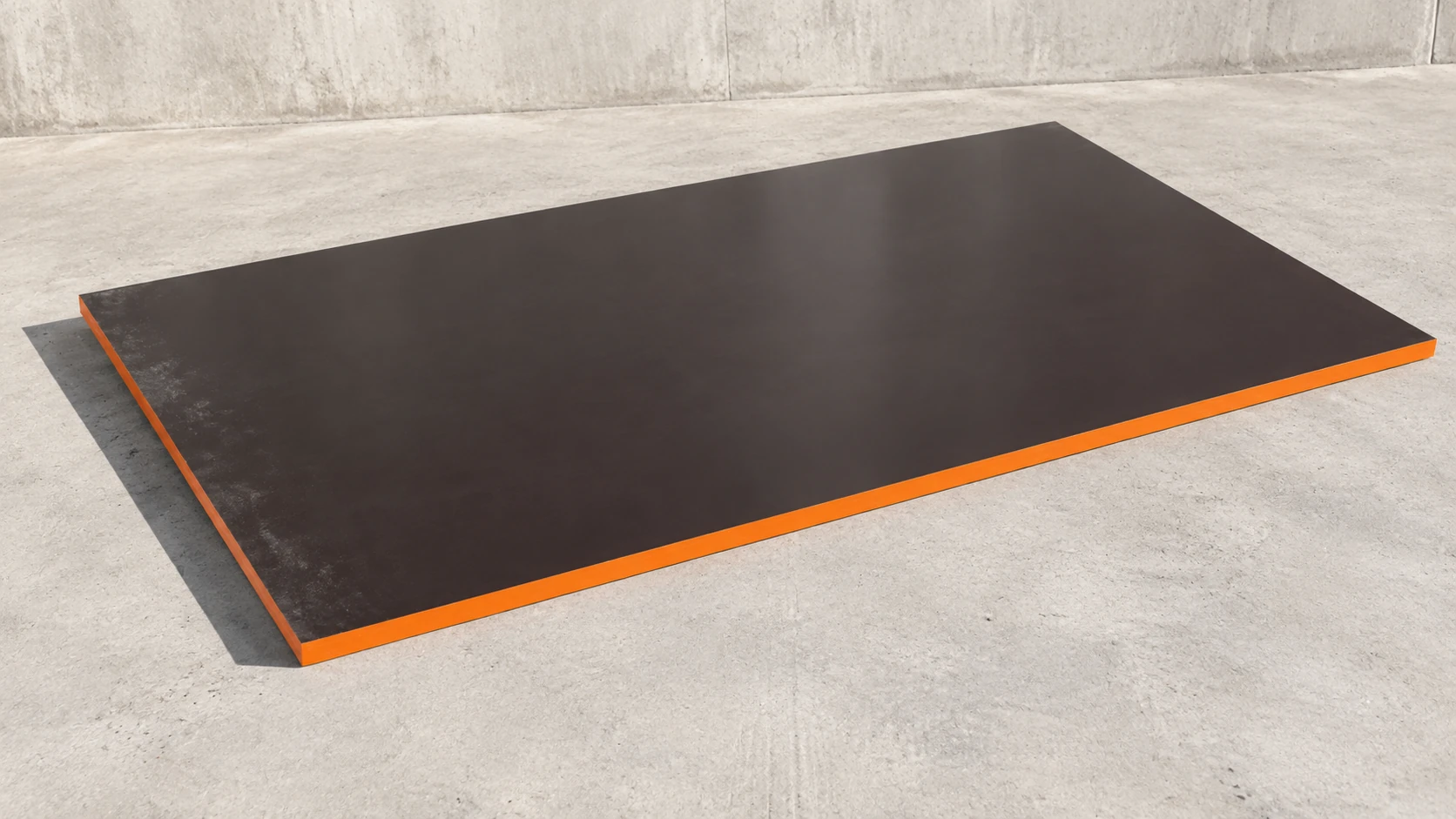
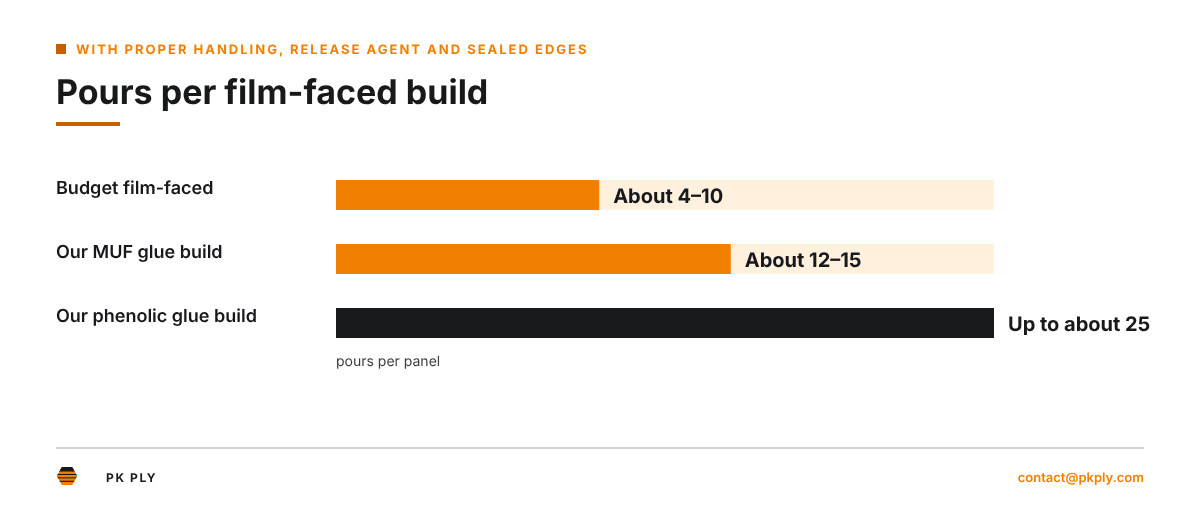
With proper handling, release agent on every pour and sealed edges, our film-faced plywood gives about 12–15 pours with MUF glue and up to about 25 with phenolic glue. Budget panels typically give about 4–10. PK Ply treats the count as a target for a build and a site routine, because a wrong build can halve the pours you paid for.
How many pours does phenolic glue film-faced plywood give compared with melamine glue?
Phenolic glue film-faced plywood gives up to about 25 pours, against about 12–15 pours for melamine (MUF) glue, with proper handling, release agent on every pour and sealed edges, including every cut edge. Budget film-faced panels typically give about 4–10. The glue line sets the ceiling; the site routine decides how close a panel gets to it.
Those are the figures we build to at our two mills in Chi Linh, Hai Phong, and they come with their conditions every time we write them. A reuse count is a target for one build used one way, not a fixed property of a sheet. The same phenolic panel that reaches its count on a crew that oils, strips and stores it well can finish far earlier on a site that pries it off the concrete and leaves cut edges bare.
| Build | Glue line | Pours with proper handling, release agent and sealed edges |
|---|---|---|
| Budget film-faced | Low glue spread, mixed core | About 4–10 |
| Our MUF film-faced | Melamine (MUF) | About 12–15 |
| Our phenolic film-faced | Phenolic | Up to about 25 |
Why phenolic lasts longer comes down to what a wet pour does to a glue line. Each pour soaks the panel’s faces and edges, each strike flexes it, and each dry spell between pours shrinks the wood again. A phenolic glue line keeps its bond through boiling water, which is what the exterior bonding tests check; a MUF glue line is water-resistant and made for fewer wet cycles. Our phenolic film-faced plywood and melamine film-faced plywood pages list each build.
How many times can film faced plywood be reused, and what counts as one pour?
One pour is one full cycle: the panel is fixed, oiled, cast against, stripped, cleaned and found fit for the next pour at the finish the project needs. A panel is finished for that finish when the face no longer leaves an acceptable surface, and finished for formwork altogether when the bond, the flatness or the edges fail.
Counting matters because two sites can quote different numbers for the same panel. One counts every time a sheet went up; the other counts only the pours that left a fair-faced soffit. Write down which rule you use before you compare builds or suppliers. Three service levels are a practical way to do it:
| Service level | Panel condition | Where it goes next |
|---|---|---|
| Finish | Film whole and smooth, edges sealed, panel flat | Visible soffits and walls |
| Standard | Light wear or small sealed repairs, bond sound | Concealed faces, foundations, blinding |
| Retire | Open glue lines, swollen edges, soft spots | Out of formwork use |
A panel that drops from the first level to the second has not failed; it has moved to work where its face no longer matters. That is where much of the real value of a phenolic panel sits: after it stops giving fair-faced concrete, it still gives sound pours on concealed work because its glue line holds.
Why do budget formwork panels fail after only 4 to 10 pours?
Budget formwork panels fail after only about 4–10 pours because the parts that a buyer cannot see are the parts that were saved on: a thin glue spread, a core with gaps and overlaps, light film and thin edge paint. Each pour drives water into those weak points, and the panel opens from the inside before the face looks worn.
The failure order is predictable once you know what to look for:
- Core gaps fill with water. Where core veneers do not meet, the film over the gap has no support; it dents under the vibrator, then cracks, and water reaches the core.
- Thin glue lines open. A low glue spread bonds when dry but does not survive repeated wetting and drying; the plies separate at the edges first.
- Light film wears through. Under scraping and rebar chairs a light film wears down to the face veneer, and the panel starts to stick to the concrete.
- Edges swell. Thin edge paint lets water in at the sides; the edge swells, the joint stands proud and prints a line on the concrete.
A budget sheet is not the wrong buy for every job. On a short programme with few repetitions, or for kickers and blinding, about 4–10 pours may be all the work needs. The mistake is buying it for a slab programme that needs twenty. Two offers called film-faced plywood are often not the same build: core grade, core joining, glue system, film weight, edge sealing and tolerance make the difference, and none of them shows in a photograph.
What inside the panel sets the pour count?
Five parts of the build set the pour count: the core, the glue line, the face veneer under the film, the film itself and the edge sealing. The core and glue decide how long the panel holds together; the film decides how long the face stays smooth; the edges decide where water gets in first.
| Part of the build | What we use | What it does to the pour count |
|---|---|---|
| Core | Acacia or Eucalyptus hardwood veneers laid crosswise | A whole core supports the film and resists dents |
| Glue line | MUF or phenolic | Sets how many wet cycles pass before plies open |
| Face veneers | Smooth hardwood veneers under the film | Keep the film flat and bonded |
| Film | Phenolic film on both faces, black or dark brown | Sets face life under vibrators and scrapers |
| Edges | Water-resistant paint on all four edges | Slows water entry at the sides |
The order of manufacture matters too. Our panels go through veneer intake, drying, core lay-up, glue and press, sizing and sanding, film press, edge sealing, then marking and packing. Sizing and sanding come before the film press for a reason: the pressed core is calibrated to an even thickness first, so the film is bonded onto a flat panel and not onto every bump in the core. A film laid over an uneven core wears through on the high spots first. The production process page shows each step.
Does a heavier film weight add more reuses?
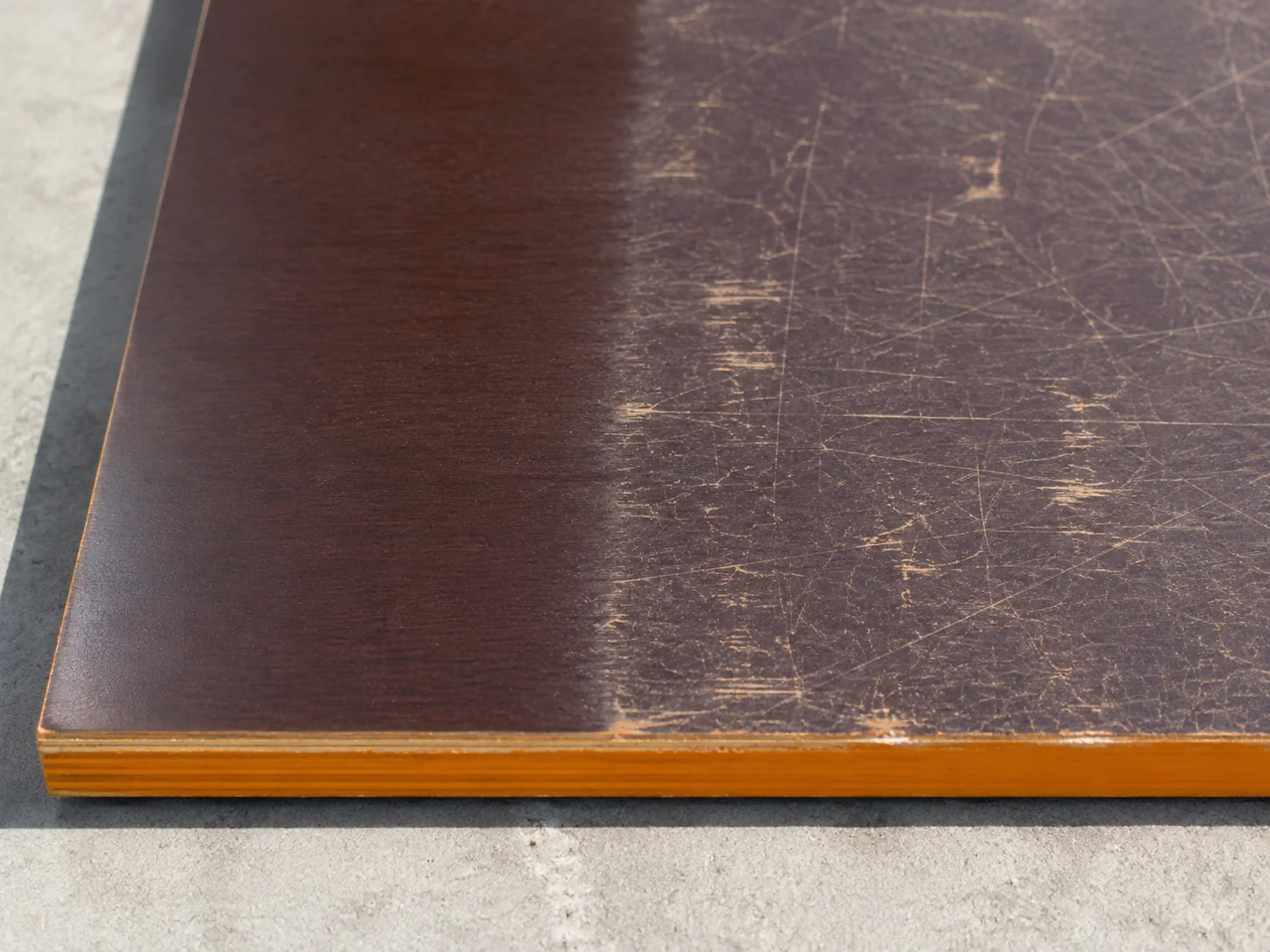
A heavier film adds face life, so it adds reuses on work where the face is what wears out first, such as repeated slab soffits under scrapers and vibrators. It does not strengthen the glue line under it: a heavy film on a MUF panel still has the bond life of MUF. Match the film weight to the glue.
Film weight is an order field, written in grams per square metre of impregnated paper. On our orders it runs from 120–125 g/m², with about 130–135 g/m² the most common choice now, and some buyers specify 165, 185 or over 200 g/m².
| Film weight | How buyers use it |
|---|---|
| 120–125 g/m² | Lower-cost orders, short programmes, concealed work |
| 130–135 g/m² | The most common choice on our orders now |
| 165 or 185 g/m² | Longer face life on repeated slab and wall pours |
| Over 200 g/m² | A heavy face for long programmes on a phenolic build |
The pairing that wastes money is a heavy film on a light glue line: the face outlasts the panel. The pairing that wastes pours is a light film on a phenolic build for a long programme: the face wears through while the bond is still sound, and the panel moves to concealed work early. For a programme planned beyond about 15 pours, order phenolic glue and a film weight in the upper rows of this table.
Does sealing cut edges really change how many times a panel can be reused?
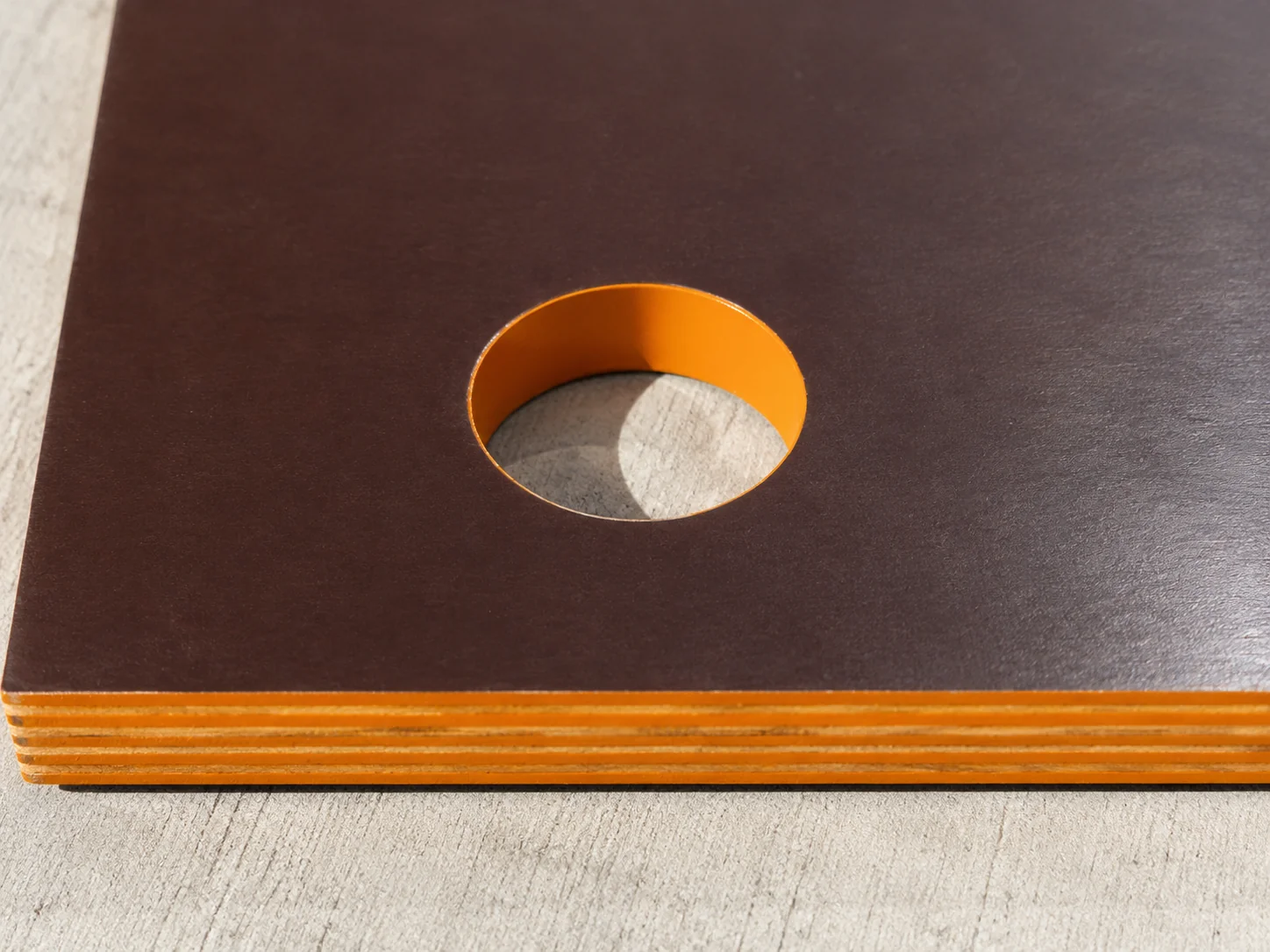
Yes. Sealed edges, including every cut edge and every hole, are one of the three conditions behind our pour figures, together with proper handling and release agent. An unsealed saw cut opens the core to water on the first pour; the edge swells, the joint stands proud and the outer veneer starts to lift.
Edge paint is part of how a panel is made, not a finish added later. In the Construction Products Regulation, factory production control is the documented, permanent and internal control of production in a factory. For panels ordered as structural CE plywood, our mills work under CE factory production control certificate 0407-CPR-2146, shown on our CE marking page.
Our panels leave the mill with water-resistant paint on all four edges. That protects the panel as delivered. On site, every cut, every notch and every tie-rod hole makes a new raw edge that has none of it. Plywood takes water up fastest through its end grain, and a cut edge of a cross-laid panel shows end grain in every second ply.
What to do on site:
- Seal cut edges the same day. Paint every saw cut with an edge sealer before the panel goes into the form.
- Seal holes, not only edges. Tie-rod and fixing holes are cut edges too; coat the inside of each hole.
- Reseal damage after each strike. Corners knocked during stripping open the edge paint; touch them up while cleaning.
- Cut to a plan. A cutting list made before the first pour keeps cut edges to the sheets that need them; we can also cut to size at the mill and seal the cut edges there.
How often should release agent be applied to film-faced formwork?
Apply release agent on every pour: a thin, even coat on the clean film face before each casting. It is one of the three conditions behind our pour figures. Without it, cement paste bonds to the film, stripping takes force, and the face tears a little more on every strike.
What works on site, in the order a crew does it:
- Clean first. Remove cement residue from the last pour with a plastic or wooden scraper and water; never a steel blade or a grinder on the film.
- Coat thin and even. Spray or wipe a thin film of release agent over the whole face; wipe off pools, which stain the concrete.
- Use an agent made for film-faced formwork. Follow its maker’s instructions for coverage and drying; used engine oil or diesel is not a release agent and can damage the film and mark the concrete.
- Recoat after rain or delay. A face washed by rain or left for days before the pour gets a fresh coat.
Release agent is also the cheapest way to add pours. A face that releases cleanly needs no prying, and prying is what tears film at the corners. Our film-faced plywood page lists the builds that each routine is written for.
Which damage usually ends a formwork panel’s life first, the edges or the face?
On most sites the edges go first: an unsealed cut, a knocked corner or a tie-rod hole lets water into the core, the edge swells and the panel stops sitting flush. The face goes first when edges are sealed but the panel is scraped with steel, stripped by force or stored wet in the sun.
| Where it fails | What you see | The usual cause | What stops it |
|---|---|---|---|
| Cut edges | Swelling, a raised joint line on the concrete | Saw cuts left unpainted | Seal every cut the same day |
| Corners | Torn film, lifted outer veneer | Prying with bars, dropping panels | Release agent, lower panels by hand |
| Holes | Swelling around tie-rod holes | Holes drilled and left raw | Coat the inside of each hole |
| Face | Dull, scratched film, wood showing | Steel scrapers, light film | Plastic scrapers, heavier film |
| Whole panel | Bow, twist | Storage on edge, wet stacks | Flat storage on level bearers, covered |
| Glue line | Plies separating | Glue not made for the wet cycles | Phenolic glue for long programmes |
Edge failure is also the cheapest to prevent, which is why it is the first thing we ask about when a buyer reports a short pour count. A can of edge sealer costs little against a panel lost in four pours. Face wear is harder to stop because it is the job the film does; that is where the film weight in the order earns its price.
Site practice, pour by pour: the routine that reaches the count
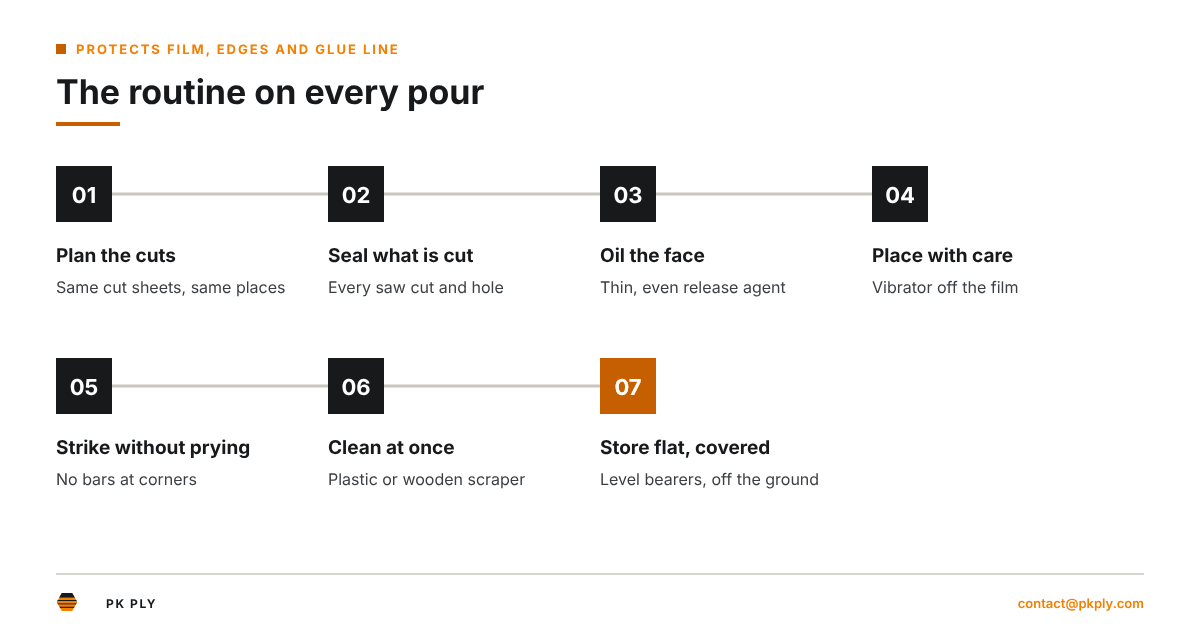
The routine that reaches the count has seven steps, repeated on every pour: plan the cuts, seal what is cut, oil the face, place and vibrate with care, strike without prying, clean at once, and store flat and covered. Each step protects either the film, the edges or the glue line.
- Plan the cuts. Fix a panel layout for the repeating floors, so the same cut sheets return to the same places.
- Seal what is cut. Every saw cut and hole gets edge sealer before the panel is fixed.
- Oil the face. A thin, even coat of release agent on every pour.
- Place and vibrate with care. Keep vibrator heads off the film and avoid dropping rebar or tools on the deck.
- Strike without prying. Lower panels by hand or with the system’s release; bars at the corners tear film.
- Clean at once. Scrape residue with plastic or wood and rinse while it is soft.
- Store flat and covered. Stack panels flat on level bearers off the ground, film to film, covered from sun and rain, with air between stacks.
A crew that follows this routine gets close to the build’s figure. One that skips steps 2, 3 and 5 can turn a phenolic panel built for up to about 25 pours into one that gives far fewer. That is why the count is always written with its conditions.
Does thicker plywood give more pours?
Not by itself. Thickness sets how stiff the panel is on its supports, so a thicker panel bows less under wet concrete; it does not change the glue line, the film or the edges, which set the pour count. An 18 mm and a 21 mm panel of the same build reach about the same number of pours.
Thickness does change the pour count indirectly in two cases. A panel that is too thin for its support spacing bends more on every pour, and repeated bending fatigues glue lines and cracks film over the supports. And a thin panel cut into many small pieces carries more cut edges per square metre. The cure in both cases is the right thickness for the span, not a thicker panel everywhere.
Our everyday formwork thicknesses are 12, 15, 18 and 21 mm, from a 9–40 mm range. The 18 mm note and the 21 mm note give each build line by line.
Does black film last longer than brown film?
No. Black and dark brown film are both phenolic-impregnated paper, and colour is not a grade. The film weight in g/m² and the glue under it decide how long the face lasts. Colour helps a site tell two suppliers or two grades apart, and shows how evenly release agent was spread.
If a site has had a good run from black panels and a poor one from brown, the cause is almost always the build behind the colour: a lighter film, a MUF glue line, or a core with gaps. Write the film weight beside the colour on the order, and the film brand if your site prefers one; then the colour stops being a guess about grade.
When should a panel be repaired, moved to concealed work or retired?
Repair a panel when the damage is local and the bond is sound: a small torn patch of film, a knocked corner, a chipped edge. Move it to concealed work when the film is worn but the panel is flat and whole. Retire it when glue lines open, edges have swollen or the core has gone soft.
| Condition after a pour | Decision |
|---|---|
| Small torn patch of film, corner knock, chipped edge paint | Repair: fill or patch, reseal the edge, keep in its class |
| Film worn dull over most of the face, bond and edges sound | Move to concealed work or blinding |
| Edge swollen less than the joint can tolerate | Trim and reseal, then reuse as a cut piece |
| Plies separating, soft spots, bow that will not lie flat | Retire from formwork |
Two rules keep the decision honest. Never paint over an open glue line and count the panel as repaired; the next pour opens it further. And mark retired panels so they do not return to the deck by mistake. A panel that moves to concealed work is still giving pours; a panel kept on fair-faced work too long costs more in concrete repair than it saves in plywood.
What our glue-line test shows, and what it does not
The bond evidence behind our phenolic build comes from one submitted 21 mm Acacia-core phenolic specimen. In an SGS Vietnam report dated 23 December 2025, it passed EN 314 bonding Class 3 after a 24 h water soak, boil-dry-boil and 72 h boiling pretreatments. That shows the glue line survives boiling; it does not count pours.
The test methods themselves are published standards. EN 314-1 sets the test methods for plywood bonding quality. EN 314-2 specifies requirements for bonding classes of veneer plywood according to their end uses. Class 3 is the class for exterior conditions, the class a glue line on formwork is asked to reach.
What a specimen result gives a buyer is evidence that the phenolic glue line is the kind that keeps its bond through repeated wetting. What it does not give is a pour count for every panel: one specimen is one specimen, and the pours depend on the film, the edges and the site as much as the glue. Our SGS specimen note reads the whole report.
Can a reuse figure be written into my order specification?
Yes, as a pour target with its conditions: for example “up to about 25 pours, phenolic glue, with proper handling, release agent on every pour and sealed edges”. We then fix the build that serves that target on the technical sheet: glue, film weight, core, edge sealing and tolerance. The target guides the build; the build is what we guarantee.
The pour target sits beside the class the panel is ordered to. EN 636 specifies requirements for plywood for general purposes or structural application in dry, humid or exterior conditions. Formwork meets wet concrete, so the order names the exterior class and its matching glue line, and the pour target then sets the film and the glue system on top of that class.
A pour target on an order does three useful things. It tells us which glue line to use, because a target above about 15 pours is a phenolic order. It sets the film weight, because a long programme on fair-faced work needs a face that lasts. And it gives both sides a number to check against a pour log if the panels finish early.
What it cannot be is a warranty that ignores the site. The same panels reach very different counts in different hands, so we write the conditions next to the number on every technical sheet. A buyer who wants to test a target before scaling up can start with one container of one or two builds and log the pours.
A pour log for the first container
A pour log turns a supplier’s figure into your own number. Mark each panel or each pack with an ID, then record after every pour where it was used, what it formed, whether release agent and edge sealer were applied, and what state it was in at stripping. After a floor or two, the log shows the real count per build.
| Log field | What to record |
|---|---|
| Panel or pack ID | Marked on the panel edge or the pack |
| Build | Glue, film weight, thickness from the technical sheet |
| Pour number and date | One line per pour |
| Location and use | Slab soffit, wall, column; visible or concealed |
| Release agent and sealing | Applied before this pour: yes or no |
| State at stripping | Film, edges, flatness, bond |
| Decision | Keep, repair, move to concealed work, retire |
The log is also the fastest way to settle a dispute. If a panel built for about 12–15 pours finished at five, the log shows whether the cut edges were sealed and the face was oiled. If they were, the build is the question, and we want to know.
What more pours are worth on a programme
More pours are worth the sheet price divided by the pours reached, so the build to buy is the one with the lowest cost per pour for your programme. If both builds reach their figures, a phenolic panel at up to about 25 pours stays cheaper per pour than a MUF panel at about 15 for as long as its sheet price is less than 25 ÷ 15, about 1.67 times the MUF price.
The same arithmetic shows when MUF is the better buy. On a programme of about twelve pours, a phenolic panel’s extra pours are never used, and the lower MUF sheet price wins. On a programme of thirty pours, both builds need replacing once, and the comparison becomes the cost of two sets. Our note on cost per pour works the numbers through with container loads and listed sheet prices.
The lines to send for a pour-target order
A pour-target order needs seven lines: the application and pour target, glue, film weight and colour, core, thickness, sheet size, and edge sealing, with the quantity and the port. With them we return a technical sheet for the build and an FOB Hai Phong offer per cubic metre.
| Line | What to write | Example for a long slab programme |
|---|---|---|
| Application and pour target | What it forms, pours planned | Slab soffits, up to about 25 pours |
| Glue | MUF or phenolic | Phenolic |
| Film | g/m² and colour | 185 g/m², black, both faces |
| Core | Acacia or Eucalyptus | Acacia |
| Thickness and size | mm | 18 mm, 1250 × 2500 mm |
| Edges | Sealing | Water-resistant paint, all four edges, cut edges sealed |
| Quantity and port | 40HC or m³, port | One 40HC, CIF Jebel Ali |
Our minimum is one 40HC, which can carry one or two builds and up to six by agreement, so a first container can hold a MUF build and a phenolic build side by side for a logged comparison. Production takes 15–45 days after the 30% deposit. Send the lines through the specification form or to [email protected].
Questions buyers ask us
How many times can film faced plywood be reused?
Our MUF-glue film-faced plywood gives about 12–15 pours and our phenolic-glue build up to about 25, with proper handling, release agent on every pour and sealed edges. Budget panels typically give about 4–10.
Can film faced plywood be reused 20 times?
A phenolic-glue build can pass 20 pours, since ours reaches up to about 25 with proper handling, release agent and sealed edges. A MUF-glue panel is built for about 12–15, so twenty pours is a phenolic order.
What counts as one reuse of a formwork panel?
One reuse is one cycle of fixing, pouring, stripping and cleaning that still leaves the panel fit for the next pour at the finish your project needs. Count the pours a panel survives at that finish, not the times it was lifted.
Does black film last longer than brown film?
No. Black and dark brown are both phenolic films, and the colour does not set the grade; the film weight in g/m² and the glue under it decide how long the face lasts.
Does thicker plywood give more reuses?
Not by itself. Thickness sets stiffness on the supports; the glue line, the film, the edge sealing and the site routine set the pour count, so an 18 mm and a 21 mm panel of the same build reach about the same number of pours.
Can a scratched film-faced panel still be used?
Yes, if the scratch has not cut through the film into the wood: it can go on concealed or lower-finish work. A cut that shows bare wood should be sealed the same day, or water will swell the veneer under it.
Why does my film-faced plywood delaminate after a few pours?
Early delamination usually means a glue line that cannot take repeated wetting, a gapped core, or water entering through unsealed cut edges and holes. A phenolic glue line with sealed edges resists it far longer than a low-spread budget build.
How should film-faced panels be stored between pours?
Clean them, stack them flat on level bearers off the ground, film to film, and cover them from sun and rain while letting air through. Panels stood on edge or stacked wet bow and swell.
Do you guarantee a number of pours?
We build to a pour target and write the build on the technical sheet, but the count also depends on how the site handles, oils, cuts and stores the panels, so we give it with those conditions rather than as a warranty.
Which glue should I order for a long slab programme?
Phenolic glue, with a film weight to match, for a programme planned beyond about 15 pours. For shorter programmes a MUF-glue build at about 12–15 pours is the lower-cost choice.