
A plywood quotation format for formwork needs ten fields: application and pour target, core, glue, film weight and colour, thickness, sheet size, tolerance, edge sealing, certificates, and the container and terms. PK Ply quotes on exactly those lines. Leave one blank and the offer fills it with the cheaper choice, which shows up after a few pours.
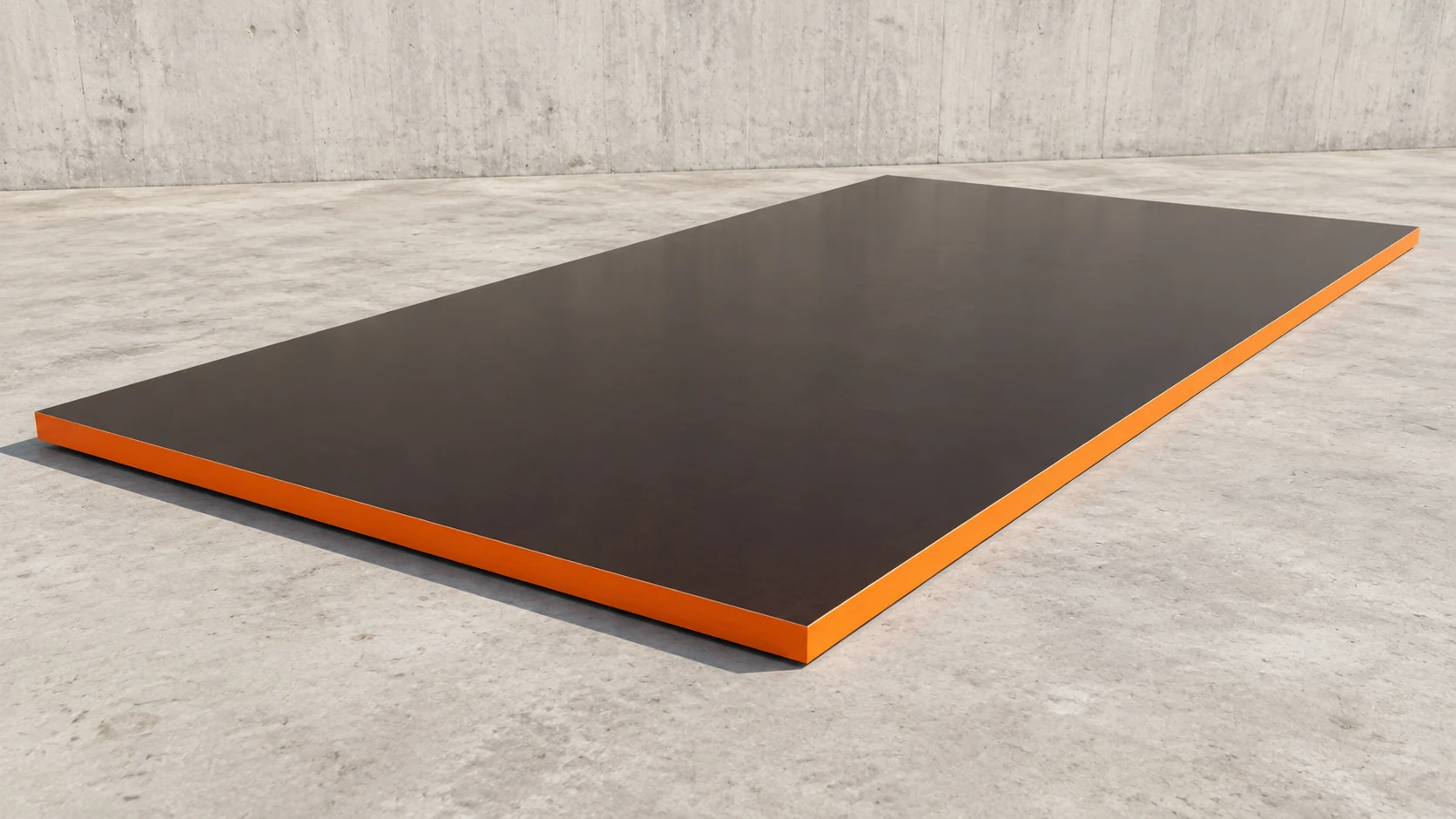
What should I specify when ordering film-faced plywood for concrete formwork?
Specify ten lines when ordering film-faced plywood for concrete formwork: the application and pour target, core species, glue, film weight and colour, thickness, sheet size, tolerance, edge sealing, the certificates you need, and the quantity, Incoterm and port. Each line changes the panel, the price or the papers.
A request that names only “18 mm film-faced plywood, WBP” leaves eight of those ten lines to the seller. Two film-faced offers with the same name are often not the same build: core grade, joining, glue system, film weight, edge sealing and tolerance make the difference. A complete request is the only way to compare two offers like for like, and the only way to check the panels against something when they arrive.
Start from the job, not from the panel. The application and the number of pours you plan decide the glue and the film; the formwork system decides the thickness and the size; the market decides the certificates. The panel follows. That order of thinking is built into the quotation format below, and into the technical sheet we return with every offer from our two mills in Chi Linh, Hai Phong.
The plywood quotation format, field by field
A plywood quotation format for formwork panels is a table of ten fields, each with the choices a mill can quote on. Fill every field, even with “your standard”, so the offer states what it assumes. The format below is the one we quote on.
| Field | What to write | Our options |
|---|---|---|
| 1. Application and pours | What the panel forms and how many pours you plan | Slab, wall, column, deck; pour target |
| 2. Core | Species | Acacia or Eucalyptus hardwood veneers, laid crosswise |
| 3. Glue | Glue system | Melamine (MUF) or phenolic |
| 4. Film | Weight in g/m² and colour, both faces | 120–125 g/m² to over 200 g/m²; black or dark brown; anti-slip patterns |
| 5. Thickness | mm | 9–40 mm; everyday 12, 15, 18 and 21 mm |
| 6. Sheet size | mm, or a cutting list | 1220 × 2440 mm, 1250 × 2500 mm, or cut to size |
| 7. Tolerance | Thickness and length/width | ±0.5 mm and ±2 mm as standard |
| 8. Edges | Sealing | Water-resistant paint on all four edges |
| 9. Certificates | What your market or buyer needs | CE to EN 13986, FSC claim, test reports, AS 6669, EUDR file set |
| 10. Quantity and terms | Containers, Incoterm, port | One 40HC minimum; FOB Hai Phong, CFR or CIF |
Copy the table into your request and fill the second column. If a line does not matter to you, write “your standard” and the offer will name what that is. An offer that comes back with a blank line has not quoted on it.
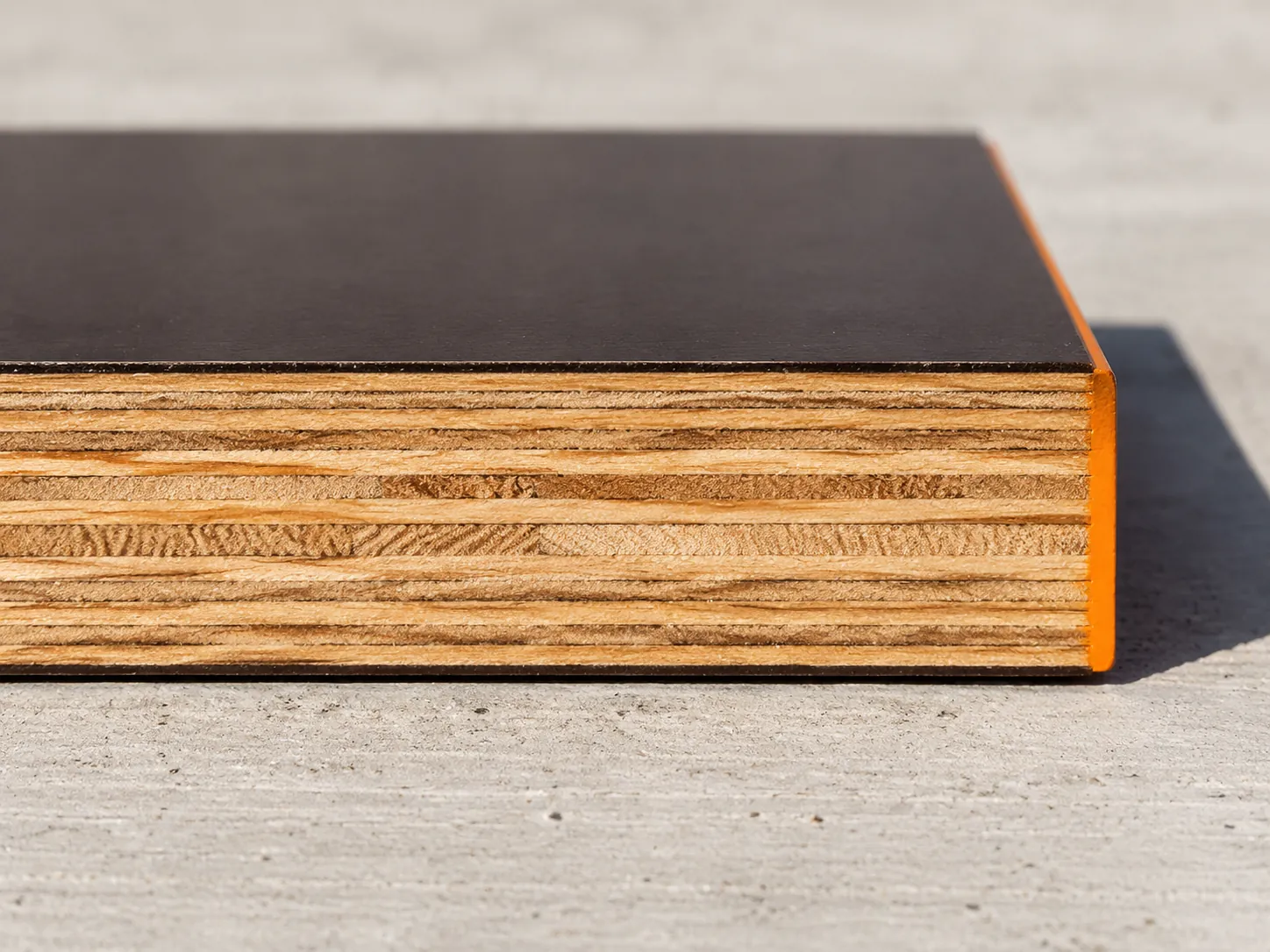
What thickness plywood for formwork?
For formwork, 18 mm is the common thickness for slabs and walls on 1220 × 2440 mm sheets, and 21 mm on many European beam and frame systems drawn around 1250 × 2500 mm panels. 12 and 15 mm suit walls, columns and light or curved work on close supports. The formwork system and the support spacing decide.
Stiffness is why thickness matters. Bending stiffness grows with the cube of thickness, so for the same build a 21 mm panel is about 1.59 times as stiff as an 18 mm one, and a 12 mm panel about 0.30 times. A thicker panel spans wider support spacing with less bow; it also weighs more and fills a container with fewer sheets.
| Thickness | Common formwork use | Sheets per 40HC, Acacia core, 1220 × 2440 mm (planning) |
|---|---|---|
| 12 mm | Walls and columns on close supports, curved work | 1,328 sheets |
| 15 mm | Walls, light slabs | 1,056 sheets |
| 18 mm | Slabs and walls, the common general thickness | 880 sheets |
| 21 mm | European beam and frame systems, wide spacing | 752 sheets |
Write the thickness your system is drawn for. Where you are unsure, write the support spacing and the pour height, and your formwork designer or ours can check the panel. Our notes on 18 mm and 21 mm film-faced builds give each one line by line.
Which film weight should I put on the quote request?
Put the film weight in g/m² and the colour for both faces on the quote request. About 130–135 g/m² is the most common choice on our orders now; 120–125 g/m² suits lower-cost orders and short programmes, and 165, 185 or over 200 g/m² long programmes and fair-faced work.
A film weight written on the request is a film weight the offer must match. Without it, the offer quotes the film the seller chooses, and film is one of the lines a low price is usually built on. The colour line is separate: black and dark brown are both phenolic films, and colour is not a grade.
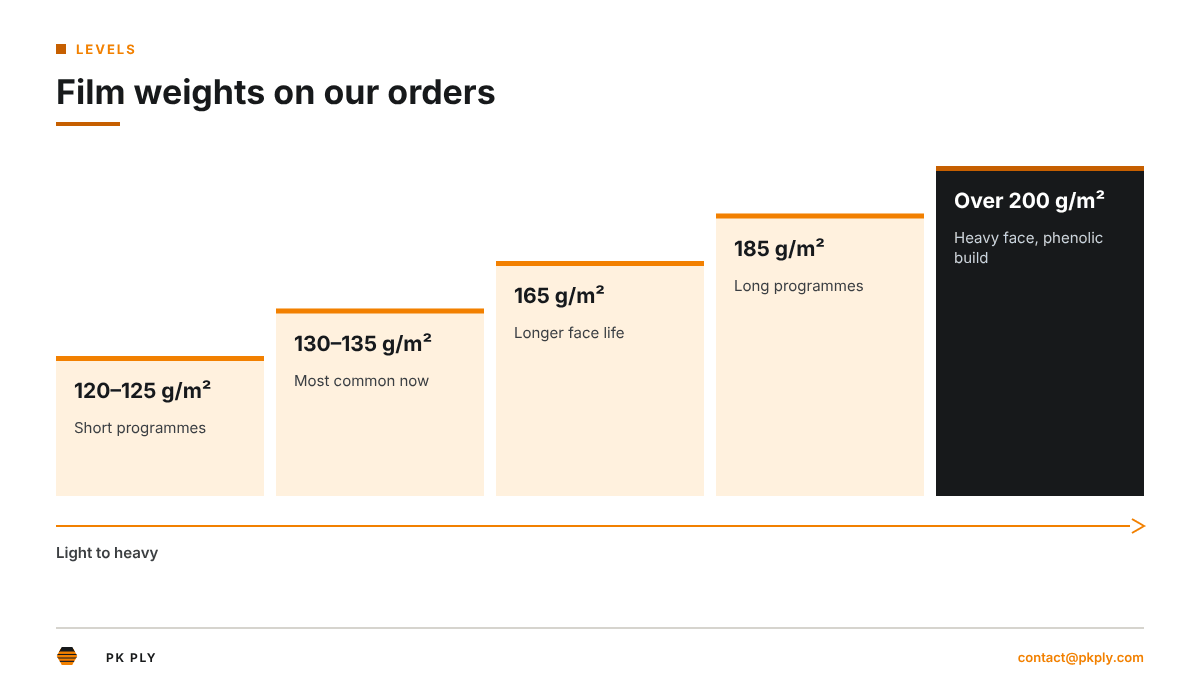
Match the film to the glue. A heavy film keeps the face smooth through more strikes, but on a MUF glue line the panel still has the bond life of MUF. So a request for 185 g/m² usually goes with phenolic glue, and a request for 120–125 g/m² with MUF.
Should the quote name MUF or phenolic glue?
Yes, the quote should name the glue: melamine (MUF) or phenolic. With proper handling, release agent on every pour and sealed edges, our MUF panels give about 12–15 pours and our phenolic panels up to about 25. Name the glue by the pours your programme needs, and ask for the test report.
“WBP” on a request does not name a glue. It is a trade term that sellers use for anything from a phenolic bond to a melamine-fortified one. What a buyer can check is a bonding class. EN 314-2 specifies requirements for bonding classes of veneer plywood according to their end uses. Class 3 is the exterior class; our SGS report of 23 December 2025 shows class 3 passed on one submitted 21 mm phenolic specimen after a 24 h soak, boil-dry-boil and 72 h boiling.
| Glue line on the request | Pours with proper handling, release agent and sealed edges | Usual pairing |
|---|---|---|
| Melamine (MUF) | About 12–15 | Film 120–135 g/m², medium programmes |
| Phenolic | Up to about 25 | Film 130 g/m² and heavier, long programmes |
The two glue systems cost differently, and the phenolic one is often the lower cost per pour where the site uses the pours. Our FOB price note works through that comparison.
How do I state a reuse target in the specification?
State a reuse target as a number of pours with the conditions beside it: “about 20 pours with release agent on every pour, sealed cut edges and flat covered storage”. A reuse target is a goal for a build and a site routine, not a property of a sheet, so the specification names both.
Writing the target lets the mill choose the glue and film that can reach it. A request for 8 pours and a request for 20 pours should not get the same panel; the first may be met by a MUF build with a 120–125 g/m² film, the second needs phenolic glue and a heavier film. Budget film-faced panels typically give about 4–10 reuses, and a target above that range is the line that rules them out.
The conditions are half of the target. The same panel gives very different counts on a site that oils every face and seals every cut, and on one that drops panels from height and leaves them in water. Our note on how many pours a panel gives lists the site routine that a pour target assumes.
Core species, sheet size and tolerance lines
Write the core species (Acacia or Eucalyptus), the sheet size (1220 × 2440 mm, 1250 × 2500 mm or a cutting list) and the tolerance (our standard is ±0.5 mm on thickness and ±2 mm on length and width). These three lines set the sheet weight, the fit with your system and how flat the joints close.
| Line | Acacia core | Eucalyptus core |
|---|---|---|
| Planning density | 580 kg/m³ | 650 kg/m³ (measured 650–750 kg/m³) |
| 18 mm sheet, 1220 × 2440 mm | About 31.1 kg | About 34.8 kg |
| 18 mm sheet, 1250 × 2500 mm | About 32.6 kg | About 36.6 kg |
| Per 40HC (planning) | About 47 m³ | About 43 m³ |
Species is a real choice, not a grade. Acacia gives a lighter sheet and a fuller container; Eucalyptus a denser sheet, which some buyers prefer for stiffness. Sheet size follows the system: 1250 × 2500 mm is common on European beam decks, 1220 × 2440 mm (8 × 4 ft) in most other markets, and nothing is pressed larger than 1250 × 2500 mm. Tolerance is written on the technical sheet for each order, so a tighter one for fair-faced work goes on the request.
Edges, cut sizes and anti-slip faces
The edge line should say “water-resistant paint on all four edges”, and a cutting list should add “cut edges sealed”. Anti-slip panels are a separate line: a patterned film face, rice, hexagon or wire-mesh pattern, on an Acacia or Eucalyptus core, with the film and duty confirmed per order.
Edges are where a film-faced panel takes water first, so an offer that does not say how the edges are sealed has left a line open. Cut sizes save site time on repeat floor layouts and frame systems; send the list with quantities per size, and each cut edge is sealed before packing. Our cut-to-size formwork panels page shows how a cutting list is quoted.
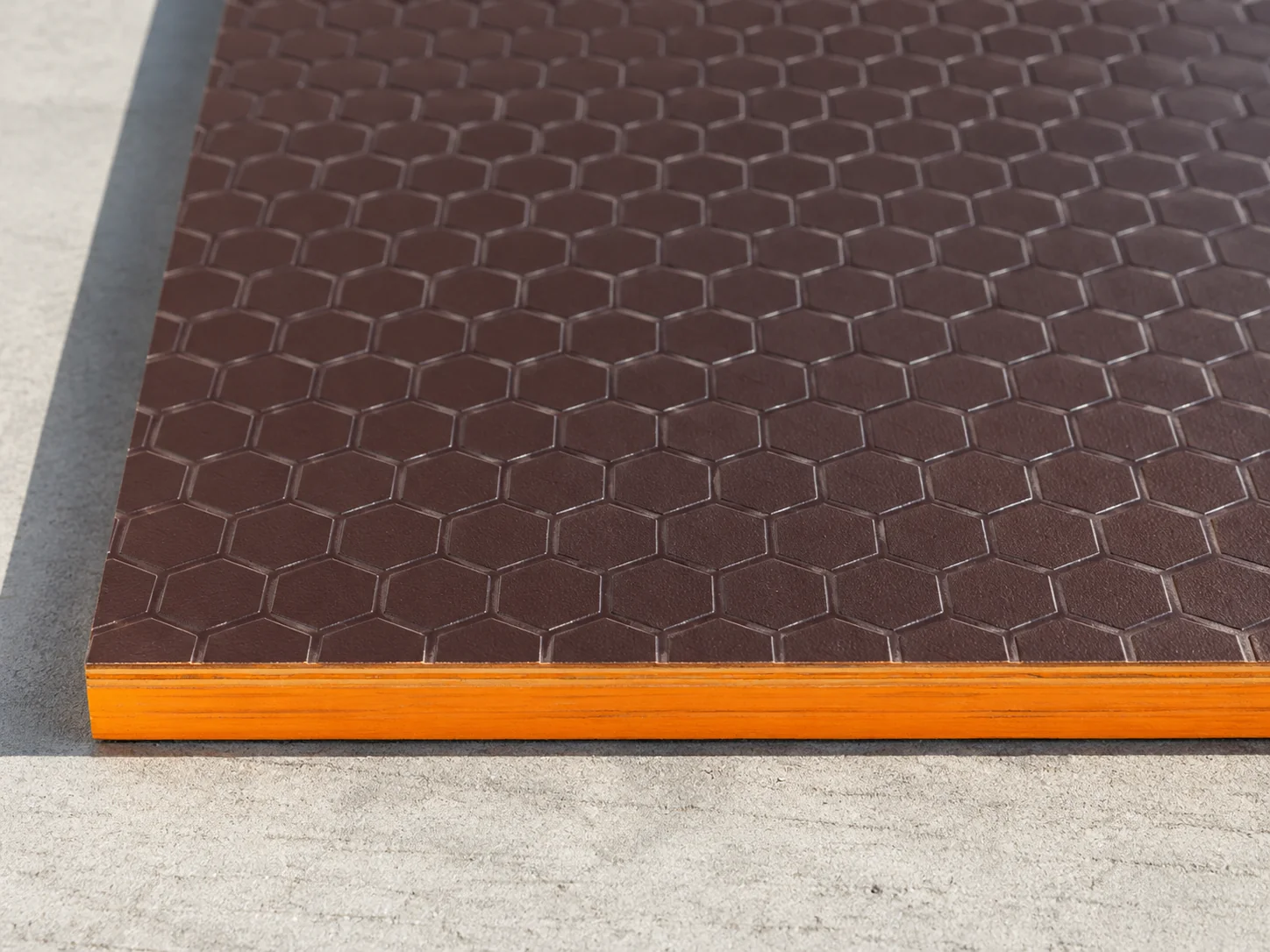
For anti-slip panels on platforms, walkways or vehicle floors, write the pattern, the film and the thickness. Our catalogue lists a 220 g/m² anti-slip reference. Two anti-slip specimens were pendulum-tested by SGS to DIN EN 16165, with results of 58 dry and 40 wet on one and 60 dry and 53 wet on the other; no slip class or field-safety guarantee is claimed from them. The anti-slip plywood page shows the patterns, and our certification hub holds the test reports and certificates behind each line.
Can one 40HC quote mix several thicknesses?
Yes. One 40HC quote can mix several thicknesses: a container usually carries one or two products, and three to six can be mixed by agreement. The offer lists each thickness with its sheets, packs and cubic metres, because each mix changes how full and how heavy the container can be.
Write the mix as a table on the request: thickness, size, build and the number of sheets or square metres you need of each. A mix of 18 mm slab panels and 12 mm wall panels of the same build is simple; a mix of Acacia and Eucalyptus cores in one container fills it to neither 47 nor 43 m³ but somewhere between, and the weight limit decides. Packs are planned about 1,000 mm high, with sheets per pack set by the thickness and then capped by weight.
| Example mix, Acacia core, 1220 × 2440 mm | Packs (planning) | Sheets |
|---|---|---|
| 18 mm phenolic, slab panels | 8 packs of 55 | 440 sheets |
| 12 mm phenolic, wall panels | 8 packs of 83 | 664 sheets |
| One 40HC in all | 16 packs | 1,104 sheets |
That example is a planning figure built from our packing model, not a packing list; real sheets are weighed before final loading. The 40HC loading page shows how packs go in.
Which certificates should the quotation name for an EU order?
An EU quotation should name CE to EN 13986 with a declaration of performance when the panel is used structurally, the FSC claim if you sell FSC, the test report for the configuration, and the EUDR file set for your due diligence. Our CE scope under certificate 0407-CPR-2146 is 3.6–30 mm, so the panel quoted must fall inside it.
CE marking for construction plywood rests on the harmonised standard. EN 13986 covers characteristics, evaluation of conformity and marking of wood-based panels for use in construction. In the Construction Products Regulation, factory production control is the documented, permanent and internal control of production in a factory. Our certificate comes from Istituto Giordano, notified body 0407, for structural plywood with MUF or phenolic glue, AVCP System 2+.
| Certificate line on an EU request | When to write it | What comes with the order |
|---|---|---|
| CE to EN 13986, structural | Panel used as part of a structure, or market asks for CE | Declaration of performance for the thickness |
| EN 636 service class | Always, to name the conditions | EN 636-3 for exterior formwork |
| FSC 100% or FSC Mix | You sell FSC | Claim on the sales documents, code SGSHK-COC-370674 |
| Test report for the configuration | Always | Report matched to the glue and build |
| EUDR file set | Every EU-bound lot | Geolocation dossier with GeoJSON files |
EN 636 specifies requirements for plywood for general purposes or structural application in dry, humid or exterior conditions. For a formwork panel that meets wet concrete, write the exterior class. The papers that travel with each container are listed in our note on the documents with each container.
Is WBP always required for formwork plywood?
A weather- and boil-proof bond is required for formwork plywood, but the letters “WBP” on a quote are not enough to prove it. Ask for the glue by name, MUF or phenolic, and for a test report showing bonding class 3 to EN 314-2, which is the exterior class a formwork panel needs.
The trouble with “WBP” is that it has no test of its own on a quote. A seller can write it over a phenolic bond, a melamine-fortified bond or an interior glue line with a little melamine in it, and all three look the same on arrival. The bonding class, tested by a laboratory after soaking and boiling, is what separates them. That is why our request format has a glue line and a certificate line, and no line for “WBP”.
What causes delamination in formwork plywood, and which fields prevent it?
Delamination in formwork plywood comes from a glue line that cannot survive wet cycles, from voids in the core, and from water entering bare edges. The fields that prevent it are glue (phenolic or MUF, with a class 3 test report), core (crosswise veneers with no gaps), and edges (paint on all four edges, cut edges sealed).
| Cause | What it looks like | Field that prevents it |
|---|---|---|
| Glue line for dry use | Plies open after a few wet pours | Glue named, bonding class 3 test report |
| Voids or overlaps in the core | Soft spots, dents under concrete pressure | Core species and lay-up; a sawn sample |
| Bare edges and cut edges | Swollen edges, open joints | Paint on all four edges; cut edges sealed |
| Thin film on a rough face | Film wears through, face lifts | Film weight in g/m² on smooth face veneers |
| Site handling | Damage at corners, film torn by levers | Reuse target with its site conditions |
Most of these are invisible on arrival, which is why they belong on the request and on the technical sheet. A sawn sample and a small boil test before ordering show the core and the glue line of the build you are being offered.
Reading the technical sheet we send back
The technical sheet we send back repeats every line of your request as the build we will press: core, glue, film weight and colour, thickness and tolerance, size, edges, the certificates that apply, and the container plan. Read it line by line against your request before you pay the deposit.
Three lines deserve a second look. First, the CE line: a panel outside 3.6–30 mm cannot carry our CE marking. Second, the container plan: sheets per pack and cubic metres per 40HC are planning figures, and the packing list made at loading is the number that counts. Third, the pour figure: it carries its conditions, and those conditions are the site routine you agreed to.
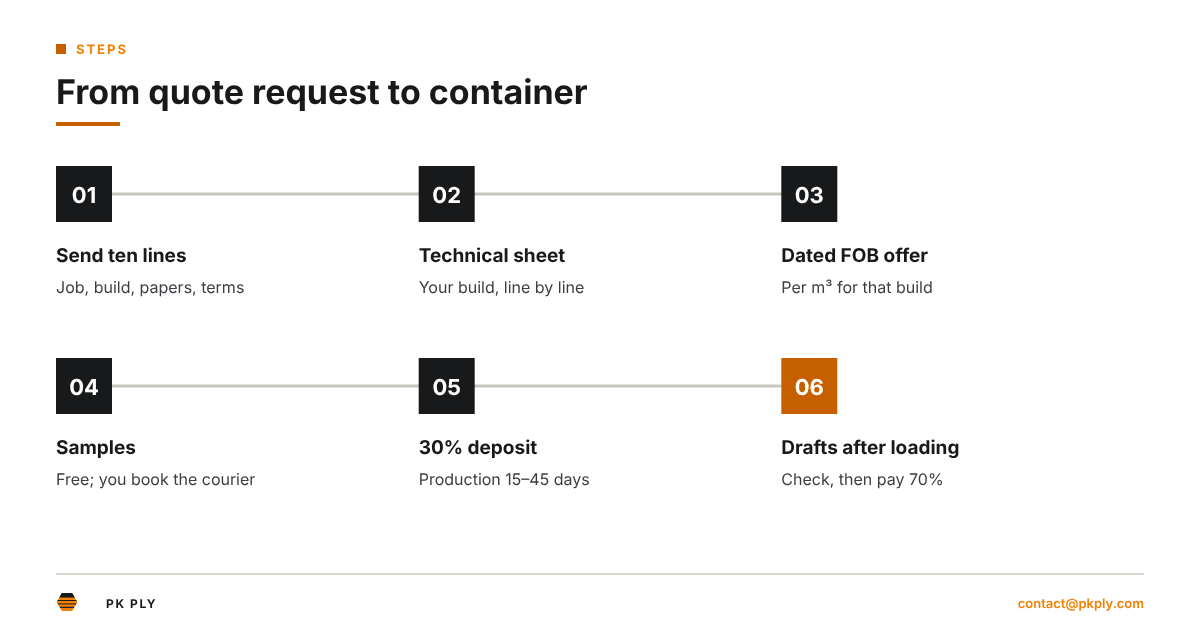
Our terms sit on the same sheet: a 30% deposit to start production, production in 15–45 days depending on quantity, production conditions and agreement, the 70% balance against the scanned bill of lading by T/T or irrevocable L/C at sight, and FOB Hai Phong, CFR or CIF.
Three worked quote requests
Three requests show how the ten fields change with the job: a European slab programme, a Gulf wall and slab job, and a short programme with a tight budget. The fields stay the same; the answers in them change the panel.
| Field | European slab programme | Gulf walls and slabs | Short programme |
|---|---|---|---|
| Application and pours | Slab decks on beams, about 20 pours | Walls and slabs, about 15 pours | Footings and walls, about 8 pours |
| Core | Acacia | Eucalyptus | Eucalyptus |
| Glue | Phenolic | Phenolic | MUF |
| Film | 165 g/m², dark brown | 130–135 g/m², black | 120–125 g/m², dark brown |
| Thickness and size | 21 mm, 1250 × 2500 mm | 18 mm, 1220 × 2440 mm | 15 mm, 1220 × 2440 mm |
| Tolerance and edges | ±0.5 mm; paint on all four edges | ±0.5 mm; paint on all four edges | ±0.5 mm; paint on all four edges |
| Certificates | CE to EN 13986, FSC Mix claim, EUDR file set | Test report for the configuration | Test report for the configuration |
| Quantity and terms | One 40HC, CIF Rotterdam | One 40HC, CFR Jebel Ali | One 40HC, FOB Hai Phong |
Typical days at sea from Hai Phong are 30–40 to Northern Europe and 15–25 to the Middle East, varying by carrier and route; write the port so a CFR or CIF offer can carry the freight of that lane.
Common mistakes on a formwork plywood quote request
The common mistakes on a formwork plywood quote request are writing “WBP” instead of a glue, leaving out the film weight, giving no pour target, asking for a thickness without the system or support spacing, and forgetting the certificates the market needs. Each one lets the offer quote a cheaper build than the job needs.
- “WBP” instead of a glue. Ask for MUF or phenolic and a bonding class 3 report.
- No film weight. Write g/m² and colour for both faces.
- No pour target. Write the pours with their site conditions.
- Thickness without a reason. Write the system or the support spacing.
- No tolerance. Write ±0.5 mm, or tighter for fair-faced work.
- Edges left open. Write “paint on all four edges, cut edges sealed”.
- Certificates after the order. Name CE, FSC and the EU files on the request.
- No port or Incoterm. Write FOB Hai Phong, CFR or CIF and the port.
Send the ten lines through the specification form or to [email protected]. Samples of the exact build go out free, with new buyers booking their own courier and the cost credited against a real order. Our film-faced plywood page shows the build each offer starts from.
Questions buyers ask us
What should a plywood quotation include?
Application and pour target, core species, glue, film weight and colour, thickness, sheet size, tolerance, edge sealing, the certificates needed, and the quantity, Incoterm and port. With those lines two offers can be compared like for like.
What thickness plywood is usually used for formwork?
18 mm is the common slab and wall thickness on 1220 × 2440 mm sheets, and 21 mm on many European systems drawn around 1250 × 2500 mm panels. 12 and 15 mm are used for walls, columns and curved or light work on close supports.
Which film weight should I ask for?
About 130–135 g/m² is the most common choice on our orders now; 120–125 g/m² suits short programmes, and 165, 185 or over 200 g/m² long ones. Write the weight and the colour for both faces.
Should I ask for MUF or phenolic glue?
Name the glue by the pours you need: about 12–15 pours with MUF and up to about 25 with phenolic, with proper handling, release agent and sealed edges. For a long programme or a heavy film, ask for phenolic.
Is WBP enough on a formwork quote?
No. WBP is a trade term, not a test class; ask for the glue by name and a test report showing bonding class 3 to EN 314-2.
Can one container carry several thicknesses?
Yes. A 40HC usually carries one or two products, and three to six can be mixed by agreement; the offer lists each with its sheets and cubic metres.
Which certificates should an EU quote name?
CE to EN 13986 with a declaration of performance when the panel is used structurally, the FSC claim if you sell FSC, the test report for the configuration, and the EUDR file set for your due diligence.
What tolerance should I write?
Our standard is ±0.5 mm on thickness and ±2 mm on length and width. A tighter tolerance can be written for fair-faced work.
Do you send a technical sheet with the offer?
Yes. Every offer comes with a technical sheet that repeats the build line by line, so the panels can be checked against it on arrival.
What is the minimum order?
One 40HC, on FOB Hai Phong, CFR or CIF terms, with a 30% deposit and the 70% balance against the scanned bill of lading.
Can I order cut sizes?
Yes, to a cutting list, with the cut edges sealed. Nothing is pressed larger than 1250 × 2500 mm.