
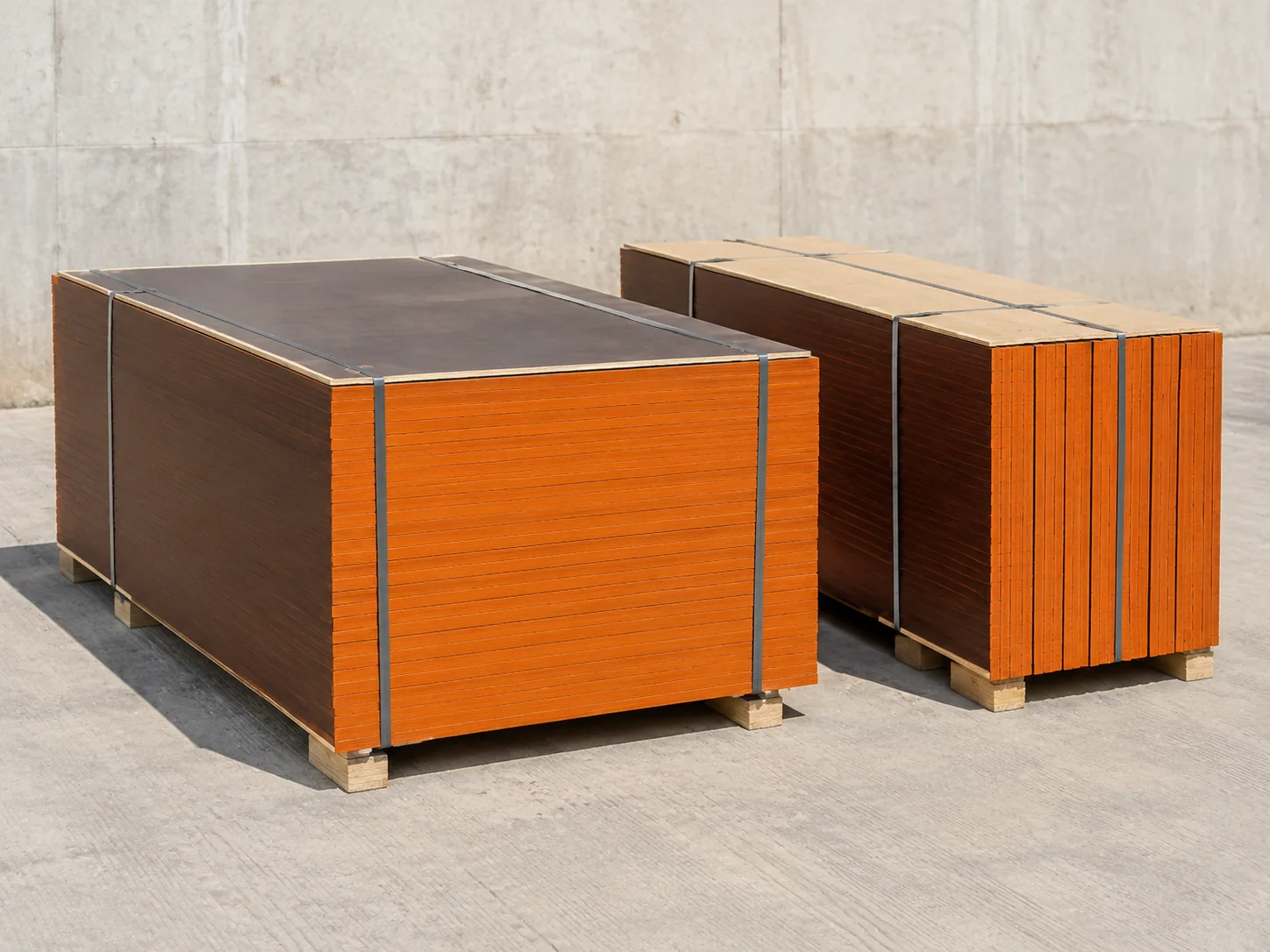
Replacement facings for frame formwork
Panels cut to the inside dimensions of steel or aluminium frames and fixed from the back; the most common cut-to-size order.
Formwork panels · cut and sealed in Chi Linh, Hai Phong
In short
We cut film-faced formwork panels to your list from 1220 × 2440 mm or 1250 × 2500 mm parent sheets at our own mill, then paint every cut edge before packing. Cut panels keep ±2 mm on length and width and ±0.5 mm on thickness, and they can share a 40HC with full sheets. Sealed edges are what let a cut panel reach the same pours as a full sheet.
Film
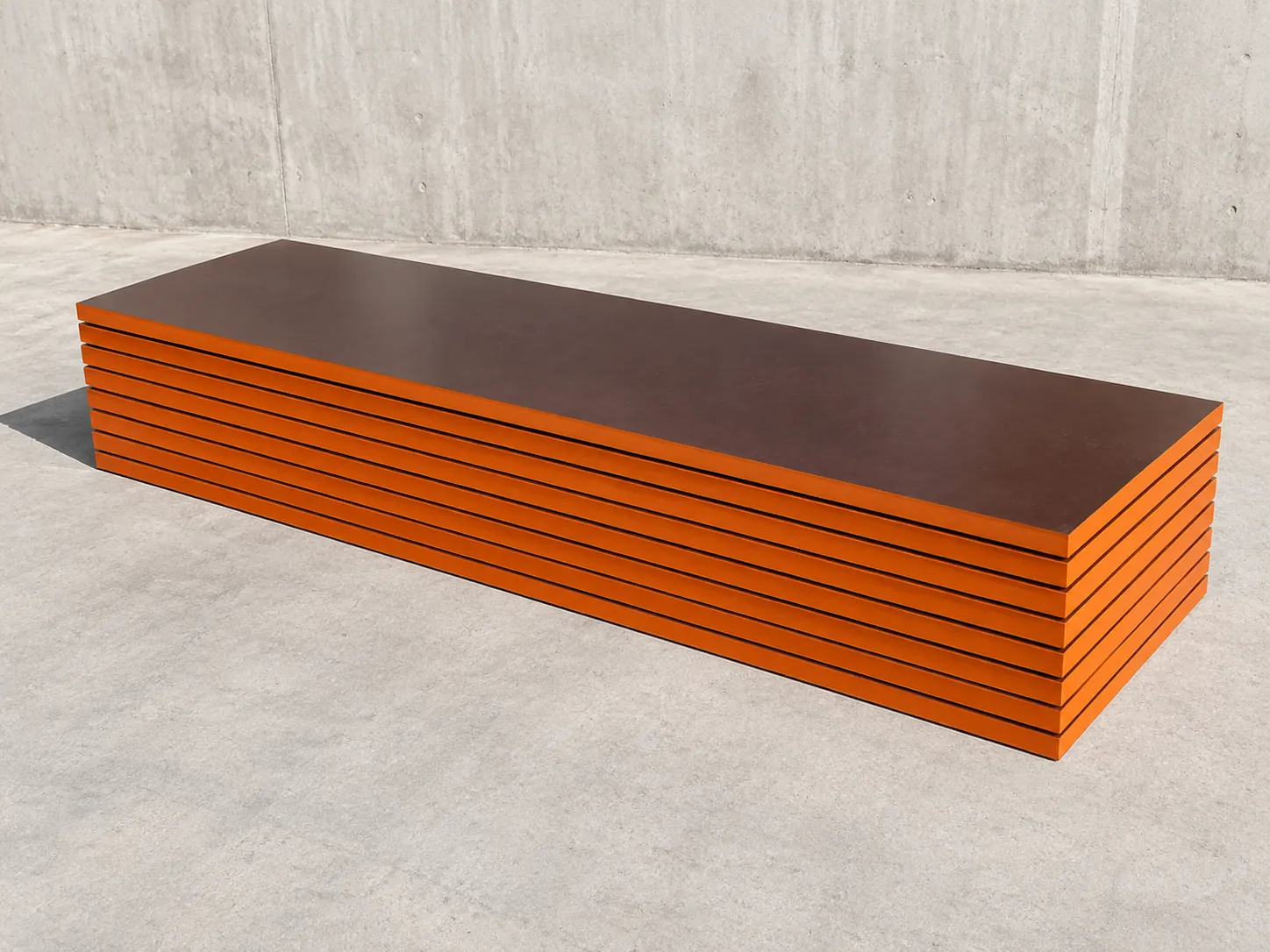
The page film will show a parent sheet going through sizing, the cut edges being painted and the cut panels being packed beside full sheets in a 40HC, from real clips at our mills.
Real panels
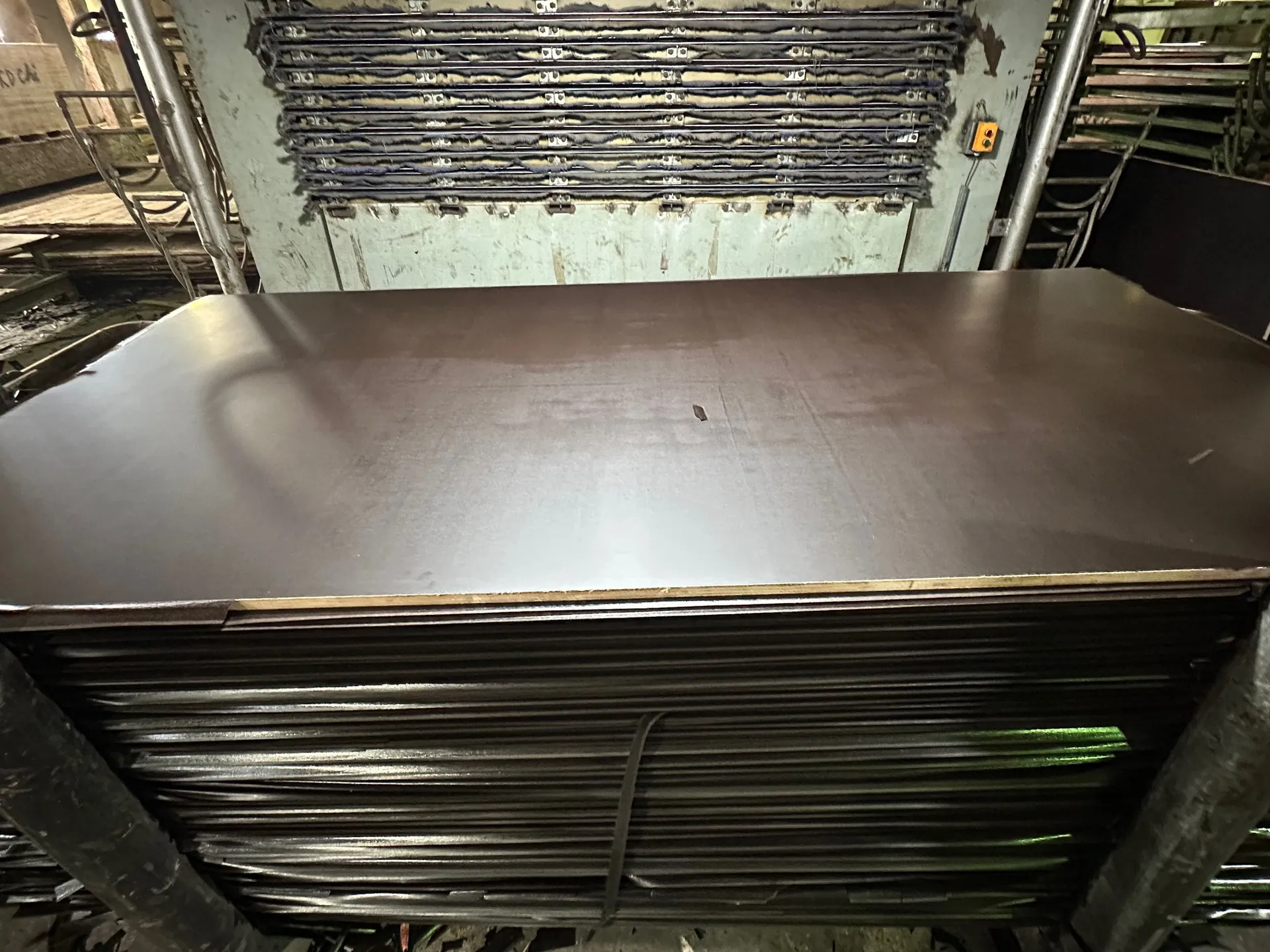
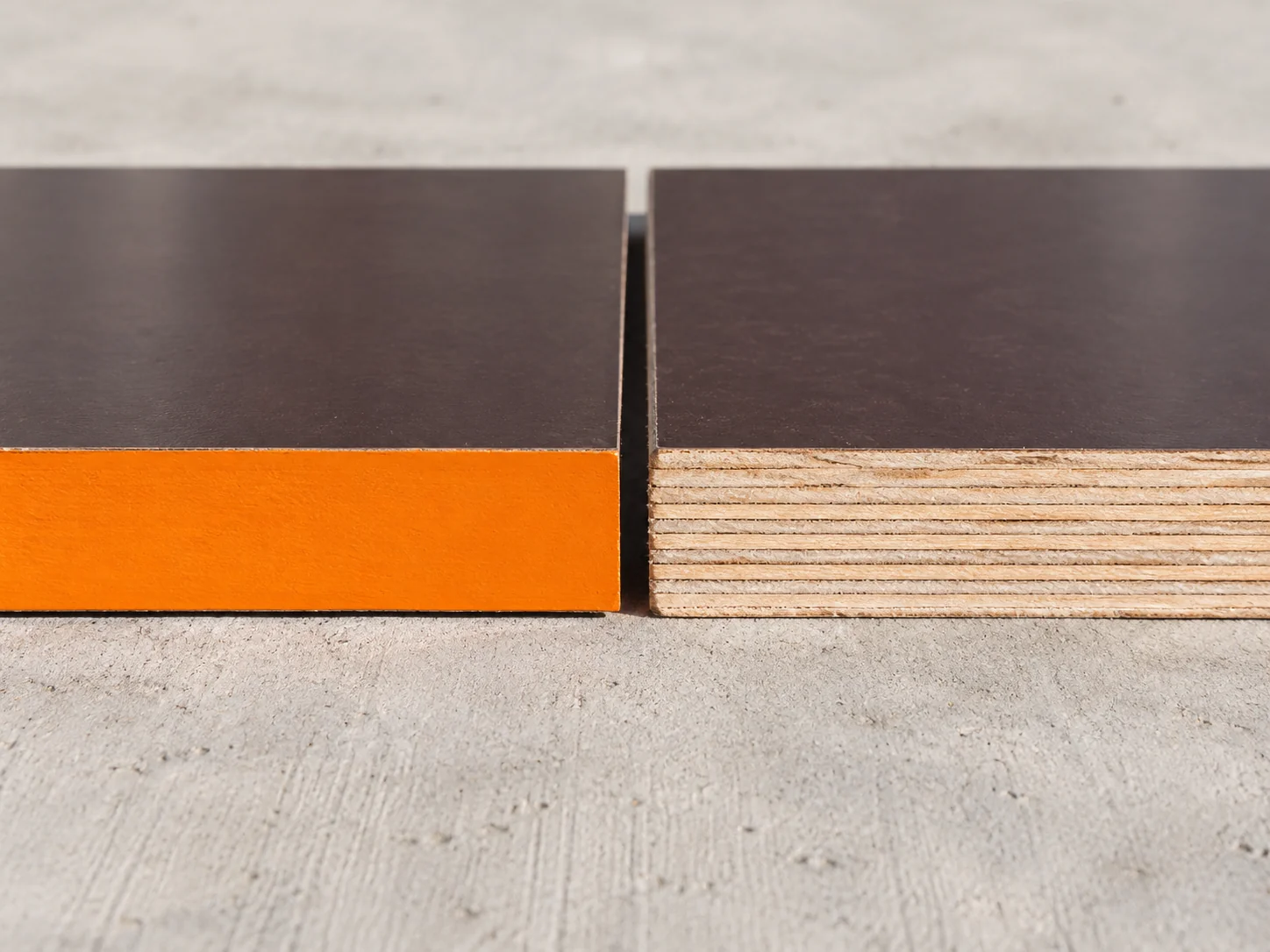
Every cut panel starts as a full film-faced sheet from our own press line, like the stack below. Photos of the sizing saw, the edge-painting station and packs of cut panels are being taken at the mill and will be added here.
Specification
A cut panel is our standard film-faced build, sized after pressing. Nothing about the face, core or glue changes when we cut it; what changes is the amount of edge per square metre, which is why the edge line in this table matters more than on a full sheet.
| Item | Standard | Options by order |
|---|---|---|
| Parent sheet | 1220 × 2440 mm or 1250 × 2500 mm | Chosen to give the best yield for your list |
| Cut sizes | From your cutting list | System panel sizes, strips, column and beam sides |
| Length and width tolerance | ±2 mm | Written on the technical sheet |
| Thickness | 12, 15, 18 and 21 mm | Any thickness from 9 mm to 40 mm |
| Thickness tolerance | ±0.5 mm | Written on the technical sheet |
| Face and back | Smooth film, dark brown | Black film; film weight 120–125 g/m² to 200 g/m² and above |
| Core | Acacia hardwood veneers | Eucalyptus hardwood veneers |
| Glue | MUF (melamine) | Phenolic for up to about 25 pours |
| Cut edges | Painted with water-resistant edge paint before packing | Edge colour by order |
| Marking | Pack label with size and count per pack | Your stamp or code on each panel |
Film and glue
Cut panels are often the hardest-working pieces on a site: column sides, beam sides and system infills are struck and reset more often than deck sheets. Buyers who cut to system sizes usually order a heavier film and phenolic glue, because the panel will see many pours and much handling.
For one-off jobs and housing programmes, MUF glue with a 130–135 g/m² film is the economical build. For rental fleets and repeat wall systems, phenolic glue with 165 g/m² or heavier film is the usual choice.
| Use of the cut panel | Glue | Film weight | Pours, with handling, release agent and sealed edges |
|---|---|---|---|
| Column and beam sides on one project | MUF | 130–135 g/m² | About 12–15 |
| Infill panels in steel or aluminium frames | Phenolic | 165–185 g/m² | Up to about 25 |
| Rental fleet replacement facings | Phenolic | 185 g/m² to 200 g/m² and above | Up to about 25 |
| Short programmes, single-use forms | MUF | 120–125 g/m² | Fewer; build to the job |
Parent sheets and yield
We choose the parent sheet that wastes least for your list. European system panels are usually drawn around 1250 × 2500 mm, so their strips come from that sheet; sizes based on feet come from 1220 × 2440 mm. Each cut loses a saw kerf, so a strip is a few millimetres under an exact half or quarter unless the list allows for it.
Send the finished sizes you need and the quantity of each. We return a cutting plan with the parent sheet, the pieces per sheet and the offcut, so you can see the yield before you approve the price. Offcuts are not packed with your order unless you ask for them.
The core does not change with cutting: both Acacia and Eucalyptus cores are full hardwood veneers laid crosswise. On narrow strips, a core without gaps matters even more, because a void near a cut edge opens straight into the panel.
| Parent sheet | Cut size | Pieces per sheet | Typical use |
|---|---|---|---|
| 1250 × 2500 mm | 625 × 2500 mm | 2 | Wall system infills, strips for climbing forms |
| 1250 × 2500 mm | 1250 × 1250 mm | 2 | Square deck infills |
| 1250 × 2500 mm | 625 × 1250 mm | 4 | Small infills, column boxes |
| 1250 × 2500 mm | 500 × 2500 mm | 2, plus a 250 mm strip | Beam sides |
| 1220 × 2440 mm | 610 × 2440 mm | 2 | Wall and column strips |
| 1220 × 2440 mm | 1220 × 1220 mm | 2 | Deck infills |
| 1220 × 2440 mm | 406 × 2440 mm | 3 | Beam and slab edge strips |
Edges and reuse
A cut edge is bare veneer and glue lines. Left open, it takes up water from the first pour and the film lifts from the outside in.
On a strip 625 mm wide there is twice as much edge per square metre as on a full 1250 mm sheet, so an open edge costs a cut panel more pours than it costs a deck sheet.
That is why every cut edge is painted at our edge-sealing station on the same day it is cut, with the same water-resistant paint as the factory edges, before the panel is packed. You receive panels that are ready to fix into the frame.
With proper handling, a release agent on every pour and sealed edges, our MUF panels give about 12–15 pours and our phenolic panels up to about 25, cut or uncut. Holes drilled on site for ties and bolts are new cut edges: seal the inside of each one the day it is drilled.
The bond holds at a cut edge as it does in the sheet. A 21 mm Acacia-core phenolic specimen tested by SGS reached EN 314 bonding Class 3 after 24 h water soak, boil-dry-boil and 72 h boiling. Its chamber emission (EN 717-1) was below the 0.04 mg/m³ reporting limit, an E1 pass.
Every cut edge painted before packing, so the panel arrives ready to fix.
Every new cut, notch and tie hole painted the same day it is made.
Phenolic for up to about 25 pours, MUF for about 12–15, with handling and release agent.
Sizes and tolerance
Cut panels hold ±2 mm on length and width and ±0.5 mm on thickness, the same tolerances as our full sheets. The tolerance for your order is written on its technical sheet, and the sizing saw is set from that sheet, not from a verbal note.
If your frames need a tighter fit than ±2 mm, tell us before the price; we confirm what we can hold for your sizes on the technical sheet. Corners are cut square so panels butt tight in a frame.
| Thickness | Typical cut panels |
|---|---|
| 9 mm | Curved form liners, cut to the form |
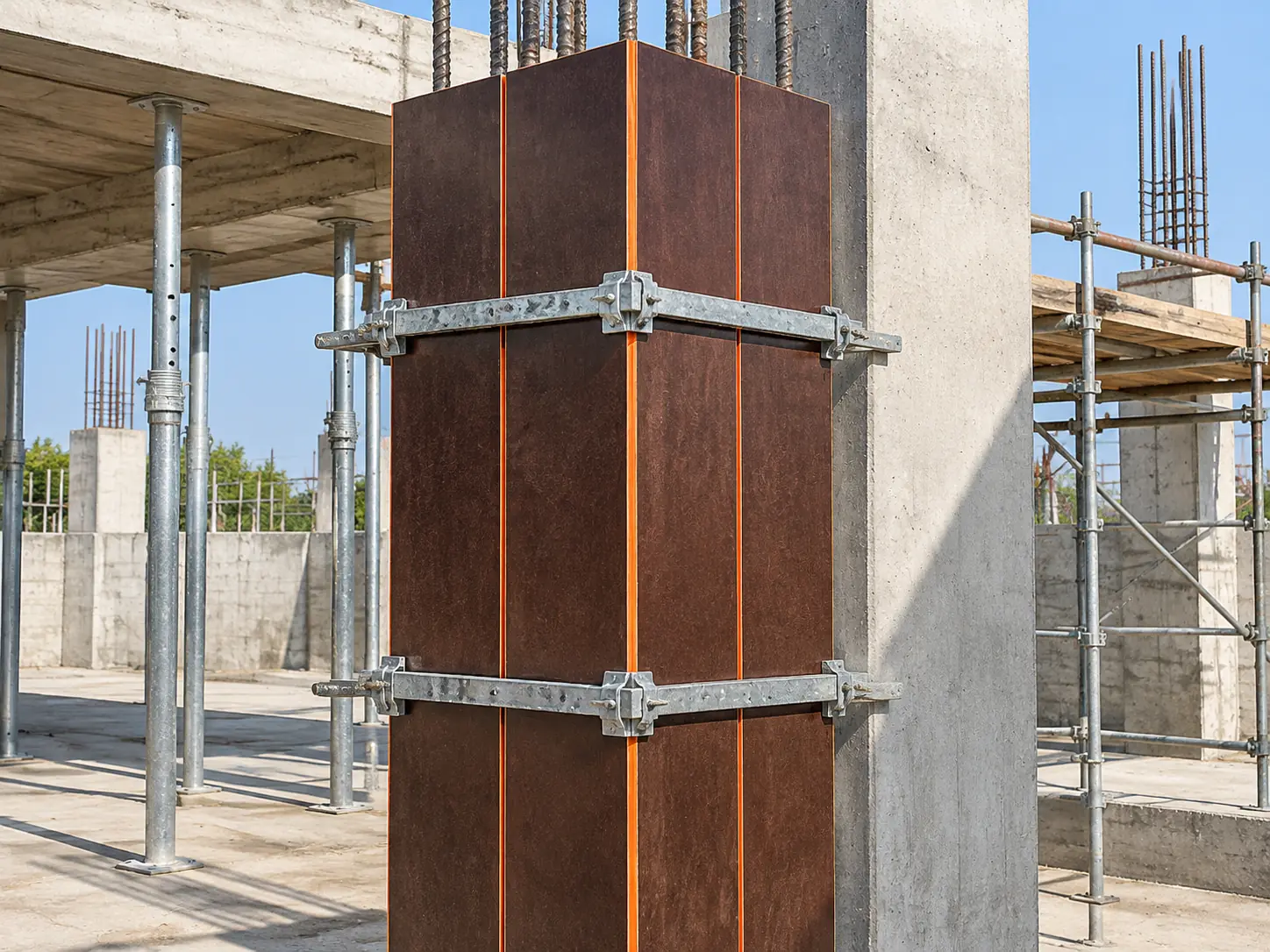
| 12 mm | Column boxes and beam sides on frames |
| 15 mm | Wall infills and beam sides |
| 18 mm | System infills and deck strips; the most ordered thickness |
| 21 mm | 1250 × 2500 mm based system panels |
| Up to 40 mm | Special forms by agreement |
Applications
Contractors, formwork rental companies and system distributors order cut panels where a full sheet would be cut on site anyway. Cutting at the mill saves site labour and returns a sealed edge instead of a raw one.
Panels cut to the inside dimensions of steel or aluminium frames and fixed from the back; the most common cut-to-size order.
Strips cut to the column face width, from 12 mm or 15 mm panels, painted on every edge.
Narrow strips from 15 mm or 18 mm panels for beam sides, upstands and slab edge forms.
Square and half panels that close the gaps between system deck panels around columns and walls.
Panels cut to mould sides, often phenolic with heavier film for daily reuse.
Compare
The question buyers ask is whether cutting at the mill is worth it. For a handful of pieces it rarely is. For hundreds of identical system panels, it saves labour, waste handling and, above all, the edge.
| Item | Cut at our mill | Cut on site |
|---|---|---|
| Edge on arrival | Painted, same paint as factory edges | Raw until someone seals it |
| Size accuracy | ±2 mm, set from the technical sheet | Depends on saw and crew |
| Offcuts | Stay at the mill | Waste to handle and remove on site |
| Site labour | Fix panels straight into frames | Measure, cut, seal, then fix |
| Freight | Only the panels you use | Full sheets including future offcuts |
| Best for | Repeat system sizes, rental fleets, large lists | Few odd pieces, last-minute changes |
Checks
Cut panels go through the same press-line checks as full sheets, then a second set after sizing. Results are recorded against your technical sheet per production run.
The first panel of each size is measured against the cutting list before the run continues.
Tape and square on sample panels from each size: within ±2 mm, corners square.
Calipers on sample panels: within ±0.5 mm of the ordered thickness.
Every cut edge painted, no bare veneer, no chipped film at the arris.
Pieces per size and per pack checked against the packing list before strapping.
Certificates
Cutting does not change the build, so the certificates and test documents of the parent panel apply to the cut panel. The FSC claim, when ordered, is printed on the invoice; CE documents are issued when a panel inside the certified scope is ordered for structural use.
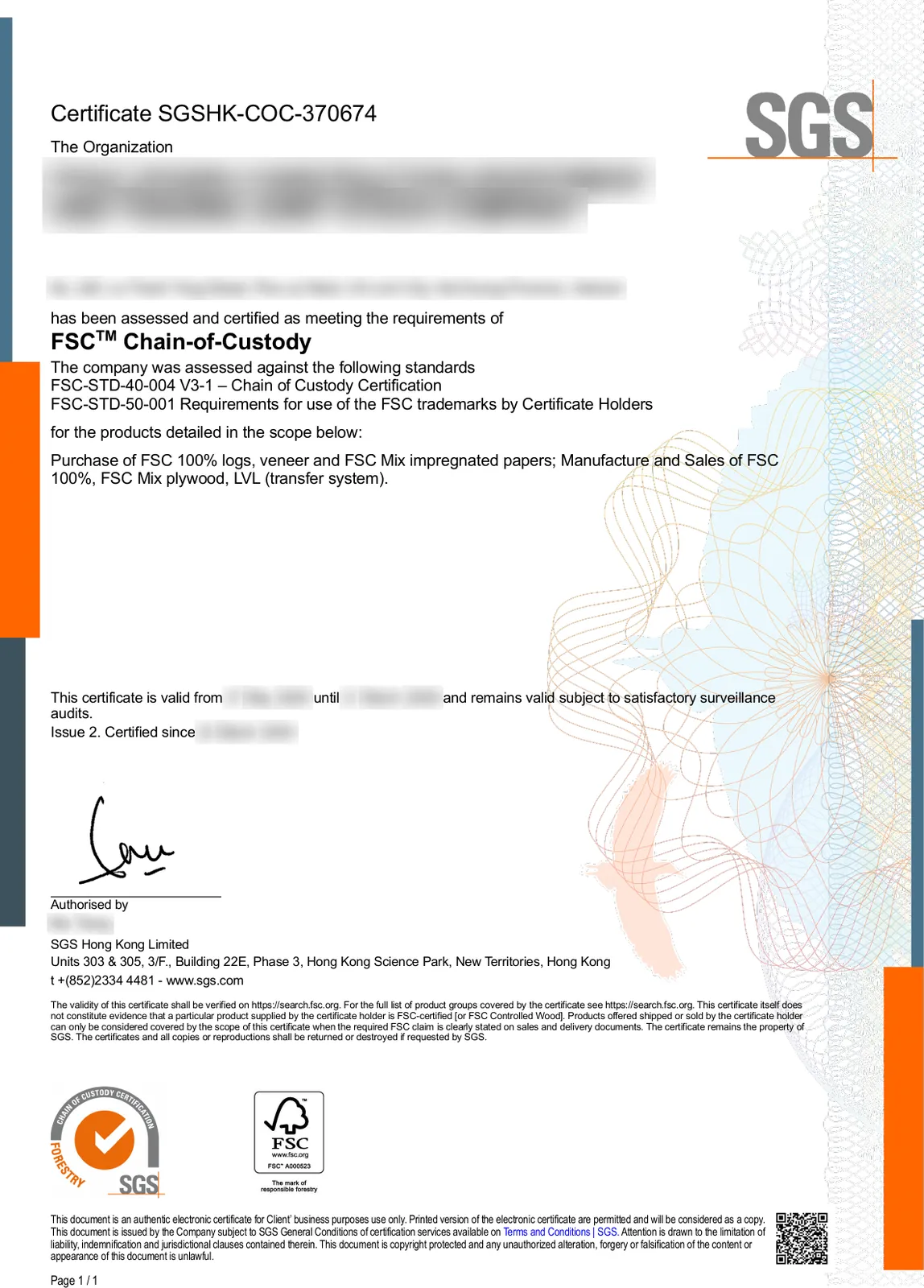
SGSHK-COC-370674
Cut or uncut FSC 100% or FSC Mix panels; we print the claim on your invoice when ordered.
FSC certificate scan; legal entity, tax ID, address and dates blurred.
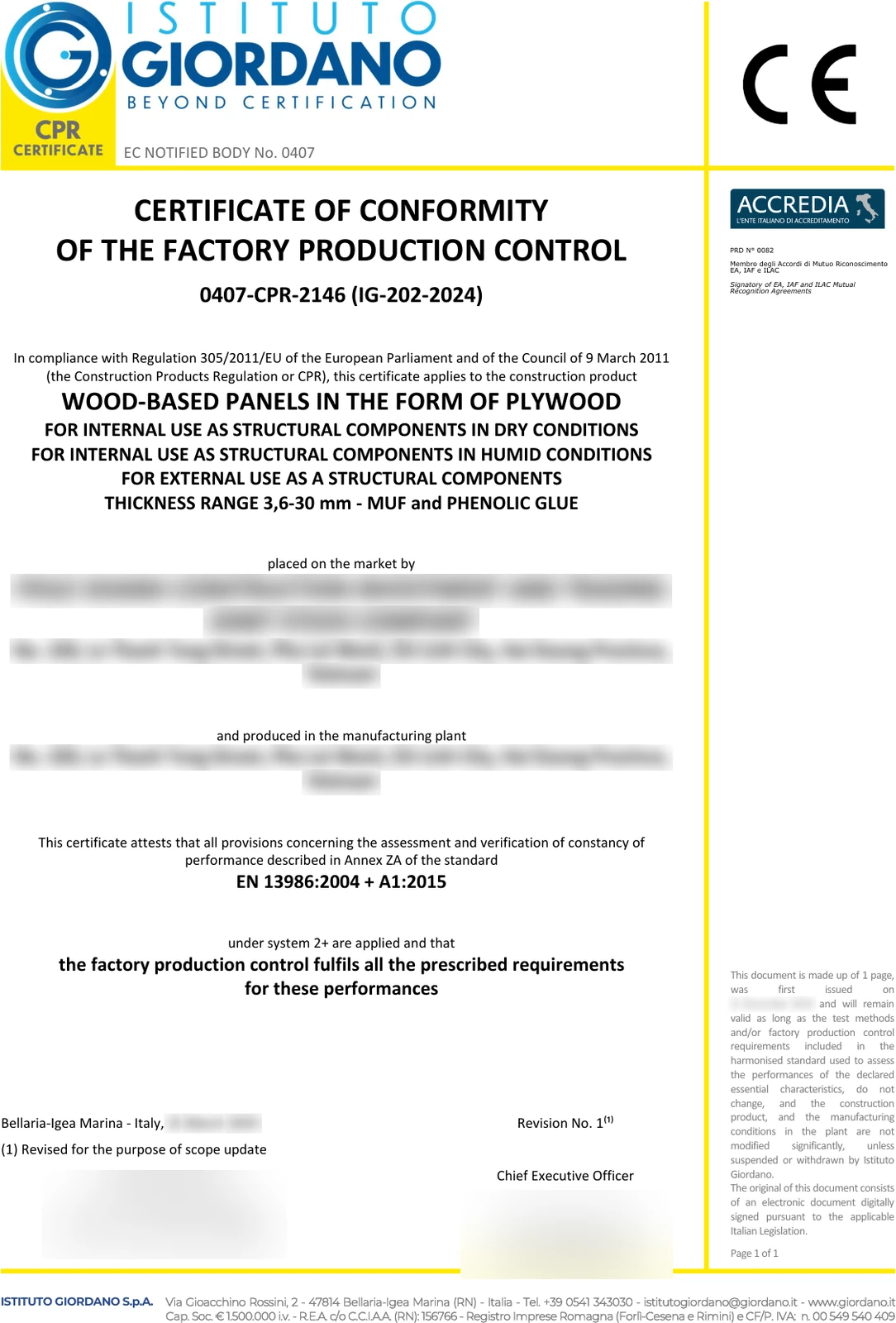
0407-CPR-2146
Covers the parent panel inside 3.6–30 mm (EN 13986, System 2+); a cut panel keeps that build.
CE certificate scan; legal entity, tax ID, address and dates blurred.
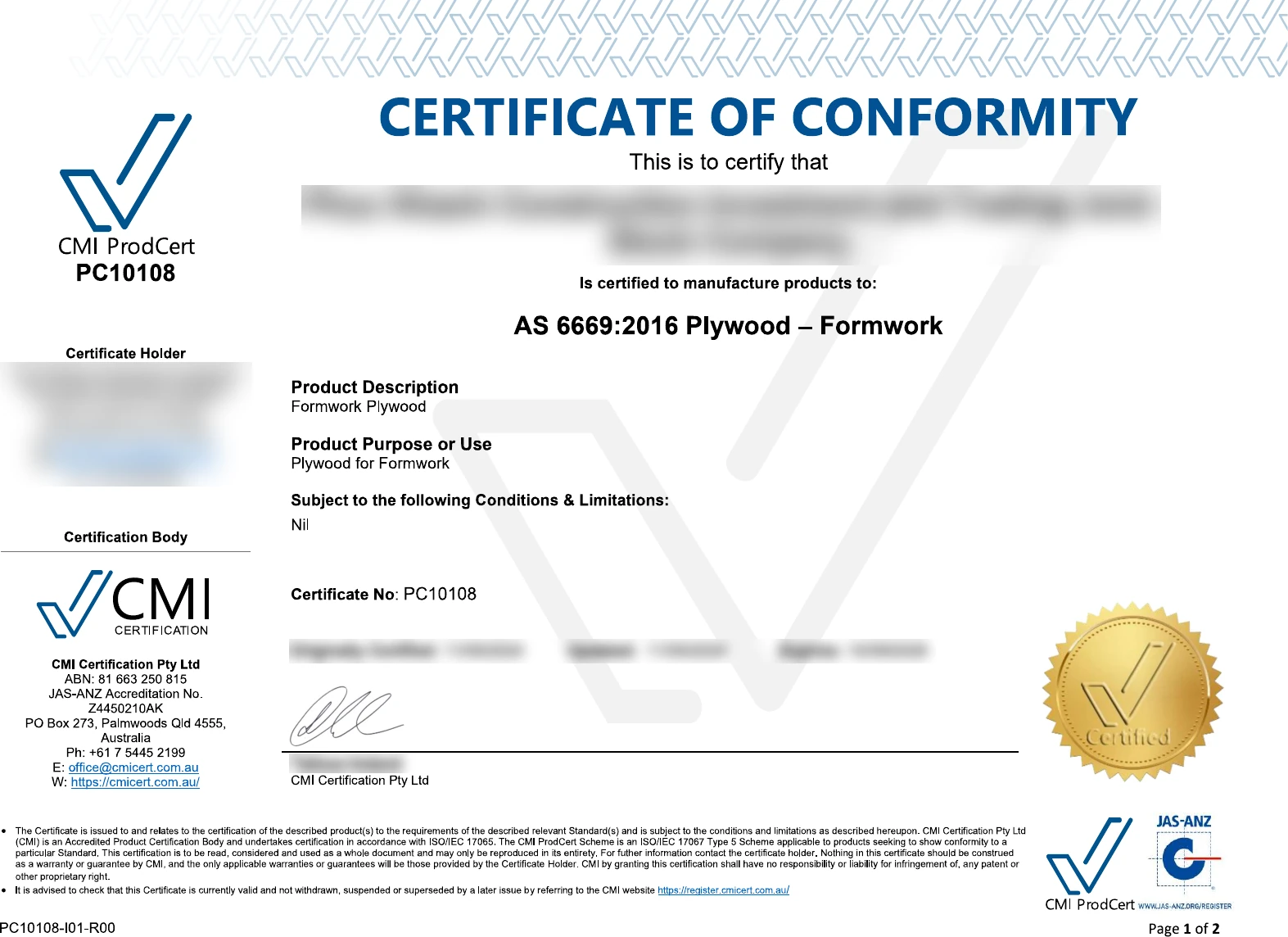
Our formwork plywood is certified to AS 6669:2016, the Australian formwork plywood standard, by CMI Certification.
AS 6669 certificate scan; legal entity, address, number and dates blurred.
Packing
Cut panels are packed by size: one size per pack where the quantity allows, on pallet feet, covered and strapped, with the size and count on the pack label. Narrow strips are packed in pairs of stacks side by side so the pack stays square and stable on a forklift.
Cut panels and full sheets can share a container. A 40HC usually carries one or two builds, and three to six by agreement; the cutting plan and the packing list show which packs hold which sizes. The volume follows the same planning model as full sheets: about 47 m³ with Acacia cores or about 43 m³ with Eucalyptus cores.
| Core | Packs per 40HC | m³ per 40HC | 18 mm full-sheet equivalent |
|---|---|---|---|
| Acacia | 16 | About 47 m³ | 880 sheets of 1220 × 2440 mm |
| Eucalyptus | 15 | About 43 m³ | 795 sheets of 1220 × 2440 mm |
Planning figure; the final count follows the cutting plan, the booking and the weighed packs.
Buy from the mill
Our two mills in Chi Linh, Hai Phong, cut and ship panels in full containers, up to 150 containers a month between them. A single 40HC is the minimum and may hold cut panels and full sheets together.
Production takes 15–45 days after the 30% deposit, depending on quantity and the length of the cutting list. You pay the remaining 70% on the scanned B/L by T/T, or use an irrevocable L/C at sight. Every quotation is FOB Hai Phong, CFR or CIF and comes with the cutting plan attached.
Your cutting list
A cutting list is quoted fastest when every line carries the same fields. Send it as a spreadsheet or a table in the email; drawings help when panels have notches or holes.
Tie holes and bolt holes can be drilled at the mill when the positions repeat on every panel, and each hole is sealed like an edge. One-off holes are better drilled on site and sealed the same day.
Length × width in mm, and which side the face grain should run along if it matters.
Pieces per size, and spare pieces if you keep a stock for repairs.
For example 18 mm, phenolic, 165 g/m², dark brown.
±2 mm unless your frames need something else.
Positions and diameters, if they repeat on every panel.
Size codes on panels, one size per pack, your pack labels.
How to order
Sizes, quantities, thickness, glue, film, holes and port of discharge.
Parent sheet, pieces per sheet and yield, with a technical sheet and an FOB, CFR or CIF price.
A free sample of one size with its sealed edges.
30% by T/T starts production; 15–45 days by quantity.
Pack photos per size, your inspector welcome, balance against the scanned B/L.
Buyer questions
Yes. We cut phenolic and MUF film-faced panels to your list at our mill and paint every cut edge before packing. Phenolic panels give up to about 25 pours with proper handling, release agent and sealed edges.
Two 625 × 2500 mm strips, two 1250 × 1250 mm squares, four 625 × 1250 mm pieces, or any size from your list, each a saw kerf under the exact fraction. We send a cutting plan with the yield.
Yes. Every cut edge is painted with the same water-resistant edge paint as the factory edges on the day it is cut, before the panel is packed.
±2 mm on length and width and ±0.5 mm on thickness, written on the technical sheet of the order.
Yes. One or two builds per container is usual, and three to six can be mixed by agreement; the packing list shows the sizes in each pack.
Not when the edges are sealed. With handling, release agent and sealed edges, MUF panels give about 12–15 pours and phenolic up to about 25, cut or uncut. An open cut edge costs pours on any panel.
Strips and small infills are cut routinely; send the size and we confirm it on the cutting plan. Very small pieces are usually better cut on site from offcuts.
Yes, when the hole positions repeat on every panel. Each hole is sealed like an edge.
Cutting and edge sealing are priced into the panel price on the quotation, alongside the yield from the cutting plan.
One 40HC, which can combine cut panels and full sheets. Production takes 15–45 days after the 30% deposit.
Our parent sheets are 1220 × 2440 mm and 1250 × 2500 mm, in any thickness from 9 mm to 40 mm; nothing larger than 1250 × 2500 mm.
Yes. Size codes on panels and your pack labels are order fields, listed on the packing list.
Quotation
Send your cutting list with thickness, glue, film, quantities and port of discharge. We reply with a cutting plan, a technical sheet and an FOB Hai Phong, CFR or CIF price.