
Vietnamese plywood for formwork ranges from budget panels that give about 4–10 pours to phenolic builds that give up to about 25 with proper handling. PK Ply shows quality as proof from our presses: an SGS specimen report, ±0.5 mm tolerance, painted edges and CE factory production control. A panel bought on the name alone can delaminate after a few pours and cost a slab programme.
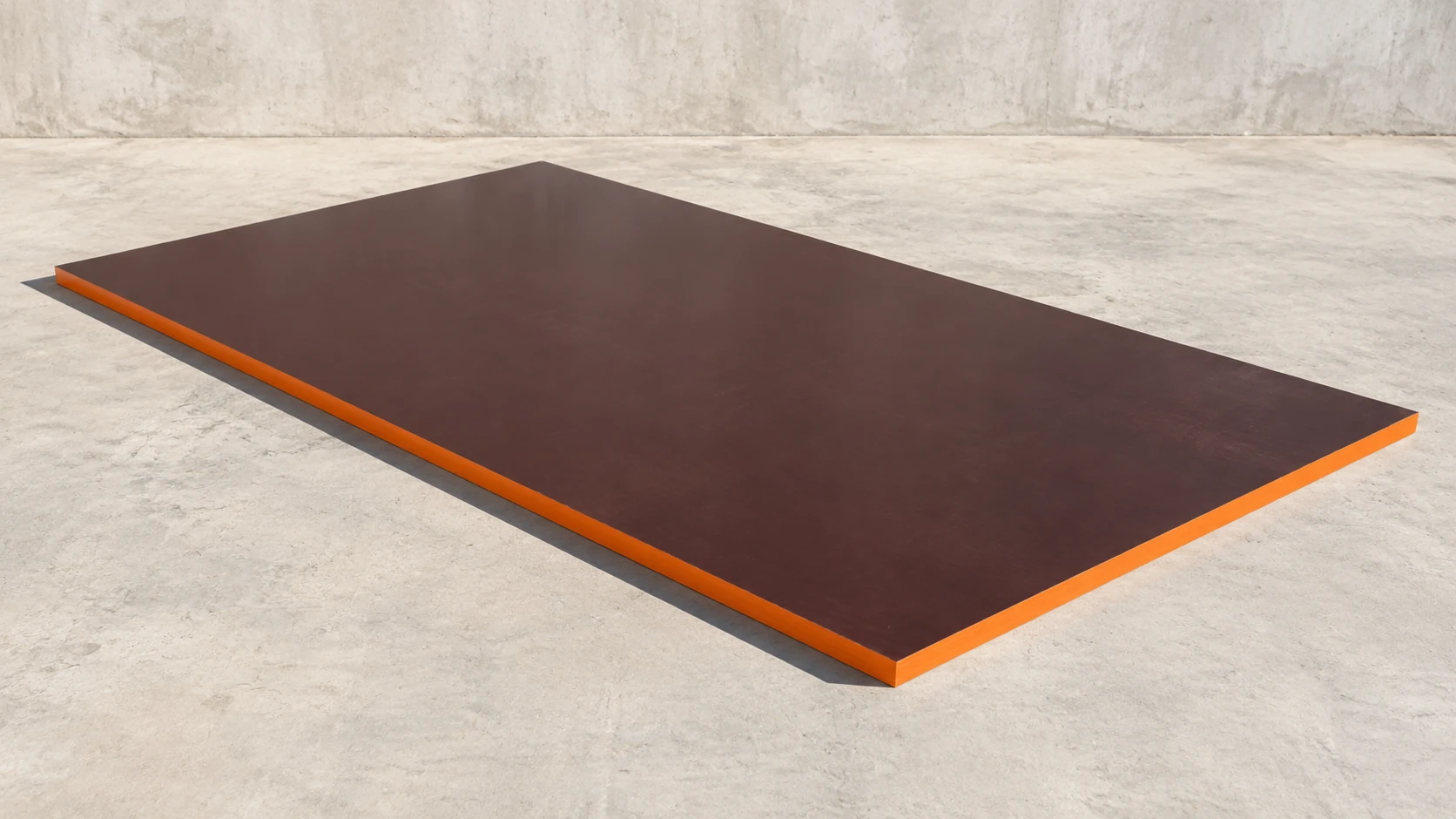
Is Vietnamese film-faced plywood good quality?
Vietnamese film-faced plywood can be good quality, but the country does not decide it: the mill and the build do. Vietnam makes budget panels that give about 4–10 pours and phenolic builds that give up to about 25 with proper handling. Judge a panel by its core, glue, film, edges, tolerance and test reports.
Most complaints about Vietnamese plywood come from the same place: two offers with the same name are often not the same build. Core grade, joining, glue system, film weight, edge sealing and tolerance make the difference, and none of those is visible on a quote that says “18 mm film-faced, WBP”. The film hides the core, and the paint hides the edge, until the panel is sawn or poured.
So this note does not argue for a country. It shows what our presses control in each panel, the proof behind each control, and how a buyer checks it. Our two mills in Chi Linh, Hai Phong make construction plywood only: film-faced formwork panels, anti-slip panels and CE-marked structural panels, with cores of Acacia or Eucalyptus and MUF or phenolic glue.
| What decides quality | Weak panel | Our build |
|---|---|---|
| Core | Mixed veneers, gaps and overlaps | Acacia or Eucalyptus veneers laid crosswise, calibrated by sanding |
| Glue | Low spread, interior glue line | MUF or phenolic, named on the order |
| Film | Light film on a rough face | 120–125 g/m² to over 200 g/m² on smooth hardwood face veneers |
| Edges | Bare or thinly painted | Water-resistant paint on all four edges |
| Tolerance | Not written | ±0.5 mm thickness, ±2 mm length and width |
| Proof | A brochure | SGS specimen report, CE factory production control, FSC chain of custody |
Why quality varies between Vietnamese mills
Quality varies between Vietnamese mills because the cost of a film-faced panel sits in the parts a buyer cannot see: the core grade and jointing, the glue spread and type, and the film weight. A mill can meet a low price by thinning any of them, and the panel still looks the same on arrival.
Budget film-faced plywood typically gives about 4–10 reuses. It is not a fraud; it is a configuration for short programmes, sold with a thin film, a mixed or hand-laid core and a melamine or interior glue line. The trouble starts when that configuration is sold under the same words as a long-life panel, or bought for a long slab programme.
What separates mills, then, is what they will put in writing. A mill that writes the core species, glue system, film weight, edge sealing and tolerance on a technical sheet, and backs the glue line with a test report, has made a build a buyer can check. A mill that writes only “WBP” has made a promise. The formwork plywood quotation format lists the fields to ask for.
What did the SGS test on your 21 mm phenolic panel show?
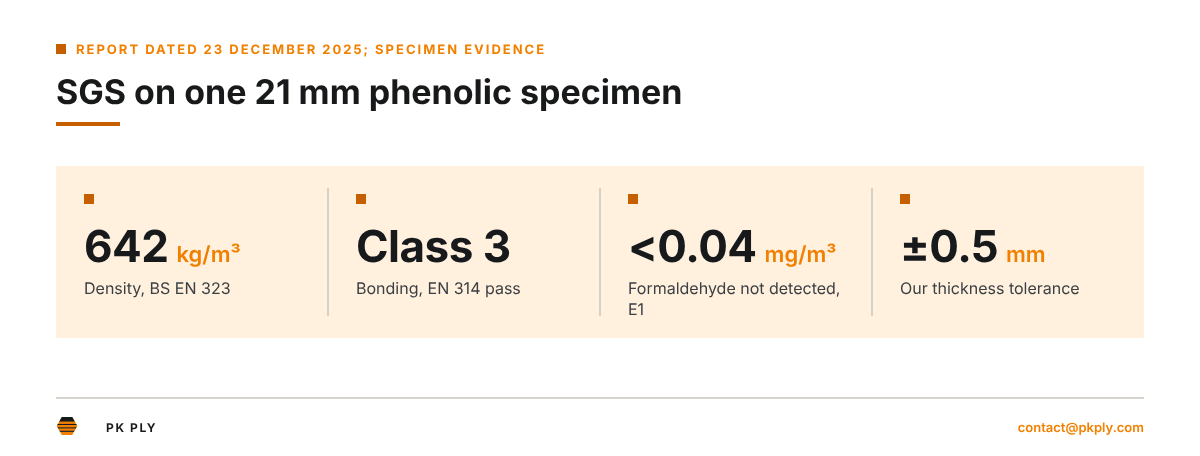
SGS Vietnam tested one submitted 21 mm dark-brown film-faced specimen with an Acacia core and phenolic glue, in a report dated 23 December 2025. It measured a density of 642 kg/m³, passed bonding Class 3 after a 24 h soak, boil-dry-boil and 72 h boiling, and passed E1 with formaldehyde not detected at the 0.04 mg/m³ reporting limit.
| Property | Method | Result on the submitted 21 mm specimen |
|---|---|---|
| Density | BS EN 323 | 642 kg/m³ |
| Bonding quality | EN 314-1 / EN 314-2 | Class 3 PASS after 24 h soak, boil-dry-boil and 72 h boiling |
| Formaldehyde emission | EN 717-1 chamber | Not detected at the 0.04 mg/m³ reporting limit; E1 PASS against ≤0.124 mg/m³ |
EN 314-2 specifies requirements for bonding classes of veneer plywood according to their end uses. Class 3 is the exterior class, the one a formwork panel needs because it meets wet concrete, rain and hot sun on open decks. EN 717-1 is the BSI standard for wood-based panels, determination of formaldehyde release, formaldehyde emission by the chamber method.
Three limits on what the report says. It covers one submitted specimen, not every panel in an order. “Not detected” means below the 0.04 mg/m³ reporting limit, not zero, and it is an E1 result, not an E0 claim. And it shows a bond that survives boiling, not a pour count. Our SGS specimen note reads the whole report.
Is film faced ply waterproof?
Film-faced ply is water-resistant, not waterproof for ever. The phenolic film keeps water off the faces, water-resistant paint seals the four edges, and a phenolic glue line keeps its bond through boiling, as our SGS specimen showed. Water still gets in through bare cut edges, drilled holes and a worn film.
The glue line decides how long a panel stays whole when water does get in. EN 636 specifies requirements for plywood for general purposes or structural application in dry, humid or exterior conditions. The exterior conditions line up with bonding class 3, which is the class formwork needs. A MUF glue line resists water well and gives about 12–15 pours; a phenolic one gives up to about 25. Both numbers hold only with proper handling, release agent on every pour and sealed edges, including every cut edge.
On site, three habits keep a panel dry inside: seal every cut edge and drilled hole the day it is made, store panels flat and off the ground under cover, and clean and oil the face after each strike. A panel left in standing water with a bare cut edge will swell at that edge whatever its glue.
What thickness tolerance do your film-faced panels hold?
Our film-faced panels hold a thickness tolerance of ±0.5 mm, so an 18 mm panel measures between 17.5 and 18.5 mm; length and width are held to ±2 mm. The tolerance for each order is written on its technical sheet, and the core is calibrated by sanding before the film goes on.
| Measure | Our tolerance | Reading range on an 18 mm, 1220 × 2440 mm sheet |
|---|---|---|
| Thickness | ±0.5 mm | 17.5 to 18.5 mm |
| Length | ±2 mm | 2438 to 2442 mm |
| Width | ±2 mm | 1218 to 1222 mm |
Tolerance is a quality line because formwork is a joined surface. On a slab deck, two neighbouring sheets that differ by a millimetre leave a step that prints on the soffit and lets paste leak through the joint. A tolerance that is not written on the offer is not a tolerance anyone can hold the mill to.
To check it on arrival, measure each sampled sheet with a caliper at the four corners, in from the edge, and at the middle of each long side; record the highest and lowest reading; both should sit inside the range. A tighter tolerance can be written for fair-faced work, and it changes the sanding and the grading of every pack.
How do you seal the edges of each panel?
We seal all four edges of each panel with water-resistant paint after the panel is sized, so no bare veneer end is left open to water. The paint goes on after the film press and the cutting to size, and every edge cut on site should get the same treatment the same day.
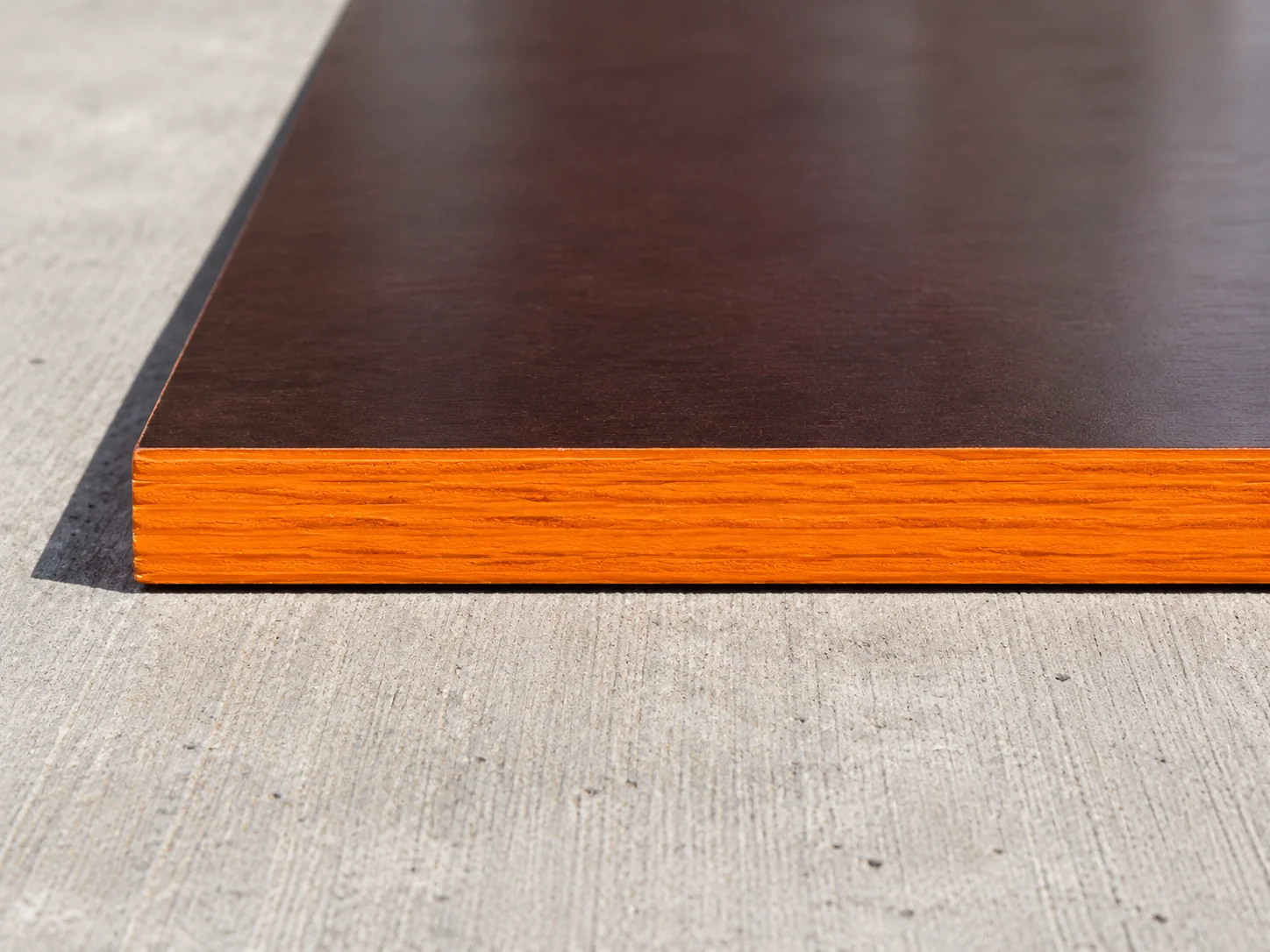
The edge is where a film-faced panel takes water first. The faces are covered by film, but the edges show the end grain of every veneer and every glue line, and end grain draws water in the way a straw does. A swollen edge stops two panels from closing tight, and the joint then prints on the concrete.
What a buyer should see on arrival is an even, continuous coat that covers the whole edge, with no bare patches at the corners and no runs on the film. Paint colour is an order field. A thin, patchy coat, or edges painted only on two sides, is a sign the panel was finished in a hurry, and it shortens the panel’s life whatever its glue.
Does your CE factory production control cover every thickness you make?
No. Our CE factory production control certificate 0407-CPR-2146 covers plywood for structural use in dry, humid and external conditions from 3.6–30 mm, with MUF or phenolic glue, under EN 13986 and AVCP System 2+. We press 9–40 mm, so panels thicker than 30 mm are outside the CE scope.
In the Construction Products Regulation, factory production control is the documented, permanent and internal control of production in a factory. Our certificate was issued by Istituto Giordano, notified body 0407. What it says about quality is that the mill’s own production control is documented and checked by a notified body; the declared performance values for a thickness sit on the declaration of performance, not on the certificate.
For a buyer, the scope line is the one to read. The everyday formwork thicknesses of 12, 15, 18 and 21 mm sit inside it. A supplier who offers CE on a panel outside the scope of its certificate is offering a document it cannot issue. Our CE marking page shows the certificate and the structural CE plywood page the panels inside it.
How can a buyer tell a well-pressed film-faced panel from a weak one?
Saw a sample and measure a few sheets to tell a well-pressed film-faced panel from a weak one. A good panel shows flat, even veneers with no gaps or overlaps, thin even glue lines, film tight to the corners, painted edges and a thickness inside its tolerance. A weak one shows voids, lifting film and uneven readings.
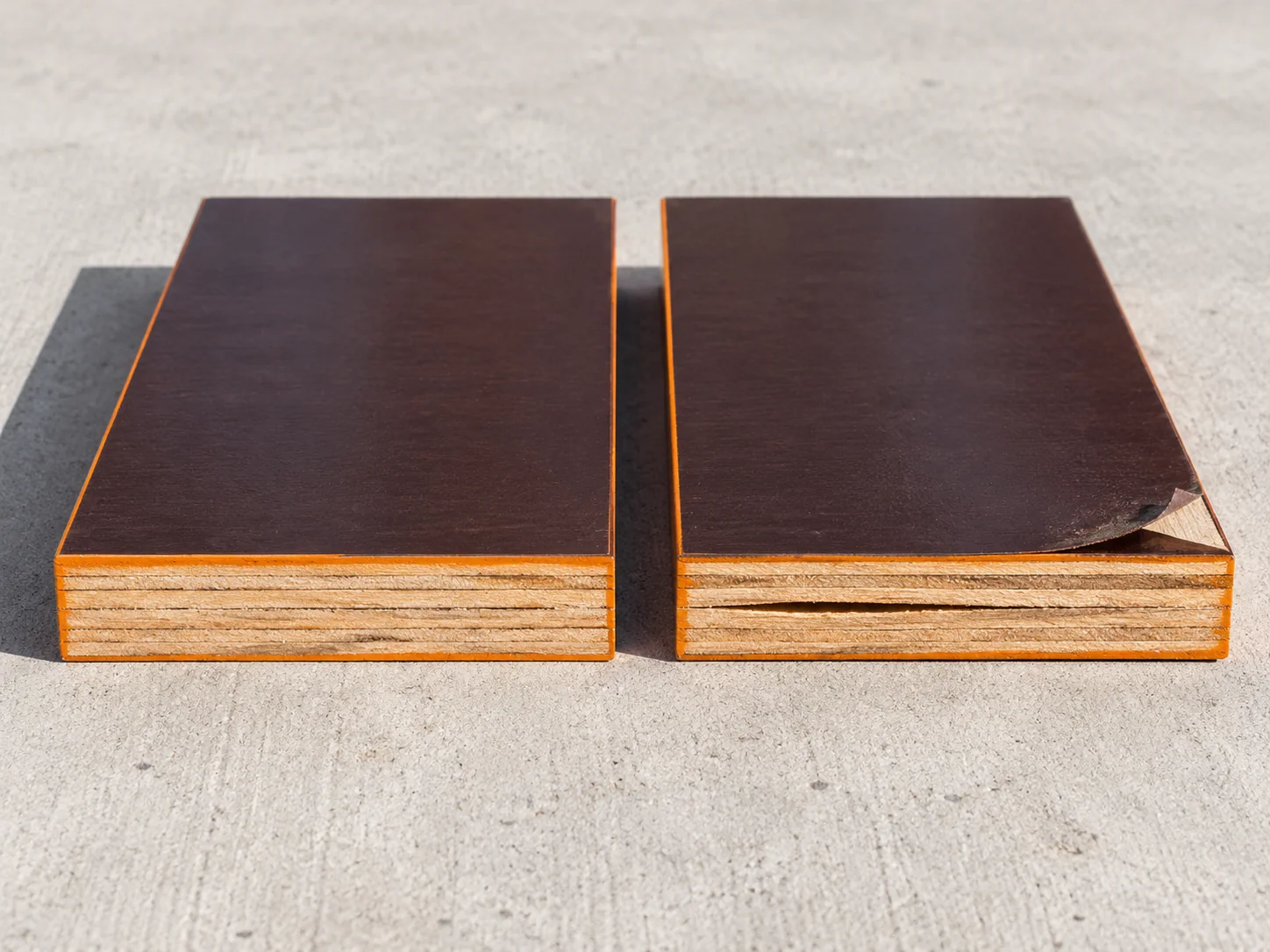
| Check | Well-pressed panel | Weak panel |
|---|---|---|
| Sawn end | Flat, even layers, no gaps or overlaps | Open voids, overlapped veneers, crushed layers |
| Glue lines | Thin and even across the width | Thick in places, missing in others |
| Film | Smooth, tight to the corners, no bubbles | Bubbles, lifting at corners, rough face showing through |
| Edges | Even paint on all four edges | Bare patches, two edges only |
| Thickness | Inside ±0.5 mm at every reading | Readings that wander across one sheet |
| Flatness | Lies flat on a flat floor | Bows or twists |
A boil test settles the glue line. Cut a small piece, boil it in water for a few hours and let it dry: a phenolic panel that keeps its plies closed has a sound bond, and a panel that opens has a bond for dry use. That is the field version of the boil-dry-boil test our SGS specimen passed under EN 314. Do it on samples before ordering, and on a few sheets from the container on arrival.
The press steps that control each result
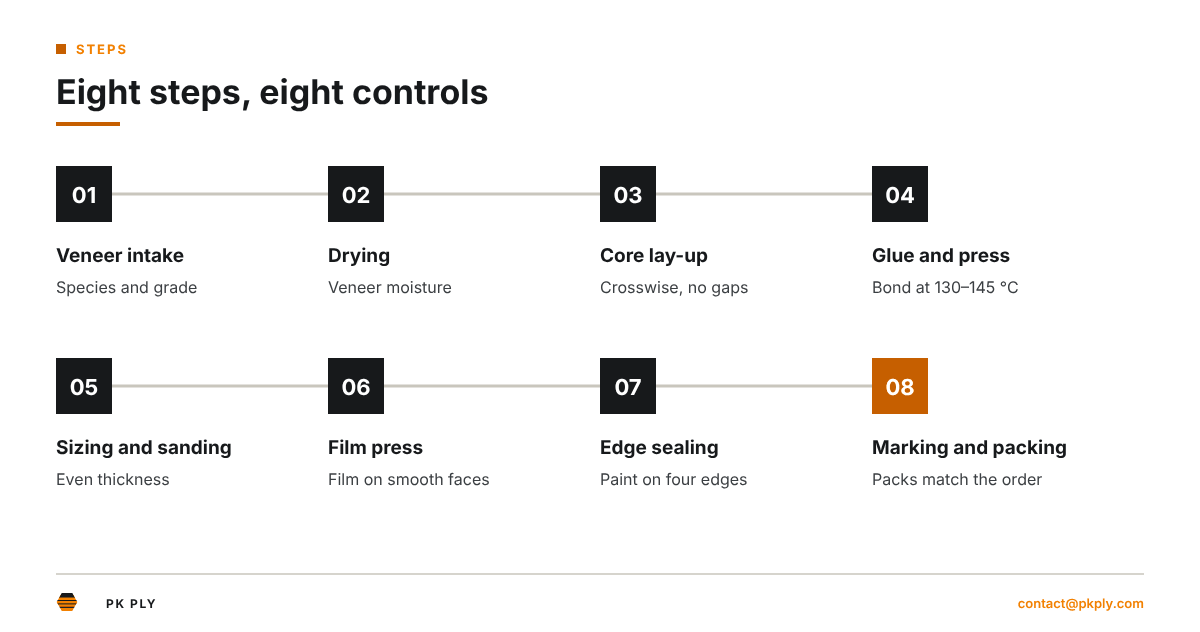
Every film-faced panel at our mills goes through eight steps: veneer intake, drying, core lay-up, glue and press, sizing and sanding, film press, edge sealing, and marking and packing. Each step controls one quality result, and a fault at one step cannot be fixed at a later one.
| Step | What it controls | What goes wrong without it |
|---|---|---|
| Veneer intake | Species and grade of the veneers | Mixed species, weak veneers in the core |
| Drying | Moisture of the veneers before gluing | Steam blisters and weak bonds in the press |
| Core lay-up | Crosswise layers with no gaps or overlaps | Voids that collapse under concrete pressure |
| Glue and press | Glue spread and bond, hot pressing at about 130–145 °C for phenolic bonds | Plies that open after wet cycles |
| Sizing and sanding | Square sheets and an even thickness | Steps at joints, film on an uneven core |
| Film press | Film bonded to the smooth face veneers | Bubbles, peeling, a rough face |
| Edge sealing | Paint on all four edges | Swollen edges, open joints |
| Marking and packing | Labels and packs that match the order | Mixed thicknesses in a pack, wrong counts |
The step a buyer cannot check on arrival is the one in the middle: glue and press. That is why it carries the test report. Our production process page walks through each step, and the QC stations page shows where each one is checked.
Veneer and core: where gaps and overlaps start
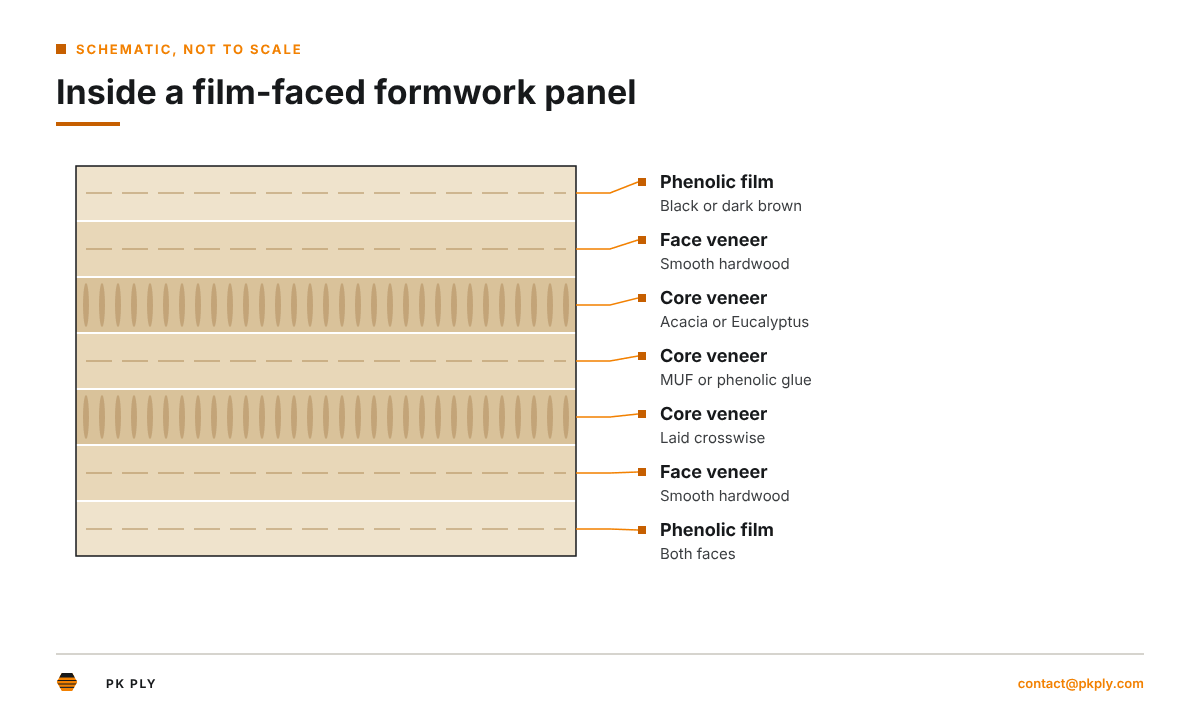
Gaps and overlaps start at core lay-up, when the veneers of each inner layer are laid side by side. A gap leaves a void that crushes under concrete pressure; an overlap leaves a lump that the press cannot flatten and the sanding cannot fully remove. Both are invisible under the film until the panel is cut or loaded.
Our cores are Acacia or Eucalyptus hardwood veneers, laid crosswise so that each layer runs at right angles to the next. The crosswise build is what gives plywood its stiffness in both directions and keeps a sheet flat. Smooth hardwood face veneers sit under the film on both sides, because a film pressed onto a rough or patched face shows every defect after a few pours.
Species sets weight. At our planning densities, an 18 mm sheet of 1220 × 2440 mm weighs about 31.1 kg with an Acacia core and about 34.8 kg with a Eucalyptus core; Eucalyptus is measured at 650–750 kg/m³, so a dense run weighs more. Neither species is the “better” one: Acacia gives a lighter sheet and a fuller container, Eucalyptus a denser, stiffer one.
Glue and pours: MUF or phenolic
Glue is the line that decides how many pours a panel gives. With proper handling, release agent on every pour and sealed edges, our melamine (MUF) panels give about 12–15 pours and our phenolic panels up to about 25. Budget panels with a low glue spread typically give about 4–10.
| Build | Glue | Pours with proper handling, release agent and sealed edges |
|---|---|---|
| Budget film-faced | Low glue spread, mixed core | About 4–10 |
| Our MUF film-faced | Melamine (MUF) | About 12–15 |
| Our phenolic film-faced | Phenolic | Up to about 25 |
Reuse is a target for a configuration and a site routine, not a fixed property of the sheet. A phenolic panel that is dropped from height, stripped with a crowbar and stored in water will not reach its count; a MUF panel on a careful site will. That is why every pour figure we give carries its conditions. Our note on how many pours a panel gives sets out the routine.
Film weight and face life
Film weight decides how long the face stays smooth. On our orders film runs from 120–125 g/m², with about 130–135 g/m² most common now and 165, 185 or over 200 g/m² for long programmes. A heavier film keeps its smoothness through more strikes and leaves a cleaner concrete surface.
Black and dark brown are both phenolic films, and colour is not a grade. What a buyer should ask for is the weight in g/m² on both faces, written beside the colour. A heavy film on a MUF glue line still has the bond life of MUF, so long programmes pair a heavy film with phenolic glue. Anti-slip panels carry a patterned film face instead, with a 220 g/m² reference in our catalogue and the actual film confirmed per order.
Certificates that back the build
Our quality claims rest on named documents: FSC chain of custody SGSHK-COC-370674 from SGS Hong Kong, CE factory production control 0407-CPR-2146 from Istituto Giordano, AS 6669:2016 formwork plywood certification by CMI Certification, ISO 9001 quality management, and the SGS specimen report of 23 December 2025.
| Document | What it proves | What it does not prove |
|---|---|---|
| FSC chain of custody SGSHK-COC-370674 | We may sell FSC 100% and FSC Mix plywood | That a lot is FSC unless the claim is on its sales documents |
| CE FPC 0407-CPR-2146 | Documented production control checked by notified body 0407, 3.6–30 mm | Values for a thickness; those are on the declaration of performance |
| AS 6669:2016 by CMI Certification | Our formwork plywood is certified to the Australian formwork standard | A stress grade; none is claimed |
| ISO 9001 | Our quality management system | The result of one panel |
| SGS report, 23 December 2025 | Class 3 bond and E1 on one submitted 21 mm specimen | Every panel in every order |
FSC labels products as FSC 100%, FSC Recycled or FSC Mix. Every certificate in the table can be checked with its issuer, and a buyer should do so before the first order. Our certification hub shows each one.
Checking a container on arrival
Check a container of film-faced plywood on arrival in five steps: count packs and sheets against the packing list, measure thickness on sampled sheets, look at the film and the edges, saw one sheet to see the core, and keep a boil-test piece. Record each result with the pack number.
- Count. Packs and sheets against the packing list and the pack labels.
- Measure. A caliper at six points on a sample of sheets from different packs; every reading inside ±0.5 mm.
- Look. Film smooth, no bubbles or lifted corners; paint even on all four edges.
- Saw. One sheet across the core: flat layers, no voids or overlaps.
- Boil. A small piece boiled and dried: plies stay closed on a phenolic build.
Write down what you find with photos and pack numbers the day the container is opened. A record made on arrival is what a mill can act on; a complaint made after three pours mixes the panel with the site.
Writing quality into the order
Quality you want is quality you write into the order: application and pour target, core species, glue, film weight and colour, thickness and tolerance, sheet size, edge sealing and the test report for the configuration. With those lines, we return a technical sheet that a buyer can check every panel against.
| Order line | Example for a long slab programme |
|---|---|
| Application and pours | Slab and wall formwork, about 20 pours |
| Core | Eucalyptus, crosswise veneers |
| Glue | Phenolic, bonding class 3 |
| Film | 165 g/m², dark brown, both faces |
| Thickness and tolerance | 18 mm, ±0.5 mm |
| Size | 1220 × 2440 mm, ±2 mm |
| Edges | Water-resistant paint, all four edges |
| Papers | Test report for the configuration; CE if the use needs it |
Samples of the exact build go out free, with new buyers booking their own courier. Our two mills load up to 150 containers a month, and every panel in them is pressed to a written sheet. Send your lines through the specification form or to [email protected], and see our film-faced plywood page for the build we start from.
Questions buyers ask us
Is Vietnamese plywood good quality?
Vietnamese plywood can be good quality: Vietnam makes both budget film-faced panels and long-life phenolic panels. Judge a panel by its core, glue, film, edges, tolerance and test reports, not by the country.
Is film-faced plywood waterproof?
The film and the painted edges keep water out of the face and edges, and a phenolic glue line keeps its bond through boiling. No plywood is waterproof for ever: cut edges must be sealed and the panel handled with release agent and care.
What tolerance do your film-faced panels hold?
Thickness ±0.5 mm and length and width ±2 mm. The tolerance for each order is written on its technical sheet.
How are the edges of your panels sealed?
All four edges are painted with water-resistant paint after sizing. Edges you cut on site should be sealed the same day, because a bare edge takes water.
What did SGS test on your panel?
One submitted 21 mm dark-brown phenolic specimen with an Acacia core, in a report dated 23 December 2025: density 642 kg/m³, bonding Class 3 passed, and formaldehyde not detected at the 0.04 mg/m³ reporting limit, an E1 result.
Is your plywood E0?
We do not claim E0. Our SGS specimen passed E1 with formaldehyde not detected at the 0.04 mg/m³ reporting limit, and not detected does not mean zero.
Does CE cover every thickness you make?
No. Our CE factory production control certificate 0407-CPR-2146 covers structural plywood of 3.6–30 mm with MUF or phenolic glue; we press 9–40 mm, so panels over 30 mm are outside the CE scope.
How many pours does your film-faced plywood give?
About 12–15 pours with MUF glue and up to about 25 with phenolic glue, with proper handling, release agent on every pour and sealed edges.
What core species do you use?
Acacia or Eucalyptus hardwood veneers, laid crosswise. Acacia gives a lighter sheet, Eucalyptus a denser one.
How can I check quality before I order?
Ask for samples of the exact build, read the test report for that configuration, and saw a sample to look at the core. Samples are free; new buyers book their own courier.
Can I visit your mills?
Yes. Our two mills are in Chi Linh, Hai Phong, and buyers can see the press lines and QC stations by appointment.