
Buy construction plywood from Vietnam for plantation Acacia and Eucalyptus cores, a low-risk EUDR classification, EU and UK trade agreements and film-faced mills that ship from Hai Phong. The country is only half the decision: a weak mill in a good origin still sends panels that fail on the third pour. PK Ply sets out the case, the risks and the checks here.
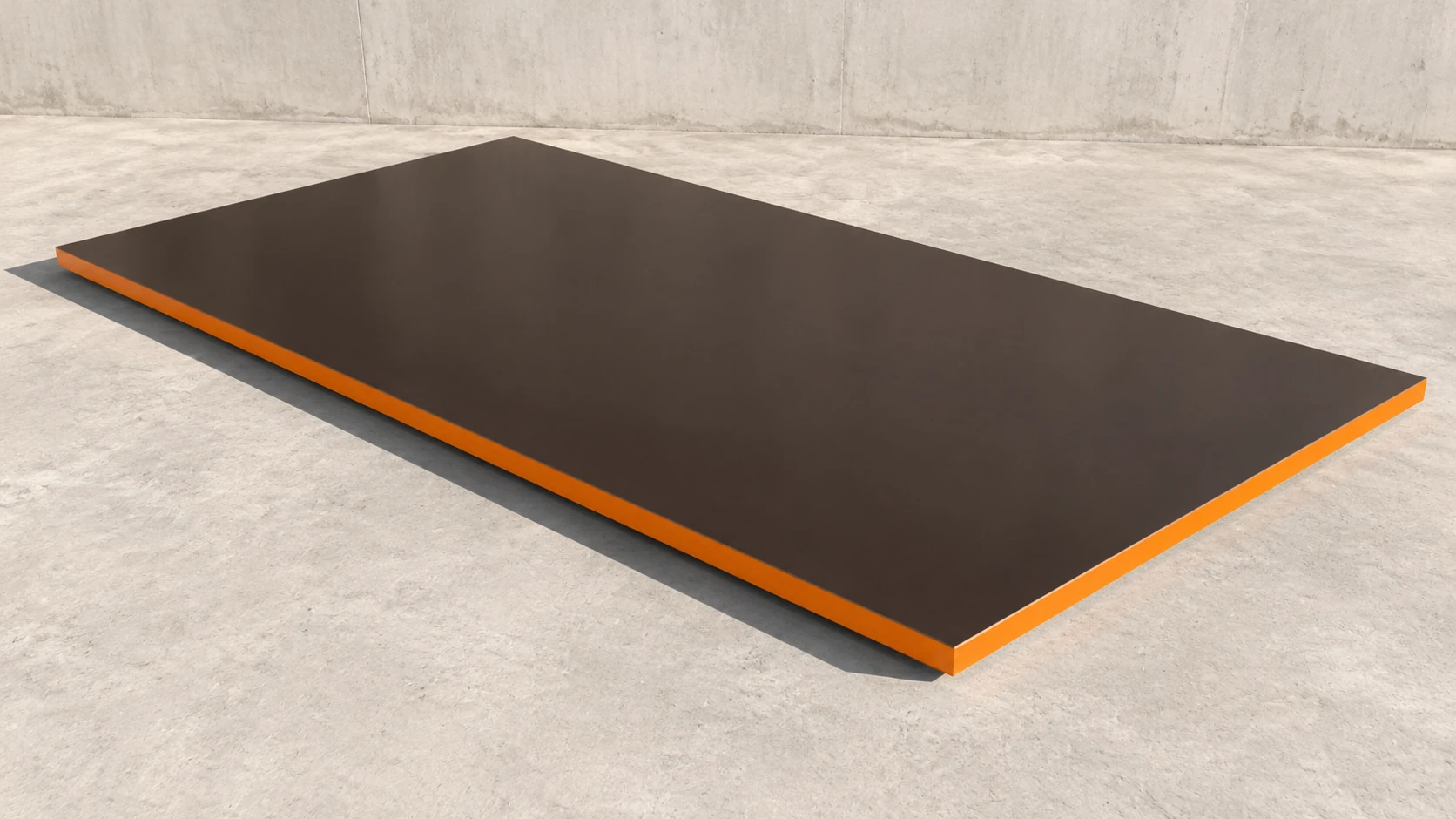
Why buy plywood from Vietnam for European construction sites?
European buyers choose Vietnam for construction plywood because it combines hardwood plantation cores, mills that specialise in film-faced formwork panels, preferential duty under the EU-Vietnam trade agreement and a low-risk classification under the EU Deforestation Regulation. It is also outside the EU anti-dumping duty on Chinese hardwood plywood. The mill you choose still decides the panel.
Those four reasons work together. A formwork panel needs a dense, stiff hardwood core, and Vietnam grows Acacia and Eucalyptus in plantations that feed the veneer lines. The film-faced trade is concentrated in the north of the country, close to the port of Hai Phong, so a mill can press, seal and load a container within reach of a deep-water port. On the legal side, the origin carries no EU trade-defence duty on plywood and sits in the low-risk group for deforestation checks, which keeps the importer’s paperwork shorter than it is for many other origins.
What Vietnam does not give is a uniform product. The same country exports packing plywood, budget film-faced panels and premium phenolic formwork panels, often under similar names. That spread is the main risk of the origin, and most of this note is about how to read it.
| Reason | What it means for a European construction buyer | Where it is covered below |
|---|---|---|
| Hardwood plantation cores | Acacia or Eucalyptus cores give the density and stiffness a formwork panel needs | Plantation Acacia and Eucalyptus |
| EU-Vietnam trade agreement | Preferential duty for goods with Vietnamese origin, with proof of origin | Trade agreements |
| EUDR low risk | Simplified due diligence is possible when every commodity is from low-risk countries | EUDR section |
| No EU plywood duty on the origin | The EU anti-dumping duty applies to Chinese-origin hardwood plywood | Anti-dumping section |
| Specialist film-faced mills near Hai Phong | Short inland haul to a deep-water port; 30–40 days at sea to Northern Europe | Lead times |
How Vietnam compares with China, Indonesia, Malaysia, birch and Brazilian pine
Compared with the other origins a European formwork buyer looks at, Vietnam has no EU trade-defence duty on plywood and a low-risk EUDR class. China shares the low-risk class but carries the EU anti-dumping duty; Indonesia, Malaysia and Brazil are standard risk; Russian and Belarusian wood is banned from EU import.
The table sets the origins side by side on the points that change an importer’s file. The core column describes what each origin typically ships; any one mill can differ, and the order’s technical sheet is what counts.
| Origin | Typical core of its construction plywood | EUDR country class | EU measure on its plywood | 2026 US hardwood plywood case |
|---|---|---|---|---|
| Vietnam | Plantation Acacia and Eucalyptus | Low risk | None; EVFTA preference with origin proof | Inside the case; Phenolic Film Faced Plyform excluded |
| China | Poplar, Eucalyptus and mixed hardwoods | Low risk | Anti-dumping duty, 43.3% or 86.8% | Inside the case |
| Indonesia | Tropical hardwoods and plantation species | Standard risk (not listed) | None covered here | Inside the case |
| Malaysia | Tropical hardwoods and plantation species | Standard risk (not listed) | None covered here | Not one of the countries named |
| Finland and other EU birch | Birch | Low risk | Made inside the EU | Not one of the countries named |
| Russia and Belarus | Birch | High risk | Import ban on wood products | Not one of the countries named |
| Brazil | Plantation pine (softwood) | Standard risk (not listed) | None covered here | Not one of the countries named |
Commission Implementing Regulation (EU) 2025/1093 lists China, Finland and Vietnam among the low-risk countries and Belarus, Myanmar and the Russian Federation among the high-risk countries. A country not named in either list is standard risk, which is where Indonesia, Malaysia and Brazil sit.
Russian and Belarusian wood is excluded by sanctions, not by risk class alone. For wood from Russia, Council Regulation (EU) 2022/576 prohibits the purchase or import into the Union of the goods in its Annex XXI if they originate in Russia or are exported from Russia, and that annex lists wood and articles of wood. For Belarus, Council Regulation (EU) 2022/355 prohibits importing into the Union the wood products listed in its Annex X if they originate in Belarus or have been exported from Belarus.
The other origins keep their own strengths. EU-made birch reaches a European site by truck instead of by sea and needs no import file at all, and some system formwork is specified with birch-faced panels. Brazilian pine is a softwood panel, lighter and used for different jobs. The Vietnamese case is clearest for hardwood-cored film-faced panels shipped by the container to buyers who want an origin with a short legal file. For a panel-by-panel comparison with one neighbour, see our planned note on Malaysian and Vietnamese formply.
Plantation Acacia and Eucalyptus: what the core supply gives a formwork panel
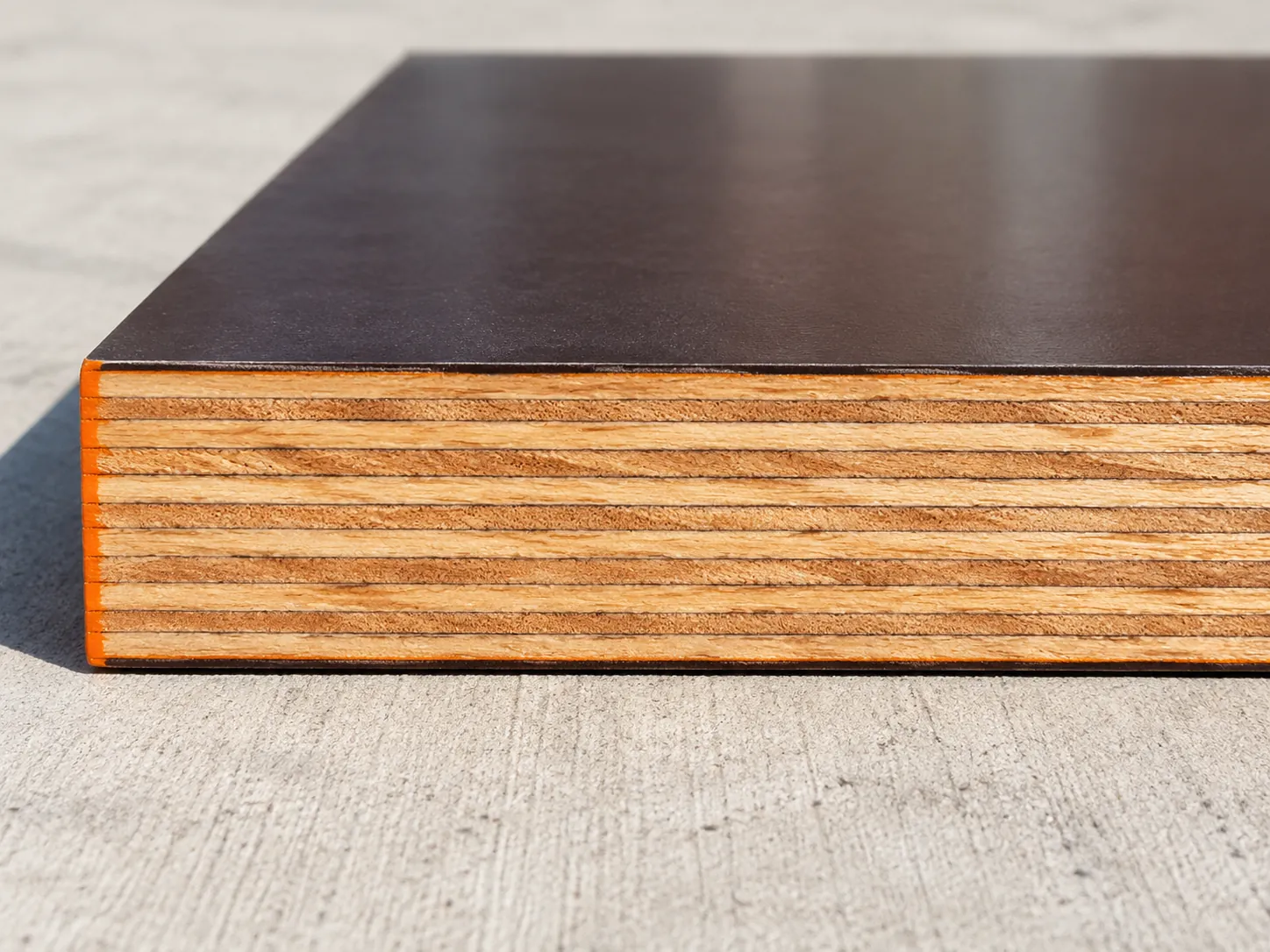
Plantation Acacia and Eucalyptus give Vietnamese formwork plywood a hardwood core of known species and known density. At our mills Acacia is planned at about 580 kg/m³ and Eucalyptus at about 650 kg/m³, measured 650–750 kg/m³. Both are laid crosswise and pressed with MUF or phenolic glue.
A formwork panel works as a beam between joists or studs. It has to stay stiff under wet concrete, hold its thickness after many wet cycles and keep its face flat at the joints. A hardwood core does that better than a light filler core, which is why the core species belongs on every quote. Vietnamese mills that make premium film-faced plywood build on these two plantation species; mills making budget panels may mix species and grades to cut cost.
The two cores behave differently for a buyer:
| Core | Planning density | 18 mm sheet, 1220 × 2440 mm | 40HC load (planning figure) | What it suits |
|---|---|---|---|---|
| Acacia | About 580 kg/m³ | About 31.1 kg | About 47 m³ | Lighter sheets for crews; more m³ per container |
| Eucalyptus | About 650 kg/m³ (measured 650–750) | About 34.8 kg | About 43 m³, weight-capped | A firmer, heavier sheet; the container fills by weight first |
Sheet weight is density times volume: an 18 mm sheet of 1220 × 2440 mm holds about 0.0536 m³. Real sheets are weighed before final loading, and the packing list is the figure that counts.
Plantation timber also matters for the paperwork. Plots planted and harvested on a cycle can be located and mapped, which is what an EU geolocation dossier asks for. Our EUDR geolocation dossier page sets out what we send. The note on Vietnamese film-faced plywood quality explains how core gaps and overlaps show up under the film.
Is Vietnam classed low risk under EUDR?
Yes. Vietnam is classed low risk under the EU Deforestation Regulation by Commission Implementing Regulation (EU) 2025/1093. An EU importer can then apply simplified due diligence, but only when every relevant commodity in the product comes from low-risk countries, and the geolocation of each production plot is still collected and filed.
Low risk changes the depth of the checks, not the existence of the file. Under Regulation (EU) 2023/1115 the importer, as the operator, files a due diligence statement before the customs declaration; there is no official “EUDR certificate” a mill can sell with the panel. The statement needs the product description, the species with common and scientific names, the quantity, the country of production and the plot locations with production dates. Regulation (EU) 2023/1115 defines geolocation as the geographical location of a plot of land described by latitude and longitude coordinates using at least six decimal digits. Plots over 4 ha are described by polygons.
The dates are set too. A plywood importer of any size that already fell under the EU Timber Regulation must comply with the EUDR from 30 December 2026, as must every large or medium operator; the remaining micro and small operators have until 30 June 2027. Forest land cleared after 31 December 2020 still disqualifies the wood.
The country class also sets how often the authorities check: the minimum annual checks are 1% of operators for low-risk origins, 3% for standard and 9% for high. That is a lower inspection rate than for Indonesian, Malaysian or Brazilian plywood, which sit in the standard group. One trap: a panel with a Vietnamese core and an imported face veneer from a standard-risk country loses the simplified route, because every commodity in the product must come from low-risk countries. Our EU import note walks through the statement field by field.
Does the EU anti-dumping duty on Chinese hardwood plywood apply to plywood made in Vietnam?
No. The EU anti-dumping duty on hardwood plywood applies to plywood originating in China, at 43.3% for one named exporter and 86.8% for all other companies, on the net free-at-Union-frontier price. Plywood whose origin is Vietnam is outside that regulation. Origin is the condition, so it must be provable.
Regulation (EU) 2025/2333 imposes a definitive anti-dumping duty on imports of hardwood plywood originating in the People’s Republic of China. The rates are in its Article 1. We state them as context: a duty on another origin is not a reason to buy a panel, and a cheap offer that only works because of an origin claim is the offer to check hardest.
Origin under EU customs law follows the place of the last substantial processing. For plywood that means where the veneer was laid up and pressed into the panel. A mill that peels or buys Vietnamese veneer, lays the core and presses it in its own plant makes Vietnamese-origin plywood. A seller that imports finished or semi-finished panels and only re-films or re-labels them does not. The section on circumvention below explains why customs authorities look closely at this line.
What the EU and UK trade agreements with Vietnam change
The EU and the UK each have a free trade agreement with Vietnam that lowers duty on goods of Vietnamese origin. The preference is claimed by the importer at entry with proof of origin; without the right origin document the lot is cleared at the standard rate, even when the panel would qualify.
The EU-Viet Nam Trade Agreement entered into force on 1 August 2020 and provides for eliminating 99% of all tariffs. For plywood the practical point is the origin form: EU-bound lots from our mills carry a certificate of origin with the shipping papers, and the importer’s broker confirms the tariff code and the preferential rate for the build before the first shipment.
For the United Kingdom, GOV.UK keeps the UK-Vietnam Free Trade Agreement treaty information, explainers and rules of origin guidance in one collection. Its rules of origin decide which panels qualify, so a UK lot needs origin evidence in the form the UK broker will use.
Two limits apply. A trade agreement lowers the customs duty; it does not remove trade-defence duties, product rules or timber due diligence. And the preference depends on origin, so the rules of origin, not the country of shipment, decide whether a panel qualifies. Our note on importing construction plywood from Vietnam gives the full import steps, and documents with each container lists the origin papers.
What does the US duty case mean for Vietnamese formwork plywood?
The 2026 US case puts hardwood and decorative plywood from Vietnam under anti-dumping and countervailing duty, with a Vietnam-wide dumping margin of 90.12% and an all-others subsidy rate of 47.68%. Phenolic Film Faced Plyform, as the scope defines it, is excluded, so a formwork panel’s build decides whether the duty applies.
The case is not about Vietnam alone. The US International Trade Commission determined that an industry in the United States is materially injured by reason of imports of hardwood and decorative plywood from China, Indonesia, and Vietnam. So moving a US order from Vietnam to China or Indonesia does not leave the case; Malaysia and Brazil are not among the countries named.
The final anti-dumping determination gives the Vietnam-Wide Entity a weighted-average dumping margin of 90.12 percent and a cash deposit rate of 84.95 percent. The final countervailing duty determination sets the All Others subsidy rate at 47.68 percent. Case numbers are A-552-851 and C-552-852.
The scope excludes Phenolic Film Faced Plyform, defined as a panel with an Exterior or Exposure 1 bond classification as defined by The Engineered Wood Association, an opaque phenolic film permanently bonded on both the face and back veneers and an opaque, moisture resistant coating applied to the edges. A panel that matches every line is outside; one that misses a line is read under the general scope. A scope ruling is the importer’s to seek, and we supply the build sheet and test evidence it needs. Our US import note reads the exclusion line by line.
Which certificates should a Vietnamese formwork plywood mill send before the order?
Before the order is confirmed, a Vietnamese formwork plywood mill should send its FSC chain of custody number, a CE factory production control certificate for structural plywood and CARB Phase 2 or TSCA Title VI papers for US lots. Add ISO 9001 and test reports that name the specimen, method and date.
A document is only useful if you can check it, so the number, the issuer and the scope matter more than a logo on a brochure. Here is what our two mills send, and what each one covers:
| Document | What it covers | Our reference |
|---|---|---|
| FSC chain of custody | FSC 100% and FSC Mix plywood; the claim is confirmed per order on the sales documents | SGSHK-COC-370674, issued by SGS Hong Kong |
| CE factory production control | EN 13986:2004+A1:2015, AVCP System 2+, structural plywood for dry, humid and external use, 3.6–30 mm, MUF or phenolic glue | 0407-CPR-2146, Istituto Giordano, notified body 0407 |
| CARB Phase 2 / TSCA Title VI | Formaldehyde documentation for applicable products and orders, hardwood plywood up to 21 mm | Sent with US orders |
| AS 6669:2016 | Product certification as formwork plywood | CMI Certification, a JAS-ANZ-accredited body |
| ISO 9001 | Quality management at our mills | Documentation sent with the order |
| SGS test report | One submitted 21 mm Acacia-core phenolic specimen: bonding Class 3 PASS; formaldehyde not detected at the 0.04 mg/m³ reporting limit, E1 PASS (EN 717-1 chamber) | SGS Vietnam, issued 23 December 2025 |
| EUDR file set | Geolocation data in GeoJSON for the importer’s due diligence statement | Prepared for EU lots |
Two lines need care. The CE scope is 3.6–30 mm, narrower than the 9–40 mm we press, so a panel ordered as structural CE plywood must fall inside it. The SGS figures describe the specimen tested; a different build gets its own report when a project calls for one, and “not detected” is an E1 result, not an E0 claim. The full test is set out in our note on the SGS test of our 21 mm phenolic specimen, and the scope of each certificate is on the CE marking and FSC plywood pages.
We send these files before the order is confirmed, not after loading. A buyer who receives them only with the shipping papers has no chance to reject a build that does not match.
How long is the sea transit from Hai Phong to Northern Europe?
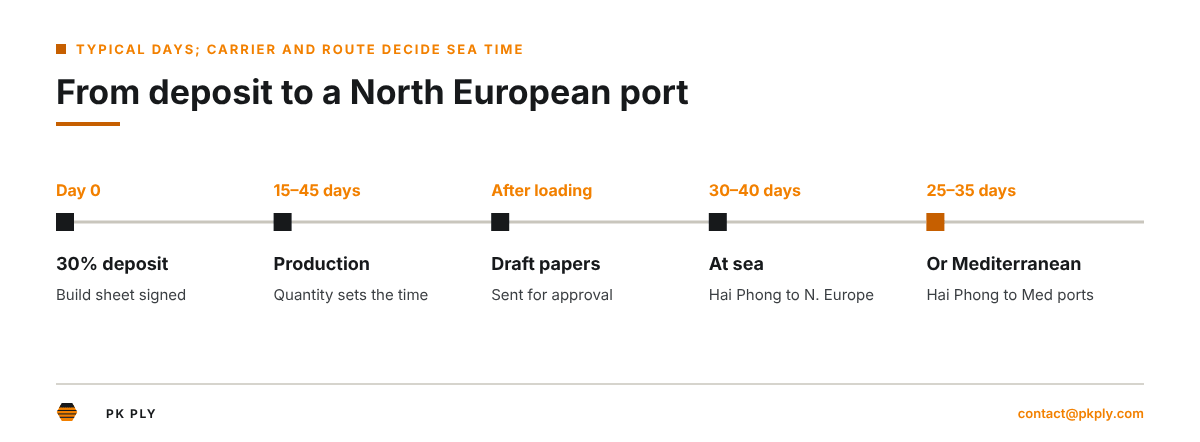
Sea transit from Hai Phong to Northern Europe is typically 30–40 days, and 25–35 days to the Mediterranean, depending on carrier and route. With production of 15–45 days after the deposit, a first order usually reaches a North European port about 45–85 days after the deposit, before loading and port days.
The lead time has two parts the buyer can plan around. Production depends on quantity, production conditions and the agreement on the order; one container of a standard build sits at the short end, several containers of a special film or size at the long end. Sea time depends on the carrier’s rotation and transhipment port.
| Destination from Hai Phong | Typical days at sea |
|---|---|
| South-East Asia | 5–12 |
| Middle East | 15–25 |
| US West Coast | 20–30 |
| Mediterranean | 25–35 |
| Northern Europe | 30–40 |
| US East Coast | 35–45 |
| West Africa | 35–50 |
For a contractor or distributor in Europe this is the real trade-off against EU-made birch, which arrives by truck. The way to live with it is to order on a programme: place the next container while the previous one is still on site, and keep one build sheet so every container matches. Our notes on freight cost and landed cost turn these days into money.
How many containers a month can our mills ship?
Our two mills in Chi Linh, Hai Phong ship up to 150 containers a month between them. A 40HC carries about 47 m³ of Acacia-core panels or about 43 m³ of Eucalyptus-core panels, so a buyer with a monthly programme can take several containers of one build without the mills changing the specification.
Capacity matters to a buyer for a simple reason: a mill working at its limit is the mill that swaps a core grade or a film weight when an order is late. One of our two mills is a modern plant that started production in 2026, and the two together give room to run a repeat programme on the same build.
What a container carries depends on the core and the thickness. These are planning figures for sheets of 1220 × 2440 mm; real sheets are weighed before final loading and the packing list is the number that counts.
| Thickness | Acacia core: sheets per 40HC, m³ | Eucalyptus core: sheets per 40HC, m³ |
|---|---|---|
| 12 mm | 1,328 sheets (16 × 83), 47.4 m³ | 1,200 sheets (15 × 80), 42.9 m³ |
| 18 mm | 880 sheets (16 × 55), 47.2 m³ | 795 sheets (15 × 53), 42.6 m³ |
| 21 mm | 752 sheets (16 × 47), 47.0 m³ | 675 sheets (15 × 45), 42.2 m³ |
The Eucalyptus loads stop at the weight limit before the container is full by volume.
The minimum order is one 40HC, and one container usually carries one or two products, with three to six mixed by agreement. A first-time buyer can therefore test our build on one container of the thickness used most, then add sizes on the next.
The risks of buying from Vietnam, stated plainly
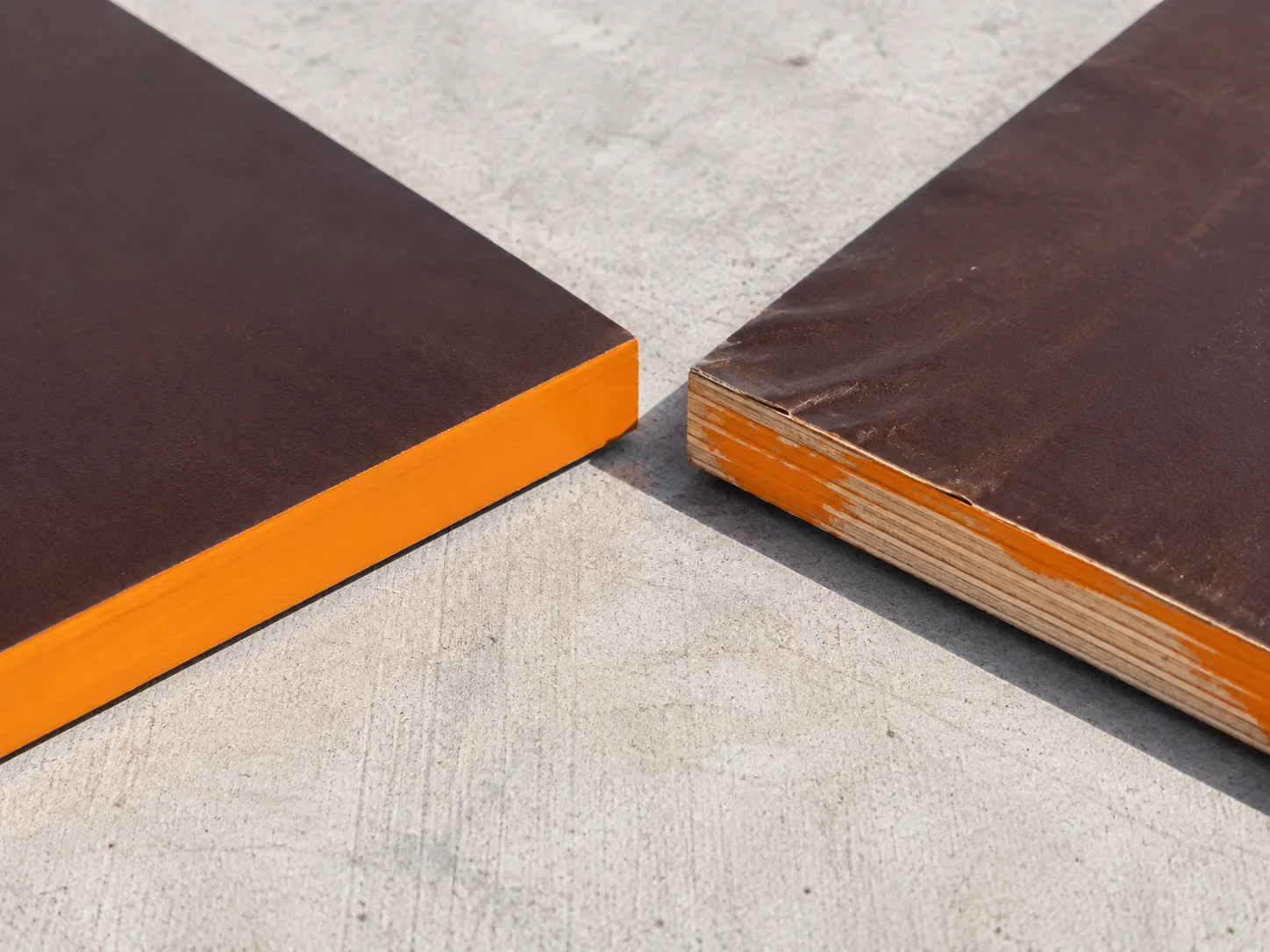
The main risk of buying plywood from Vietnam is the quality spread between mills: the same name, “film-faced plywood”, covers budget panels that give about 4–10 reuses and premium panels built for many more. The other risks are origin scrutiny, lead time and a duty position that differs by destination.
The spread comes from the build. Two film-faced offers with the same thickness can differ in core grade, how the core veneers are joined, the glue system, the film weight, the edge sealing and the tolerance. Each of those lines moves the price, and most of them cannot be seen on a new sheet. A thin film wears through after a few pours, an unsealed edge swells, and a low glue spread opens at the edges in wet cycles. The note on cheap formwork plywood shows where the saving in a budget sheet comes from.
The risks, and what controls each one:
| Risk | What it looks like | What controls it |
|---|---|---|
| Quality spread between mills | A sample that does not match the container; thin film, mixed core | A written build sheet, a sample from the same build, a trial container |
| Origin scrutiny | Questions from customs on where the veneer and core were made | A mill that presses its own panels and can document veneer and log sources |
| Trader in the middle | A seller with no presses who changes mills between orders | Seeing the press that makes your order |
| Lead time | Weeks of production plus weeks at sea | Ordering on a programme, one build sheet for every container |
| Destination duty | US AD/CVD scope; EU origin rules | Settling scope and origin papers before the deposit |
| Certificate scope | A certificate that does not cover the panel ordered | Reading scope, thickness range and product on each certificate |
None of these is particular to Vietnam; they apply to any origin shipping by sea. What makes them worth stating is that the low price of the weakest Vietnamese panels pulls buyers toward offers that fail on site. Reuse is a target for a build and a site, not a fixed property of the sheet: our MUF film-faced panels give about 12–15 pours and our phenolic panels up to about 25, with proper handling, release agent and edge sealing.
Why origin must be provable: circumvention and transshipment checks
Origin must be provable because duties attach to it. When one origin carries a duty, customs authorities look for panels from that origin passing through another country, so a Vietnamese mill has to show that its veneer, lay-up and pressing happen in Vietnam, with records that match each shipment.
The US has already ruled on this route. In July 2023 the US Department of Commerce determined that hardwood plywood completed in Vietnam using face veneer, back veneer or core made in China circumvents the US duty orders on hardwood plywood from China. The finding covers panels assembled in Vietnam from Chinese inputs, not plywood that a Vietnamese mill makes from its own veneer. The EU anti-dumping duty on Chinese hardwood plywood gives the same incentive in Europe, which is why an EU importer should expect origin questions on any low-priced Asian lot.
For a buyer the protection is documentary. Ask the mill where its core veneer comes from, whether it peels or buys veneer, and which presses make the panel. Ask for the species and country of harvest on the invoice, which the US Lacey Act declaration and the EU due diligence statement both need anyway. A mill that makes the panel answers these questions in a day. A seller that buys panels from others cannot answer them the same way for every container.
How can I find plywood suppliers in Vietnam and check a mill?
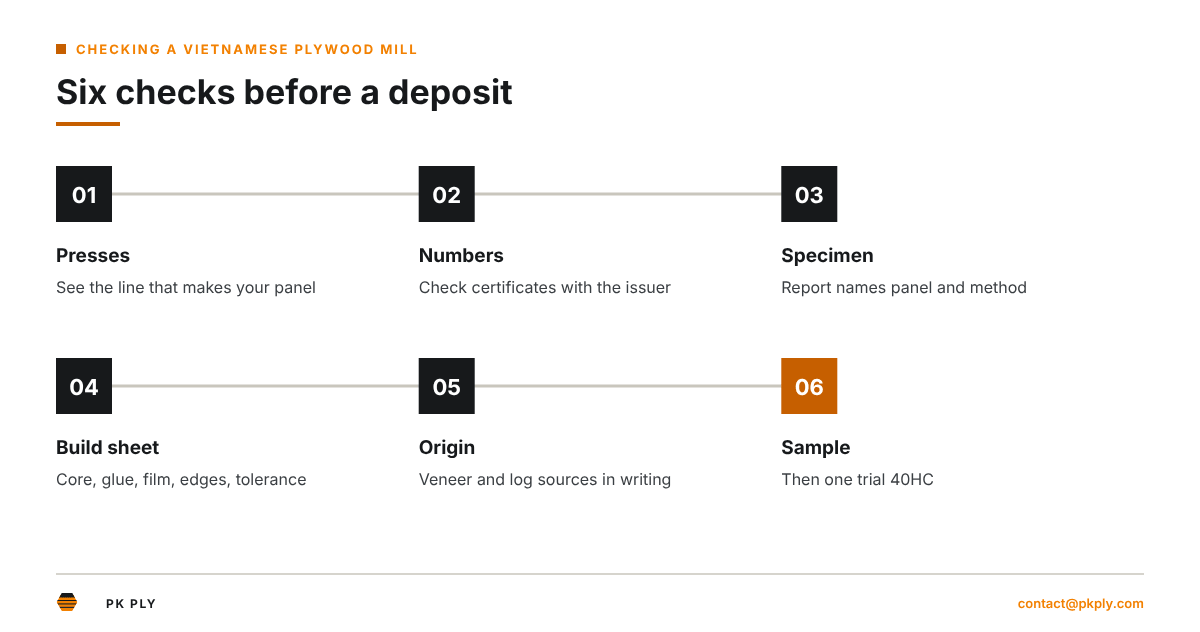
Find plywood suppliers in Vietnam through trade fairs, embassy trade offices, timber association lists, certificate databases and mill websites. Then check each one the same way: see the presses, check certificate numbers with the issuer, read the specimen test report, get a written build sheet, ask for origin records and order a sample before one trial container.
Search is the easy part. FSC’s public certificate database lets you search by certificate number and country, and the European Commission’s NANDO database lists notified bodies such as 0407, so a CE claim can be traced to the body that checks the factory. Mill websites and trade fair lists give names; what separates a mill from a trader is the check that follows.
- See the presses. Ask which mill presses your panel and see that line, in person or on a live video call: the core press, the film press and the edge-sealing step.
- Check certificate numbers. Take each number to the issuer’s own database. Read the scope: product, thickness range, glue and the site it covers.
- Read the test report. It should name the specimen, its thickness, core and glue, the method and the date. A report on a different build is not evidence for yours.
- Get a build sheet. Core species, glue system, film weight in g/m² and colour, edge sealing, thickness tolerance and sheet size, in writing, before the deposit.
- Ask for origin records. Veneer and log sources, species with scientific names and the plots for an EU geolocation file.
- Test a sample, then one container. A sample from the same build, then one trial 40HC of the size you use most.
A mill exporting to Europe expects these questions and answers them in writing. Our note on importing construction plywood from Vietnam puts the same checks into the order steps.
Why our two mills in Chi Linh, Hai Phong
Our case is the facts a buyer can check. PK Ply is the export brand of two own mills in Chi Linh, Hai Phong, that press construction plywood only: film-faced, anti-slip and CE-marked structural panels. We ship up to 150 containers a month, directly from the mills, and send the certificate files before the order is confirmed.
- What we make. Film-faced plywood with Acacia or Eucalyptus cores, MUF or phenolic glue, film from 120–125 g/m² to over 200 g/m² by order, and water-resistant paint on all four edges. Thickness 9–40 mm, with 12, 15, 18 and 21 mm the everyday formwork sizes; sheets of 1220 × 2440 mm and 1250 × 2500 mm, or cut to a list.
- How we press it. Veneer intake, drying, core lay-up, glue and press, sizing and sanding, film press, edge sealing, then marking and packing. The core panel is pressed and calibrated before the film goes on, which is what holds the ±0.5 mm thickness tolerance. Our production process page shows each step.
- What we send. FSC SGSHK-COC-370674, CE FPC 0407-CPR-2146, CARB Phase 2 / TSCA Title VI documentation for applicable products, ISO 9001, AS 6669:2016 certification by CMI Certification, the SGS specimen report and an EUDR geolocation file set for EU lots.
- How we sell. One 40HC minimum, a 30% deposit and the 70% balance against the scanned B/L by T/T or by irrevocable L/C at sight; FOB Hai Phong, CFR or CIF. Our note on payment terms explains each step.
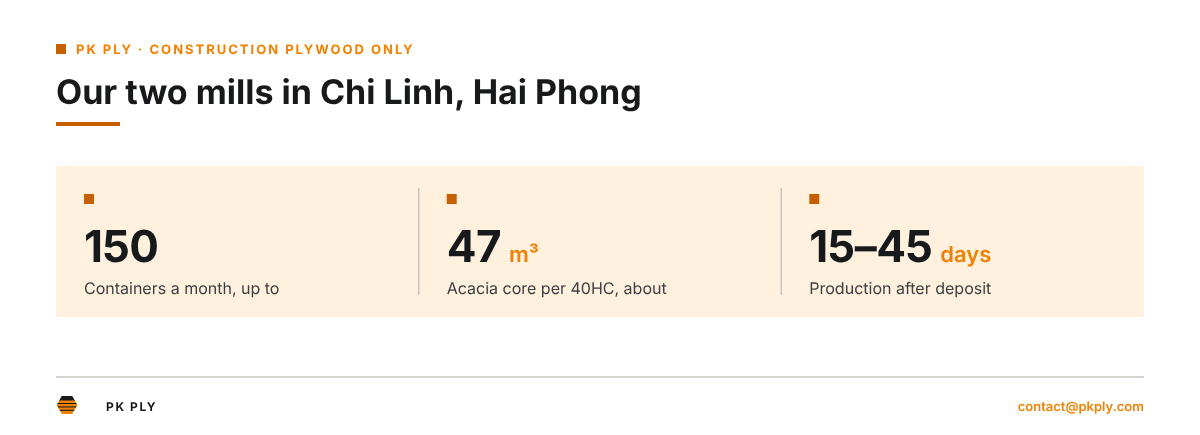
Chi Linh sits in Hai Phong city since the province merger of July 2025, so our panels go from the press to the port of loading within the same city. Our film-faced plywood page lists the builds.
When Vietnam, or our mills, is not the right source
Vietnam, and our mills, are the wrong source in a few clear cases: when a site needs panels within days rather than weeks, when a formwork system is specified for birch-faced panels, or when a panel falls outside what we press or what our certificates cover.
- Short notice. If the site needs panels next week, a local merchant’s stock is the answer. A container from Hai Phong takes production plus 30–40 days at sea to Northern Europe.
- Systems specified for birch. Some system formwork is specified and warranted with a birch-faced panel; buy what the system’s supplier specifies.
- Sizes above 1250 × 2500 mm. We press nothing larger. Oversize sheets come from mills with larger presses.
- CE structural above 30 mm. Our CE scope ends at 30 mm, so a structural CE panel thicker than that is outside it.
- CARB or TSCA above 21 mm. Our formaldehyde documentation covers hardwood plywood up to 21 mm.
- A US panel inside the duty scope. A build that does not meet the film-faced exclusion carries the duty from any of the three named countries.
- Furniture, birch or poplar faces, packing plywood. We make construction plywood only.
Saying so early saves a buyer a container that does not fit the job, and it saves us a claim.
What to send us for a first offer
Send eight lines for a first offer: the application and pour target, core species, glue system, film weight and colour, thickness, sheet size, edge sealing and marking, and the quantity with the port of discharge. With those lines we return a build sheet and an FOB Hai Phong offer you can compare line by line.
| Line | Example for a European slab and wall programme |
|---|---|
| Application and pours | Slab decks and walls, about 20 pours |
| Core | Acacia, about 47 m³ per 40HC |
| Glue | Phenolic |
| Film | 165 g/m², dark brown, both faces |
| Thickness and tolerance | 18 mm, ±0.5 mm |
| Sheet size | 1250 × 2500 mm |
| Edges and marking | Water-resistant paint on all four edges |
| Quantity and port | One 40HC, CFR to your port, with certificate files before confirmation |
Samples are free; new buyers book their own courier, and that cost can be credited against a real order. Send the lines through our specification form or to [email protected], and ask for the certificate files with the offer, so you can check our mills before you pay anything.
Questions buyers ask us
Why is so much formwork plywood made in Vietnam?
Vietnam has plantation Acacia and Eucalyptus for hardwood cores, a cluster of mills in the north that specialise in film-faced panels, and a deep-water port at Hai Phong. EU and UK trade agreements add preferential access for goods with Vietnamese origin.
Is Vietnamese plywood better than Chinese plywood?
Neither origin is better as a whole; both have strong and weak mills. For EU buyers the difference is legal: hardwood plywood of Chinese origin carries an EU anti-dumping duty of 43.3% or 86.8%, and plywood of Vietnamese origin does not.
What are the best plywood manufacturers in Vietnam?
No public ranking exists that a buyer can rely on. Judge each mill on its own presses, certificate numbers you can check with the issuer, a specimen test report, a written build sheet and a trial container.
What are the best film-faced plywood manufacturers in Vietnam?
The ones whose build you can check: core species, glue system, film weight in g/m², edge sealing and thickness tolerance on a technical sheet, backed by test reports that name the specimen and method. Ask every mill for the same lines and compare them side by side.
Is Vietnam low risk under the EU Deforestation Regulation?
Yes. Implementing Regulation (EU) 2025/1093 lists Vietnam as low risk, so an EU importer can use simplified due diligence when every commodity in the product comes from low-risk countries. Geolocation of the production plots is still required.
Does the EU anti-dumping duty on Chinese plywood apply to Vietnamese plywood?
No. Regulation (EU) 2025/2333 covers hardwood plywood originating in China; plywood whose origin is Vietnam is outside it. Origin follows where the panel was substantially made, so the mill must be able to show its own veneer and pressing.
Is Vietnamese formwork plywood subject to US anti-dumping duty?
Hardwood and decorative plywood from Vietnam is inside the 2026 US anti-dumping and countervailing duty case, but Phenolic Film Faced Plyform as defined in the scope is excluded. Whether a given film-faced panel meets that definition is a question for your customs broker before shipment.
How long does it take to get plywood from Vietnam to Europe?
Production takes 15–45 days after the deposit at our mills, and sea transit from Hai Phong is typically 30–40 days to Northern Europe or 25–35 days to the Mediterranean. Carrier and route decide the exact days.
What is the minimum order for plywood from Vietnam?
At our mills the minimum is one 40HC, which can carry one or two products and up to six by agreement. A 40HC holds about 47 m³ of Acacia-core panels or about 43 m³ of Eucalyptus-core panels.
Which certificates can a Vietnamese formwork plywood mill provide?
Ask for an FSC chain of custody number, a CE factory production control certificate for structural plywood, CARB Phase 2 or TSCA Title VI documentation for the US, ISO 9001, and test reports. Ours are FSC SGSHK-COC-370674 and CE FPC 0407-CPR-2146, plus AS 6669:2016 certification by CMI Certification.
Is it safe to pay a deposit to a plywood factory in Vietnam?
It is safer when you have checked the mill first: seen its presses, checked its certificate numbers with the issuer and tested a sample. Our terms are a 30% deposit and the 70% balance against the scanned B/L by T/T, or an irrevocable L/C at sight.
Can I visit plywood mills in Vietnam before ordering?
Yes, and a visit tells a buyer more than any document. Our two mills are in Chi Linh, Hai Phong; ask to see the press that will make your order, the film press and the edge-sealing line.