
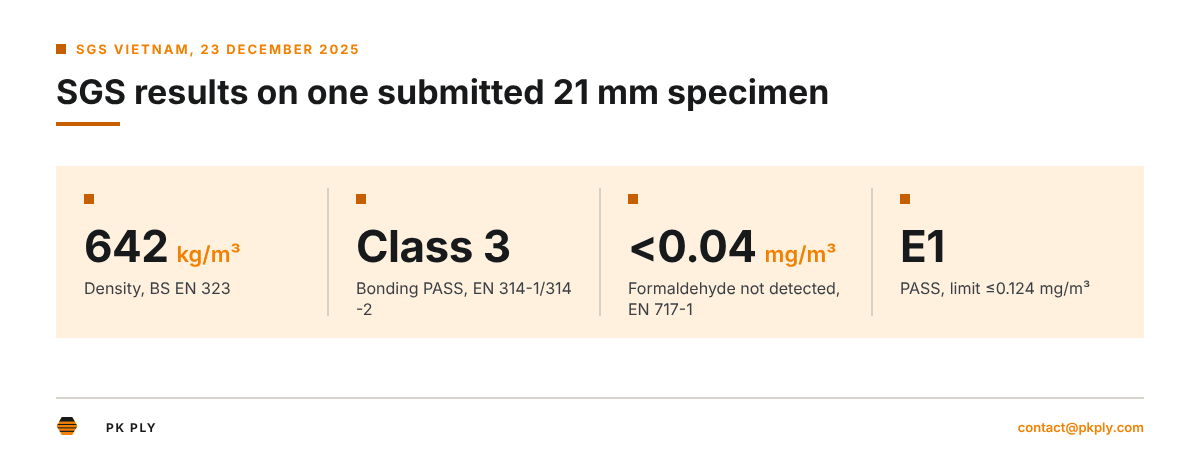
SGS Vietnam tested one submitted 21 mm phenolic film-faced specimen from PK Ply with an Acacia core: density 642 kg/m³, EN 314 bonding Class 3 PASS and E1 PASS, with formaldehyde not detected below 0.04 mg/m³. A buyer who reads those lines as a promise for every panel, or as an E0 claim, can order the wrong build and reject a good load.
What our film faced plywood test report covers, in one table
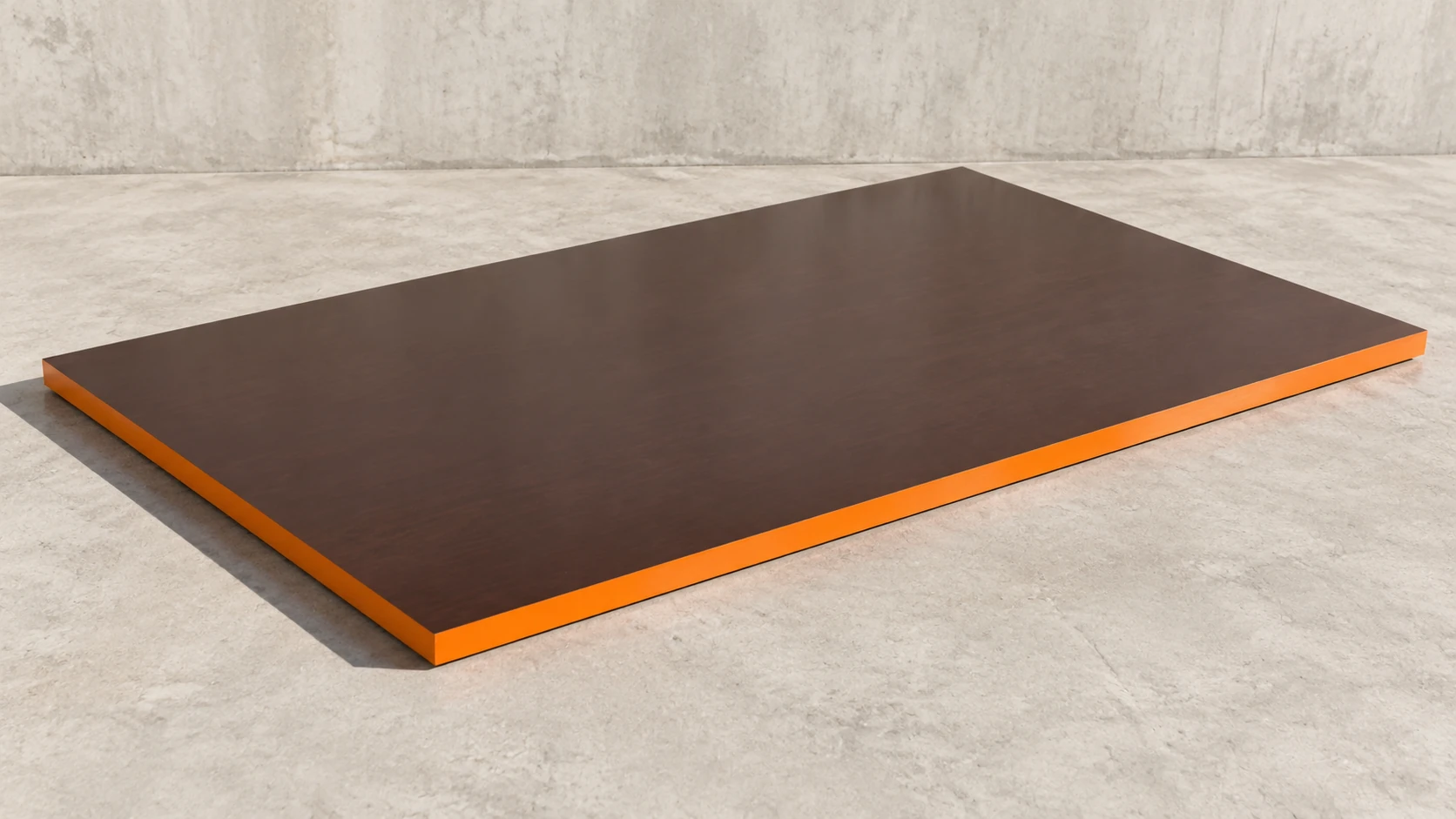
Our film faced plywood test report is an SGS Vietnam report issued on 23 December 2025 for one submitted 21 mm dark-brown film-faced specimen with an Acacia core and phenolic glue. It reports three results that matter to a formwork buyer: density, bonding quality and formaldehyde emission, each with the method SGS used.
The table below is the whole public result set, with the method beside every value. We publish the three values that describe what a buyer asks first: how heavy the build is, whether the glue line survives exterior wet cycles, and what the panel releases into indoor air.
| Property | Method | Result on the tested specimen |
|---|---|---|
| Density | BS EN 323 | 642 kg/m³ |
| Bonding quality | EN 314-1 test methods, EN 314-2 requirements | Class 3 PASS after 24 h water soak, boil-dry-boil and 72 h boiling pretreatments |
| Formaldehyde emission | EN 717-1 chamber method | Not detected at the 0.04 mg/m³ reporting limit; E1 PASS against ≤0.124 mg/m³ |
| Specimen | As submitted | One 21 mm dark-brown film-faced panel, Acacia core, phenolic glue |
| Report date | SGS Vietnam | 23 December 2025 |
Three habits make a test report useful instead of decorative. Read the specimen line first, because it fixes what the results describe. Read the method next, because a density or emission value means nothing without the standard behind it. Read the result last, with its unit and its limit. The rest of this note goes through each line in that order, and the E1 chamber test page shows the emission result in its certificate context.
Which specimen SGS tested, and why the context matters
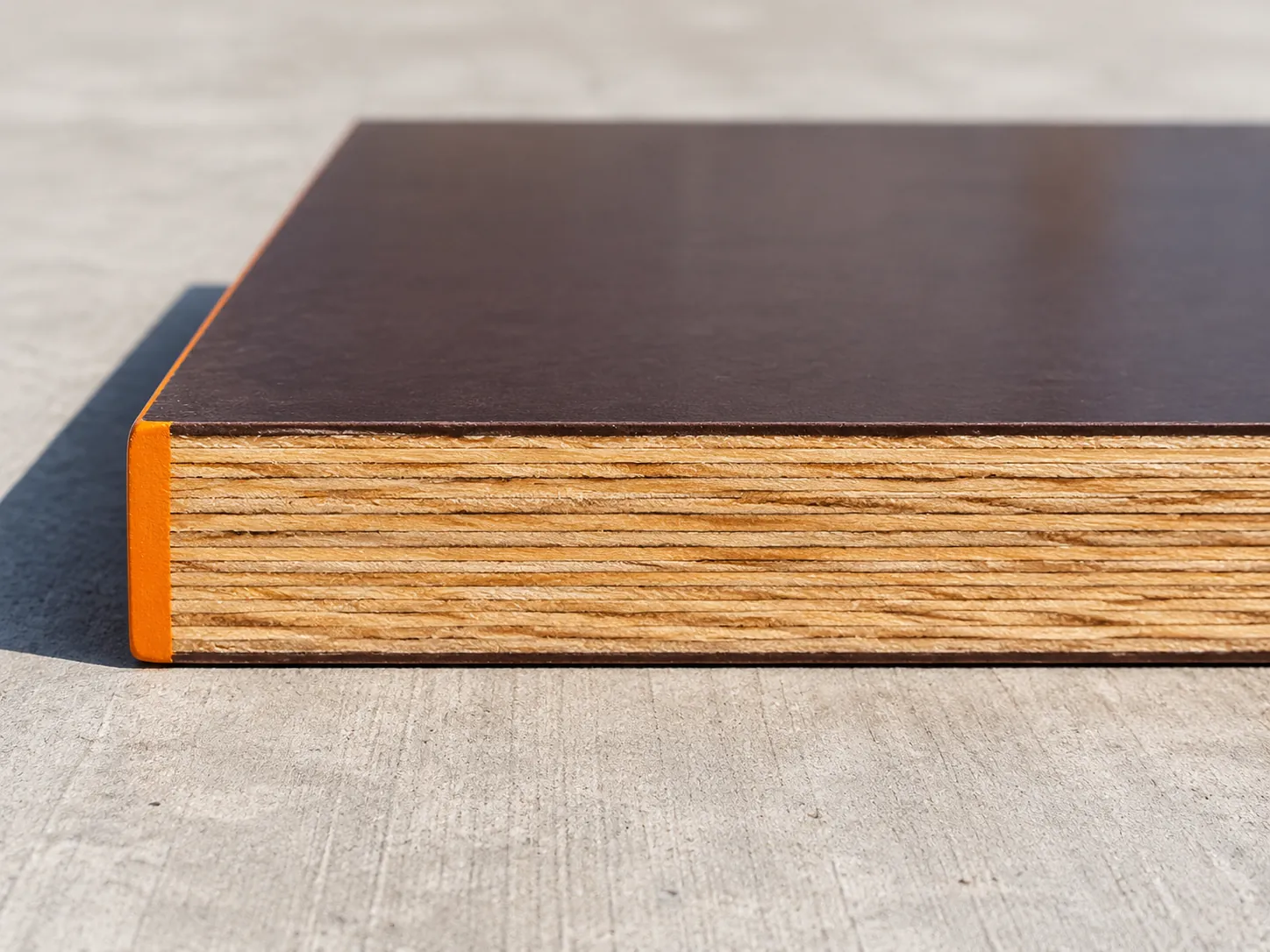
SGS tested one specimen that we submitted: a 21 mm film-faced panel with dark-brown phenolic film, an Acacia hardwood core and a phenolic glue line. Every number in the report belongs to that configuration. It shows what this build achieves; it is not a certificate for every thickness, core or glue we press.
A plywood test report is specimen evidence. The laboratory receives a sample, records what it received, prepares test pieces from it and reports the results for those pieces. It does not visit the mill, choose the sample from a running order or follow the panels into a container. That is normal for a product test, and it is why buyers who read reports well always ask the same follow-up questions: which thickness, which core species, which glue system, which film, and on what date.
Our answers for this report are short. Thickness 21 mm. Core Acacia. Glue phenolic. Film dark brown, phenolic-impregnated paper. Date 23 December 2025. Those five lines are what we mean every time we say “the SGS 21 mm specimen”, and they are the five lines you should copy into your own file next to the results.
What changes if you order something else? An 18 mm sheet, a Eucalyptus core or a melamine (MUF) glue line is a different build. The 21 mm phenolic result tells you what our phenolic line can do at that thickness; it does not move automatically to a MUF panel, whose glue line is made for a different number of wet cycles. When a project needs a report for its own configuration, we arrange a test on that build. Our 21 mm film-faced plywood note covers the tested thickness as a product.
What does bonding class 3 under EN 314-2 mean for film faced plywood?
Bonding class 3 under EN 314-2 is the exterior class: the glue line of the plywood has passed the most severe of the three pretreatment routes in the standard, including boiling, and still holds the veneers together. For film-faced plywood it is the class that matches formwork, where panels go through repeated wet pours outdoors.
The standard behind the class has two parts. EN 314-1 sets the test methods for plywood bonding quality. EN 314-2 specifies requirements for bonding classes of veneer plywood according to their end uses. Part 1 says how the test pieces are cut, pretreated and pulled apart in shear; part 2 says which results a panel needs for each class.
The three classes follow three service conditions:
| Bonding class | Service condition it is meant for | What the panel must survive in the test |
|---|---|---|
| Class 1 | Dry interior conditions | A short water soak |
| Class 2 | Humid conditions, protected from weather | Water soak and hot water treatment |
| Class 3 | Exterior conditions, exposed to weather | Water soak plus boiling routes, including long boiling |
For a formwork buyer the practical meaning is simple. A Class 1 or Class 2 glue line can hold a dry or protected panel together for years and still open after a few weeks of wet pours, because the concrete, the rain and the cleaning water reach every edge. A Class 3 glue line is built for that duty. Our tested 21 mm specimen passed Class 3 PASS under EN 314-1/314-2, which is the bonding evidence behind our phenolic film-faced panels.
Class 3 is also the class most trade terms point to. When a quote says WBP, boil-proof, exterior or weather- and boil-proof, ask which EN 314-2 class the supplier can show and on which specimen. A name is not a test result.
Which pretreatments did the 21 mm specimen pass in the SGS test?
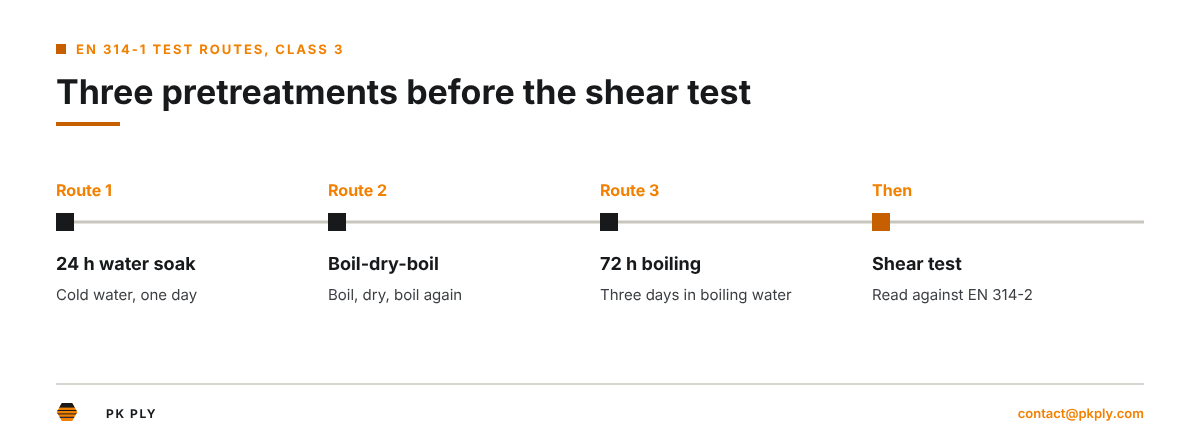
The 21 mm specimen passed three pretreatments before its shear test: a 24 h water soak, a boil-dry-boil cycle and 72 h boiling. Each route attacks the glue line in a different way, and the specimen kept its Class 3 bond after all three, which is what the report records as Class 3 PASS.
Here is what each route does to a glue line, in plain terms:
- 24 h water soak. Test pieces stay under cold water for a day. Water swells the wood and works into the glue line from the cut edges. Weak or interior glue lines start to lose strength here.
- Boil-dry-boil. Test pieces are boiled, dried and boiled again. The cycle swells and shrinks the veneers around the glue line, which is close to what a formwork panel feels when it goes from a wet pour to sun and back.
- 72 h boiling. Test pieces boil for three days. This is the long route for exterior glue lines, and the one that separates a true exterior bond from one that only looks waterproof after a short test.
After each pretreatment the pieces are cut in shear, and the result is read against the requirements of EN 314-2. The report gives a PASS for Class 3 on our specimen after those three routes.
The value for a buyer is that the test copies the abuse a shuttering panel gets on site: soaking in a wet pour, drying in the sun, soaking again. A glue line that survives 72 h of boiling has a margin over the wet cycles of a normal programme. It still needs sealed edges and release agent to reach its pours, because the test protects the glue line, not the raw wood at a bare saw cut.
Is phenolic film faced plywood waterproof after boiling tests?
The glue line is: a phenolic film-faced panel that passes the boiling pretreatments of EN 314-2 Class 3 keeps its bond in water. The panel as a whole is water-resistant, not waterproof, because wood still takes up water through any surface left open, above all the end grain at a fresh saw cut.
Three parts of the panel decide how it behaves in water:
- The glue line. Phenolic glue does not soften in water or boiling water once cured. That is what Class 3 proves.
- The film. Phenolic-impregnated paper pressed into both faces closes the face against water and cement paste. A torn film opens the face.
- The edges. Our panels leave the mill with water-resistant paint on all four edges. Every cut made on site opens a new edge, and that edge needs sealing the same day.
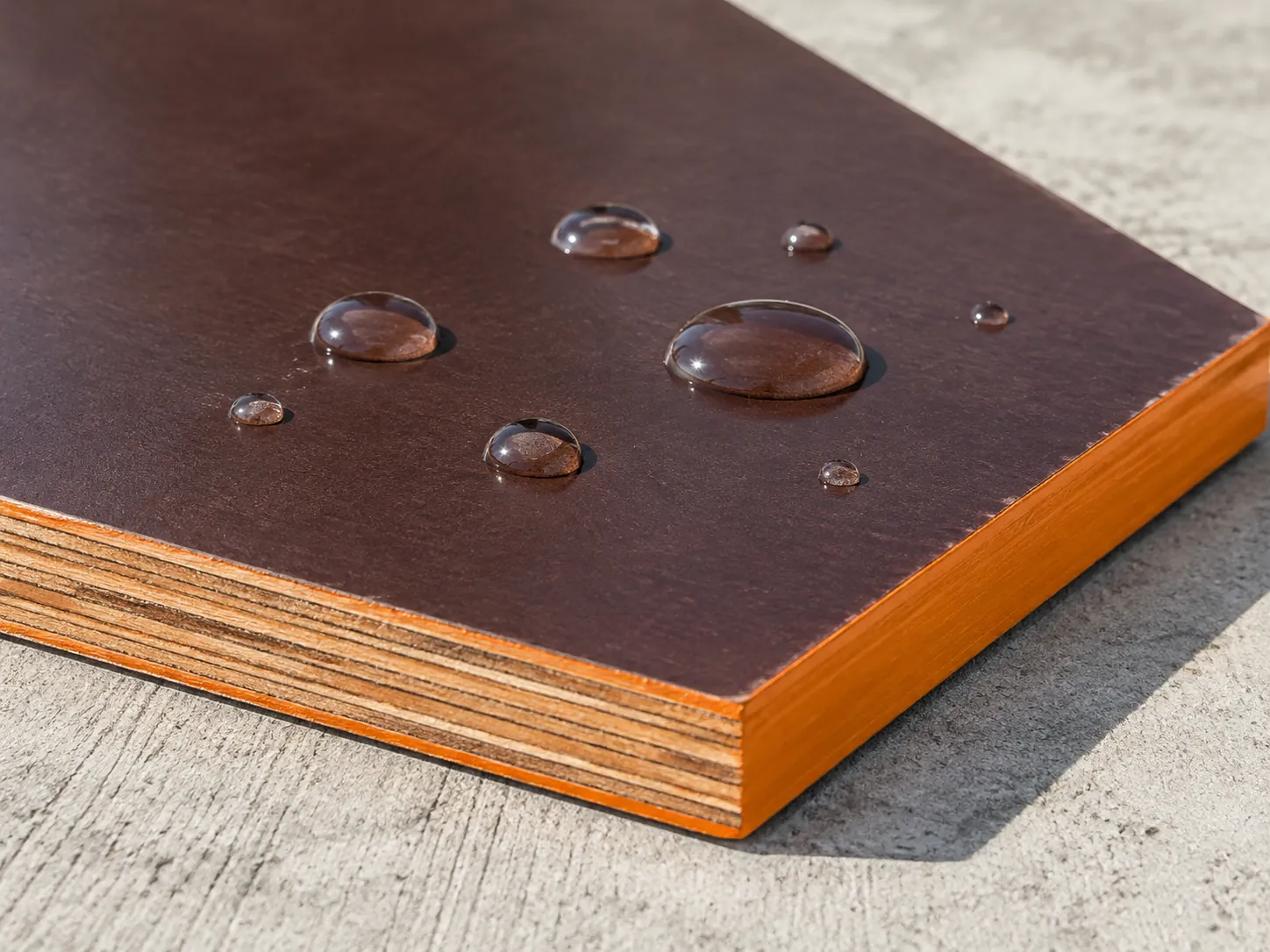
So the honest answer to “is it waterproof?” has two halves. The bond is waterproof in the sense the test measures. The sheet stays water-resistant only while film and edge paint are whole. That is why our pour figures always carry their conditions: about 12–15 pours with MUF glue and up to about 25 with phenolic glue, with proper handling, release agent and edge sealing. A panel that boils for three days in a laboratory can still swell at a bare cut edge on a wet deck within a few pours.
What density did SGS measure on the 21 mm Acacia core specimen?
SGS measured a density of 642 kg/m³ on the 21 mm Acacia-core specimen, by the method of BS EN 323. That is the density of the whole panel as tested, film and glue included, and it sits above the 580 kg/m³ we use for Acacia in container and weight planning.
Density matters to a formwork buyer in three ways. It sets the weight a crew lifts on every strike. It decides how many cubic metres fit in a container before the weight limit stops the load. And it says something about the build: a well-pressed panel with full glue lines and a filmed face weighs more than a loosely pressed one.
The arithmetic is density times volume. A 21 mm sheet of 1220 × 2440 mm holds 0.0625 m³ of panel. At the specimen’s 642 kg/m³ it would weigh about 40.1 kg; at our Acacia planning density of 580 kg/m³ the same sheet is planned at 36.3 kg. The gap is why we treat planning densities as planning figures and weigh real sheets before final loading.
| 21 mm sheet, 1220 × 2440 mm | Density | Sheet weight |
|---|---|---|
| Tested specimen (SGS, BS EN 323) | 642 kg/m³ | About 40.1 kg |
| Acacia planning figure | 580 kg/m³ | 36.3 kg |
| Eucalyptus planning figure | 650 kg/m³ | 40.6 kg |
Read the specimen density as a measured point, not a promise for every pack. Veneer moisture, glue spread and film weight all move density by a few per cent between runs. For container planning we keep our published figures for Acacia and Eucalyptus cores, and our shuttering ply note gives the loads per thickness that follow from them.
Formaldehyde: the EN 717-1 chamber result and the limits around it
The specimen’s formaldehyde emission was tested by the EN 717-1 chamber method and was not detected at the 0.04 mg/m³ reporting limit, which gives E1 PASS against the E1 limit of ≤0.124 mg/m³. The chamber method is the reference test for formaldehyde release from wood-based panels in Europe.
EN 717-1 is the BSI standard for wood-based panels, determination of formaldehyde release, formaldehyde emission by the chamber method. In the chamber, a set area of panel sits in a sealed room at a fixed temperature, humidity and air exchange until the formaldehyde in the chamber air settles, and that steady-state concentration is the result.
The limits a European buyer meets have moved. E1, the long-standing class for wood-based panels, sits at ≤0.124 mg/m³ in the chamber. The EU restriction on formaldehyde in articles adds a lower line for wood-based articles. From 6 August 2026, REACH Annex XVII entry 77 bars articles whose formaldehyde release exceeds 0.062 mg/m³ for furniture and wood-based articles under its test conditions. The same entry lists exemptions, including articles exclusively for outdoor use and articles for professional use that do not expose the general public, which many formwork uses fall under; your compliance adviser decides the case for your goods.
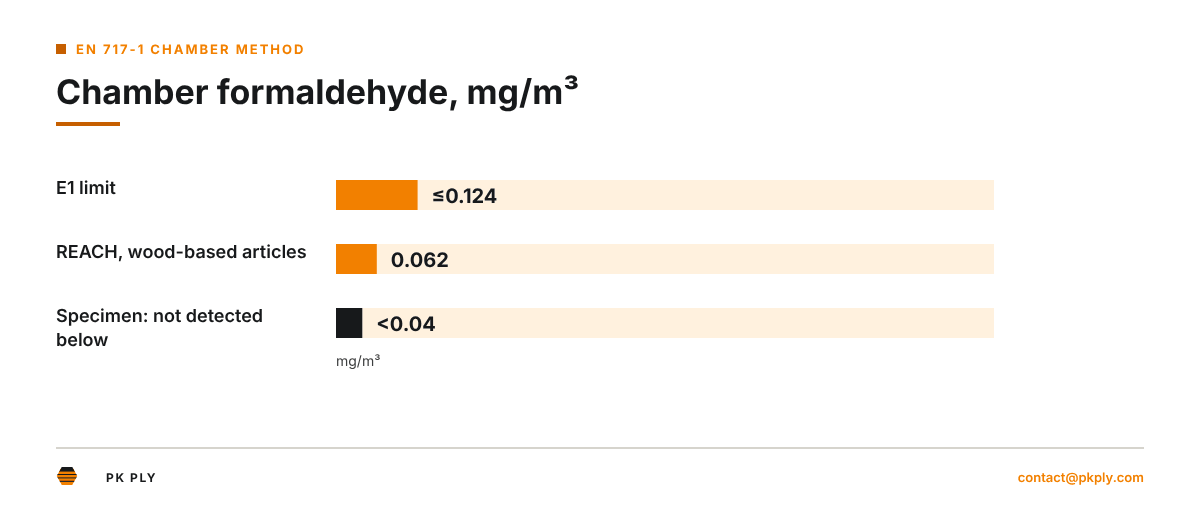
Where does the specimen sit? Not detected at 0.04 mg/m³ means the measured value was below that reporting limit. That is below the E1 line and below the 0.062 mg/m³ line for the configuration that was tested. Phenolic glue is the reason: a phenolic glue line releases very little formaldehyde once cured, compared with urea-based glues. A MUF panel is a different build and is tested on its own.
Does formaldehyde not detected mean the panel is E0 or emits zero?
No. Formaldehyde not detected means the chamber result was below the 0.04 mg/m³ reporting limit of the test; it does not mean zero emission, and it is not an E0 claim. The class the report gives is E1 PASS, and that is the class we state for the tested specimen.
The difference matters because buyers read labels literally. “Not detected” is a laboratory term for a value under the lowest level the method reports in that test. Wood itself releases traces of formaldehyde, and no panel is truly zero. “E0” is a name used in several markets for classes with lower limits than E1, but it is not one single standard everywhere, and an E1 PASS line on a report does not place a panel in any of them.
What a buyer can say from our report, word for word, is this: “One submitted 21 mm Acacia-core phenolic film-faced specimen, SGS Vietnam, 23 December 2025, EN 717-1 chamber: formaldehyde not detected at the 0.04 mg/m³ reporting limit; E1 PASS.” That sentence carries the specimen, the method, the date and the result. It is the sentence we use on our E1 formaldehyde chamber test page, and it is the safe one to put in a tender file.
Does one specimen report guarantee every panel in my order?
No. One specimen report shows what one tested configuration achieved on the test date; it does not guarantee every panel in a later order. What carries the result into your order is the same build on the technical sheet, the mill’s production control and, if you need it, a test on samples from your own run.
A test report and an order are linked by the build, not by the paper. If your order is 21 mm, Acacia core, phenolic glue, dark-brown phenolic film, our technical sheet for it names the same five lines as the tested specimen. If your order is 18 mm with a MUF glue line, the report is still evidence of what our phenolic line can do, but it is not a test of your panel.
There are three ways to close the gap, from light to strict:
- Match the configuration. Order the tested build, and keep the report with the technical sheet that names it.
- Check the production control. For structural CE panels, our factory production control certificate 0407-CPR-2146 from Istituto Giordano, notified body 0407, covers the mill’s own control of production for plywood of 3.6–30 mm under EN 13986. The CE marking page shows the scope.
- Test your own run. Name a laboratory and a sampling plan in the order, and the result is then evidence for your shipment rather than for a specimen.
Most buyers use the first two for repeat formwork orders and the third for a first container on a public project or a tender that asks for batch evidence.
What our test report does not tell you
The report answers density, bonding class and formaldehyde emission for one 21 mm phenolic specimen; it does not give a pour count, a slip rating, a stress grade or results for other thicknesses. Those questions have their own evidence, and mixing them up is the most common way a good report is misread.
- Pour count. No laboratory test gives the number of pours a panel makes on site. Our figures (about 12–15 with MUF glue, up to about 25 with phenolic) are targets for a build with proper handling, release agent and edge sealing, and our note on how many pours a panel gives explains how they are reached.
- Slip resistance. Anti-slip panels are tested separately with a pendulum on their patterned face, on different specimens.
- Structural values for design. Bending and stiffness values a designer uses for a CE structural panel come on the declaration of performance for that thickness, inside the 3.6–30 mm scope of our factory production control.
- Other builds. 12, 15 and 18 mm panels, Eucalyptus cores and MUF glue lines are configurations of their own.
Keeping the report to what it says protects the buyer as much as the mill. A tender file that quotes a specimen density as a guaranteed weight, or an E1 PASS as E0, can be rejected on review; a file that quotes the specimen, method, date and result stands.
How the result maps to EN 636 classes and CE marking
A Class 3 bond is what the exterior use class of EN 636 calls for, so the tested build answers the bonding part of an order written as EN 636-3 (exterior) plywood. CE marking of structural plywood is a separate step under EN 13986, and our factory production control certificate 0407-CPR-2146 covers 3.6–30 mm with MUF or phenolic glue.
EN 636 specifies requirements for plywood for general purposes or structural application in dry, humid or exterior conditions. The dry, humid and exterior use classes line up with bonding classes 1, 2 and 3 of EN 314-2. For a formwork order in Europe, that gives three lines to write:
| What the order says | What it asks for | Our evidence |
|---|---|---|
| EN 636-3 (exterior) | Exterior plywood with a Class 3 bond | SGS Class 3 PASS on the 21 mm phenolic specimen |
| CE to EN 13986, structural use | Declared performance and factory production control | FPC 0407-CPR-2146, scope 3.6–30 mm, MUF or phenolic |
| E1 formaldehyde | Chamber emission ≤0.124 mg/m³ | E1 PASS, not detected at 0.04 mg/m³ on the specimen |
EN 13986 covers characteristics, evaluation of conformity and marking of wood-based panels for use in construction. A structural CE panel from us therefore sits inside 3.6–30 mm, and its performance per thickness comes on the declaration of performance, not on the specimen report. The structural CE plywood page lists the panels inside the scope.
Is phenolic plywood the same as film-faced plywood?
Not always. Phenolic plywood names the glue line, film-faced plywood names the face, and a panel can be one without the other. Our tested specimen is both: a phenolic glue line in the core and phenolic-impregnated film pressed on both faces, which is the build buyers usually mean by phenolic faced ply.
The confusion comes from trade shorthand. Some markets say phenolic board for any film-faced sheet; others say film-faced for a sheet whose film is phenolic but whose glue is MUF. Both can be good panels, and both give different pour counts:
| Build | Glue line | Face | Pours (with proper handling, release agent and edge sealing) |
|---|---|---|---|
| MUF film-faced | Melamine (MUF) | Phenolic film | About 12–15 |
| Phenolic film-faced (the tested build) | Phenolic | Phenolic film | Up to about 25 |
| Budget film-faced | Low glue spread, mixed core | Thin film | About 4–10 |
When you compare offers, write both words on the enquiry: the glue system and the film. Our phenolic film-faced plywood and film-faced plywood pages give each build line by line.
How to read any film-faced plywood test report: a checklist
Read any shuttering plywood test report in six steps: the laboratory and date, the specimen description, the method for each value, the unit, the limit or class it was judged against, and the PASS or result line. A report that skips any of these is weaker evidence, whoever issued it.
| Check | What to look for | On our SGS report |
|---|---|---|
| Laboratory and date | An independent laboratory and an issue date | SGS Vietnam, 23 December 2025 |
| Specimen | Thickness, core, glue, film, how many specimens | One 21 mm specimen, Acacia core, phenolic glue, dark-brown film |
| Method per value | A standard number beside each result | BS EN 323, EN 314-1/314-2, EN 717-1 |
| Unit | kg/m³ for density, mg/m³ for chamber emission | 642 kg/m³; below 0.04 mg/m³ |
| Limit or class | The class or limit the result is judged against | Class 3; E1 ≤0.124 mg/m³ |
| Result | PASS or a value, and what “not detected” means | Class 3 PASS; E1 PASS; not detected at the reporting limit |
Two warning signs come up often in the trade. A report with no specimen line, or one that names a product range instead of a tested piece, cannot tell you what was tested. And a perforator or desiccator result written in other units is not the same as a chamber result in mg/m³; never convert one into the other on a quote. If you are comparing two suppliers, put both reports through the same six lines and compare line by line.
Can I receive the SGS report before I confirm an order?
Yes. We send the SGS specimen report with our certificate files before the order is confirmed, so you can check the specimen, methods, date and results against your specification. Raw laboratory files stay between us and the buyer; this page carries the results in their specimen context.
What comes with the report depends on the order. For a European structural order, the certificate set adds the CE factory production control certificate 0407-CPR-2146 and the declaration of performance for the thickness. For an FSC order, it adds our FSC chain of custody certificate SGSHK-COC-370674, and the claim appears on the invoice. FSC labels products as FSC 100%, FSC Recycled or FSC Mix, and our certificate covers FSC 100% and FSC Mix plywood; the FSC plywood page shows the scope.
After loading, draft shipping documents go to you for approval before they are final. The test report is not one of them; it is part of the file you already hold when you confirm. That order is deliberate: a buyer should never have to pay a deposit to find out what a supplier’s evidence says.
Ordering the tested configuration: the lines to send
To order the configuration SGS tested, send five lines: 21 mm, Acacia core, phenolic glue, dark-brown phenolic film on both faces, painted edges, plus the sheet size, quantity and port. We return a technical sheet that names the same build as the report, and an FOB Hai Phong offer.
| Line | The tested build | Your order |
|---|---|---|
| Thickness | 21 mm | 21 mm, ±0.5 mm |
| Core | Acacia | Acacia |
| Glue | Phenolic | Phenolic |
| Film | Dark-brown phenolic film, both faces | Film weight in g/m² and colour |
| Edges | Water-resistant paint | All four edges |
| Size and quantity | — | 1220 × 2440 mm or 1250 × 2500 mm, one 40HC or more |
| Evidence | SGS specimen report, 23 December 2025 | Report with the file; own batch test if your project needs one |
Our standard terms apply: one 40HC minimum, production in 15–45 days after the 30% deposit, the 70% balance against the scanned bill of lading, FOB Hai Phong, CFR or CIF. Samples are free, and new buyers book their own courier. Send the lines through the specification form or by email to [email protected].
Questions buyers ask us
What is a film faced plywood test report?
It is a laboratory report on a submitted sample of film-faced plywood that states the specimen, the test methods and the results, such as density, bonding class and formaldehyde emission. Ours comes from SGS Vietnam and is dated 23 December 2025.
What did SGS test on your 21 mm panel?
SGS tested one submitted 21 mm dark-brown film-faced specimen with an Acacia core and phenolic glue for density, bonding quality and formaldehyde emission. The report gives 642 kg/m³, bonding Class 3 PASS and E1 PASS with formaldehyde not detected below 0.04 mg/m³.
Is EN 314 Class 3 the same as WBP?
Class 3 is the exterior bonding class of EN 314-2, the European class buyers usually mean when they write WBP or boil-proof. Ask for the class and the report, because WBP alone names no test.
Does a Class 3 bond mean the panel is waterproof?
It means the glue line survived the exterior pretreatments, including boiling, and kept its bond. The wood still takes up water through bare edges, so cut edges must be sealed on site.
Is your film-faced plywood E0?
No E0 claim is made. The tested specimen passed E1 with formaldehyde not detected at the 0.04 mg/m³ reporting limit, which means below that limit, not zero.
Does the report cover 18 mm or Eucalyptus-core panels?
No. It covers the tested 21 mm Acacia-core phenolic specimen; a different thickness, core or glue is a different configuration and gets its own test when a project asks for one.
Can I see the SGS report before I pay a deposit?
Yes. Certificate and test files are sent before the order is confirmed, so you can check the specimen, methods and date against your specification.
Can I order my own third-party test on a shipment?
Yes. Name the laboratory and the sampling plan in the order, and the result becomes evidence for your own shipment.
Is phenolic plywood the same as film-faced plywood?
Not always. Phenolic plywood names the glue, film-faced plywood names the face; our tested specimen is both, a phenolic glue line under a phenolic film.
Does the test report replace a CE declaration of performance?
No. A specimen report is evidence for one configuration, while CE structural panels inside our 3.6–30 mm scope come with a declaration of performance under factory production control 0407-CPR-2146.