
Freight and duty to export plywood from Vietnam turn an FOB Hai Phong price into a landed cost, and the container decides how they spread: one 40HC carries 47.2 m³ of 18 mm Acacia-core panels from PK Ply, or 42.6 m³ with a Eucalyptus core. Get the tariff code, the duty basis or the preference wrong and the margin on a whole container is gone before the panels reach the site.
How do I calculate landed cost for plywood imports from Vietnam?
Landed cost is the FOB Hai Phong value of the container plus sea freight, cargo insurance, import duty, port and broker charges and inland haulage, divided by the cubic metres or sheets inside it. Import VAT or GST is paid at clearance but usually recovered. For 18 mm Acacia-core panels, the divisor is 47.2 m³ or 880 sheets per 40HC.
Every line except the panel price is a container-level cost. The freight bill, the broker’s fee, the terminal charges and the truck to your yard hardly change whether the box holds 42 or 48 cubic metres. So the fill of the container decides how much each cubic metre carries. That is why we start every landed-cost question from the container, not from the sheet.
Written as one line, the method is:
- FOB value = price per m³ × m³ loaded.
- CFR value = FOB value + sea freight.
- Insurance = premium rate × insured value (usually 110% of the CFR value).
- CIF value = CFR value + insurance.
- Duty = duty rate × CIF value (EU, UK) or × FOB value (US), plus any additional duty on the entry date.
- Landed cost = CIF value + duty + port and broker charges + inland haulage.
- Landed cost per m³ = landed cost ÷ m³ loaded; per sheet = landed cost ÷ sheets loaded.
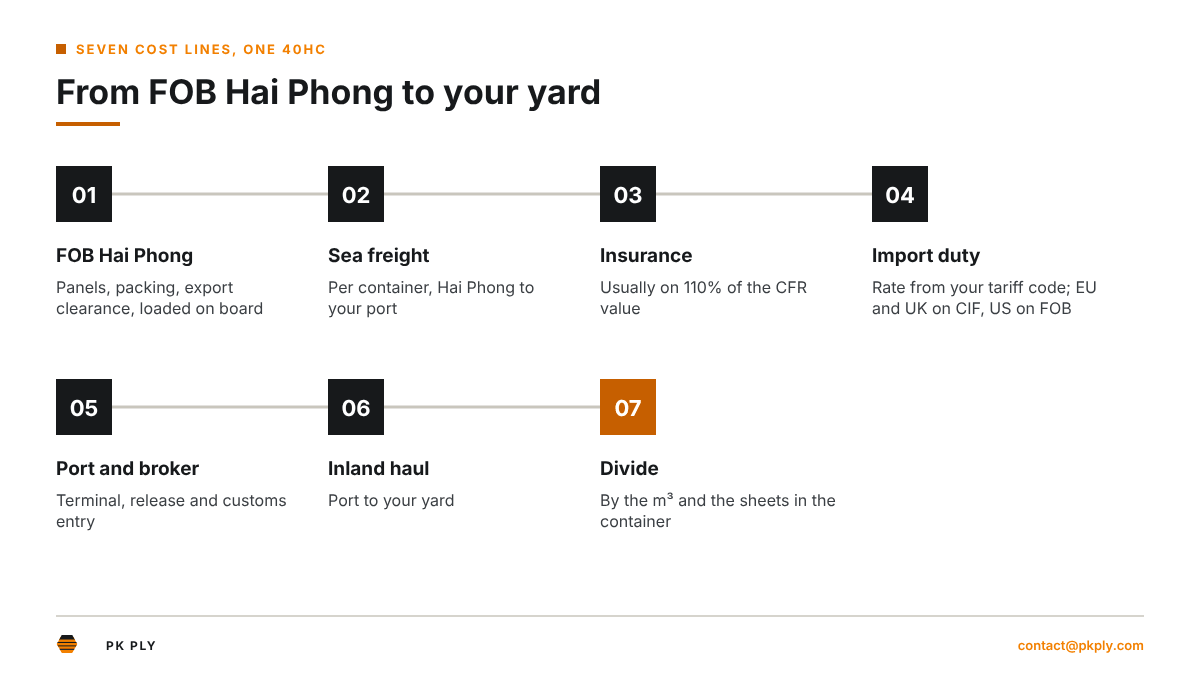
Our landed cost calculator runs the same seven lines with your own figures. This note fills them in for real routes, with rates from the official tariffs and a dated freight index. You can then see which line moves the result most.
What an FOB Hai Phong price already includes
An FOB Hai Phong price from our mills already includes the panels, the export packing, the inland transport from Chi Linh to the port, export customs clearance in Vietnam and loading the container on board. From that point the cost and the risk pass to you, and every later line is yours.
So the first line of a landed cost is a number we write on the offer. It is quoted per cubic metre for one build: core species, glue, film weight, thickness, size, edges and tolerance. The figure for that build is the base of everything below, and two quotes that differ on the build differ in landed cost by much more than the freight.
There is no published price list from our mills; every offer is written per build and dated. For a public reference point, a Vietnamese plywood price guide gives US$350 to US$380 per m³ FOB for a high-density face on a composer-jointed core with melamine glue, published range checked 12 November 2026 (Kosmex). The worked examples below use the low end of that published range, US$350 per m³, only as an index. How a figure like that is built line by line is the subject of our note on what an FOB Hai Phong quote is built from.
Should I buy FOB Hai Phong or CIF?
Buy FOB Hai Phong when you or your forwarder can book freight and insurance on better terms than a supplier, or when you consolidate several origins. Buy CIF when you want one landed figure to the port and no booking work. Both give the same panels, papers and payment terms; only who books freight and insurance changes.
| Line | FOB Hai Phong | CFR your port | CIF your port |
|---|---|---|---|
| Panels, packing, export clearance, loading | In our price | In our price | In our price |
| Sea freight to your port | You book and pay | In our price | In our price |
| Cargo insurance for the sea leg | You arrange | You arrange | In our price |
| Risk passes to you | On board at Hai Phong | On board at Hai Phong | On board at Hai Phong |
| Import duty, VAT, port charges at destination | You | You | You |
| Inland haul to your yard | You | You | You |
Risk passes at Hai Phong under all three terms, which surprises some buyers on CIF: our insurance covers the sea leg, but the panels travel at your risk once loaded. A CIF price is therefore a price of convenience, not a transfer of risk.
There is one tax reason to look closely. In the EU and the UK, duty is charged on the value at the border, which includes freight and insurance whoever paid them, so the term does not change the duty. In the US, duty is charged on the transaction value without international freight. A CIF invoice must therefore show freight and insurance as separate lines, so that your broker can deduct them. We write them separately on every CFR and CIF invoice.
How many cubic metres of 18 mm panels fit in one 40HC?
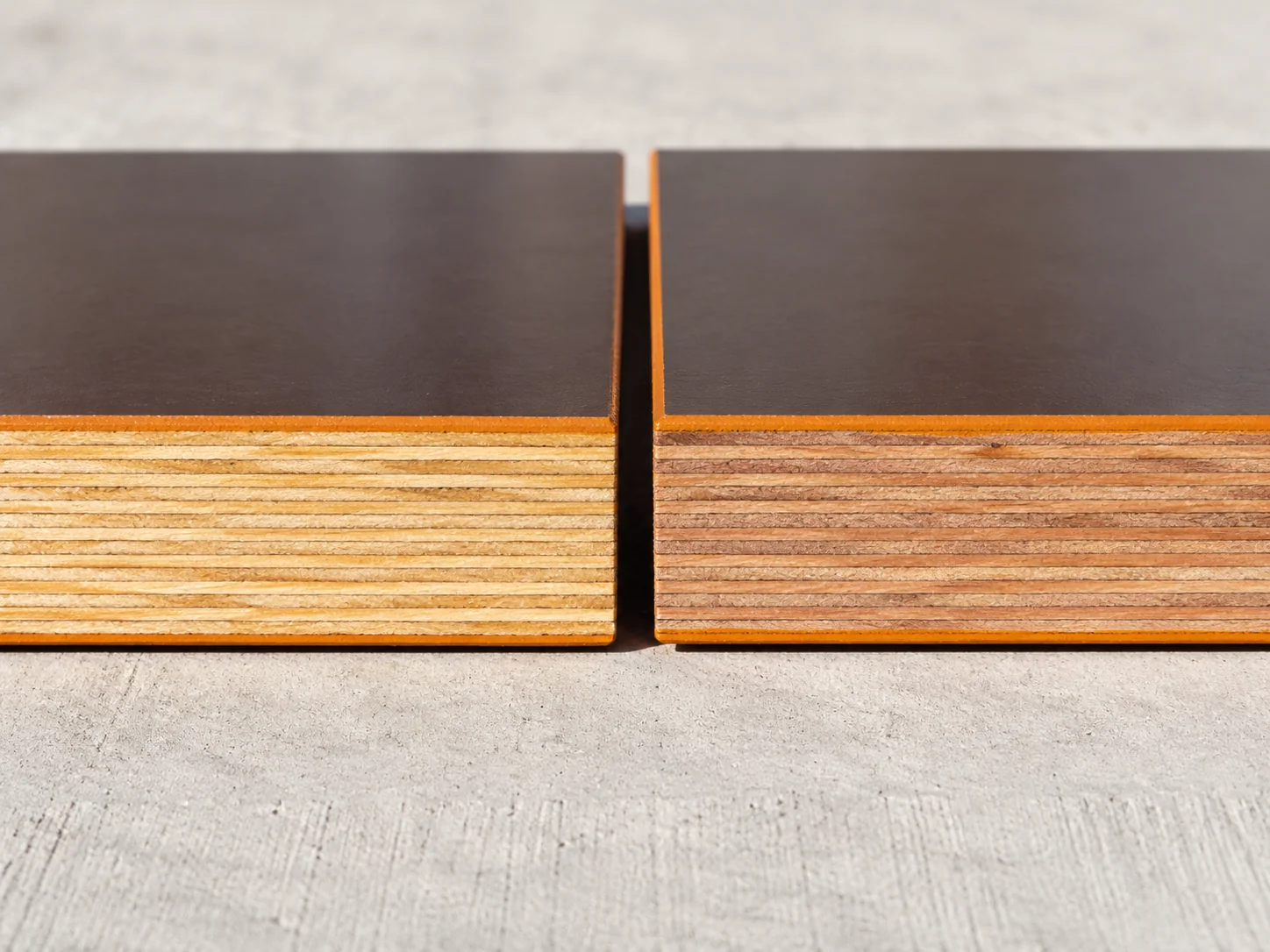
One 40HC takes about 47.2 m³ of 18 mm film-faced panels with an Acacia core (880 sheets of 1220 × 2440 mm) or about 42.6 m³ with a Eucalyptus core (795 sheets). These are planning figures from our packing model, not a packing list: we weigh real sheets before final loading.
| 1220 × 2440 mm, per 40HC (planning figures) | Acacia core, 580 kg/m³ | Eucalyptus core, 650 kg/m³ |
|---|---|---|
| 12 mm | 1,328 sheets, 47.4 m³ | 1,200 sheets, 42.9 m³ |
| 15 mm | 1,056 sheets, 47.2 m³ | 960 sheets, 42.9 m³ |
| 18 mm | 880 sheets, 47.2 m³ | 795 sheets, 42.6 m³ |
| 21 mm | 752 sheets, 47.0 m³ | 675 sheets, 42.2 m³ |
The model behind the table is short. Packs stand about 1,000 mm high. Sheets per pack are 1,000 ÷ thickness, rounded down and then capped by weight. A 40HC takes 16 packs of Acacia core or 15 of Eucalyptus core. The planning payload is 28,000 kg of panels, which the carrier and route confirm. The Eucalyptus loads are weight-capped: the container is full by weight before it is full by volume.
The 1250 × 2500 mm European size changes the sheet count but hardly the volume. It gives 848 sheets and 47.7 m³ for 18 mm Acacia, and 750 sheets and 42.2 m³ for Eucalyptus. Use the sheet count of your size as the divisor for a cost per sheet, and the cubic metres for a cost per m³. How the packs are stowed is shown on our page on loading a 40HC at the mill.
Why does the core species change landed cost per m³?
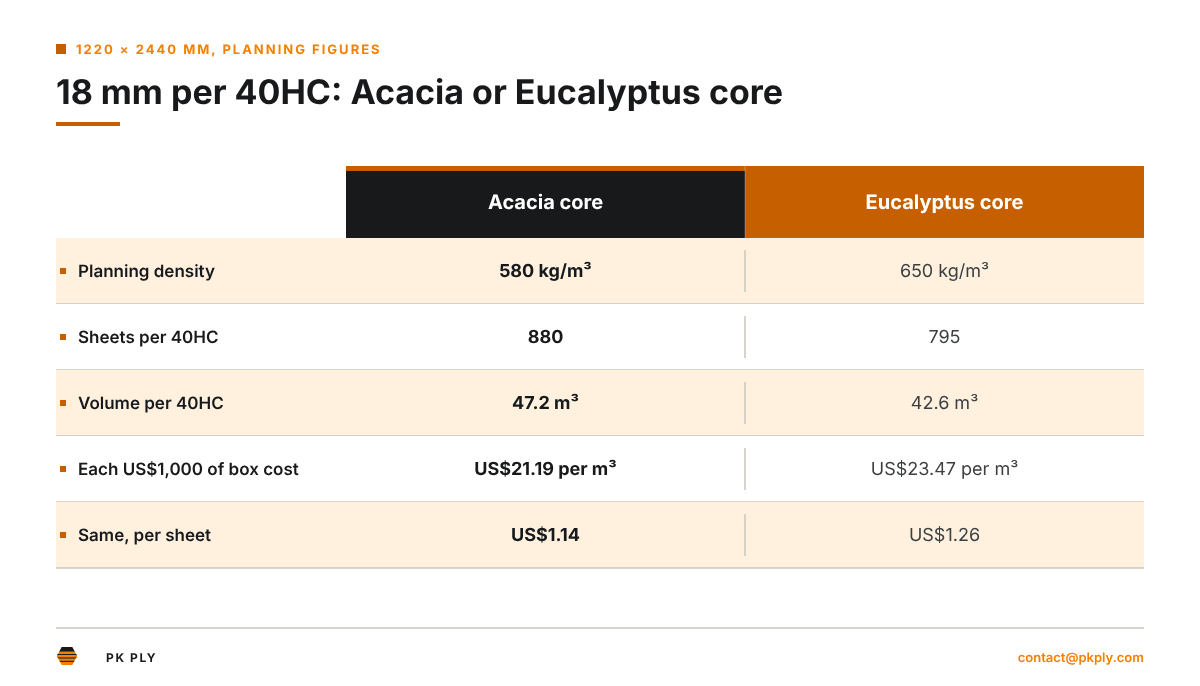
The core species changes landed cost per m³ because it changes how many cubic metres share each container-level cost. At our planning densities, a 40HC carries 47.2 m³ of 18 mm Acacia core but only 42.6 m³ of the heavier Eucalyptus core, so freight, port, broker and haulage cost about 11% more per m³ on Eucalyptus.
The arithmetic is the same for every cost paid per box. Each US$1,000 of container cost adds US$21.19 per m³ to 18 mm Acacia core and US$23.47 per m³ to 18 mm Eucalyptus core; per sheet it adds US$1.14 and US$1.26. A route whose freight, port and haulage add up to US$6,000 therefore puts about US$127 on each Acacia cubic metre and about US$141 on each Eucalyptus cubic metre, before duty.
| Each US$1,000 of container-level cost, 1220 × 2440 mm | Acacia: per sheet | Acacia: per m³ | Eucalyptus: per sheet | Eucalyptus: per m³ |
|---|---|---|---|---|
| 12 mm | US$0.75 | US$21.10 | US$0.83 | US$23.31 |
| 15 mm | US$0.95 | US$21.19 | US$1.04 | US$23.31 |
| 18 mm | US$1.14 | US$21.19 | US$1.26 | US$23.47 |
| 21 mm | US$1.33 | US$21.28 | US$1.48 | US$23.70 |
That does not make Eucalyptus the wrong core: it is the denser wood, and the FOB price per m³ of the two cores is not the same either. The point for a landed-cost comparison is narrower. Compare two offers per landed cubic metre or per landed sheet, never per FOB cubic metre. A cheaper FOB figure on a heavier core can land dearer. Our note on what sets a construction plywood price covers the build side of that choice.
Sea freight from Hai Phong, in short
Sea freight is one figure per container from Hai Phong to your port, quoted by a carrier or forwarder for a sailing date. It is usually the largest cost after the panels, and it changes week by week, so a landed-cost plan carries a dated freight figure, not a fixed one.
Hai Phong has no index of its own in the public weekly benchmarks, so we use the Shanghai lanes of an index only to show the order of size. Drewry’s World Container Index detailed assessment for 12 November 2026 put Shanghai to Rotterdam at $3,504 per 40ft container and Shanghai to Los Angeles at $7,416 per 40ft container (Drewry, checked 12 November 2026). A Hai Phong booking is quoted on its own and can sit above or below those lanes; the worked examples below use the two index figures only as stand-ins.
| Freight spread, 18 mm, 1220 × 2440 mm | Acacia core: per sheet | Acacia core: per m³ | Eucalyptus core: per sheet | Eucalyptus core: per m³ |
|---|---|---|---|---|
| US$3,504 per 40HC (Shanghai–Rotterdam index, 12 Nov 2026) | US$3.98 | US$74.24 | US$4.41 | US$82.25 |
| US$7,416 per 40HC (Shanghai–Los Angeles index, 12 Nov 2026) | US$8.43 | US$157.12 | US$9.33 | US$174.08 |
Typical days at sea from Hai Phong are 30–40 to Northern Europe and 25–35 to the Mediterranean. The US West Coast takes 20–30 days and the US East Coast 35–45, varying by carrier and route. Surcharges, free time at the terminal and how to book the freight are worked through in our note on plywood shipping for formwork panels, which this note does not repeat.
Cargo insurance: what it costs and what a CIF price covers
Cargo insurance is a premium on the insured value, which by trade practice is usually the CFR value plus 10%. On one 40HC it is a small line next to freight and duty. It still enters the CIF value on which EU and UK duty is charged, so it belongs in the calculation.
The premium rate is set by your insurer or ours for the route and the cover, so we publish none. The arithmetic shows its size. On a container with a CFR value of US$20,024, the insured value is about US$22,026. Each 0.1% of premium then adds about US$22 to the container, under three cents a sheet across 880 sheets. A rate several times higher still stays well below one freight surcharge.
On CIF orders we arrange the cover for the sea leg and send the insurance certificate with the shipping papers. On FOB and CFR orders you arrange it, and you should do so before the container is loaded, because the risk is yours from the moment the panels are on board. A cover note that starts on arrival leaves the voyage uninsured.
Freight and duty to export plywood from Vietnam: duty by market
Import duty on film-faced plywood from Vietnam depends on the tariff line of the outer plies and on the origin proof. In the EU the conventional rate is 7% and the EU-Viet Nam preference brings it to zero; in the UK it is 6% or 0% with the preference; in the US it is 8%, plus additional duties.
| Market | Tariff line for our panels (broker confirms) | Standard rate | Rate with Vietnamese origin proof | Charged on |
|---|---|---|---|---|
| European Union | 4412 34 00, or 4412 33 30 with a eucalyptus outer ply | 7% | 0% under the EU-Viet Nam agreement | CIF value at the EU border |
| United Kingdom | 4412 34 00 10, or 4412 33 30 10 with a eucalyptus outer ply | 6% | 0% under the UK-Vietnam agreement | CIF value at the UK border |
| United States | 4412.34.57, or 4412.33.57 with a eucalyptus outer ply | 8% | No preference; 12.5% Section 301 tariff added | Transaction value, without international freight and insurance |
The line follows the outer plies, not the core. A panel whose face and back veneers are eucalyptus falls under the eucalyptus subheading; an Acacia face falls under the subheading for other hardwoods. The technical sheet names the species we used, and the invoice description should match it word for word.
In the Combined Nomenclature for 2026, plywood “with at least one outer ply of eucalyptus” and plywood with an outer ply of other “non-coniferous wood not specified” there both carry a conventional rate of 7. Those are subheadings 4412 33 30 and 4412 34 00. The 7% is what a lot pays when the preference is not claimed or the origin proof fails.
The preference comes from the trade agreement. The EU-Viet Nam Free Trade Agreement entered into force on 1 August 2020. In the Union’s tariff schedule of the agreement, the hardwood plywood lines of heading 4412 carry a base rate of 7 with staging category B5. Goods in staging category B5 have their customs duties “removed in six equal annual stages beginning on the date of entry into force”. Counting the stages from August 2020 brings these lines to zero from 1 January 2025, the same date the UK tariff shows for its own Vietnamese preference.
For the UK, the UK Integrated Online Tariff sets a third-country duty of 6% on commodity 4412340010 and a 0% tariff preference for Vietnam. The same tariff shows import VAT at 20% on that commodity.
For the US, the Harmonized Tariff Schedule gives a general rate of 8% for subheading 4412.34.57.00. The eucalyptus-faced line 4412.33.57 carries the same general rate. Vietnam has no US trade agreement, so there is no preferential column to claim.
Does the EU anti-dumping duty on Chinese plywood apply to panels made in Vietnam?
No. The EU anti-dumping duty on hardwood plywood applies to plywood originating in China, not to plywood made in Vietnam. A lot from our mills is cleared on its own Vietnamese origin, so the China duty does not enter its landed cost; only the tariff rate and the preference above do.
Regulation (EU) 2025/2333 imposes a definitive anti-dumping duty on imports of hardwood plywood originating in the People’s Republic of China, at rates of 43.3 and 86.8 per cent. The lower rate is for one named exporter, the higher for all other companies. We state it as context for the calculation, not as a reason to buy: it changes the landed cost of Chinese-origin plywood, not of ours.
What keeps a Vietnamese lot on the right side of the line is paperwork, and it costs nothing extra when it is right. The certificate of origin names our mills in Vietnam, the invoice and the technical sheet describe the same build, and the EUR.1 carries the origin for the preference. A lot whose origin is challenged is held while customs checks it, and the cost of that wait, storage and demurrage, lands on the importer. Our note on importing formwork plywood into the EU covers the full EU file, including CE marking and EUDR.
Does US anti-dumping duty apply to phenolic film-faced formwork plywood from Vietnam?
The US anti-dumping and countervailing duty case on hardwood and decorative plywood from Vietnam excludes phenolic film-faced plyform as the scope defines it. A panel that meets every line of that definition pays the tariff duty and the Section 301 tariff but no AD/CVD; one that misses a line can fall inside the case.
The exclusion is a definition, not a product name. It asks for an Exterior or Exposure 1 bond classification as defined by APA. It asks for an opaque phenolic film permanently bonded on both the face and the back, at a minimum film weight printed in the notice. And it asks for an opaque, moisture-resistant coating on the edges. Your importer and broker read the build against it before the order; our note on importing formwork plywood into the US sets out each line against our technical sheet.
The stakes show why that review comes first. In the final anti-dumping determination, the Vietnam-Wide Entity has a weighted-average dumping margin of 90.12 percent and a cash deposit rate of 84.95 percent adjusted for subsidy offsets. In the final countervailing duty determination, the All Others subsidy rate is 47.68 percent ad valorem. On a container with an entered value of US$16,520, those two deposits would add about US$21,910, more than the value of the panels. We give the figure as context for the scope review, not as a forecast for any build.
The additional tariff applies either way. USTR’s final action imposes 12.5 percent tariffs on products of Vietnam, except as provided in Annex I and Annex II, Part A. The notice gives 24 July 2026 as the start date, and the duty is added to the rate of the tariff line. The only plywood it exempts is eucalyptus-faced plywood not exceeding 6 mm in thickness, so our 12–21 mm formwork panels are not covered by an exception.
Customs fees and the duty basis in the US
US duty is charged on the transaction value, which excludes the cost of international freight and insurance, so on a CIF invoice the broker deducts those lines first. Two customs fees are added on the same value: the merchandise processing fee and, at a sea port, the harbor maintenance fee.
US customs law defines the price actually paid or payable as exclusive of costs for transportation, insurance, and related services “incident to the international shipment” of the merchandise. The duty basis is therefore the FOB value even when you buy CIF.
Merchandise that is formally entered is subject to an ad valorem fee of 0.3464 percent. The same section sets a minimum and a maximum per entry, adjusted each fiscal year. Commercial cargo unloaded from a commercial vessel at a covered port is subject to a port use fee of 0.125 percent of its value. On a US$16,520 container the two fees come to about US$57 and US$21: small, but they belong in a cost per sheet that is meant to be exact.
Import VAT and GST: paid at clearance, usually recovered
Import VAT is charged at clearance on the customs value plus duty and the transport costs to the first destination in the importing country. A VAT-registered business usually recovers it, so it is a cash-flow line in the landed-cost plan rather than a cost of the panels. Budget it for the weeks between paying it and recovering it.
The EU VAT Directive includes in the taxable amount on importation taxes and duties due by reason of importation and “incidental expenses, such as commission, packing, transport and insurance costs” up to the first place of destination. So the VAT base is larger than the duty base: it includes the duty itself and the port and haulage costs to the first destination.
The standard VAT rate is 19 in Germany, 20 in France, 21 in the Netherlands and Belgium and 23 in Poland, in per cent. The UK charges 20%. The US has no import VAT; state and local sales or use tax follows the use and the buyer, outside the customs entry.
On the EU worked example below, German import VAT on the CIF value alone is about US$3,805 per container with the preference, or about US$4,071 if the 7% duty is paid. Both figures leave the account at clearance and come back with the VAT return.
Port, broker and inland haul: the lines only your route can price
Destination port charges, the customs broker’s fee and inland haulage are paid per container and priced by your terminal, broker and haulier. We publish none of them because they differ by port, by yard and by month; what we can give is how each one spreads across the load.
| Charge at destination | Who sets it | How it spreads |
|---|---|---|
| Terminal handling at the port of discharge | Carrier or terminal tariff | Per container: US$1.14 per 18 mm Acacia sheet for each US$1,000 |
| Delivery order and documentation | Carrier or agent | Per bill of lading |
| Customs entry and broker fee | Your customs broker | Per entry; one entry can cover several containers |
| Inspection or scanning, when selected | Customs | Per container, plus storage while it waits |
| Storage, demurrage and detention past free time | Terminal and carrier | Per container per day |
| Inland haulage to your yard | Haulier | Per container and distance; Eucalyptus loads are heavier per box |
Two of these lines are under your control. The broker’s fee per container falls when one entry covers several containers on one bill of lading. Our papers make that easy, because each container’s packing list sums to the invoice. Storage and demurrage fall when the papers arrive before the ship. We send draft documents after loading for your approval and release the originals against the 70% balance. A broker who has the drafts can then lodge the entry while the container is still at sea.
The weight of the load matters on the road. An 18 mm Acacia load of 880 sheets weighs about 27,400 kg of panels at our planning density. A Eucalyptus load of 795 sheets weighs about 27,700 kg, close to the 28,000 kg planning payload. Your haulier needs that gross weight before quoting. In some countries a heavy box needs a heavier chassis or a permit, and that cost is set per container, too.
Worked example: one 40HC of 18 mm Acacia to an EU port
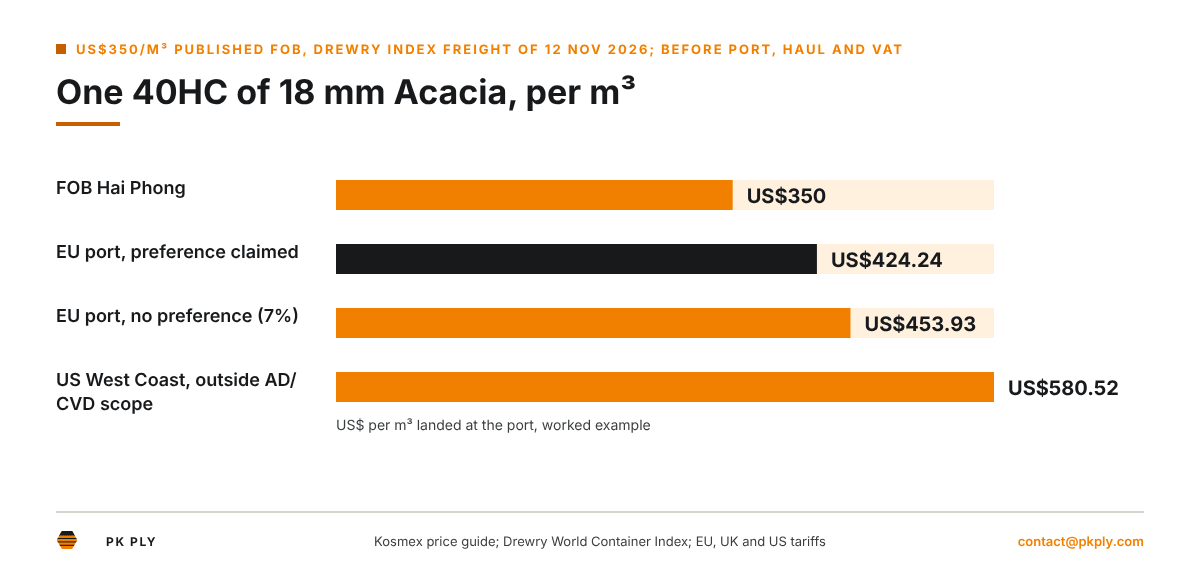
One 40HC of 18 mm Acacia-core film-faced panels at the published US$350 per m³ FOB, with the Shanghai–Rotterdam index of US$3,504 as freight, lands at an EU port at about US$424.24 per m³ or US$22.75 per sheet with the preference claimed. Without the preference, the 7% duty raises it to about US$453.93 per m³.
| Line, one 40HC, 47.2 m³, 880 sheets | Container | Per m³ | Per sheet |
|---|---|---|---|
| FOB Hai Phong, at the published US$350 per m³ | US$16,520 | US$350.00 | US$18.77 |
| Sea freight, at the 12 November 2026 index | US$3,504 | US$74.24 | US$3.98 |
| CFR value | US$20,024 | US$424.24 | US$22.75 |
| Insurance, each 0.1% of premium | about US$22 | about US$0.47 | about US$0.03 |
| EU duty with the EU-Viet Nam preference | US$0 | US$0 | US$0 |
| Landed at the port, before port, broker and haul | US$20,024 | US$424.24 | US$22.75 |
| EU duty at 7% if no preference is claimed | US$1,401.68 | US$29.70 | US$1.59 |
| Landed at the port, no preference | US$21,425.68 | US$453.93 | US$24.35 |
| Port, broker and haul, each US$1,000 | US$1,000 | US$21.19 | US$1.14 |
| German import VAT at 19% on the CIF value, recoverable | US$3,804.56 | US$80.61 | US$4.32 |
This is a worked method from dated public figures, not our quote and not a freight quote. The insurance line is left as a rate because the premium is yours or your insurer’s to set. The destination charges are left per US$1,000 because only your route can price them.
The same container on a Eucalyptus core moves the per-m³ figure even at the same FOB price per m³. At US$350 per m³ the FOB value is US$14,910 for 42.6 m³, the freight is unchanged, and the result is about US$432.25 per m³ or US$23.16 per sheet at the port. The difference is all freight: US$82.25 per m³ against US$74.24.
Worked example: the same container to a US West Coast port
The same 47.2 m³ of 18 mm Acacia core, with the Shanghai–Los Angeles index of US$7,416 as freight and a build outside the AD/CVD scope, lands at a US West Coast port at about US$580.52 per m³ or US$31.14 per sheet. Duty and the Section 301 tariff are charged on the FOB value, not on the CIF value.
| Line, one 40HC, 47.2 m³, 880 sheets | Container | Per m³ | Per sheet |
|---|---|---|---|
| FOB Hai Phong, at the published US$350 per m³ | US$16,520 | US$350.00 | US$18.77 |
| Sea freight, at the 12 November 2026 index | US$7,416 | US$157.12 | US$8.43 |
| Duty at 8% on the FOB value | US$1,321.60 | US$28.00 | US$1.50 |
| Section 301 tariff at 12.5% on the FOB value | US$2,065.00 | US$43.75 | US$2.35 |
| Merchandise processing fee, 0.3464% | US$57.22 | US$1.21 | US$0.07 |
| Harbor maintenance fee, 0.125% | US$20.65 | US$0.44 | US$0.02 |
| Landed at the port, before broker and haul | US$27,400.47 | US$580.52 | US$31.14 |
| Broker, port and haul, each US$1,000 | US$1,000 | US$21.19 | US$1.14 |
Insurance is left out of the US table because it does not change the duty base; add it at your premium. The table assumes the build passes the scope review; if a broker finds a build inside the AD/CVD scope, the deposits in the section above apply on top. A Eucalyptus core on the same route lands at about US$597.48 per m³, again because the freight is shared by 42.6 m³ instead of 47.2.
Which documents does an EU-bound lot need at import?
An EU-bound lot needs the commercial invoice, the packing list, the bill of lading, the EUR.1 certificate of origin for the preference, the phytosanitary and fumigation papers for the solid-wood packing, and the insurance certificate under CIF. Structural panels add the CE declaration of performance, and the EUDR file supports your due diligence statement.
Each paper has a cost if it is missing. Without the EUR.1, the 7% duty is charged, about US$1,402 on the worked example. A packing list that does not match the invoice holds the entry while the broker reconciles it, and the terminal’s storage clock keeps running. A missing due diligence statement reference stops the customs declaration altogether once EUDR applies to the importer.
| Paper | What it saves or costs in the landed cost | When it reaches you |
|---|---|---|
| EUR.1 certificate of origin | The difference between 0% and 7% duty | Draft after loading, original with the papers |
| Commercial invoice with freight and insurance shown | The correct customs value | Draft after loading |
| Packing list, sheets and m³ per pack | A clean entry without a hold | Draft after loading |
| Bill of lading | Release of the container | Scanned against the 70% balance |
| Phytosanitary and fumigation papers | No hold for the solid-wood packing | With the shipping papers |
| CE declaration of performance (structural use) | The right to place the panel on the market | With the lot |
| EUDR geolocation dossier | The data for your due diligence statement | Before shipment |
The full list for every destination, with what each paper proves, is in our note on the documents with each container.
From landed cost per sheet to cost per pour
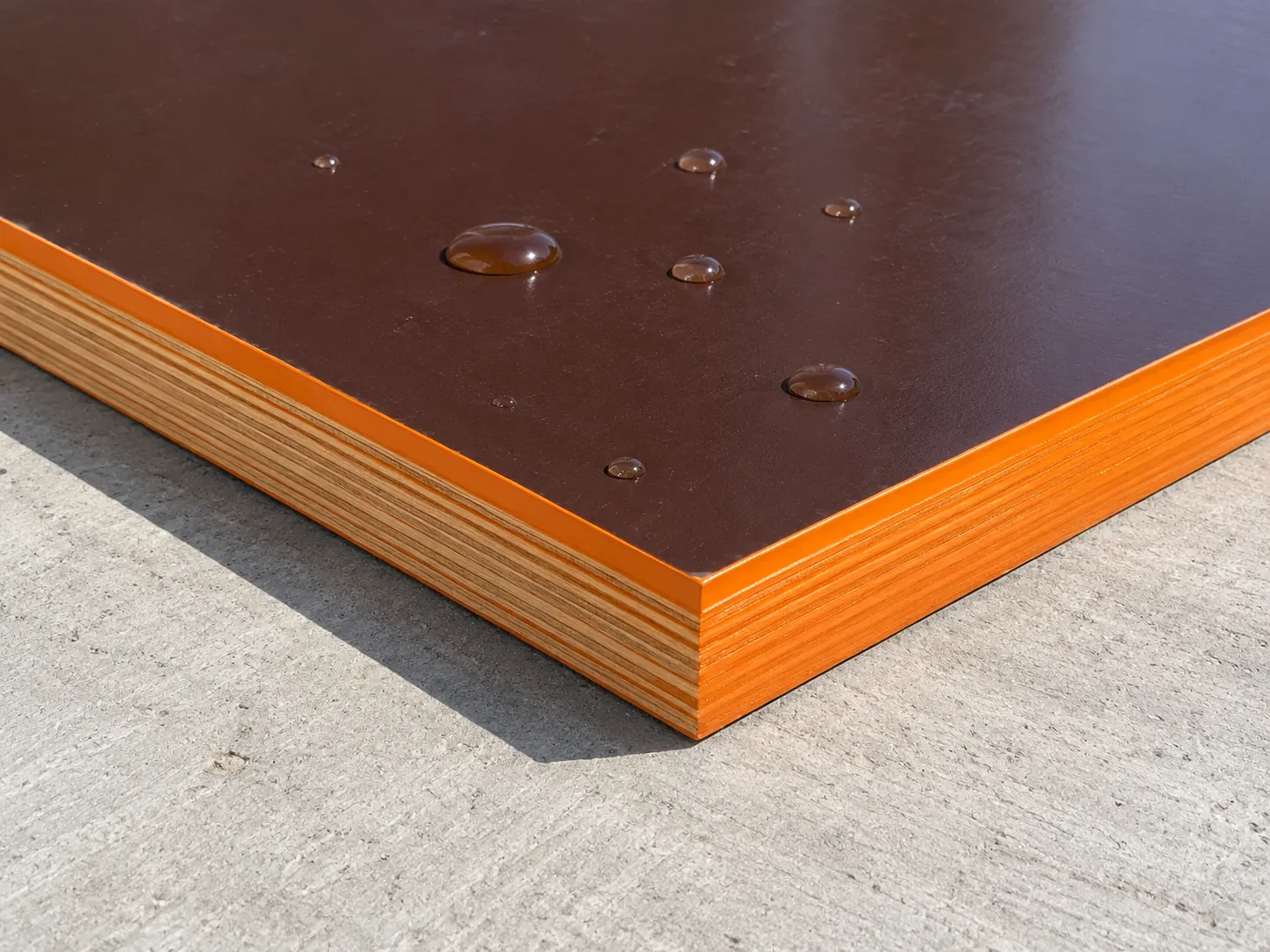
A landed cost per sheet becomes a cost per pour when you divide it by the pours the sheet gives on your site. Our MUF-glue film-faced build gives about 12–15 pours and our phenolic-glue build up to about 25, with proper handling, release agent on every pour and sealed edges, including cut edges.
On the EU worked example, a landed US$22.75 per sheet comes to about US$1.52 per pour at 15 pours and about US$0.91 per pour at 25 pours, before your port, broker and haulage. Freight and duty are paid once per sheet, so a sheet that gives more pours spreads them further. That is why a phenolic build with a higher FOB figure often lands cheaper per pour.
Budget panels often give about 4–10 pours in the trade, so the same freight and duty on a budget sheet are spread over far fewer pours. Our note on what each pour costs works the comparison through for MUF, phenolic and budget builds, and the pour cost calculator takes your own figures.
Payment terms and the cost of money in a landed-cost plan
Payment terms carry a cost that sits outside the customs value but inside your budget. On our standard terms, a 30% deposit starts production. The 70% balance is paid against the scanned bill of lading, by T/T or irrevocable L/C at sight. Most of the money stays with you until the panels are on the water.
Count the weeks between each payment and the day the panels earn money on your site: 15–45 days of production after the deposit, then the voyage, then clearance. The deposit is out for all of that time; the balance for the voyage and the clearance. VAT and duty are paid at clearance, and VAT comes back later. An L/C adds bank charges on both sides, which is a fixed cost per container like the broker’s fee. How the terms work in practice, and what an L/C at sight changes, is in our note on payment terms for formwork plywood.
What to send us for a landed-cost quote
To get a quote you can land, send the build, the size, the quantity and your port, and say whether you want FOB Hai Phong, CFR or CIF. We return a dated offer per cubic metre for that build, the sheets and cubic metres per container, and the gross weight your haulier needs.
| Line | Example |
|---|---|
| Application and pour target | Slab formwork, about 20 pours |
| Core and glue | Acacia core, phenolic glue |
| Film | 130 g/m², dark brown, both faces |
| Thickness and size | 18 mm, 1220 × 2440 mm, ±0.5 mm |
| Edges | Water-resistant paint, all four edges |
| Quantity | One 40HC, 880 sheets as a planning figure |
| Term and port | CIF Rotterdam, or FOB Hai Phong with your forwarder |
| Papers | EUR.1, FSC claim if needed, CE declaration for structural use |
The minimum is one 40HC, which can carry one or two products, or three to six by agreement; production takes 15–45 days after the deposit. Our two mills in Chi Linh, Hai Phong load up to 150 containers a month, and every offer is written on your build, not from a list. Send the lines through the specification form or to [email protected], and run the result through the landed cost calculator with your own freight, port and haulage figures.
Questions buyers ask us
How do I calculate the landed cost of plywood per cubic metre?
Add the FOB value of the container, sea freight, insurance, import duty, port and broker charges and inland haulage, then divide by the cubic metres loaded. For 18 mm Acacia-core panels that is 47.2 m³ per 40HC as a planning figure.
What is the EU import duty on film-faced plywood from Vietnam?
The EU conventional rate for the plywood lines our panels fall under is 7%, charged on the CIF value. Vietnamese plywood with valid proof of origin claims the EU-Viet Nam preference, whose staging for these lines ended at zero duty.
What is the UK import duty on plywood from Vietnam?
The UK Global Tariff charges 6% on the plywood lines for hardwood-faced panels, and plywood of Vietnamese origin claims 0% under the UK-Vietnam agreement with proof of origin. Import VAT of 20% is charged on top and is usually recoverable.
Is US duty on plywood charged on the FOB or the CIF value?
On the transaction value, which excludes international freight and insurance, so in practice on the FOB value. The EU and the UK charge duty on the value at their border, which includes freight and insurance.
Does the US Section 301 tariff apply to plywood from Vietnam?
USTR imposed a 12.5 percent additional tariff on products of Vietnam from 24 July 2026, on top of the duty of the tariff line, with listed exceptions. Your broker confirms whether any exception covers your code on the entry date.
How much does sea freight add per sheet of 18 mm plywood?
Divide the freight per container by the sheets loaded: 880 sheets of 18 mm Acacia core or 795 of Eucalyptus core per 40HC as planning figures. Each US$1,000 of freight adds about US$1.14 or US$1.26 per sheet.
Is import VAT part of the landed cost?
For a VAT-registered importer import VAT is usually recovered, so it is a cash-flow cost rather than a cost of the panels. Budget it anyway, because it is paid at clearance before the panels are sold or used.
Who arranges insurance on a CIF plywood order?
Under CIF we arrange cargo insurance for the sea leg and send the insurance certificate with the shipping papers. Under FOB and CFR you arrange it yourself.
Are port and broker charges higher per cubic metre for Eucalyptus-core plywood?
Yes, by about 11%, because those charges are paid per container and a 40HC holds 42.6 m³ of 18 mm Eucalyptus core against 47.2 m³ of Acacia core. The charge per container is the same.
Do you quote CIF to my port?
Yes. We quote FOB Hai Phong, CFR or CIF on the same build and the same payment terms, and a CFR or CIF figure carries a shorter validity because freight moves fastest.
What is the minimum order for a landed-cost quote?
One 40HC, which can carry one or two products, or three to six by agreement. Production takes 15–45 days after the 30% deposit.