
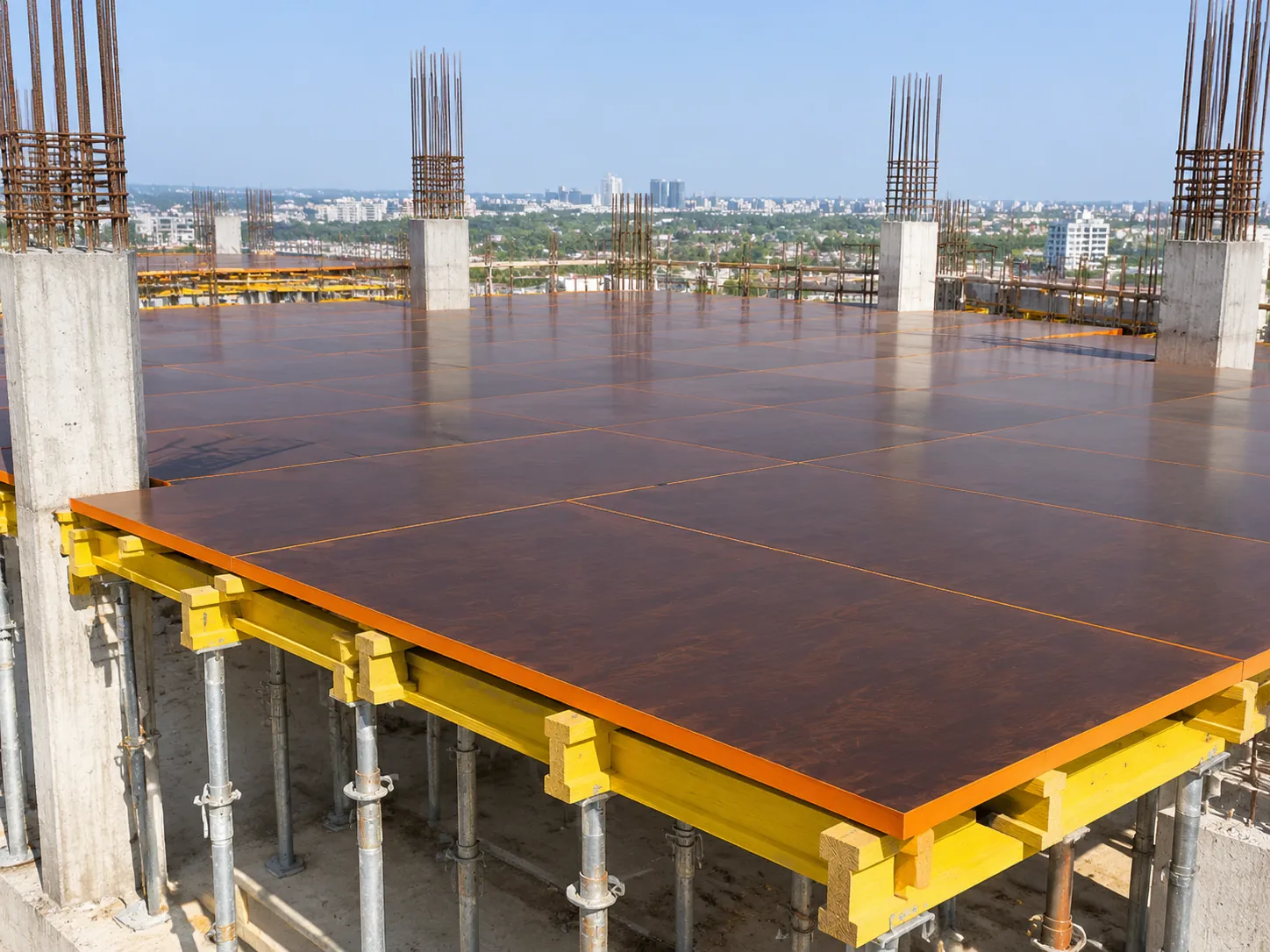
Slab decks on timber beams
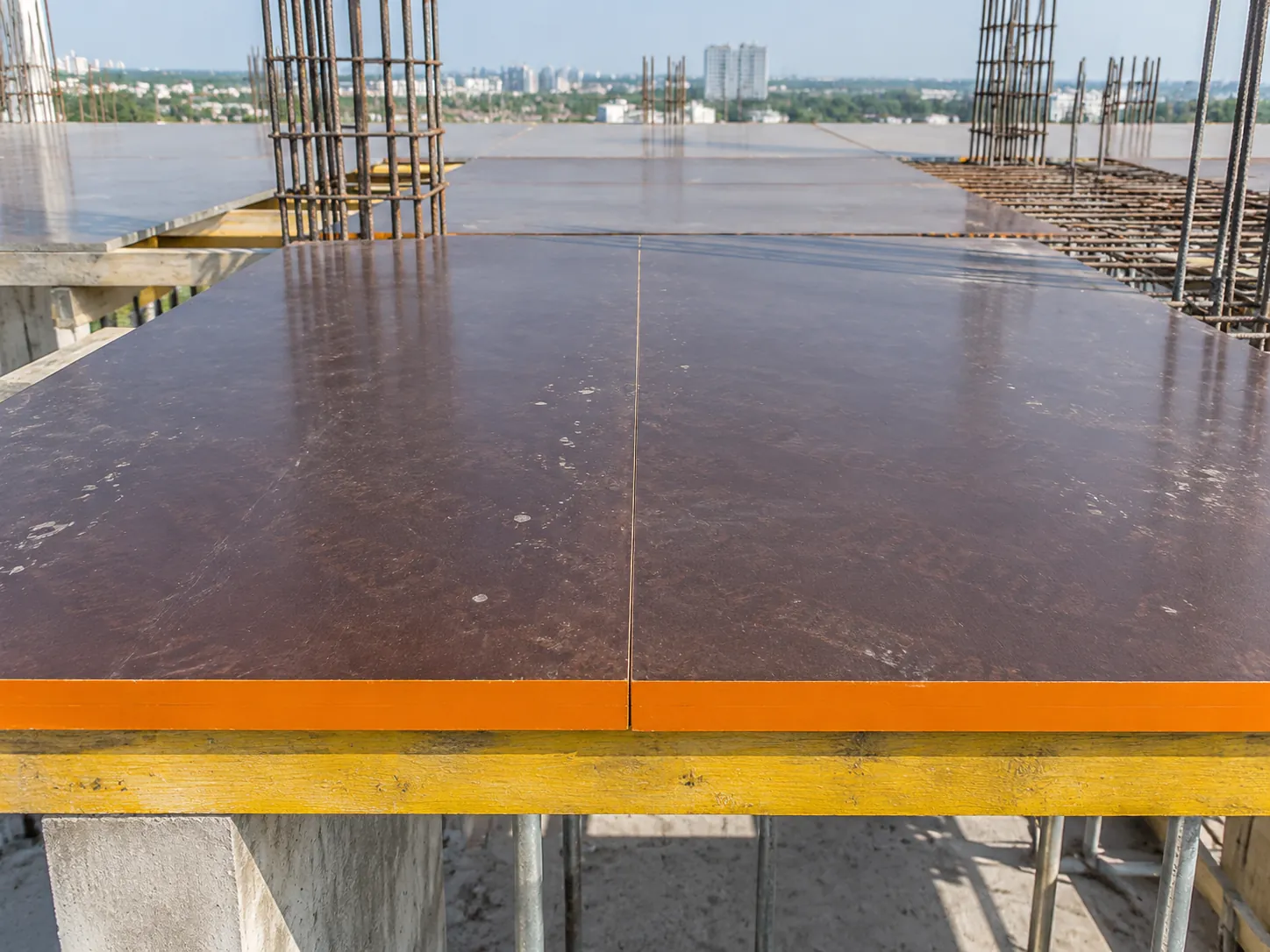
Sheets laid on timber beams and props for floor slabs; the 21 mm thickness spans the beam spacing of common deck systems.
1250 × 2500 mm · 21 mm · for European deck and wall systems
In short
Our 21 mm EU-format panel is a 1250 × 2500 mm sheet with an Acacia core, phenolic glue and dark brown film on both faces, the same build as the SGS specimen that passed EN 314 Class 3 bonding and E1. It falls inside our CE certificate 0407-CPR-2146. A 40HC takes about 720 sheets, a planning figure.
Film
The film shows the 21 mm build being pressed, sized to 1250 × 2500 mm, edge-painted, measured and loaded for a European port.
Real panels
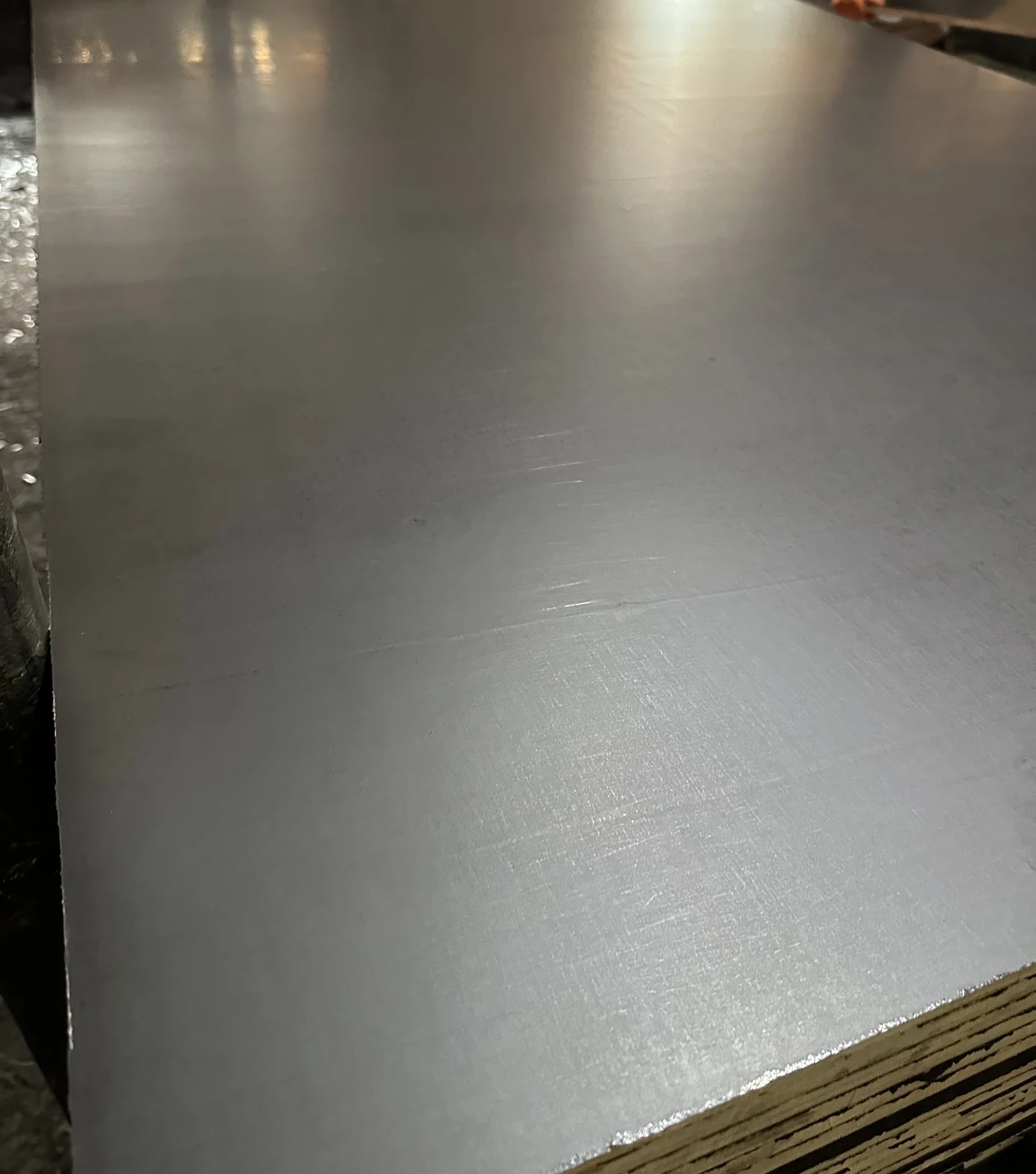
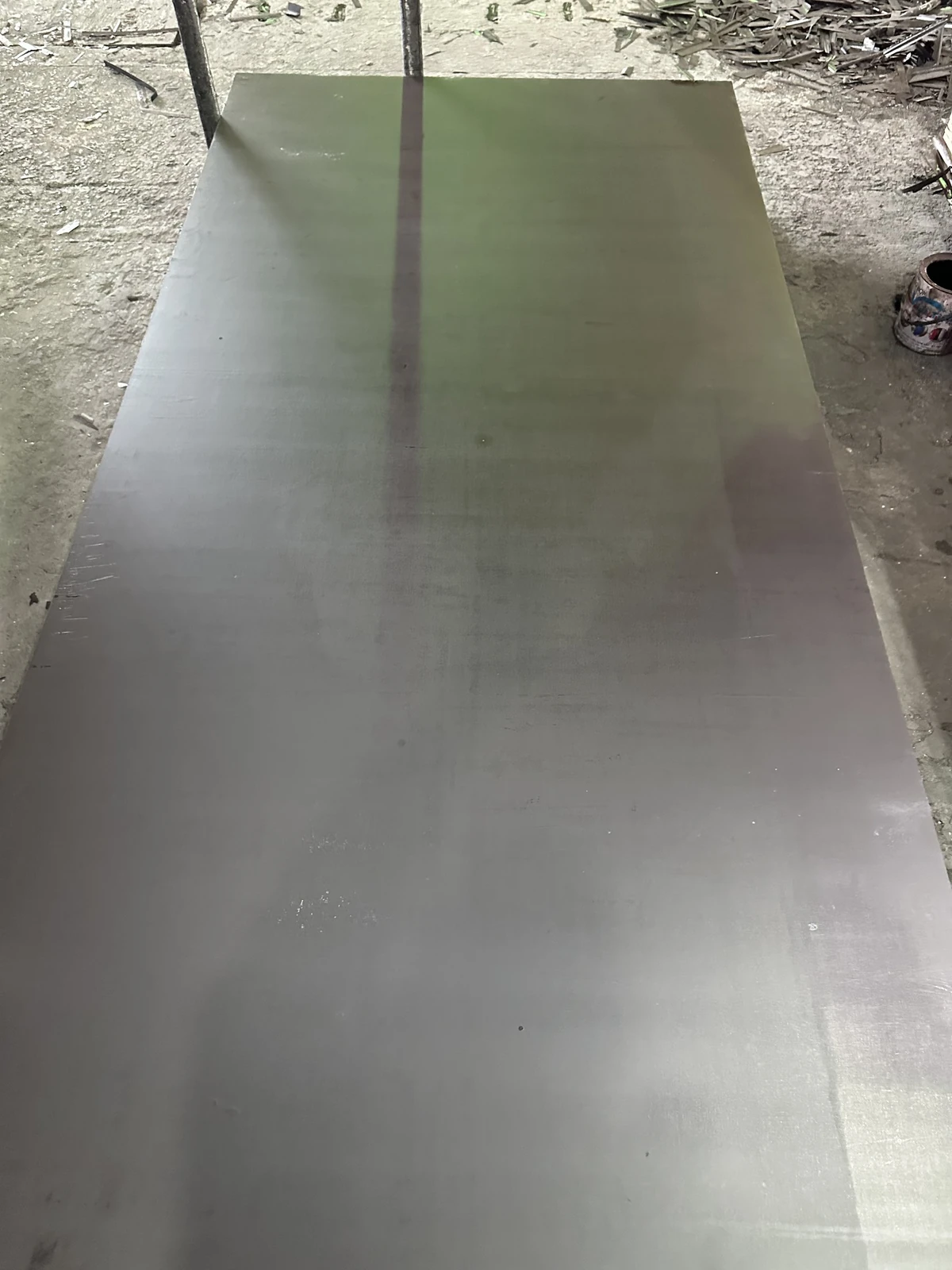
Our photos of finished film-faced sheets and stacks, taken on the mill floor. A 21 mm sheet is heavy and stiff: it lies dead flat on the stack, and the film face reads as one even satin surface across the whole 2500 mm length.
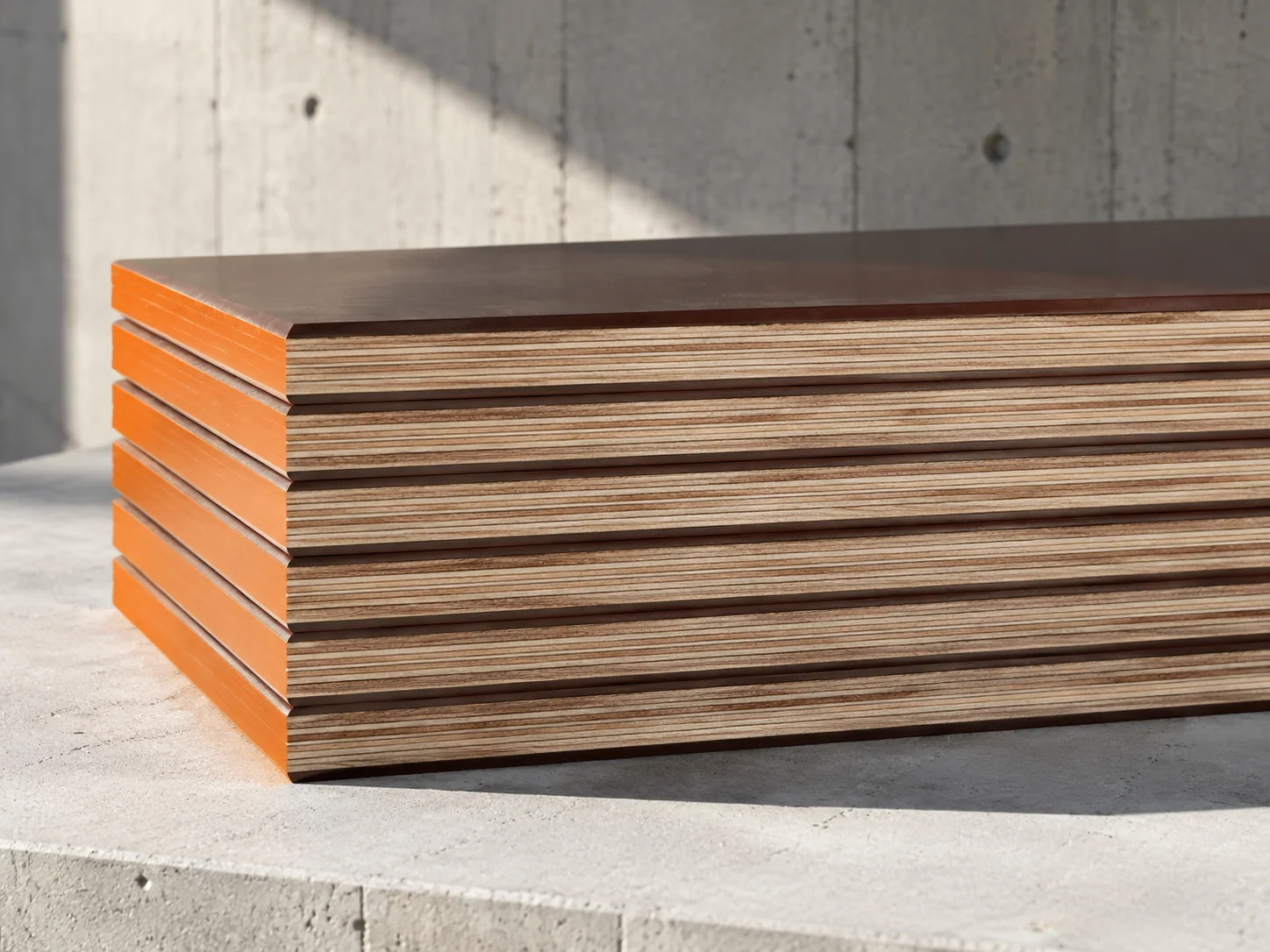
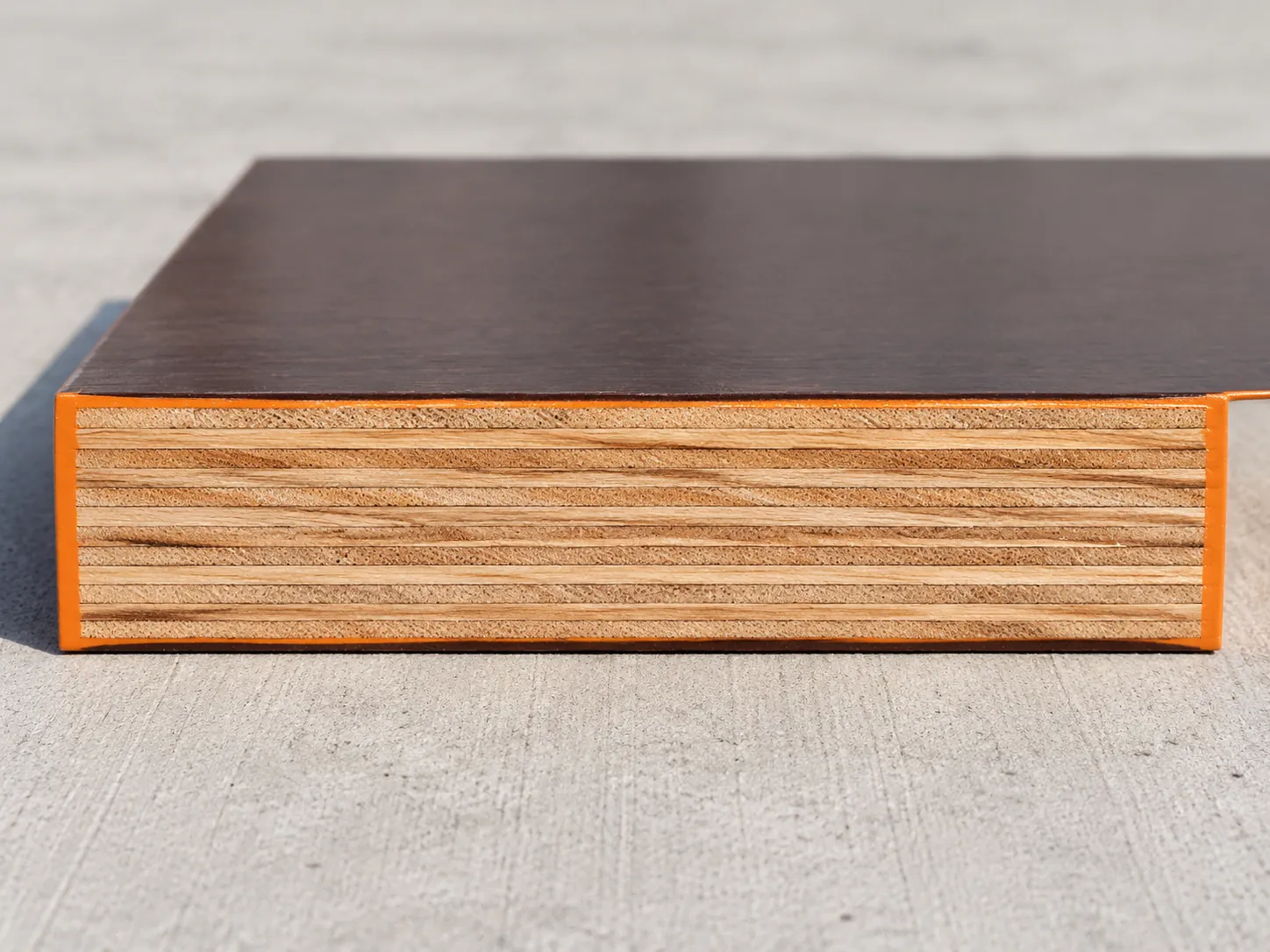
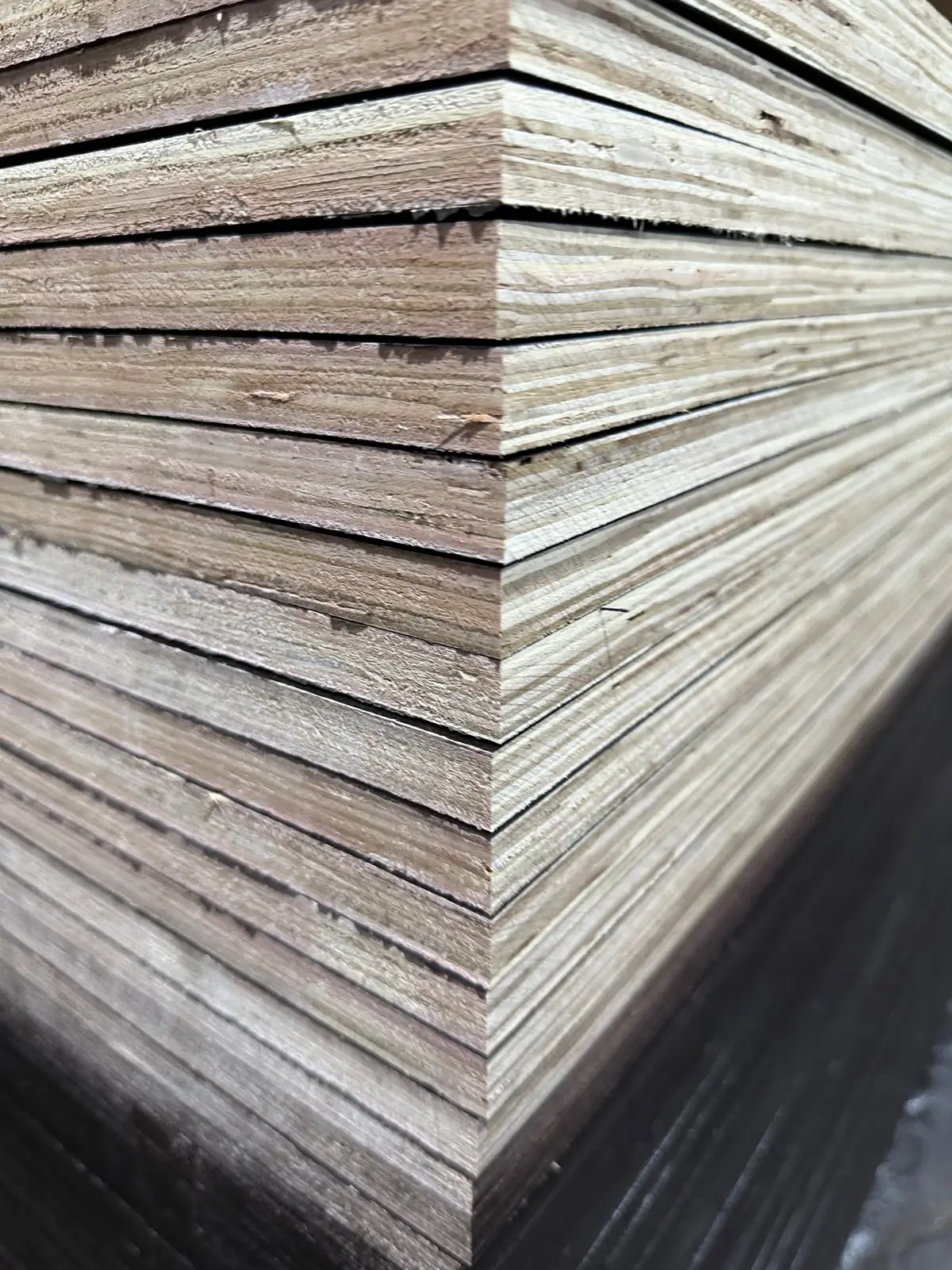
The stack side shows the veneer layers of each sheet before the edges are painted; after painting, the pack side is one colour and the layers no longer show.
Specification
This is the 21 mm sheet as we press it for European buyers. The default line matches the specimen SGS tested; the options column lists what we change on request without changing the sheet's place in our CE scope.
Write the film weight and edge colour you want on the enquiry. Both go on the technical sheet, which is also what the inspector checks against at loading.
| Item | Default build | On request |
|---|---|---|
| Thickness | 21 mm | 18 mm or other thickness to 30 mm inside CE scope |
| Sheet size | 1250 × 2500 mm | 1220 × 2440 mm; cut sizes from a list |
| Core | Acacia hardwood veneers, crosswise | Eucalyptus hardwood veneers |
| Glue | Phenolic | MUF for shorter programmes |
| Film | Dark brown, 130–135 g/m² | Black; 165, 185 or 200 g/m² and above |
| Thickness tolerance | ±0.5 mm | Written per order |
| Length and width tolerance | ±2 mm | Written per order |
| Bond | EN 314-2 Class 3 (SGS specimen) | Lot test through SGS |
| Formaldehyde | E1 pass, EN 717-1 (SGS specimen) | Test to your method |
| Density | 642 kg/m³ measured (SGS specimen) | Eucalyptus core is denser |
| Edges | Water-resistant paint, four sides | Colour to order |
| Marking | Plain | Buyer stamp on panel and pack label |
Film grade
European deck users usually ask for a dark brown film on this sheet, because system decks are rented and reused. 130–135 g/m² is the default; buyers running rental fleets move to 165 or 185 g/m², and 200 g/m² and above is pressed for the heaviest reuse.
Heavier film raises the price per sheet but protects the face against scraping and nail marks over many cycles. On a phenolic 21 mm sheet, the film is usually what wears out first.
| Film | Fits | Note |
|---|---|---|
| 130–135 g/m² dark brown | Contractor-owned decks, regular wall forms | Default |
| 165 g/m² | Decks reused across several projects | Harder face |
| 185 g/m² | Rental fleets of deck panels | Long-cycle face |
| 200 g/m² and above | Very high reuse targets | Heaviest face we press |
| Black film | Markets that expect black faces | Same strength as brown |
Build
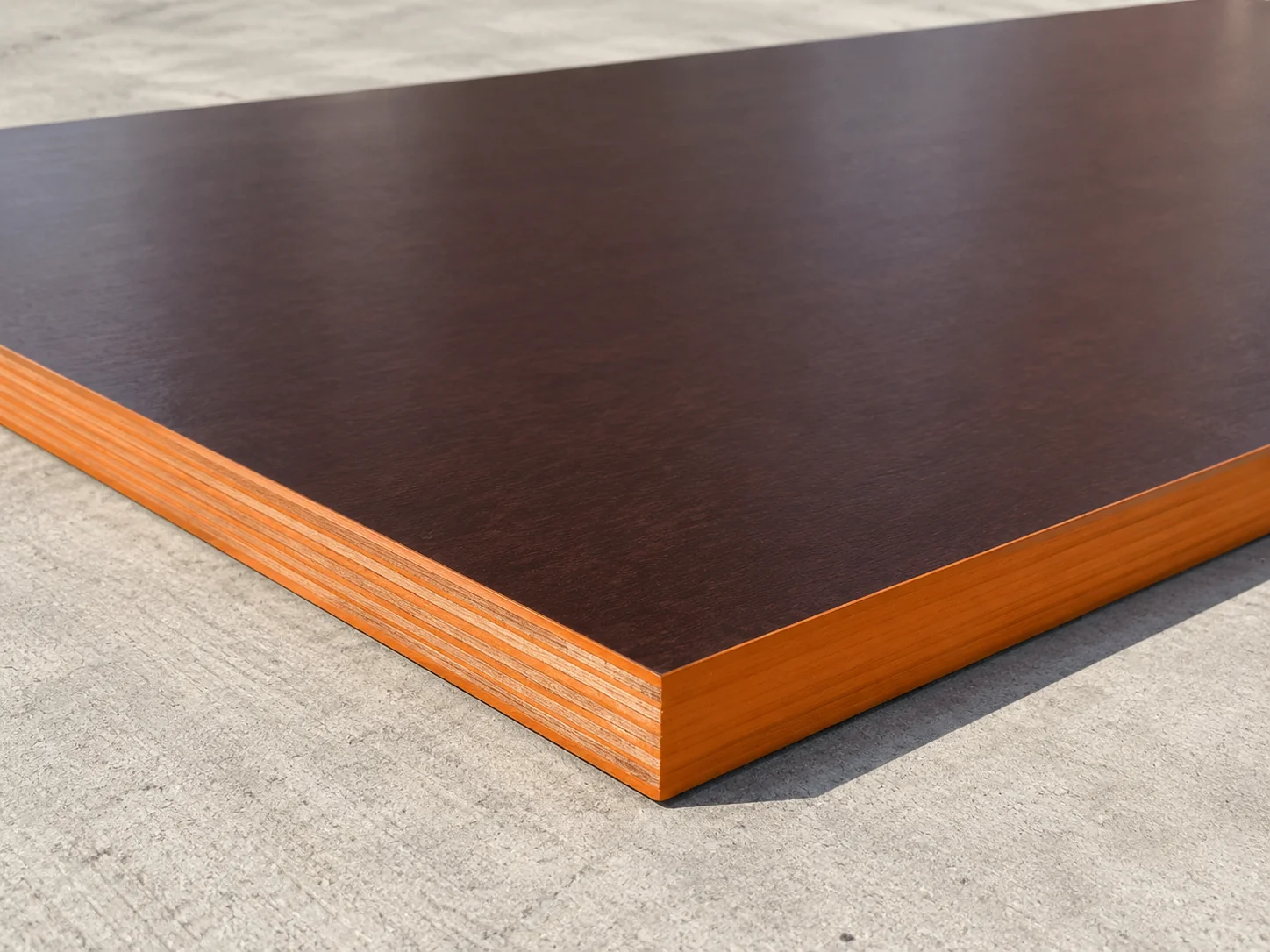
A 21 mm sheet is usually built from 13 to 15 hardwood veneers, each layer turned 90 degrees to its neighbour, with phenolic glue in every line. The exact count for your order is written on the technical sheet.
The core was Acacia on the SGS specimen, and Acacia is our default for this sheet: it keeps the 1250 × 2500 mm sheet at about 38.1 kg, which crews can still handle on a deck. Eucalyptus cores weigh about 42.7 kg per sheet and give a stiffer, denser panel.
Phenolic film, 130–135 g/m² by default, up to 200 g/m² and above.
Sanded hardwood veneer that the film is pressed onto.
Acacia veneers, full length, alternate layers at 90 degrees.
Every line hot-pressed with phenolic glue.
Film on the back; water-resistant paint on all four edges.
Veneer layers
Tests
SGS Vietnam tested one submitted 21 mm dark-brown specimen with an Acacia core and phenolic glue; the report was issued in December 2025. Our EU-format sheet is that build. The results below are specimen results with their methods; a lot test for your order can be booked through SGS.
REACH entry 77 sets formaldehyde limits for wood-based articles placed on the EU market from 6 August 2026, measured under its own chamber conditions. If your lot needs that method, ask and we book it.
| Test | Method | Result |
|---|---|---|
| Density | EN 323 | 642 kg/m³ |
| Bonding quality | EN 314-1 / EN 314-2: 24 h soak, boil-dry-boil, 72 h boil | Class 3, pass |
| Formaldehyde | EN 717-1 chamber | Not detected at 0.04 mg/m³; E1 pass (limit 0.124 mg/m³) |
Not detected is not zero and is not an E0 claim.
Pours and edges
With proper handling, release agent on every pour and sealed edges, including cut edges, a phenolic 21 mm sheet gives up to about 25 pours. On a rented deck that is cleaned, stacked and checked between hires, the count depends mostly on how the yard handles returns.
The film and the phenolic bond keep water out of the face. The edges are the open side of any plywood sheet: we paint all four at the mill, and a sheet cut to fit a deck infill needs its new edge painted before it goes back into service. A bare edge on a 21 mm sheet takes water into 13 to 15 veneers at once.
Lay sheets with tight joints over beams, keep nails and screws away from the edges, and strip by lowering panels onto the props, not dropping them.
Clean, paint any damaged edge, store flat on level bearers under cover, and sort out sheets with lifted film before the next hire.
Size and tolerance
European slab deck and wall systems are drawn around a 1250 mm module: two sheets cover a 2500 mm bay, and the sheet lands on beams spaced to that grid. A 1220 × 2440 mm sheet leaves gaps in that grid, which is why EU buyers order 1250 × 2500 mm.
We hold ±0.5 mm on thickness and ±2 mm on length and width, measured on pack samples. For a deck that is enough for flush joints between sheets; if your system needs a tighter figure, it goes on the technical sheet before production.
| Item | Value | Note |
|---|---|---|
| Sheet size | 1250 × 2500 mm | EU deck and wall module |
| Alternative size | 1220 × 2440 mm | For 4 × 8 ft systems |
| Thickness | 21 mm ±0.5 mm | Caliper on every pack sample |
| Length and width | ±2 mm | Tape on sample sheets |
| Cut sizes | From your cutting list | Cut edges painted before packing |
| CE scope | 3.6–30 mm | 21 mm sits inside it |
Applications
The 21 mm sheet is the heavy-duty face of European formwork: stiff enough to span between beams under a slab and to take the pressure of a wall pour.
Sheets laid on timber beams and props for floor slabs; the 21 mm thickness spans the beam spacing of common deck systems.
Re-facing steel or aluminium wall and deck frames whose original plywood is worn out, cut to the frame size.
Large wall forms built from 21 mm sheets on timber or steel walers for basements, cores and retaining walls.
Deck sheets that go out on hire and come back to the yard; heavier film grades pay back here.
Compare
Two choices change the 21 mm order most: going down to 18 mm to save weight and price, or switching the core to Eucalyptus for a denser sheet. The table puts the four options side by side on 1250 × 2500 mm sheets.
For deck systems designed for 21 mm, keep 21 mm; an 18 mm sheet on the same beam spacing deflects more under wet concrete.
| Option | Weight per sheet | Sheets per 40HC | m³ per 40HC | Best for |
|---|---|---|---|---|
| 21 mm, Acacia core | 38.1 kg | 720 | 47.3 m³ | Default EU deck sheet |
| 21 mm, Eucalyptus core | 42.7 kg | 630 | 41.3 m³ | Denser, stiffer sheet |
| 18 mm, Acacia core | 32.6 kg | 848 | 47.7 m³ | Lighter walls and closer beam spacing |
| 18 mm, Eucalyptus core | 36.6 kg | 750 | 42.2 m³ | Denser 18 mm sheet |
Checks
Every 21 mm run is checked against the order's technical sheet. Sheet weight is checked too, because European buyers plan crane lifts and manual handling around it.
An inspector you appoint can open packs at the mill before loading and check the same points.
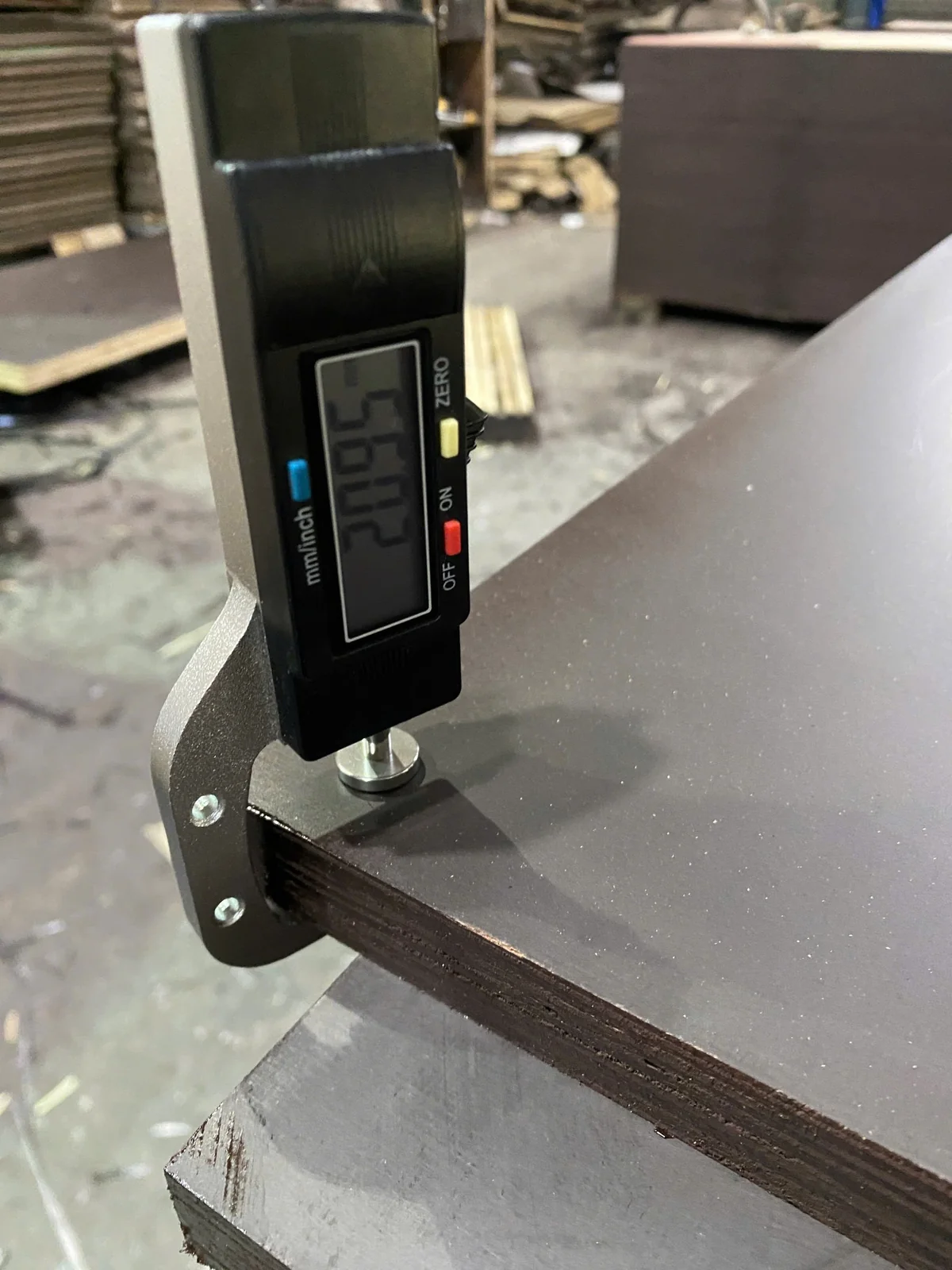
Caliper reading within ±0.5 mm of 21 mm on every pack sample.
1250 × 2500 mm within ±2 mm, diagonals compared.
Sample sheets laid on a flat surface; no bow or twist.
Both faces fully covered, no blisters or dry spots.
Run samples boiled; no open glue lines.
Sample sheets weighed; sheets per pack match the packing list.
Caliper
Certificates
Scans are shown with legal entity, tax ID, address and dates blurred. The order's documents state which certificate covers which panels; CE documents are issued when the sheet is ordered for structural use.
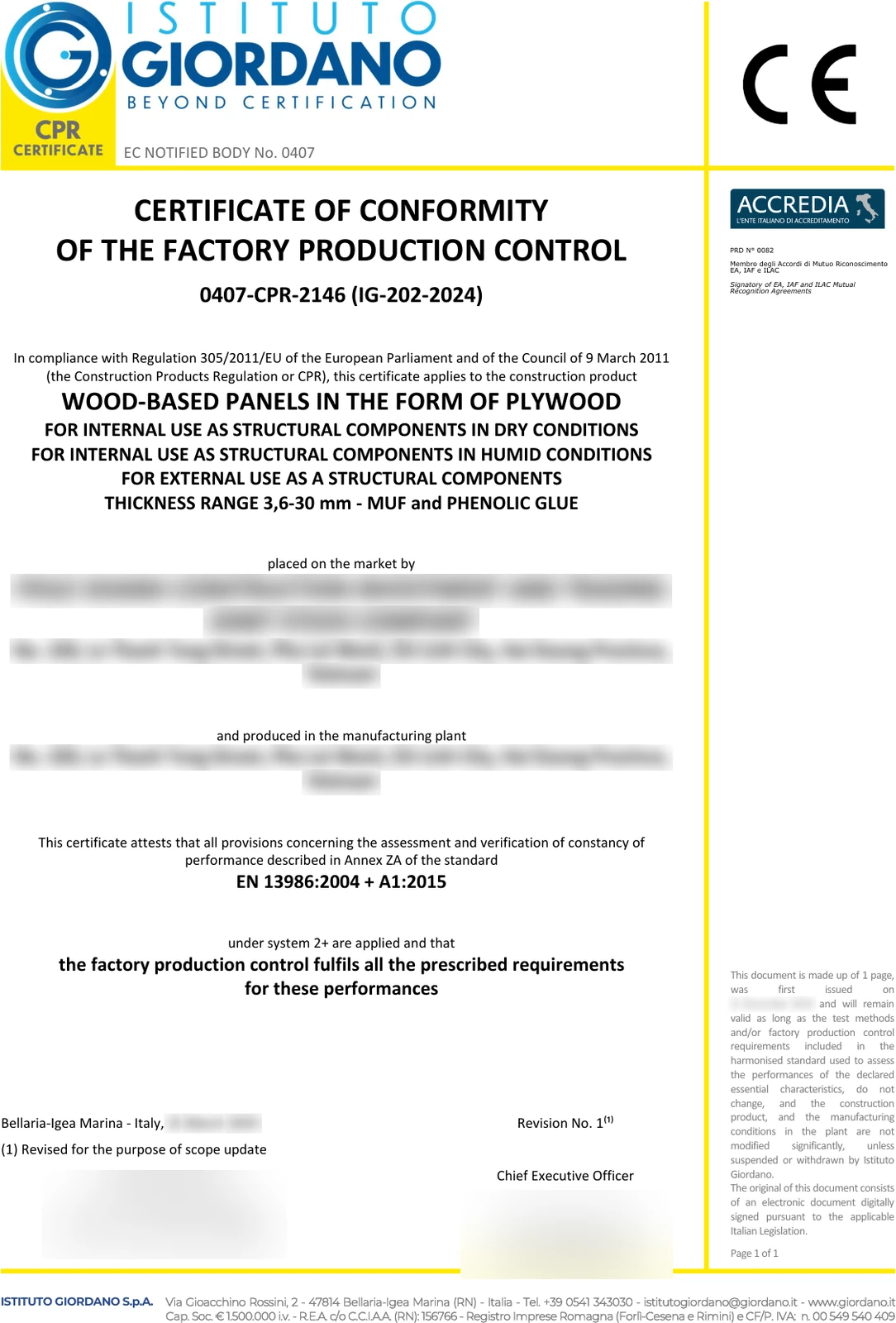
0407-CPR-2146
EN 13986:2004+A1:2015, AVCP System 2+, Istituto Giordano (notified body 0407): structural plywood 3.6–30 mm, MUF or phenolic glue, dry, humid and external use.
CE FPC certificate scan, company details and dates blurred
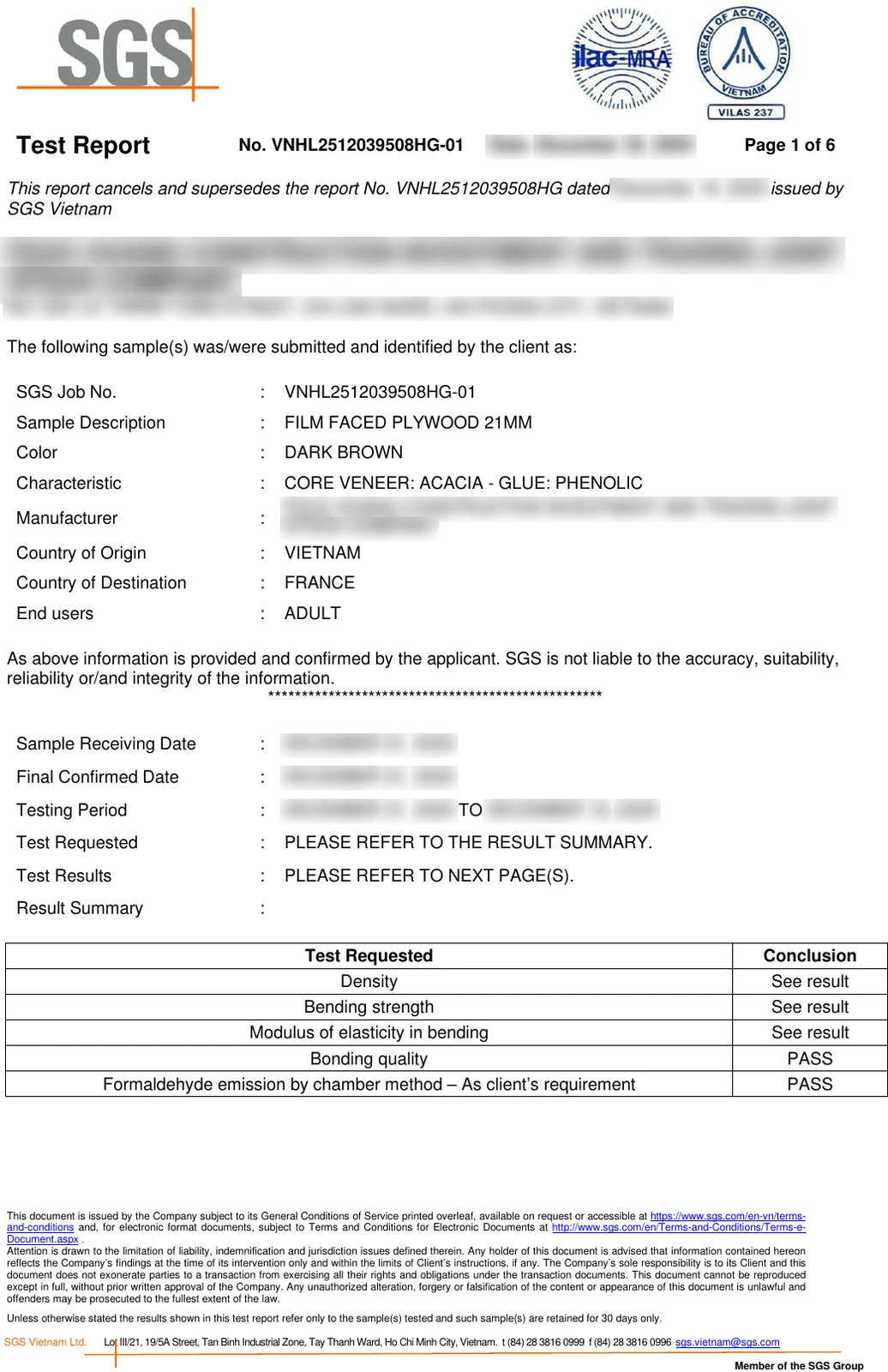
EN 314 Class 3 · EN 717-1 E1
The 21 mm dark-brown phenolic specimen, Acacia core: Class 3 bond, 642 kg/m³, formaldehyde not detected at 0.04 mg/m³ (E1).
SGS report page, company details and dates blurred
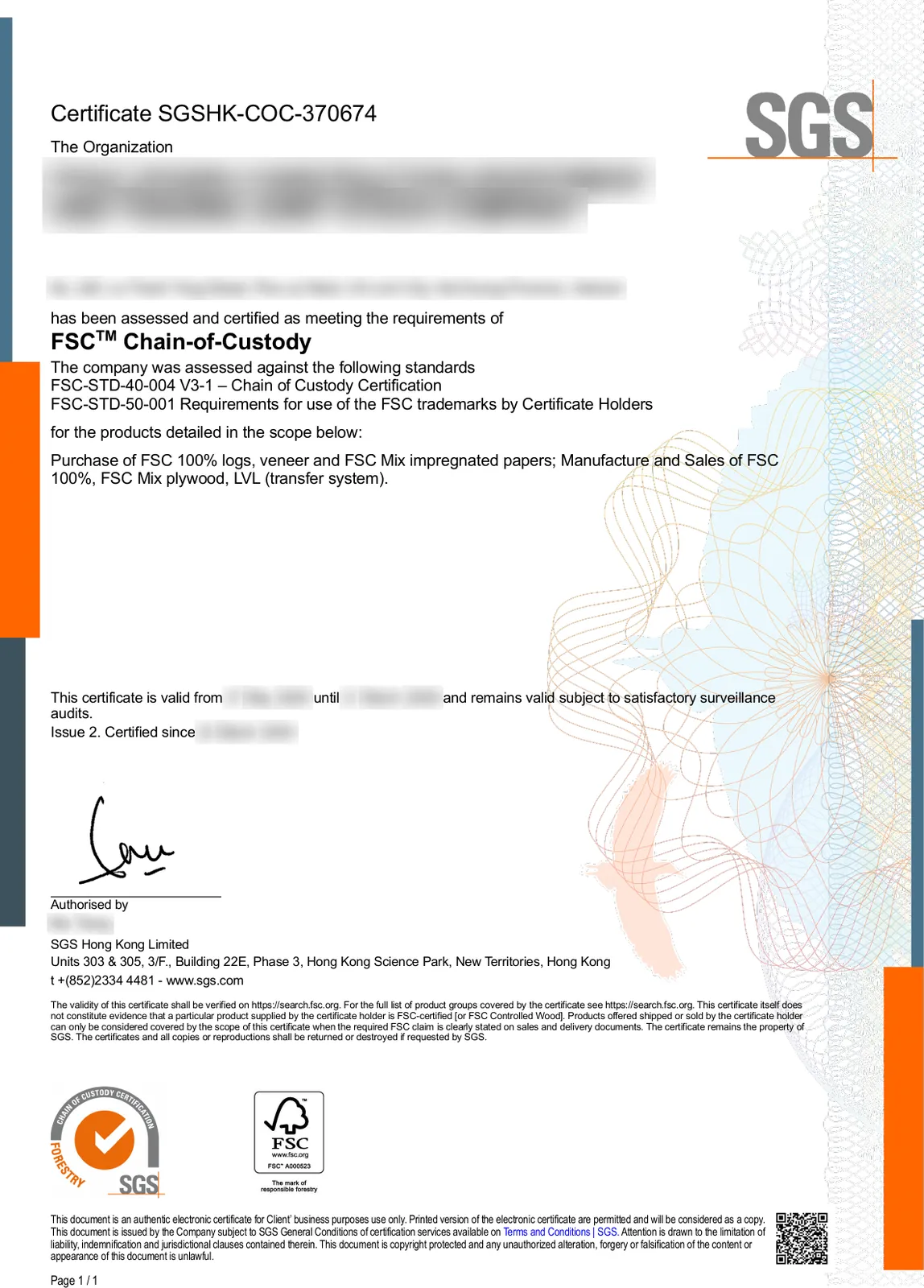
SGSHK-COC-370674
FSC 100% and FSC Mix plywood under chain of custody SGSHK-COC-370674; the claim is printed on the invoice for FSC orders.
FSC certificate scan, company details and dates blurred
Loading
1250 × 2500 mm packs are built lower than 1220 × 2440 mm packs: about 970 mm for Acacia-core sheets and 900 mm for Eucalyptus-core sheets. A 40HC takes 16 Acacia packs or 15 Eucalyptus packs.
Both 21 mm loads are capped by weight rather than volume, so the planning counts below already respect a 28,000 kg payload. Final counts follow the booking, the route and the weighed sheets.
| Sheet | Sheets per pack | Packs | Sheets per 40HC | m³ per 40HC | Weight per sheet |
|---|---|---|---|---|---|
| 21 mm, Acacia | 45 | 16 | 720 | 47.3 m³ | 38.1 kg |
| 21 mm, Eucalyptus | 42 | 15 | 630 | 41.3 m³ | 42.7 kg |
| 18 mm, Acacia | 53 | 16 | 848 | 47.7 m³ | 32.6 kg |
| 18 mm, Eucalyptus | 50 | 15 | 750 | 42.2 m³ | 36.6 kg |
Planning densities 580 kg/m³ Acacia and 650 kg/m³ Eucalyptus; not yet checked against a packing list for this size.
To Europe
Containers leave from Hai Phong. Typical days at sea are 30–40 to Northern Europe and 25–35 to the Mediterranean, depending on carrier and route. Each EU-bound container carries a certificate of origin on form EUR.1 with the usual invoice, packing list and bill of lading.
EUDR applies from 30 December 2026 to large and medium operators. The EU importer files the due-diligence statement; we supply the geolocation file of the production plots for the timber in your lot.
| Item | What you receive |
|---|---|
| Days at sea, Northern Europe | About 30–40 |
| Days at sea, Mediterranean | About 25–35 |
| Origin | EUR.1 certificate of origin |
| EUDR | Geolocation file (GeoJSON) for your due-diligence statement |
| Structural use | CE documents under 0407-CPR-2146 when ordered |
Buy direct from the mill
We sell the 21 mm sheet by the container from our two mills, which ship up to 150 containers a month. One 40HC is the minimum; 21 mm and 18 mm sheets, or 1250 × 2500 mm and 1220 × 2440 mm sizes, can share a container, and three to six builds can be mixed by agreement.
Production is 15–45 days after the 30% deposit; the 70% balance is paid against the scanned bill of lading by T/T, or by irrevocable L/C at sight. We quote FOB Hai Phong, CFR or CIF to your European port.
How to order
Deck or wall system, sheets or containers, film grade, port of discharge.
Build, tolerances, CE and EUDR papers listed, price FOB, CFR or CIF.
Free 21 mm samples; caliper them or send them to your lab.
30% starts production, 15–45 days by quantity.
Your inspector welcome; pack and container photos before sealing.
Draft papers for approval, EUR.1 and EUDR file, balance against the B/L scan.
Buyer questions
An Acacia hardwood core with phenolic glue in every line and a dark brown film of 130–135 g/m² on both faces, with painted edges. Eucalyptus core, MUF glue and heavier or black film are options.
About 720 Acacia-core sheets (16 packs of 45, 47.3 m³) or 630 Eucalyptus-core sheets (15 packs of 42, 41.3 m³), as planning figures before booking and weighing.
Up to about 25, with proper handling, release agent on every pour and sealed edges, including cut edges. Rough stripping and bare cut edges shorten that.
Our factory production control certificate 0407-CPR-2146 under EN 13986, System 2+, notified body 0407, which covers 3.6–30 mm with MUF or phenolic glue; and the SGS report on a 21 mm phenolic specimen: Class 3 bond and E1.
±0.5 mm on thickness and ±2 mm on length and width, checked on pack samples and written on the order's technical sheet.
Only when the edge is sealed. We paint all four edges at the mill; any edge cut later must be painted before use, or water enters the veneers.
About 38.1 kg with an Acacia core and 42.7 kg with a Eucalyptus core, from planning densities of 580 and 650 kg/m³.
Yes, it is the same type of panel: a 21 mm film-faced formwork sheet in 1250 × 2500 mm. In French it is called contreplaqué filmé 21 mm.
Yes, black film is pressed to order with the same glue and core; dark brown is the default.
Yes. Two thicknesses or two sizes in one container is normal, and three to six builds can be mixed by agreement.
Commercial invoice, packing list, bill of lading, EUR.1 certificate of origin, the FSC claim when ordered, CE documents for structural use and the EUDR geolocation file.
About 30–40 days at sea from Hai Phong, plus 15–45 days of production after the deposit.
Quotation
Send the quantity, core, film grade and colour, edge colour, marking and your European port. We reply with a technical sheet and an FOB Hai Phong, CFR or CIF price.