
Technical sheet
Build, core, glue, film weight and colour, edge sealing and the tolerance for your order.
Production process · our two mills in Chi Linh, Hai Phong
In short
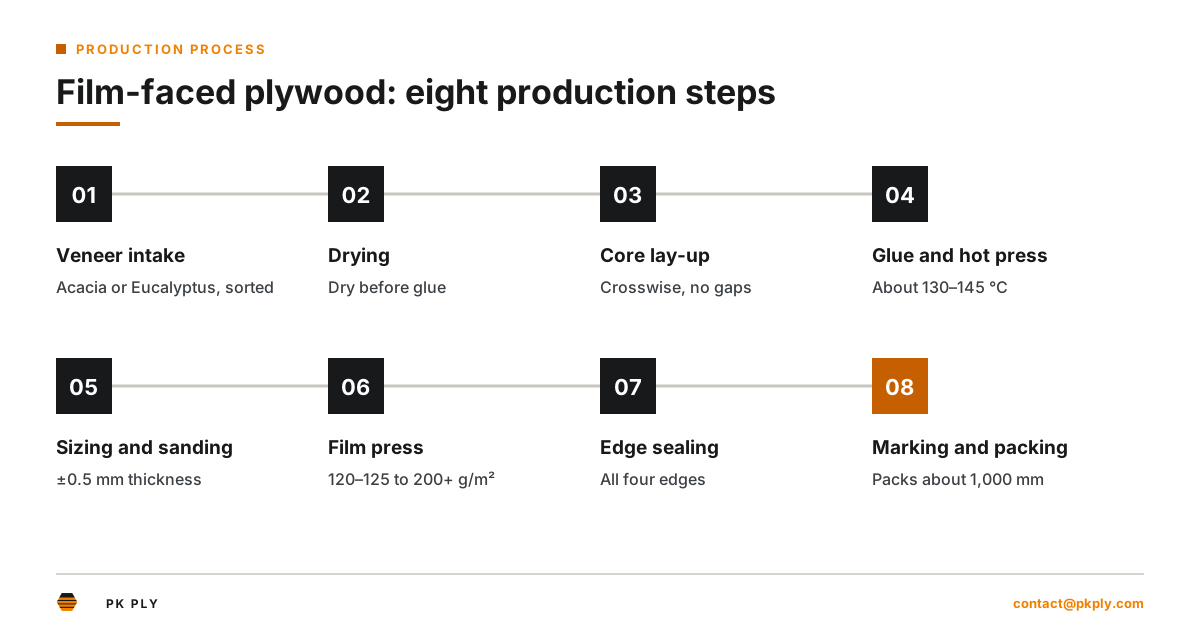
At PK Ply, a film-faced panel is made in eight steps: veneer intake, drying, crosswise core lay-up, glue and hot press (phenolic bonds at about 130–145 °C), sizing and sanding, film press, sealing all four edges, then marking and packing. Our two mills in Chi Linh, Hai Phong run every step in-house at up to 150 containers a month, with production 15–45 days after the deposit.
Film
The page film follows one 18 mm film-faced panel from a bundle of core veneer to a sealed, strapped pack, one chapter per production step.
Chapters: veneer and drying; lay-up and glue; hot press; sizing and sanding; film press; edge sealing; packing. Each chapter ends on the check that step must pass before the panel moves on.
Certificates
Two of our certificates audit the production process itself: CE factory production control 0407-CPR-2146 checks how we control structural plywood production, and FSC chain of custody SGSHK-COC-370674 checks how certified veneer moves through the line.
Scans are the originals, with the legal entity, tax ID, address and dates blurred.
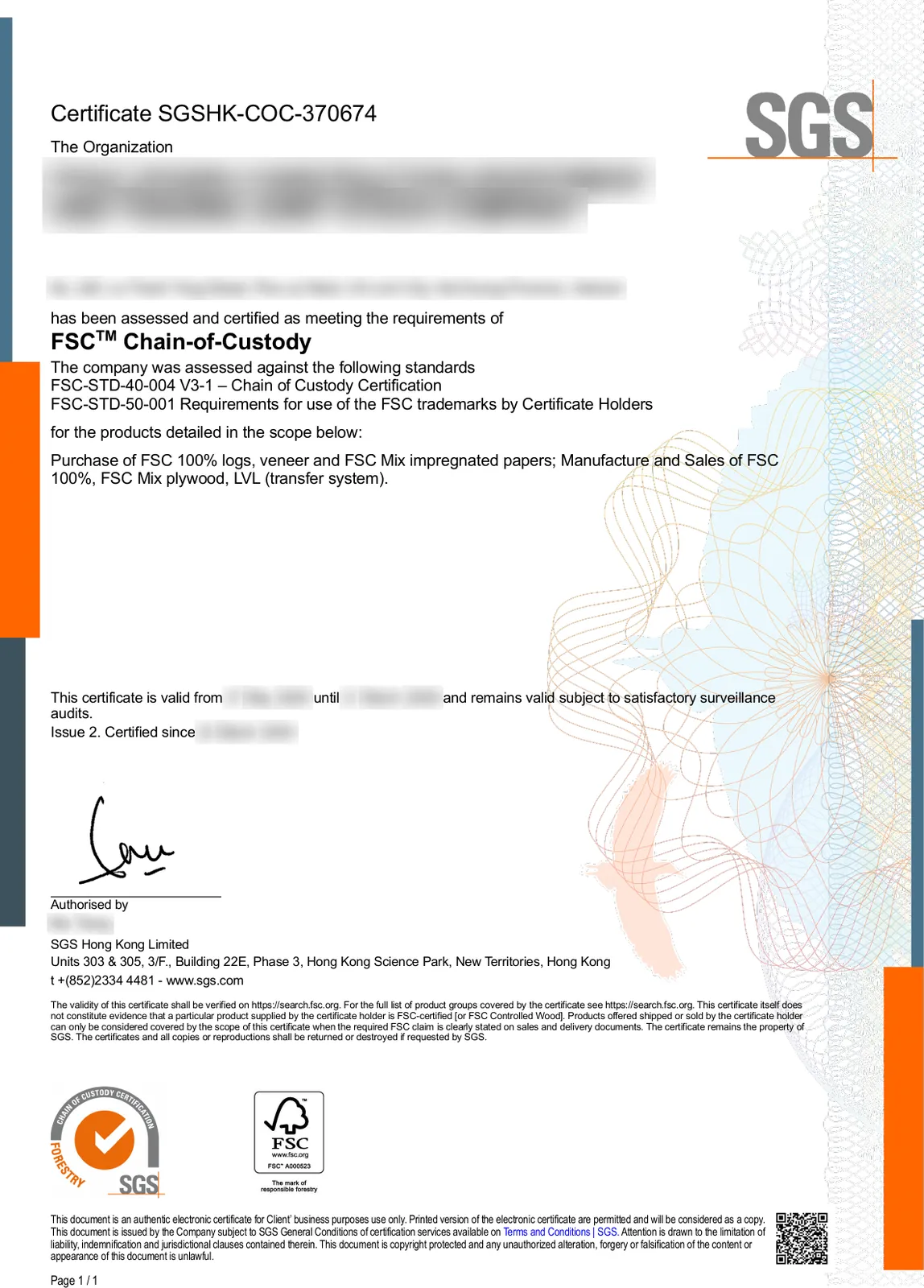
SGSHK-COC-370674
Covers the purchase of FSC 100% logs and veneer and FSC Mix impregnated papers, and the manufacture of FSC plywood; certified material can go into core, face and back of an FSC order.
FSC certificate scan: holder name, address and dates blurred.
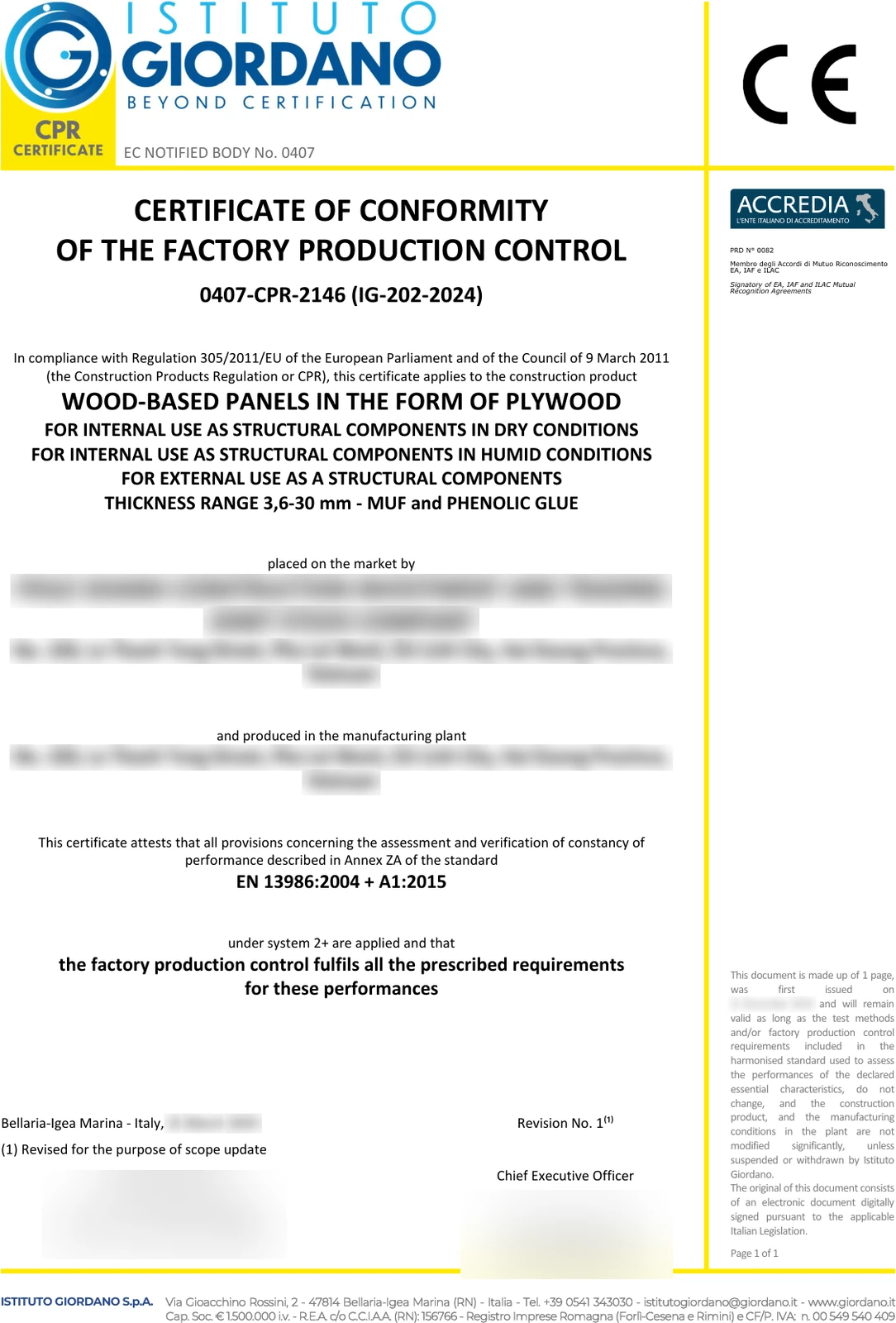
0407-CPR-2146
The notified body audits how we control production of structural plywood 3.6–30 mm, MUF or phenolic glue, under EN 13986, System 2+.
CE FPC certificate scan: holder name, tax ID, address and dates blurred.
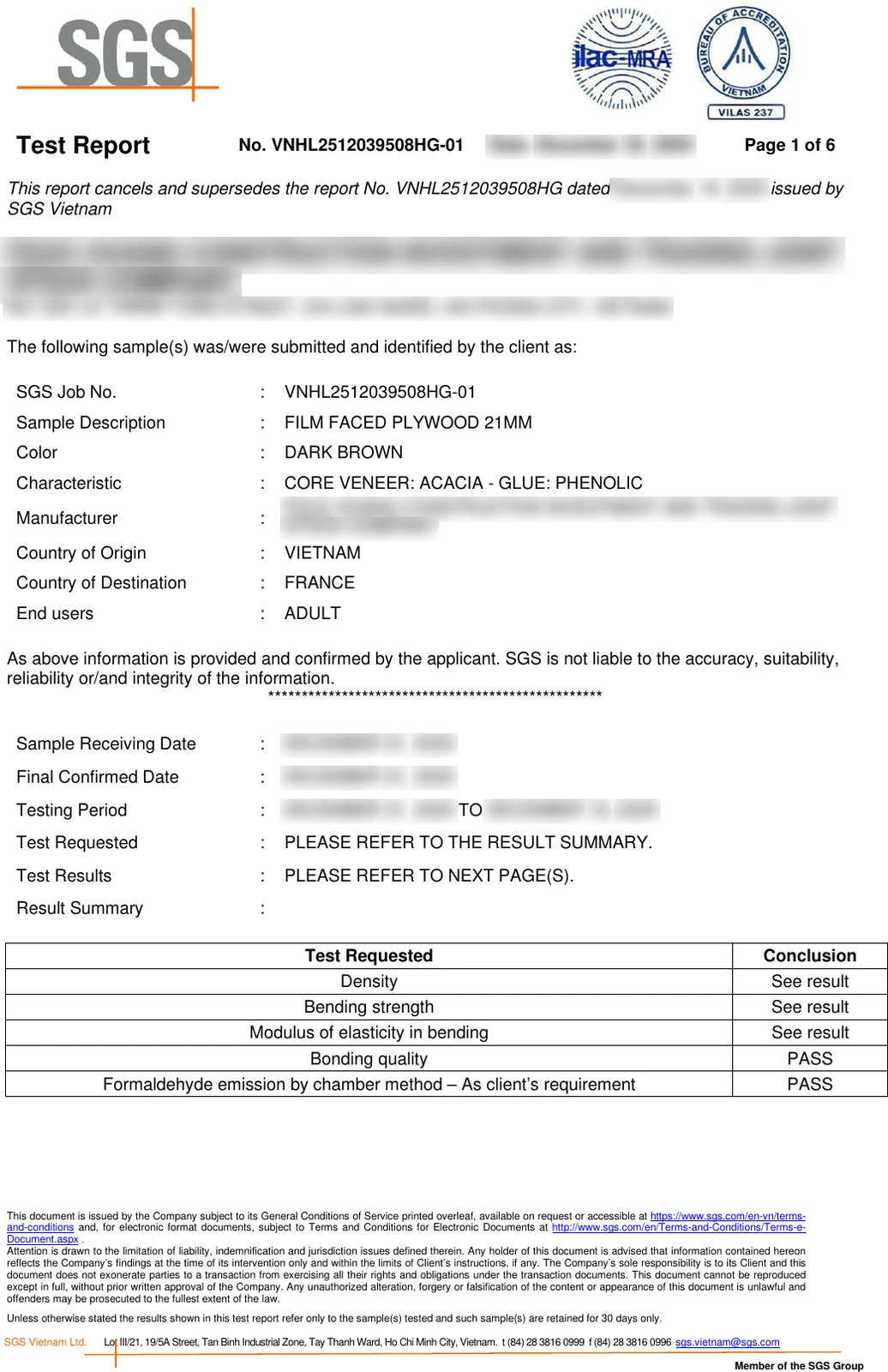
A 21 mm Acacia-core, phenolic-glue specimen from our line: density 642 kg/m³, bonding Class 3 pass after soak and boil pretreatments, formaldehyde not detected at 0.04 mg/m³. Specimen evidence only.
SGS report scan: client name, address and dates blurred.
The quality system the production steps and their records run under; the certificate copy goes with the order documents.
At a glance
Film-faced plywood is made by drying thin hardwood veneers, laying them crosswise with glue between them, curing the stack in a hot press, sizing and sanding the board, pressing resin film onto both faces and sealing every edge with water-resistant paint.
| Step | What happens | Key number | Check before the next step |
|---|---|---|---|
| 1 Veneer intake | Acacia or Eucalyptus core veneer sorted by species and grade | Species per order | Grade and species match the build |
| 2 Drying | Veneer dried before gluing | Dry before glue | Damp veneer held back |
| 3 Core lay-up | Veneers laid crosswise, gaps closed | Odd number of plies, grain alternating | No gaps or overlaps |
| 4 Glue and hot press | MUF or phenolic glue spread, stack cured under heat and pressure | About 130–145 °C for phenolic bonds | Bond and blows checked |
| 5 Sizing and sanding | Trimmed to size, sanded flat | ±0.5 mm thickness, ±2 mm length and width | Thickness gauged |
| 6 Film press | Film pressed on both faces | 120–125 g/m² to over 200 g/m² | Film face even, no bubbles |
| 7 Edge sealing | Water-resistant paint on all four edges | 4 edges, and every cut edge | Paint complete on every edge |
| 8 Marking and packing | Counted into packs, covered, strapped, marked | Packs about 1,000 mm high | Count and marks match the packing list |
Raw materials
Three materials make a film-faced panel: hardwood core veneers (Acacia or Eucalyptus), the glue that bonds them (melamine MUF or phenolic) and the resin film pressed on both faces (black or dark brown).
Reference densities we plan with are 580 kg/m³ for Acacia-core and 650 kg/m³ for Eucalyptus-core panels; Eucalyptus measures 650–750 kg/m³, which is why Eucalyptus-core containers reach the weight limit first.
| Material | Options at our mills | What it decides | Goes into |
|---|---|---|---|
| Core veneer | Acacia or Eucalyptus hardwood | Weight and load per container: about 47 m³ Acacia or 43 m³ Eucalyptus per 40HC | Film-faced, anti-slip, structural |
| Glue | Melamine (MUF) or phenolic | Reuse: about 12–15 pours MUF, up to about 25 pours phenolic, with proper handling, release agent and sealed edges | All panels; CE scope covers both |
| Film | Black or dark brown, smooth or patterned; 120–125 g/m² up to over 200 g/m² | Concrete finish and face wear; about 130–135 g/m² is the most common order | Film-faced and anti-slip |
| Anti-slip film | Rice, hexagon or wire-mesh pattern | Grip on decks and platforms; 220 g/m² catalogue reference | Anti-slip plywood |
| Edge paint | Water-resistant paint | Water uptake at the edges between pours | Every panel and cut edge |
The eight steps
Here is what happens to one 18 mm panel at each step in our mills, the number that step works to and the check it must pass before the next step starts.
Core veneer arrives in strapped bundles and is sorted by species, Acacia or Eucalyptus, and by grade. The order decides the species: Acacia makes a lighter panel and a fuller container, Eucalyptus a heavier, denser one. FSC orders take certified veneer only, kept apart under our chain of custody. Check: species and grade match the technical sheet.
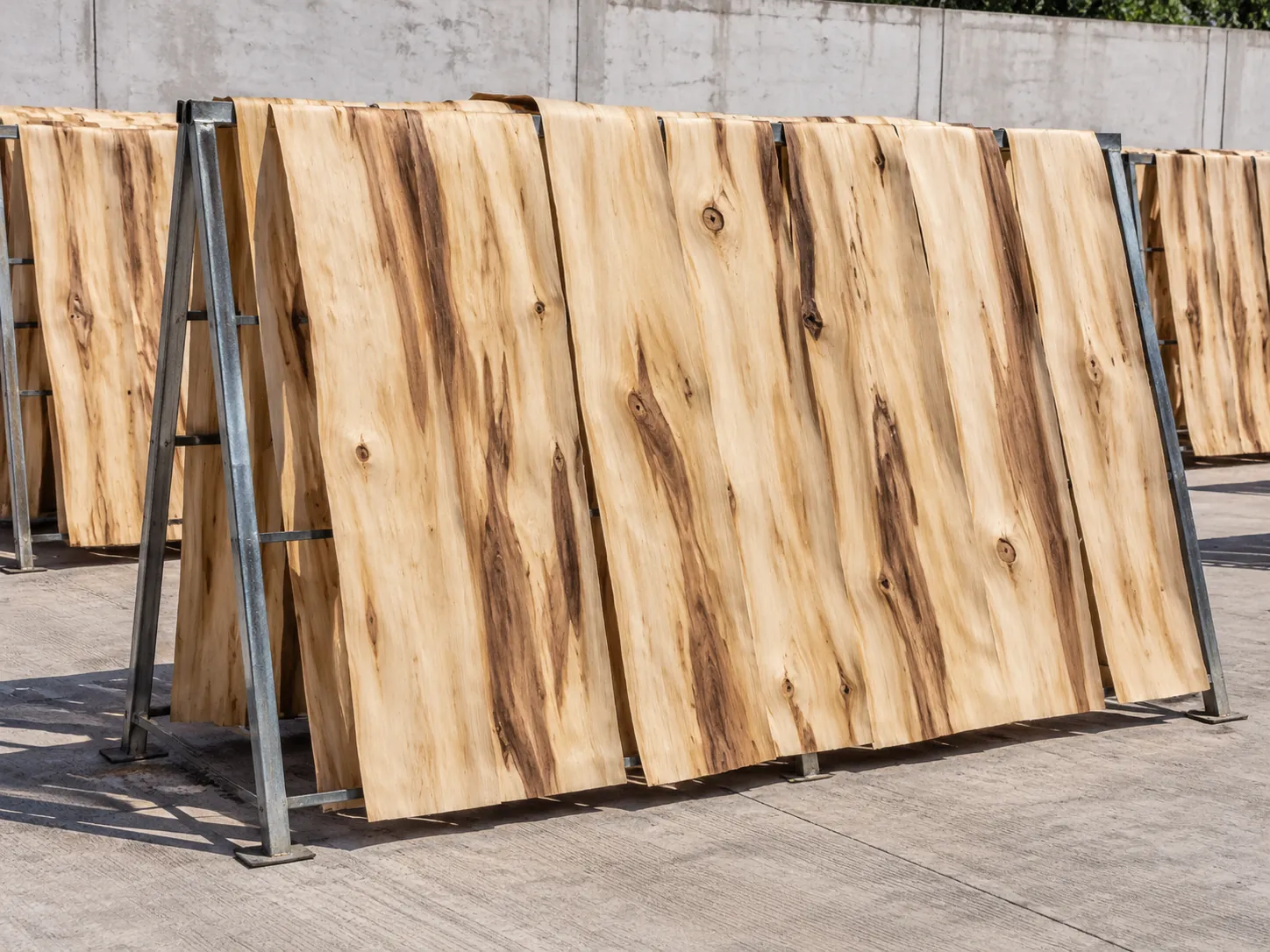
Veneer is dried before it reaches the glue spreader. Damp veneer turns to steam in the press and leaves blows and weak glue lines, so the rule is simple: only dry veneer goes to lay-up. Check: damp veneer is held back and dried again.
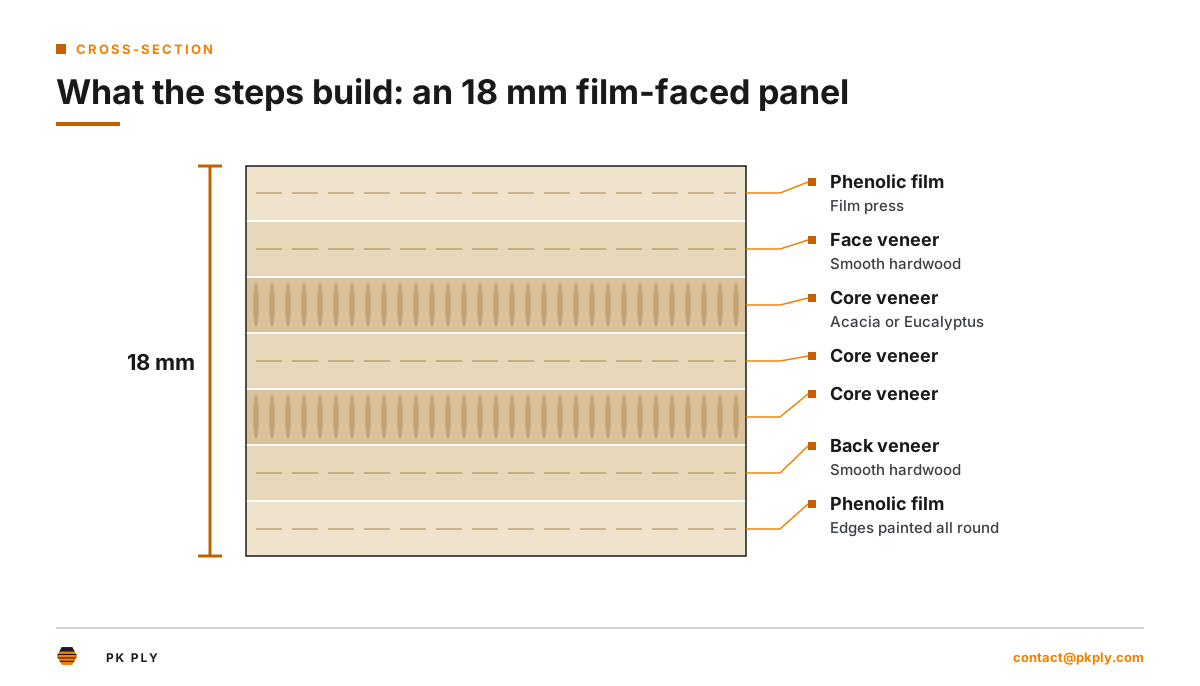
Veneers are laid one on another with the grain of each layer at right angles to the next, which gives the panel strength in both directions and keeps it flat. An 18 mm panel is built from smooth hardwood face veneers under the film and Acacia or Eucalyptus core veneers between them. Check: no gaps, overlaps or broken pieces in the core, because a gap shows later as a soft spot under the film.
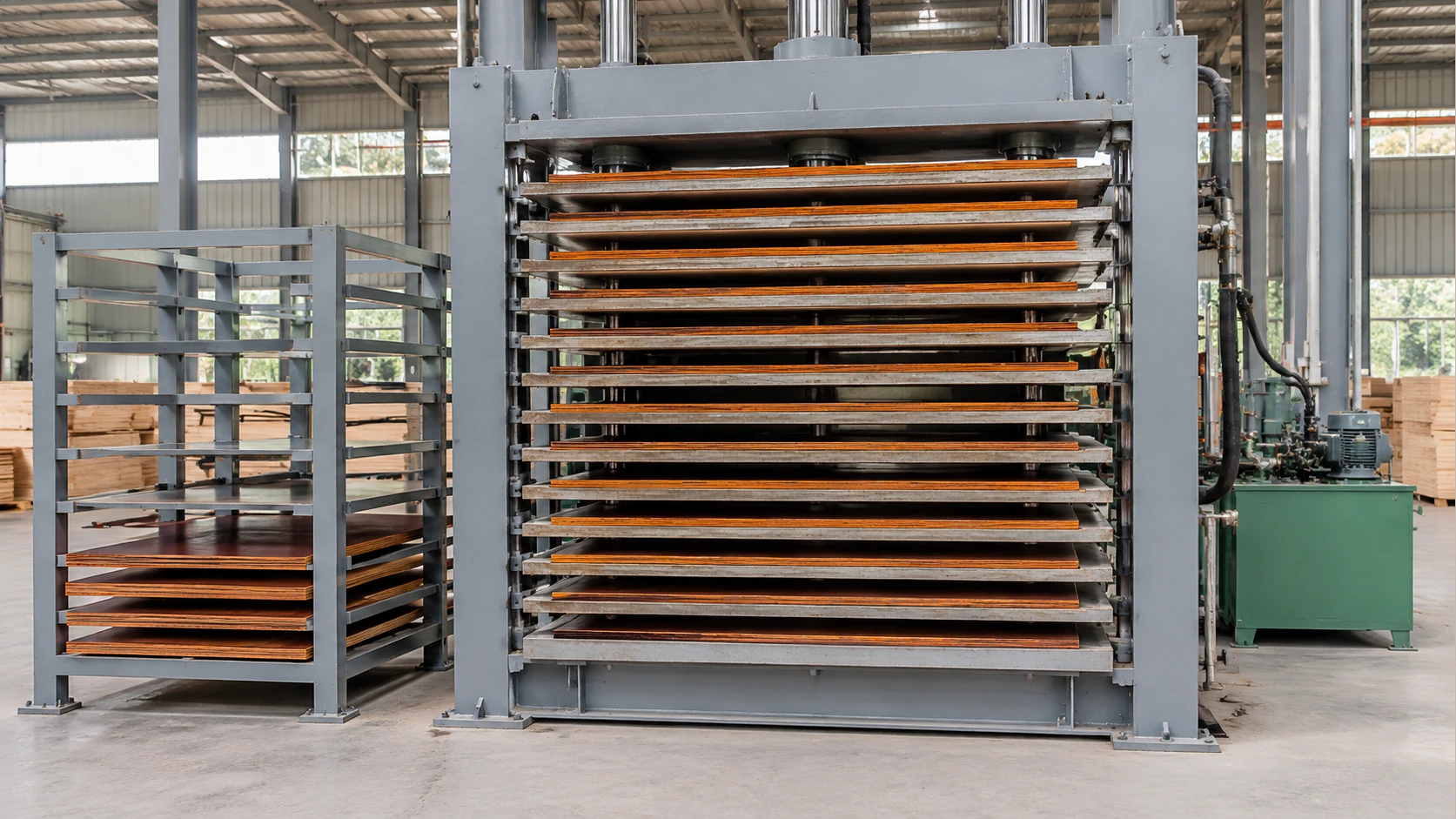
Glue, melamine (MUF) or phenolic as ordered, is spread on the veneers by roller, and the assembly goes into a multi-opening hot press. Phenolic (WBP) bonds are pressed at about 130–145 °C; heat and pressure cure the glue through the full thickness. Check: boards out of the press are checked for blows and open glue lines before sizing.
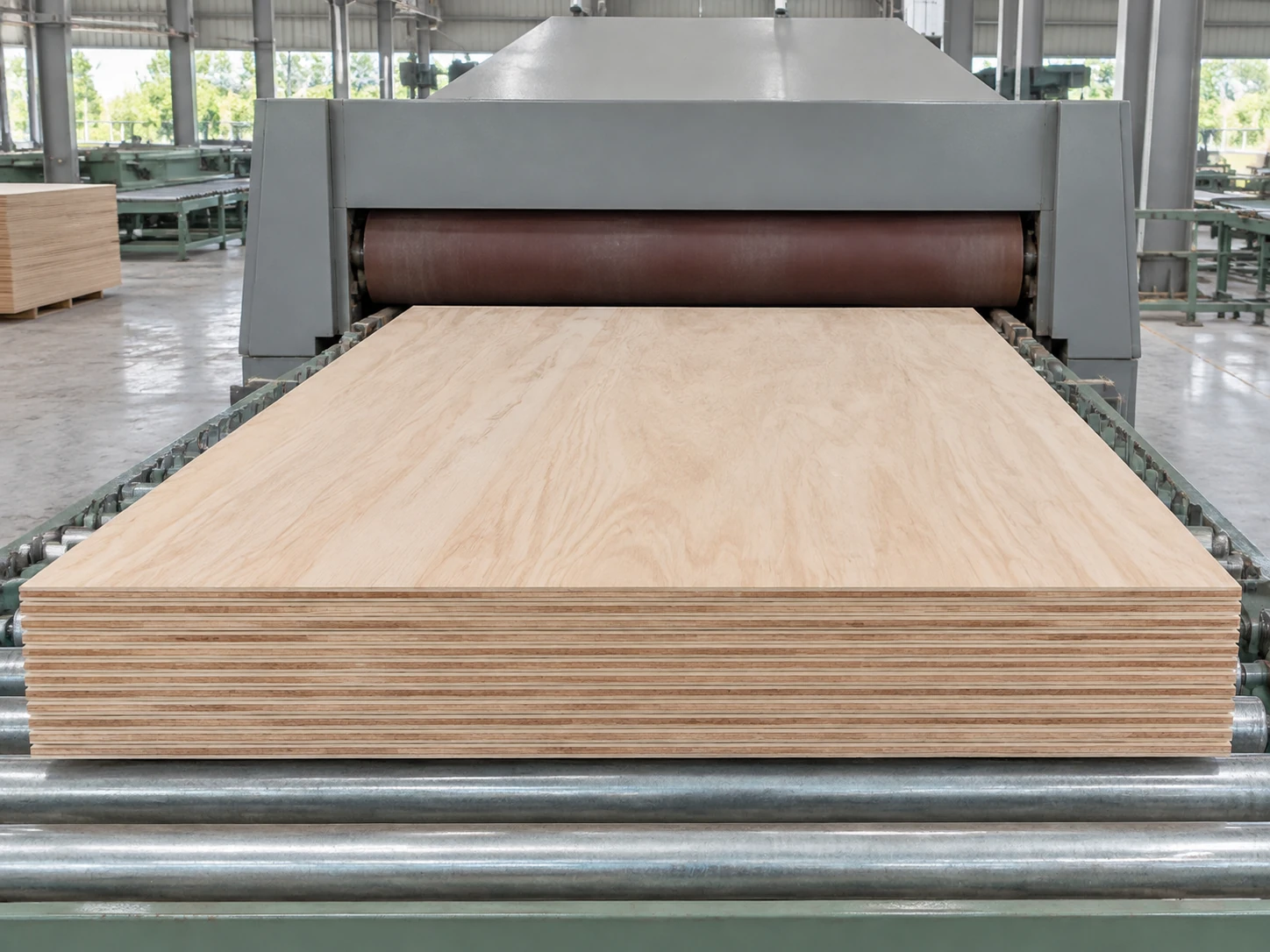
Pressed boards are trimmed square to 1220 × 2440 mm, 1250 × 2500 mm or a custom size and sanded so the film will lie on an even surface. Check: thickness is gauged against ±0.5 mm and length and width against ±2 mm; the tolerance for each order is the one on its technical sheet.
Resin film, black or dark brown, smooth or with a rice, hexagon or wire-mesh anti-slip pattern, is pressed onto both faces at the weight on the order: from 120–125 g/m², about 130–135 g/m² most commonly, up to 165, 185 or over 200 g/m². Check: film face even, fully bonded, no bubbles or dry spots.
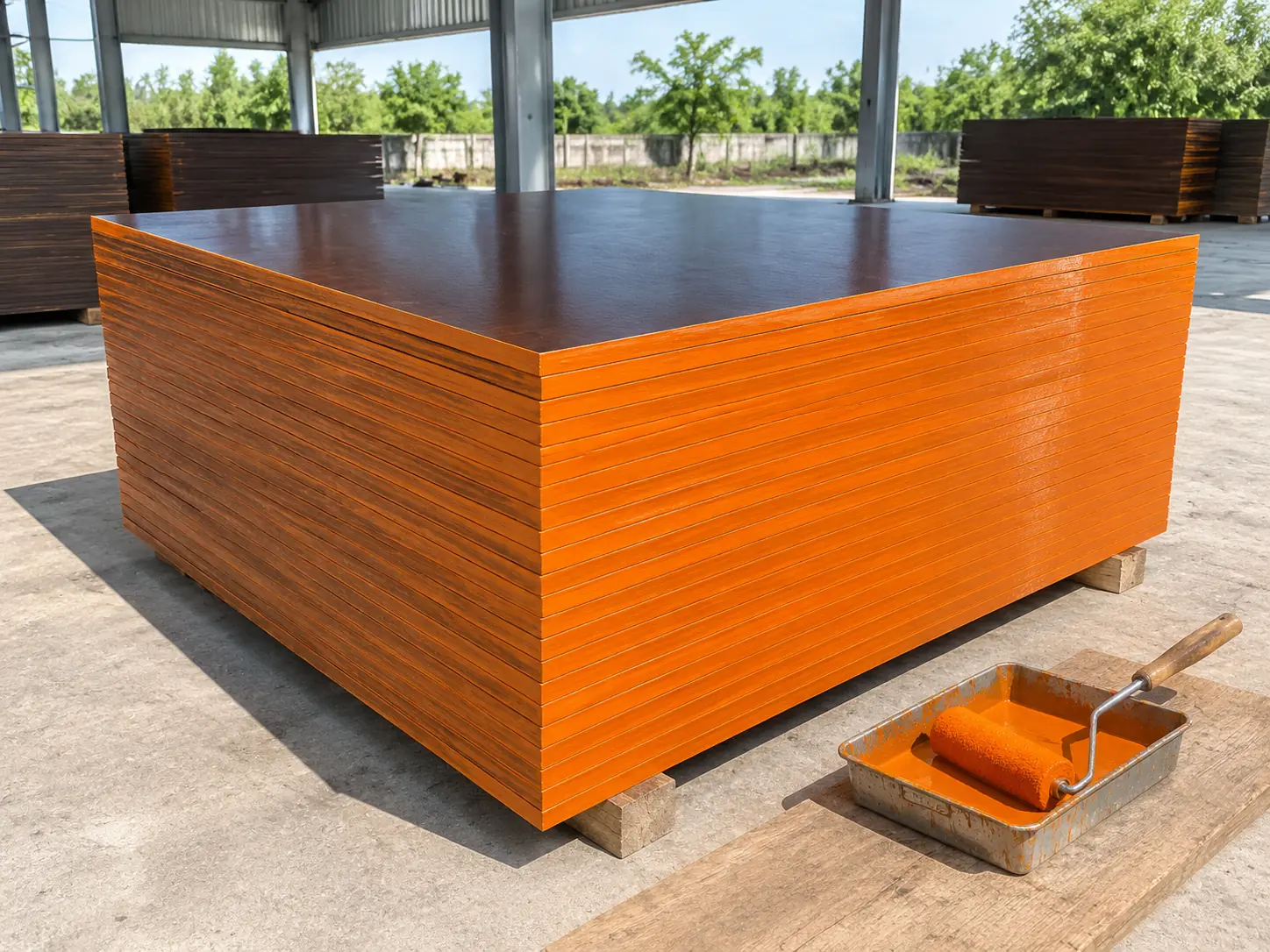
All four edges get water-resistant paint, and so does every cut edge on cut-to-size panels. The film keeps water off the faces; the paint keeps it out of the core at the edges, which is where an unsealed panel swells first on site. Check: paint complete on every edge before the panel goes into a pack.
Finished panels are counted into packs about 1,000 mm high, covered, strapped over corner protectors and marked, then loaded into the container to the planned pack count. Check: count, marks and pack list agree before loading.
Pictures
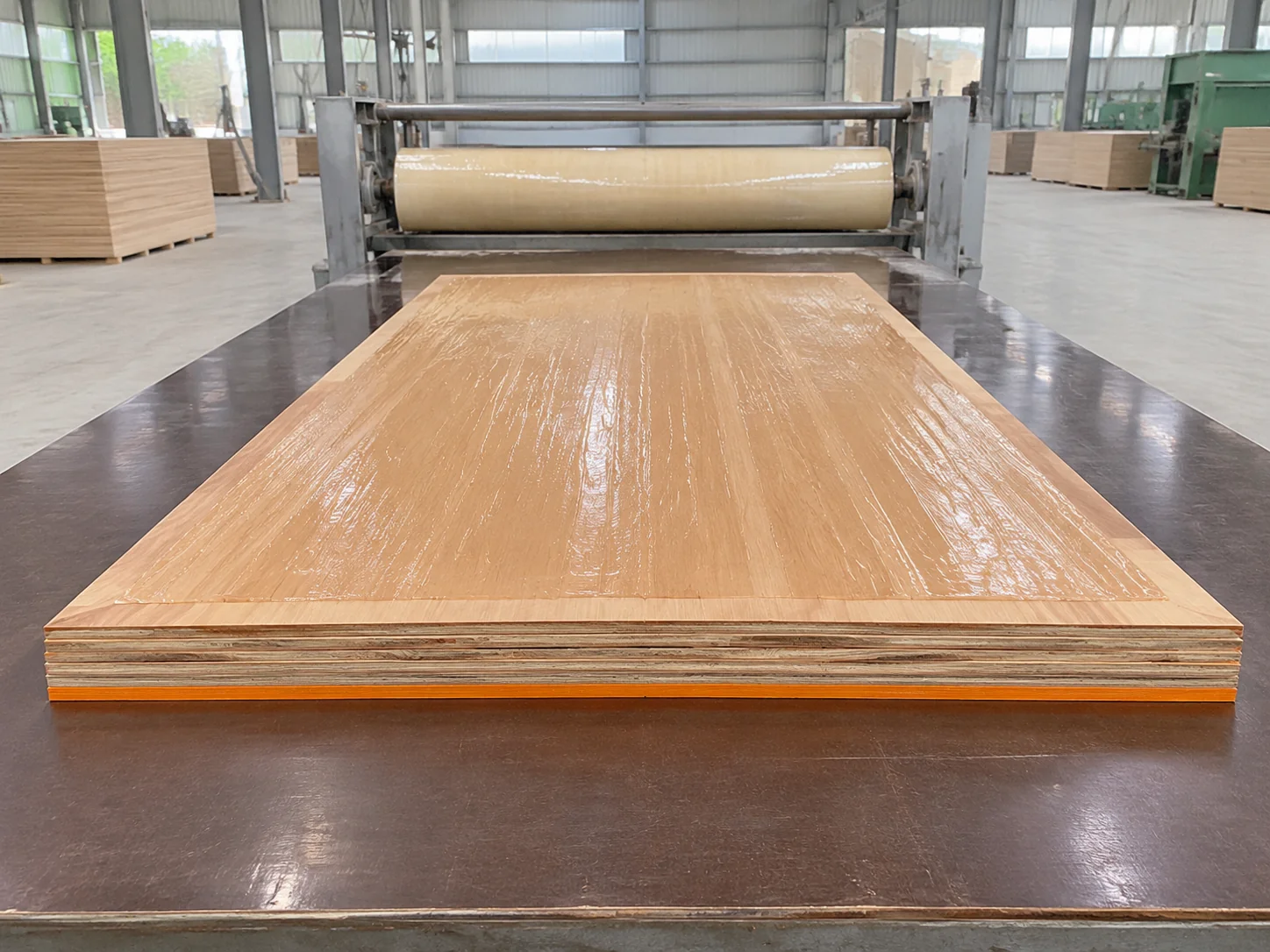
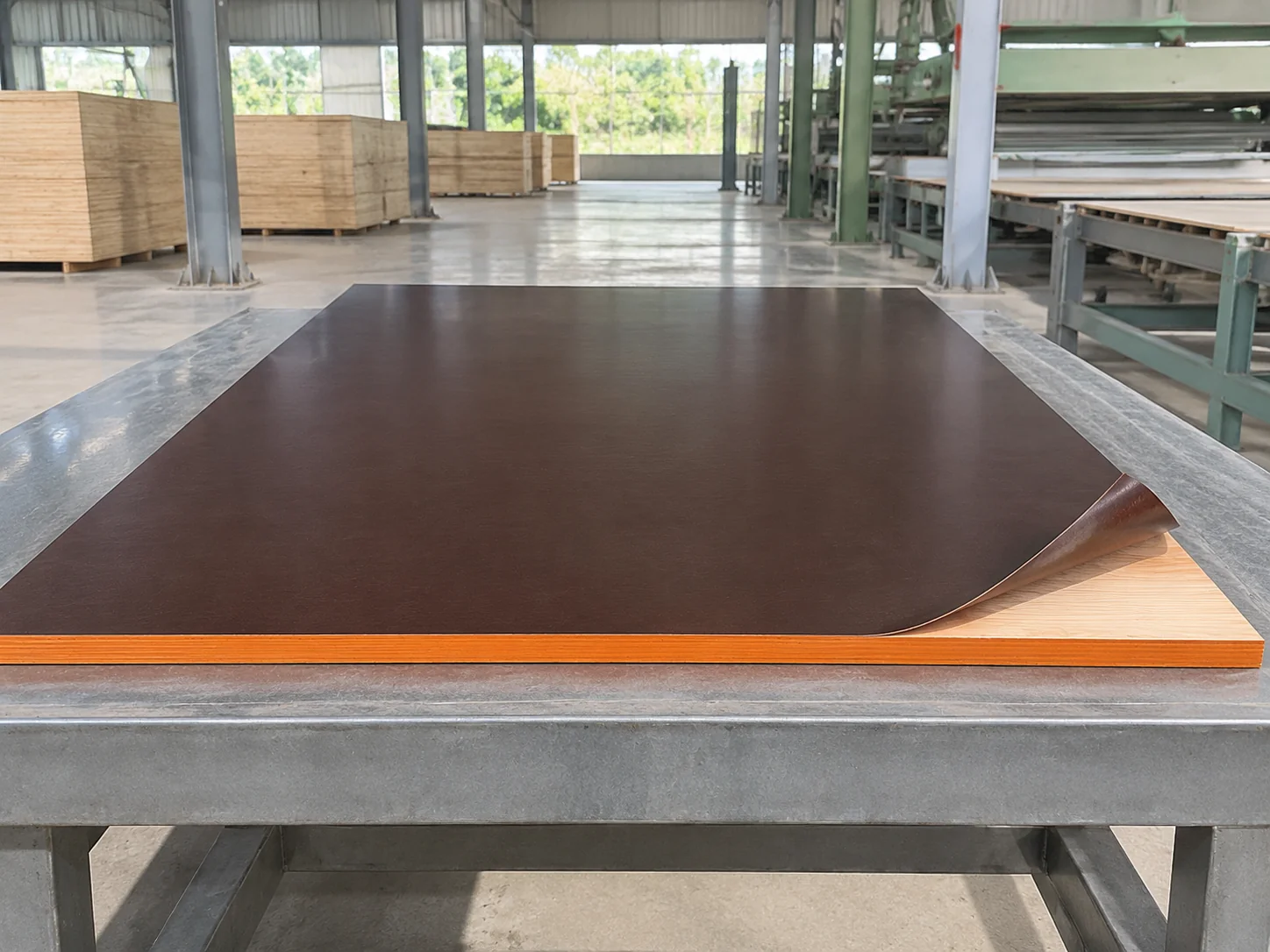
The pictures below show what the main production steps look like on a plywood line: glue spreading, film laying, edge sealing, veneer drying, sanding and the diagram of the whole sequence.
Real clips and photos from our own press and edge-sealing lines are being filmed and will replace these pictures as they arrive.
Defects
Most defects in film-faced plywood start at one step and show up at a later one; this table names the defect, where it starts and the check in our line that stops it.
| Defect | Usual cause | Where we stop it |
|---|---|---|
| Blows (blisters inside the board) | Damp veneer turning to steam in the press | Drying check before lay-up; boards checked out of the press |
| Soft spots under the film | Gaps or overlaps in the core | Lay-up check: no gaps or overlaps |
| Delamination after pours | Weak or uncured glue lines | Glue spread and press temperature; bond tests on specimens |
| Thickness out of tolerance | Uneven core or sanding | Thickness gauged after sizing against ±0.5 mm |
| Film bubbles or dry spots | Uneven board surface or film press fault | Sanding before film; film face inspected after the press |
| Edge swelling on site | Unsealed or partly sealed edges | Paint checked on every edge, including cut edges |
| Broken pallet feet | Overfilled packs | Pack height about 1,000 mm and planned sheets per pack |
Numbers
These are the numbers our production works to; the values for your order are written on its technical sheet.
| Item | Value | Condition |
|---|---|---|
| Thickness range | 9–40 mm | Everyday formwork thicknesses 12, 15, 18 and 21 mm |
| Sheet sizes | 1220 × 2440 mm, 1250 × 2500 mm | Custom sizes and cutting lists by request; nothing larger than 1250 × 2500 mm |
| Thickness tolerance | ±0.5 mm | Per order on the technical sheet |
| Length and width tolerance | ±2 mm | Per order on the technical sheet |
| Hot press temperature | About 130–145 °C | WBP / phenolic bonds |
| Film weight | 120–125 g/m² to over 200 g/m² | About 130–135 g/m² most common |
| Reuse, MUF glue | About 12–15 pours | With proper handling, a release agent on every pour and sealed edges |
| Reuse, phenolic glue | Up to about 25 pours | With proper handling, a release agent on every pour and sealed edges |
| Bonding, 21 mm specimen | Class 3 pass | SGS, EN 314-1/314-2, after 24 h soak, boil-dry-boil and 72 h boil |
| Density, 21 mm specimen | 642 kg/m³ | SGS, EN 323, one submitted specimen |
Buyer guide
The number of pours a film-faced panel gives is set by three production steps more than any other: the glue line at the hot press, the film weight at the film press and the paint at edge sealing.
With melamine (MUF) glue our panels reach about 12–15 pours; with phenolic glue up to about 25. Both numbers hold only with proper handling, a release agent on every pour and sealed edges, including edges cut on site. Budget film-faced plywood on the market typically gives about 4–10 reuses, and the difference is mostly made in the steps above.
Two offers with the same name are often not the same build: core grade, joining, glue system, film weight, edge sealing and tolerance make the difference. Start the specification from the application and the reuse target, then ask for the build that gets there.
On arrival, check what the steps promised: measure thickness at several points of a few sheets against the technical sheet, look along the film face under raking light for bubbles, and look at every edge in an opened pack for complete paint.
MUF for about 12–15 pours; phenolic for up to about 25.
Heavier film for more pours and a finer finish; about 130–135 g/m² is most common.
Sealed edges keep water out of the core; reseal edges cut on site.
±0.5 mm thickness keeps joints flush between panels.
What you receive
Every order comes with the technical sheet it was produced to, the certificate copies that apply and the shipping documents, so you can check the panels against what the production steps promised.
Build, core, glue, film weight and colour, edge sealing and the tolerance for your order.
FSC claim on the sales documents where ordered, CE declaration for structural panels, emission documentation.
Reports for the agreed configuration, with specimen, method and date.
Packs, sheets per pack and marks, matched to what was loaded.
Documents
Each container ships with a commercial invoice, packing list, B/L, certificate of origin and phytosanitary and fumigation papers, plus insurance under CIF; draft shipping documents go to you for approval after loading.
Commercial invoice
Panels, quantities and price on the agreed terms.
Packing list
Packs, sheets per pack, volume and weight.
Bill of lading
The 70% balance is paid against the scanned B/L.
Certificate of origin
EUR.1 for EU-bound lots.
Phytosanitary and fumigation papers
For the wooden packing shipped with the panels.
Insurance certificate
Under CIF.
EUTR/EUDR file set
For EU lots: species, origin and plot geolocation for your due diligence.
Capacity
Our two mills produce up to 150 containers a month, and an order is produced 15–45 days after the 30% deposit, depending on the quantity, the build and the production schedule.
The production slot is set when the deposit arrives. Cut-to-size orders add a cutting and edge-painting pass after sizing, and a repeat of an earlier build is the quickest to schedule because its technical sheet is already agreed.
The minimum order is one 40HC. A container usually carries one or two products; three to six can be mixed by agreement.
Order checklist
Put these six lines in your specification and every production step has a number to work to.
| Line | Example | Step it controls |
|---|---|---|
| Core species | Acacia or Eucalyptus | Veneer intake, lay-up |
| Glue | MUF or phenolic | Glue and hot press |
| Thickness and tolerance | 18 mm ±0.5 mm | Sizing and sanding |
| Size | 1250 × 2500 mm or a cutting list | Sizing |
| Film | Dark brown, 130–135 g/m² | Film press |
| Edges and packing | All edges sealed; packs about 1,000 mm | Edge sealing, packing |
FAQ
Eight steps, all in our own mills: veneer intake, drying, crosswise core lay-up, glue and hot press, sizing and sanding, film press, edge sealing, and marking and packing.
At about 130–145 °C. Heat and pressure in the hot press cure the WBP/phenolic glue through the full thickness of the panel.
Because water enters a film-faced panel through its edges. We paint all four edges and every cut edge with water-resistant paint; edges cut on site should be resealed before use.
Glue, film and edges decide most of it: about 12–15 pours with MUF glue and up to about 25 with phenolic glue, with proper handling, a release agent on every pour and sealed edges.
Acacia or Eucalyptus hardwood veneers, laid crosswise. Acacia gives about 47 m³ per 40HC and Eucalyptus, denser, about 43 m³.
15–45 days after the 30% deposit, depending on quantity, build and the production schedule. The balance of 70% is paid against the scanned B/L.
Thin wood veneers are dried, glued and laid with the grain of each layer crosswise to the next, pressed under heat until the glue cures, then trimmed and sanded; film-faced plywood also gets resin film on both faces and sealed edges.
±0.5 mm on thickness and ±2 mm on length and width, gauged after sizing; the tolerance for each order is written on its technical sheet.
About 130–135 g/m² is the most common order. Orders run from 120–125 g/m², and some buyers specify 165, 185 or over 200 g/m² for more pours and a finer concrete finish.
Yes. Ask for a visit to our mills in Chi Linh, Hai Phong or a live video tour of the press and edge-sealing lines, or start with free samples.
Quotation
Send the core, glue, thickness, size, film and edge requirements with the quantity and port. We reply with a technical sheet for each production step and an FOB Hai Phong, CFR or CIF price.