
Repeat wall forms
Walls and lift cores on towers, where one set of forms is struck and reset floor after floor. The phenolic bond holds through the wet cycles; the film grade decides how long the face stays smooth.
WBP phenolic build · pressed at our two mills in Chi Linh, Hai Phong
In short
Phenolic plywood is plywood bonded with phenol-formaldehyde resin, the boil-proof WBP glue. Ours carries a phenolic film on both faces over an Acacia or Eucalyptus core, with painted edges. With proper handling, release agent on every pour and sealed edges, it gives up to about 25 pours. An SGS-tested 21 mm specimen passed EN 314 Class 3 bonding and E1.
Film
The film follows one phenolic panel from glue spreading and hot pressing to edge painting, the boil check and loading, so a buyer sees the build before reading the tables.
Real panels
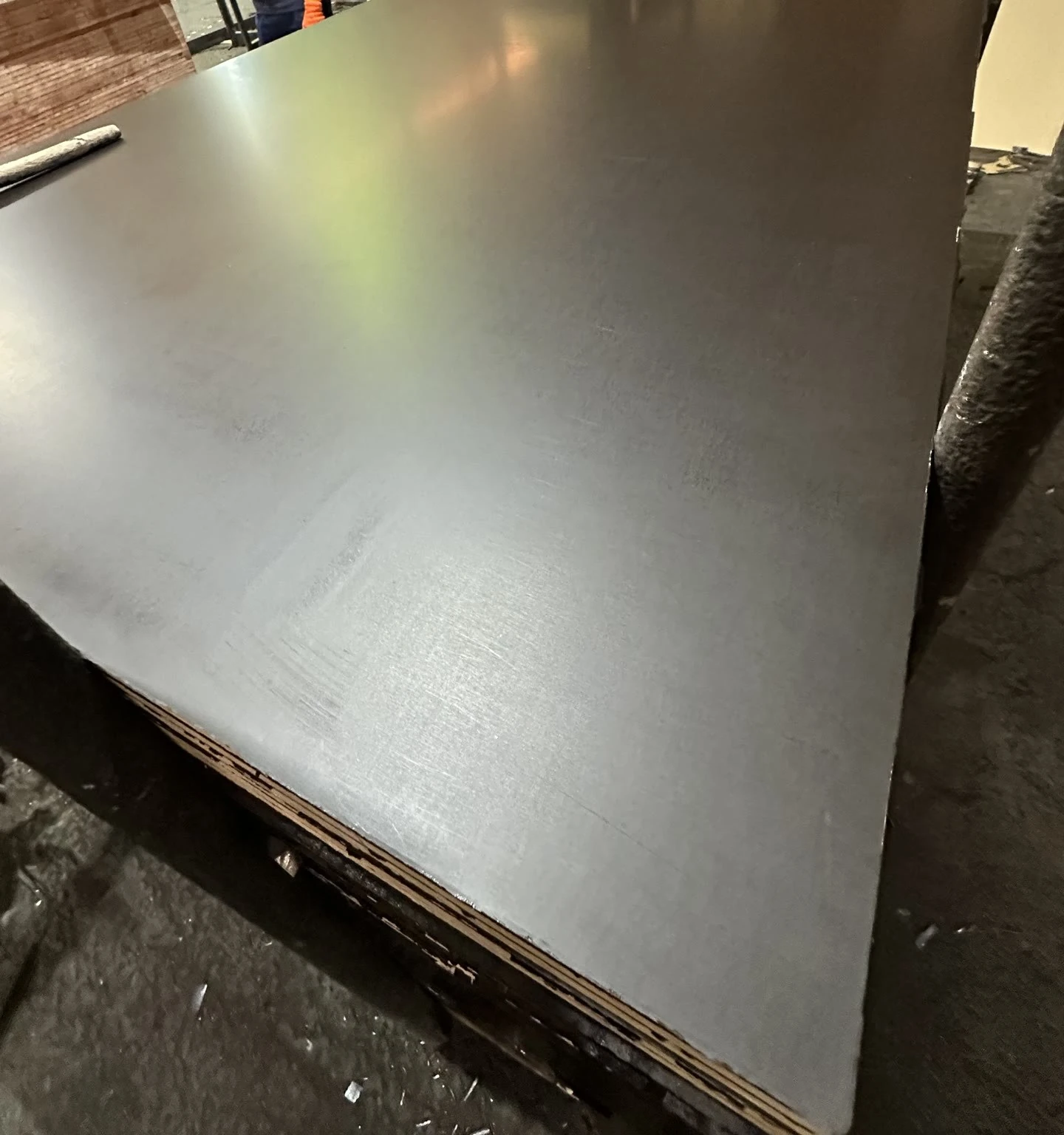
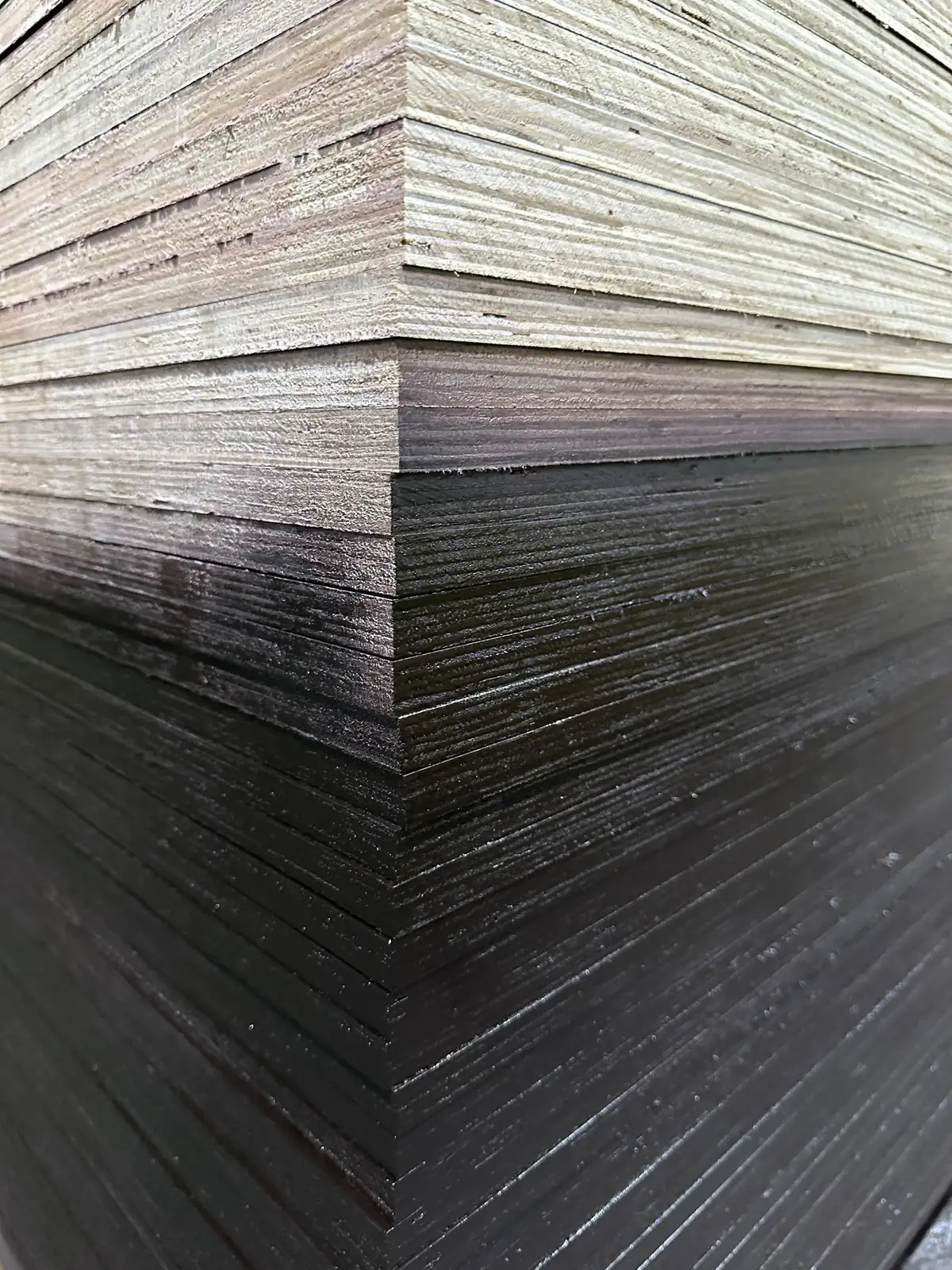
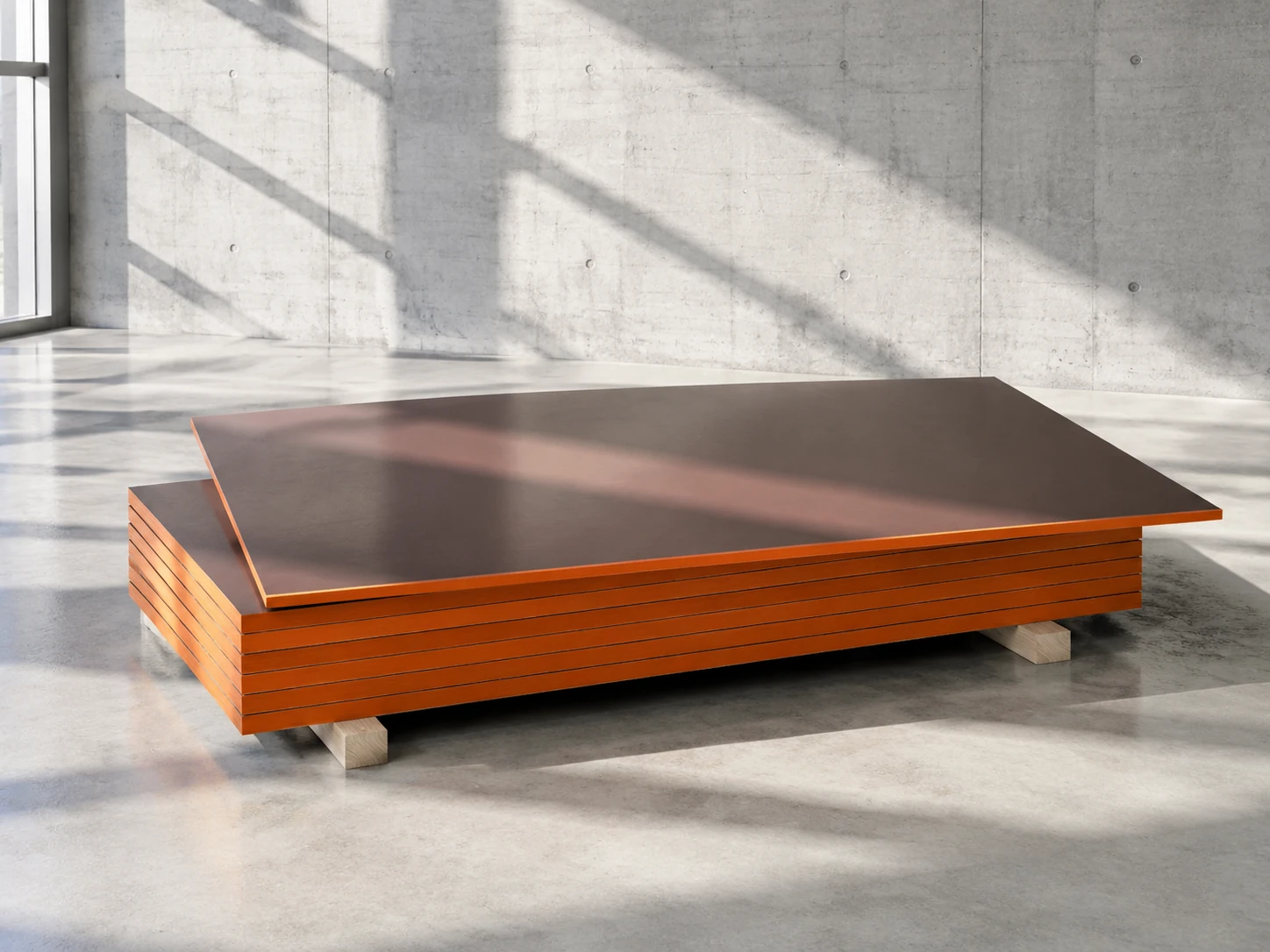
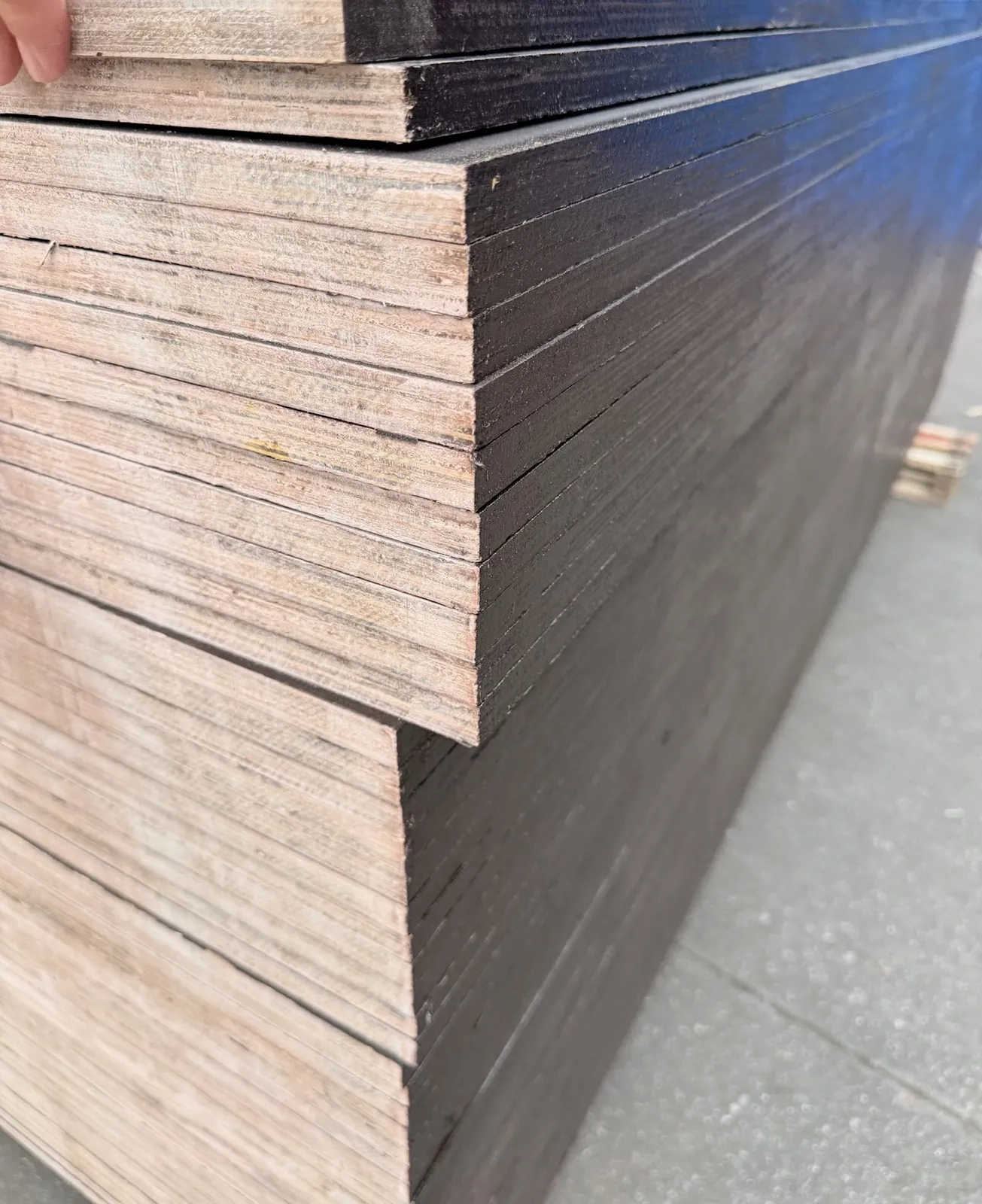
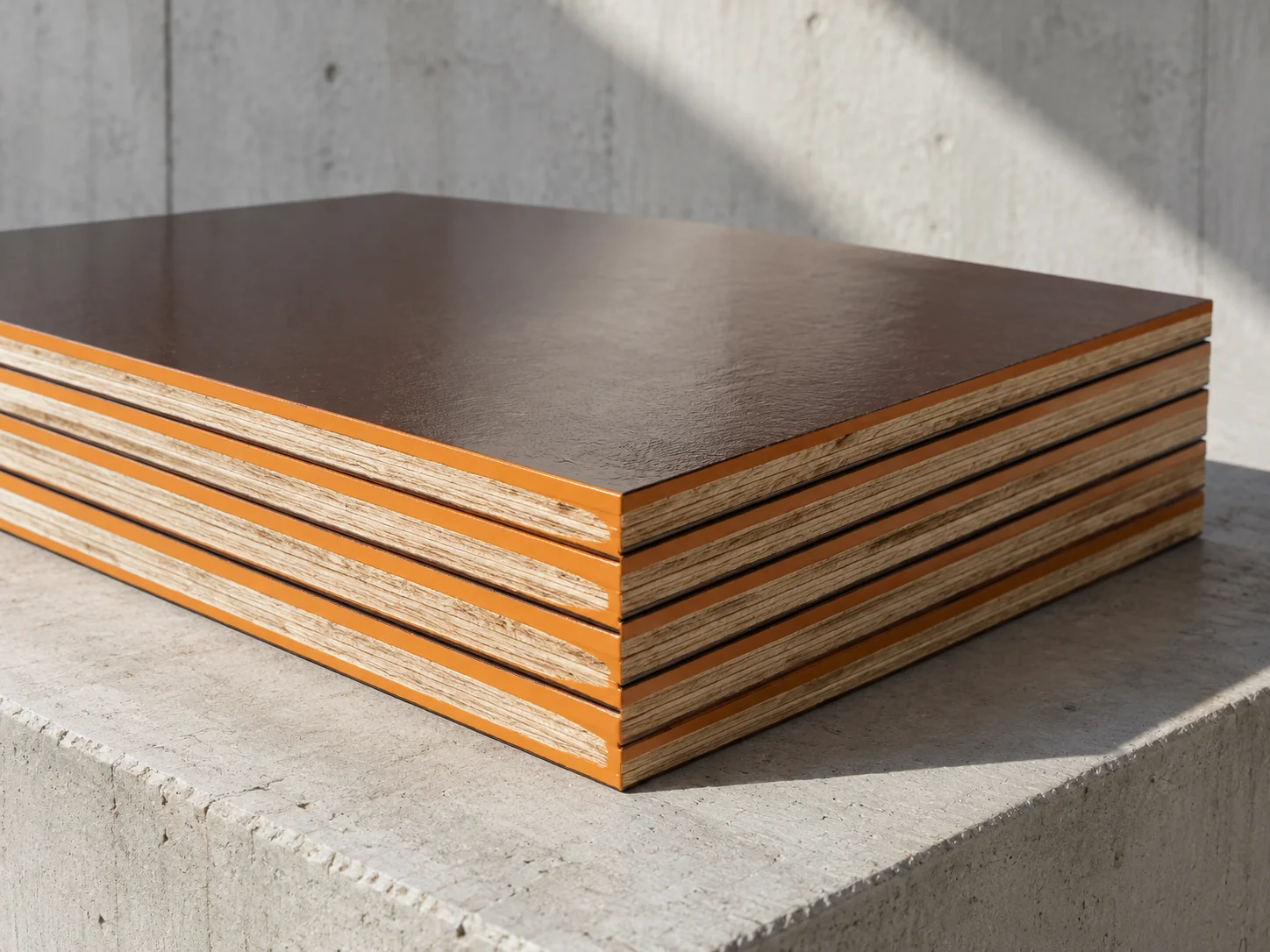
These are our own sheets, photographed at the press line and in the finished-goods area. The film face is a smooth satin dark brown; the stacked edges show the hardwood veneers that carry it.
Photos are of production stock, not of a hand-picked sample. A buyer who orders the same build receives sheets from the same line, with the same film and the same edge paint.
Specification
The table is the build we press as phenolic film-faced plywood. Each order gets a technical sheet with these lines filled in for your thickness, size, film and core, and that sheet is what our QC checks the run against.
Phenolic glue is the only difference that matters between this panel and our MUF panel. Film, core species and sizes are shared, so a buyer can move a programme from MUF to phenolic without changing the formwork design.
| Item | Phenolic build | Options by order |
|---|---|---|
| Glue | Phenol-formaldehyde (WBP), boil-proof | Fixed for this product |
| Face and back | Smooth phenolic film, dark brown | Black film; film brand on the technical sheet |
| Film weight | 130–135 g/m² | 165, 185 or 200 g/m² and above |
| Core | Acacia hardwood veneers, crosswise | Eucalyptus hardwood veneers |
| Thickness | 12, 15, 18 and 21 mm | Any thickness from 9 mm to 40 mm |
| Sheet size | 1220 × 2440 mm | 1250 × 2500 mm, or cut to your list |
| Thickness tolerance | ±0.5 mm | Agreed on the technical sheet |
| Length and width tolerance | ±2 mm | Agreed on the technical sheet |
| Bond class | EN 314-2 Class 3 (SGS, 21 mm specimen) | Bond test per lot on request |
| Formaldehyde | E1 pass, EN 717-1 chamber (21 mm specimen) | Test to your method through SGS |
| Edges | Water-resistant paint, all four edges | Edge colour to order |
| Reuse | Up to about 25 pours with handling | Depends on site practice |
Film grade
On a phenolic panel the glue holds the veneers together through many wet cycles, so the face usually wears out before the bond. That is why phenolic buyers order heavier film than MUF buyers: the film grade decides how much scraping and abrasion the face survives.
We press phenolic panels with film from about 130–135 g/m² up to 200 g/m² and above. The colour is dark brown as standard or black to order; colour does not change strength. Film brand, weight and colour are written on the technical sheet so a repeat order carries the same face.
| Film grade | Face behaviour | Buyers who choose it |
|---|---|---|
| 130–135 g/m² | Smooth face for regular wall and slab pours | Contractors moving up from MUF panels |
| 165 g/m² | Thicker film, more abrasion before wood shows | Repeat wall forms on housing blocks |
| 185 g/m² | Holds an even face over long cycles | Rental fleets and system formwork users |
| 200 g/m² and above | Heaviest face for the longest reuse | Precast yards and civil works |
Core and build
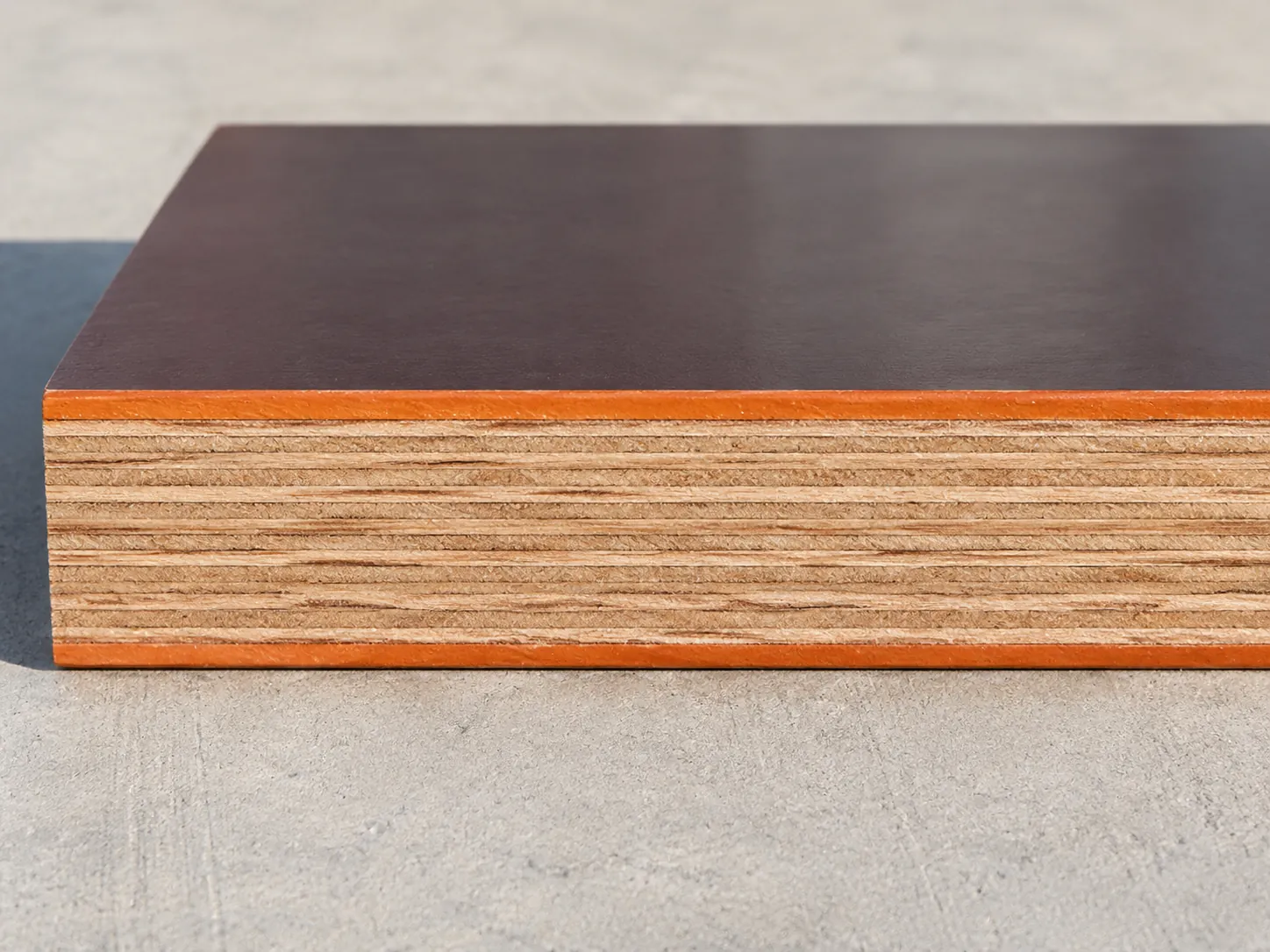
A phenolic panel is only as good as its core. Our cores are Acacia or Eucalyptus hardwood veneers, laid with the grain crosswise in alternate layers, so the sheet stays flat and stiff in both directions. An 18 mm panel is usually built from 11 to 13 veneers and a 21 mm panel from 13 to 15; the count for your order is on the technical sheet.
Every glue line in the panel is phenolic, not only the film. The core is pressed hot, sized and sanded, and then the film is pressed on both faces. A core with gaps or overlapping veneers shows through the film after a few pours, so sample sheets from each run are cut open and the layers checked before packing.
Resin-impregnated paper, 130–135 g/m² to 200 g/m² and above, on the face.
Smooth hardwood veneer under the film, sanded so the film lies flat.
Acacia or Eucalyptus, laid crosswise, full length with no gaps.
Boil-proof bond between every veneer, pressed hot.
Same film on the back; water-resistant paint on all four edges.
Glue and tests
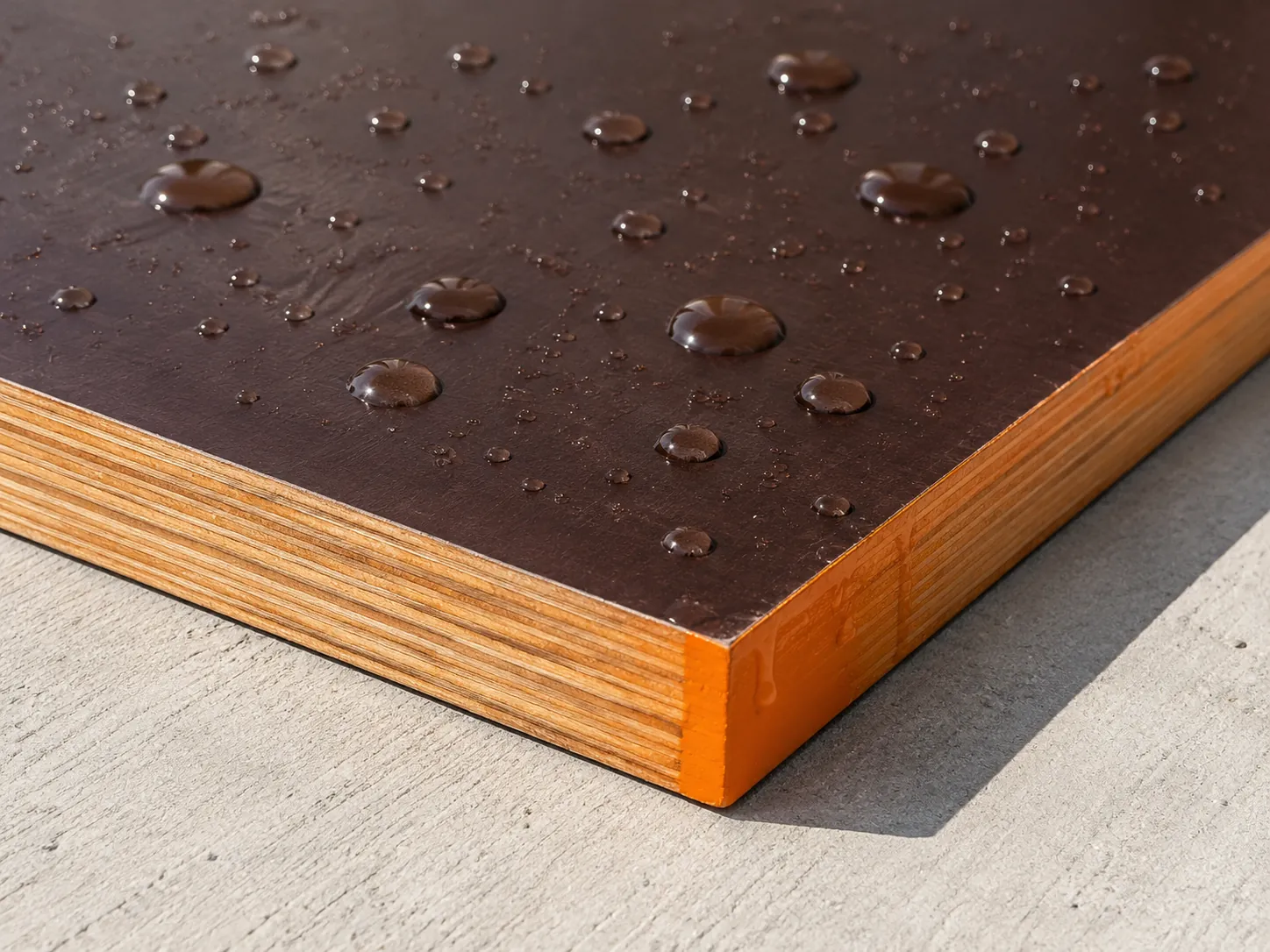
Phenolic glue does not soften in water, which is what WBP means: weather and boil proof. The film and the painted edges keep water out of the face and the core; the phenolic glue keeps the veneers together if water does reach them. The weak point is a cut edge left bare, so every cut is sealed.
SGS Vietnam tested one submitted 21 mm dark-brown specimen of our phenolic build with an Acacia core, report issued in December 2025. It passed bonding Class 3 under EN 314-1 and EN 314-2 after the 24 h water soak, the boil-dry-boil cycle and 72 h of boiling. The density measured 642 kg/m³ under EN 323.
In the EN 717-1 chamber, formaldehyde from the same specimen was not detected at the 0.04 mg/m³ reporting limit, an E1 pass against the 0.124 mg/m³ limit. Not detected is not zero and is not an E0 claim. These are specimen results: they show what the build can do, and a lot test for your order can be booked through SGS.
Weather and boil proof: an old British name for phenolic bonds. Today the bond is specified as EN 314-2 Class 3, the exterior class our specimen passed.
No. Marine plywood is a separate standard for boat building. Our panel is construction plywood with an exterior phenolic bond and film faces.
Phenolic resin cures with heat; our phenolic bonds are pressed at about 130–145 °C so every glue line sets fully before the film goes on.
Pours
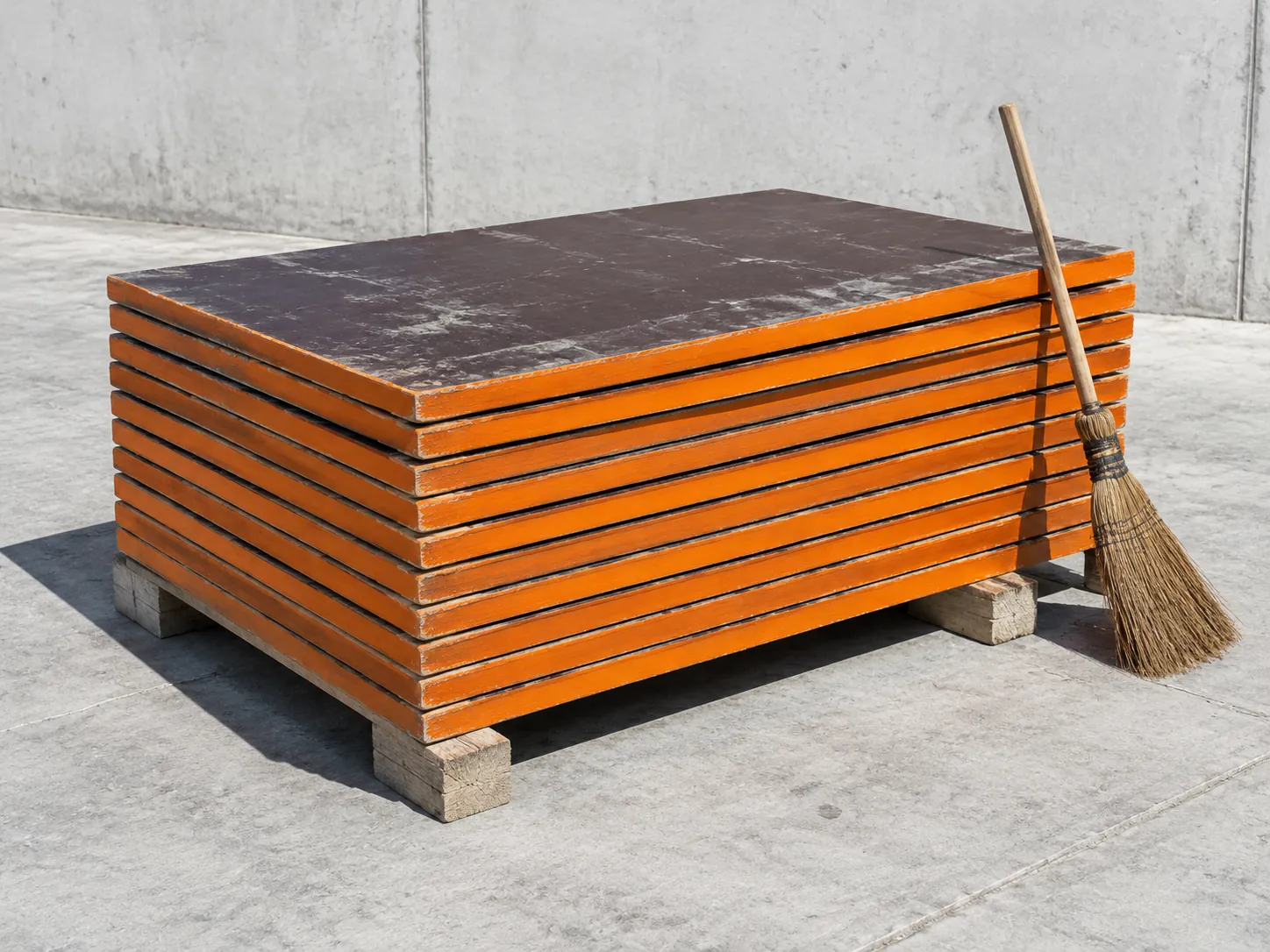
Reuse is not printed on a sheet; it is what a build gives under a site practice. With proper handling, release agent on every pour and sealed edges, including cut edges, our phenolic panel reaches up to about 25 pours. The same panel abused on site can be scrapped after a handful.
The table shows how site habits move the count. It is the reason we ask about the job, not only the thickness, before we quote a phenolic build.
| Site practice | Effect on the face and core | What to do |
|---|---|---|
| Release agent before every pour | Concrete does not bond to the film | Thin even coat, first pour included |
| Cut edges sealed the same day | No water path into the core | Paint every cut and drilled hole |
| Stripping with wedges, not steel bars | Film stays unbroken | Wooden or plastic wedges |
| Cleaning while the concrete is green | Film is not torn off with hard concrete | Soft scraper and water |
| Storage flat, covered, off the ground | Panels stay flat and dry | Level bearers, straps on until use |
Sizes
Phenolic panels are pressed in 1220 × 2440 mm for most markets and 1250 × 2500 mm for European deck systems, from 9 mm to 40 mm thick. We cut custom sizes to your list at the mill and paint each cut edge before the sheets are packed.
Thickness tolerance is ±0.5 mm and length and width tolerance ±2 mm, measured on every pack sample. Panels for CE-marked structural use must fall inside 3.6–30 mm, the scope of our factory production control certificate.
| Thickness | Common phenolic use | Sheet sizes |
|---|---|---|
| 12 mm | Column boxes and beam sides with many repeats | 1220 × 2440 · 1250 × 2500 mm |
| 15 mm | Wall forms struck and reset on one building | 1220 × 2440 · 1250 × 2500 mm |
| 18 mm | Walls and slab decks; the usual phenolic order | 1220 × 2440 · 1250 × 2500 mm |
| 21 mm | Deck systems and heavy slabs | 1250 × 2500 mm mostly |
| 25–40 mm | Special forms and heavy-duty liners | To order |
Applications
Phenolic film-faced plywood earns its price where the same form is used many times. These are the jobs where buyers choose it over a melamine panel.
Walls and lift cores on towers, where one set of forms is struck and reset floor after floor. The phenolic bond holds through the wet cycles; the film grade decides how long the face stays smooth.
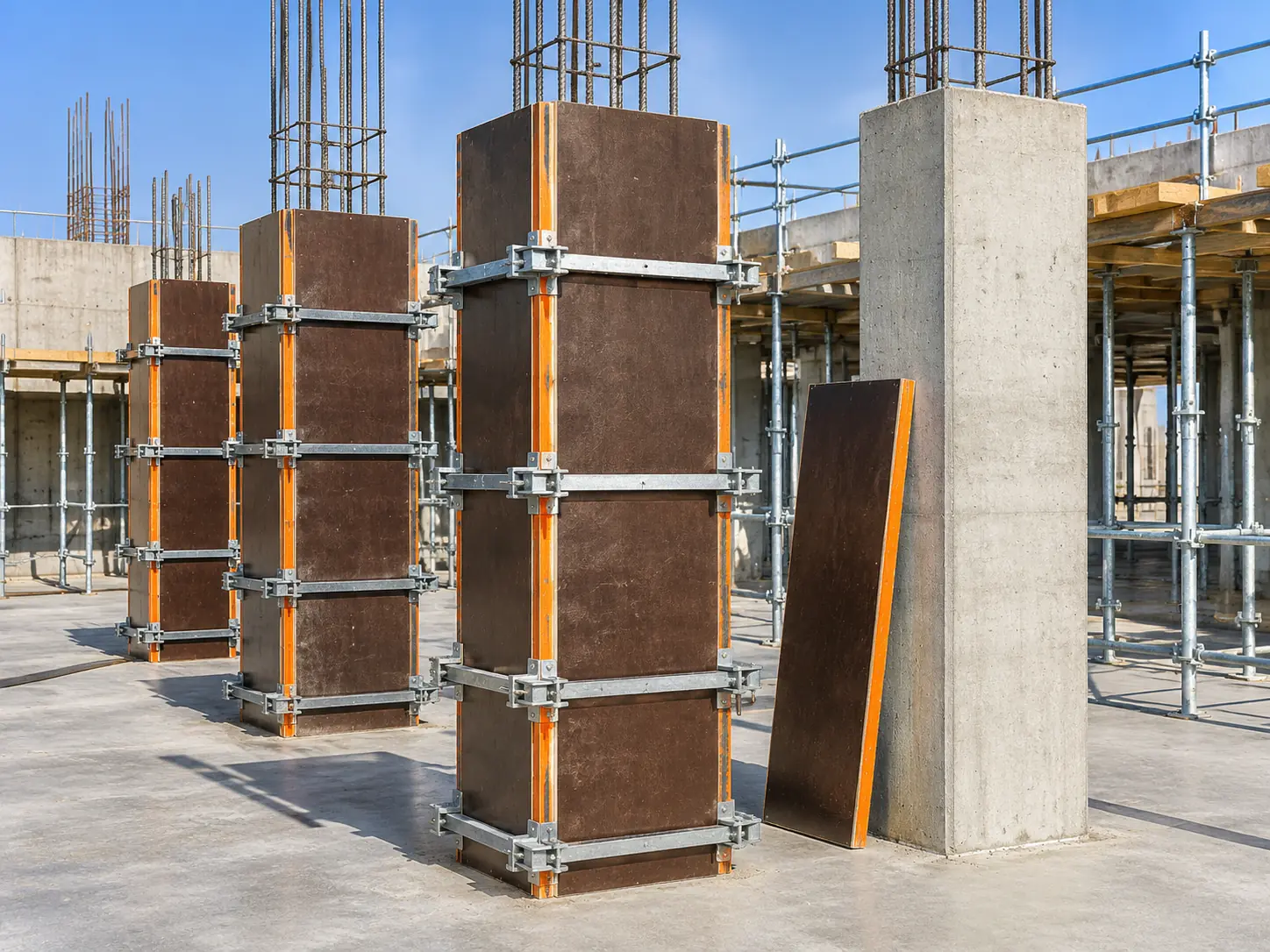
12 mm and 15 mm phenolic sheets cut to column boxes and beam sides. Small pieces have a lot of cut edge per square metre, so each cut is painted before the first pour.
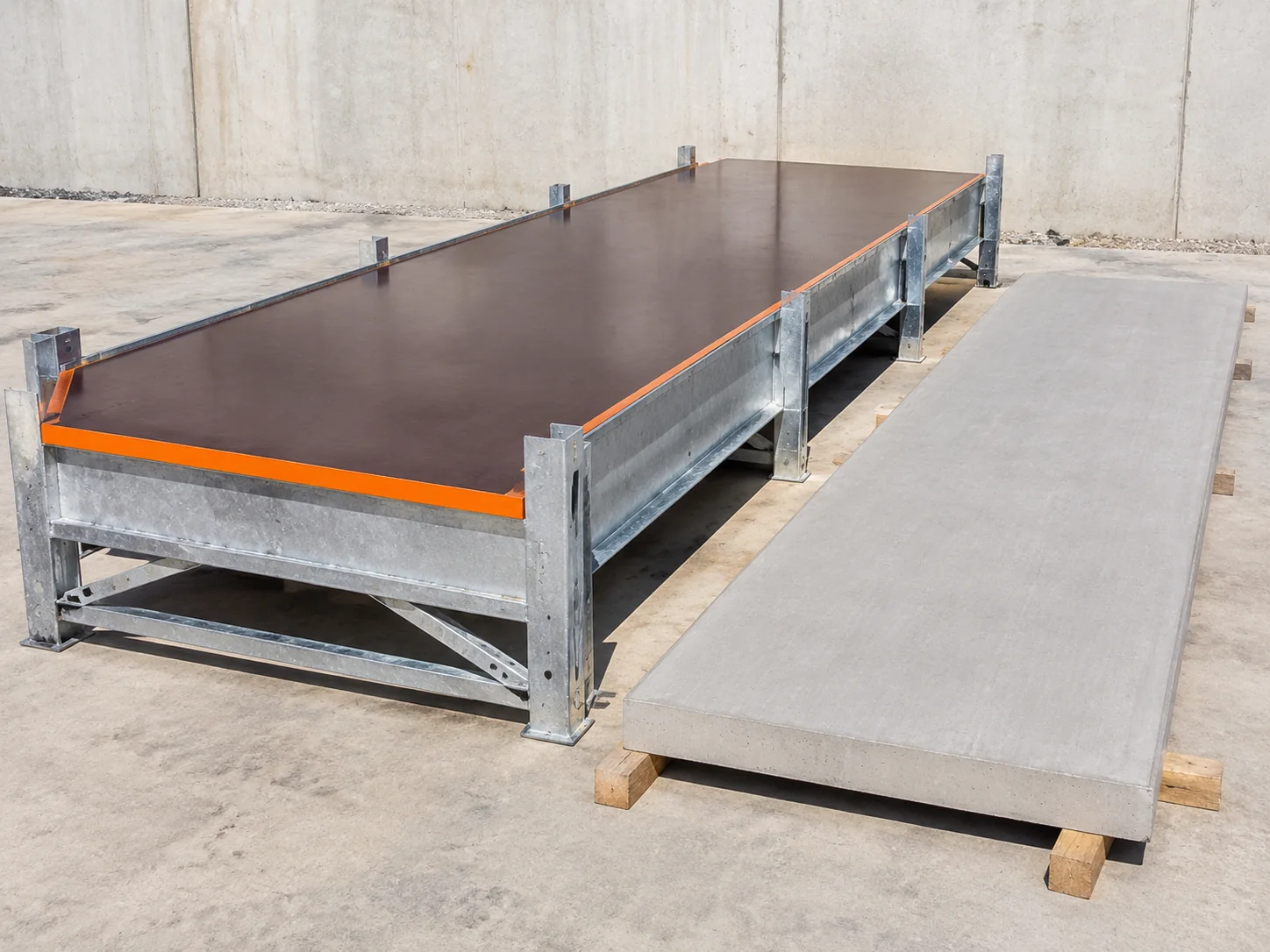
Mould beds and side forms that are cast every day. Heavier film of 185 g/m² or 200 g/m² and above suits the daily cleaning cycle.
System formwork, bridges and tunnels, where panels go from site to site. Phenolic panels keep their bond through storage outdoors between jobs.
Compare
Buyers usually weigh three panels: our phenolic build, our MUF build, and plywood without film. The film and the glue together make the difference on a concrete job.
Phenolic costs more per sheet than MUF. When a programme needs more than about 15 pours, the phenolic sheet usually costs less per pour; under that, MUF is the economical choice.
| Item | Phenolic film-faced (this page) | MUF film-faced | Plywood without film |
|---|---|---|---|
| Glue | Phenolic, boil-proof | Melamine (MUF) | Varies |
| Pours with handling, release agent and sealed edges | Up to about 25 | About 12–15 | One or a few, face marks the concrete |
| Usual film | 130–135 g/m² to 200 g/m²+ | 120–125 to 130–135 g/m² | None |
| Concrete finish | Smooth, even | Smooth, even | Shows wood grain |
| Best for | Repeat forms, rental, precast | Housing slabs, short programmes | Hidden or one-off forms |
Quality control
A phenolic run is checked against its technical sheet at the press line. The bond check is the one that matters most for this product, so sample pieces are boiled before the run is released.
Your inspector or a third-party company is welcome before loading and works from the same sheet and tolerances.
Pieces cut from the run are boiled; any open glue line stops the run.
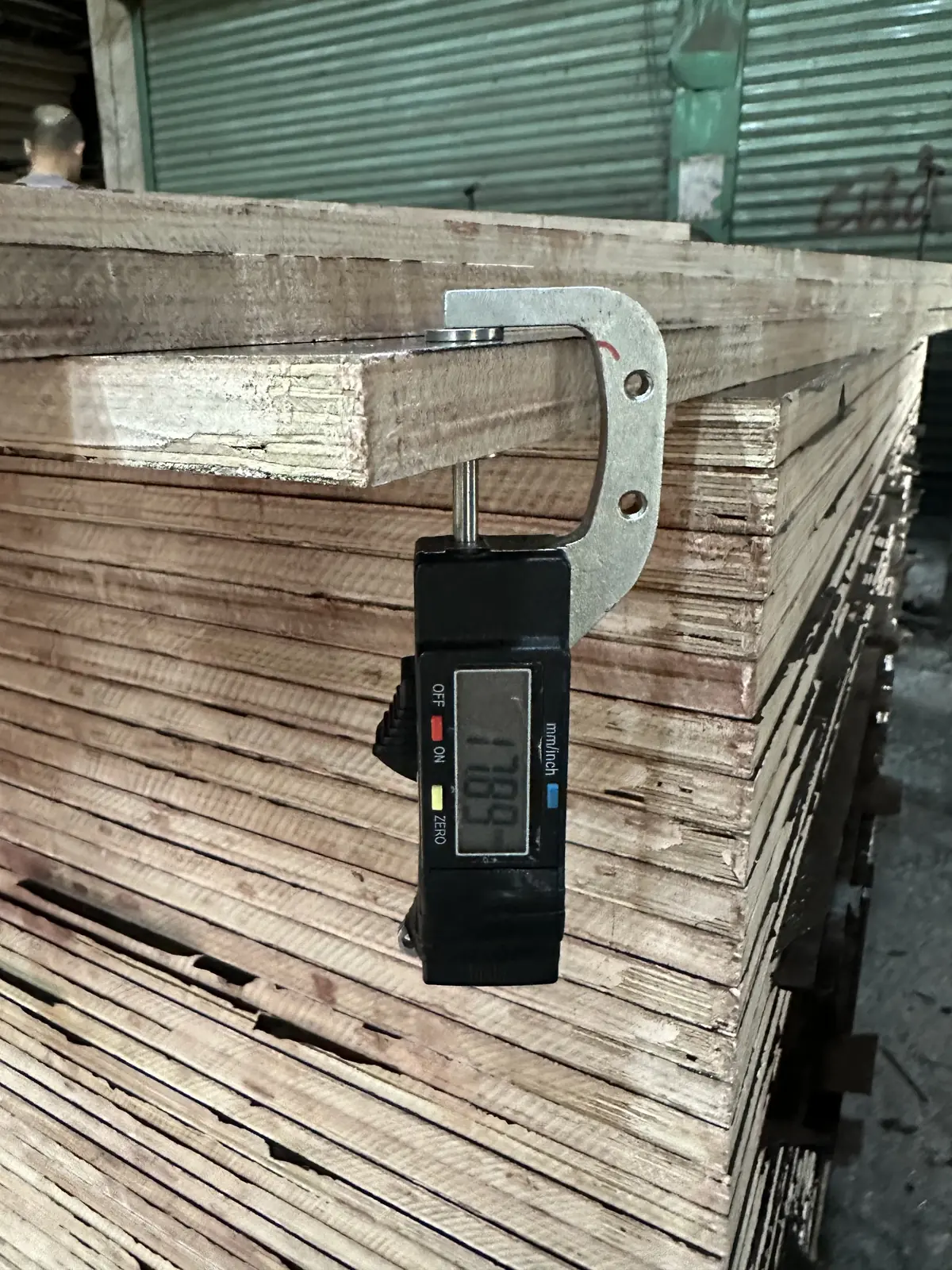
Every pack sample within ±0.5 mm of the ordered thickness.
Length and width within ±2 mm; corners checked square.
No bubbles, dry patches or wood showing through the film.
All four edges painted with no bare veneer left on any side.
Sheets per pack and buyer marks match the packing list.
Caliper check
Certificates
Scans are shown with legal entity, tax ID, address and dates blurred. Full copies go out with the quotation, and the order's sales documents state which panels each one covers.
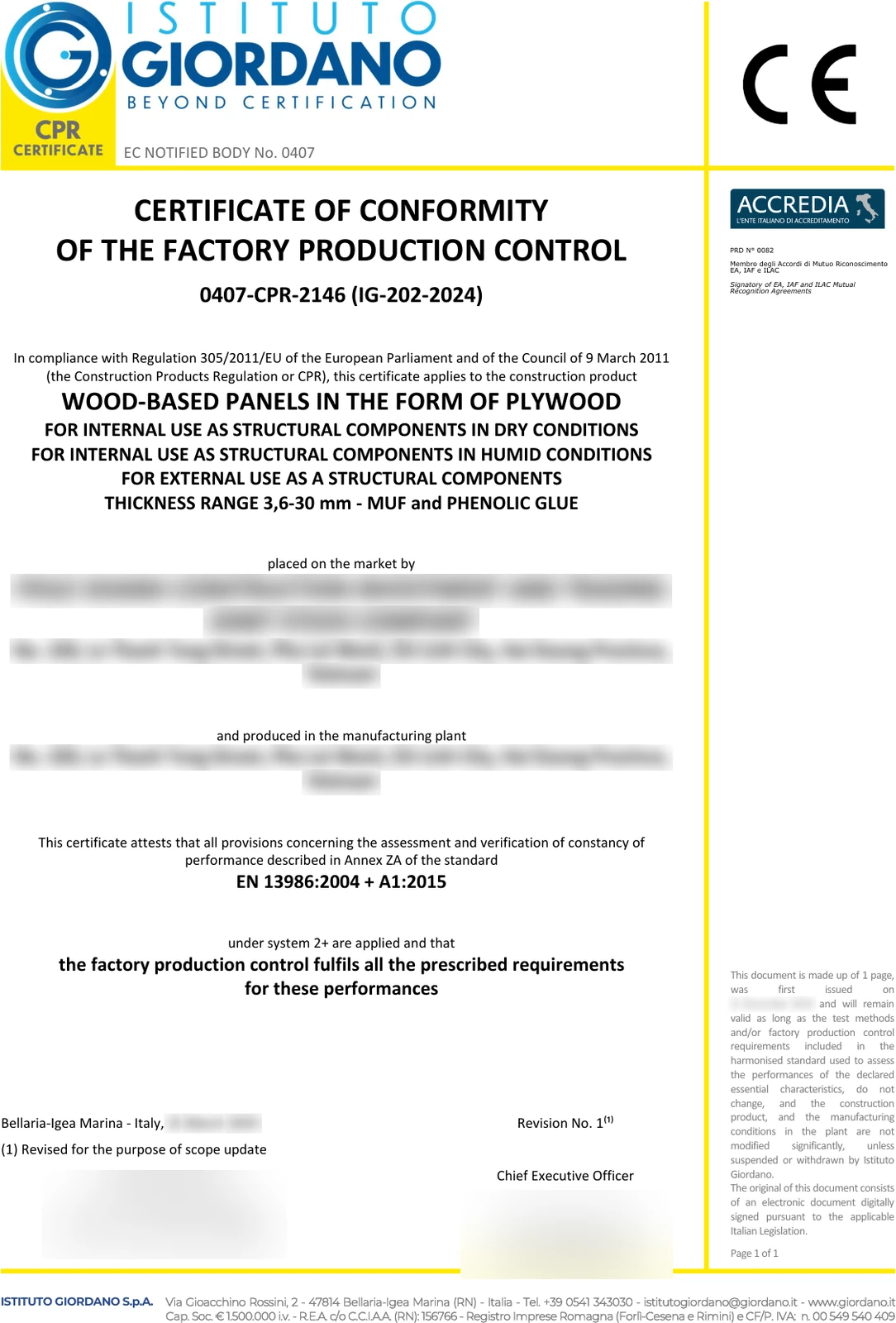
0407-CPR-2146
EN 13986, AVCP System 2+, notified body 0407 (certificate IG-202-2024): structural plywood 3.6–30 mm with MUF or phenolic glue, dry, humid and external use.
CE FPC certificate scan, company details and dates blurred
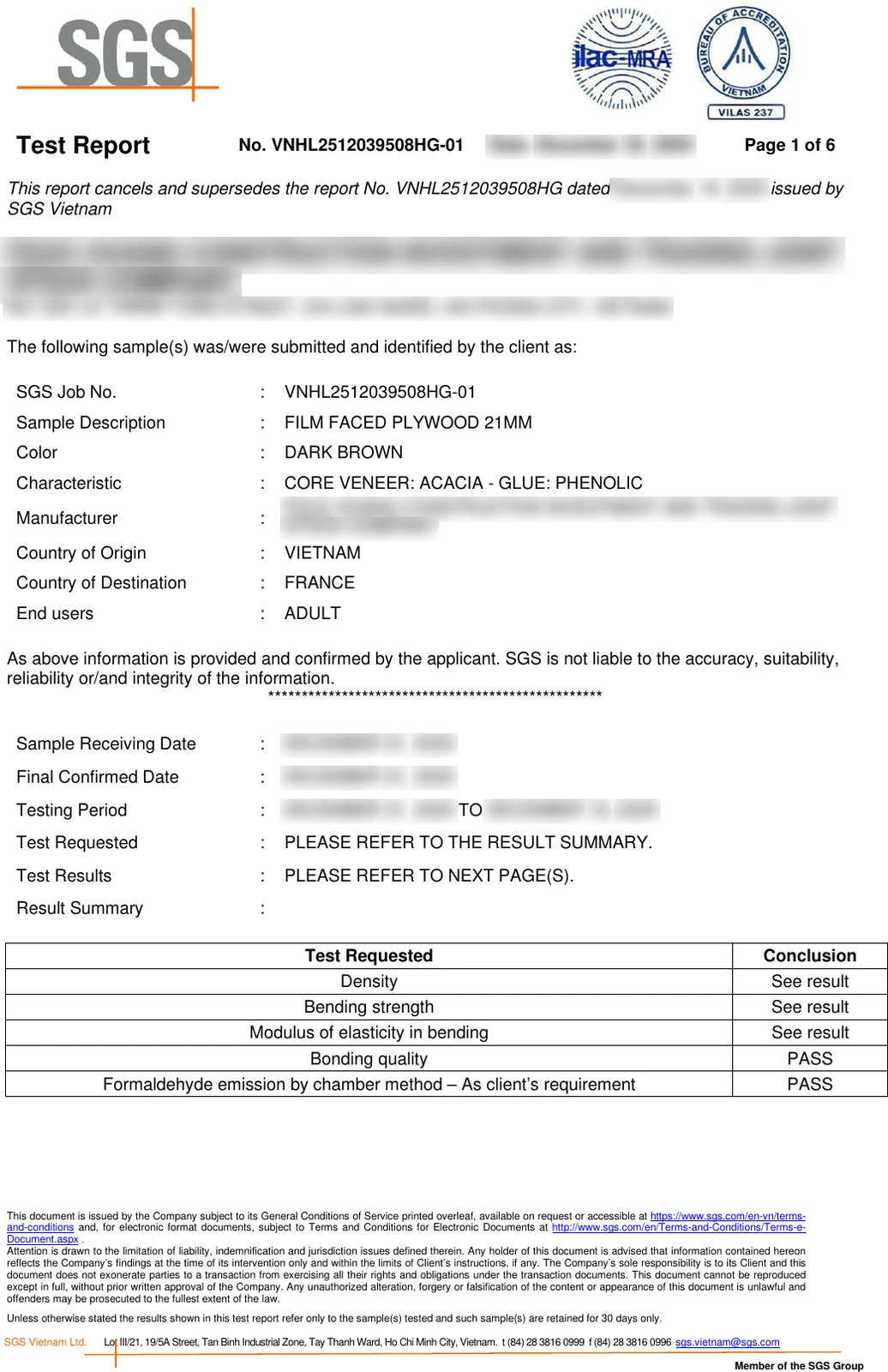
EN 314 Class 3 · EN 717-1 E1
21 mm dark-brown phenolic specimen, Acacia core: Class 3 bond after 72 h boiling, 642 kg/m³, formaldehyde not detected at 0.04 mg/m³.
SGS report page, company details and dates blurred
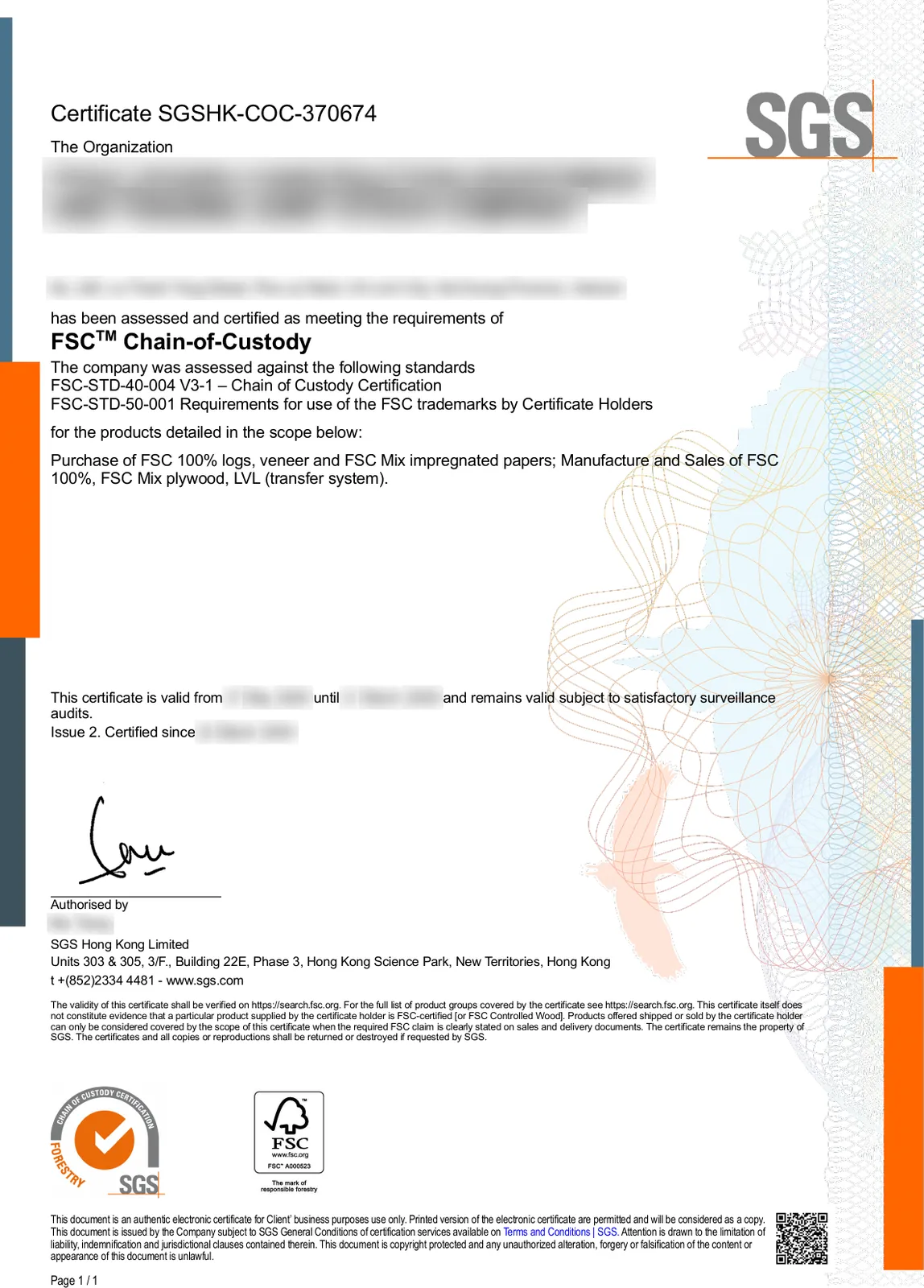
SGSHK-COC-370674
SGS Hong Kong, FSC-STD-40-004 V3-1 transfer system: FSC 100% and FSC Mix plywood; the claim is printed on the invoice.
FSC certificate scan, company details and dates blurred
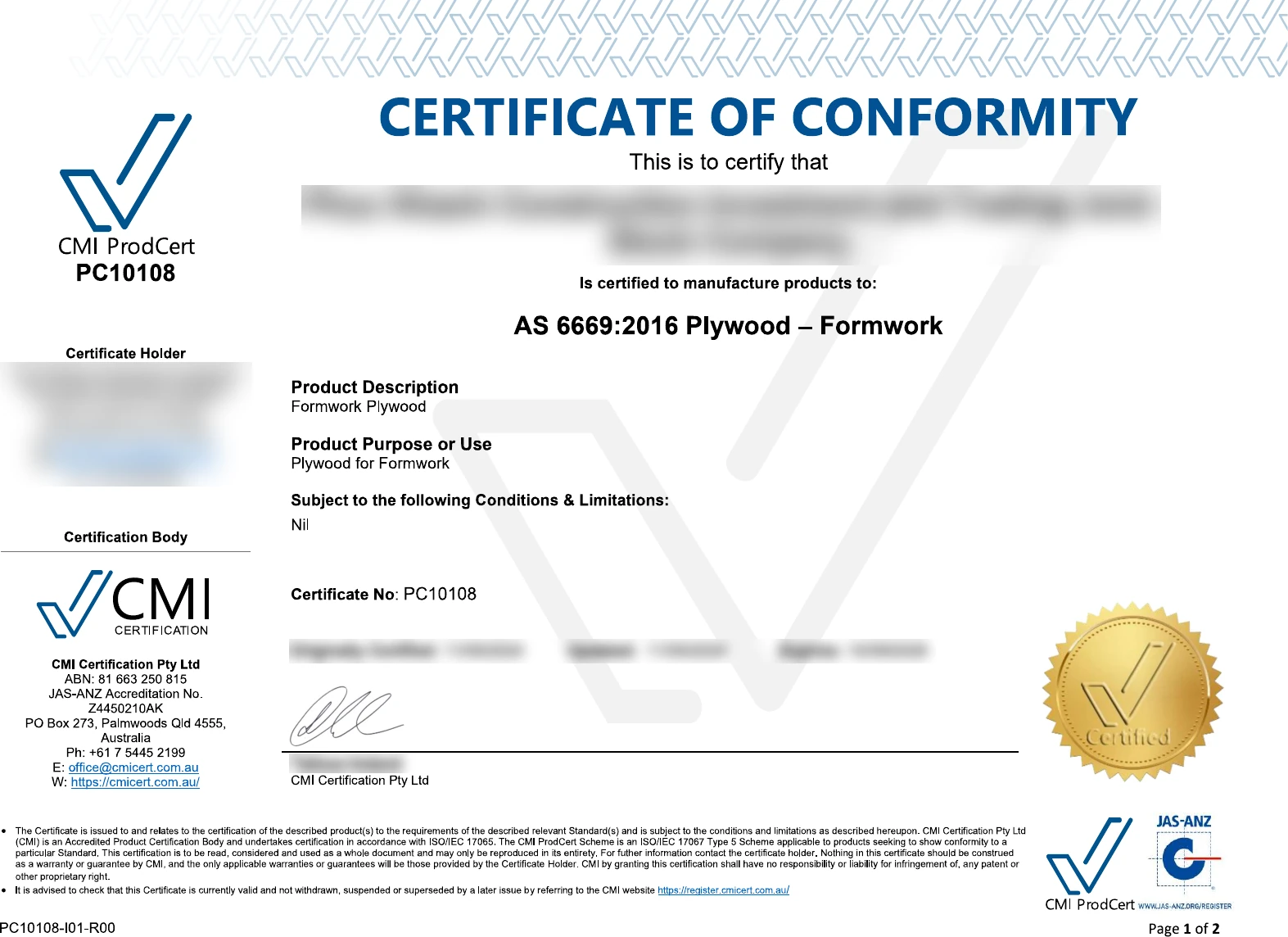
CMI Certification, ISO/IEC 17065
Formwork plywood certified to AS 6669:2016 by CMI Certification, a JAS-ANZ-accredited body.
AS 6669 certificate scan, company details and dates blurred
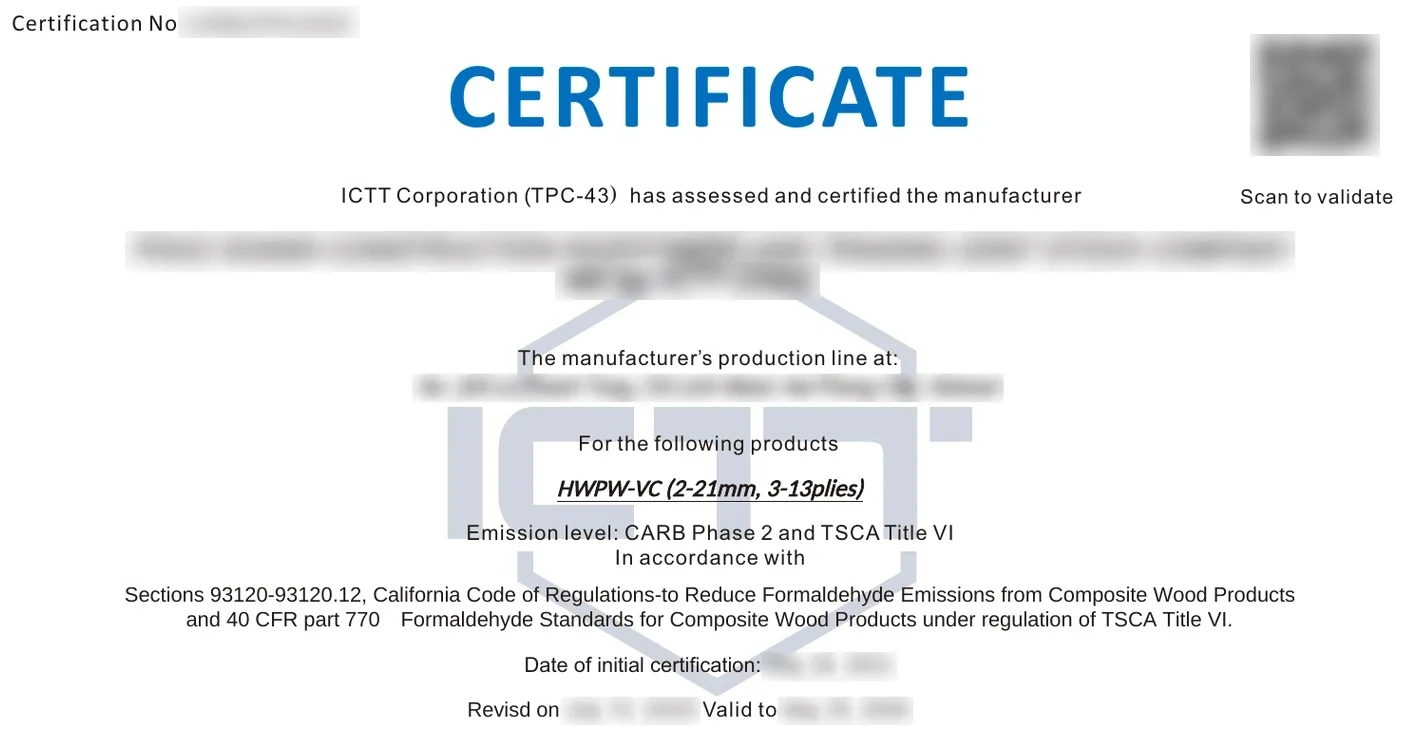
Hardwood plywood, veneer core, 2–21 mm
CARB Phase 2 and TSCA Title VI documentation for applicable orders; the copy on file covers 2–21 mm, 3–13 plies.
CARB / TSCA certificate scan, company details and dates blurred
Packing
Phenolic panels ship in strapped packs on pallet feet, about 1,000 mm high for 1220 × 2440 mm sheets. A 40HC takes 16 packs of Acacia-core panels or 15 of Eucalyptus-core panels, which reach the payload before the volume is full.
The counts are planning figures from our loading model; the final count follows the booking, the route and the weighed sheets.
| Core | Thickness | Sheets per pack | Sheets per 40HC | m³ per 40HC | Weight per sheet |
|---|---|---|---|---|---|
| Acacia | 15 mm | 66 | 1,056 | 47.2 m³ | 25.9 kg |
| Acacia | 18 mm | 55 | 880 | 47.2 m³ | 31.1 kg |
| Acacia | 21 mm | 47 | 752 | 47.0 m³ | 36.3 kg |
| Eucalyptus | 15 mm | 64 | 960 | 42.9 m³ | 29.0 kg |
| Eucalyptus | 18 mm | 53 | 795 | 42.6 m³ | 34.8 kg |
| Eucalyptus | 21 mm | 45 | 675 | 42.2 m³ | 40.6 kg |
Planning densities 580 kg/m³ Acacia and 650 kg/m³ Eucalyptus; planning payload 28,000 kg of panels.
Buy direct from the mill
Phenolic panels are sold by the container straight from our mills, which ship up to 150 containers a month. One 40HC is the minimum; a container can carry one or two builds, or three to six by agreement, so phenolic and MUF panels can travel together.
Production takes 15–45 days after the 30% deposit. The 70% balance is paid against the scanned bill of lading by T/T, or by irrevocable L/C at sight. Prices are quoted FOB Hai Phong, CFR or CIF.
How to order
Wall, column, slab or precast, and how many pours you plan per panel.
Film grade, core, thickness, size and tolerances, with an FOB, CFR or CIF price.
Free samples of the same build; boil a piece or send it to your lab.
Production starts on the 30% deposit and takes 15–45 days.
Pack and loading photos, your inspector welcome; balance against the B/L scan.
Buyer questions
Plywood whose veneers are bonded with phenol-formaldehyde resin, a boil-proof exterior glue. For formwork it carries a phenolic film on both faces and painted edges. Ours has an Acacia or Eucalyptus core and gives up to about 25 pours with proper handling, release agent and sealed edges.
The phenolic bond does not fail in water: an SGS-tested 21 mm specimen of our build passed EN 314-2 Class 3 after 72 h of boiling. The film and painted edges keep water out; a cut edge left unsealed still lets water into the core.
Weather and boil proof, an older British term for phenolic bonds. Buyers now specify the bond as EN 314-2 Class 3, the exterior class.
Up to about 25 with our build, given proper handling, release agent on every pour and sealed edges, including cut edges. Rough stripping, wet storage or unsealed cuts reduce that on any panel.
On one submitted 21 mm dark-brown specimen with an Acacia core: density 642 kg/m³, bonding Class 3 pass under EN 314, and formaldehyde not detected at the 0.04 mg/m³ reporting limit in the EN 717-1 chamber, an E1 pass.
No. Marine plywood is built to a boat-building standard. Phenolic film-faced plywood is construction plywood with an exterior bond, made for concrete forms.
About 880 sheets of 1220 × 2440 mm with an Acacia core, or 795 with a Eucalyptus core, as planning figures before booking and weighing.
Not always. Film-faced plywood can be bonded with melamine (MUF) or phenolic glue. Phenolic film-faced plywood has phenolic glue in every glue line as well as a phenolic film.
Concrete formwork that is reused many times: repeat wall forms, columns and beams, slab decks on system formwork, precast moulds, bridges and tunnels.
About 130–135 g/m² for regular wall and slab work; 165 or 185 g/m² for repeat forms and rental fleets; 200 g/m² and above for precast yards and civil works.
Yes. 15 mm is a standard thickness on 1220 × 2440 mm and 1250 × 2500 mm sheets, with the same phenolic glue and film options as 18 mm.
Phenolic panels from 3.6 mm to 30 mm fall inside our CE factory production control certificate 0407-CPR-2146 under EN 13986. CE documents are issued when the panel is ordered for structural use.
Per sheet or per m³, FOB Hai Phong, CFR or CIF, from your technical sheet: thickness, size, film grade, core and quantity. Send the specification and we reply with the price.
Quotation
Send the job, pours per panel, thickness, size, film grade and colour, core, quantity and port of discharge. We reply with a technical sheet and an FOB Hai Phong, CFR or CIF price.