
To import plywood from Vietnam to the USA, check first whether the panel falls inside the 2026 anti-dumping and countervailing duty case, then settle the TSCA Title VI and Lacey Act papers before loading. PK Ply supplies the build sheet, species and formaldehyde documentation for applicable products. A scope question left open can cost the duty deposit at entry.
How do you import formwork plywood from Vietnam to the USA?
You import formwork plywood from Vietnam to the USA by settling three questions before the deposit. They are whether the panel is inside the 2026 duty case, which formaldehyde documentation applies, and what the Lacey Act declaration will say. Then the container ships from Hai Phong, and your broker files the entry with those answers.
The US route differs from the European one in where the risk sits. In the EU, the new work is paperwork on deforestation. In the US, the first question is scope. Hardwood and decorative plywood from Vietnam is the subject of anti-dumping and countervailing duty determinations, and a panel inside the scope can carry a large cash deposit at entry. Formwork buyers have a specific line to read, because the scope excludes one kind of phenolic film-faced panel.
| Step | What happens | Who acts | When |
|---|---|---|---|
| 1. Build | Glue, film weight, edges, thickness in mm and inches | Buyer, with our technical sheet | Before the order |
| 2. Scope review | Build read against the AD/CVD scope and its exclusions | Importer and customs broker | Before the order |
| 3. Formaldehyde papers | TSCA Title VI / CARB Phase 2 documentation where it applies | Mill sends | Before the order is confirmed |
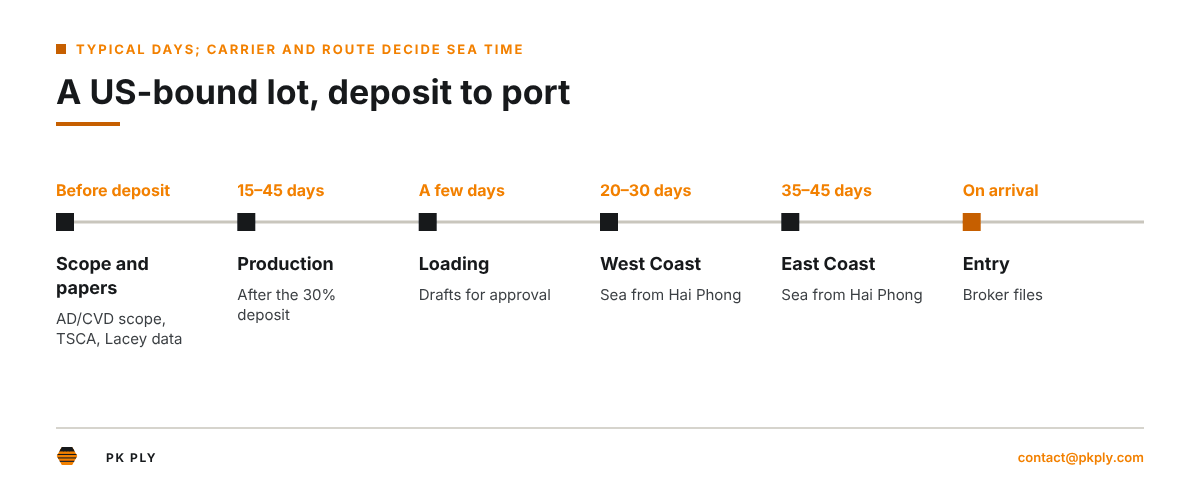
| 4. Deposit and production | 30% deposit, then 15–45 days of production | Buyer, then mill | Order |
| 5. Species and origin | Core and face species, country of harvest, for the Lacey declaration | Mill sends | Before shipment |
| 6. Loading and papers | Invoice, packing list, B/L, origin and phytosanitary papers | Mill, then buyer approves drafts | After loading |
| 7. Sea | Hai Phong to a US port | Carrier | 20–45 days by coast |
| 8. Entry | Tariff code, AD/CVD status, Lacey declaration, formaldehyde records | Importer and broker | On arrival |
This note follows a US-bound lot from our two mills in Chi Linh, Hai Phong. The general route for other markets is in our guide to importing construction plywood from Vietnam, and the European rules are in the EU import note.
Is phenolic film-faced formwork plywood from Vietnam inside the US AD/CVD scope?
Phenolic film-faced formwork plywood can be outside the US AD/CVD scope, because the scope excludes Phenolic Film Faced Plyform as it defines it. A panel that matches that definition line by line is excluded. One that misses a line is read under the general scope, which covers hardwood plywood regardless of surface coverings, including phenolic film.
The general scope is wide on purpose. It covers hardwood and decorative plywood regardless of whether the face and back veneers are surface coated or covered, and its list of coverings names phenolic film. So a film-faced panel is inside the scope unless an exclusion takes it out.
The scope excludes Phenolic Film Faced Plyform, defined as a panel with an Exterior or Exposure 1 bond classification as is defined by The Engineered Wood Association, having an opaque phenolic film layer permanently bonded on both the face and back veneers and an opaque, moisture resistant coating applied to the edges. The same definition also prints a minimum film weight, written in the notice as “90g/m3”.
How to read a formwork build against it:
| Line of the exclusion | What to check on the technical sheet |
|---|---|
| Bond classification, Exterior or Exposure 1, as defined by APA | The glue system and the bond evidence for the build |
| Opaque phenolic film, permanently bonded | Film type and colour |
| Film on both the face and the back veneers | Film on both faces, not one |
| Minimum film weight as printed in the notice | Film weight in g/m² per face; our orders start at 120–125 g/m² |
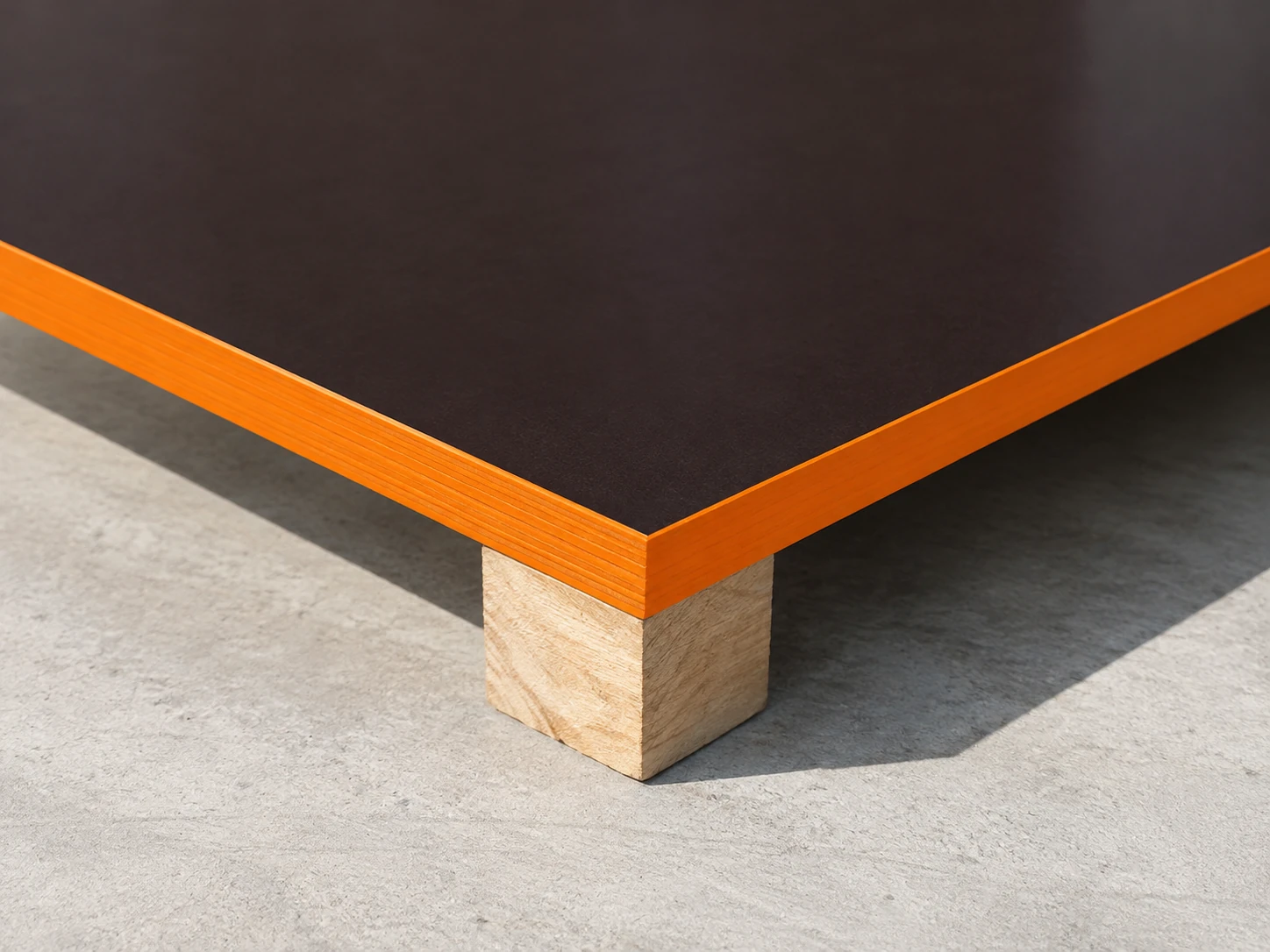
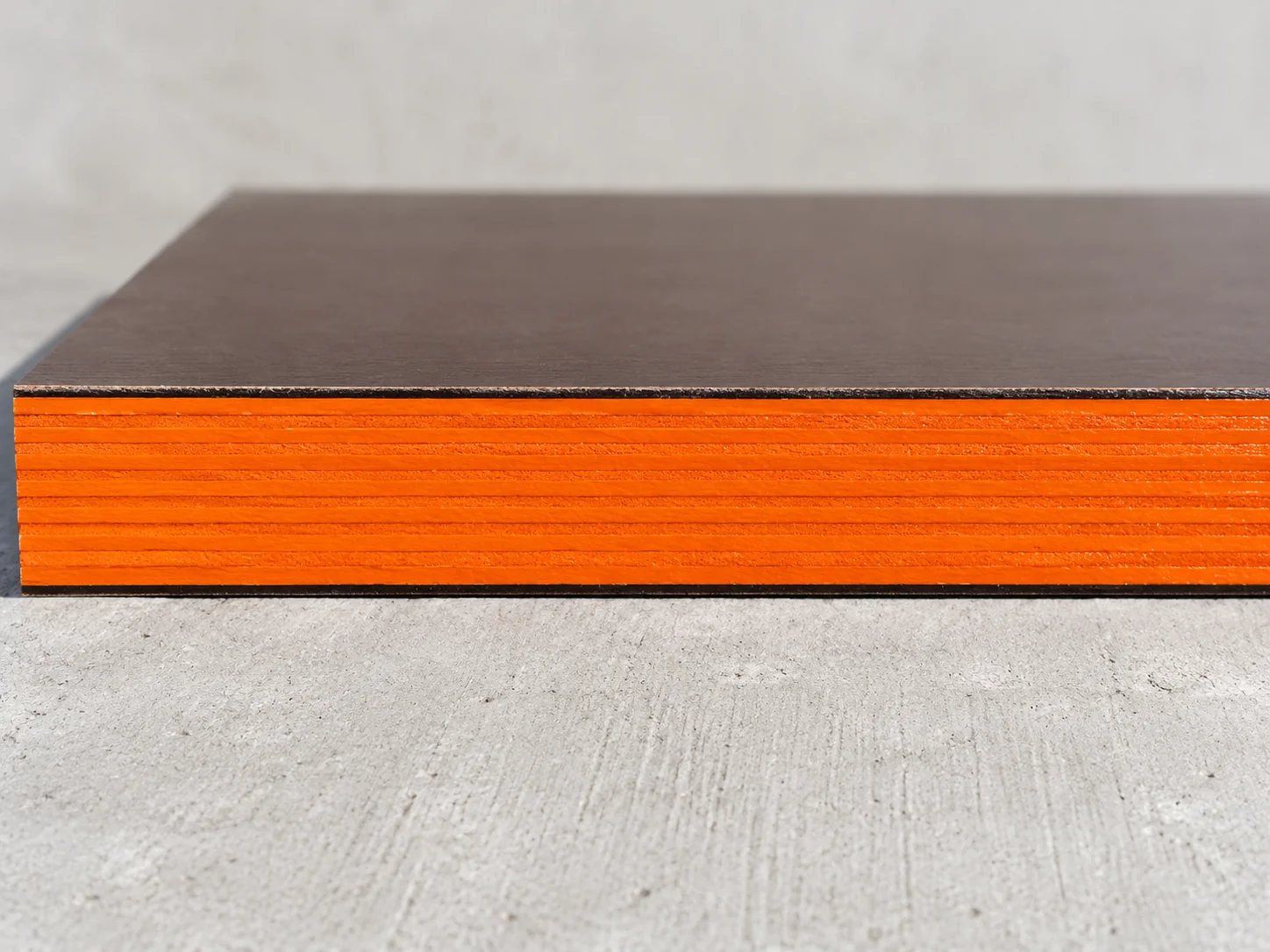
| Opaque, moisture-resistant coating on the edges | Edge sealing; our film-faced panels leave with water-resistant paint on all four edges |
Our bond evidence for the phenolic build is an SGS Vietnam report on one submitted 21 mm specimen, with EN 314 bonding Class 3 PASS. That is a European test class, and the exclusion names a US bond classification, so the comparison is for your broker to judge. A scope ruling is the importer’s to seek; we supply the build sheet and test evidence it needs.
What dumping and countervailing rates apply to Vietnamese hardwood plywood?
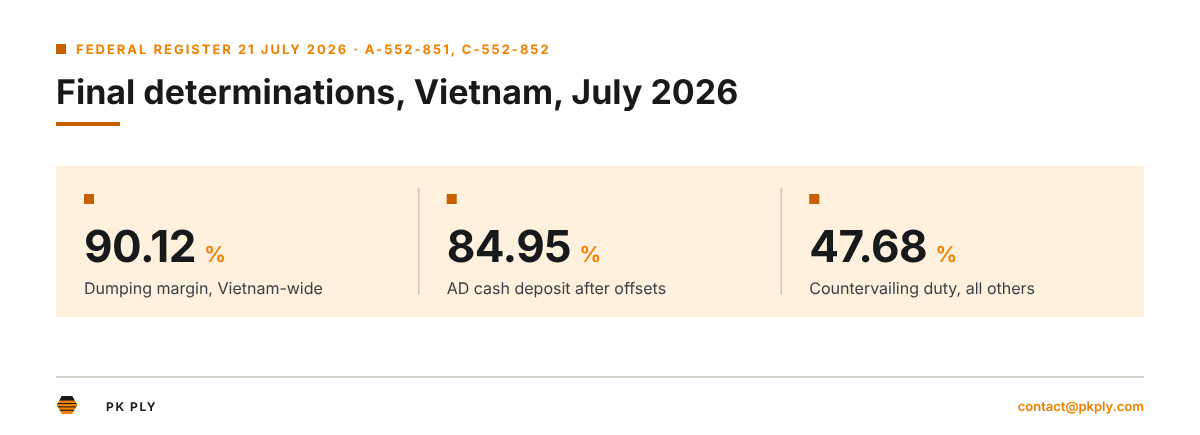
For hardwood and decorative plywood from Vietnam inside the scope, the July 2026 final determinations set a Vietnam-wide dumping margin of 90.12% with an 84.95% cash deposit rate, and an all-others countervailing subsidy rate of 47.68%. Company-specific rates are listed in the notices. Case numbers are A-552-851 for anti-dumping and C-552-852 for countervailing duty.
In the final anti-dumping determination, the Vietnam-Wide Entity has a weighted-average dumping margin of 90.12 percent and a cash deposit rate of 84.95 percent adjusted for subsidy offsets. The notice lists the rates of individual producers and exporters in the same table.
In the final countervailing duty determination, the All Others subsidy rate is 47.68 percent ad valorem. That rate applies to companies not individually investigated.
| Proceeding | Case number | Final determination | Rate in the notice |
|---|---|---|---|
| Anti-dumping, Vietnam | A-552-851 | Federal Register, 21 July 2026 | Vietnam-wide 90.12% margin; 84.95% cash deposit |
| Countervailing duty, Vietnam | C-552-852 | Federal Register, 21 July 2026 | All others 47.68% |
| Injury, ITC | 701-TA-764-766 and 731-TA-1747-1749 | Federal Register, 9 September 2026 | Affirmative |
The US International Trade Commission determined that an industry in the United States is materially injured by reason of imports of hardwood and decorative plywood from China, Indonesia, and Vietnam. Duty orders follow affirmative determinations; check the order notice and the current cash deposit instructions with your broker before each entry. We state these figures as published context, and the scope exclusions above decide whether a given formwork panel meets them at all.
Which other products does the US scope leave out?
Besides phenolic film-faced plyform, the US scope excludes certified structural plywood stamped to PS 1 or PS 2 with a core made entirely of the listed softwood species. It also excludes cork-faced panels, products already under the China plywood orders, multilayered wood flooring, non-flat plywood, solid bamboo and assembled or ready-to-assemble furniture and cabinets.
For a formwork buyer, the structural plywood exclusion is the one most often misread. It needs both parts: a panel certified, made and stamped to the US structural standard, and a core made entirely of listed species. The notice lists firs, spruces, pines, larch and hemlock. Acacia and Eucalyptus, the hardwood veneers in our cores, are not on that list, so for a hardwood-core formwork panel the film-faced exclusion is the one to read.
The ITC’s injury vote also names its own carve-out. Its notice covers hardwood and decorative plywood “excluding all softwood structural plywood”, and it terminated the investigations on softwood structural plywood on grounds of negligibility. That again concerns softwood structural panels, not hardwood-core formwork.
Does formwork plywood need TSCA Title VI documentation?
Formwork plywood needs TSCA Title VI documentation when it is a regulated composite wood product: hardwood plywood intended for interior use, outside the PS 1 and PS 2 structural exclusions. Film-faced formwork is built for wet concrete, but many US buyers and distributors still ask for TSCA documentation, so it belongs on the order either way.
Hardwood plywood under TSCA Title VI means a hardwood or decorative panel that is intended for interior use, and it does not include military-specified plywood, curved plywood, or any plywood specified in PS 1-19 or PS 2-18. The same definition explains “intended for interior use” as use or storage inside a building, or a build not suitable for long-term use exposed to the elements. Whether a given formwork panel is in or out is the importer’s judgement under the rule, made on the panel and its end use.
We hold CARB Phase 2 and EPA TSCA Title VI documentation for applicable products and orders, up to 21 mm. The certificate and its scope go out with the quotation, and the sales documents for your order state which panels it covers. No certificate number is printed on this site. The CARB P2 and TSCA page shows how the documentation is handled, and our note on CARB Phase 2 or TSCA Title VI for formwork explains the two rules side by side.
What formaldehyde limit applies to hardwood plywood under TSCA and CARB Phase 2?
The formaldehyde limit for hardwood plywood with a veneer core or a composite core is 0.05 ppm under both TSCA Title VI and CARB Phase 2. The value is measured on the ASTM E1333 chamber basis, and the federal rule was set to be consistent with California’s.
For hardwood plywood made with a veneer core or a composite core, the TSCA Title VI emission standard is 0.05 parts per million (ppm) of formaldehyde. The federal rule came from the Environmental Protection Agency. On December 12, 2016, EPA published in the Federal Register a final rule to reduce exposure to formaldehyde emissions from certain wood products produced domestically or imported into the United States.
Importers carry duties under the rule too. Panels or bundles of panels imported into the United States must be labeled with the panel producer’s name, the lot number, the number of the EPA TSCA Title VI TPC, and a statement that the products are TSCA Title VI certified. Importers also keep records and make an import certification, so ask your broker how they file it.
Our European evidence is separate and is never converted to ppm. It is an SGS chamber result on one submitted 21 mm phenolic specimen, formaldehyde not detected at the 0.04 mg/m³ reporting limit, E1 PASS by EN 717-1.
What goes on the Lacey Act declaration for plywood?
The Lacey Act declaration for plywood names the scientific name of each plant species in the panel and the value of the import. It also gives the quantity with its unit of measure and the country where the timber was harvested. The importer files it; the mill supplies the species and the country of harvest for the core, face and back.
A person importing any plant must file upon importation a declaration that contains the scientific name of any plant, the value of the importation, the quantity including the unit of measure, and the name of the country from which the plant was taken. Plywood is a plant product, so the declaration lists every species in it.
What we put on the technical sheet for that purpose:
- Core species: Acacia or Eucalyptus, as built.
- Face and back veneer species, under the film.
- Country of harvest: Vietnam, for plantation timber from our supply.
- Quantity: m³ and sheets, matching the packing list.
A declaration that names the wrong species is a Lacey problem even when the panel is perfect. The invoice description, the technical sheet and the declaration should use the same species words.
Which tariff heading does formwork plywood use in the US?
Formwork plywood enters the US under heading 4412 of the Harmonized Tariff Schedule, at a subheading set by the species of the outer plies and the build. The ITC injury notice lists the 4412 subheadings that the duty case covers, so the subheading your broker picks also tells you which part of the case to read.
The ITC determinations name subheadings across 4412.10, 4412.31, 4412.33, 4412.34, 4412.39, 4412.41, 4412.42, 4412.51, 4412.52, 4412.91 and 4412.92. The tariff code does not decide scope on its own; the written scope does. Give your broker the technical sheet, not just the product name, so the code and the scope review start from the same build.
Which documents do you send with a US-bound container?
With a US-bound container we send the commercial invoice, packing list, bill of lading, certificate of origin and phytosanitary and fumigation papers where required, with insurance under CIF. The order’s certificate documents, including the formaldehyde documentation for applicable products and the test reports for the agreed build, reach the buyer before the order is confirmed.
| Document | What it is for at US entry | When it reaches you |
|---|---|---|
| Technical sheet | Build for the scope review; species for the Lacey declaration | Before the order |
| CARB P2 / TSCA Title VI documentation | Formaldehyde records for applicable products | Before you confirm |
| Test evidence for the build | Bond class and emission results | Before you confirm |
| Commercial invoice | Value and description for the entry | Draft after loading |
| Packing list | Sheets, packs, m³ | Draft after loading |
| Certificate of origin | Country of origin | With the shipping papers |
| Bill of lading | Shipment and title | Scanned against the 70% balance |
| Phytosanitary and fumigation papers | Solid-wood packing material | With the shipping papers |
Plywood is processed wood and outside ISPM 15; the pallets, battens and dunnage shipped with it fall under ISPM 15. Draft shipping documents go to the buyer for approval after loading, before they are issued.
How long is the sea transit from Hai Phong to the US West and East Coasts?
Sea transit from Hai Phong is typically 20–30 days to the US West Coast and 35–45 days to the US East Coast, varying by carrier and route. Add production of 15–45 days after the deposit and a few days for loading and papers, and plan around two to three months from deposit to a US port.
| US destination | Typical days at sea from Hai Phong |
|---|---|
| West Coast | 20–30 |
| East Coast | 35–45 |
The transit days are the carrier’s and the production window is ours. Book freight against the agreed production date. Finish the scope review and the Lacey data before the container sails, so the broker is not waiting on the mill when the ship arrives.
Is 18 mm formwork plywood the same as 3/4 inch?
No. 3/4 inch is 19.05 mm, so an 18 mm formwork panel is about 1 mm thinner than a 3/4 inch panel. US form systems are often drawn around 3/4 inch, so check the system’s tolerance before ordering 18 mm, or order the thickness the system needs.
We press 9–40 mm, and the everyday formwork thicknesses are 12, 15, 18 and 21 mm, with a thickness tolerance of ±0.5 mm. Our sheets are 1220 × 2440 mm, which is 4 × 8 ft, or 1250 × 2500 mm, and cutting lists by request. Write the thickness in millimetres on the order and the inch size the system expects beside it; the 18 mm film-faced note covers the most common panel.
How many sheets fit in a 40HC to the US?
A 40HC carries about 880 sheets of 18 mm, 1220 × 2440 mm panels with an Acacia core, or about 795 with a Eucalyptus core, as planning figures. By volume that is about 47 m³ of Acacia-core panels or about 43 m³ of Eucalyptus-core panels; the packing list made at loading is the final count.
| 1220 × 2440 mm | Acacia core (planning figures) | Eucalyptus core (planning figures) |
|---|---|---|
| 12 mm | 1,328 sheets | 1,200 sheets |
| 15 mm | 1,056 sheets | 960 sheets |
| 18 mm | 880 sheets | 795 sheets |
| 21 mm | 752 sheets | 675 sheets |
Eucalyptus-core loads reach the weight limit before the volume limit, which is why they carry fewer sheets. For a US buyer the fill matters twice: freight per sheet, and the value per container on which any ad valorem duty is calculated.
From FOB Hai Phong to a US warehouse: the cost lines
The landed cost of a US lot is the FOB Hai Phong price plus ocean freight, insurance, US port charges, customs brokerage and regular duty. Add any AD/CVD cash deposit if the panel is inside the scope, and inland delivery. Under CFR or CIF, freight and insurance are in our price; everything from the US port onward stays with the importer.
| Cost line | Who quotes it | What moves it |
|---|---|---|
| Panels, packing, loading | We do (FOB Hai Phong) | The build, per m³ |
| Ocean freight | Forwarder, or us under CFR/CIF | Coast, season, 40HC fill |
| Insurance | Insurer, or us under CIF | Cargo value |
| Port and terminal | Forwarder or broker | Port |
| Brokerage and entry | Broker | Filings, bond |
| Regular duty | Broker, from the tariff | Subheading |
| AD/CVD cash deposit | Broker, from the instructions | Scope result |
| Delivery | Trucker or rail | Distance |
The AD/CVD line is the one that can change the whole calculation, which is why the scope review comes before the deposit, not after the container lands.
Common mistakes on a first US plywood import
The common mistakes on a first US plywood import are ordering by name without reading the scope and assuming every film-faced panel is excluded. Others are leaving the Lacey species to the last week, ordering 18 mm for a 3/4 inch system and treating a European emission result as a US one. Each is fixed by one line written before the deposit.
| Mistake | What it costs | The line that prevents it |
|---|---|---|
| “Film-faced plywood” with no build | A scope question at entry | Glue, film weight per face, edge coating |
| Assuming the PFF exclusion applies | Cash deposit if the panel misses a line | Read each exclusion line against the sheet |
| Film on one face only | Outside the PFF definition | Film on both faces |
| Species left vague | A Lacey declaration that does not match | Core and face species named |
| 18 mm for a 3/4 inch system | Steps and gaps in the form | Thickness checked against the system |
| EN 717-1 result used as a ppm value | A formaldehyde record that does not fit | TSCA/CARB documentation where it applies |
How to start a US order with our mills
To start a US order, send the build, the US port, the Incoterm, the form system thickness and whether you need CARB Phase 2 or TSCA Title VI documentation. We return a technical sheet that names glue, film weight per face, edge coating and species. With it come the certificate files and an offer FOB Hai Phong, CFR or CIF for one 40HC or more.
Payment is a 30% deposit to start production and the 70% balance against the scanned bill of lading, by T/T or irrevocable L/C at sight. The terms of supply set out the rest. Our phenolic film-faced plywood is the build most formwork buyers ask about for the US, and the destinations page lists the files by market. Send your lines through the specification form or to [email protected].
Questions buyers ask us
Is there an anti-dumping duty on plywood from Vietnam?
Commerce issued final affirmative anti-dumping and countervailing duty determinations on hardwood and decorative plywood from Vietnam in July 2026, and the ITC made affirmative injury determinations in September 2026. Whether a given panel is covered depends on the scope and its exclusions.
Is phenolic film-faced plyform excluded from the US plywood case?
The scope lists Phenolic Film Faced Plyform among the excluded products and defines it by bond classification, film on both faces and edge coating. Whether your panel matches is a ruling for your broker and, if needed, for Commerce.
What is the Vietnam-wide anti-dumping rate on hardwood plywood?
The final determination sets a weighted-average dumping margin of 90.12% for the Vietnam-wide entity, with an 84.95% cash deposit rate after subsidy offsets.
What is the countervailing duty rate for Vietnamese hardwood plywood?
The final countervailing duty determination sets an all-others subsidy rate of 47.68%.
Does formwork plywood need TSCA Title VI documentation?
TSCA Title VI covers hardwood plywood intended for interior use and excludes plywood specified in PS 1 or PS 2. Many US buyers still ask for TSCA documentation, and we hold CARB Phase 2 and TSCA Title VI documentation for applicable products.
What formaldehyde limit applies to hardwood plywood in the US?
0.05 ppm for hardwood plywood with a veneer core or a composite core, under both TSCA Title VI and CARB Phase 2.
What goes on the Lacey Act declaration for plywood?
The scientific name of each plant species, the value and quantity of the import with the unit of measure, and the country where the timber was harvested. Our technical sheet names the core and face species.
How long is shipping from Hai Phong to the US?
Typically 20–30 days at sea to the US West Coast and 35–45 days to the US East Coast, varying by carrier and route.
Is 18 mm plywood the same as 3/4 inch?
No. 3/4 inch is 19.05 mm, so an 18 mm panel is about 1 mm thinner; check the form system before ordering.
What is the minimum order for a US-bound container?
One 40HC, which can carry one or two products and up to six by agreement, shipped FOB Hai Phong, CFR or CIF.
Do you label panels for TSCA Title VI?
Labelling follows the documentation that applies to the ordered panels. The certificate and its scope go out with the quotation, and the sales documents state which panels it covers.