
Cheap plywood saves money on formwork only when the job needs few pours. A budget film-faced sheet usually gives about 4–10 reuses with good handling, against about 12–15 for a melamine build and up to about 25 for phenolic. PK Ply explains where the saving comes from, so a contractor can see what a low price leaves out.
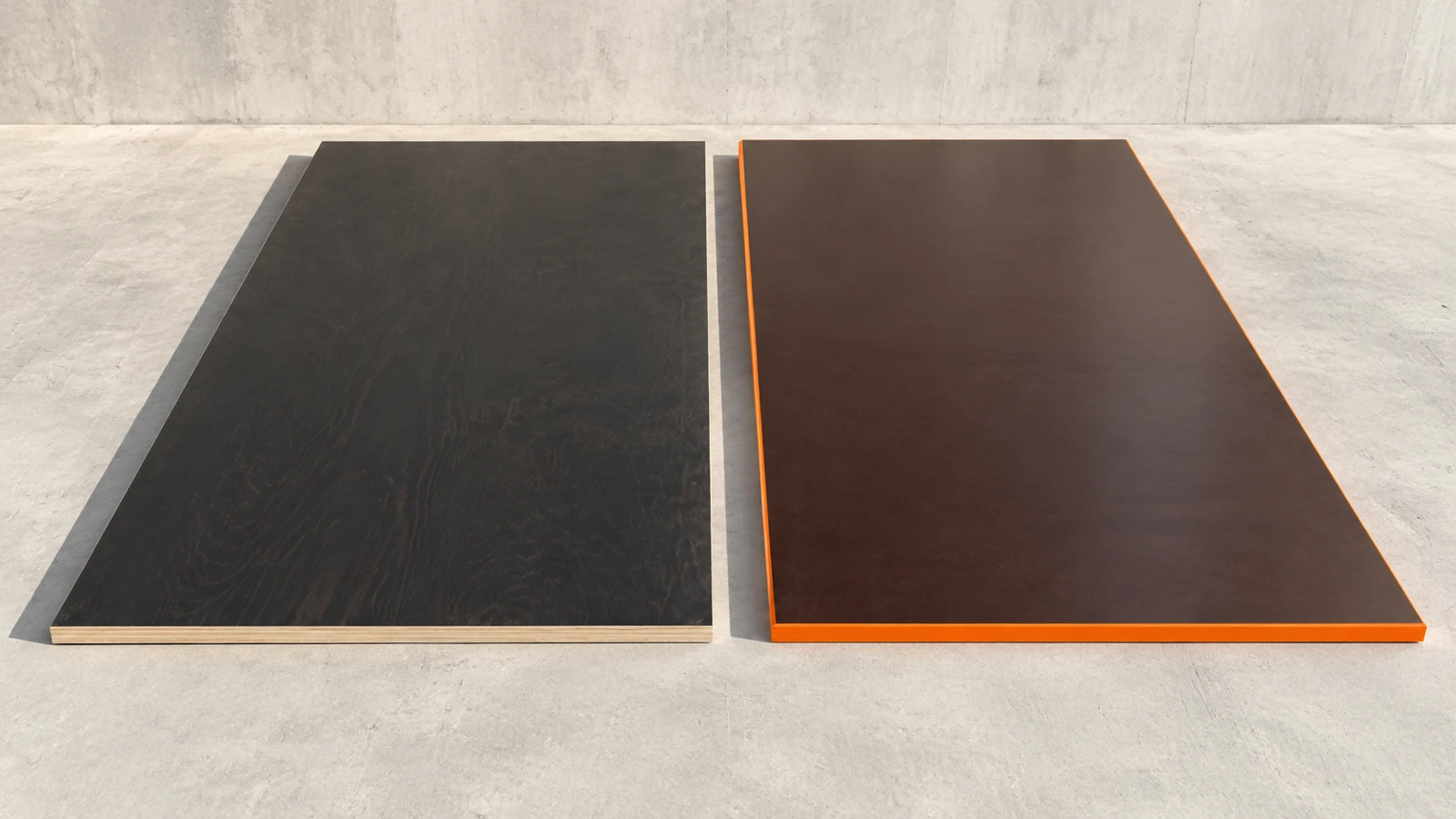
Why does cheap film-faced plywood give only 4 to 10 reuses?
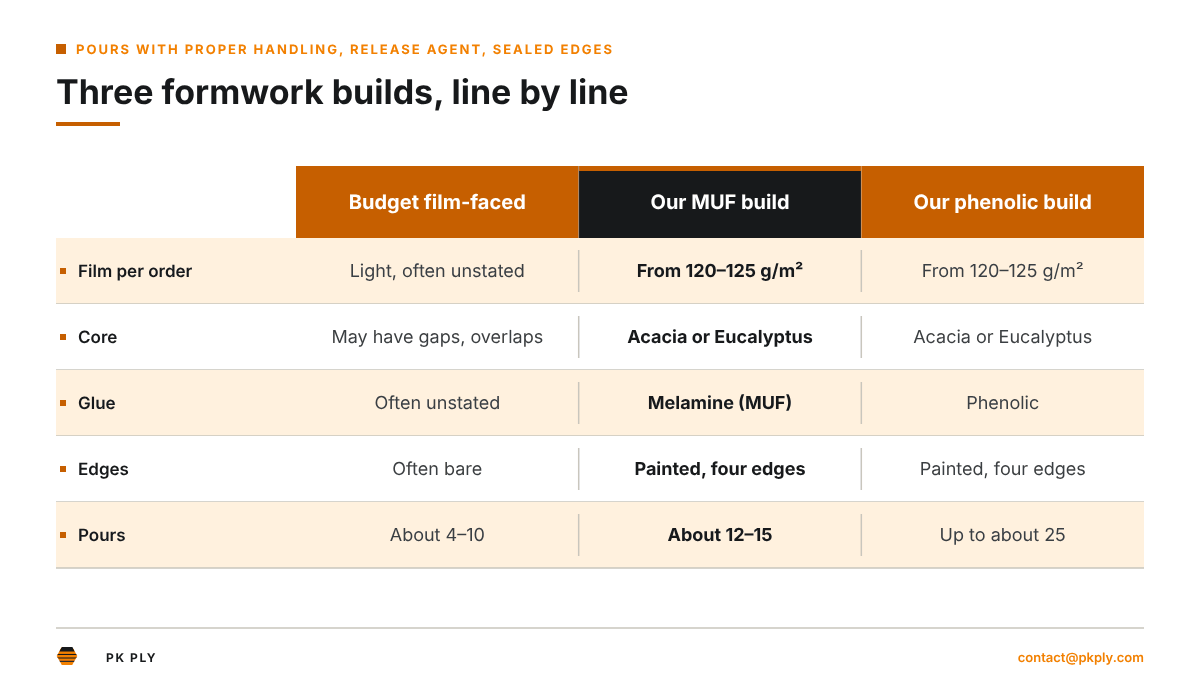
Cheap film-faced plywood gives about 4–10 reuses because the saving sits in the parts that carry the pours: a thin film that wears through, a core with gaps or overlaps that lets the face dent, a glue line that softens in wet concrete, and edges left bare so water swells the plies from the side.
That range is market context, and it assumes the site does its part: a release agent on every pour, careful stripping and sealed cut edges. Without that care a budget sheet can fail sooner. With the same care, our melamine (MUF) film-faced build gives about 12–15 pours and our phenolic build up to about 25. Reuse is a target for a configuration and site practice, not a fixed property of the sheet.
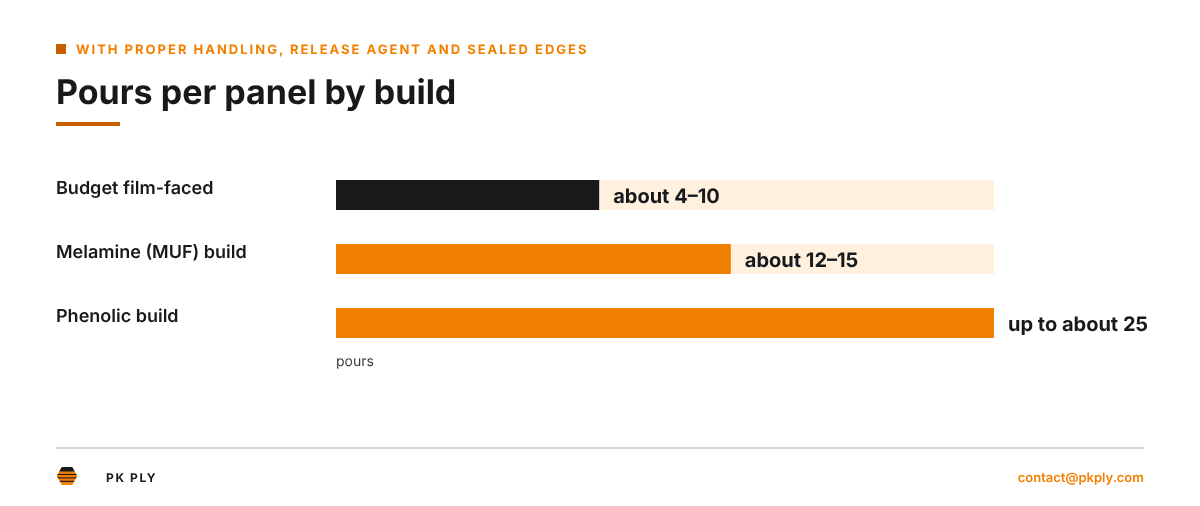
So “cheap plywood” for formwork is really a question about pours. A sheet that costs less and gives four pours can cost more per pour than a sheet that costs more and gives fifteen. The rest of this note goes through where the saving comes from, part by part, and where a budget build is still the right buy.
Where does the saving in a cheap formwork sheet come from?
The saving in a cheap formwork sheet comes from six places: film weight, core quality, glue system, edge sealing, pressing and tolerance. Each one lowers the cost of making the sheet and each one shows up later on site, as a rougher face, fewer pours or a sheet that will not sit flat.
| Where a budget sheet saves | What it saves at the mill | What it costs on site |
|---|---|---|
| Lighter film | Less film per sheet | The face wears through in fewer pours and marks the concrete |
| Core with gaps or overlaps | Lower-grade veneer, less sorting | Soft spots, dents, bumps that print into the concrete |
| Cheaper glue line | Less resin, a weaker bond class | Plies separate after repeated wetting |
| Bare or thinly painted edges | One step skipped | Water enters from the side and the edge swells |
| Shorter or cooler pressing | More sheets per press per day | A bond that does not reach its class |
| Loose thickness tolerance | Less sanding and sizing | Steps between sheets on the deck, uneven pour faces |
None of these is visible on a price list, and most are hard to see on a photo. That is why two offers with the same name, “18 mm film-faced plywood”, are often not the same build: core grade, joining, glue system, film weight, edge sealing and tolerance make the difference. The construction plywood price note shows how each line moves a mill price; this note looks at what each line does to the pours.
Which film weight is the sensible minimum for repeated pours?
For repeated pours, the sensible minimum is the film weight the site needs for its pour count and finish, and on our orders that starts at 120–125 g/m². About 130–135 g/m² is the most common weight now. For many pours or a fair-faced finish, buyers specify 165, 185 or over 200 g/m².
The film is the wearing surface. Every pour, the concrete presses on it, the vibrator shakes it and the crew scrapes it clean. A light film is fine for a few pours on concrete that will be buried. On a slab soffit or a wall that will stay exposed, a film that wears through in a few cycles leaves wood fibre marks in the concrete, and the panel then absorbs water through its face.
What to write on the order:
- Film weight in g/m², per face. A sheet described only as “film-faced” can carry any weight.
- Film colour: black or dark brown. Colour says nothing about weight, so name both.
- Film brand where it matters, if the site has a preferred one; on our orders film brand, weight and colour are order fields.
- The same weight on both faces, unless one face is meant to be the back for the whole life of the panel.
A heavier film costs more per sheet, and it is not always the right buy: a 200 g/m² film on a job that pours each panel three times buys wear the site will never use. The film has to match the pour count, which is why the pour target comes first in the specification.
How can I tell a budget core from a full hardwood core in a quote?
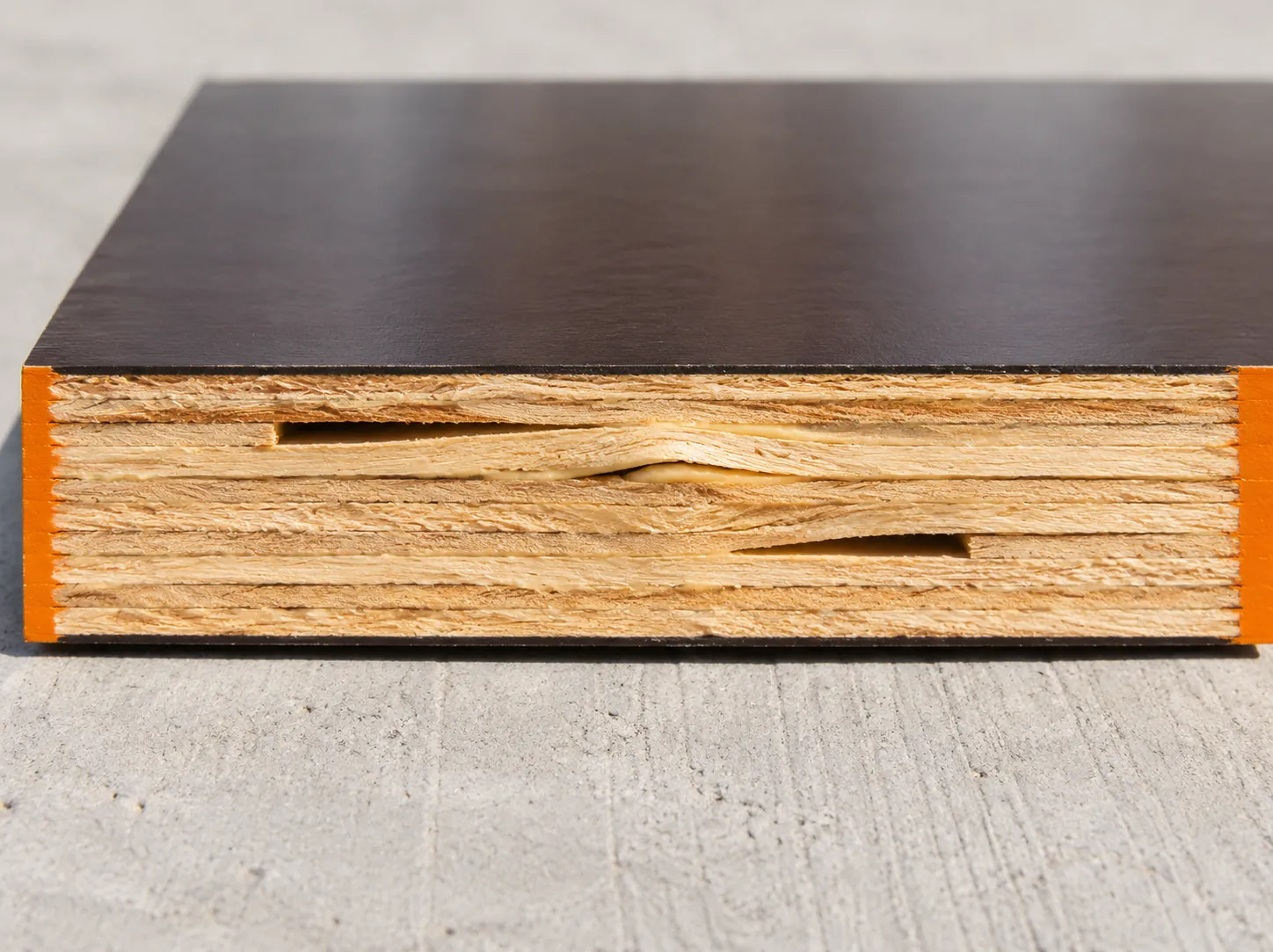
You can tell a budget core from a full hardwood core by asking the quote to name it: the core species, how core veneers are joined, whether gaps and overlaps are allowed, and the thickness tolerance. A quote that names none of these leaves the core open, and an open core is usually where a cheap price comes from.
Our film-faced panels have hardwood cores of Acacia or Eucalyptus veneers laid crosswise, under smooth hardwood face veneers and the film. A budget core may be built from thinner, broken or mixed veneers, with gaps between pieces and overlaps where two pieces ride over each other. Under the film the sheet looks the same. Under wet concrete, a gap is a soft spot that dents, and an overlap is a bump that prints into the concrete face.
How to check, before and after the order:
- On the quote: core species, veneer grade, joining, ply count for the thickness, and tolerance.
- On the sample: saw a fresh cut across the sheet and look at the edge. Whole veneers edge to edge, thin even glue lines and no voids are what a full core looks like.
- By weight: weigh a known area and work out the density. A light sheet for its core species can mean voids.
- On arrival: caliper sampled sheets at several points. Our film-faced tolerance is ±0.5 mm on thickness and ±2 mm on length and width, written on the technical sheet.
What does the glue line change in a cheap panel?
The glue line decides whether the plies stay together after repeated wetting, and it is one of the first places a cheap panel saves. Our film-faced plywood is pressed with melamine (MUF) or phenolic glue; MUF gives about 12–15 pours and phenolic up to about 25, with proper handling, release agent and sealed edges.
Bonding is not a matter of opinion: it is tested. EN 314-2 specifies requirements for bonding classes of veneer plywood according to their end uses. The test pieces are pretreated in water, and the shear result decides the class. EN 314-1 sets the test methods for plywood bonding quality. Formwork is wet work, so the class an offer names is a first line of comparison between two cheap offers.
Two things follow for a buyer:
- Ask for the bonding class and the evidence, not a word such as “WBP” alone. Our evidence for the phenolic build is an SGS Vietnam report on one submitted 21 mm Acacia-core specimen, dated 23 December 2025: bonding quality Class 3 PASS after 24 h water soak, boil-dry-boil and 72 h boiling pretreatments. The SGS specimen note reads it line by line.
- Match the glue to the pours. A phenolic glue line on a job that needs four pours buys life the site will not use; a cheap glue line on a twenty-pour job is the most expensive panel on the deck.
Why do bare edges cut the number of pours?
Bare edges cut the number of pours because plywood takes up water through its edges far faster than through a filmed face. Once water gets into the plies from the side, the edge swells, the film starts to lift at the corners and the sheet stops sitting flush with its neighbours.
Every film-faced panel from our mills leaves with water-resistant paint on all four edges. That covers the factory edges only. The cuts the site makes, the tie holes it drills and the corners it chips are new bare edges, and a budget sheet with a thin film and a soft core is the first to show it.
Three habits keep the edges working:
- Seal every cut edge the same day, with an edge sealant or paint suited to formwork.
- Seal tie holes and fixing holes before the panel goes back into the form.
- Strip without prying at the edge, so the film is not torn at the corners.
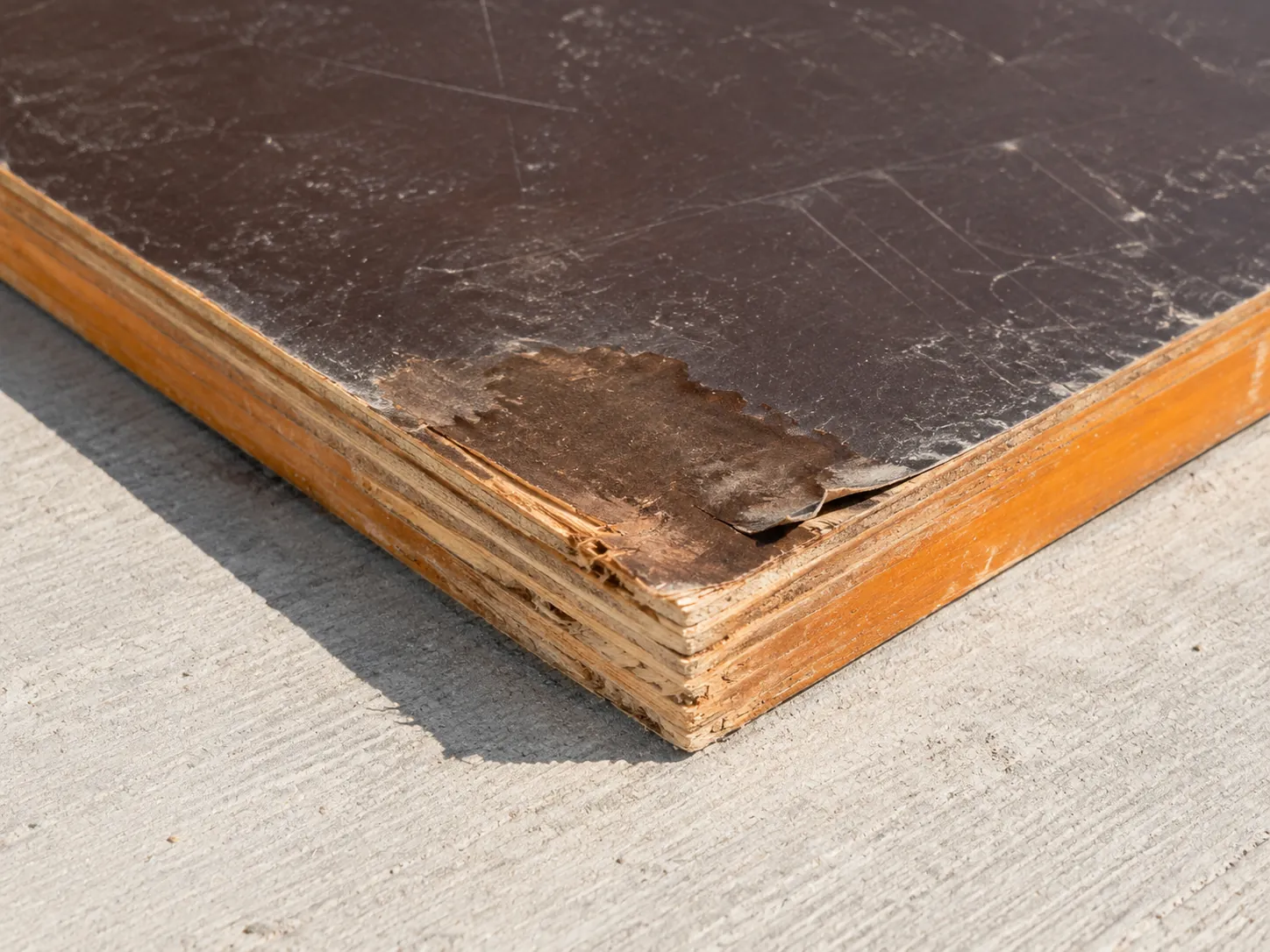
Edge sealing is the cheapest step in the life of a formwork sheet. It is also the step a low price most often leaves out at the mill and the one a busy site most often skips.
Does a lower sheet price mean a lower cost per pour?
A lower sheet price does not mean a lower cost per pour. The cost per pour is the landed price of the sheet divided by the pours the site gets from it, so a sheet that gives four pours has to cost less than a third of a sheet that gives twelve to come out ahead.
That arithmetic needs no price list. It only needs the pour count each build gives on your site. With proper handling, release agent and sealed edges, the planning figures are about 4–10 pours for a budget panel, about 12–15 for our melamine (MUF) build and up to about 25 for our phenolic build. The break-even price ratio follows directly:
| Compared with a budget sheet that gives… | A 12-pour sheet still costs less per pour if its price is below… | A 15-pour sheet… | A 25-pour sheet… |
|---|---|---|---|
| 4 pours | 3 times the budget price | 3.75 times | 6.25 times |
| 10 pours | 1.2 times the budget price | 1.5 times | 2.5 times |
Read across the row your site lives in. A crew that gets the full ten pours from a budget panel makes it a closer call; a crew that gets four makes almost any better build cheaper per pour. The cost per pour note works the same arithmetic with landed prices and the sheets per container.
Two costs make the ratio wider than it looks. Every sheet that fails early has to be replaced, cut and fitted again, which is labour. And every pour on a worn face needs more cleaning, more release agent and sometimes repair to the concrete surface.
Is cheap shuttering plywood worth it for a single-pour job?
Cheap shuttering plywood is worth it for a single-pour job when the concrete will be buried or covered, the forms are cut to odd shapes that will not be reused, and the face finish does not matter. On those jobs the panel’s later pours have no value, so paying for them makes no sense.
Typical single-pour or few-pour uses:
- Footings, pile caps and ground beams that are backfilled after stripping.
- Blinding edges and kickers cut to size and thrown away.
- Temporary works, such as hoarding or protection, where the panel is not a casting face at all.
Where it does not pay:
- Exposed concrete, where a worn face prints into the finish the client sees.
- Repeated cycles of slabs and walls on a building with many floors, where pour count is the whole point.
- Tight programmes, where a sheet that fails mid-cycle stops a pour while a replacement is cut.
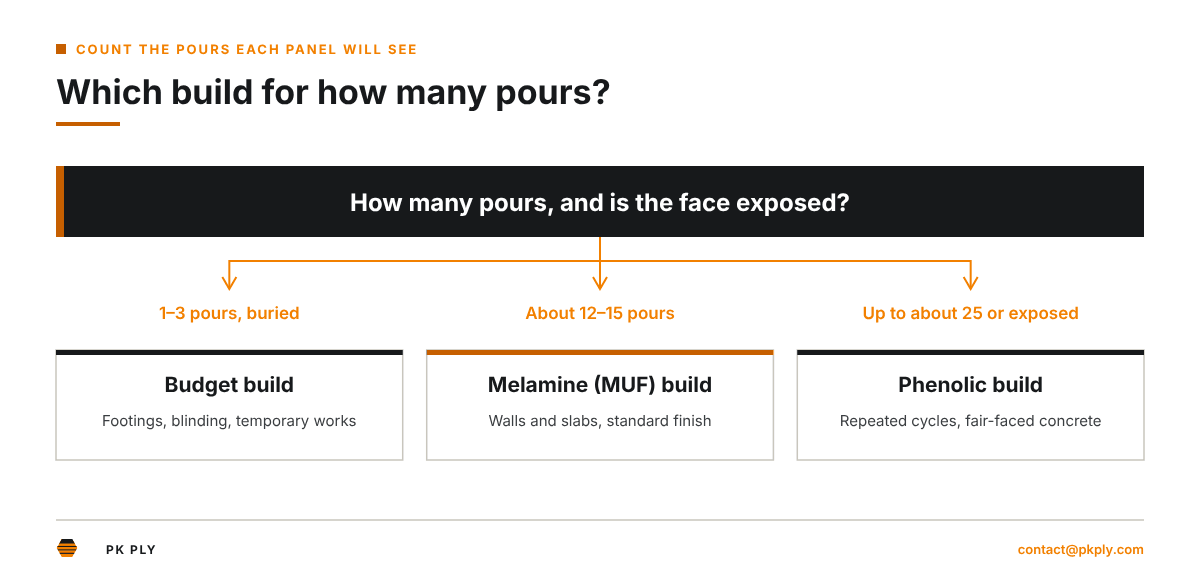
A rule of thumb that works on most sites: count the pours each panel will really see, then buy the build whose pour figure covers that count with a margin. If the answer is one or two, a budget build is fair. If it is ten or more, it is not.
Cheap plywood sheets 4x8: what size and thickness change
Cheap plywood sheets in 4x8 are 1220 × 2440 mm, the same size as most formwork sheets, so size alone does not make a sheet cheap. What changes the price is thickness and how close the sheet stays to it: a sheet sold as 18 mm that measures less holds less wood and less stiffness than its label.
Our sheets are 1220 × 2440 mm or 1250 × 2500 mm, with custom sizes and cutting lists by request, in thicknesses of 9–40 mm. The everyday formwork thicknesses are 12, 15, 18 and 21 mm. One 18 mm sheet of 1220 × 2440 mm holds about 0.0536 m³ of plywood; a sheet that is a millimetre thin holds about 0.0030 m³ less.
What to check on a cheap 4x8 offer:
- Nominal and actual thickness. Ask for the tolerance in writing; ours is ±0.5 mm.
- Length and width. Ours are held to ±2 mm, so sheets butt together on the deck.
- Squareness. Measure the diagonals of a sampled sheet.
- The standard named. EN 636 specifies requirements for plywood for general purposes or structural application in dry, humid or exterior conditions. A formwork sheet is wet work, so the class written on the offer should be the humid or exterior one.
A metric sheet in an imperial form system is another trap. US form systems are often drawn around 3/4 inch, which is 19.05 mm, so an 18 mm sheet is about 1 mm thinner. Check the system before ordering the cheaper metric sheet.
What does a cheap panel cost on site that the price leaves out?
A cheap panel costs the site more labour per pour, more release agent, more repairs to the concrete face and more waste, none of which is on the sheet price. Those costs grow as the panel wears, so they are smallest on the first pour and largest on the last few.
| Site cost | Why a budget panel raises it |
|---|---|
| Replacing sheets | Fewer pours per sheet means more sheets cut and fitted over the job |
| Cleaning | A worn or rough face holds concrete and takes longer to clean |
| Release agent | A worn face soaks up more agent per square metre |
| Concrete repair | Fibre marks, steps and bumps on the finish need grinding or filling |
| Stand-down time | A sheet that fails mid-cycle stops the pour while it is replaced |
| Waste | More used sheets leave the site per square metre of concrete |
None of this means a budget sheet is always wrong. It means the comparison should be made per pour and per square metre of finished concrete, not per sheet, and the pour count note gives the site habits that move the figure up or down.
How do we build a lower-cost formwork panel at our mills?
At our two mills in Chi Linh, Hai Phong we lower the cost of a formwork panel by matching each line of the build to the pours the job needs, not by leaving lines out. The core stays a hardwood core and the edges are always painted; the film weight and the glue system are where the price moves.
The choices that change the cost of a build, and what each trades:
| Choice | Lower-cost option | What it trades |
|---|---|---|
| Glue system | Melamine (MUF) instead of phenolic | About 12–15 pours instead of up to about 25 |
| Film weight | 120–125 g/m² instead of 130–135 g/m² or heavier | Fewer pours on exposed work; fine for few-pour jobs |
| Core species | Acacia or Eucalyptus | Acacia fills a 40HC to about 47 m³, Eucalyptus to about 43 m³, which changes freight per sheet |
| Thickness | The thinnest the form design allows | Stiffness between supports |
| Container mix | One or two products per 40HC | Simpler loading; three to six can be mixed by agreement |
Two lines never move. Every film-faced sheet leaves with all four edges painted, and the tolerance is written on the technical sheet. A buyer who wants a cheaper sheet gets a build that says what it is for. Our melamine film-faced plywood is the build most budget-minded buyers start from, and the phenolic film-faced plywood is where the pour count is the priority.
What should a formwork specification fix so two cheap offers can be compared?
A formwork specification should fix the pour target, core species, glue system, film weight and colour, edge sealing, thickness with tolerance, sheet size and quantity. With those lines written, two cheap offers either match the same build or show where they differ, and the price gap can be read against the gap in the build.
The lines to send:
- Application and pour target: what is cast and how many pours each panel should give.
- Core: Acacia or Eucalyptus hardwood, with joining and voids stated.
- Glue: melamine (MUF) or phenolic, with the bonding class and its evidence.
- Film: weight in g/m² per face, colour, and brand if it matters.
- Edges: water-resistant paint on all four edges.
- Thickness and tolerance: for example 18 mm ±0.5 mm.
- Size: 1220 × 2440 mm, 1250 × 2500 mm or a cutting list.
- Quantity and port: one 40HC minimum from our mills, FOB Hai Phong, CFR or CIF.
When two offers come back on the same eight lines, the cheaper one is either the better deal or it has quietly changed a line. Ask the supplier which line it changed. Our terms of supply set out how an offer from our mills is priced and paid.
Common traps in a cheap formwork plywood offer
The common traps in a cheap formwork plywood offer are a name without a build, a film without a weight, a glue word without a class, a thickness without a tolerance and edges not mentioned. Each one lets the supplier deliver a lighter sheet than the buyer pictured, and each one is fixed by one written line.
| What the offer says | What it may mean | The line to ask for |
|---|---|---|
| “Film-faced plywood 18 mm” | Any film, any core | Film g/m², core species, glue |
| “WBP glue” | A word, not a test | Bonding class and the test evidence |
| “Black film” | Colour only | Weight per face |
| “18 mm” | A nominal size | Tolerance in mm |
| No mention of edges | Bare edges | Paint on all four edges |
| “Reusable many times” | No number | Pours for the build, with the site conditions |
Most of these traps cost nothing to close before the deposit and a great deal to argue about after the container arrives.
How to get an offer for a budget build from our mills
To get an offer for a budget build, send the eight lines above with the pour count the job really needs. We return a technical sheet that names every line and an offer FOB Hai Phong, CFR or CIF for one 40HC or more. Samples are free; new buyers book their own courier, and the courier cost can be credited against a real order.
Production takes 15–45 days after the 30% deposit, depending on quantity, production conditions and agreement, and the 70% balance is paid against the scanned bill of lading. The film-faced plywood page shows the builds most buyers start from. Send your lines through the specification form or to [email protected], and say how many pours each sheet has to give.
Questions buyers ask us
Why is some film-faced plywood so cheap?
The saving usually comes from a thinner film, a core with gaps or overlaps, a cheaper glue line and edges left bare. Each of those cuts the price of the sheet and the number of pours it gives.
How many times can cheap shuttering plywood be reused?
Budget film-faced plywood typically gives about 4–10 reuses with proper handling, release agent and sealed edges. Without that care it gives fewer.
Is cheap plywood good enough for foundations?
Often, yes. Footings and other concrete that will be buried or covered need few pours and no fine finish, which is where a budget build is a fair choice.
What film weight should I ask for on repeated pours?
Our orders start at 120–125 g/m², and about 130–135 g/m² is the most common weight now. For many pours or a fair-faced finish, buyers specify 165, 185 or over 200 g/m².
Is 18 mm cheap plywood the same as 18 mm film-faced plywood from a mill?
Not necessarily. The thickness can match while the core, glue, film weight, edges and tolerance differ, and those set the pours.
Can I make cheap plywood last longer on site?
Yes, to a point: oil every pour, strip without prying the face, seal every cut edge and tie hole, and store sheets flat and covered. Care cannot add a film or a glue line the sheet does not have.
Is melamine film-faced plywood a budget option?
It is the middle option. Our melamine (MUF) build gives about 12–15 pours with proper handling, release agent and sealed edges, which is more than a budget panel and less than phenolic.
Do you make budget formwork panels?
We make construction plywood to the build the buyer writes, including a lighter film for jobs that need few pours. We state the pours each build is meant for, so the trade-off is on paper.
What is the minimum order for formwork plywood from your mills?
One 40HC, which can carry one or two products and up to six by agreement.
Does a cheaper panel change how many sheets fit in a container?
The core species changes it more than the price does. A 40HC takes about 47 m³ of Acacia-core panels or about 43 m³ of Eucalyptus-core panels, as planning figures.