
To import plywood from Vietnam, fix the build in writing, pay a 30% deposit and plan 15–45 days of production plus the sea days to your port, with the papers your market needs in hand before loading. PK Ply ships film-faced and anti-slip panels FOB Hai Phong, CFR or CIF from our two mills. A missing document or a vague build is what holds a container at the port.
How do you import plywood from Vietnam, step by step?
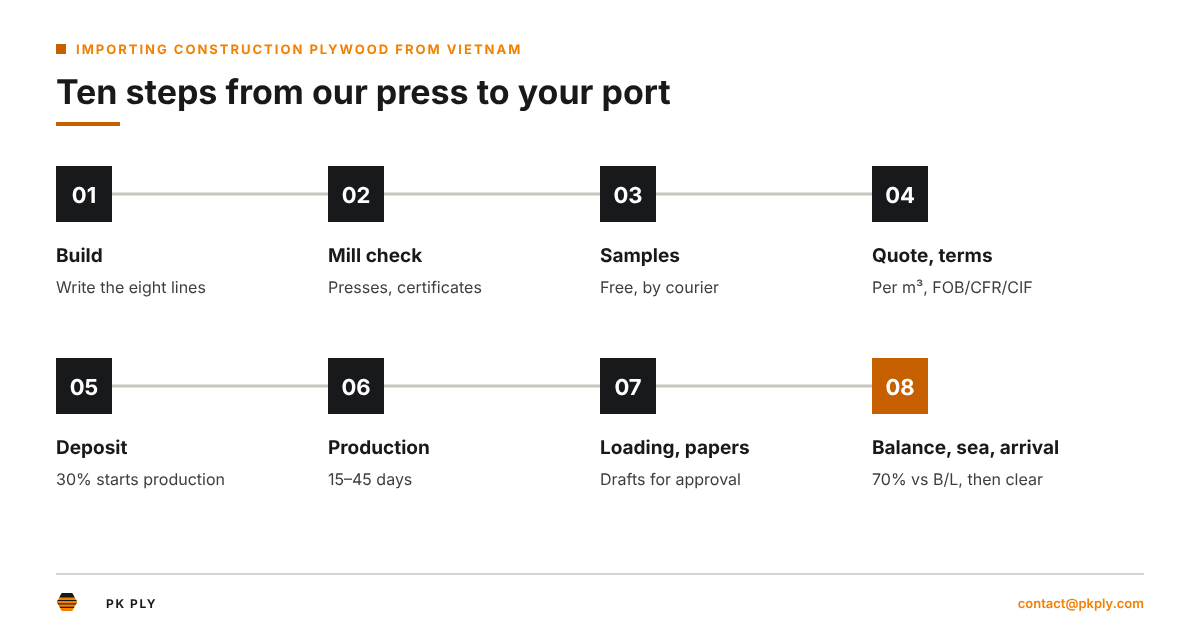
Importing plywood from Vietnam takes ten steps: choose the build, check the mill, get samples, agree the quote and terms, pay the deposit, wait out production, approve the packing and documents, pay the balance against the bill of lading, ship, then clear and inspect at your port. Straight from our mills, steps two to eight are one conversation.
| Step | What happens | Who acts | Typical time |
|---|---|---|---|
| 1. Build | Application, pours, core, glue, film, thickness, size, quantity | Buyer, with our technical sheet | A few days |
| 2. Mill check | Presses, certificates by number, test evidence | Buyer | A few days |
| 3. Samples | Free samples of the build by courier | Mill sends, new buyer books courier | Courier time |
| 4. Quote and terms | Price per m³, Incoterm, port, validity | Mill | A few days |
| 5. Deposit | 30% by T/T starts production | Buyer | — |
| 6. Production | Veneer to packed panels | Mill | 15–45 days |
| 7. Loading and papers | Packing list, draft shipping documents for approval | Mill, then buyer | A few days |
| 8. Balance | 70% against the scanned B/L, T/T or L/C at sight | Buyer | — |
| 9. Sea | Hai Phong to your port | Carrier | 5–50 days by region |
| 10. Arrival | Import clearance, duty, inspection | Buyer and broker | By market |
Two things decide how smooth the route is. The first is how complete the build is on day one: a technical sheet that names every line leaves nothing to argue about at arrival. The second is how early the papers are settled: certificate files reach you before you confirm, and draft shipping documents reach you after loading, before they are issued. The rest of this note goes through each step, then the rules of the main import markets.
Why buyers import construction plywood from Vietnam
Buyers import construction plywood from Vietnam for three reasons. Plantation Acacia and Eucalyptus give veneer for hardwood cores. Mills in the north specialise in film-faced formwork panels and ship from Hai Phong. Trade agreements give Vietnamese goods preferential access to markets such as the European Union and the UK.
The panel itself is the first reason. Vietnamese construction plywood is built on hardwood cores of plantation Acacia and Eucalyptus, laid crosswise and pressed with MUF or phenolic glue. Those cores give the stiffness and weight a formwork panel needs, at densities of about 580 kg/m³ for Acacia and about 650 kg/m³ for Eucalyptus in our planning. They are also cores a buyer can trace: the timber comes from plantation plots, which is what an EU geolocation dossier asks for.
The second reason is specialisation. Northern Vietnam has many plywood mills, and they serve different segments: furniture and commercial panels, packing panels, budget film-faced panels and premium film-faced panels. Our two mills in Chi Linh, Hai Phong press only construction plywood: film-faced, anti-slip and structural panels, up to 150 containers a month across the two mills. A buyer who imports from a specialist gets a technical conversation about glue, film and pours, not a price list.
The third reason is market access. The EU and the UK both have free trade agreements with Vietnam, covered in their own sections below. Duty is one line of the landed cost; the build and the evidence behind it decide whether the container is worth landing.
What is the minimum order for construction plywood from Vietnam?
Our minimum order for construction plywood is one 40HC container, which can carry one or two products and up to six by agreement. A 40HC holds about 47 m³ of Acacia-core panels or about 43 m³ of Eucalyptus-core panels, so the minimum is a full container of one or a few builds, not a set number of sheets.
Most Vietnamese mills quote per container, because a container is the unit that makes production and freight work. Some set the minimum per specification, so a mixed container costs more; some accept a 20 ft container at a higher price. Ours is one 40HC, the unit our planning, packing and loading are built around.
What one 40HC means in sheets depends on the thickness and core:
| Thickness, 1220 × 2440 mm | Acacia core (planning figures) | Eucalyptus core (planning figures) |
|---|---|---|
| 12 mm | 1,328 sheets, 47.4 m³ | 1,200 sheets, 42.9 m³ |
| 15 mm | 1,056 sheets, 47.2 m³ | 960 sheets, 42.9 m³ |
| 18 mm | 880 sheets, 47.2 m³ | 795 sheets, 42.6 m³ |
| 21 mm | 752 sheets, 47.0 m³ | 675 sheets, 42.2 m³ |
Every figure in this table is a planning figure: real sheets are weighed before final loading, and the packing list is the number that counts. For a first order, many buyers take one container with one or two thicknesses they use most, then add builds once the first container has been on site.
How do I get free samples before the first order?
Ask for samples of the build you plan to order: thickness, core, glue and film. Samples are free; new buyers book their own courier, and the courier cost can be credited against a real order. Buyers with an order or repeat buyers receive samples free with no courier cost.
A sample is most useful when it matches the order line for line. A sample of 18 mm phenolic film-faced plywood with a 165 g/m² dark-brown film tells you about that panel; a generic offcut tells you about the mill’s best day. Write the build on the sample request, and keep the sample labelled with it.
What to do with samples when they arrive:
- Measure. Caliper the thickness at several points and compare with the ±0.5 mm tolerance on the technical sheet.
- Look at the edge. Saw a fresh cut and look at the core: whole veneers laid edge to edge, thin even glue lines, no gaps.
- Weigh. Weigh a known area and work out the density; compare with the planning density of the core.
- Test it on site. If you can, put a sample panel into a real pour or two with your crew’s release agent and stripping practice.
- Test it in a laboratory. For a tender or a public project, a bonding test on the sample answers the glue question with a certificate.
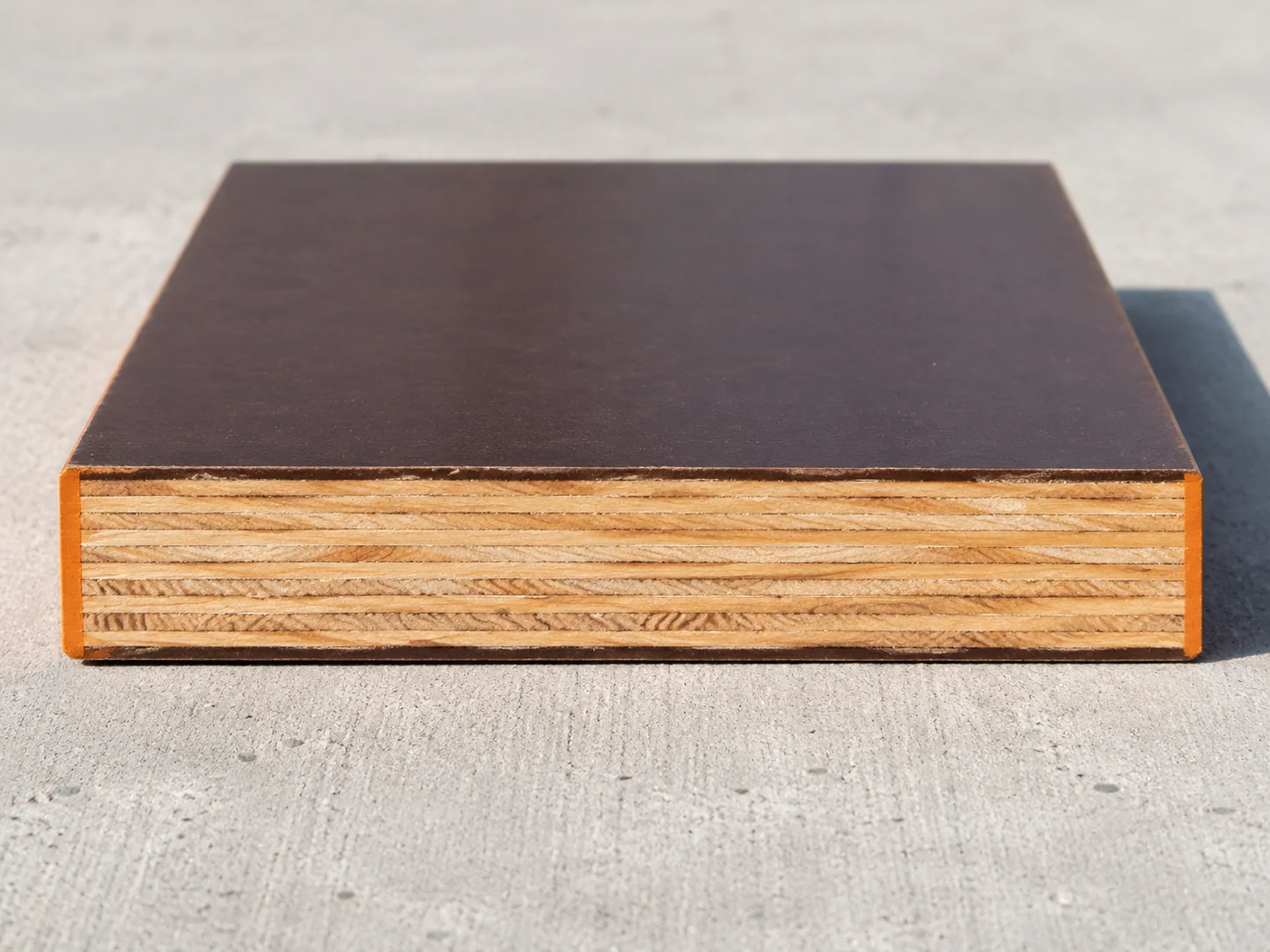
Our test evidence for the phenolic build is an SGS Vietnam report on one submitted 21 mm Acacia-core specimen, dated 23 December 2025: density 642 kg/m³, EN 314 bonding Class 3 PASS, and E1 PASS with formaldehyde not detected at the 0.04 mg/m³ reporting limit. The SGS specimen note reads it line by line.
How to check a plywood factory in Vietnam before the deposit
Check five things before you pay a deposit to any plywood factory in Vietnam. Does it press the panel itself? Is the build in writing? Does the test evidence name the specimen and method? Do the certificates carry numbers you can check with the issuer? Are its terms a mill’s terms? A seller that cannot answer one of them is a risk.
| Check | What to ask | Our answer |
|---|---|---|
| Own presses | Which mill presses the panel, and can I visit or see the line on a video call? | Two own mills in Chi Linh, Hai Phong |
| Build in writing | Core, glue, film weight, tolerance, edges on a technical sheet | A technical sheet for every order |
| Test evidence | Specimen, method, date and result | SGS specimen report, 21 mm phenolic, 23 December 2025 |
| Certificates | Numbers you can check with the issuer | FSC SGSHK-COC-370674; CE FPC 0407-CPR-2146 |
| Terms | Per container, deposit, production time, own port | One 40HC minimum, 30% deposit, 15–45 days, Hai Phong |
A certificate number is checkable. Our FSC chain of custody certificate is SGSHK-COC-370674, issued by SGS Hong Kong, and covers FSC 100% and FSC Mix plywood; the FSC claim of each order is confirmed on its sales documents. Our CE factory production control certificate is 0407-CPR-2146 from Istituto Giordano, notified body 0407, for structural plywood of 3.6–30 mm. Our formwork plywood is certified to AS 6669:2016 by CMI Certification, a JAS-ANZ-accredited body. The FSC plywood and CE marking pages show the scope of each.
A visit is the strongest check of all. Ask to see the press that will make your order, the film press and the edge-sealing line, and ask how core veneers are sorted. A mill that makes the panel can show each step.
Writing the specification and reading the quote
A construction plywood specification for a container quote needs eight lines: application and pour target, core species, glue, film weight and colour, thickness and tolerance, sheet size, edge sealing and quantity, plus the port of discharge and the Incoterm. With those lines the quote is a price for a defined panel, and two offers can be compared line by line.
| Line | What to write | Example for a first container |
|---|---|---|
| Application and pours | What the panel forms, pours planned | Slabs and walls, about 20 pours |
| Core | Acacia or Eucalyptus | Acacia |
| Glue | MUF or phenolic | Phenolic |
| Film | g/m², colour, both faces | 165 g/m², dark brown, both faces |
| Thickness | mm and tolerance | 18 mm, ±0.5 mm |
| Size | mm | 1220 × 2440 mm |
| Edges and marking | Paint, marking | Water-resistant paint, all four edges |
| Quantity, port, Incoterm | 40HC, port, term | One 40HC, CIF Rotterdam |
The quote comes back per cubic metre, with its Incoterm, port, validity, production time and payment terms. Export plywood is priced per cubic metre because a container is sold by volume. To turn it into a raw FOB figure per sheet, multiply by the sheet volume: 0.0536 m³ for an 18 mm sheet of 1220 × 2440 mm. The construction plywood price drivers note explains every line that moves the price, including why the cost per pour is the number to compare.
Write any project requirement into the specification before the quote, not after: CE structural use, FSC, a laboratory test on your run, marking on every sheet, a cutting list. Each one can change the build or the paperwork, and a quote made without it is a quote for a different order.
Which payment terms and Incoterms apply to a first order?
A first order from our mills runs on the same terms as every order: a 30% deposit by T/T starts production, and the 70% balance is paid against the scanned bill of lading by T/T or by irrevocable L/C at sight. We sell FOB Hai Phong, CFR or CIF to the port you name.
The payment sequence protects both sides in a simple way. The deposit pays for the veneer, glue and film that go into your panels. The balance is paid when the goods are loaded and the carrier has issued the bill of lading, so the buyer pays for panels that are on board. An irrevocable letter of credit at sight adds a bank between the two for buyers who prefer it.
Incoterms rules are a set of eleven three-letter trade terms reflecting business-to-business practice in contracts for the sale and purchase of goods. The three we sell on split the costs like this:
| Cost | FOB Hai Phong | CFR your port | CIF your port |
|---|---|---|---|
| Panels, packing, loading on board at Hai Phong | Seller | Seller | Seller |
| Ocean freight | Buyer | Seller | Seller |
| Cargo insurance | Buyer | Buyer | Seller |
| Import clearance, duty, VAT, delivery | Buyer | Buyer | Buyer |
Choose FOB if you have a forwarder who buys freight well; choose CFR or CIF if you want every offer to land at the same port, or if this is your first container from Asia. Insurance under CIF is the seller’s minimum cover; buyers who want wider cover arrange it themselves.
How long does production take after the deposit?
Production takes 15–45 days after the 30% deposit, depending on quantity, production conditions and agreement. One container of a standard build sits at the short end; several containers, a new configuration or a heavy film order take longer. The production date is agreed with the order, before the deposit.
The time goes into the same eight steps for every panel: veneer intake, drying, core lay-up, glue and press, sizing and sanding, film press, edge sealing, then marking and packing. The film press comes after the core panel has been pressed, sized and sanded, so a film-faced panel goes through the presses twice. That is part of why a formwork panel takes longer than a commercial one.
| Stage | What happens | Typical time |
|---|---|---|
| Order confirmed | Technical sheet, price and terms agreed | Day 0 |
| Deposit received | 30% by T/T | Day 0 to a few days |
| Production | Eight steps from veneer intake to packing | 15–45 days |
| Loading | Packs into the 40HC at Hai Phong | A day or two |
| Draft documents | Sent to the buyer for approval | After loading |
| Balance and B/L | 70% against the scanned bill of lading | After sailing |
| Sea | Hai Phong to your port | 5–50 days by region |
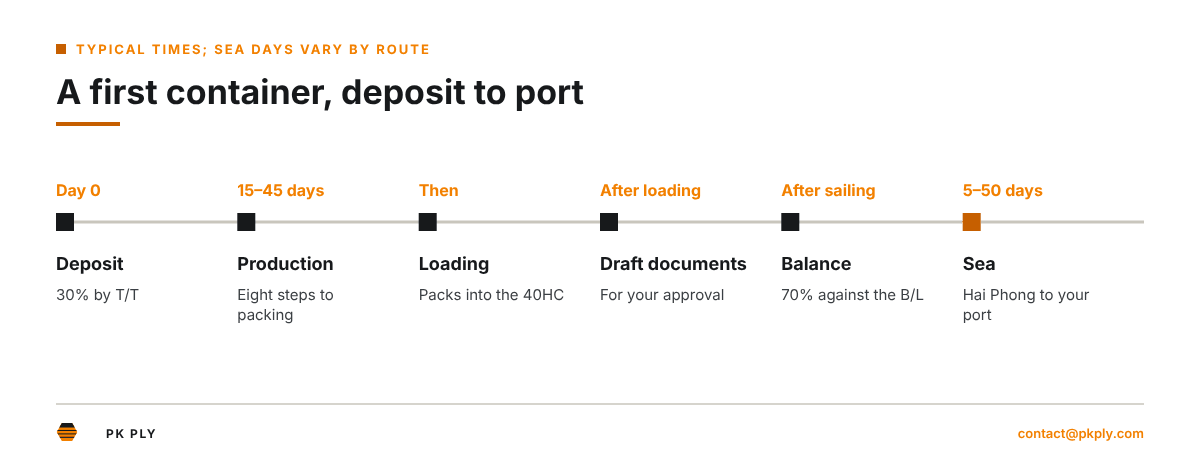
A buyer who needs panels on site by a fixed date counts back from it: sea days for the route, a margin for the port, the loading and document days, and the production window. Repeat orders of a build already on a technical sheet are simpler to schedule than a first configuration.
Can I mix several thicknesses or products in one container?
Yes. A 40HC usually carries one or two products, and three to six products can be mixed by agreement: for example 18 mm and 12 mm film-faced, or film-faced and anti-slip. Each product is priced on its own line, and each mix changes how full and how heavy the container can be.
Mixing is how many importers make one container serve a whole site. A slab programme might take mostly 18 mm deck panels with a share of 12 mm for edges, kickers and curved forms; a distributor might add anti-slip panels for platforms and truck floors. The limits come from the container and the press:
- Weight and volume. A Eucalyptus-core build reaches the weight limit before the container is full; mixing it with Acacia-core panels changes where the limit falls.
- Packs. Each product needs its own packs, and small quantities of a product make part-packs that fill less tightly.
- Press runs. Each change of build is a change at the press, so many small lines take longer to produce than two large ones.
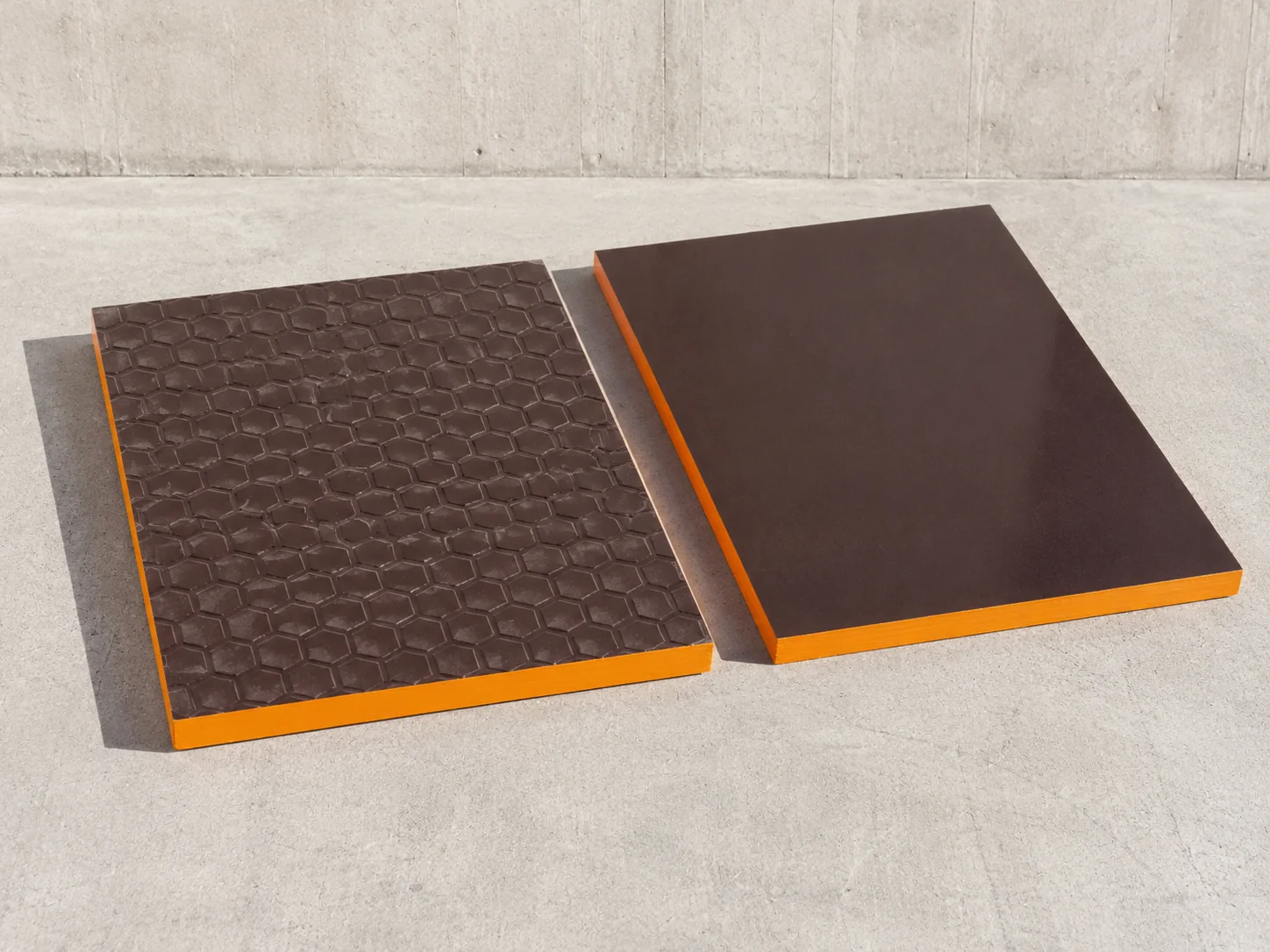
Send the mix with the quantities you want per product, and we plan the container with you before the quote. Our anti-slip plywood page covers the patterned panels that often share a container with film-faced ones.
Packing and loading: what a 40HC carries
A 40HC carries about 47 m³ of Acacia-core panels or about 43 m³ of Eucalyptus-core panels in packs about 1,000 mm high. That is 16 packs for Acacia and 15 for Eucalyptus. These are planning figures under a planning payload of 28,000 kg of panels that the carrier and route confirm.
Packs are stacked flat, strapped and covered for the container, and marked as the order asks. Sheets per pack are 1,000 mm divided by the thickness, rounded down, then capped by weight. The European sheet of 1250 × 2500 mm packs a little differently:
| 18 mm sheet size | Acacia core (planning figures) | Eucalyptus core (planning figures) |
|---|---|---|
| 1220 × 2440 mm | 880 sheets (16 × 55), 47.2 m³ | 795 sheets (15 × 53), 42.6 m³ |
| 1250 × 2500 mm | 848 sheets (16 × 53), 47.7 m³ | 750 sheets (15 × 50), 42.2 m³ |
Two points matter for the import side. The packing list made at loading, with the real count and weight of every pack, is the number that goes on the documents; the planning figure is only for the quote. And the wooden parts of the packing count for phytosanitary rules: plywood is processed wood and is outside ISPM 15, but solid-wood pallets, battens and dunnage shipped with it fall under ISPM 15. Our 40HC loading page shows how packs go in.
Which documents arrive before loading and which after?
Certificate files arrive before you confirm the order: the FSC claim set, emission and test reports for the agreed configuration and, for EU lots, the EUTR or EUDR file set. Shipping documents come after loading: commercial invoice, packing list, bill of lading, certificate of origin, phytosanitary and fumigation papers where required and, under CIF, insurance.
| Document | When you receive it | What it is for |
|---|---|---|
| Certificate files (FSC, CE, test reports) | Before you confirm the order | Checking the evidence against your specification |
| Technical sheet | With the quote | The build you are buying |
| EUDR geolocation dossier (EU lots) | Before shipment, for your due diligence | Your due diligence statement |
| Commercial invoice | Draft after loading, then final | Customs value; FSC claim where ordered |
| Packing list | Draft after loading, then final | Pack count, sheets, m³ and weights |
| Bill of lading | After sailing | Title to the goods; balance is paid against the scan |
| Certificate of origin (EUR.1 for EU-bound lots) | After loading | Preferential duty where an agreement applies |
| Phytosanitary and fumigation papers | After loading, where required | Wooden packing and the destination’s rules |
| Insurance certificate | Under CIF | Cargo cover |
Draft shipping documents go to the buyer for approval after loading, before they are issued. That is the moment to check the consignee, the notify party, the product description, the HS code line and the marks. A mistake corrected on a draft costs nothing; a mistake on an original bill of lading costs days. Our note on the documents with each container goes through each paper.
How many days at sea is it from Hai Phong to Northern Europe or the US East Coast?
From Hai Phong it is typically 30–40 days at sea to Northern Europe and 35–45 days to the US East Coast, depending on carrier and route. The Middle East is about 15–25 days, the Mediterranean 25–35, the US West Coast 20–30, West Africa 35–50 and South-East Asia 5–12 days.
| Buyer market | Sea leg from Hai Phong, typical | What to plan around it |
|---|---|---|
| Northern Europe | 30–40 days | Book after the production date is fixed; EUDR papers ready before arrival |
| Mediterranean | 25–35 days | Transhipment port named on the booking |
| US East Coast | 35–45 days | Duty scope checked for the exact build before loading |
| US West Coast | 20–30 days | Inland leg to site added to the plan |
| Middle East | 15–25 days | Destination conformity papers matched to the market |
| West Africa | 35–50 days | Widest range: allow a margin on site dates |
| South-East Asia | 5–12 days | Documents travel faster than the ship: send them early |
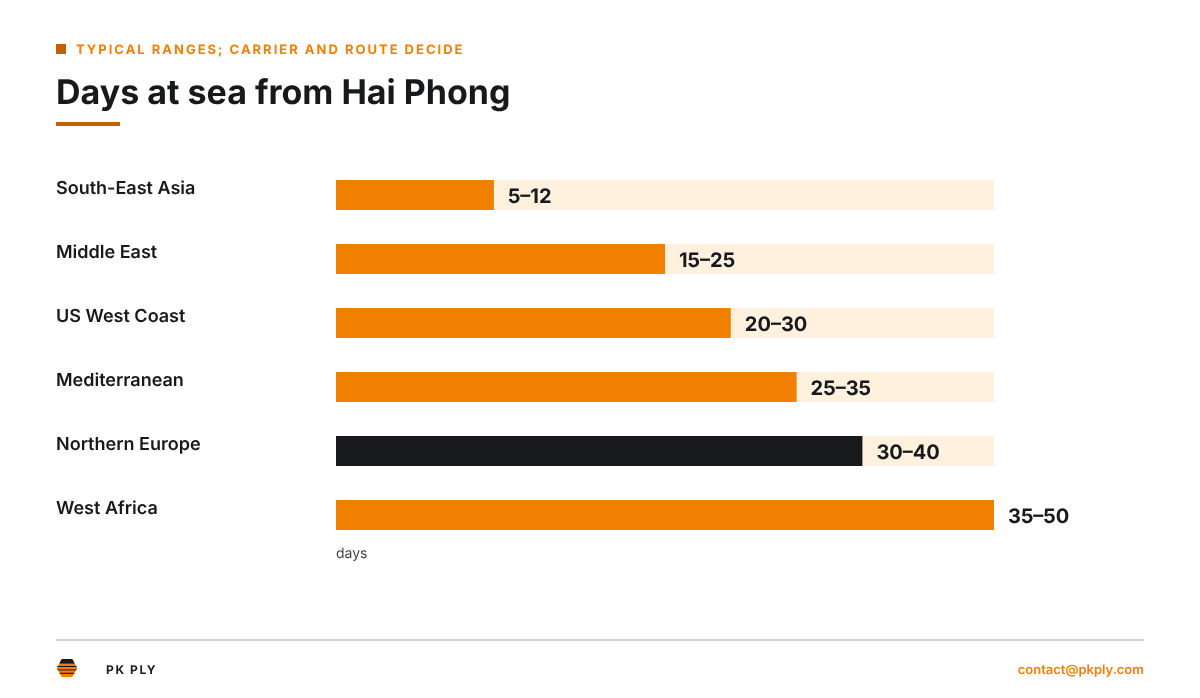
Shipping time from Hai Phong to Europe varies with the service. A direct call at Rotterdam, Antwerp, Hamburg or Gdansk is faster than a service that transships in an Asian hub, and a service that changes vessels adds days at the hub. Ask the forwarder or carrier for the routing, not only the quoted transit time.
To plan arrival on site, add the sea days to the production window and a margin at each end. Allow a few days for loading and documents in Hai Phong. Then allow the clearance time at your port, which depends on the market and on how complete the papers are.
Importing into the EU: tariff heading, origin, CE and EUDR
Construction plywood enters the EU under tariff heading 4412, with preferential duty available under the EU-Viet Nam Trade Agreement when the lot carries proof of Vietnamese origin. Structural uses need CE marking under EN 13986, and from 30 December 2026 the importer, as operator, files an EUDR due diligence statement with the geolocation of every production plot.
The trade agreement sets the duty line. The EU-Viet Nam Trade Agreement entered into force on 1 August 2020. Preferential treatment depends on proof of origin, which is why EU-bound lots from our mills carry a certificate of origin, the EUR.1, with the shipping papers. Your customs broker confirms the eight-digit code and the duty rate for your panel before the first shipment.
CE marking is the construction-products line. In the Construction Products Regulation, factory production control is the documented, permanent and internal control of production in a factory. Our FPC certificate 0407-CPR-2146 covers structural plywood of 3.6–30 mm with MUF or phenolic glue under EN 13986:2004+A1:2015, AVCP System 2+, and a structural CE panel ships with its declaration of performance. The structural CE plywood page lists the panels inside the scope.
The deforestation regulation is the new line. Regulation (EU) 2025/2650 repeals Regulation (EU) No 995/2010 with effect from 30 December 2026. From that date the EUDR applies to large and medium operators and to micro and small operators already under the EU Timber Regulation, which includes plywood importers.
For micro or small undertakings established by 31 December 2024, the amended articles apply from 30 June 2027. The deforestation cut-off date stays 31 December 2020. Regulation (EU) 2023/1115 defines geolocation as the geographical location of a plot of land described by latitude and longitude coordinates using at least six decimal digits. Plots of more than four hectares need polygons.
What that means for a plywood import:
- The EU importer is the operator and files the due diligence statement; its reference must exist before the customs declaration, and one statement can cover several shipments.
- There is no official “EUDR certificate”. What the mill gives is information: species with common and scientific names, quantity, country of production and the geolocation of every plot, with production dates.
- Vietnam is classed low risk, so simplified due diligence applies when every commodity in the product comes from low-risk countries.
- Records are kept five years.
We supply an EUDR geolocation dossier with GeoJSON files for the buyer’s own due diligence; the EUDR dossier page describes it. The same route applies to every member state, whether you import plywood from Vietnam to Denmark, Finland, Romania, Belgium, Ireland, Poland, Germany, the Czech Republic or Slovakia. The tariff, origin, CE and EUDR rules are EU rules. The national authority enforces them.
Importing into the UK: tariff, origin and timber due diligence
Plywood imported into the UK from Vietnam is classified under heading 4412 of the UK tariff, can claim preferential duty under the UK-Vietnam Free Trade Agreement with proof of origin, and must meet the UK timber due diligence rules for the importer. Construction panels for structural use are declared to their UK and European standards.
The tariff names the species that set the subheading. The UK Integrated Online Tariff places plywood with at least one outer ply of eucalyptus, among other listed hardwoods, under subheading 441233. Acacia is not one of the species named there, so an Acacia-faced panel is usually declared under another subheading of 4412; the broker confirms the commodity code for your build before the first shipment.
The trade agreement sets the preference. The UK-Vietnam Free Trade Agreement collection on GOV.UK holds the treaty information and a summary of the UK-Vietnam trade agreement. As with the EU, a preference needs proof of origin with the shipment, and draft shipping documents reach you for approval after loading so the origin line can be checked.
Timber due diligence is the importer’s job in the UK, as it was in the EU before the EUDR. The supplier’s part is the same information an EU buyer receives: species, origin, the FSC claim where ordered, and the chain of custody behind it. For UK formwork orders, buyers usually write the same lines as EU buyers: EN 636-2 or EN 636-3, CE or UKCA where the panel is structural, glue type and film weight.
Importing into the US: the plywood duty case and the film-faced exclusion
Hardwood and decorative plywood from Vietnam has been the subject of US anti-dumping and countervailing duty proceedings, and the 2025 scope notice lists Phenolic Film Faced Plyform among the excluded products. Whether a given film-faced panel matches that exclusion is a ruling for your customs broker, made on the panel’s bond classification, film and edge coating.
The 2025 notice on hardwood and decorative plywood from China, Indonesia and Vietnam lists Phenolic Film Faced Plyform among the products excluded from the scope. The notice defines it by an Exterior or Exposure 1 bond classification as defined by The Engineered Wood Association, an opaque phenolic film permanently bonded on both the face and back veneers, and an opaque, moisture-resistant coating on the edges. Read the exclusion against the build on your technical sheet, and ask your broker to rule on it before you ship.
Three more lines belong on a US import plan:
- Lacey Act declaration. Plywood is a plant product, and the importer declares the species and country of harvest. Our technical sheet names the core and face species.
- Formaldehyde rules. US rules for composite wood products apply to some plywood uses; ask which apply to your panel and its end use before the order.
- Thickness in inches. US form systems are often drawn around 3/4 inch, which is 19.05 mm. An 18 mm metric panel is about 1 mm thinner, so check the system before ordering 18 mm.
From Hai Phong it is typically 20–30 days at sea to the US West Coast and 35–45 days to the US East Coast. Our US import note covers the duty case and the papers in more detail.
Gulf, Africa and Australia: what changes on the route
For the Gulf and Africa the order is written in glue type, film weight and sheet size, and the papers follow the destination’s conformity and phytosanitary rules; for Australia the order usually names AS 6669 formwork plywood. Sea time from Hai Phong is about 15–25 days to the Middle East and 35–50 days to West Africa.
Gulf. Contractors in Saudi Arabia, the UAE, Qatar, Oman and Kuwait order film-faced shuttering plywood by glue (MUF or phenolic), film weight and 1220 × 2440 mm sheets, with 18 mm the main thickness. Saudi imports go through the kingdom’s product conformity platform, SABER, for the product categories it covers; ask your clearing agent which certificate your HS code needs before the first shipment, because the conformity file is the importer’s.
Africa. West and East African buyers usually order film-faced panels in 1220 × 2440 mm, often a mix of 12 and 18 mm in one container. Phytosanitary rules for the wooden packing apply; plywood itself is processed wood and outside ISPM 15, but solid-wood pallets and dunnage fall under it.
Australia and New Zealand. Formwork buyers order formply to AS 6669. Our formwork plywood is certified to AS 6669:2016 by CMI Certification, a JAS-ANZ-accredited body; no stress grade is claimed from that certification, so a project that specifies one gets a quote against it separately. Biosecurity rules at the Australian border apply to timber and its packing, and the importer’s broker checks the documents they need.
| Market | What the order names | Papers to settle before shipment |
|---|---|---|
| Gulf | Glue, film weight, 1220 × 2440 mm | Conformity certificate where required, certificate of origin |
| West and East Africa | Film-faced, 12 and 18 mm mixes | Phytosanitary papers for packing, certificate of origin |
| Australia, New Zealand | AS 6669 formwork plywood | Biosecurity documents, AS 6669 certification |
From FOB to landed cost: the lines to budget
The landed cost of a container of plywood from Vietnam is the FOB price plus ocean freight, insurance, destination port charges, customs clearance, import duty where it applies, import VAT or sales tax, and delivery to your warehouse or site. Under CFR or CIF, freight and insurance are already in the price; the rest stays with the buyer.
| Cost line | What sets it | Who quotes it |
|---|---|---|
| Panels, packing, loading at Hai Phong | The build, per m³ | We do (FOB) |
| Ocean freight | Carrier, route, season, one 40HC | Forwarder, or us under CFR/CIF |
| Insurance | Cargo value and cover | Insurer, or us under CIF |
| Destination port charges | Port and terminal | Forwarder or broker |
| Customs clearance | Broker fee, documents | Broker |
| Import duty | Tariff code, origin, trade agreement | Broker, from the tariff |
| Import VAT or sales tax | Destination rules | Broker |
| Delivery | Distance, unloading | Haulier |
Two lines move most between builds. Freight per cubic metre is lower with an Acacia core, because a 40HC fills to about 47 m³ against about 43 m³ with Eucalyptus; per 18 mm sheet, the container carries about 880 sheets against about 795, as planning figures. And the duty line depends on the tariff code and the origin proof, which is why the certificate of origin is worth checking on the draft.
Then divide the landed cost by the pours. A landed sheet price over the pours your site gets is the figure that decides between builds: about 12–15 pours with MUF glue, up to about 25 with phenolic, and about 4–10 for budget panels, with proper handling, release agent and edge sealing. The price drivers note works the per-pour arithmetic through.
Inspection on arrival and what to record
When the container is opened, check the seal against the bill of lading, photograph the doors and the packs before unloading, count packs against the packing list, then sample sheets for thickness, size, face and edges against the technical sheet. A record made on the day the container opens is the evidence any later question rests on.
A short arrival routine that works for formwork panels:
- Seal and doors. Check the seal number against the bill of lading and photograph the closed and open doors.
- Packs. Photograph the packs in place, then count them against the packing list and check the marks.
- Thickness. Caliper sampled sheets at several points; our tolerance is ±0.5 mm on the technical sheet.
- Size and squareness. Measure length, width and diagonals; length and width are held to ±2 mm.
- Face and edges. Look for film damage, lifted corners and edges without paint.
- Core. Saw one sampled sheet and look at the core and glue lines.
- Store. Stack flat on bearers, covered, out of standing water and direct sun.
If a pack arrives damaged in transit, the photographs from the door are what the insurer and the carrier ask for first. If a question is about the panel itself, the sampled sheets and their measurements are what we look at with you, against the technical sheet both sides signed.
Common mistakes on a first plywood import from Vietnam
Most problems on a first import come from six mistakes. Buyers order by name instead of build and compare price per sheet instead of per pour. They skip samples or leave the documents to the last week. They book freight before the production date is fixed, or ignore the destination’s rules on duty and timber due diligence.
| Mistake | What it costs | How to avoid it |
|---|---|---|
| Ordering “film-faced plywood 18 mm” with no build | A panel that gives fewer pours than expected | Write core, glue, film weight, tolerance and edges |
| Comparing price per sheet | Paying less per sheet and more per pour | Compare per m³, then per pour |
| Skipping samples | Surprises on the first pour | Order samples of the exact build |
| Documents left late | A container held at the port | Agree the document list with the order; approve drafts after loading |
| Freight booked too early | Storage, rebooking | Book against the agreed production date |
| Destination rules unchecked | Unplanned duty, a held entry | Ask your broker to confirm code, origin and due diligence before shipping |
The one habit that prevents most of them is to put everything in writing before the deposit: the technical sheet, the document list, the Incoterm and port, and the production window. Every one of those lines is something both sides can check later.
From the first container to repeat supply
After the first container has been on site, a repeat order is the same technical sheet with a new quantity, a new production date and a fresh price per cubic metre. Buyers who settle on one or two builds and a regular rhythm of containers get the simplest scheduling and the most consistent panels.
What changes after the first order is mostly on the buyer’s side: you know how many pours your site gets from the build, which thicknesses you use, and how long clearance takes at your port. Feed that back into the next specification. A site that gets more pours than planned may move to a lighter film; one that wants more pours may move from MUF to phenolic glue.
To start, send the eight lines of your panel, the port and the Incoterm through our specification form or by email to [email protected]. We return a technical sheet and an offer FOB Hai Phong, CFR or CIF, with the certificate files before you confirm. Our film-faced plywood page shows the builds most importers start with.
Questions buyers ask us
What is the minimum order to import plywood from Vietnam?
Our minimum is one 40HC, which can carry one or two products and up to six by agreement. Other Vietnamese mills set their own minimums, often per container and per specification.
How long does it take to import plywood from Vietnam?
Plan production of 15–45 days after the 30% deposit, a few days for loading and documents, then the sea days to your port: about 30–40 days to Northern Europe and 35–45 days to the US East Coast from Hai Phong.
Which Incoterms do you sell on?
FOB Hai Phong, CFR or CIF to your port. Duty, import clearance and delivery stay with the buyer under all three.
How do I pay for a first container?
A 30% deposit starts production, and the 70% balance is paid against the scanned bill of lading by T/T or by irrevocable L/C at sight.
Do you send free samples?
Yes. Samples are free; new buyers book their own courier, and the courier cost can be credited against a real order.
Can I mix thicknesses in one 40HC?
Yes. A container usually carries one or two products, and three to six can be mixed by agreement; each mix changes how full and how heavy the container can be.
Is plywood from Vietnam subject to ISPM 15?
Plywood is processed wood and is outside ISPM 15, but solid-wood pallets, battens and dunnage shipped with it fall under ISPM 15.
What documents come with each container?
Commercial invoice, packing list, bill of lading, certificate of origin (EUR.1 for EU-bound lots), phytosanitary and fumigation papers where required, insurance under CIF, and the order's certificate documents.
Who files the EUDR due diligence statement for plywood?
The EU importer, as operator, files the due diligence statement; we supply the geolocation dossier with GeoJSON files for the core and face material.
Is film-faced plywood from Vietnam inside the US plywood duty case?
The 2025 scope notice lists Phenolic Film Faced Plyform among the excluded products, with a definition based on bond classification, phenolic film on both faces and coated edges. Whether your panel matches it is a ruling for your customs broker.
Which port do you ship from?
We load at Hai Phong, the port for our two mills in Chi Linh.
Can I visit your mills before I order?
Yes, you can ask to visit the mill that presses your panel, or to see the line on a video call, before you pay the deposit.
How many sheets of 18 mm fit in one container?
About 880 sheets of 1220 × 2440 mm with an Acacia core or about 795 with a Eucalyptus core, as planning figures; the packing list made at loading is the final count.