
Film faced birch plywood is a dense, fine-ply formwork panel; an Acacia or Eucalyptus-core film-faced panel does the same slab and wall work lighter and at a lower price per pour. A wrong pick costs freight, crew effort or reuse. At PK Ply we press only the hardwood-core build: up to about 25 pours with phenolic glue, release agent and sealed edges.
What is a strong, lower-cost alternative to birch plywood for formwork?
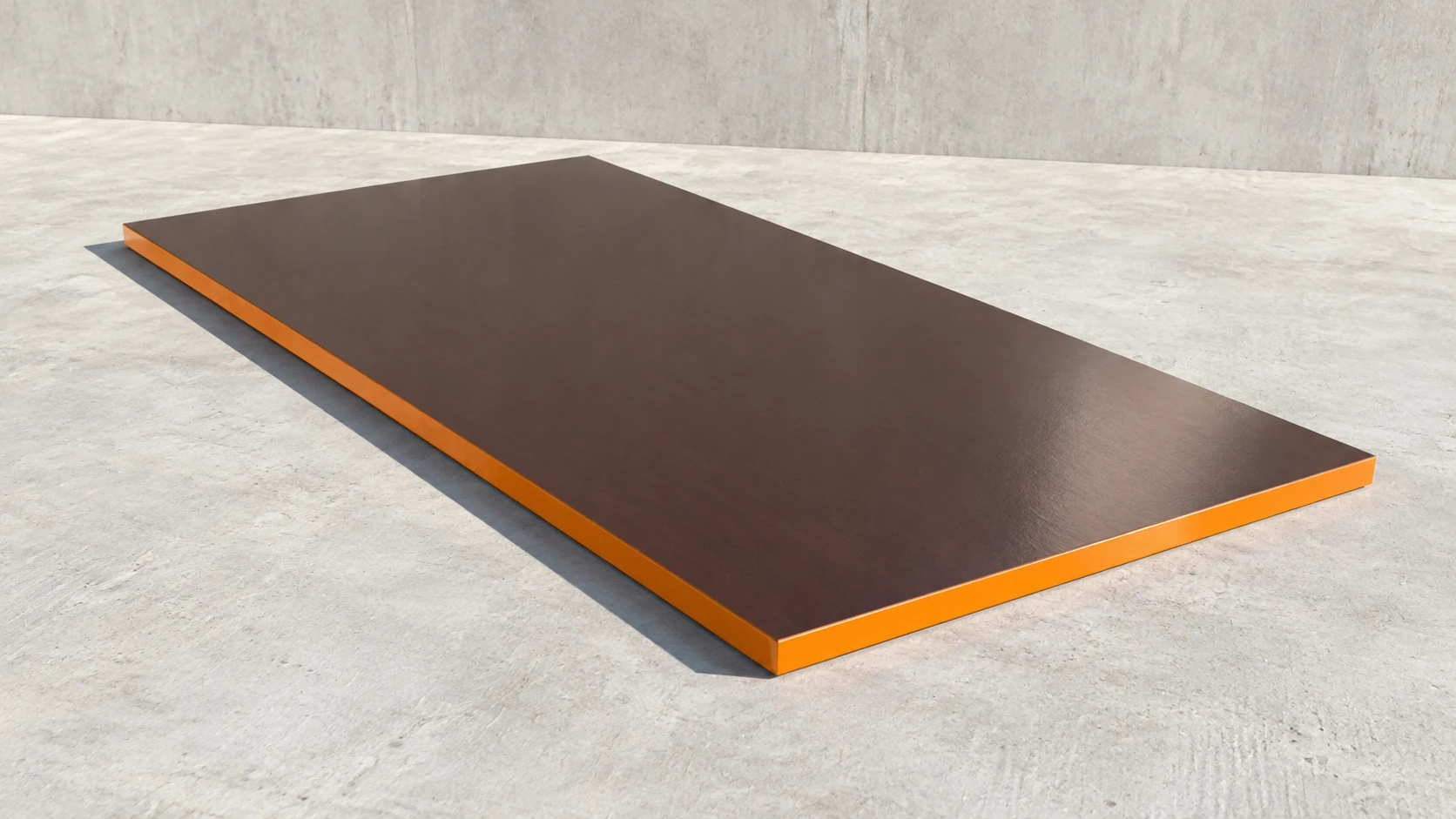
The strong, lower-cost alternative to film faced birch plywood is a film-faced panel on an Acacia or Eucalyptus hardwood core with phenolic glue. It forms the same slabs and walls, weighs less per sheet, and gives up to about 25 pours with proper handling, release agent and sealed edges, so the price per pour falls.
Birch earned its name in formwork for good reasons. Birch veneers are thin and even, the panel is dense and stiff, and the large sheet formats fit frame systems built around them. Those same qualities make a birch sheet heavy and expensive to buy and to ship. For most deck and wall work the question is not whether birch is good, but whether the job needs what birch adds.
We make one side of this comparison. Our two mills in Chi Linh, Hai Phong press film-faced plywood on Acacia or Eucalyptus cores with MUF or phenolic glue; we do not make birch panels. Below, our hardwood-core build meets birch line by line. We also say where birch is still the right buy, and what to write on an order when you switch.
Film faced birch plywood and hardwood-core panels, line by line
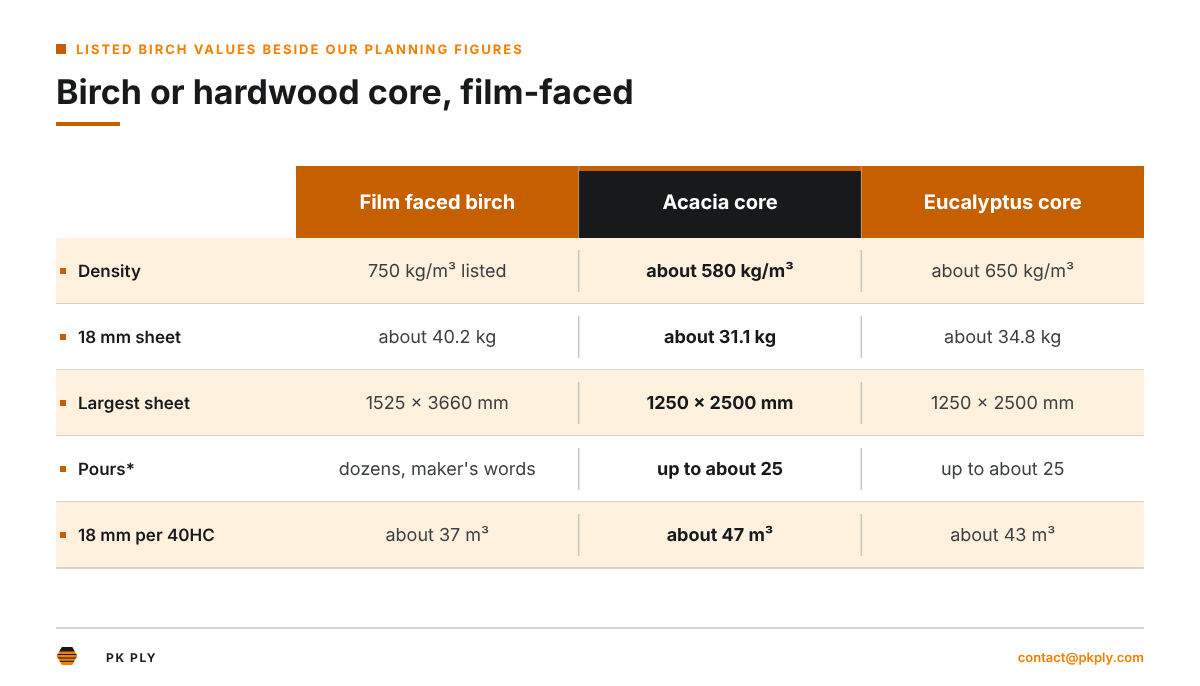
Film faced birch plywood and a hardwood-core film-faced panel differ most in weight, sheet format and price; they share the film, the exterior glue and the job. The table puts one measured or stated value in every row, from a listed birch sheet and from our own planning figures and documents.
| Line | Film faced birch plywood | Our hardwood-core film-faced panel |
|---|---|---|
| Core species | Birch veneer throughout | Acacia or Eucalyptus hardwood veneers laid crosswise |
| Density | 750 kg/m³ listed for one 12 mm Latvian sheet | About 580 kg/m³ (Acacia) or 650 kg/m³ (Eucalyptus) in planning; 642 kg/m³ measured on one SGS 21 mm specimen |
| Weight, 12 mm, 1220 × 2440 mm | 27 kg listed | About 20.7 kg (Acacia) or 23.2 kg (Eucalyptus) |
| Weight, 18 mm, 1220 × 2440 mm | About 40.2 kg at 750 kg/m³ | About 31.1 kg (Acacia) or 34.8 kg (Eucalyptus) |
| Glue | Phenolic exterior glue | MUF or phenolic glue, by order |
| Film | 220 g/m² on both sides on the listed sheet | 120–125 g/m² to over 200 g/m², by order |
| Thickness range | 6.5–50 mm on one EU-made range | 9–40 mm; 12, 15, 18 and 21 mm every day |
| Largest sheet | 1525 × 3660 mm on one EU-made range | 1250 × 2500 mm |
| Pours | Stated as “dozens of times with proper care” by one maker | About 12–15 (MUF) or up to about 25 (phenolic) with proper handling, release agent and sealed edges |
| 18 mm per 40HC | About 37 m³ before the 28,000 kg planning payload is reached | About 47 m³ (Acacia) or 43 m³ (Eucalyptus), planning figure |
| Formwork area per 40HC, 18 mm | About 2,070 m² | About 2,620 m² (Acacia) or 2,370 m² (Eucalyptus), planning figure |
The birch weight, density, film and ply count come from one retail listing. The birch thickness range, largest size and pour wording come from one maker’s product page. The 18 mm birch weight and container rows are our arithmetic at the listed 750 kg/m³. Birch panels from other mills and forests weigh a little more or less, so weigh a sample sheet of the exact offer before you plan freight.
What are the key differences between birch and eucalyptus plywood?
The key differences between birch and eucalyptus plywood are density, ply structure and sheet format. Birch is denser and is peeled into thin, even veneers, so a birch sheet carries more plies and is stiffer for its thickness. Eucalyptus is lighter, comes from fast-growing plantations and is pressed in the 1220 × 2440 mm and 1250 × 2500 mm sheets most decks use.
Density is the first difference a crew feels. A 12 mm Latvian birch film-faced sheet of 1220 × 2440 mm is listed at 27 kg, 750 kg/m³ and 9 plies, with grey phenolic film of 220 g/m² on both sides. Our 12 mm Eucalyptus-core sheet of the same size is about 23.2 kg at our planning density of 650 kg/m³, and the Acacia-core sheet about 20.7 kg.
Ply structure is the second. More, thinner plies spread defects through the thickness and make the sheet more even in stiffness across its width. A hardwood-core panel uses thicker plantation veneers. Its build depends more on how the core is laid and joined: gaps or overlaps in the core show up later as soft spots or bumps under the film. That is why our core lay-up is sorted and checked before the glue goes on, and why the veneer sorting step matters as much as the species.
The third difference is the face. A birch panel’s film sits on a birch face veneer. Ours sits on a smooth hardwood face veneer chosen for the film it carries, because a rough face shows through a thin film after a few pours. With a matched film weight, the concrete sees the film, not the species under it.
Is an Acacia core lighter than a Eucalyptus core?
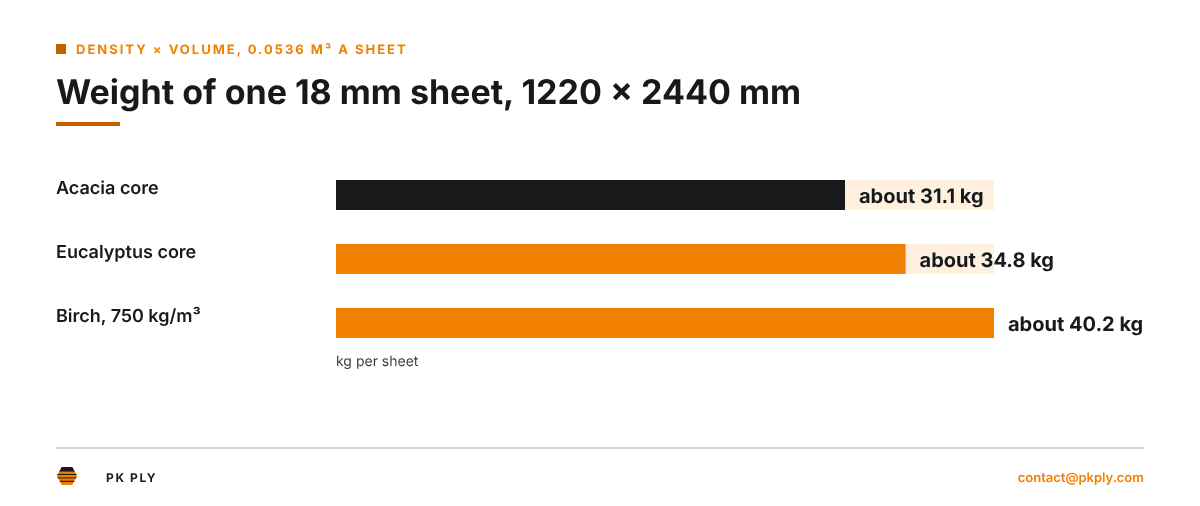
Yes. We plan an Acacia core at about 580 kg/m³ and a Eucalyptus core at about 650 kg/m³, with Eucalyptus measured at 650–750 kg/m³. An 18 mm sheet of 1220 × 2440 mm therefore weighs about 31.1 kg with Acacia and about 34.8 kg with Eucalyptus, and both weigh less than birch at 750 kg/m³.
A sheet’s weight is its density times its volume. An 18 mm sheet of 1220 × 2440 mm holds 0.0536 m³. The arithmetic is short: 0.0536 × 580 is about 31.1 kg, 0.0536 × 650 about 34.8 kg, and 0.0536 × 750 about 40.2 kg. The plywood sheet weight calculator runs the same sum for any thickness and core.
| Thickness, 1220 × 2440 mm | Acacia core (580 kg/m³) | Eucalyptus core (650 kg/m³) | Birch at the listed 750 kg/m³ |
|---|---|---|---|
| 12 mm | About 20.7 kg | About 23.2 kg | 27 kg listed |
| 15 mm | About 25.9 kg | About 29.0 kg | About 33.5 kg |
| 18 mm | About 31.1 kg | About 34.8 kg | About 40.2 kg |
| 21 mm | About 36.3 kg | About 40.6 kg | About 46.9 kg |
Nine kilograms a sheet sounds small until a crew lifts several hundred sheets a day on and off a deck. Acacia is the core we suggest when hand-handling and container volume decide the job. Eucalyptus is a little heavier and firmer under foot, holds fixings well, and fills a 40HC by weight at about 43 m³. The glue decides the pour count more than either species, as the next section shows.
How many pours does a hardwood-core phenolic panel give?
A hardwood-core film-faced panel with phenolic glue gives up to about 25 pours. The same build with melamine (MUF) glue gives about 12–15. Both counts hold when it is handled properly, coated with release agent before every pour and kept with sealed edges, including every cut edge. Budget film-faced panels typically give about 4–10 pours under the same care.
The birch maker quoted here prints no single pour number. One EU birch panel maker writes that its forming panel can be reused dozens of times with proper care. The wording is fair: reuse is a target for a build and a site, not a fixed property of a sheet, and the same is true of ours. Our numbers come with their conditions written beside them for that reason.
| Build | Glue line | Pours with proper handling, release agent and sealed edges | Typical job |
|---|---|---|---|
| Budget film-faced, mixed core | Low glue spread | About 4–10 | Short jobs, edge forms |
| Our Acacia or Eucalyptus core, MUF | Melamine (MUF) | About 12–15 | Slabs and walls on a normal programme |
| Our Acacia or Eucalyptus core, phenolic | Phenolic | Up to about 25 | Long programmes, repeated walls, wet climates |
The pour count that matters is the one your crew gets. A birch panel dropped on its corner or stripped with a steel bar loses pours just as a hardwood panel does. Our note on pours per panel goes through the site habits that decide it, and the phenolic film-faced plywood page lists the long-programme build.
Payback on site: cost per pour, not price per sheet
Payback on a formwork panel is the delivered price of the sheet divided by the pours your site gets from it. A birch sheet that costs far more on the shelf has to give far more pours to break even. On a programme that ends after twenty pours, a phenolic hardwood-core panel at up to about 25 pours usually reaches the end first.
Shelf prices show the gap in size. The listed birch sheet below is a 12 mm retail sheet in Australia, the kind of panel a contractor buys when one job runs short.
| Panel as listed | Size | Listed price |
|---|---|---|
| 12 mm Latvian birch, grey phenolic film 220 g/m², exterior glue | 1220 × 2440 mm | AUD 182 per sheet including tax, listed price checked 12 November 2026 (Ply Online) |
| Our 12–21 mm hardwood-core film-faced, MUF or phenolic | 1220 × 2440 or 1250 × 2500 mm | FOB Hai Phong per m³ for your build, one 40HC minimum |
A 12 mm sheet of 1220 × 2440 mm holds about 0.0357 m³, so AUD 182 a sheet is about AUD 5,100 per m³ at retail. That figure includes the shop’s tax, stock and margin, so it is not a mill price; it shows what a site pays when it buys birch by the sheet. A container price per m³ turns into a sheet price only after freight, duty and local delivery.
The sum itself is short. Take the landed price of a sheet, divide it by the pours you expect on your site, and compare the two results. The cost per pour note shows the arithmetic with freight and duty lines, and the pour cost calculator runs it for your own figures.
How our hardwood-core film-faced panel is built
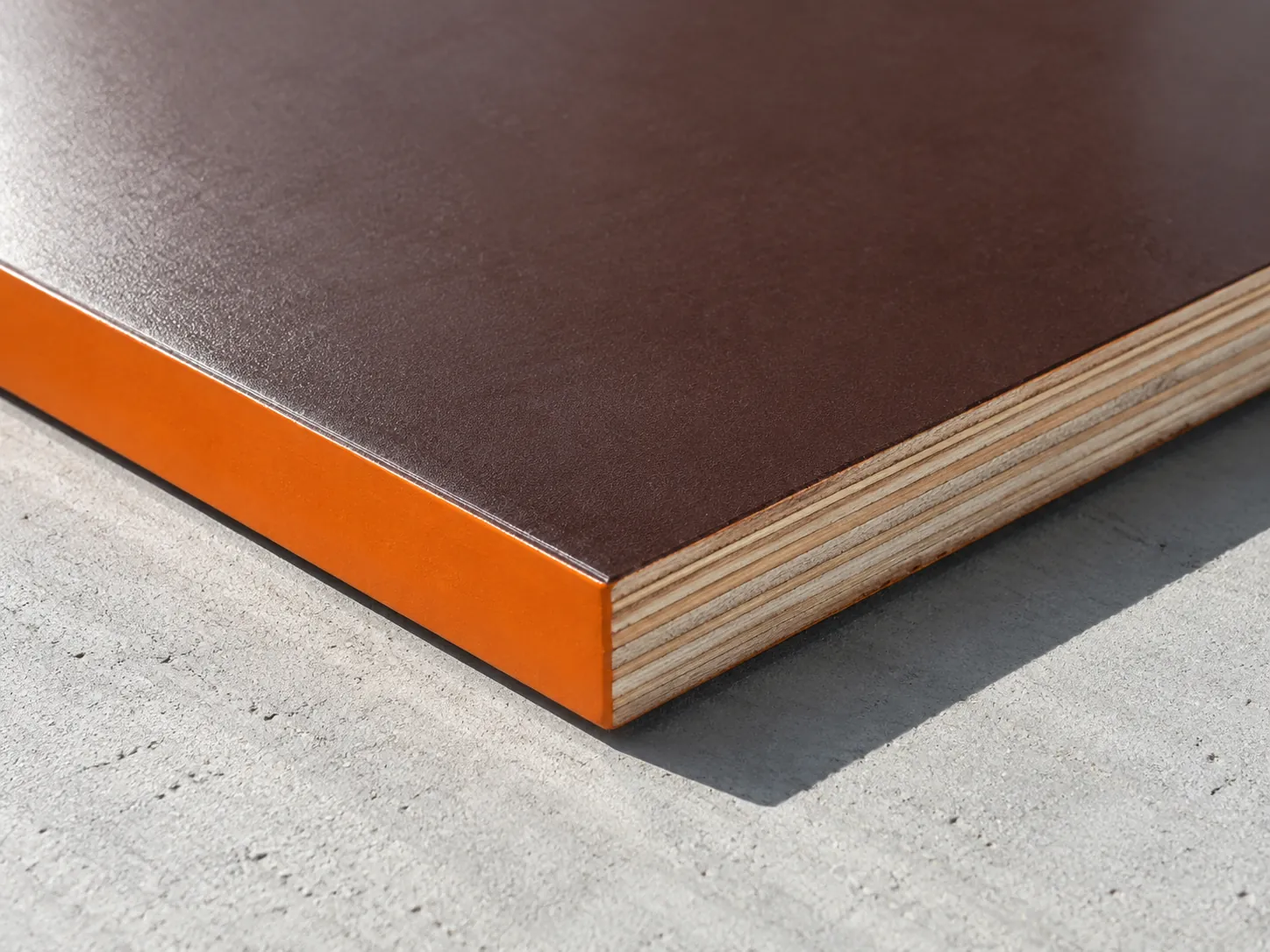
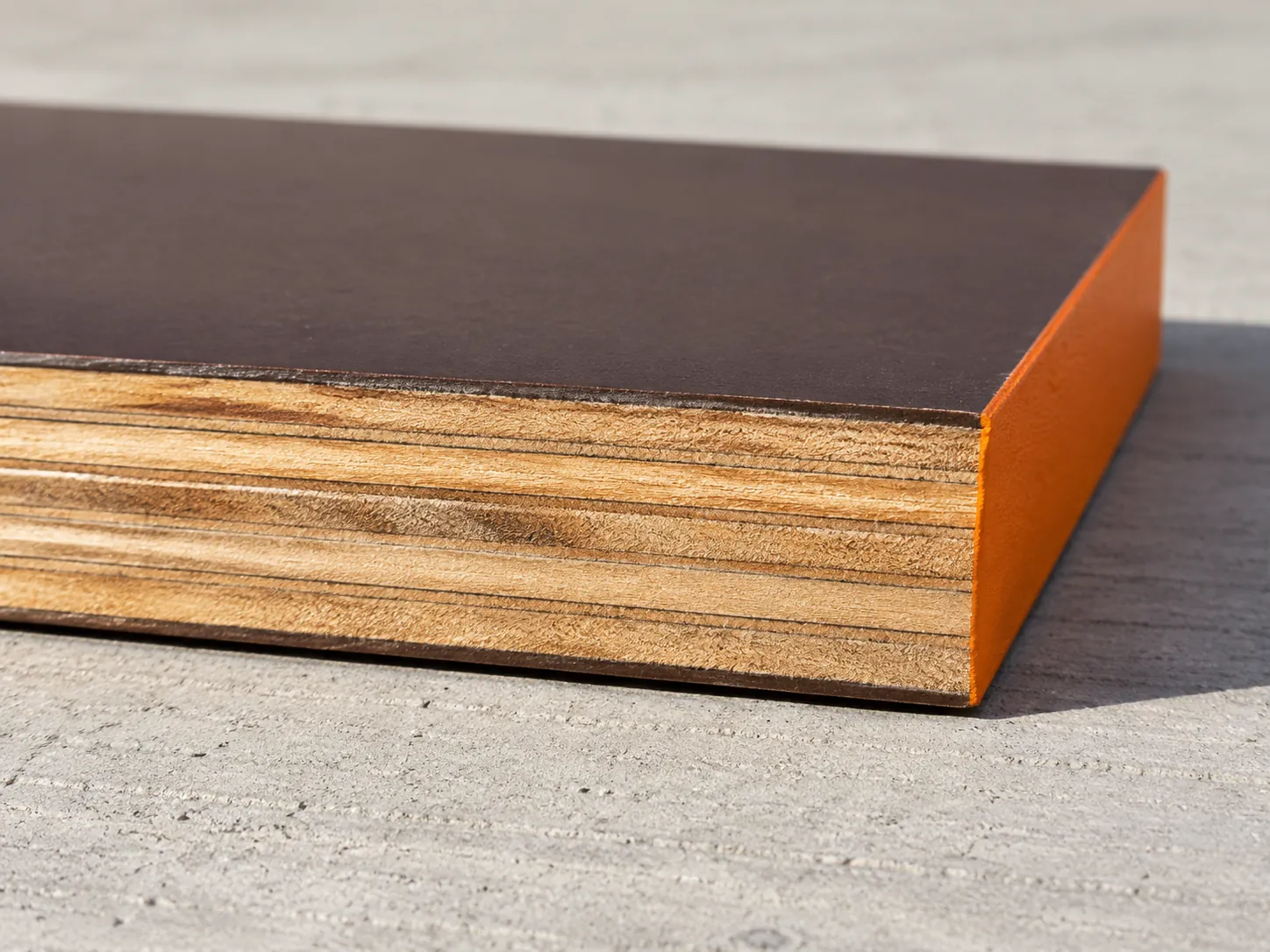
Our hardwood-core panel has five parts from face to face: phenolic film, a smooth hardwood face veneer, a cross-laid Acacia or Eucalyptus core, the back face veneer and a second film, with water-resistant paint on all four edges. Each part does the job the birch build does, with plantation hardwood in the core.
- Film is phenolic-impregnated paper pressed into both faces. Its weight is an order field, from 120–125 g/m² to 165, 185 or over 200 g/m².
- Face veneers under the film are smooth hardwood, chosen so the film stays flat over them.
- The core is Acacia or Eucalyptus veneer, each layer at right angles to the next, which keeps the panel stiff in both directions and stops it cupping when one face is wet.
- Glue lines are MUF or phenolic; the glue decides how many wet cycles the bond survives.
- Edge paint closes the end grain on all four sides, where water enters any plywood first.
The panel is pressed twice. The core is glued and hot-pressed at about 130–145 °C for phenolic bonds. It is then sized and sanded to an even thickness, so the film press puts the film on a panel that is already flat. Thickness tolerance is ±0.5 mm and length and width ±2 mm, written on each order’s technical sheet. The two-stage pressing page shows why the film press comes last.
Which sheet sizes can you press compared with birch panels?
We press 1220 × 2440 mm and 1250 × 2500 mm sheets, or cut to a cutting list, in 9–40 mm, and nothing larger than 1250 × 2500 mm. Birch formwork panels also come in 1500 and 1525 mm widths and lengths up to 3000–3660 mm, so a frame system built for those large formats still needs birch.
One EU-made birch forming panel is listed in thicknesses of 6.5 to 50 mm, with a maximum size of 1525 × 3660 mm. Large formats exist because some frame and table systems are designed around them: fewer joints per wall and fewer sheets to lift with a crane.
| Format | Typical use | Film faced birch plywood | Our hardwood-core panel |
|---|---|---|---|
| 1220 × 2440 mm (8 × 4 ft) | Decks and walls in the Gulf, India, Africa, UK trade | Yes | Yes |
| 1250 × 2500 mm | European beam decks and systems | Yes | Yes |
| Cut to a cutting list, within 1250 × 2500 mm | Frame facings, columns, beam sides | Yes | Yes |
| 1500 × 3000 mm and 1525 × 3050 mm | Large frame and table forms | Yes | No |
| Over 40 mm thick | Heavy special forms | Up to 50 mm on one range | No; our range ends at 40 mm |
If your system uses an 1250 × 2500 mm deck or a cut facing inside it, our panel fits. The 21 mm EU-format panel is the sheet most European beam decks take, and the cut-to-size formwork panels page covers facings cut to a list. For frame-system replacement facings in detail, see our note on replacement facing for frame formwork.
Are your hardwood-core panels certified to AS 6669 for formwork?
Yes. Our formwork plywood is certified to AS 6669:2016, the Australian standard for formwork plywood, by CMI Certification, a JAS-ANZ-accredited product certification body. The certificate names the product as formwork plywood for formwork, with no conditions or limitations listed.
That matters for Australian and New Zealand buyers who used to order birch formply by habit. The certificate covers formwork plywood as a product; it does not state a stress grade, a thickness or a glue, so we do not claim an F-grade from it. A stress-graded panel for structural design in Australia is a separate question from AS 6669 formwork certification, and your formwork engineer sets which one the job needs.
For other markets the panel carries other documents. In Europe our CE route is EN 13986:2004+A1:2015 under AVCP System 2+, with factory production control certificate 0407-CPR-2146 from Istituto Giordano, notified body 0407. Its scope is structural plywood in dry, humid and external use, 3.6–30 mm, MUF or phenolic glue. For the US, CARB Phase 2 and EPA TSCA Title VI documentation is held for applicable hardwood plywood up to 21 mm. The full set sits on our CE marking page and the certification hub.
EN 636, EN 314 and CE marking: what either panel must meet in Europe
In Europe both birch and hardwood-core formwork panels are ordered against the same standards: EN 636 for the use class, EN 314 for the bond and EN 13986 for CE marking. The species is not a class; a buyer orders humid or exterior plywood, and the bond test proves it.
EN 636 specifies requirements for plywood for general purposes or structural application in dry, humid or exterior conditions. Formwork is wet work, so a formwork panel is ordered as humid or exterior plywood whatever its species. The bond behind that class comes from the EN 314 tests: EN 314-2 specifies requirements for bonding classes of veneer plywood according to their end uses. Its companion part, EN 314-1, sets the test methods.
CE marking adds the factory side. Regulation (EU) No 305/2011 defines factory production control as the documented, permanent and internal control of production in a factory. For wood-based panels the harmonised standard is EN 13986, and EN 13986 covers characteristics, evaluation of conformity and marking of wood-based panels for use in construction.
Our test evidence follows the same route. SGS Vietnam tested one submitted 21 mm dark-brown film-faced specimen with an Acacia core and phenolic glue. Its report, issued 23 December 2025, gives density 642 kg/m³ (BS EN 323). Bonding was Class 3 PASS (EN 314-1/314-2) after 24 h water soak, boil-dry-boil and 72 h boiling pretreatments. Formaldehyde was not detected at the 0.04 mg/m³ reporting limit, E1 PASS (EN 717-1 chamber). It is specimen evidence for that configuration, not a guarantee for every panel. The SGS 21 mm specimen note sets out each method.
What a 40HC of hardwood-core panels holds against birch
A 40HC holds about 880 sheets of 18 mm Acacia-core panels in 1220 × 2440 mm (16 packs of 55, about 47.2 m³) or about 795 sheets with a Eucalyptus core (15 packs of 53, about 42.6 m³). Birch at 750 kg/m³ reaches the same 28,000 kg planning payload at about 37 m³, or about 696 sheets. These are planning figures until the packing list is made.
Dense panels fill a container by weight before they fill it by space. The planning payload is 28,000 kg of panels, unconfirmed until the carrier and route are fixed. At 750 kg/m³ that payload is 28,000 ÷ 750, about 37.3 m³; at 0.0536 m³ a sheet that is about 696 sheets of 18 mm birch. Each 1220 × 2440 mm sheet covers 2.98 m² of deck. The same container therefore carries about 2,620 m² of Acacia-core face, 2,370 m² of Eucalyptus-core face or 2,070 m² of birch face.
| 18 mm, 1220 × 2440 mm, one 40HC | Sheets | Volume | Formwork face |
|---|---|---|---|
| Acacia core, 16 packs of 55 | 880 sheets | About 47.2 m³ | About 2,620 m² |
| Eucalyptus core, 15 packs of 53 | 795 sheets | About 42.6 m³ | About 2,370 m² |
| Birch at 750 kg/m³, weight-capped | About 696 sheets | About 37.3 m³ | About 2,070 m² |
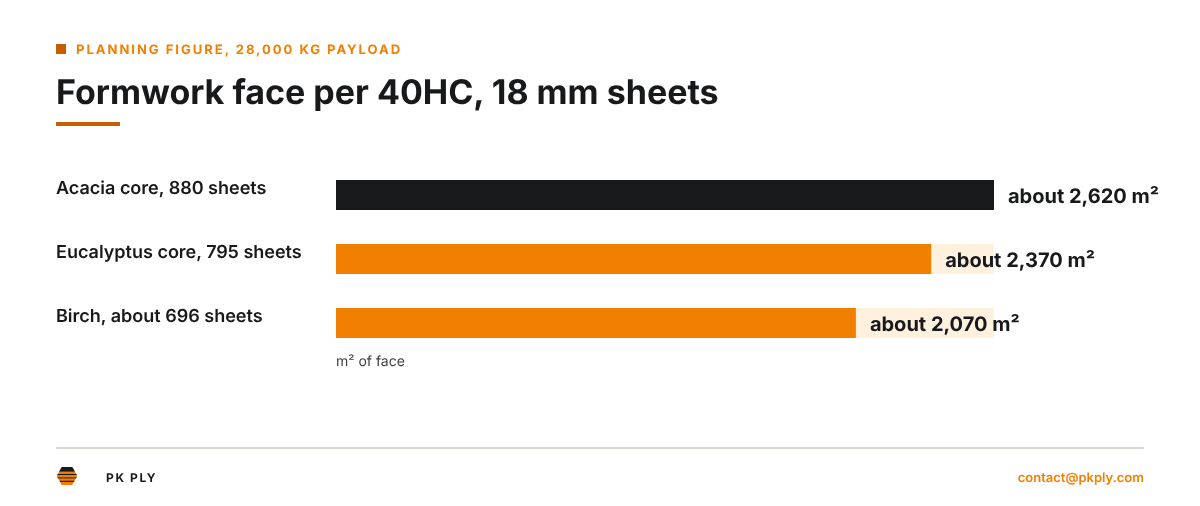
More face per container is less freight per square metre of formwork, before a single pour. Real sheets are weighed before final loading, and the packing list is the number that counts. The 40HC loading page shows how the packs go in, and the pallet loading calculator runs the count for other thicknesses.
Where birch film-faced plywood is still the better buy
Birch is still the better buy where a frame system needs 1500 × 3000 mm or larger sheets, where a panel over 40 mm is specified, and where a project specification names birch by species. In those cases our hardwood-core panel is the wrong sheet, and we say so before a quote.
- Large frame and table formats. Our presses stop at 1250 × 2500 mm, so 1500 and 1525 mm-wide facings stay birch.
- Very thick panels. Our range ends at 40 mm, and our CE scope ends at 30 mm; a heavier special form outside those limits is a birch job.
- A specification that names the species. Some architects and system owners write birch into the contract. A hardwood-core panel can meet the same EN 636 class, but a named species is a contract term, not a technical one.
- Very long programmes on one set of facings. Some contractors run one system for many dozens of pours, with crane time and storage to look after it. There a birch facing with heavy film may outlast a set of hardwood panels.
For everything else on a deck or wall, the hardwood-core panel does the work at a lower price per pour. Before switching a long-running birch system, run one container of hardwood-core panels on part of the job and count the pours.
Which panel for which job: a verdict by use
For slab decks, walls, columns and edge forms on 1220 × 2440 mm or 1250 × 2500 mm sheets, choose a hardwood-core film-faced panel: phenolic glue for long programmes, MUF for normal ones. Choose birch for large frame formats, panels over 40 mm or a contract that names birch.
| Job | Better choice | Why |
|---|---|---|
| Slab deck on beams or joists | Hardwood core, 18 or 21 mm, phenolic | Lighter sheets, more face per 40HC, up to about 25 pours with proper handling, release agent and sealed edges |
| Walls with a normal programme | Hardwood core, MUF | About 12–15 pours under the same care, lower price per sheet |
| Columns, beam sides, kickers | Hardwood core, 12 or 15 mm, cut to a list | Light to handle, cut sizes from the mill |
| Exposed fair-faced concrete | Either, with a heavy film | Film weight and flatness decide the face, not the species |
| Frame system with 1500 × 3000 mm facings | Birch | Our largest sheet is 1250 × 2500 mm |
| Panels over 40 mm | Birch | Our range ends at 40 mm |
| Anti-slip decks and walkways | Hardwood-core anti-slip | Patterned film on an Acacia or Eucalyptus core |
Hot and wet climates favour phenolic glue whatever the species. For decks and walkways, our anti-slip plywood carries a rice, hexagon or wire-mesh pattern on the same hardwood core.
Supply, timber origin and documents behind each panel
A hardwood-core panel from our mills comes from plantation Acacia and Eucalyptus. It ships with its document set: FSC chain of custody SGSHK-COC-370674 for eligible orders, the CE certificate, test reports for the agreed build and an EUDR geolocation dossier for EU lots. Birch supply runs through Nordic and Baltic mills, and sanctions have changed where birch can come from.
For FSC orders, the certified material can cover core, face and back, and the claim is printed on the sales documents. FSC labels products as FSC 100%, FSC Recycled or FSC Mix, and our certificate covers FSC 100% and FSC Mix plywood. The FSC plywood page shows the scope.
For EU buyers, the EUDR applies from 30 December 2026 to large and medium operators and to micro and small operators already under the EUTR, which includes plywood importers. Vietnam is classed low risk, and our dossier carries the geolocation files the importer needs for its own due-diligence statement; the EUDR geolocation dossier page lists what is in it. EU sanctions on Russian and Belarusian wood have moved much of the birch trade to other forests. Our note on birch supply after the sanctions covers what that means for a buyer.
Our mills ship up to 150 containers a month. A buyer who moves a programme from birch to hardwood core can plan repeat containers from one build sheet.
How to order a hardwood-core panel in place of birch
To replace birch with a hardwood-core panel, send the birch panel’s thickness, sheet size, film weight and pour target, then choose the core and glue. With those lines we return a build sheet and an FOB Hai Phong offer for the same job on an Acacia or Eucalyptus core.
| Line | What to write | Example replacing an 18 mm birch deck panel |
|---|---|---|
| Application and pours | What the panel forms, pours planned | Slab deck on beams, about 20 pours |
| Core | Acacia or Eucalyptus | Acacia, for weight and 40HC volume |
| Glue | MUF or phenolic | Phenolic |
| Film | Weight in g/m² and colour, both faces | 165 g/m², dark brown |
| Thickness and tolerance | mm, tolerance | 18 mm, ±0.5 mm |
| Sheet size | mm, or a cutting list | 1250 × 2500 mm |
| Edges | Edge paint on all four sides | Water-resistant paint |
| Quantity and port | Containers or m³, port of discharge | One 40HC, CIF Rotterdam |
Our standard terms follow from that sheet. The minimum order is one 40HC, which usually carries one or two products and up to six by agreement. Production takes 15–45 days after the 30% deposit, and the 70% balance is paid against the scanned bill of lading by T/T or irrevocable L/C at sight. We sell FOB Hai Phong, CFR or CIF.
Samples are free: new buyers book their own courier, and that cost can be credited against a real order. Put a sample next to your birch panel on the next pour, count the strikes, then send the eight lines through our specification form or to [email protected].
Questions buyers ask us
Is film faced birch plywood better than hardwood film faced plywood?
Not for every job. Birch has thinner, more even plies and comes in larger sheets, while an Acacia or Eucalyptus core is lighter per sheet and fills a 40HC with more formwork area; choose by the job, the sheet size your system needs and the cost per pour.
Can a hardwood-core panel replace birch on a slab deck?
Yes. On beam and joist decks with 1220 × 2440 mm or 1250 × 2500 mm sheets, an 18 or 21 mm phenolic-glue Acacia or Eucalyptus panel does the same work, with up to about 25 pours under proper handling, release agent and sealed edges.
Do you make birch film-faced plywood?
No. Our two mills in Chi Linh, Hai Phong press film-faced panels on Acacia or Eucalyptus cores only, with MUF or phenolic glue.
Why is birch film-faced plywood heavier?
Birch veneer is denser than our plantation hardwood veneers: one 12 mm Latvian birch film-faced sheet is listed at 750 kg/m³ and 27 kg, against about 580 kg/m³ and 20.7 kg for our 12 mm Acacia-core sheet.
Is an Acacia core lighter than a Eucalyptus core?
Yes. We plan Acacia at about 580 kg/m³ and Eucalyptus at about 650 kg/m³, so an 18 mm sheet of 1220 × 2440 mm weighs about 31.1 kg with Acacia and about 34.8 kg with Eucalyptus.
What is the largest sheet you can press?
1250 × 2500 mm. We also press 1220 × 2440 mm and cut to a cutting list, but nothing larger than 1250 × 2500 mm, so 1500 × 3000 mm birch-format facings are outside our range.
Which film weight should replace a birch panel's film?
Match the film weight the birch panel carried, written in g/m². Our orders run from 120–125 g/m² up to over 200 g/m², and about 130–135 g/m² is the most common now.
Are your hardwood-core panels CE marked?
Yes, inside the scope of our factory production control certificate 0407-CPR-2146 under EN 13986: structural plywood for dry, humid and external use, 3.6–30 mm, MUF or phenolic glue.
Can I mix Acacia and Eucalyptus panels in one container?
Yes. A container usually carries one or two products, and three to six can be mixed by agreement.
What is the minimum order for hardwood-core film-faced panels?
One 40HC. Production takes 15–45 days after the 30% deposit, and we sell FOB Hai Phong, CFR or CIF.
Can I get a sample to test against my birch panels?
Yes. Samples are free; new buyers book their own courier, and the courier cost can be credited against a real order.