
The formwork plywood price that matters is the landed sheet cost divided by the pours your site reaches: about 12–15 for our MUF build and up to about 25 for phenolic, with proper handling, release agent and sealed edges. PK Ply quotes per cubic metre so buyers can run that sum; comparing sheet prices alone often buys the dearer panel.
How do I work out the cost per pour of formwork plywood?
Work out the cost per pour of formwork plywood by dividing the landed cost of one sheet by the pours your site actually gets from it at the finish you need. Landed cost is the price per cubic metre plus freight, duty and delivery, multiplied by the sheet volume. Pours come with conditions: handling, release agent and sealed edges.
The formula has two halves, and each one has a trap. The top half is the landed sheet cost, not the quoted price: two offers on different Incoterms, cores or thicknesses only compare once they are landed. The bottom half is the pours reached on your site, not a figure in a brochure: our MUF build gives about 12–15 pours and our phenolic build up to about 25, with proper handling, release agent on every pour and sealed edges, and budget panels typically give about 4–10.
- Land the price. Price per m³ on its Incoterm, plus freight per m³, duty, port charges and delivery to site.
- Turn it into a sheet. Multiply by the sheet volume, for example 0.0536 m³ for an 18 mm sheet of 1220 × 2440 mm.
- Add the site costs per sheet. Release agent, edge sealer, cleaning and repairs over the sheet’s life.
- Divide by the pours reached. Use your own pour history where you have it, at the finish the project needs.
Our pour cost calculator runs the same steps. The sections below work through each half with our builds, our container loads and listed sheet prices.
Why is a price per sheet not enough to compare formwork offers?
A price per sheet is not enough because it says nothing about the pours a sheet will give, and the pours are the bottom half of the cost. Two sheets called film-faced plywood at the same price can be a budget build at about 4–10 pours and a phenolic build at up to about 25, with proper handling, release agent and sealed edges.
What changes between two offers with the same name sits inside the panel: core grade and how core veneers are joined, the glue system, the film weight, the edge sealing and the thickness tolerance. None of it shows in a photograph, and all of it moves either the price or the pours. A buyer who compares sheet prices alone tends to buy the build that saved on exactly those lines.
A sheet price also hides the volume. An 18 mm sheet of 1220 × 2440 mm holds 0.0536 m³; a 1250 × 2500 mm sheet of the same thickness holds 0.0563 m³. A cheaper sheet that is thinner, smaller or out of tolerance is not cheaper per cubic metre. The standard written on the offer is a first check. EN 636 specifies requirements for plywood for general purposes or structural application in dry, humid or exterior conditions. An offer that names its EN 636 service class and its glue system can be compared; one that names only a thickness and a colour cannot.
Is phenolic glue formwork plywood cheaper per pour than melamine glue?
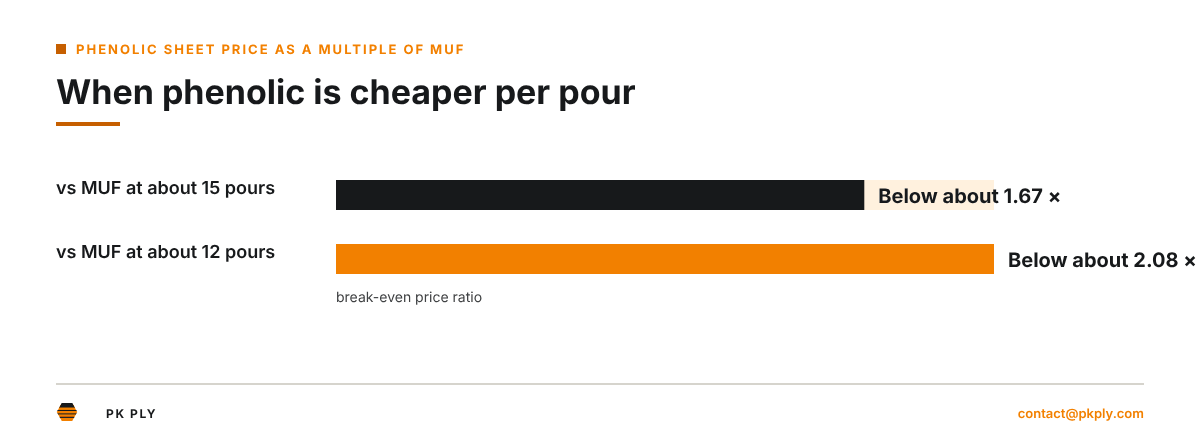
Yes, on any programme that uses its extra pours. If both builds reach their figures, phenolic glue at up to about 25 pours is cheaper per pour than melamine (MUF) glue at about 15 for as long as the phenolic sheet costs less than about 1.67 times the MUF sheet; against MUF at about 12 pours, the margin rises to about 2.08 times.
The arithmetic is a ratio of pours. A phenolic sheet that gives 25 pours where a MUF sheet gives 15 can cost 25 ÷ 15 times as much and still match it per pour. Below that price ratio, phenolic is cheaper per pour; above it, MUF is.
| Comparison, both builds reaching their figures | Pour ratio | Phenolic is cheaper per pour while its sheet price is below |
|---|---|---|
| Phenolic up to about 25 vs MUF about 15 | 25 ÷ 15 | About 1.67 × the MUF price |
| Phenolic up to about 25 vs MUF about 12 | 25 ÷ 12 | About 2.08 × the MUF price |
Pours with proper handling, release agent on every pour and sealed edges.
Two things decide whether the ratio holds on your job. First, the programme: on a job of about twelve pours, the phenolic panel’s extra pours are never used, and the lower MUF sheet price wins outright.
Second, the site: a crew that pries panels off and leaves cut edges raw does not reach either figure, and a phenolic panel bought for twenty-five pours that gives ten is the most expensive panel on the deck. Why the glue line matters is set out in the bonding standards. EN 314-2 specifies requirements for bonding classes of veneer plywood according to their end uses. Our phenolic film-faced plywood and melamine film-faced plywood pages list each build.
Can a budget panel ever be cheaper per pour?
Yes, but only at a deep discount or on a short programme. A budget panel at about 4–10 pours matches a MUF panel at about 15 per pour only if it costs about 0.27–0.67 times the MUF sheet price; against MUF at about 12, about 0.33–0.83 times. On a job of a few pours, its low price wins.
| Budget panel, about 4–10 pours, against | Budget sheet must cost less than |
|---|---|
| Our MUF build, about 15 pours | About 0.27–0.67 × the MUF price |
| Our MUF build, about 12 pours | About 0.33–0.83 × the MUF price |
Pours with proper handling, release agent and sealed edges.
The wide band is the honest part of this table. A budget panel that gives four pours has to be very cheap to compete; one that gives ten is close to a MUF panel on a short programme. What the band does not show is the cost of a panel that fails on the deck: a swollen joint that prints on a fair-faced soffit, paste leaking through an open edge, or a delaminated sheet replaced mid-pour. Those costs belong in the top half of the formula. Our note on how many pours a panel gives explains why budget panels stop early.
From a price per m³ to a landed sheet price
A mill price per cubic metre becomes a landed sheet price in three steps: add freight, duty and local costs per cubic metre, then multiply by the sheet volume. For an 18 mm sheet of 1220 × 2440 mm the volume is 0.0536 m³, so a landed price per m³ times 0.0536 is the landed cost of one sheet.
| Thickness, 1220 × 2440 mm | Sheet area | Sheet volume | Sheets per 40HC, Acacia core (planning) |
|---|---|---|---|
| 12 mm | 2.98 m² | 0.0357 m³ | 1,328 sheets |
| 15 mm | 2.98 m² | 0.0447 m³ | 1,056 sheets |
| 18 mm | 2.98 m² | 0.0536 m³ | 880 sheets |
| 21 mm | 2.98 m² | 0.0625 m³ | 752 sheets |
The volume column is the bridge between a container price and a site price. Freight is paid per container and spread over the sheets in it, so it is worth working per m³ first and per sheet last. Duty is set by the destination and the tariff line, and port and delivery costs by the importer’s own route; our import note lists the documents and steps for the main markets.
We quote in the same unit. Our offers are FOB Hai Phong, CFR or CIF per cubic metre for the build you specify, so the first step of the formula is already on the page. Prices are not published as a list, because glue, film weight, core and thickness all change the price per cubic metre.
How many square metres of formwork does one 40HC of 18 mm panels cover?
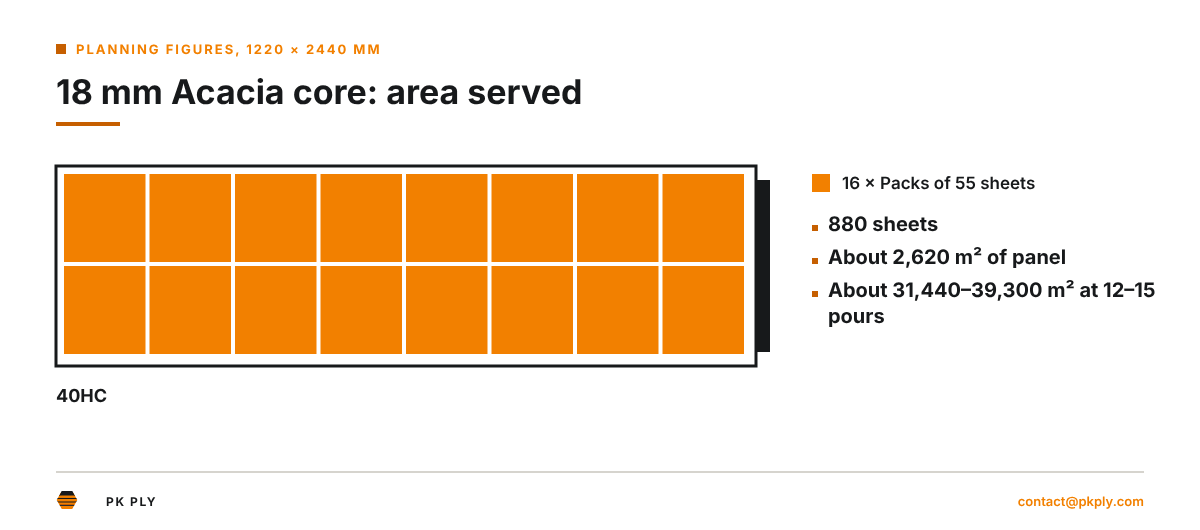
One 40HC of 18 mm film-faced panels in 1220 × 2440 mm covers about 2,620 m² with an Acacia core (880 sheets) and about 2,367 m² with a Eucalyptus core (795 sheets), as planning figures. Multiplied by the pours reached, that is the formwork area one container serves over its life.
| 18 mm, 1220 × 2440 mm, one 40HC (planning) | Acacia core | Eucalyptus core |
|---|---|---|
| Sheets | 880 sheets (16 × 55) | 795 sheets (15 × 53) |
| Panel area | About 2,620 m² | About 2,367 m² |
| Formwork area served at about 12–15 pours (MUF) | About 31,440–39,300 m² | About 28,404–35,505 m² |
| Formwork area served at up to about 25 pours (phenolic) | About 65,500 m² | About 59,175 m² |
Pours with proper handling, release agent on every pour and sealed edges. Planning figures until the packing list is made.
The area served is the number to put against the container’s landed cost. Divide one by the other and the result is the plywood cost per square metre of formwork per pour, before labour, props and beams. It also shows why a phenolic container that costs more can still be the cheaper container: it serves up to about 65,500 m² of Acacia-core deck against about 39,300 m² at the top of the MUF range. The 40HC loading page shows how the packs go in.
How does an Acacia or Eucalyptus core change container fill and cost per sheet landed?
An Acacia core fills a 40HC with more sheets than a Eucalyptus core, because Acacia is lighter: about 880 sheets of 18 mm in 1220 × 2440 mm against about 795, where weight stops the Eucalyptus load first. Freight per container is the same, so each Eucalyptus sheet carries about 11% more freight.
The cause is density. Our planning densities are 580 kg/m³ for Acacia and 650 kg/m³ for Eucalyptus, which is measured at 650–750 kg/m³. With a planning payload of 28,000 kg, an Acacia-core load of 18 mm sheets reaches about 47 m³ before the weight limit, while a Eucalyptus-core load stops at about 43 m³.
| 18 mm, 1220 × 2440 mm, one 40HC (planning) | Acacia core | Eucalyptus core |
|---|---|---|
| Density, planning | 580 kg/m³ | 650 kg/m³ |
| Weight per sheet | About 31.1 kg | About 34.8 kg |
| Sheets per 40HC | 880 sheets | 795 sheets |
| Volume per 40HC | About 47.2 m³ | About 42.6 m³ |
| Freight share per sheet, Acacia = 1 | 1 | About 1.11 |
That 11% is on freight only, not on the whole price. On a long sea route, where freight is a large part of the landed cost, it matters more than on a short one. Against it sits what the denser core gives: a stiffer, heavier panel that some buyers prefer for wide support spacing. The choice is weight against stiffness and freight. Real sheets are weighed before final loading, and the packing list is the number that counts.
Formwork plywood prices on retail shelves, per pour (November 2026)
Retail shelves price formwork plywood per sheet, with stock, VAT and local delivery inside the number. In November 2026 an 18 mm film-faced shuttering sheet was listed in Saudi Arabia at SAR 102.64 including 15% VAT, and an 18 mm softwood shuttering sheet without film in the UK at £26.35. Dividing a shelf price by the pours shows what each pour costs.
| Market | Panel as listed | Listed price |
|---|---|---|
| Saudi Arabia | 18 mm film-faced shuttering plywood, 1220 × 2440 mm | SAR 102.64 per sheet including 15% VAT, listed price checked 12 November 2026 (Madar) |
| United Kingdom | 18 mm softwood shuttering plywood, 1220 × 2440 mm, no film | £26.35 per sheet, listed price checked 12 November 2026 (Builders Merchant) |
| Our mills | 12–21 mm film-faced, MUF or phenolic, Acacia or Eucalyptus | FOB Hai Phong per m³ for your build, one 40HC minimum |
Each row is a listed price as shown on the day it was checked; shelf prices move with stock, exchange rates and VAT. What a listed sheet price comes to per pour depends only on the pours it reaches. At SAR 102.64, a sheet that gives about 4 pours costs about SAR 25.66 per pour, about 10 pours about SAR 10.26, about 15 pours about SAR 6.84, and about 25 pours about SAR 4.11. The listing does not state a pour count for that sheet, so the row reads as a scale, not a rating of the product.
The UK row is a different kind of sheet: softwood without a film face, sold for shuttering where the concrete finish does not matter. It is the sheet a site buys for blinding or a one-off pour, not for a repeating slab programme. A merchant price also pays for the stock it holds, the single sheet it sells and the van that delivers it; a container buyer takes those jobs on and pays per cubic metre instead.
Formwork cost per square metre and per square foot
The plywood share of formwork cost per square metre per pour is the landed sheet cost divided by the sheet area and by the pours. A 1220 × 2440 mm sheet covers 2.98 m², about 32 sq ft. At a listed SAR 102.64, that is about SAR 34.48 per m² of panel, or about SAR 2.30 per m² per pour at about 15 pours.
The square-foot figure follows from the definition of the foot. Schedule 1 of the Weights and Measures Act 1985 defines the yard as 0.9144 metre and the foot as 1/3 yard. A foot is therefore 0.3048 m, and a 4 × 8 ft sheet is very close to our 1220 × 2440 mm sheet.
| Listed SAR 102.64 sheet, 1220 × 2440 mm | Per m² | Per sq ft |
|---|---|---|
| Panel cost | About SAR 34.48 | About SAR 3.21 |
| Per pour at about 15 pours | About SAR 2.30 | About SAR 0.21 |
| Per pour at about 25 pours | About SAR 1.38 | About SAR 0.13 |
Pour counts with proper handling, release agent and sealed edges; the listing itself states no pour count.
These are plywood costs only. Formwork cost per square foot quoted by contractors also carries labour, beams, props, release agent and the system’s hire or depreciation, and on many jobs the plywood is the smaller part. That is a reason to get the plywood share right, not to ignore it: the plywood is the part that wears out pour by pour, and the part a buyer chooses.
Which site practices raise the number of pours from each sheet?
Five site practices raise the pours from each sheet: release agent on every pour, sealing every cut edge and hole the same day, stripping without prying, cleaning residue at once with plastic or wooden scrapers, and storing panels flat and covered. Each extra pour lowers the cost per pour without changing the price paid.
- Release agent on every pour. A thin, even coat on the clean film; the face releases without force.
- Seal cuts and holes. Every saw cut and tie-rod hole is raw wood until painted; seal it before the panel goes in.
- Strike without prying. Bars at the corners tear film and crush edges.
- Clean at once. Scrape residue while it is soft, with plastic or wood, never a steel blade.
- Store flat and covered. Level bearers off the ground, film to film, out of sun and rain, with air between stacks.
The money is in the bottom half of the formula. A phenolic sheet built for up to about 25 pours that gives fifteen on a careless site costs two-thirds more per pour than the same sheet on a careful one. No price negotiation saves that much. Our shuttering ply note covers the build behind these practices.
The costs a sheet price leaves out
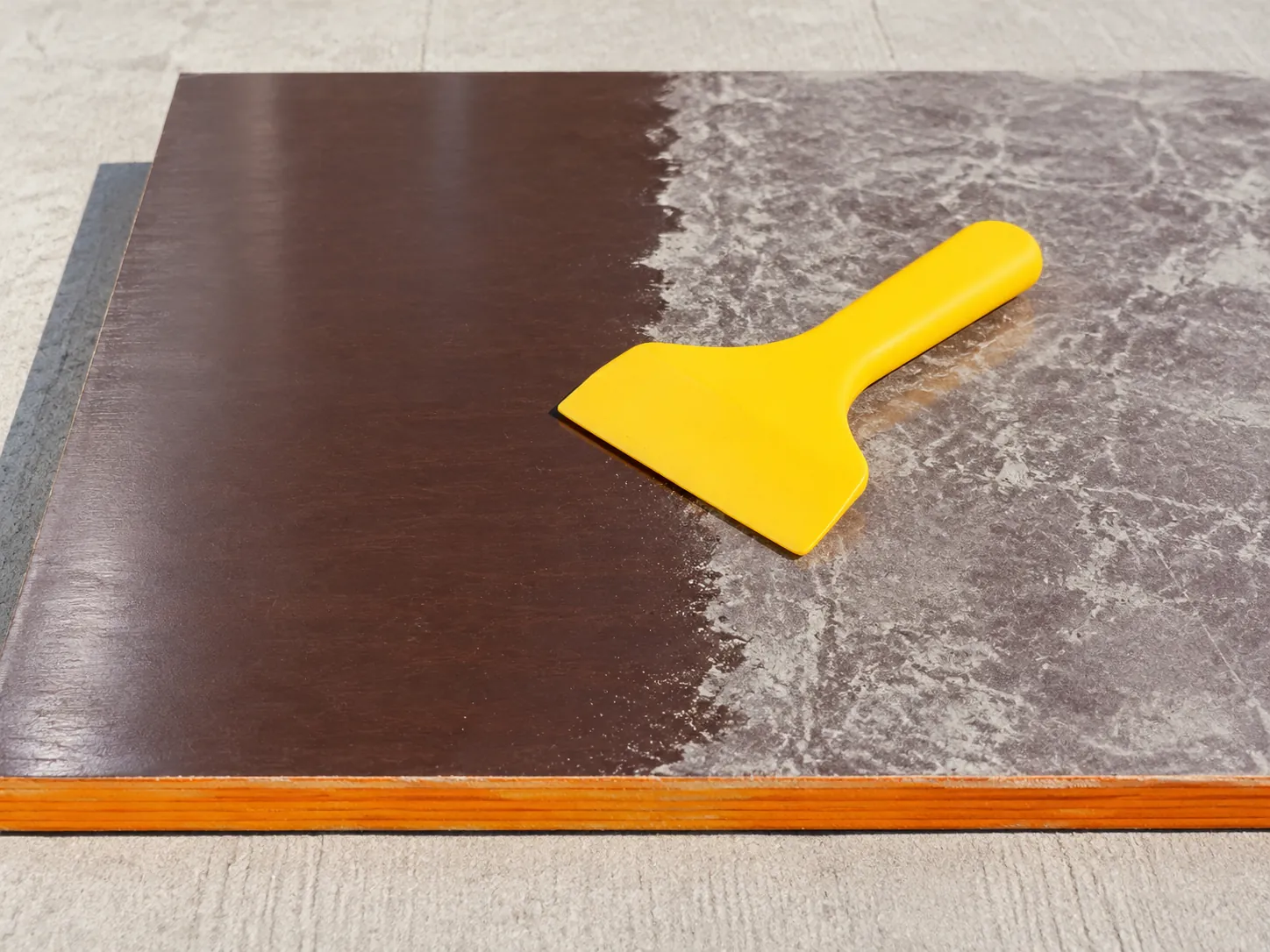
A sheet price leaves out what it costs to keep the sheet working: release agent, edge sealer, cleaning time, repairs, handling between floors, and concrete rework when a worn face marks a visible surface. The full cost per pour adds these to the landed sheet cost before dividing by the pours reached.
The fuller formula reads:
(landed sheet cost + release agent + edge sealer + cleaning and repairs + handling) ÷ pours reached at the required finish
Two habits keep it comparable between offers. Use the same scope for both: if one landed cost stops at the port and the other includes delivery to site, the comparison is wrong. And count pours by the same rule: a count that includes concealed pours after the face has worn cannot be laid next to one that counts only fair-faced soffits.
Some of these costs fall as the build improves. A heavier film needs less repair; a phenolic glue line does not open at the edges; a calibrated panel leaves flatter joints and less grinding of the concrete. Others rise with the build: a heavier panel takes longer to handle. The worksheet further down puts them side by side.
Does a thicker panel cost more per pour?
Usually yes. A 21 mm sheet holds about 17% more volume than an 18 mm sheet, so at the same price per cubic metre it costs about 17% more, and the glue line, the film and the site, not the thickness, set the pours. Choose the thickness the support spacing needs, then choose the build for the pours.
| 1220 × 2440 mm sheet | Volume | Weight, Acacia core | Sheets per 40HC, Acacia (planning) |
|---|---|---|---|
| 18 mm | 0.0536 m³ | About 31.1 kg | 880 sheets |
| 21 mm | 0.0625 m³ | About 36.3 kg | 752 sheets |
Thickness earns its cost in stiffness. A panel that is too thin for its supports bends on every pour, prints the bend on the concrete and fatigues its glue lines; there the thicker sheet is the cheaper one per acceptable pour. Where the formwork system is drawn around 18 mm, a 21 mm sheet adds cost and weight without adding pours. Our 18 mm note and 21 mm note give each build.
What FOB, CFR and CIF include in a formwork plywood price
FOB Hai Phong covers the panels loaded on board at Hai Phong; CFR adds the sea freight to your port; CIF adds the marine insurance as well. Duty, port charges and delivery to site are the importer’s under all three, so they are added before the price becomes a landed sheet cost.
Incoterms rules are a set of eleven three-letter trade terms reflecting business-to-business practice in contracts for the sale and purchase of goods. We sell on FOB Hai Phong, CFR (CNF) or CIF only. The payment terms are the same on all three: a 30% deposit, then the 70% balance against the scanned bill of lading, by T/T or irrevocable L/C at sight.
| Term | Price includes | Importer adds before cost per pour |
|---|---|---|
| FOB Hai Phong | Panels loaded on board at Hai Phong | Sea freight, insurance, duty, port, delivery |
| CFR | FOB plus sea freight to the named port | Insurance, duty, port, delivery |
| CIF | CFR plus marine insurance | Duty, port, delivery |
Typical days at sea from Hai Phong are 15–25 to the Middle East, 25–35 to the Mediterranean and 30–40 to Northern Europe, varying by carrier and route. Time at sea does not enter the cost per pour, but it sets when the first pour can happen.
A cost-per-pour worksheet for two offers
Put two offers in the same worksheet and fill every line before comparing the bottom row. The lines are the build, the price per m³ and its term, the landed cost per m³, the sheet volume, the landed sheet cost, the site costs per sheet, the pours reached and, last, the cost per pour.
| Line | Offer A | Offer B |
|---|---|---|
| Build: glue, film weight, core, thickness | e.g. MUF, 130–135 g/m², Acacia, 18 mm | e.g. phenolic, 165 g/m², Acacia, 18 mm |
| Price per m³ and Incoterm | From the quote | From the quote |
| Freight, duty, port, delivery per m³ | Your route | Your route |
| Landed cost per m³ | Sum of the two lines above | Sum of the two lines above |
| Sheet volume | 0.0536 m³ | 0.0536 m³ |
| Landed sheet cost | Landed cost per m³ × volume | Landed cost per m³ × volume |
| Site costs per sheet over its life | Release agent, sealer, cleaning, repairs | Release agent, sealer, cleaning, repairs |
| Pours reached at the required finish | About 12–15 | Up to about 25 |
| Cost per pour | (Landed sheet cost + site costs) ÷ pours | (Landed sheet cost + site costs) ÷ pours |
Pours with proper handling, release agent on every pour and sealed edges; replace them with your own pour log once you have one.
The worksheet does one more job: it shows which line is missing from a quote. An offer without a glue system, a film weight or a thickness tolerance cannot be put in the first row, and a panel that cannot be described cannot be costed per pour. Compare quotes line by line with our price drivers note.
The lines to send for a cost-per-pour quote
Send the programme and the pour target with the build lines, and we return a technical sheet and a price per cubic metre that drops straight into the formula: application and pours planned, glue, film weight and colour, core, thickness and sheet size, edge sealing, quantity and the port of discharge.
| Line | What to write | Example |
|---|---|---|
| Application and pour target | What it forms, pours planned | Slab soffits, about 20 pours |
| Glue | MUF or phenolic | Phenolic |
| Film | g/m² and colour | 165 g/m², dark brown, both faces |
| Core | Acacia or Eucalyptus | Acacia, more sheets per 40HC |
| Thickness and size | mm | 18 mm, 1220 × 2440 mm |
| Edges | Sealing | Water-resistant paint, all four edges |
| Quantity, term and port | 40HC, Incoterm, port | One 40HC, CFR Dammam |
We press these builds at our two mills in Chi Linh, Hai Phong, with capacity of up to 150 containers a month. The minimum is one 40HC, which can carry one or two builds and up to six by agreement, so a first container can hold a MUF and a phenolic build for a logged side-by-side test. Production takes 15–45 days after the 30% deposit. Send the lines through the specification form or to [email protected].
Questions buyers ask us
How do you calculate the cost per pour of formwork plywood?
Divide the landed cost of one sheet by the number of pours your site gets from it at the finish you need. Landed cost means the price per cubic metre plus freight, duty and delivery, multiplied by the sheet volume.
Is phenolic formwork plywood worth the extra price?
It is when the programme needs more than about 15 pours. If both builds reach their figures, phenolic at up to about 25 pours is cheaper per pour than MUF at about 15 while its sheet price is under about 1.67 times the MUF price.
How many square metres does a 40HC of 18 mm formwork plywood cover?
About 2,620 m² of 1220 × 2440 mm sheets with an Acacia core and about 2,367 m² with a Eucalyptus core, as planning figures. Multiplied by the pours reached, that is the formwork area the container serves.
Why is formwork plywood quoted per cubic metre?
Mills price the volume of wood, glue and film they press, and a container is filled by volume or weight. A price per m³ also lets buyers compare thicknesses: multiply by the sheet volume to get a sheet price.
What is the cheapest formwork plywood per pour?
The build whose landed sheet cost divided by the pours actually reached is lowest for your programme. A budget sheet at about 4–10 pours only wins if its price is a small fraction of a sheet that gives about 12–15.
Do you publish a formwork plywood price list?
No. We quote FOB Hai Phong, CFR or CIF per cubic metre for the build you specify, because glue, film weight, core and thickness change the price.
How much does freight add to the cost per pour?
Freight is paid per container, so it adds less per sheet when more sheets fit: 880 Acacia-core 18 mm sheets per 40HC against 795 with Eucalyptus, as planning figures. Divide the freight by the sheets, then by the pours.
Does a thicker formwork panel cost more per pour?
Usually yes: a 21 mm sheet holds about 17% more volume than an 18 mm sheet, so at the same price per m³ it costs about 17% more, while the glue line and film, not the thickness, set the pours.
What is the minimum order for a formwork plywood quote?
One 40HC, which can carry one or two builds and up to six by agreement. Production takes 15–45 days after the 30% deposit.
Which costs besides the sheet belong in cost per pour?
Release agent, edge sealer, cleaning, repairs, handling and any concrete rework caused by a worn face. Add them to the landed sheet cost before dividing by the pours.