
Yes: the Peri plywood, Doka facing or other sheet in a steel or aluminium frame can be replaced from another mill, if the new facing matches the old one in thickness, size and hole positions. A facing that is too thick, or has bare cut edges, steps at every joint and swells within a few pours. PK Ply cuts facings to your size list and paints every cut edge.
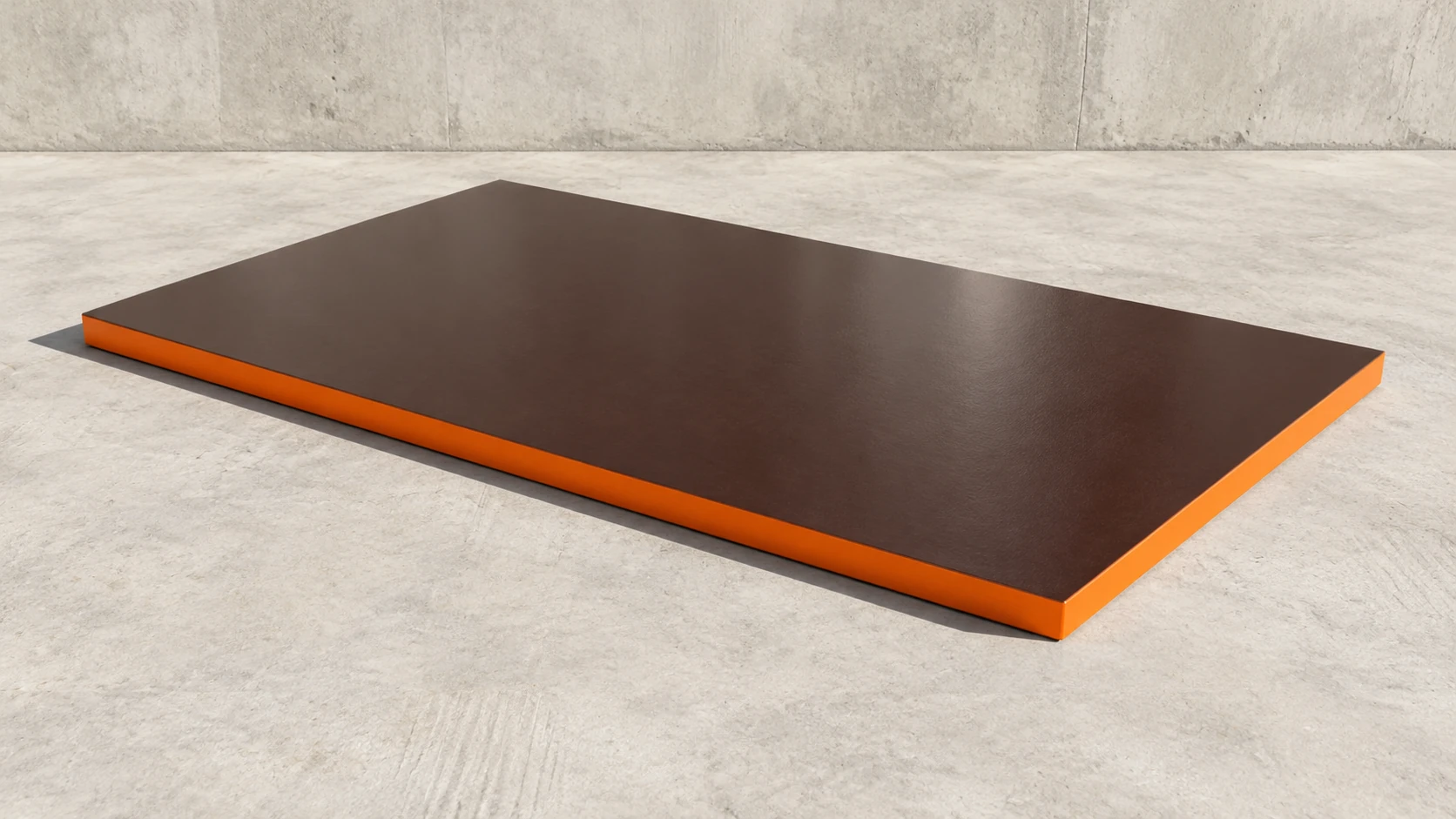
Can system frame formwork be re-faced with plywood from another mill?
Yes. A frame panel is a steel or aluminium frame with a plywood facing fixed into it, and the facing is the part that wears. Any film-faced sheet that matches the old facing in thickness, length, width, squareness and hole positions can be fitted, whichever mill pressed it. The frame maker’s approval is a separate question.
Frame owners re-face for a simple reason: the frame lasts for years, the plywood does not. After a run of wall or slab pours the film wears through, the edges near the fixings swell and the face starts to print its damage on the concrete. Replacing the steel would be waste. Replacing the plywood is maintenance, and one frame maker’s regional site says so directly. Panel products are available for maintenance of formwork systems.
PERI and Doka are trademarks of their owners and appear on this page only as frame systems a buyer may own. PK Ply has no affiliation with either company, and our facings carry no approval from any frame maker. What we supply is a film-faced plywood facing cut to your size list from our own sheets, with every cut edge painted, made at our two mills in Chi Linh, Hai Phong.
Three things decide whether a re-faced frame works as well as it did new:
- The facing fits the frame. Same thickness, same outer size, square corners, holes where the frame needs them. A mismatch shows on the concrete as a step or a gap at the joint.
- The facing is built for the pours. Film, glue and core decide how many pours the facing survives. The pour count by build is the number to match against your programme.
- Every cut and hole is sealed. A facing is cut on all four sides and drilled for fixings, so it has more open end grain than a full sheet. Paint on each of those surfaces decides how soon water gets in.
| What the frame owner asks | Short answer |
|---|---|
| Can another mill’s plywood be used? | Yes, if it matches thickness, size, square and holes |
| Is it approved by the frame maker? | We claim no approval; check your own contract terms |
| Which sheets are facings cut from? | Our 1220 × 2440 mm or 1250 × 2500 mm sheets, nothing larger |
| How are the cuts protected? | Water-resistant paint on every cut edge before packing |
| How many pours? | About 12–15 (MUF) or up to about 25 (phenolic) with proper handling, release agent and sealed edges |
What a replacement for Peri plywood must match on your frame
A replacement facing must match six things on the frame: thickness, length, width, squareness, the position and size of every hole, and the way it is fixed. Measure them on the frame and the old facing before you order, not from a catalogue drawing.
Start with the old facing still in the frame. Measure the thickness at the frame edge on all four sides, away from worn or swollen spots, with a calliper rather than a tape. Then take the facing out and measure length and width on both pairs of edges and both diagonals: equal diagonals mean the old facing was square, and a difference shows how far it had moved. Mark every hole on a drawing with its distance from two edges and its diameter, and note whether the holes are for fixings into the frame or for tie rods through the wall.
| Measurement | How to take it | What we hold on the new facing |
|---|---|---|
| Thickness | Calliper at four points on the frame edge, not on swollen areas | Your nominal thickness, ±0.5 mm |
| Length and width | Steel tape on both pairs of edges | Your size, ±2 mm |
| Squareness | Compare the two diagonals | Cut square to your size list; check before painting |
| Holes | Distance from two edges, diameter, purpose | Drilled on your bench, or a hole plan agreed at enquiry |
| Fixing | Screws, rivets or bolts; from the face or the back | Your choice; it decides whether the face carries fixing heads |
| Face side | Which film face goes to the concrete | Both faces filmed, so either face can be used |
Two numbers in that table set how well neighbouring frames meet. With a thickness tolerance of ±0.5 mm, two facings can differ by up to 1.0 mm in the worst case; with a length and width tolerance of ±2 mm, two facings can differ by up to 4 mm in size. A frame usually hides the size difference inside its profile, but a thickness step sits right on the concrete face, which is why thickness is the first number to fix. Our thickness tolerance note explains how the sanding step sets it.
Which thickness fits common frame panels, 15, 18 or 21 mm?
The frame fits the thickness it was built for, and nothing else. Heavy wall and slab frames commonly carry 18 mm facings, some 21 mm; lighter hand-set frames often use 15 mm or thinner. Measure the facing you are replacing and order the same nominal thickness, because the frame profile and the fixings are set to it.
A facing that is too thin sits below the frame edge and leaves a ridge on the concrete at every joint. A facing that is too thick stands proud of the profile, so the frame edges no longer meet and the screws or rivets pull at an angle. Neither problem can be fixed on site without packing or planing, and both cost the fair face you bought the system for.
Re-facing suppliers sell by system for that reason. One European re-facing supplier lists 18 mm birch plywood machined to fit Peri Trio panels and 15 mm birch plywood for Peri Domino panels. We do not make birch plywood. Our facings are hardwood-core film-faced panels in the same nominal thicknesses, and the comparison of birch film-faced and hardwood-core panels shows where each one fits.
| Thickness | Where it is common in frames | Weight per m², Acacia / Eucalyptus core |
|---|---|---|
| 12 mm | Small fillers, closures, light column forms | 6.96 kg/m² / 7.8 kg/m² |
| 15 mm | Light hand-set wall and column frames | 8.7 kg/m² / 9.75 kg/m² |
| 18 mm | Heavy wall frames and slab panels | 10.44 kg/m² / 11.7 kg/m² |
| 21 mm | Frames built for a thicker facing, fair-faced walls | 12.18 kg/m² / 13.65 kg/m² |
The weights are density times thickness at our planning densities of 580 kg/m³ for Acacia and 650 kg/m³ for Eucalyptus. Multiply by the facing area to get the weight of one facing: a hand-set frame stays hand-set only if the new facing is not heavier than the old one, so a crew that lifts frames by hand may prefer the Acacia core.
Our mills press 9–40 mm, and the everyday thicknesses are 12, 15, 18 and 21 mm. If your old facing measures a thickness outside those four, write the measured figure on the enquiry; anything inside the 9–40 mm range can be pressed to order.
What is the maximum sheet size we cut facings from?
We cut facings from 1250 × 2500 mm or 1220 × 2440 mm film-faced sheets, and we press nothing larger. The longest one-piece facing we can supply is therefore 2500 mm and the widest 1250 mm, cut to ±2 mm in length and width. A facing bigger than that needs a joint, or a large-format panel from another source.
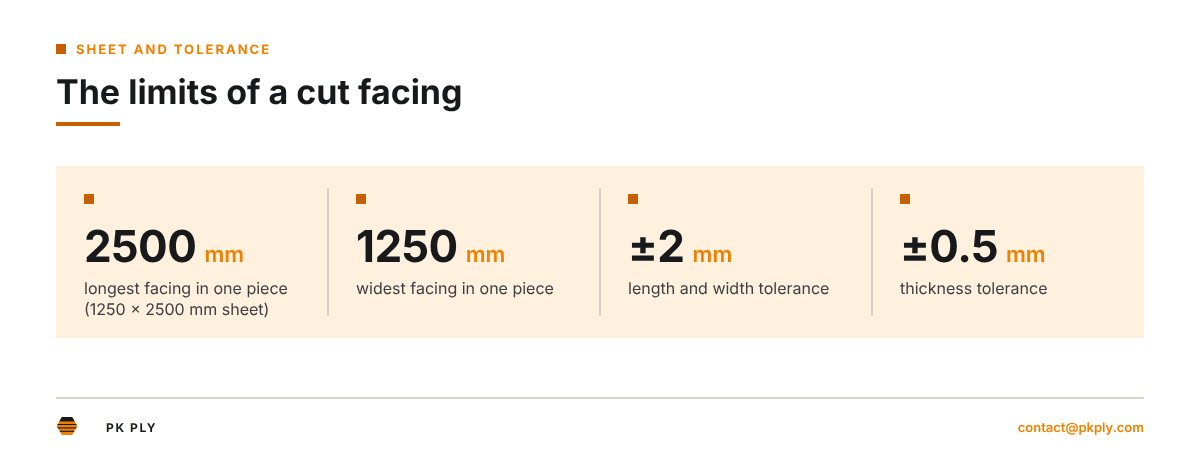
The two sheet sizes cover most frame facings. 1250 × 2500 mm is the common size for European systems and beam decks; 1220 × 2440 mm (8 × 4 ft) is the size of the Gulf, Indian, African and UK merchant trade. A facing is cut from whichever sheet leaves the smaller offcut for your size list, and the cut-to-size formwork panels page shows the sizes we cut most.
Three cases need a decision before the order:
- A facing exactly the size of a sheet. If your facing is 1250 × 2500 mm or 1220 × 2440 mm, you need a whole sheet, not a cut piece. It arrives with the mill’s painted edges and the sheet tolerance of ±2 mm.
- A facing longer than 2500 mm or wider than 1250 mm. We cannot cut it in one piece. Two pieces can be joined over a frame member, with both joint edges painted; a fair-faced wall will show that joint, so check with whoever approves the finish.
- Many small facings. Fillers, corner and column pieces are nested on full sheets so the offcuts stay small. Send all sizes on one list, and we plan the sheets for the whole order.
| Sheet | Area | Longest one-piece facing | Widest one-piece facing |
|---|---|---|---|
| 1250 × 2500 mm | 3.125 m² | 2500 mm | 1250 mm |
| 1220 × 2440 mm | 2.977 m² | 2440 mm | 1220 mm |
Use those areas to turn your size list into sheets and cubic metres before you ask for a price, because our offer is per cubic metre of the build you specify.
How we cut facings to your size list
Facings are cut in eight steps at our mills: your size list comes in, the build is fixed, sheets are chosen, each piece is cut to size and checked, every cut edge is painted, then each piece is marked with its size code and packed by size. The build is fixed before any sheet is cut.
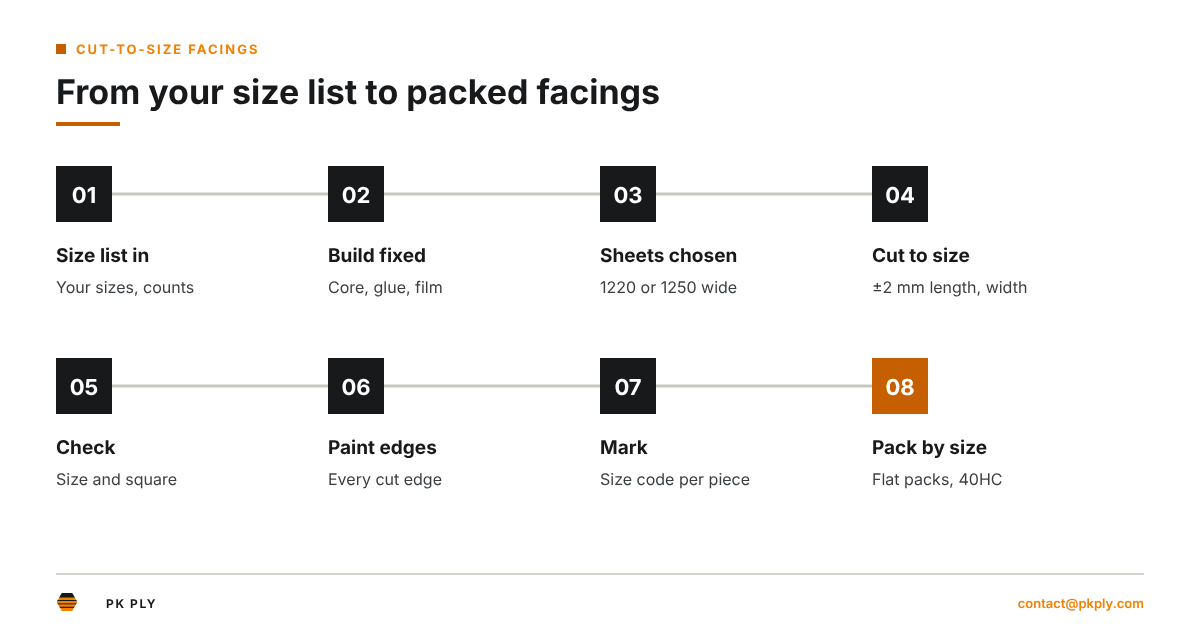
- Size list in. Each line gives length, width, thickness and count, with a code you use on site for that size.
- Build fixed. Core species, glue, film weight and colour, and edge paint colour are written on the order’s technical sheet. A size list without a build is two different products waiting to happen.
- Sheets chosen. We plan the cuts on 1220 or 1250 mm wide sheets to keep offcuts small.
- Cut to size. Pieces are cut to your length and width within ±2 mm.
- Check. Size and squareness are checked before the paint goes on, because a painted edge hides a bad cut.
- Paint edges. Every cut edge gets water-resistant paint, the same edge sealing a full sheet gets at the mill.
- Mark. Each piece is marked as your order asks, usually with its size code, so the site does not measure every facing again.
- Pack by size. Facings of one size are stacked flat in their own packs, strapped and covered for the container.
The facing is cut from a sheet that has already gone through the whole production line: veneer intake, drying, core lay-up, glue and press, sizing and sanding, film press and edge sealing. Cutting is the last step before marking and packing, so a cut facing has the same core, glue and film as the full sheet it came from. Our production process page shows the earlier steps.
How are cut edges and drilled holes sealed before shipping?
Every cut edge of a facing is painted with water-resistant paint before the facing is marked and packed, the same edge sealing every full sheet gets on our line. Holes follow the same rule: a hole made before packing has its wall painted like a cut edge, so no end grain leaves the mill open.
Paint on an edge does one job: it closes the end grain. Wood takes up water fastest through its cut ends, and a saw cut or a drilled hole exposes cut ends across every ply of the core. On a facing, that open area adds up quickly. A full sheet has four edges; a set of small facings cut from it has many more, plus every fixing and tie hole.
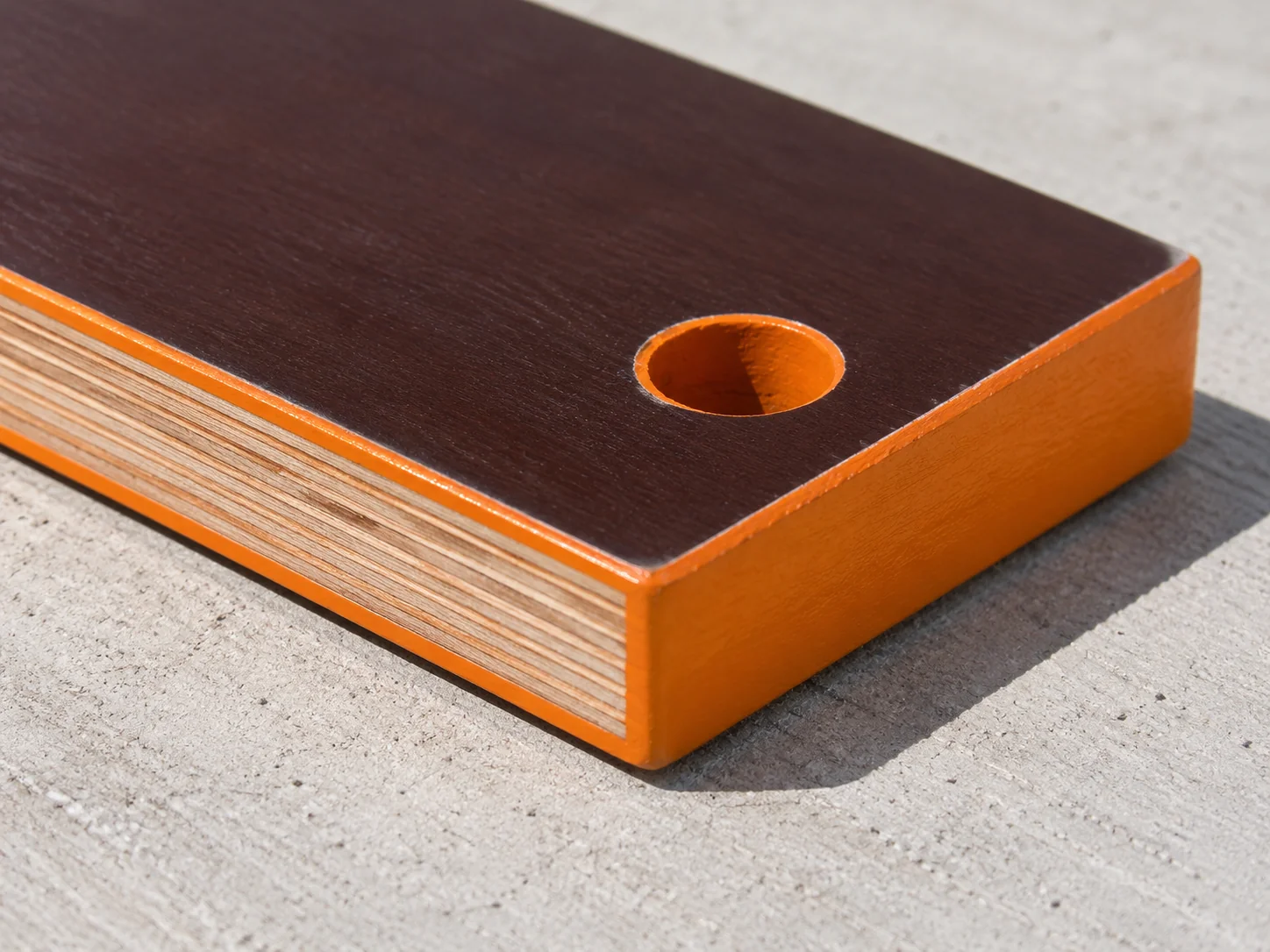
How the holes are made is agreed per order. Fixing and tie holes have to line up with the frame, so most frame owners drill them on their own bench with the frame as the template. If you want holes before shipping, send a dimensioned hole plan with the size list, and we confirm at enquiry whether holes are made on that order. Either way, a hole is only finished when its wall is sealed.
What leaves our mills, piece by piece:
- Cut edges: water-resistant paint on all four sides of every facing, in the colour on the order.
- Faces: phenolic film on both faces, unbroken, so either face can go to the concrete.
- Holes agreed on the order: wall painted before packing.
- Marking: size code or other marking as the order asks.
- Packing: flat packs by size, strapped and covered, so cut edges are not chipped in transit.
Our cut-to-size formwork panels page lists the edge paint colours and marking options in one place.
What to seal plywood edges with when you re-face a frame?
Seal plywood edges with a water-resistant edge sealant or paint made for plywood edges, brushed onto clean, dry wood on the day of the cut. Coat every saw cut, every drilled hole and every countersink, in two thin coats, before the facing sees its first pour.
The product type matters less than the habit. Merchants sell acrylic edge sealants, solvent-based edge paints and polyurethane sealers for formwork plywood, and any of them works on a cut you seal at once. None of them works on a cut that has already been rained on, because the wood under the coat is already wet.
A sealing routine for re-facing in the yard:
- Cut and drill on the bench. Make every site cut and hole before the facing goes into the frame, on a clean, dry bench.
- Brush off the dust. Sawdust in the end grain stops the coat from soaking in.
- First coat. Brush sealant into every cut edge and the full depth of every hole.
- Second coat. Once the first is dry to the touch, coat again. End grain drinks the first coat.
- Fix into the frame. Seal around fixing heads on the face side if your frame is fixed from the front.
- Touch up after each strike. Repaint chipped corners and edges when the frame is cleaned.
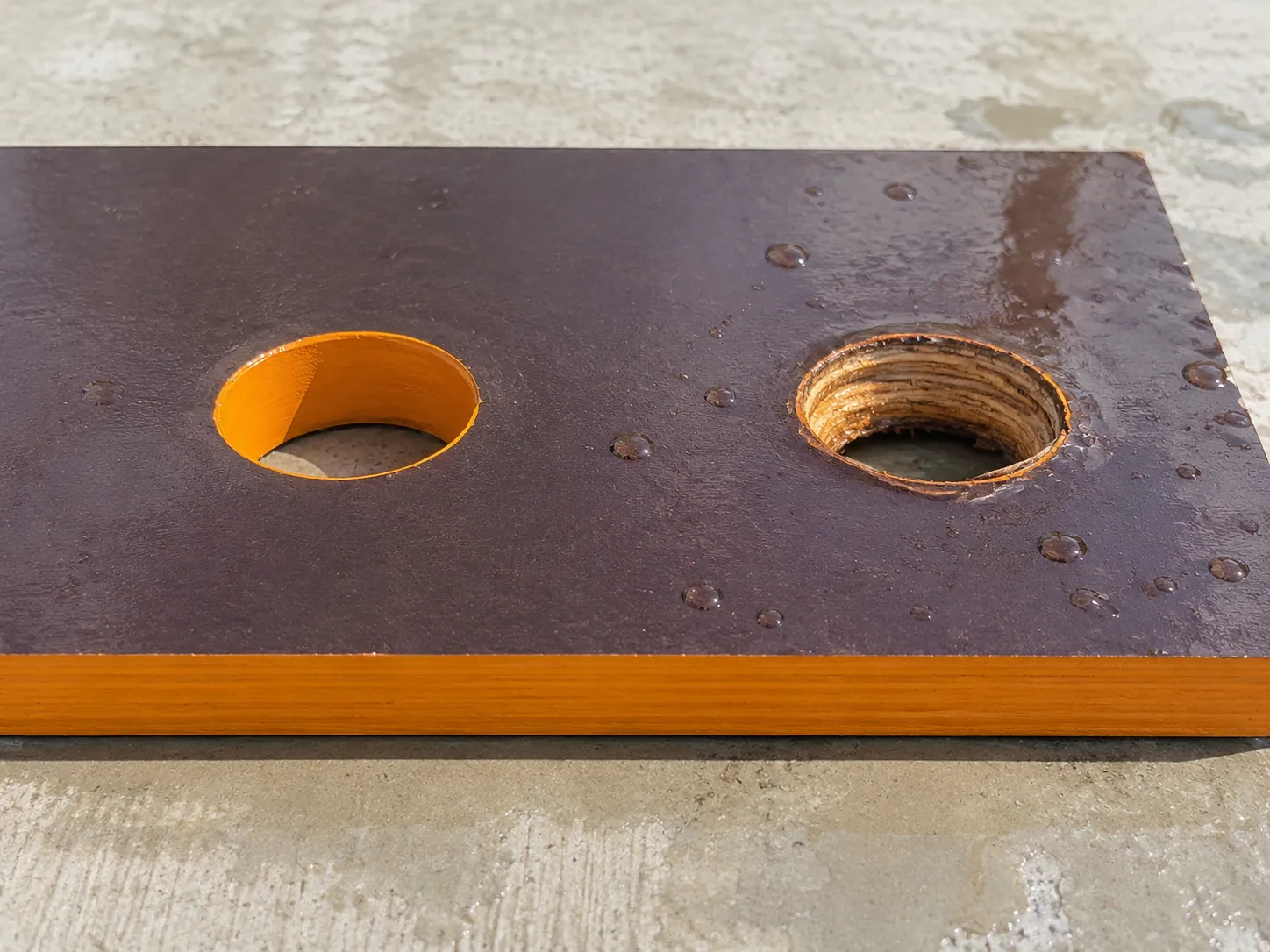
What an unsealed hole does on site follows a fixed order. The wood around the hole takes up water and swells, so the film around the rim rises in a small ring that prints on the concrete. Then the outer veneers near the hole lift, because the wet wood pulls on the glue line with every wet and dry cycle. Finally the film tears around the hole and the facing is replaced, often long before its face is worn.
In a frame, the facing’s outer edges sit against the steel or aluminium profile, so they are knocked less than the edges of a loose sheet. Water still reaches them through the joint between facing and frame. Seal them as carefully as you would a loose sheet.
How many pours does a phenolic facing give in a frame?
A phenolic glue facing gives up to about 25 pours, and a MUF glue facing about 12–15, with proper handling, a release agent on every pour and sealed edges, including every cut edge and hole. Budget film-faced panels typically give about 4–10 pours under the same care.
The pour count is a target for a build on a site, not a property printed on the sheet. The glue sets how many wet cycles the plies hold together. The film weight sets how long the face lasts under vibrators and cleaning. Site practice decides whether either gets the chance: a frame stripped with a steel bar, cleaned with a wire brush or stacked wet in the sun loses pours that no glue can give back.
| Facing build | Glue | Pours with proper handling, release agent and sealed edges | Where it pays in a frame fleet |
|---|---|---|---|
| Budget film-faced | Low glue spread, mixed core | About 4–10 | One short job, then scrap |
| Our MUF facing | Melamine (MUF) | About 12–15 | Normal wall and slab programmes |
| Our phenolic facing | Phenolic | Up to about 25 | Long programmes, repeated walls, frames on hire |
A frame helps the count in one way and hurts it in another. The steel or aluminium profile protects the facing’s edges from knocks and keeps the sheet flat. The fixings and tie holes add open end grain in the middle of the face, where water stands during a pour. A frame facing with sealed holes keeps its edge advantage; one with bare holes can fail in the middle of the face long before its edges wear.
Compare builds on cost per pour, not on sheet price: divide the delivered price of one facing by the pours you expect from it on your site. Our phenolic film-faced plywood and melamine film-faced plywood pages list both builds.
MUF or phenolic: choosing the facing build by frame part
Choose the glue by how many pours each part of your fleet will see before the next re-facing. Phenolic suits wall frames on long, repeating programmes and frames that go out on hire; MUF suits frames on normal programmes; a budget build only suits pieces you plan to throw away after one job.
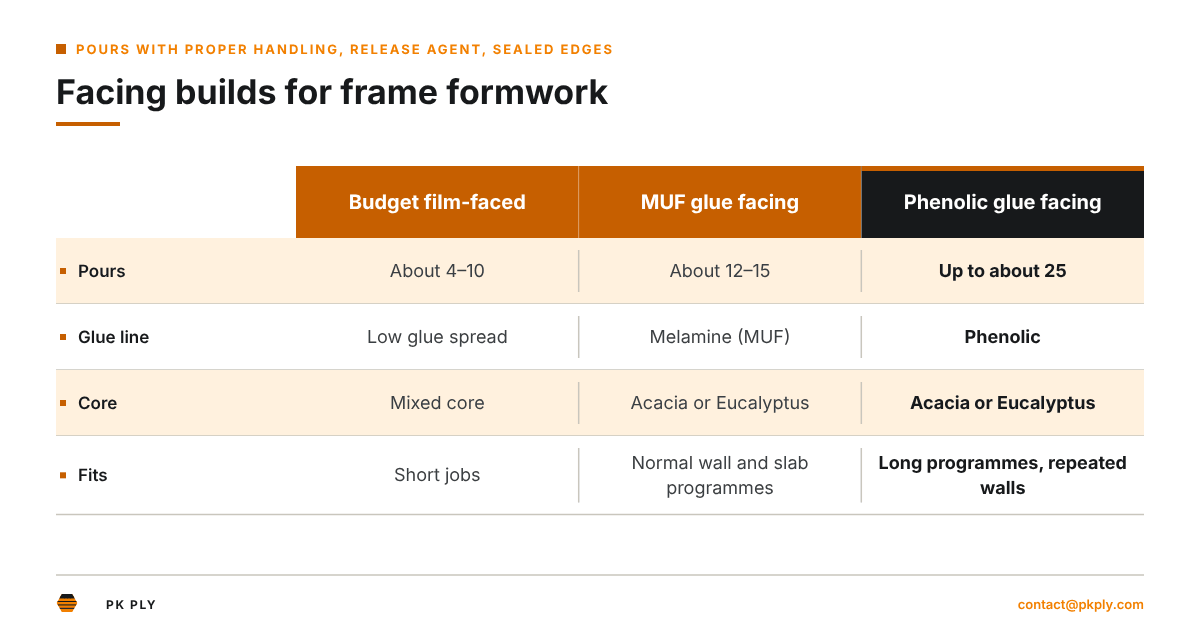
The same fleet often holds parts that wear at very different rates. A large wall frame on a core wall may pour every day; a filler or corner piece may be used a few times and then cut down. Ordering one build for all of them pays phenolic prices for pieces that never reach their count, or puts MUF facings on frames that need twice the pours.
| Frame part | Usual duty | Build we suggest | Thickness |
|---|---|---|---|
| Large wall frames, repeating storeys | Daily or near-daily pours | Phenolic glue, heavier film | As the old facing, often 18 or 21 mm |
| Frames sent out on hire | Unknown site practice | Phenolic glue | As the old facing |
| Wall and column frames, normal programme | Regular pours, one project | MUF glue | As the old facing |
| Light hand-set frames | Low pressure, hand lifting | MUF glue, Acacia core to save weight | As the old facing, often 15 mm |
| Slab panels in a frame or drop-head deck | Repeating slab pours | MUF or phenolic by the pour target | As the old facing |
| Fillers, closures, corner pieces | Short life, cut on site | MUF glue | Same as the frames they join |
The core species changes weight more than pour count. Acacia is about 580 kg/m³ in our planning and Eucalyptus about 650 kg/m³, so an Acacia facing is lighter to lift, while a Eucalyptus facing is a little stiffer and heavier. Choose the glue for the pours, then the core for the crew and the container.
Film weight and face finish for frame facings
Film weight, written in g/m², sets how long the facing’s face lasts; colour does not. Orders run from 120–125 g/m² up to 165, 185 or over 200 g/m², with about 130–135 g/m² the most common now; a frame that pours fair-faced walls every day earns a heavier film.
| Film weight | How frame owners use it |
|---|---|
| 120–125 g/m² | Short programmes, fillers and closures |
| 130–135 g/m² | The most common choice on our orders now |
| 165 or 185 g/m² | Long wall programmes, frames on hire |
| Over 200 g/m² | Heavy repeat use where the face must stay smooth |
A heavier film does not change the glue line under it. A 185 g/m² film on a MUF glue line still has the bond life of MUF, so a frame owner who wants twenty pours orders phenolic glue and a film weight to match. Black and dark brown film are both phenolic-impregnated paper. A fleet that mixes facings from different orders often uses the film colour to tell them apart, which is useful when two builds are in use at once. Our note on film weight grades goes through the figures.
Both faces of our facings are filmed, which matters for frames. If the face side is damaged early, some owners turn the facing and use the second face; that only works if the fixings allow it and both faces are filmed and sealed.
Tolerances that keep re-faced frames flush
Our film-faced facings are made to ±0.5 mm in thickness and ±2 mm in length and width, and the tolerance for each order is written on its technical sheet. Thickness is the one to watch on frames, because a step between two neighbouring facings prints directly on the concrete.
Thickness tolerance comes from the sizing and sanding step: the pressed core panel is sanded to an even thickness before the film is pressed on. A facing order should state the nominal thickness and the tolerance on the same line, for example “18 mm, ±0.5 mm”, so the technical sheet and the inspection at loading use the same number.
| Tolerance | Our figure | What it means on a frame |
|---|---|---|
| Thickness | ±0.5 mm | Two facings can differ by up to 1.0 mm; order one build and one thickness per fleet |
| Length and width | ±2 mm | Two facings can differ by up to 4 mm in size; most frame profiles absorb it |
| Squareness | Checked before painting | Out-of-square facings open a gap at one end of the frame |
Mixing facings from different suppliers in one fleet adds their tolerances together, and nominal 18 mm from one mill is not always 18 mm from another. Re-face a whole set of frames from one order when the wall finish matters, and keep a measured offcut of each order for the next one. EN 636 also gives requirements for tolerances on dimensions, alongside mechanical characteristics and bonding quality.
Does re-facing affect the frame maker’s data or warranty?
It can, and only the frame owner can find out. The frame maker’s published data and any warranty or hire terms refer to its own frame and the facing it supplied; whether another facing changes them is a question for your contract and your formwork engineer. We claim no approval from any frame maker.
What we can give the frame owner and the engineer is the build in writing: core species, glue system, film weight, nominal thickness and tolerance, edge sealing, and the test and certificate documents that apply to the panel. That is the information needed to compare the new facing with the old one.
Four practical checks before re-facing a fleet:
- Read your purchase or hire terms for any rule on facings from other sources.
- Ask your formwork engineer whether a facing of the same thickness and a different core changes the allowed concrete pressure or support spacing for your use.
- Re-face one frame first, pour with it and check the joint with its neighbours before you re-face the rest.
- Keep the order’s technical sheet with the frame records, so the next re-facing matches the last one.
Standards and test reports behind our facings
Our facings are cut from film-faced plywood with four documents behind it. CE factory production control 0407-CPR-2146 covers structural plywood of 3.6–30 mm under EN 13986; an SGS report covers a 21 mm phenolic specimen; FSC chain of custody SGSHK-COC-370674 and AS 6669:2016 certification as formwork plywood complete the set.
The European standards give the frame owner a language for the order. EN 636 specifies the requirements for plywood for general purposes or structural application in dry, humid or exterior conditions. Formwork is wet work, so a facing is ordered as humid or exterior plywood. EN 314-2 specifies requirements for bonding classes of veneer plywood according to their end uses. Our EN 636 classes note sets out which class fits which use.
For CE marking, the harmonised standard is EN 13986, the standard for the characteristics, evaluation of conformity and marking of wood-based panels for use in construction. Under the Construction Products Regulation, factory production control means the documented, permanent and internal control of production in a factory. Our certificate 0407-CPR-2146 from Istituto Giordano, notified body 0407, covers plywood for structural use in dry, humid and external conditions, 3.6–30 mm, with MUF or phenolic glue, under AVCP System 2+. The CE marking page shows its scope.
| Document | What it covers | Reference |
|---|---|---|
| CE factory production control | EN 13986:2004+A1:2015, System 2+, structural plywood for dry, humid and external use, 3.6–30 mm, MUF or phenolic glue | 0407-CPR-2146, Istituto Giordano, notified body 0407 |
| SGS Vietnam test report, issued 23 December 2025 | One submitted 21 mm dark-brown film-faced specimen, Acacia core, phenolic glue: density 642 kg/m³ (BS EN 323); bonding Class 3 PASS after 24 h water soak, boil-dry-boil and 72 h boiling pretreatments; formaldehyde not detected at the 0.04 mg/m³ reporting limit, E1 PASS against ≤0.124 mg/m³ (EN 717-1 chamber) | Specimen evidence for the tested configuration |
| FSC chain of custody | FSC 100% and FSC Mix plywood; the claim is confirmed per order on the sales documents | SGSHK-COC-370674, issued by SGS Hong Kong |
| AS 6669:2016 | Product certification as formwork plywood | CMI Certification, JAS-ANZ-accredited |
The SGS figures describe the specimen that was tested, with its method and date; a different thickness, core or glue gets its own report when a project calls for one. “Not detected” means below the 0.04 mg/m³ reporting limit, an E1 result. The full test is in our note on the SGS 21 mm phenolic specimen.
Sheet weights and 40HC loads for facing orders
A full 1250 × 2500 mm sheet at 18 mm weighs about 32.6 kg with an Acacia core and about 36.6 kg with a Eucalyptus core, and a 40HC carries about 848 or 750 such sheets as a planning figure. Cut facings load by cubic metre: about 47 m³ of Acacia-core or about 43 m³ of Eucalyptus-core panels per 40HC.
| Thickness, 1250 × 2500 mm sheet | Acacia core: weight, sheets per 40HC | Eucalyptus core: weight, sheets per 40HC |
|---|---|---|
| 12 mm | 21.8 kg, 1,280 sheets (16 × 80), 48.0 m³ | 24.4 kg, 1,125 sheets (15 × 75), 42.2 m³ |
| 15 mm | 27.2 kg, 1,024 sheets (16 × 64), 48.0 m³ | 30.5 kg, 900 sheets (15 × 60), 42.2 m³ |
| 18 mm | 32.6 kg, 848 sheets (16 × 53), 47.7 m³ | 36.6 kg, 750 sheets (15 × 50), 42.2 m³ |
| 21 mm | 38.1 kg, 720 sheets (16 × 45), 47.3 m³ | 42.7 kg, 630 sheets (15 × 42), 41.3 m³ |
Every load figure in this table is a planning figure from our packing model: packs about 1,000 mm high, 16 packs for Acacia and 15 for Eucalyptus, a planning payload of 28,000 kg of panels, which the carrier and route confirm. Sheet weight is density times volume at 580 kg/m³ (Acacia) and 650 kg/m³ (Eucalyptus); real sheets are weighed before final loading, and the packing list is the number that counts.
Cut facings change the pack, not the cubic metres. Facings of one size are packed together, and small sizes make more packs of different footprints, so the count of pieces per container comes from the packing list for your size list. Plan in cubic metres: add up length × width × thickness × count for every line of the list, and compare the total with about 47 m³ (Acacia) or about 43 m³ (Eucalyptus). Our 40HC loading page shows how packs go in, and the plywood sheet weight calculator gives weights for other sizes.
What to write on a re-facing order
A re-facing order needs the frame system you own, the size list with counts, thickness and tolerance, core, glue, film weight and colour, edge paint, holes, marking, quantity and port of discharge. With those lines, two offers can be compared facing for facing, and the next re-facing matches this one.
| Line | What to write | Example for a wall-frame fleet |
|---|---|---|
| Frame system | The system you own, as you name it on site | Steel wall frames, owner’s fleet |
| Size list | Length × width × thickness × count, with your size code | 2400 × 1200 × 18, code W24, 400 pieces (with the other lines of the list) |
| Thickness and tolerance | Nominal thickness, ±0.5 mm | 18 mm, ±0.5 mm |
| Core | Acacia or Eucalyptus | Acacia, for hand lifting |
| Glue | MUF or phenolic | Phenolic, for a long programme |
| Film | Weight in g/m², colour, both faces | 165 g/m², dark brown, both faces |
| Edges | Edge paint colour, every cut edge | Water-resistant paint, all cut edges |
| Holes | None, or a dimensioned hole plan | None; drilled on the owner’s bench |
| Marking and packing | Marking per piece, packs by size | Size code on each piece, one size per pack |
| Quantity and port | Containers or m³, port of discharge | One 40HC, CIF port of discharge |
Our standard terms follow from that sheet. The minimum order is one 40HC, which usually carries one or two products and up to six by agreement, so facings can share a container with full sheets. Production takes 15–45 days after the 30% deposit, and the 70% balance is paid against the scanned bill of lading, by T/T or by irrevocable L/C at sight. We sell FOB Hai Phong, CFR or CIF.
Samples are free; new buyers book their own courier, and that cost can be credited against a real order. A useful first step is to send your size list with a photo of the old facing’s edge beside a ruler through our specification form, or by email to [email protected]. We return a build sheet with an FOB Hai Phong offer per cubic metre for the facings on your list.
Questions buyers ask us
Can I buy replacement plywood for Peri or Doka frames from a mill that is not the frame maker?
Yes. The facing is a wearing part held in the frame by screws, rivets or bolts, and any film-faced sheet that matches the old facing's thickness, size and hole positions can be fitted. PK Ply has no affiliation with either company and claims no approval from them.
What thickness of plywood is used on formwork frames?
The frame decides: it is built around one facing thickness, so measure the old facing and order the same. Heavy wall frames commonly carry 18 or 21 mm facings and light hand-set frames 15 mm or thinner.
Do you cut facings to my own size list?
Yes. We cut facings from 1220 × 2440 mm or 1250 × 2500 mm sheets to the sizes and counts on your list, to ±2 mm in length and width, and paint every cut edge before packing.
Can you supply a one-piece facing longer than 2500 mm?
No. Our largest sheet is 1250 × 2500 mm, so a longer or wider facing has to be made of two pieces joined over a frame member, or bought as a large-format panel elsewhere.
How long does a phenolic facing last in a frame?
Up to about 25 pours, with proper handling, release agent on every pour and sealed edges, including every cut edge and hole. A MUF glue facing gives about 12–15 pours under the same care.
What should I paint the cut edges of film-faced plywood with?
Use a water-resistant edge sealant or paint made for plywood edges, applied on the day of the cut to clean, dry wood. Two thin coats close the end grain better than one thick one.
Should I seal the screw and tie holes in a new facing?
Yes. Every hole you drill opens end grain through the full thickness, so coat the hole wall with the same edge sealant before the facing sees its first pour.
Does film colour matter on a frame facing?
No grade follows from colour: black and dark brown are both phenolic film. Order the film weight in g/m², and the colour your site uses to tell facings apart.
How heavy is an 18 mm facing?
About 10.44 kg/m² with an Acacia core and 11.7 kg/m² with a Eucalyptus core at our planning densities, so a full 1250 × 2500 mm sheet weighs about 32.6 kg or 36.6 kg.
Can you drill the holes before shipping?
Send a dimensioned hole plan with the size list and we confirm at enquiry whether holes are made on that order. Most frame owners drill on their own bench against the steel, because the holes have to line up with the frame.
What is the minimum order for replacement facings?
One 40HC, which can carry one or two products, or three to six by agreement. Production takes 15–45 days after the 30% deposit.
Can I get a sample facing before ordering?
Yes. Samples are free; new buyers book their own courier, and the courier cost can be credited against a real order.