
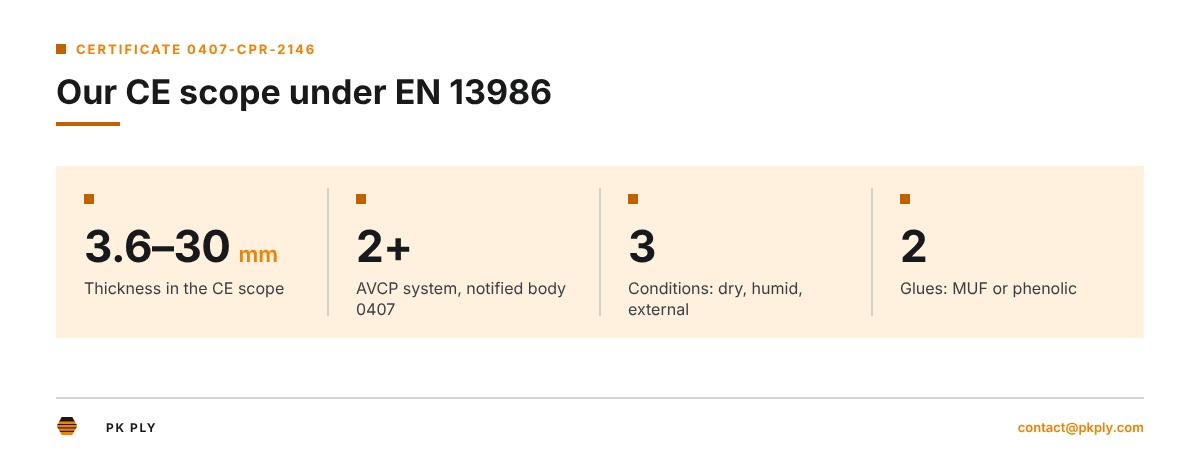
EN 636-3 plywood is plywood specified for exterior conditions: its glue lines must pass the EN 314 Class 3 boil tests, and the panel must meet the rest of EN 636 for outdoor service. Order -2 where you needed -3 and the plies open after the first wet season. At PK Ply our CE certificate covers dry, humid and external structural plywood from 3.6 to 30 mm.
What is EN 636-3 plywood?
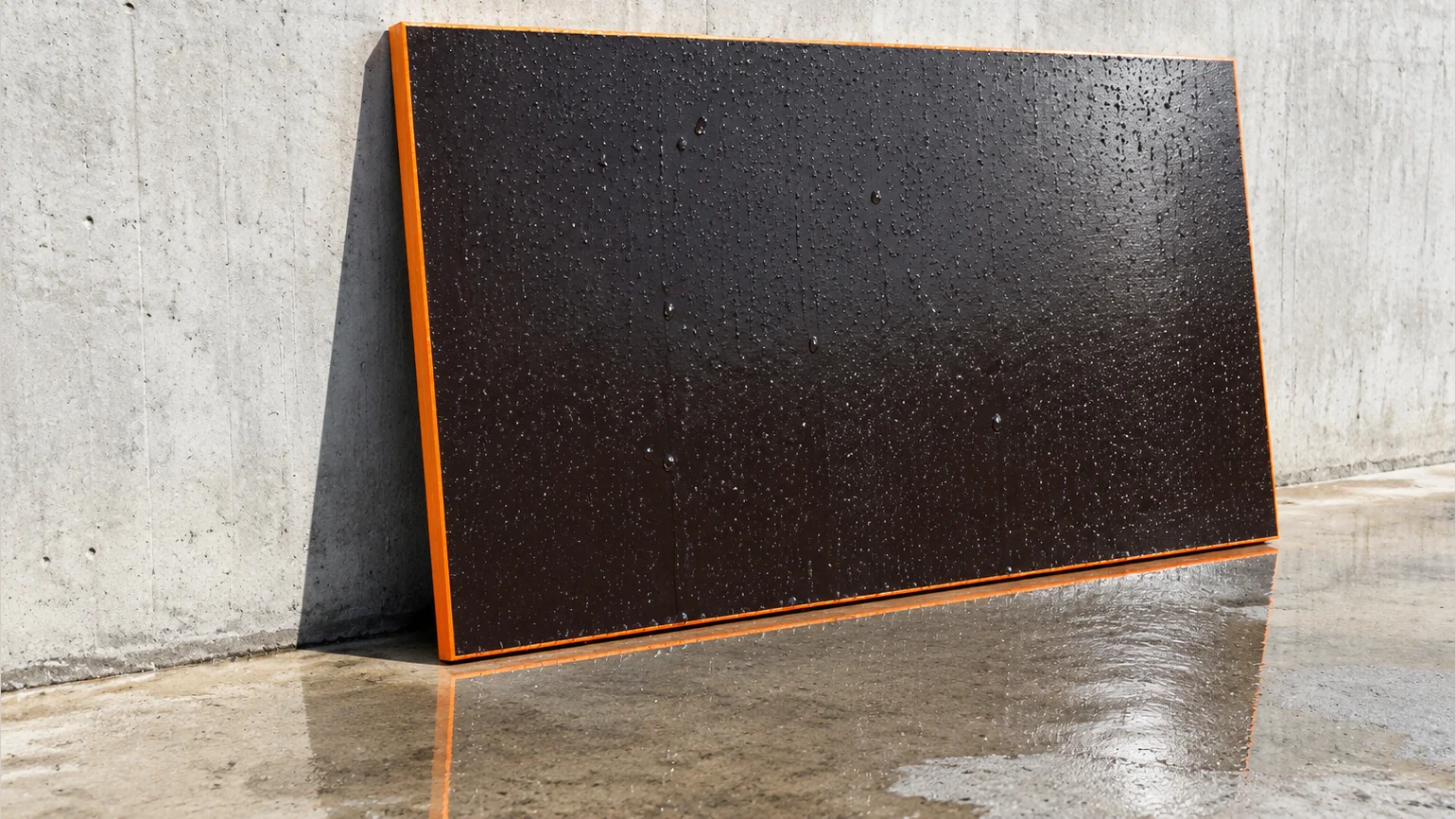
EN 636-3 plywood is plywood made and declared for exterior conditions under EN 636, the European specification for plywood. The -3 is a service class. The panel’s glue lines must pass the EN 314 Class 3 bond tests, and the panel must meet the standard’s other requirements for outdoor use. The -1 class means dry conditions and -2 humid conditions.
BS EN 636 specifies the requirements for plywood for both general purpose use (non-structural application) and structural application in dry, humid or exterior conditions. The current text is EN 636:2012+A1:2015, published in the UK as BS EN 636:2012+A1:2015 on 31 January 2013 with its amendment folded in. The earlier EN 636:2003 replaced a three-part standard with one document but kept the -1, -2 and -3 designations. That is why merchants still say “EN 636-3” as if it were a separate part.
The standard does not name a glue, a species or a ply count. It sets what the finished panel must do. The panel holds its dimensions within tolerance and keeps its glue lines together in a given climate. Where it is used for structure it reaches a bending class, and it stays inside a formaldehyde class and is made under factory production control. Brazilian pine, Indonesian hardwood and a film-faced sheet from our mills in Chi Linh, Hai Phong can all be EN 636-3 plywood. Each one has to meet those requirements for exterior use.
What the class does not say is just as useful to know. EN 636-3 does not promise a pour count, a film weight or a face grade, and it says nothing about how many times a formwork panel can be reused. Those are order lines on top of the class.
What is the difference between EN 636-2 and EN 636-3?
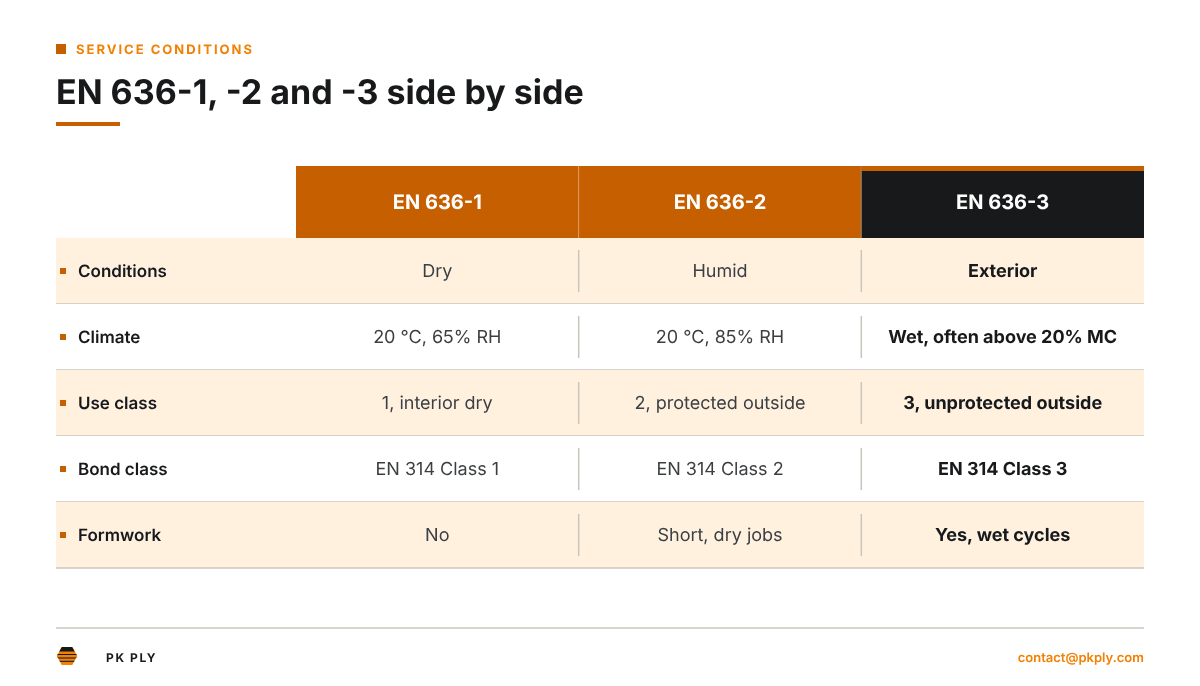
EN 636-2 plywood is for humid conditions, such as protected outside use and damp interiors, and needs an EN 314 Class 2 bond. EN 636-3 plywood is for exterior conditions, where weather wets the panel or humidity stays high for long periods. It needs a Class 3 bond that survives boiling, drying and 72 h of boiling.
The three classes follow the use classes of EN 335 for wood and wood-based products. UK importers describe them by climate. Dry means a moisture content in balance with 20 °C and 65% relative humidity, and humid means 20 °C and 85% relative humidity. Exterior means a moisture content that is frequently above 20%.
| Class | Service condition | Use class (EN 335) | Bond class (EN 314-2) | Typical use |
|---|---|---|---|---|
| EN 636-1 | Dry: interior, no risk of wetting | 1 | Class 1 | Internal partitions, intermediate floors, joinery |
| EN 636-2 | Humid: protected exterior, damp interiors | 2 | Class 2 | Roof sarking, soffits, sheathing under cladding |
| EN 636-3 | Exterior: weather or long high humidity | 3 | Class 3 | Fascias, hoarding, vehicle floors, concrete formwork |
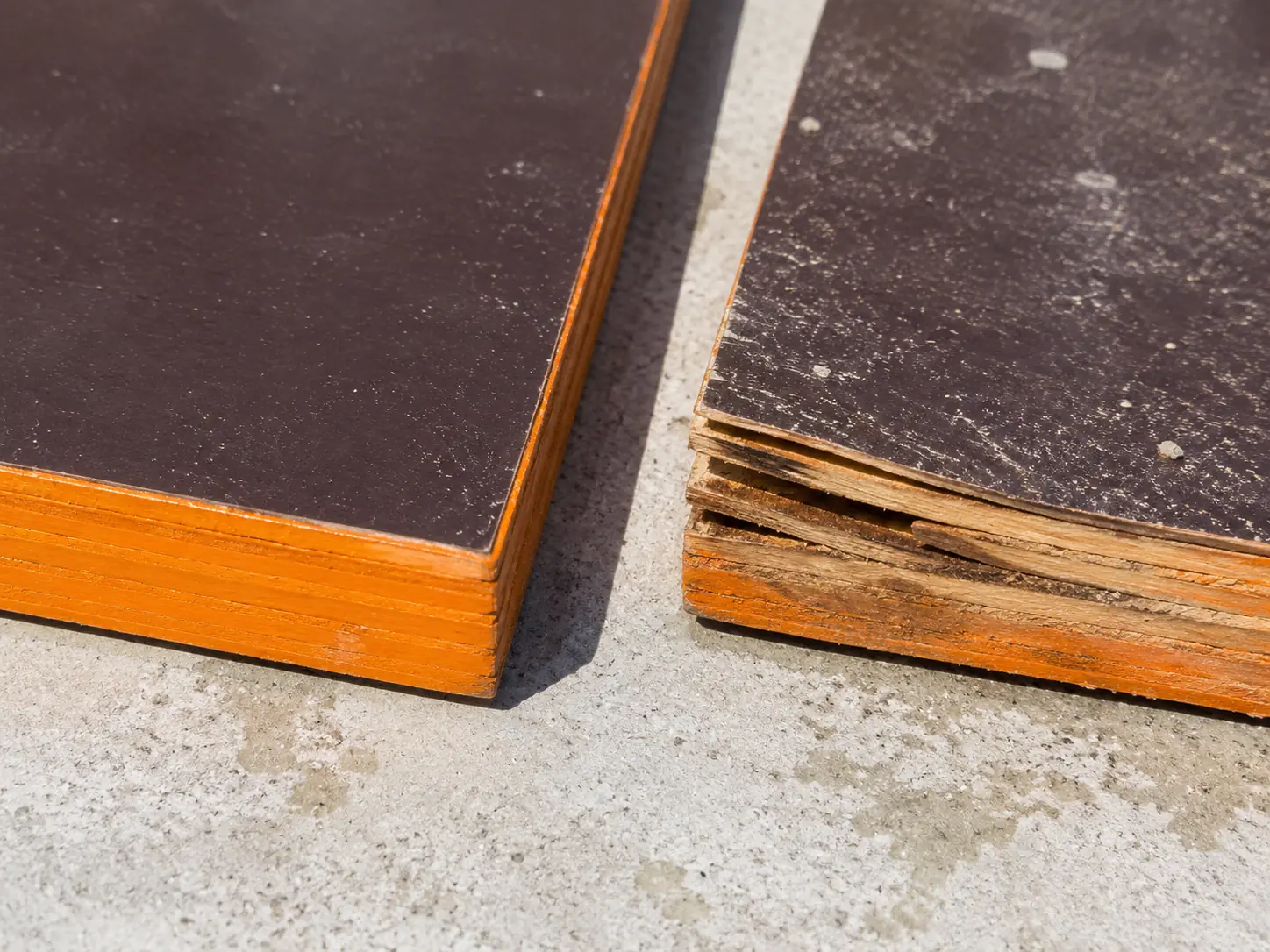
The step from -2 to -3 is larger than it looks on a label. A Class 2 bond is tested after a 6 h boil. A Class 3 bond is tested after a boil-dry-boil cycle and again after 72 h in boiling water, so the glue line has to resist hot water for days, not hours. On a building site that difference shows up as plies that open at the edge after one wet season on an -2 sheet and stay closed on an -3 sheet.
How do EN 314 bond tests decide Class 1, 2 or 3?
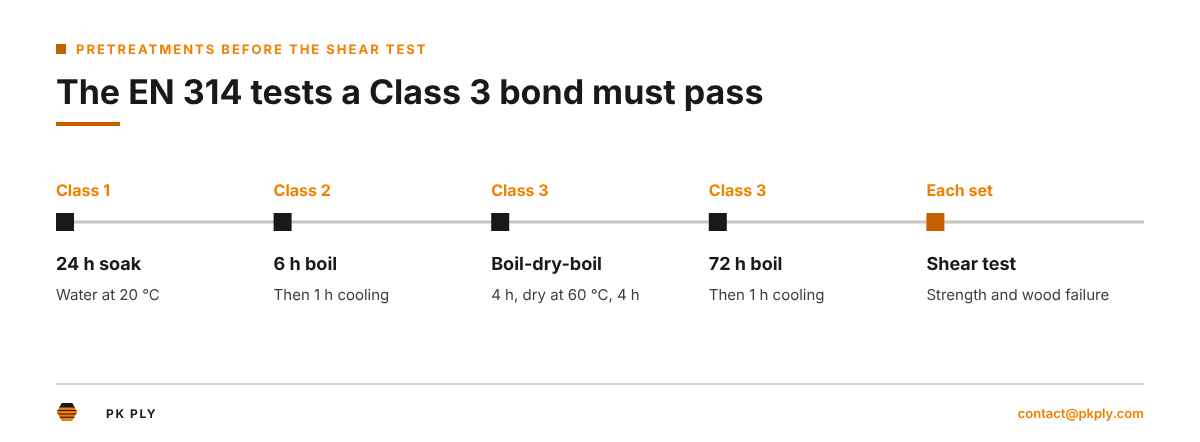
The EN 314 tests decide the bond class by soaking or boiling test pieces cut from the panel. Each glue line is then sheared, and the lab measures the shear strength and the share of wood failure. Class 1 needs the cold soak, Class 2 adds a 6 h boil, and Class 3 adds a boil-dry-boil cycle and a 72 h boil.
The standard comes in two parts. EN 314-2 specifies requirements for bonding classes of veneer plywood according to their end uses. The test methods are in its companion part, EN 314-1, which says how the test pieces are cut, pretreated and loaded.
| Pretreatment | What happens to the test pieces | Class 1 | Class 2 | Class 3 |
|---|---|---|---|---|
| Cold soak | 24 h immersion in water at 20 °C | Yes | Yes | Yes |
| Short boil | 6 h in boiling water, then 1 h cooling in water at 20 °C | — | Yes | — |
| Boil-dry-boil | 4 h boiling, 16–20 h drying at 60 °C, 4 h boiling, then 1 h cooling | — | — | Yes |
| Long boil | 72 h in boiling water, then 1 h cooling | — | — | Yes |
After each pretreatment the pieces are pulled in shear until the glue line breaks. A strong bond can pass on shear strength alone. A weaker one passes only if the break runs through the wood instead of the glue, which is what “wood failure” measures.
| Mean shear strength (fv) | Mean wood failure needed |
|---|---|
| 0.2 ≤ fv < 0.4 N/mm² | At least 80% |
| 0.4 ≤ fv < 0.6 N/mm² | At least 60% |
| 0.6 ≤ fv < 1.0 N/mm² | At least 40% |
| fv ≥ 1.0 N/mm² | No wood-failure requirement |
Our own evidence follows that route. The SGS Vietnam report issued 23 December 2025 covers one submitted 21 mm dark-brown film-faced specimen with an Acacia core and phenolic glue. It records bonding Class 3 PASS under EN 314-1/314-2 after the 24 h water soak, the boil-dry-boil and the 72 h boiling pretreatments. That is specimen evidence for the tested build, not a guarantee for every panel. Our note on the SGS 21 mm phenolic specimen reads the report line by line.
Does an EN 314 Class 3 bond pass make a panel EN 636-3?
No. EN 636-3 needs an EN 314 Class 3 bond, but the bond is one requirement of several. The panel must also meet the dimensional tolerances and the biological durability expected in use class 3. It needs a formaldehyde class, a bending class where it is structural, and factory production control and marking.
The older text of the standard lists those items plainly. Its 2003 edition gives requirements for tolerances on dimensions, mechanical characteristics, structural application, formaldehyde release, classification and the relevant bonding quality and biological durability requirements. The 2012 edition keeps the same structure. A test report that says “Class 3 PASS” answers the bonding line and leaves the other lines open.
This is where UK merchant listings blur two different things. “EN 314-2 Class 3” on a sheet describes the glue line; “EN 636-3” describes the panel. A hardwood sheet with a Class 3 bond can carry the first marking honestly. If its veneer species does not suit long outdoor exposure, it still falls short of the second. A buyer who needs exterior plywood writes EN 636-3 on the order, not only the bond class.
For our film-faced panels the lines are covered as follows:
- Bonding. The SGS 21 mm phenolic specimen passed Class 3 after all three pretreatments.
- Tolerances. Thickness ±0.5 mm and length and width ±2 mm, written on the order’s technical sheet.
- Formaldehyde. The same specimen was not detected at the 0.04 mg/m³ reporting limit in the EN 717-1 chamber, an E1 PASS.
- Production control. CE factory production control certificate 0407-CPR-2146, AVCP System 2+.
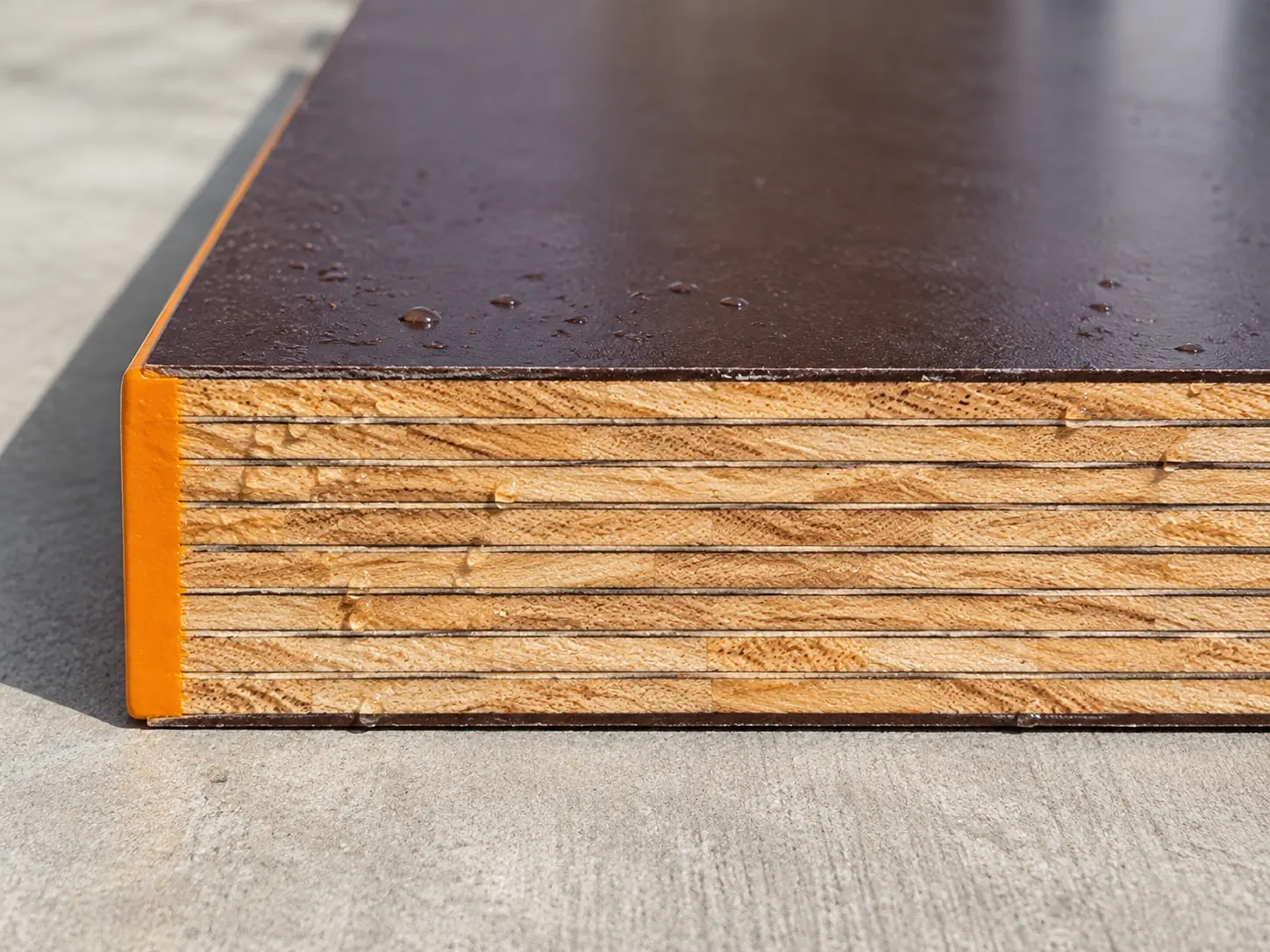
- Durability in service. Phenolic film on both faces and water-resistant paint on all four edges keep water out of the veneers. The durability statement for the order is on the declaration of performance.
What does the S in EN 636-3S mean?
The S in EN 636-3S means the plywood is declared for structural use in exterior conditions; a G in the same place means general purpose, non-structural use. A structural declaration adds bending strength and stiffness classes from EN 310 tests, so a designer can use the panel’s values in a calculation.
The S matters wherever the panel carries load in the finished building: roof decks, floor decks, wall sheathing that braces a frame. In those uses the designer needs characteristic values, which EN 12369-2 gives for each bending class. A G panel can be just as durable and just as well bonded, but nobody may design with it as a structural member.
Bending classes are written as an F class for strength and an E class for stiffness, with one figure along the face grain and one across it. Hanson Plywood gives “F10/20” as an example of the designation. The class comes from the tests, not from the species or the ply count, so two panels of different species can share one class.
In UK merchant listings the S often appears inside shorthand such as “CE2+S”, which combines the CE route (AVCP System 2+) with the structural letter. One English merchant lists a 12 mm structural softwood sheet as “CE2+S, EN636-3/314-2/13986”: structural CE marking, exterior class, Class 3 bond under EN 314-2, and the harmonised standard EN 13986.
Our CE scope is structural, which is the S side of the table: factory production control certificate 0407-CPR-2146 covers plywood for structural use in dry, humid and external conditions. Formwork itself is temporary works rather than a permanent structure, but a structural declaration gives a formwork designer tested values to start from.
Which EN 636 service classes does a CE certificate under EN 13986 cover?
A CE certificate under EN 13986 covers the service classes written in its scope: dry, humid, external, or a mix of them, for structural or non-structural use. Our factory production control certificate 0407-CPR-2146 covers structural plywood in dry, humid and external conditions, so it spans the conditions of EN 636-1, EN 636-2 and EN 636-3.
EN 13986 is the harmonised standard that turns EN 636 into a CE mark. BS EN 13986 covers wood-based panels for internal use as structural components in dry conditions, for internal (or protected external) use as structural components in humid conditions and for external use as structural components. It lists the same three conditions for non-structural use and for floor decking, roof decking and wall sheathing.
The legal frame is the Construction Products Regulation. Regulation (EU) No 305/2011 defines factory production control as the documented, permanent and internal control of production in a factory. For structural plywood the route is AVCP System 2+. The manufacturer tests the product type and runs the production control. A notified body certifies that control after an inspection of the plant and keeps it under surveillance.
Our route reads like this:
| Element | Our CE file |
|---|---|
| Harmonised standard | EN 13986:2004+A1:2015 |
| Assessment system | AVCP System 2+ under Regulation (EU) 305/2011 |
| Notified body | Istituto Giordano S.p.A., notified body 0407 |
| Certificate | Factory production control 0407-CPR-2146 |
| Scope | Plywood for structural use in dry, humid and external conditions |
| Thickness | 3.6–30 mm |
| Glue | MUF or phenolic |
| Performance values | On the declaration of performance, per thickness |
The certificate covers the factory and the product family. The class a given order is declared in, and its bending and emission values, come on the declaration of performance for that product. Our CE marking page shows the certificate, and the structural CE plywood page lists the panels inside its scope.
What thickness range does our factory production control 0407-CPR-2146 cover?
Our factory production control certificate 0407-CPR-2146 covers plywood from 3.6 to 30 mm thick, with MUF or phenolic glue. Our mills press 9–40 mm, so a CE-marked order is placed at 30 mm or thinner. A heavier panel is still pressed to order, but it ships without the CE mark.
| Thickness we press | Inside CE scope 3.6–30 mm? | What it is usually ordered for |
|---|---|---|
| 9 mm | Yes | Linings, curved and light formwork |
| 12 mm | Yes | Edges, kickers, beam sides, columns |
| 15 mm | Yes | Light slabs, low walls |
| 18 mm | Yes | Slab decks and walls: the standard formwork sheet |
| 21 mm | Yes | Wider support spacing, tall walls, fair-faced concrete |
| Up to 30 mm | Yes | Heavy decks and floors by project |
| Above 30 mm, up to 40 mm | No | Special heavy-duty panels, without CE marking |
The everyday formwork thicknesses, 12, 15, 18 and 21 mm, all sit inside the scope. That matters for EU buyers. A CE mark applies only to products inside the certified scope. The declaration of performance for that thickness is the document a site engineer or a market surveillance officer asks for.
Sheet size does not change the scope. We press 1220 × 2440 mm and 1250 × 2500 mm sheets and cut to a cutting list, and nothing is pressed larger than 1250 × 2500 mm.
Which of our film-faced builds goes with which EN 636 class
The glue sets the class a build can reach, and the class an order is declared in is written on its declaration of performance. Our phenolic-glue build is the one with Class 3 evidence on file, the SGS 21 mm specimen. For a MUF build, ask for the bond class in writing before you order it for exterior use.
| Build | Glue | Bond evidence on file | Class to write on the order | Pours with proper handling, release agent and sealed edges |
|---|---|---|---|---|
| Phenolic film-faced, Acacia core | Phenolic | SGS 21 mm specimen, Class 3 PASS (23 December 2025) | EN 636-3 S, Class 3 bond | Up to about 25 |
| Phenolic film-faced, Eucalyptus core | Phenolic | Same glue system; report per project on request | EN 636-3 S, Class 3 bond | Up to about 25 |
| MUF film-faced, Acacia or Eucalyptus core | Melamine (MUF) | Class stated on the order’s declaration of performance | EN 636-2 or -3, as declared | About 12–15 |
| Anti-slip film-faced | MUF or phenolic | As for the glue chosen | As for the glue chosen | Set by the deck duty |
The core species changes weight, not class. Acacia is about 580 kg/m³ in our planning and Eucalyptus about 650 kg/m³. An 18 mm sheet of 1220 × 2440 mm weighs about 31.1 kg with Acacia and about 34.8 kg with Eucalyptus. The bond class comes from the glue system and the pressing: hot pressing for phenolic, weather- and boil-proof bonds runs at about 130–145 °C at our mills.
A different thickness, core or glue from the tested specimen is a different configuration. When a project needs proof for its own build, we have that build tested and send the report with the order documents. Our phenolic film-faced plywood and melamine film-faced plywood pages list the two glue systems side by side.
Is class 2 or class 3 plywood better for formwork?
Class 3 plywood is the better choice for formwork, because every pour wets the panel, stripping stresses its glue lines and the cycle repeats for weeks. A Class 2 bond can last a few pours in dry weather. For regular wet pours order a Class 3 bond, and phenolic glue for long programmes.
Formwork is harder on a glue line than most permanent exterior uses. A fascia board gets wet and dries in the sun; a formwork panel sits under wet concrete for a day, is levered off, washed, oiled and set up again. Each cycle swells and shrinks the outer plies against the glue line, and a crushed corner or a bare cut edge lets water straight into the core.
The bond class and the pour count are related but not the same number. Our MUF film-faced build gives about 12–15 pours and our phenolic build up to about 25, with proper handling, a release agent on every pour and sealed edges, including cut edges. Budget film-faced panels typically give about 4–10 pours under the same care. The class tells you whether the glue line survives water; the glue, film weight and site practice decide how many pours you get before the face or the edge gives out.
The way to decide is cost per pour. Divide the delivered price of a sheet by the pours your site will get from it. A phenolic Class 3 panel that costs more per sheet often costs less per pour on a programme that will use it twenty times. Our note on pours per panel works through that arithmetic, and the shuttering ply note compares the types sold under that name.
Are marine plywood and WBP the same as EN 636-3?
No. Marine plywood is a boat-building grade with its own rules on species, face quality and core gaps, and WBP is a retired British bond term. Both overlap with EN 636-3 at the bond: a Class 3 glue line is the present-day equal of a WBP bond, and marine plywood uses one too.
Elliotts, a UK merchant, writes that WBP was phased out in 1995. Its guide tells buyers who used to order WBP or exterior plywood for construction to order EN 314-2 Class 3 today. The habit survives in quotes from many countries, and a quote that says “WBP” without a class leaves the buyer with nothing to test against.
Marine plywood answers a different question. A boat hull needs durable face and core species, no voids in the core and tight thickness control because it is glued and screwed into a hull for decades. A formwork panel needs a hard film, sealed edges and a bond that survives many wet cycles. Paying for marine grade on a formwork job buys qualities the job does not use.
| Name on a quote | What it states | What to write instead |
|---|---|---|
| WBP | An old bond description, no test class | EN 314-2 Class 3 bond |
| Marine plywood | A boat-building grade | The grade only for boats; EN 636-3 for exterior construction |
| Exterior plywood | No defined meaning | EN 636-3, with S or G |
| Class 3 plywood | The bond class only | EN 636-3 plus the bond class |
Glue type and bond class: why EN 636 names no glue
EN 636 and EN 314 set performance, not a glue recipe: any glue that passes the Class 3 tests gives a Class 3 bond. In practice phenolic glue is the usual route to Class 3, melamine-fortified glue (MUF) to Class 2 and urea glue to Class 1. The test decides, not the name of the resin.
UK merchant guides often shorten the classes to glue names: -1 urea formaldehyde, -2 melamine urea formaldehyde, -3 phenol formaldehyde. That shorthand is close to what most mills do and still misleads at the edges. Hanson Plywood notes that Class 3 bonds are largely comparable with the old WBP bonds, except that the requirement that effectively they be made with phenolic-type glues “has now been dropped”. A MUF line with a high melamine share can pass Class 3, and a poorly spread phenolic line can fail it.
For a buyer the rule is short. Name the glue system because it drives cost and pour count, and name the bond class because it is the tested result. If a quote gives only the glue, ask for the class; if it gives only the class, ask for the glue. Our quotes carry both lines, and the glue line on our film-faced panels is either MUF or phenolic, never urea.
The pressing matters as much as the resin. A phenolic glue line cures only at temperature and pressure held long enough. Our presses run at about 130–145 °C for phenolic bonds, and the core panel is pressed and calibrated before the film goes on.
How to read the EN 636 marking on a sheet or pack label
An EN 636 marking names the standard and the class with its suffix. A CE label adds the notified body number, the reference to the declaration of performance, the harmonised standard EN 13986 and the declared characteristics. Read it from left to right: every element answers one question about the sheet.
- The CE mark and the notified body number. For our structural plywood that number is 0407, Istituto Giordano.
- The declaration of performance reference. It links the label to the document that holds the values for that product and thickness.
- The harmonised standard. EN 13986, the standard for wood-based panels in construction.
- The EN 636 class and suffix. For example EN 636-3 S for structural plywood in exterior conditions, or EN 636-2 G for general-purpose plywood in humid conditions.
- The bond class. EN 314-2 Class 3 for exterior bonds.
- The formaldehyde class. E1 for panels in construction under EN 13986.
- Thickness and the declared characteristics. Bending class, density, reaction to fire and other values, as the declaration lists them.
Merchant listings compress the same information into one line. A 12 mm sheet sold at a UK merchant as “Q-Mark Chinese Plywood EN636-3” names the class and nothing else. A structural softwood sheet listed as “CE2+S, EN636-3/314-2/13986” names the CE route, the structural suffix, the class, the bond standard and the harmonised standard. The second line tells a site engineer far more.
On film-faced panels the marking goes on the pack label and the documents, because a stamp on the film face would print into the concrete. Ask for a photo of the pack label with the order’s sample if you need to check it before shipment.
What EN 636-3 plywood costs at UK merchants (November 2026)
In November 2026, 12 mm EN 636-3 plywood sheets of 1220 × 2440 mm were listed at UK merchants for about £31.59 before VAT and £31.97 to £37.91 with VAT. Our own price is an FOB Hai Phong offer per cubic metre for the build you specify, with one 40HC as the minimum.
Each row below is a listed price as shown on the day we checked it; local prices move with stock, exchange rates and VAT.
| Seller | Panel as listed | Listed price |
|---|---|---|
| Basildon Timber, England | 12 mm Q-Mark Chinese plywood EN636-3, 1220 × 2440 mm | £31.97 per sheet including VAT, listed price checked 12 November 2026 (Basildon Timber) |
| FORT Merchanting, England | 12 mm structural softwood plywood CE2+S, EN636-3/314-2/13986, 1220 × 2440 mm | £31.59 per sheet before VAT, £37.91 including VAT, listed price checked 12 November 2026 (FORT Merchanting) |
| Our mills | 9–30 mm film-faced, MUF or phenolic, inside our CE scope | FOB Hai Phong per m³ for your build, one 40HC minimum |
The two UK sheets are unfilmed construction plywood: one hardwood-faced with a Class 3 bond, one structural softwood. A film-faced EN 636-3 panel costs more per sheet because of the film and the edge paint, and it is bought for the pours it gives, not for the sheet price. A container price per cubic metre turns into a sheet price only after freight, duty and local delivery, which our construction plywood price drivers note breaks down.
Formaldehyde class beside the EN 636 class
The EN 636 class says where a panel can be used; the formaldehyde class says how much formaldehyde it releases, and both appear on a CE declaration. EN 13986 sets the E1 class for construction panels at 0.124 mg/m³ or less in the EN 717-1 chamber. Our SGS 21 mm specimen was not detected at the 0.04 mg/m³ reporting limit, an E1 PASS.
| Formaldehyde line | Limit | Method and scope |
|---|---|---|
| E1 under EN 13986 | 0.124 mg/m³ or less | EN 717-1 chamber, construction panels |
| REACH Annex XVII entry 77 | 0.062 mg/m³ (wood-based articles), 0.080 mg/m³ (other articles) | Appendix 14 chamber, EU market, from 6 August 2026 |
| CARB Phase 2 / TSCA Title VI | 0.05 ppm | ASTM E1333 basis, hardwood plywood with veneer core |
| Our SGS 21 mm specimen | Not detected at 0.04 mg/m³ | EN 717-1 chamber, E1 PASS, report of 23 December 2025 |
“Not detected” means below the laboratory’s reporting limit of 0.04 mg/m³. It is an E1 result for that specimen, not a zero and not an E0 claim. A different build gets its own test when a project calls for one, and our E1 chamber test page explains how the chamber method works.
A second line now sits beside E1 for the EU. REACH Annex XVII entry 77 has applied since 6 August 2026. Furniture and wood-based articles may not be placed on the EU market if their formaldehyde emission exceeds 0.062 mg/m³ under the chamber conditions of its Appendix 14. For other articles the line is 0.080 mg/m³. Articles used only outdoors are excluded. Formwork panels are used outdoors, but a buyer who also sells the same sheet for indoor use should check it against 0.062 mg/m³.
For the US, the formaldehyde rule is separate again. CARB Phase 2 and TSCA Title VI set 0.05 ppm for hardwood plywood with veneer core, measured by a different method. A ppm result is never converted to mg/m³.
What to write on an EN 636 order
An EN 636 order needs the class with its suffix, the bond class, thickness and size, glue system, face and film, emission class, edge sealing, quantity and the documents you need. With those lines a mill knows what to press and you know what to check when the container arrives.
| Line | What to write | Example for an exterior formwork order |
|---|---|---|
| Class and suffix | EN 636-1, -2 or -3, with S or G | EN 636-3 S |
| Bond class | EN 314-2 Class 1, 2 or 3 | Class 3 |
| CE marking | Required or not; inside the CE scope | CE under EN 13986, 18 mm |
| Thickness and size | mm, tolerance, sheet size | 18 mm ±0.5 mm, 1250 × 2500 mm |
| Glue | MUF or phenolic | Phenolic |
| Core | Acacia or Eucalyptus | Acacia |
| Face | Film weight and colour | 130–135 g/m², dark brown, both faces |
| Emission | E1 or the market’s limit | E1 |
| Edges | Edge paint | Water-resistant paint, all four edges |
| Quantity and documents | Containers, port, documents | One 40HC, declaration of performance, test report for the build |
Our standard terms follow from that sheet. The minimum order is one 40HC, which carries one or two products and up to six by agreement. Production takes 15–45 days after the 30% deposit, and the 70% balance is paid against the scanned bill of lading by T/T or by irrevocable L/C at sight. We sell FOB Hai Phong, CFR or CIF. Certificate files and the test reports for the agreed build go out before the order is confirmed, and EU lots carry the EUTR/EUDR file set.
Send these lines through our specification form or by email to [email protected], and we return a build sheet with the class, the bond evidence and an FOB Hai Phong offer. Samples are free; new buyers book their own courier, and that cost can be credited against a real order.
Questions buyers ask us
What does EN 636-3 mean on plywood?
It means the plywood is declared for exterior conditions under EN 636: its bond meets EN 314 Class 3 and the panel meets the standard's other requirements for outdoor service. It is a service class, not a brand or a glue name.
Is EN 636-2 plywood waterproof?
No. EN 636-2 is for humid conditions such as protected outside use and damp interiors; its Class 2 bond is tested with a 6 h boil, not the boil-dry-boil and 72 h boil that Class 3 needs. Keep it out of the weather.
What is class 3 plywood?
Class 3 plywood is plywood whose glue lines passed the EN 314 Class 3 tests for exterior conditions. In the UK the phrase is often used for EN 636-3 plywood as a whole, but the bond class is only one of its requirements.
What does BS EN 636-3 mean?
BS EN 636-3 is the British adoption of the same European standard and class; the BS prefix adds nothing to the technical content. A sheet marked BS EN 636-3 and one marked EN 636-3 are specified the same way.
What does CE2+S mean on a plywood label?
It is merchant shorthand for a CE mark under AVCP System 2+ for structural (S) plywood. Ask for the declaration of performance to see the EN 636 class and the values for the thickness you buy.
Is EN 636-3 plywood the same as marine plywood?
No. Marine plywood is a boat-building grade with its own rules for species and core gaps; EN 636-3 is a construction class for exterior service. A Class 3 bond is common to both.
Is WBP the same as EN 636-3?
WBP is an old British bond term that was retired; the nearest present-day equal is an EN 314 Class 3 bond. Order EN 636-3 with a Class 3 bond instead of writing WBP.
Does EN 636-3 plywood need edge sealing?
Yes. A Class 3 bond resists boiling in a lab, but water still enters bare end grain on site, swells the edge and stresses the glue lines. Our panels leave the mill with all four edges painted, and every cut edge needs the same.
Can I use EN 636-2 plywood for concrete formwork?
Only for a few pours in dry weather, because formwork wets the panel on every pour. For regular wet pours order a Class 3 bond, and phenolic glue for long programmes.
Which thicknesses of your plywood carry CE marking?
Our factory production control certificate 0407-CPR-2146 covers 3.6–30 mm. Our mills press 9–40 mm, so a CE order is placed at 30 mm or thinner.
Does EN 636 set a formaldehyde class?
EN 636 points to formaldehyde release, and EN 13986 sets the E1 class for CE-marked construction panels: 0.124 mg/m³ or less in the EN 717-1 chamber. Our SGS 21 mm specimen was not detected at the 0.04 mg/m³ reporting limit, an E1 PASS.
How do I order EN 636-3 plywood from your mills?
Send the class with its suffix, the bond class, thickness and size, glue, film weight, emission class and the documents you need. The minimum is one 40HC, and production takes 15–45 days after the 30% deposit.