
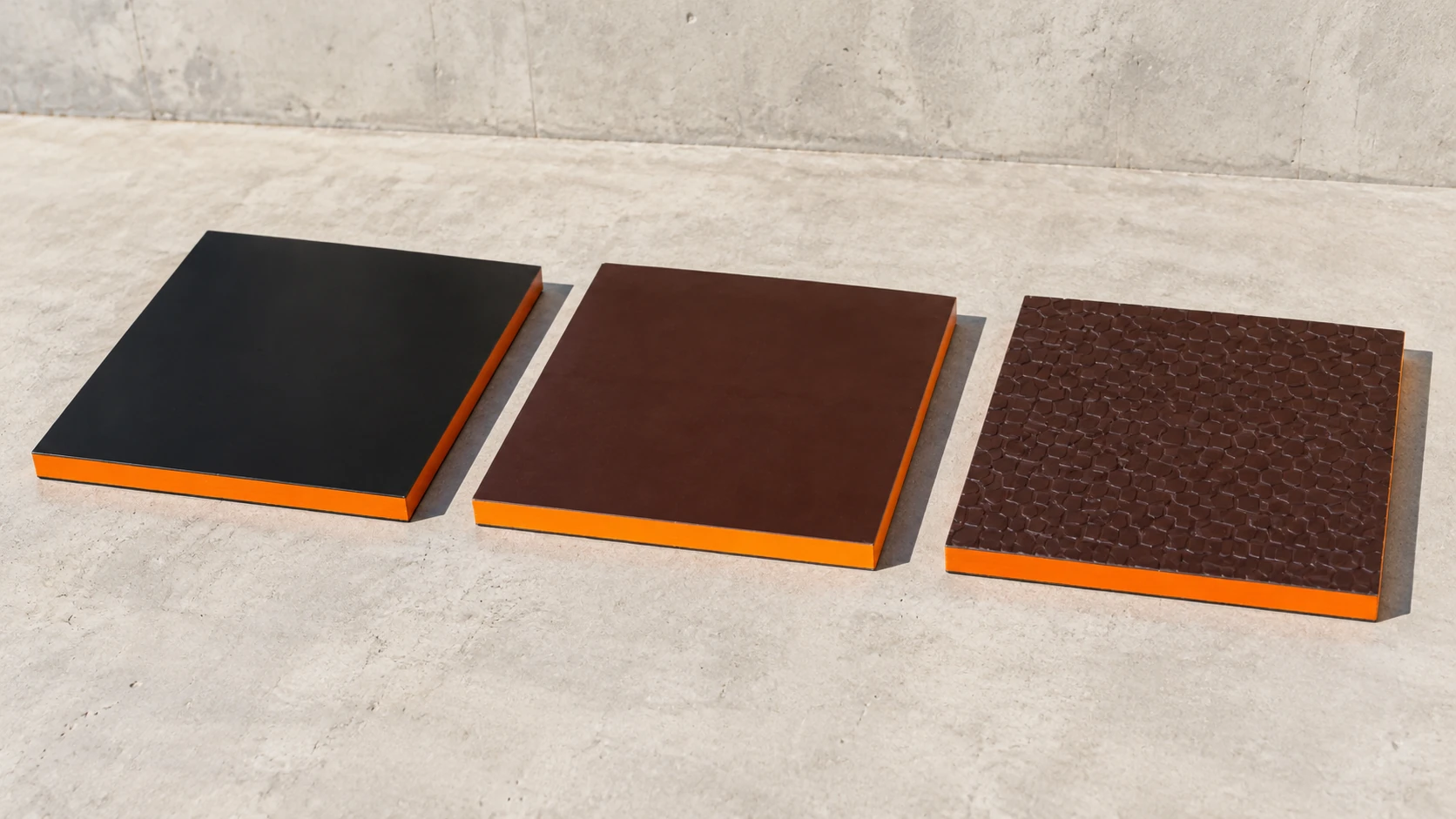
Film-faced plywood samples from PK Ply are cut from the build you plan to order: the same core, glue, film and edge paint. They are free; new buyers book the courier and can have that cost credited against a real order. Test them for thickness, density and bond before you compare offers, and read our lab data beside your own results.
Are your film-faced samples free, and can the courier cost be credited against my order?
Our film-faced plywood samples are free. Repeat buyers and buyers with an order receive them as part of the order. New buyers receive the same free samples and book their own courier, and that courier cost can be credited against a real order placed afterwards. Nothing in the sample is cut differently for a first enquiry.
| Buyer | Sample pieces | Courier | Credit |
|---|---|---|---|
| New buyer, no order yet | Free | Booked by the buyer | Courier cost credited against a real order |
| Buyer with an order in hand | Free | Arranged with the order | — |
| Repeat buyer | Free | Arranged with the order | — |
The split is simple on purpose. A sample costs us time on the saw and on the paperwork, and the courier costs real money on a long route; a buyer who books the courier shows that the enquiry is serious, and gets the money back when the order follows. Our terms of supply carry the same line.
What we do not do is send a “showroom” piece. A sample cut from a stock panel that does not match your enquiry tells you nothing about the panel you will receive, so every sample is cut from the build you name. That is the point of the rest of this note: what a sample is, what you can test on it yourself, and what our test reports add.
What a film-faced sample shows, and what it cannot
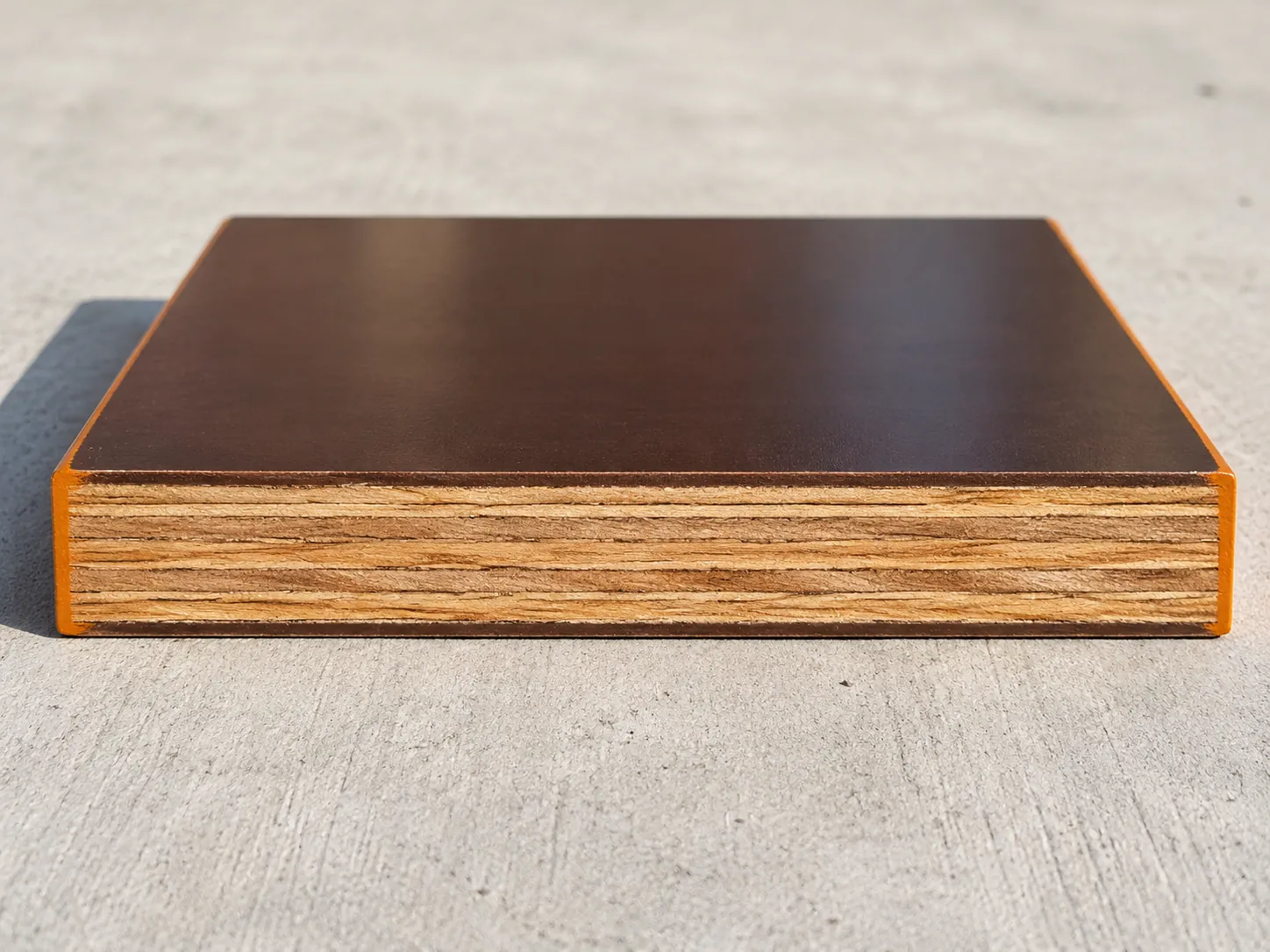
A film-faced sample shows four things you can see and measure: the film and its colour, the core veneers at the sawn edge, the glue line between them and the edge paint. It cannot show the pour count, the flatness of a whole sheet, or how the next 40HC will compare with it.
| On the sample | What you learn | What you do not learn |
|---|---|---|
| Film face | Colour, smoothness, film weight by feel and gloss | Face life over many strikes |
| Sawn edge | Core species, crosswise lay-up, gaps or overlaps | The core of every sheet in an order |
| Glue line | Whether it holds through a boil | A pour count |
| Edge paint | Whether the paint covers every veneer end | How cut edges will be sealed on site |
| Thickness | Measured thickness against ±0.5 mm | Flatness over 1220 × 2440 mm |
That is why we treat a sample as the first of three checks, not the last. The second is the technical sheet that fixes the build in writing. The third is the inspection of the first container on arrival, against the sample you kept. Our note on the first container and repeat supply shows how the three link up.
Does the sample match the glue and film of my order?
Yes, when the enquiry names them. We cut the sample from the build written on your request: core species, glue system, film weight and colour, thickness and edge paint. A sample that differs from the order in any of those lines is a sample of another panel, so the request has to name each one.
Write the request in the same lines as the order:
- Core. Acacia or Eucalyptus hardwood veneers.
- Glue. Melamine (MUF) or phenolic.
- Film. Weight in g/m² and colour, black or dark brown; orders run from 120–125 g/m², about 130–135 g/m² is most common now, and some buyers specify 165, 185 or over 200 g/m².
- Thickness. The everyday formwork thicknesses are 12, 15, 18 and 21 mm, inside our 9–40 mm range.
- Face pattern. Smooth for formwork, or a rice, hexagon or wire-mesh pattern for anti-slip.
- Use and pours. What the panel forms and how many pours you plan.
Two buyers who both ask for “18 mm film-faced, WBP” can receive samples that differ in every hidden line. The fields our mills quote on are the same lines; send them once and the sample, the technical sheet and the offer all describe one build.
What should I test on a plywood sample myself?
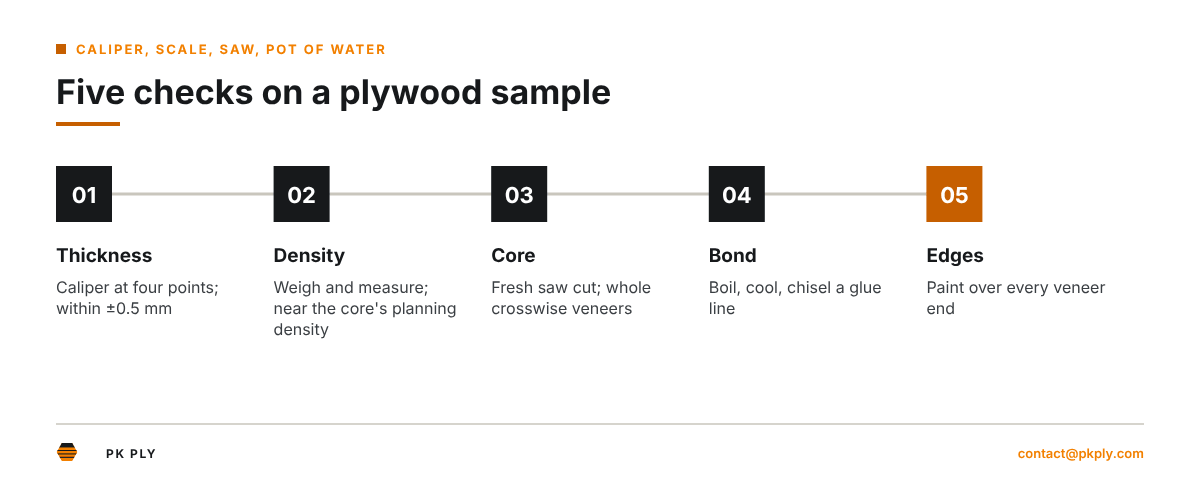
Test five things on a plywood sample before you compare offers: thickness with a caliper, density by weighing and measuring, the core at a fresh saw cut, the glue line after a boil, and the edge paint. Each needs only a caliper, a scale, a saw and a pot of water, and each answers one line of the build.
| Check | Tool | What a sound sample shows | Line of the build it checks |
|---|---|---|---|
| Thickness | Caliper | Within ±0.5 mm of the ordered thickness | Calibration before the film press |
| Density | Scale, rule, caliper | Close to the planning density of its core | Core species and compaction |
| Core at a fresh cut | Fine saw | Whole crosswise veneers, no gaps or overlaps | Core grade and lay-up |
| Bond after boiling | Pot of water, chisel | Wood fibre tears; glue lines do not part cleanly | Glue system |
| Edge paint | Eye, fingernail | Paint over every veneer end, no bare wood | Edge sealing |
Run every check on the piece you received, and keep a second piece untouched. The untouched piece is the reference you hold against the first container. Record each result with the date, the build lines and a photo; that record is worth more than the sample itself when two mills’ offers look alike.
How do I run a boil test on a film-faced sample?
Cut a strip from the sample, boil it in water for a few hours, let it cool, then try to split one glue line with a chisel. A sound exterior bond tears wood fibre on both sides of the line; a weak bond parts cleanly along the glue. It is a quick check, not the laboratory method.
The laboratory method is published. EN 314-1 sets the test methods for plywood bonding quality. EN 314-2 specifies requirements for bonding classes of veneer plywood according to their end uses. Formwork meets wet concrete and weather, so the class a formwork buyer asks for is the exterior one, bonding class 3, which is tested after boiling pretreatments.
A home boil test, step by step:
- Saw a strip across the sample with a fine blade so the cut shows every glue line.
- Put the strip in boiling water and keep it boiling for a few hours.
- Let it cool in water, then take it out while still wet.
- Drive a sharp chisel into one glue line from the sawn end and lever it open.
- Look at both faces of the split: torn wood fibre is a good sign, a smooth, clean glue surface is not.
- Repeat on two more glue lines, including one near the film.
Two cautions. A MUF glue line can pass a short boil and still give fewer pours than phenolic; our planning figures are about 12–15 pours for MUF and up to about 25 for phenolic, with proper handling, release agent on every pour and sealed edges. And a boil test on one strip says nothing about a whole order. Use it to sort samples, then rely on the test report and the written build.
What density should I expect from a 21 mm phenolic sample?
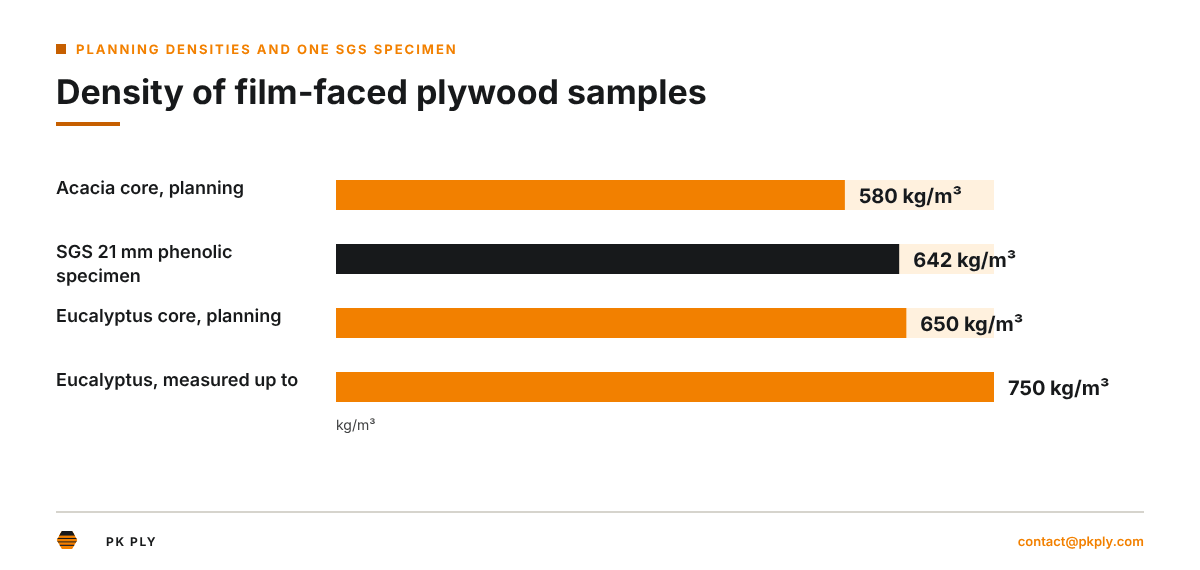
Expect a 21 mm phenolic sample to measure near the planning density of its core: about 580 kg/m³ for Acacia and about 650 kg/m³ for Eucalyptus, which is measured at 650–750 kg/m³. SGS measured 642 kg/m³ to BS EN 323 on one submitted 21 mm Acacia-core phenolic specimen, report dated 23 December 2025.
Density is mass divided by volume. Measure the sample’s length, width and thickness, multiply them for the volume in cubic metres, weigh it, and divide. A small error in thickness moves the result a lot on a small piece, so take the thickness at four points and use the average.
| Core | Planning density | What a 1220 × 2440 mm, 21 mm sheet weighs at that density |
|---|---|---|
| Acacia | 580 kg/m³ | About 36.3 kg |
| Acacia, as measured on our SGS specimen | 642 kg/m³ | About 40.1 kg |
| Eucalyptus | 650 kg/m³ (measured 650–750 kg/m³) | About 40.6 kg |
The sheet weights follow from density times the sheet volume of 0.0625 m³. A sample far below the planning figure for its core points to a lighter species or open gaps in the core; one well above it points to a denser species or a heavy glue spread. Neither is wrong in itself, but both change the container weight, so the density you measure feeds straight into the loading plan. Our 21 mm build note gives the sheet weights by size.
The test reports that come with our samples
Our samples come with the test reports for the configuration you are sampling: the SGS Vietnam report on one submitted 21 mm phenolic specimen for density, bonding and formaldehyde, and for anti-slip pieces the SGS pendulum reports on two specimens. Each report names its specimen, its method and its date.
| Report | Specimen | Method | Result |
|---|---|---|---|
| SGS Vietnam, 23 December 2025 | One submitted 21 mm dark-brown film-faced specimen, Acacia core, phenolic glue | BS EN 323 | Density 642 kg/m³ |
| Same report | Same specimen | EN 314-1 / EN 314-2 | Bonding class 3 PASS after 24 h water soak, boil-dry-boil and 72 h boiling |
| Same report | Same specimen | EN 717-1 chamber | Formaldehyde not detected at the 0.04 mg/m³ reporting limit; E1 PASS against ≤0.124 mg/m³ |
| SGS, 14 October 2025 | Anti-slip specimens 200 × 145 × 18.38 mm and 200 × 150 × 14.62 mm | DIN EN 16165, Annex C, slider 96 | 58 dry / 40 wet and 60 dry / 53 wet |
EN 717-1 is the BSI standard for wood-based panels, determination of formaldehyde release, formaldehyde emission by the chamber method. Read each result for what it is: one specimen, one method, one date. “Not detected” means below the reporting limit, not zero, and it is an E1 result. Our SGS specimen note reads the 21 mm report section by section, and the certification page lists the certificates behind the mill.
Can I get an anti-slip sample with pendulum test data?
Yes. Anti-slip samples come with the pendulum data from SGS: two specimens tested to DIN EN 16165, Annex C, with slider 96, in reports dated 14 October 2025. The 18.38 mm specimen gave 58 dry and 40 wet; the 14.62 mm specimen gave 60 dry and 53 wet. No slip class is claimed from these results.
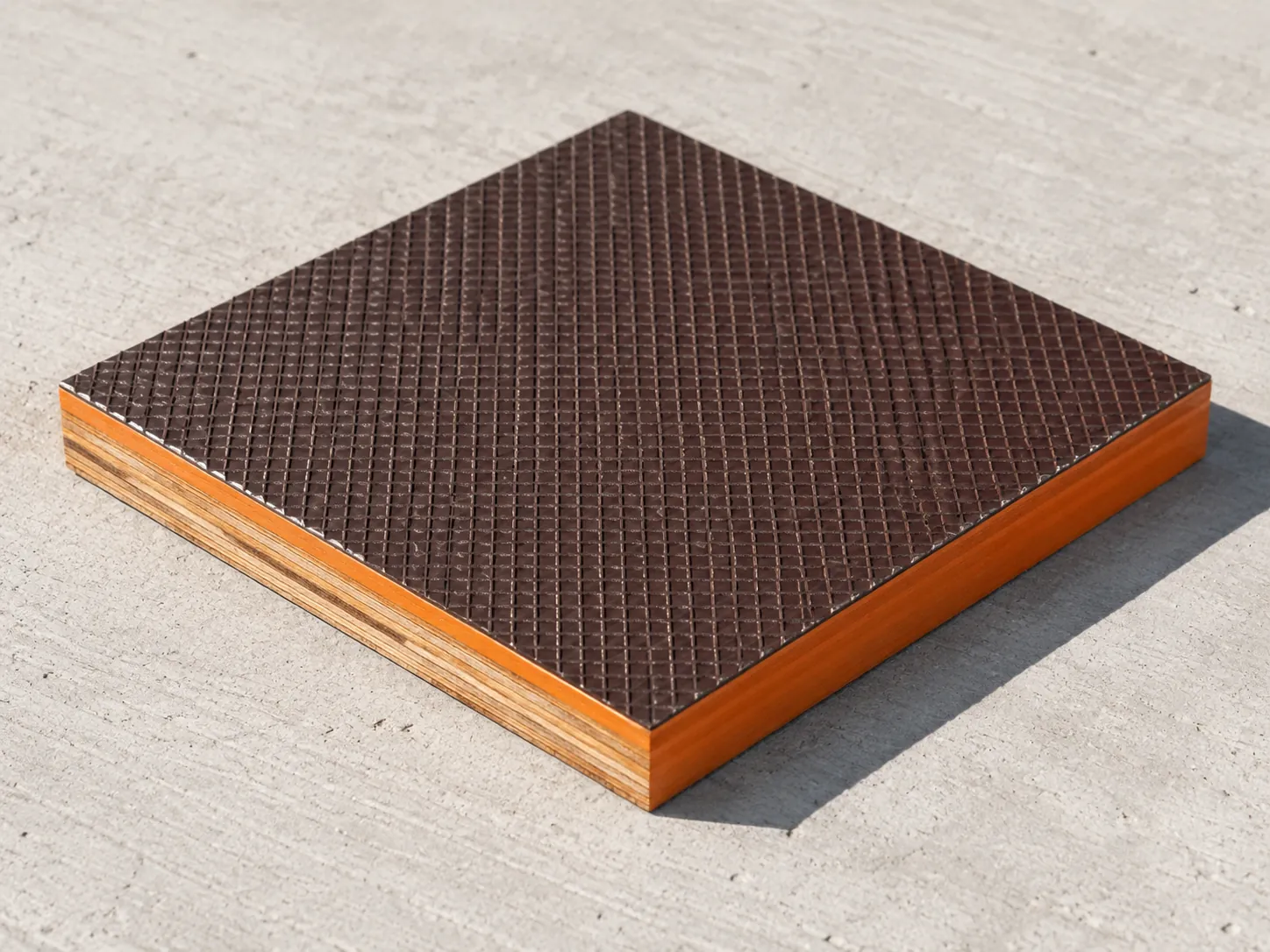
Anti-slip plywood carries a patterned film face, in a rice, hexagon or wire-mesh pattern, on an Acacia or Eucalyptus core. The catalogue lists a 220 g/m² anti-slip reference; the actual film and duty are confirmed per order. A sample of the pattern you plan to use is the only way to judge grip under your boots, under a pallet truck or on a trailer floor.
| What to compare on two anti-slip samples | How |
|---|---|
| Pattern height and sharpness | Run a fingernail across; look at it in raking light |
| Film coverage on the ridges | Look for bare wood at the tips of the pattern |
| Cleaning | Wet the face, add grit, sweep it, see what stays |
| Pendulum values | Read the report: which specimen, which thickness, dry and wet |
Two limits matter. The pendulum values belong to those two specimens, not to every pattern or thickness, and they are not a field-safety guarantee for a deck or a vehicle floor. Our anti-slip plywood page shows the patterns and the build.
How do I get plywood samples from a Vietnamese mill?
Send the build lines, the use and your delivery address, and say how many builds you want to compare. We confirm what we will cut, you book the courier if you are a new buyer, and the pieces go out with the matching test data. From our two mills in Chi Linh, Hai Phong, that is one exchange of messages.
The sample request, in order:
- Send the lines. Core, glue, film weight and colour, thickness, face pattern, use and pours, through the specification form.
- Confirm the cut list. We reply with the builds we will cut and the reports that go with them.
- Book the courier. New buyers book their own courier to our mills; for buyers with an order and repeat buyers we arrange it with the order.
- Receive and test. Run the checks above on one piece and keep the second.
- Compare. Put your results next to our reports and next to any other mill’s samples.
- Approve the build. We write the approved build on a technical sheet and send a dated offer.
A request that names only a thickness gets a question back, not a parcel. A request with all six lines lets us cut the right piece the first time, which saves a second courier.
How to compare samples from two or more mills
Compare samples of the same build, line by line, on the same day, with the same tools. Two film-faced offers with the same name are often not the same panel: core grade, joining, glue system, film weight, edge sealing and tolerance make the difference, and a side-by-side test of samples is where that shows.
| Line | Sample A | Sample B | Pass rule you set |
|---|---|---|---|
| Measured thickness, average of four points | Within ±0.5 mm | ||
| Density | Near the planning density of the stated core | ||
| Core at a fresh cut | Whole crosswise veneers, no gaps | ||
| Boil and chisel | Wood fibre tears | ||
| Edge paint | No bare veneer ends | ||
| Film face | Smooth, even, no pinholes | ||
| Test reports supplied | Named specimen, method and date |
Fill the empty columns yourself. Do the test blind if you can: have a colleague number the pieces so nobody knows which mill is which until the results are written. The price comes last. A panel that is cheaper per cubic metre and gives fewer pours costs more per pour, and the sample is the earliest point at which you can see the difference in build.
Sample, technical sheet, first container: keeping them aligned
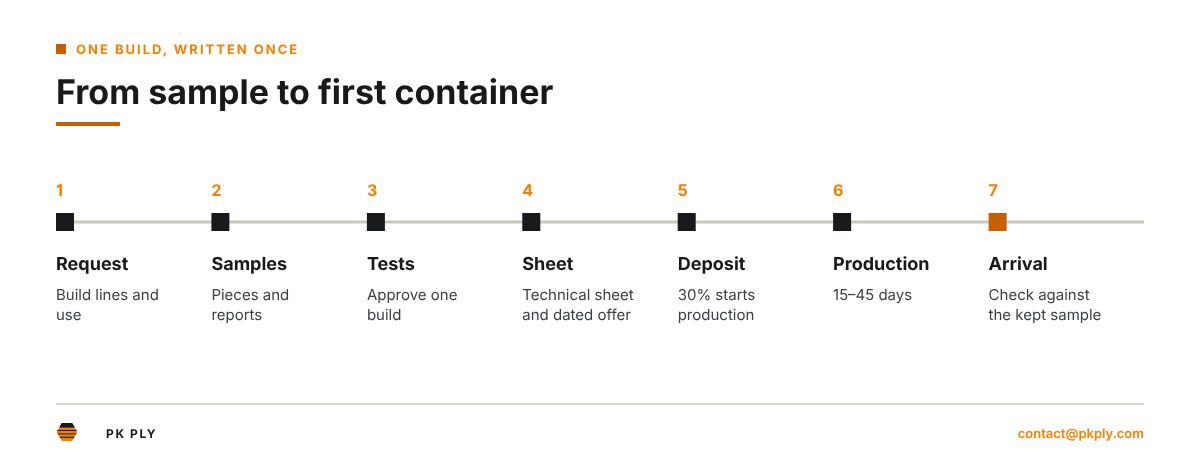
Keep the sample, the technical sheet and the first container aligned by writing every line of the approved sample onto the technical sheet, quoting that sheet on the order, and checking the first packs against the untouched sample when they arrive. If one link is missing, the sample proves nothing about the order.
| Stage | Document | What carries over |
|---|---|---|
| Sample approved | Your test record and the untouched piece | Build lines, measured thickness and density |
| Order confirmed | Technical sheet and offer | The same build lines, the tolerance for the order |
| Production | 15–45 days after the 30% deposit | The build on the technical sheet |
| Arrival | Packing list and your inspection | Thickness, core and edge checked against the kept piece |
The tolerance for each order is written on its technical sheet; on film-faced panels it is ±0.5 mm in thickness and ±2 mm in length and width. Repeat orders quote the same technical sheet, so the panel stays the build you sampled. Our QC stations page shows where those lines are checked in production.
What a sample cannot tell you about pours and flatness
A sample cannot tell you how many pours a panel gives or how flat a full sheet lies. Pours depend on the glue, the film and the site routine; flatness shows only over a whole 1220 × 2440 mm or 1250 × 2500 mm sheet. Judge those from the build, the technical sheet and the first panels on site.
| Question | Where the answer comes from |
|---|---|
| How many pours? | Glue and film on the technical sheet, plus handling, release agent and sealed edges |
| How flat is a full sheet? | Calibration and tolerance on the technical sheet; first sheets on arrival |
| Will every sheet match? | Production control and the build written on the order |
| Is the face life long enough? | Film weight, glue, and how the crew strikes and cleans |
Our planning figures are about 12–15 pours for MUF film-faced and up to about 25 for phenolic, with proper handling, a release agent on every pour and sealed edges, including every cut edge; budget panels typically give about 4–10. A sample that passes every test is the start of that number; the site routine finishes it. Our note on how many pours a panel gives sets out the site routine.
Mistakes buyers make with plywood samples
The common mistakes are asking for a sample without naming the build, testing only the face, cutting up every piece and keeping none, and comparing one mill’s report with another mill’s untested sample. Each one turns a sample into a souvenir instead of evidence.
- No build lines. The sample is cut from whatever is on the saw, and the order is not.
- Face only. The film looks the same on most panels; the core and the glue line decide the pours.
- Nothing kept. Without an untouched piece there is nothing to hold against the first container.
- Report without a specimen. A report that does not name its specimen, thickness, method and date is a brochure.
- One strip, one boil. Test at least three glue lines, including one near the film.
- Price before test. The cheaper sample is often a different build.
Our buyer FAQ answers the questions that come after the samples: payment, documents and loading.
After the samples: from approval to the first 40HC
After approval, we write the build on a technical sheet and send a dated offer FOB Hai Phong, CFR or CIF. A 30% deposit starts production, which takes 15–45 days depending on quantity, production conditions and agreement. The minimum order is one 40HC, carrying one or two products, or three to six by agreement.
| Step | What happens | Time |
|---|---|---|
| Approval | You confirm the build that passed your tests | — |
| Technical sheet and offer | Build lines, tolerance, Incoterm and port | A few days |
| Deposit | 30% by T/T | — |
| Production | Veneer intake to packed panels at our mills | 15–45 days |
| Balance | 70% against the scanned bill of lading, by T/T or irrevocable L/C at sight | — |
The samples stay useful after the order. Keep the untouched piece with the technical sheet, and check the first container against both. When you change a film weight or add a thickness on a repeat order, ask for a new sample of that build; samples stay free for repeat buyers. Send your build lines through the specification form or to [email protected].
Questions buyers ask us
Are your film-faced plywood samples free?
Yes. Samples are free for repeat buyers and buyers with an order, and new buyers receive free samples too. New buyers book their own courier.
Can the courier cost for a sample be credited against my order?
Yes. A new buyer who books the courier can have that cost credited against a real order placed afterwards.
Does the sample have the same glue and film as my order?
It is cut from the build written on your enquiry: the same core species, glue system, film weight and colour, and edge paint. Write those lines on the request so the sample matches them.
How do I run a simple boil test on a film-faced sample?
Cut a strip, boil it in water for a few hours, let it cool and try to split a glue line with a chisel. A sound exterior bond tears wood fibre rather than parting cleanly along the glue.
What density should a 21 mm phenolic sample have?
Our planning densities are 580 kg/m³ for an Acacia core and 650 kg/m³ for Eucalyptus. SGS measured 642 kg/m³ on one submitted 21 mm Acacia-core phenolic specimen.
Can I get an anti-slip sample with pendulum test data?
Yes. Two of our anti-slip specimens were pendulum-tested by SGS to DIN EN 16165, with results of 58 dry and 40 wet, and 60 dry and 53 wet. The report data comes with the sample; no slip class is claimed.
How many sample pieces should I ask for?
One piece per build you are comparing, plus a second piece of the build you lean towards, so you can cut one and keep one for comparison with the first container.
Can a sample prove how many pours a panel will give?
No. A sample shows build, bond and finish. The pour count of about 12–15 for MUF or up to about 25 for phenolic depends on handling, release agent and sealed edges on site.
Do repeat buyers get free samples?
Yes. Samples are free for repeat buyers, for example when they change a film weight or add a thickness on the next order.
Can I test formaldehyde emission on a sample myself?
Not meaningfully. Emission is measured in a chamber under EN 717-1 by a laboratory; our 21 mm specimen was not detected at the 0.04 mg/m³ reporting limit, an E1 result.
What happens after the samples are approved?
We confirm the build on a technical sheet and send a dated offer. The order then starts with a 30% deposit and production takes 15–45 days.