
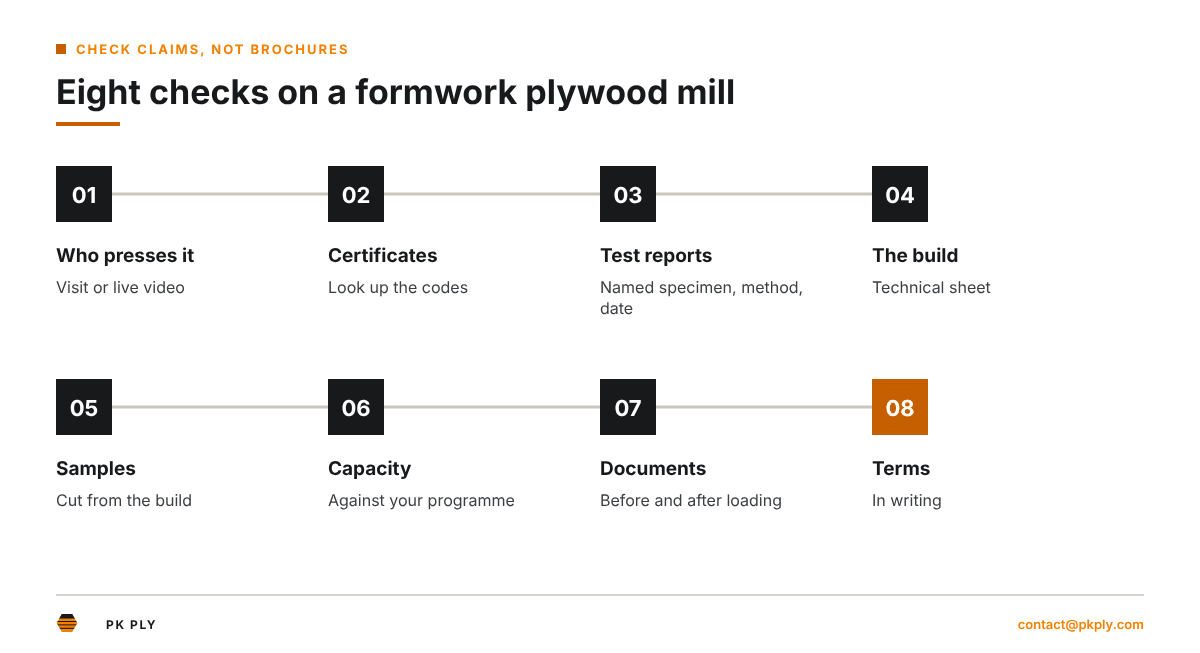
How to find a reliable plywood supplier for formwork: choose a mill whose claims you can check yourself, through certificate codes you look up, test reports on a named specimen, a written build, samples cut from it and terms in writing. PK Ply answers each check from our two mills in Chi Linh, Hai Phong; the same checks work on any mill you shortlist.
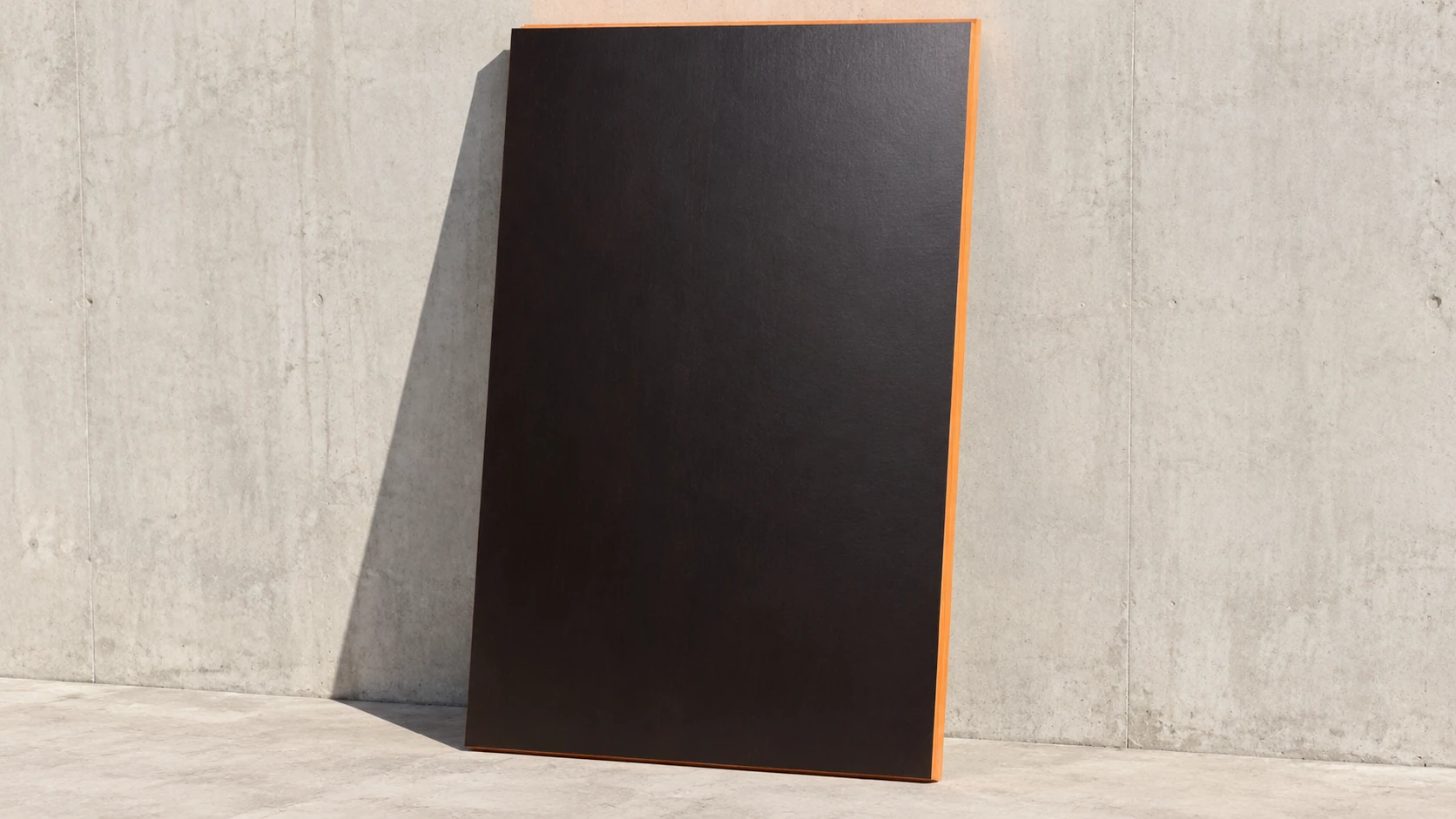
How to find a reliable plywood supplier for formwork panels?
Find a reliable formwork plywood manufacturer by checking claims, not reading them. Look up its certificate codes, ask for test reports on a named specimen, get samples cut from the build you will order, fix that build on a written sheet and compare terms in writing. A mill that passes all five checks is worth a trial container.
| Check | What you ask for | What you do with it |
|---|---|---|
| 1. Who presses the panel | The mill’s location and press lines | Visit, or watch a live video of the line |
| 2. Certificates | Codes and scopes | Look them up in the public registers |
| 3. Test evidence | Reports on a named specimen | Match specimen, method and date to your panel |
| 4. The build | A technical sheet | Compare offers line by line |
| 5. Samples | Pieces cut from that build | Test them; keep one untouched |
| 6. Capacity | Containers a month, lead time | Set it against your programme |
| 7. Documents | What comes before and after loading | Check it against your market’s rules |
| 8. Terms | Deposit, balance, Incoterm | Compare in writing, not by phone |
The order matters. The first three checks cost nothing but time and filter out most offers; samples and a visit come only for the mills that pass them. Price comes last, because a price for an unnamed build cannot be compared with anything. The rest of this note takes each check in turn, then shows how our two mills in Chi Linh, Hai Phong answer it.
What plywood is used for formwork, and what must the mill make?
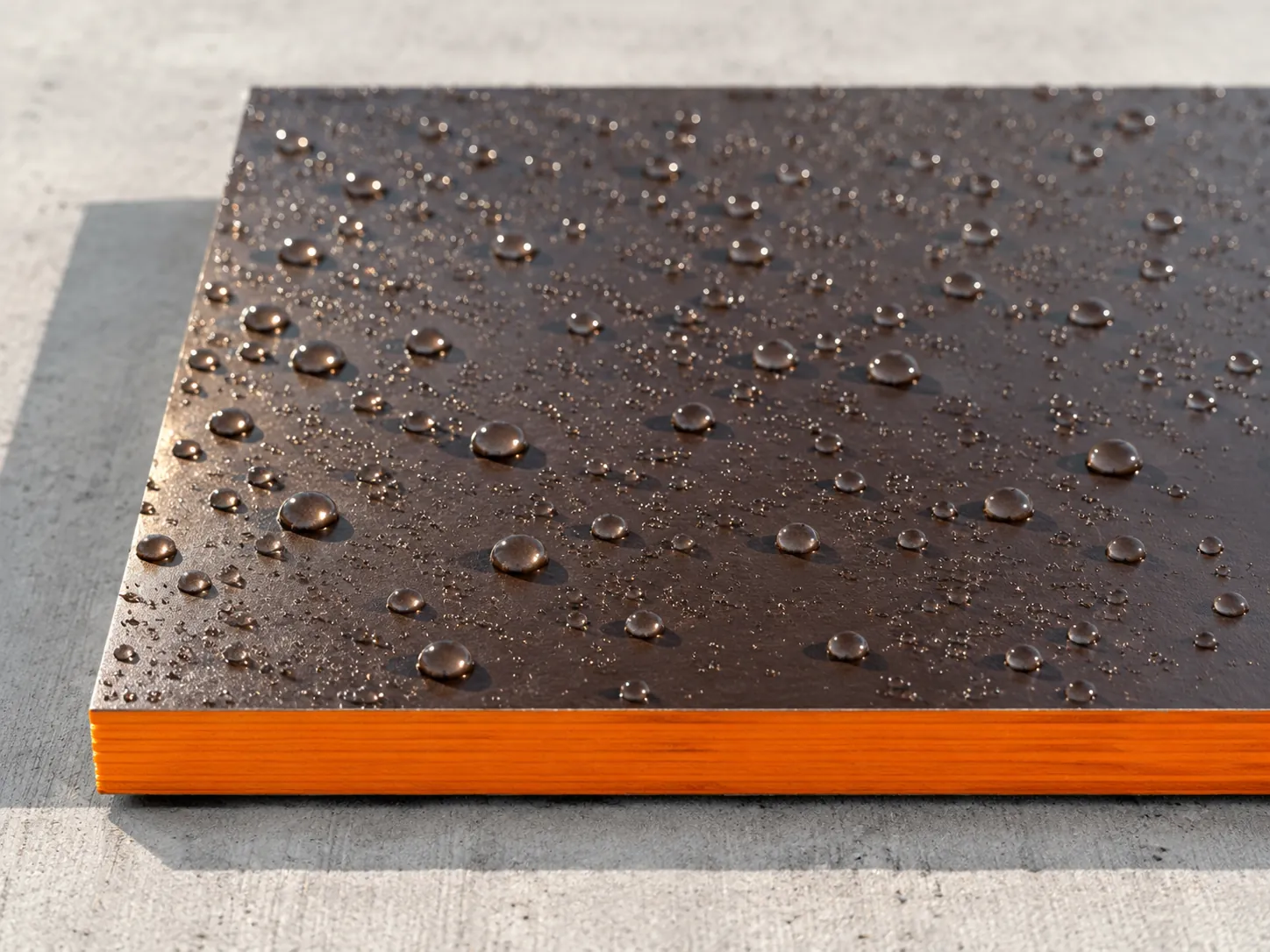
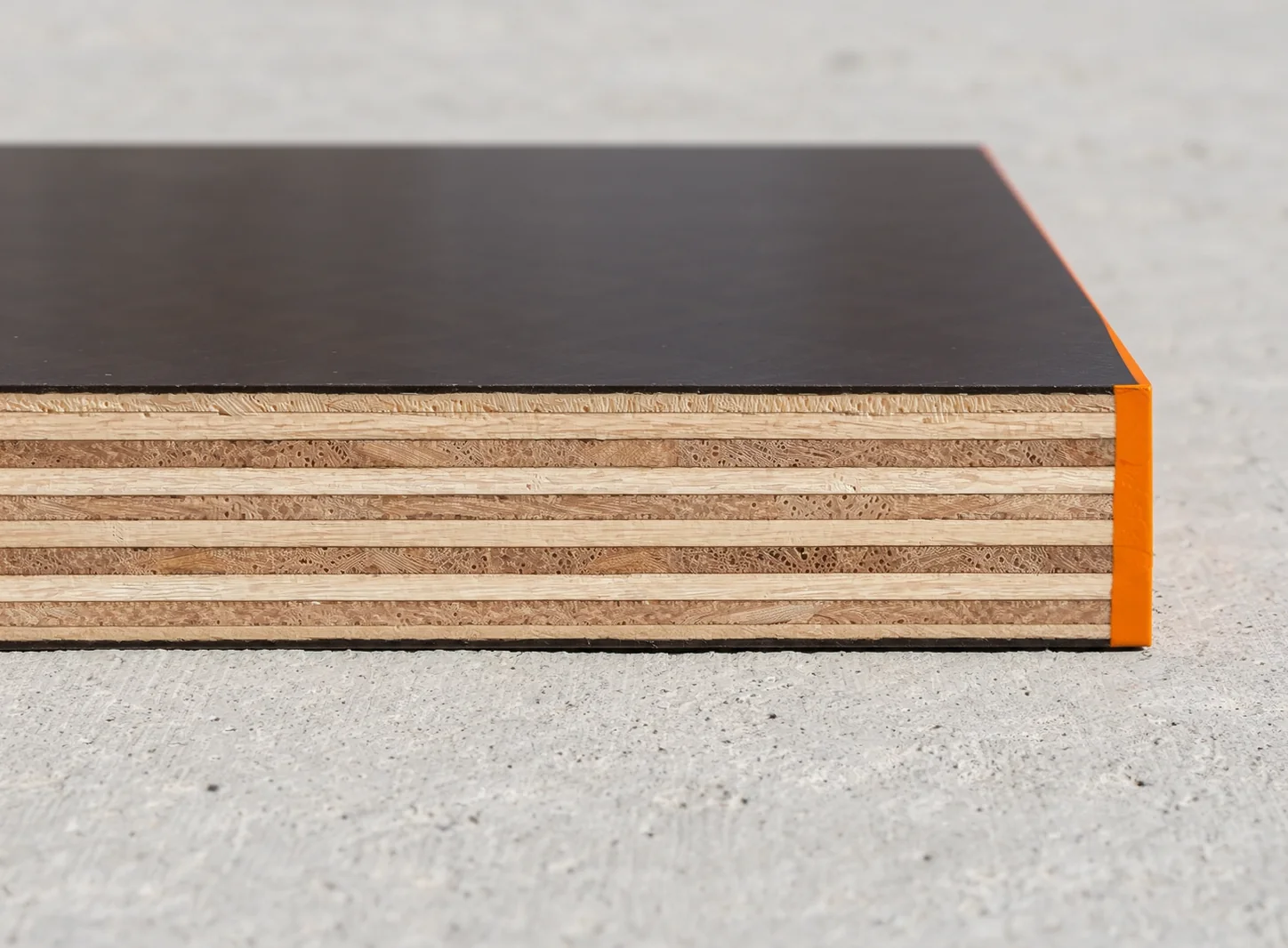
Formwork uses film-faced plywood: a veneer core bonded with an exterior glue, a phenolic film pressed on both faces and water-resistant paint on the edges. A mill that makes it well controls four things: the core, the glue, the film and the edges. Those four lines are what a buyer’s checks have to reach.
| Line | What a formwork buyer needs | What to ask the mill |
|---|---|---|
| Core | Whole veneers laid crosswise, no gaps or overlaps | Species and how the core is graded |
| Glue | An exterior bond that survives boiling | MUF or phenolic, and the bonding test |
| Film | A smooth face that releases cleanly | Film weight in g/m² and colour |
| Edges | Sealed against water at every joint | Paint on all four edges; sealing cut edges |
| Thickness | Flat joints between sheets | Tolerance, written per order |
On our panels the core is Acacia or Eucalyptus hardwood veneer, the glue is melamine (MUF) or phenolic, film weights run from 120–125 g/m² to over 200 g/m², and every edge is painted. With proper handling, a release agent on every pour and sealed edges, our MUF film-faced panels give about 12–15 pours and our phenolic panels up to about 25. A mill that cannot tell you its own version of each line is not ready to quote. Our film-faced plywood page shows the build.
Manufacturer, trader or agent: who presses your panel?
Ask who presses your panel and where, because the certificates, the test reports and the samples only mean something if they come from the production that will make your order. A trading company or an agent can be a good partner; what matters is that you know which mill is behind the offer and can check it.
Three questions sort it out:
- Where is the press line that will make my order? A manufacturer names the plant and can show it.
- Whose name is on the certificates and test reports? The name, the address region and the products should fit the plant that presses the panel.
- Can I see the line, in person or on a live video? A short live walk from veneer to film press answers more than a brochure.
| What you hear | What to ask next |
|---|---|
| “We have our own factory” | Which plant, which line, and can I see it on video this week? |
| “We work with several factories” | Which one makes my build, and is it named on the certificates? |
| “Certificates on request” | The codes now, so I can look them up |
| “Same quality as brand X” | The build line by line on a technical sheet |
We are a manufacturer: PK Ply is the export brand of our two mills in Chi Linh, Hai Phong, and goods are produced and exported directly from them. Our mills page describes both, and our note on visiting our mills lists what a visitor can check at each station.
How can I check a plywood mill’s FSC chain-of-custody code?
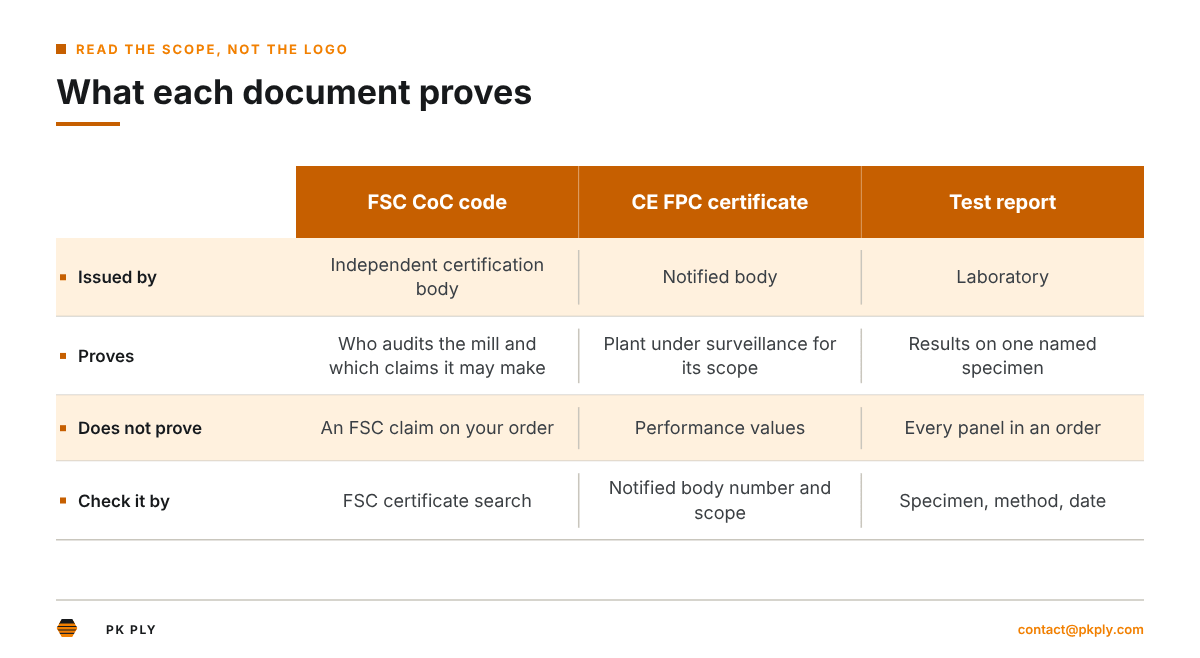
Ask the mill for its FSC chain-of-custody code, look the code up in FSC’s public certificate search, and check four things: the company named, the certificate status, the product types in scope and the FSC claims it may make. Then ask for the FSC claim to appear on the sales documents of your order.
The certificate itself is issued by a certification body, not by FSC. FSC offices or representatives do not issue certificates; to obtain certification, interested applicants must contact an independent certification body. Your certification body will conduct annual audits to assess conformance to your chain of custody certification. So the code you look up tells you who audits the mill and what for.
| What to check in the search result | Why |
|---|---|
| Company and site | The certificate must belong to the mill that presses your panel |
| Status | Valid, suspended or terminated |
| Product scope | Plywood, and the claim types (FSC 100%, FSC Mix) |
| Certification body | Who audits the mill |
A certificate is not a claim on your panel. An FSC claim is made per order, on the invoice and delivery documents, for material that qualifies. Our code is FSC SGSHK-COC-370674, issued by SGS Hong Kong; its scope covers the manufacture and sale of FSC 100% and FSC Mix plywood, and the claim for an order is confirmed on the sales documents. Our FSC page shows the certificate.
What does a CE factory production control certificate prove about a mill?
A CE factory production control certificate proves that a notified body inspected the plant and its production control and keeps it under continuing surveillance, for the products and thicknesses in its scope. It does not give the panel’s performance values; those come on the declaration of performance for each product.
Two facts let you check one. The Commission shall make publicly available the list of bodies notified under this Regulation, including the identification numbers that have been allocated to them. In the Construction Products Regulation, factory production control is the documented, permanent and internal control of production in a factory. The number in front of “CPR” on the certificate is the notified body’s number; look it up, and check that the body is notified for wood-based panels.
| On the certificate | What to check |
|---|---|
| Certificate number | Format “body number-CPR-…”; the body number matches a notified body |
| Harmonised standard | EN 13986 for wood-based panels in construction |
| AVCP system | System 2+ for structural plywood |
| Scope | Product, uses, glue and thickness range |
| Plant | The plant that makes your panel |
Read the scope against your panel. Ours is certificate 0407-CPR-2146 from Istituto Giordano, notified body 0407, under EN 13986 and AVCP System 2+, covering plywood for structural use in dry, humid and external conditions from 3.6–30 mm with MUF or phenolic glue. That is narrower than our 9–40 mm range, so a panel offered as CE must fall inside it. Our CE marking page shows the certificate.
Why ask a supplier for test reports on a named specimen?
Ask for test reports on a named specimen because only a named specimen can be matched to your panel: thickness, core, glue, film, the method used for each value and the report date. A result with no specimen behind it, or a table of values on a brochure, cannot be checked against anything you will receive.
The methods for formwork plywood are published. EN 314-2 specifies requirements for bonding classes of veneer plywood according to their end uses. EN 717-1 is the BSI standard for wood-based panels, determination of formaldehyde release, formaldehyde emission by the chamber method. A report that names one of them, with a specimen and a date, is evidence.
| A useful report names | Example from our own report |
|---|---|
| Laboratory and date | SGS Vietnam, 23 December 2025 |
| Specimen | One submitted 21 mm dark-brown film-faced specimen, Acacia core, phenolic glue |
| Method per value | BS EN 323 density; EN 314-1 / EN 314-2 bonding; EN 717-1 chamber |
| Result per value | 642 kg/m³; Class 3 PASS after 24 h soak, boil-dry-boil and 72 h boiling; formaldehyde not detected at the 0.04 mg/m³ reporting limit, E1 PASS |
| What it does not prove | Every panel in an order; a pour count; an E0 claim |
Read every report for its limits. One specimen is not a guarantee for every panel, and “not detected” means below a reporting limit, not zero. Our SGS specimen note reads our report value by value.
How many containers a month can your two mills supply?
Our two mills in Chi Linh, Hai Phong can supply up to 150 containers a month. One of them is a modern plant that started production in 2026. For any mill you shortlist, set its stated capacity against your programme and its lead time, and ask what share of that capacity your orders would take.
| Capacity question | Why it matters | Our answer |
|---|---|---|
| Containers a month | Whether the mill can follow your programme | Up to 150 containers a month |
| Plants | Whether one breakdown stops supply | Two own mills in Chi Linh, Hai Phong |
| Lead time | How far ahead you must order | 15–45 days after the 30% deposit |
| Minimum order | The smallest step you can take | One 40HC |
| Mixed loads | Whether one container can carry several items | One or two products; three to six by agreement |
Capacity is a ceiling, not a promise for your order. The lead time depends on quantity, production conditions and agreement, and a mill that never says “not this month” is not telling you how it plans. Our second plant page describes the 2026 plant.
What documents do you send before an order is confirmed?
Before an order is confirmed we send the certificate files for its configuration, the technical sheet for the build and a dated offer. Draft shipping documents follow for approval after loading. Ask any mill for the same split: what you see before you pay the deposit, and what you see before you pay the balance.
| Before the deposit | Before the balance |
|---|---|
| Certificate files for the order’s configuration | Packing list from loading |
| Technical sheet: core, glue, film, thickness, tolerance, size, edges | Draft bill of lading for approval |
| Test reports for the agreed configuration | Commercial invoice |
| Dated offer with Incoterm and port | Certificate of origin, EUR.1 for EU-bound lots |
| Payment terms in writing | Phytosanitary and fumigation papers; insurance under CIF |
The first column is where a buyer checks the mill; the second is where the buyer checks the shipment. For EU lots the order’s file also carries the FSC claim on the sales documents where it applies, the emission certificate, and the EUTR or EUDR file set. Our note on the documents with each container lists every paper.
Samples cut from the build you will order
Ask for samples cut from the build you will order, test them, and keep one piece untouched. A sample from another build tells you about another panel. With the build written on the request, the sample, the technical sheet and the first container can all be compared with each other.
| Test on the sample | Tool | What a sound sample shows |
|---|---|---|
| Thickness | Caliper | Within ±0.5 mm of the ordered thickness |
| Core at a fresh cut | Fine saw | Whole crosswise veneers, no gaps |
| Bond after boiling | Pot of water, chisel | Torn wood fibre, not a clean glue line |
| Edge paint | Eye | Paint over every veneer end |
Our samples are free; new buyers book their own courier, and that cost can be credited against a real order. Our note on film-faced samples sets out each test step by step.
Same name, different panel: reading two quotes
Read two quotes line by line, because two film-faced offers with the same name are often not the same build. Core grade, joining, glue system, film weight, edge sealing and tolerance make the difference. Start the comparison from the application and the reuse target, then hold each offer against the same lines.
| Line | Offer A | Offer B | Why it moves the price |
|---|---|---|---|
| Core species and grade | Whole veneers cost more than patched or joined ones | ||
| Glue | Phenolic costs more than MUF and gives more pours | ||
| Film weight | Heavier film costs more and lasts longer | ||
| Edge sealing | Painted edges resist swelling at joints | ||
| Thickness tolerance | Calibration costs sanding time | ||
| Incoterm and port | FOB, CFR and CIF price different costs |
Fill the blank columns from the technical sheets, not from the e-mail. An offer that leaves a line blank is quoting the cheaper version of it. Our list of the fields our mills quote on gives every line.
Terms that show how a mill works
Payment terms, Incoterms and lead time show how a mill works as clearly as its certificates. Clear terms in writing, a deposit that starts production and a balance tied to a shipping document are signs of a mill used to export; vague terms are a reason to slow down.
Incoterms rules are a set of eleven three-letter trade terms reflecting business-to-business practice in contracts for the sale and purchase of goods. Ask which rule applies and which port is named, because that sets where the mill’s cost and risk end.
| Term | Ours |
|---|---|
| Minimum order | One 40HC |
| Deposit | 30% to start production |
| Production | 15–45 days after the deposit, depending on quantity, production conditions and agreement |
| Balance | 70% against the scanned bill of lading, by T/T or irrevocable L/C at sight |
| Incoterms | FOB Hai Phong, CFR or CIF |
Compare terms the same way you compare builds: in a table, from written offers. Our terms of supply set them out in one place.
Visit or video: seeing the press line before the deposit
See the press line before the deposit, either on a visit or on a live video call that walks from veneer intake to the film press and the edge painting. A visit lets you hold panels and talk to the people who press them; a live video lets you check the same stations without travelling.
| On the line | What to look for |
|---|---|
| Veneer intake and drying | Sorted veneer, a dryer in use |
| Core lay-up | Veneers laid crosswise, gaps rejected |
| Glue and hot press | Glue mixed and spread evenly; press running |
| Sanding and film press | Calibrated cores before the film goes on |
| Edge sealing | Paint over every edge |
| Marking and packing | Marks and packing that match the order |
Ask for the walk to follow production order and for the certificates to be in the room. Hot pressing for phenolic bonds runs at about 130–145 °C at our mills; a buyer who asks the press operator for the setting gets a number, not a slogan. Our note on visiting our mills takes each station in turn.
Red flags when checking a plywood supplier
The red flags are claims that cannot be checked: certificate photos without a code, codes that do not match the company, test results with no specimen or date, samples that differ from the offer, a price far below other offers for “the same” panel, and terms that change between messages.
| Red flag | What it usually means | What to do |
|---|---|---|
| Certificate image, no code | The certificate may not be current or may not be theirs | Ask for the code; look it up |
| CE claim for every thickness | The scope may be narrower than the offer | Ask for the scope on the certificate |
| “Low emission” or “WBP” with no report | A name, not a result | Ask for the method and the specimen |
| Pour count without conditions | A sales figure | Ask for the glue, film and site conditions behind it |
| Sample not cut from the build | You are testing another panel | Re-request with the build lines |
| Price far below the others | A different build | Compare line by line |
None of these proves bad faith on its own. Each one is a question the mill should be able to answer in writing, and a mill that answers them all has done most of your checking for you.
A scorecard for comparing formwork plywood mills
Score each shortlisted mill on the same eight checks, with evidence in every cell: a code you looked up, a report you read, a sample you tested. A mill without evidence in a row scores zero there, whatever its brochure says. Keep the scorecard with the technical sheet of the build you choose.
| Check | Evidence | Mill 1 | Mill 2 | Mill 3 |
|---|---|---|---|---|
| Who presses the panel | Visit or live video | |||
| FSC code | Search result matches company and scope | |||
| CE certificate | Notified body and scope match the panel | |||
| Test reports | Named specimen, method, date | |||
| Written build | Technical sheet line by line | |||
| Samples | Your own test results | |||
| Capacity and lead time | Written figures against your programme | |||
| Terms | Written offer: deposit, balance, Incoterm |
Score with the same people and on the same day for every mill. When two mills tie, the trial container decides; our note on the first container and repeat supply shows how to run one.
How our two mills answer the checks
Our two mills in Chi Linh, Hai Phong answer every check with something you can look up, test or see: certificate codes, a named SGS specimen, a technical sheet per build, free samples, up to 150 containers a month and written terms. Send your build lines, and we return the papers before you decide.
| Check | Our evidence |
|---|---|
| Who presses the panel | Two own mills in Chi Linh, Hai Phong; visits and live video on request |
| FSC | SGSHK-COC-370674, issued by SGS Hong Kong |
| CE | 0407-CPR-2146, Istituto Giordano, EN 13986, 3.6–30 mm |
| Australia | Certified to AS 6669:2016, formwork plywood, by CMI Certification |
| Test reports | SGS Vietnam, one submitted 21 mm phenolic specimen, 23 December 2025 |
| Build | Technical sheet per order: core, glue, film, ±0.5 mm, size, edges |
| Samples | Free; new buyers book the courier, credited against a real order |
| Terms | One 40HC minimum, 30% deposit, 70% against the scanned B/L |
Our certification page shows the certificates, and the buyer FAQ answers the questions that follow. Send your build lines through the specification form or to [email protected].
Questions buyers ask us
How do I find a reliable plywood supplier for formwork?
Shortlist mills that state their build, then check what they claim: certificate codes in the public registers, test reports that name a specimen, samples cut from the build you will order, and terms in writing. Keep the mill that passes every check, not the cheapest offer.
How can I check a plywood mill's FSC chain-of-custody code?
Ask for the certificate code, look it up in FSC's public certificate search, and check that the company, the status and the product scope match the panel you are buying. Then ask for the FSC claim on the sales documents of your order.
What does a CE factory production control certificate prove?
That a notified body inspected the plant and its factory production control and keeps it under surveillance for the products in the certificate's scope. It does not give performance values; those are on the declaration of performance for each product.
How can I tell a manufacturer from a trading company?
Ask who presses the panel and where, then check that the certificates, test reports and samples all come from the same production. A visit or a live video of the press line settles it.
Which certificates should a formwork plywood mill hold?
It depends on your market: CE to EN 13986 for structural use in Europe, FSC chain of custody if you sell FSC claims, AS 6669 for formwork plywood in Australia, and test reports for bonding and formaldehyde. Check each one's scope against your panel.
Why ask for test reports on a named specimen?
Because a report that names its specimen, thickness, glue, method and date tells you exactly what was tested. A result without a specimen cannot be matched to the panel you will buy.
How many containers a month can your mills supply?
Up to 150 containers a month across our two mills in Chi Linh, Hai Phong. The minimum order is one 40HC.
What documents do you send before an order is confirmed?
The certificate files for the order's configuration, the technical sheet for the build and a dated offer. Draft shipping documents follow for approval after loading.
Should I choose the cheapest film-faced plywood offer?
Only if it is the same build. Two offers with the same name often differ in core grade, glue, film weight, edge sealing and tolerance, and the cheaper build usually gives fewer pours.
What payment terms are normal for a first container?
Our terms are a 30% deposit and the 70% balance against the scanned bill of lading, by T/T or irrevocable L/C at sight. Other mills set their own; compare them in writing.
What plywood is used for formwork?
Film-faced plywood: a hardwood or softwood veneer core with an exterior glue line and a phenolic film on both faces, with sealed edges. The glue, film and core decide how many pours it gives.