
A first order with PK Ply is one 40HC carrying one or two products, or up to six by agreement, produced 15–45 days after the 30% deposit. The build is written on a technical sheet that every repeat order quotes, so the panel stays the same while supply grows toward the 150 containers a month our two mills can produce.
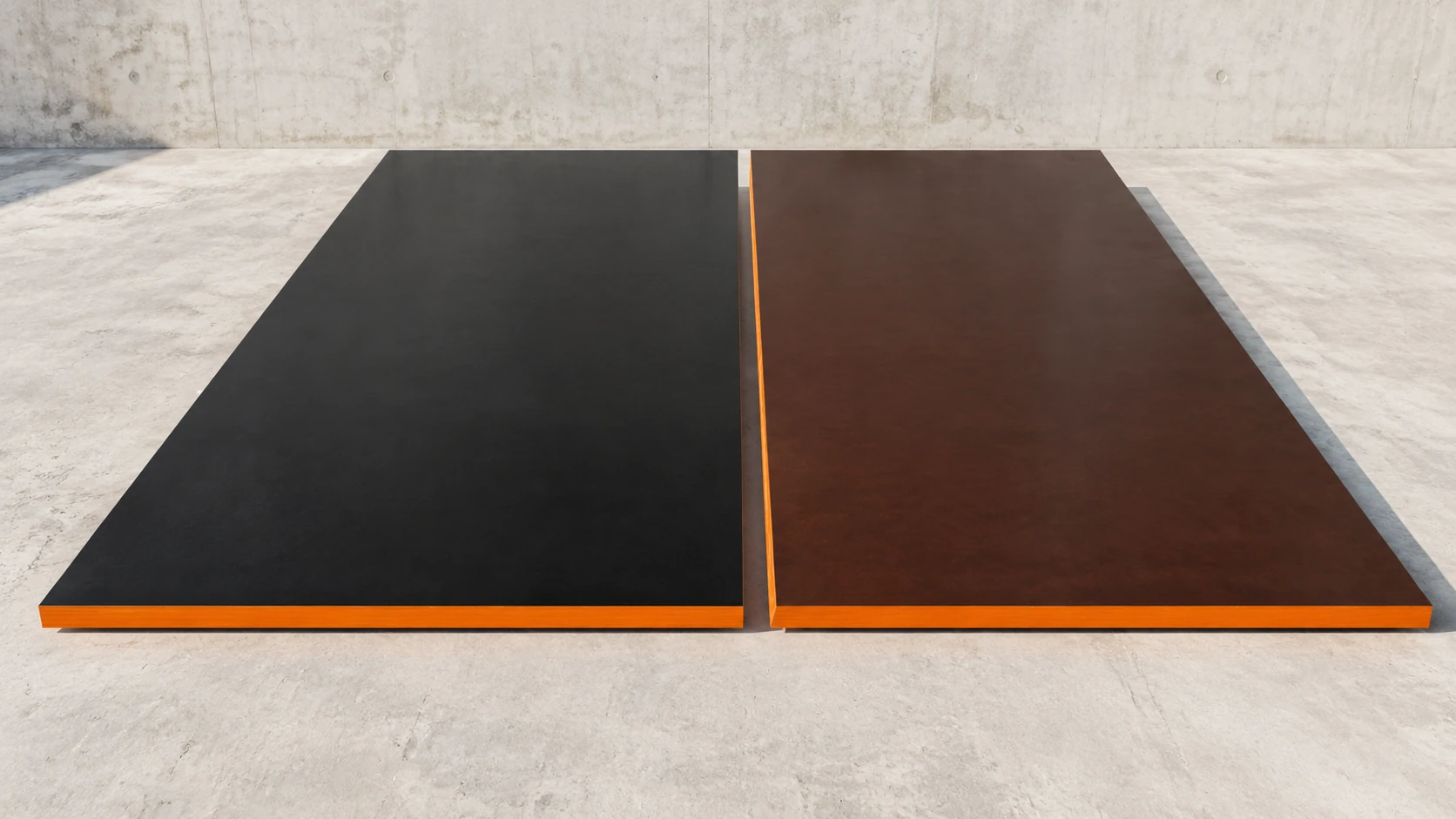
What does a first order with a plywood supplier look like?
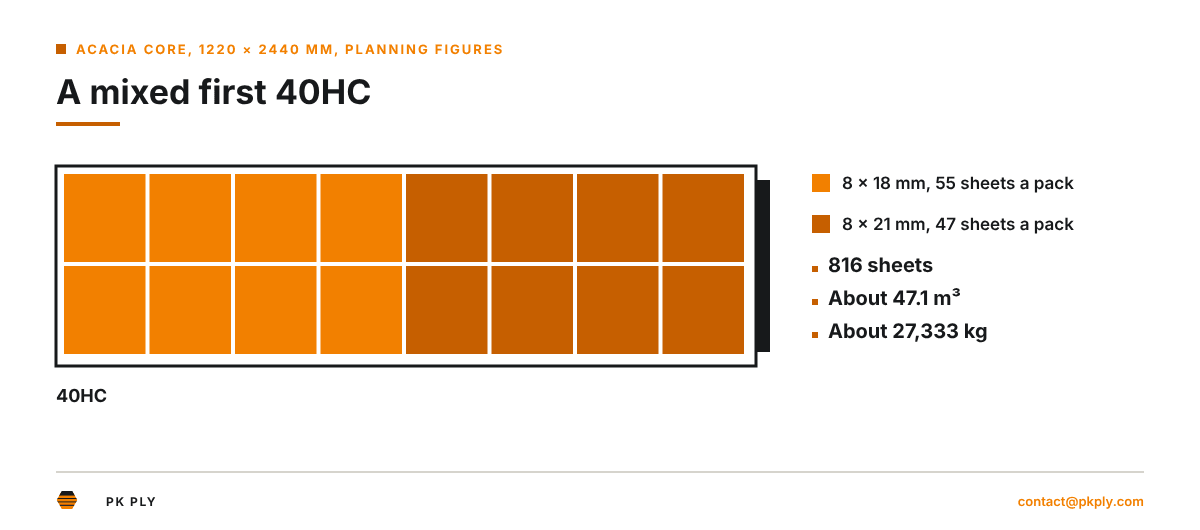
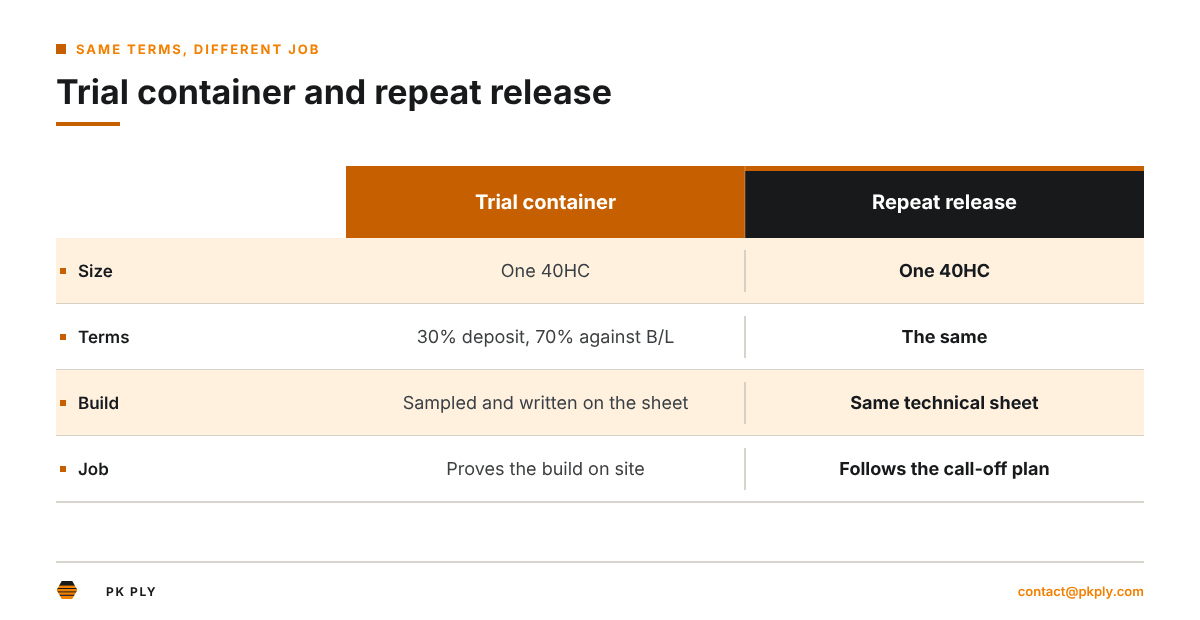
A first order with us is one 40HC of a build you have sampled and approved, written on a technical sheet and quoted FOB Hai Phong, CFR or CIF. A 30% deposit starts production, which takes 15–45 days; the 70% balance is paid against the scanned bill of lading. Repeat orders then quote the same sheet.
| Step | What happens | Time |
|---|---|---|
| 1. Build and samples | You send the build lines; we send free samples cut from that build | Courier time |
| 2. Technical sheet and offer | Core, glue, film, thickness and tolerance, size, edges; Incoterm and port | A few days |
| 3. Deposit | 30% by T/T | — |
| 4. Production | Veneer intake to packed panels | 15–45 days |
| 5. Loading and drafts | Packing list; draft documents for your approval | A few days |
| 6. Balance | 70% against the scanned B/L, T/T or irrevocable L/C at sight | — |
| 7. Sea and arrival | Days at sea to your port; your inspection | By route |
| 8. Review and repeat | Site results written down; next order quotes the same sheet | — |
The trial container is not a smaller version of a normal order. It is a full 40HC, and it does one job: to prove that the build on the sheet arrives as written and performs on your site. Everything after it, from the second container to a monthly call-off, depends on that proof.
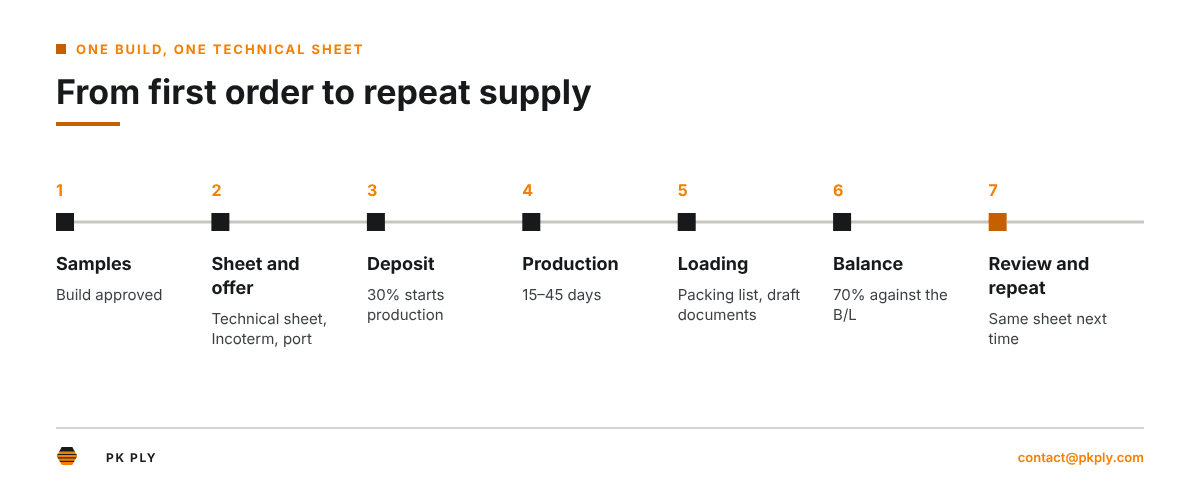
Can my first 40HC carry several thicknesses?
Yes. A 40HC usually carries one or two products, and three to six products can be mixed by agreement, for example several thicknesses of one film-faced build, or a film-faced and an anti-slip build. Each mix changes how full and how heavy the container is, so we plan the load with you before production.
Our planning model stacks packs about 1,000 mm high: 16 packs with an Acacia core, 15 with Eucalyptus, against a planning payload of 28,000 kg of panels that the carrier and route confirm. A two-thickness Acacia-core load shows how a mix works:
| Example mix, Acacia core, 1220 × 2440 mm (planning figures) | Packs | Sheets | Volume | Panel weight |
|---|---|---|---|---|
| 18 mm film-faced, 55 sheets a pack | 8 | 440 sheets | About 23.6 m³ | About 13,684 kg |
| 21 mm film-faced, 47 sheets a pack | 8 | 376 sheets | About 23.5 m³ | About 13,649 kg |
| Container total | 16 | 816 sheets | About 47.1 m³ | About 27,333 kg |
The figures follow from the per-pack counts and sheet weights of our planning table: about 31.1 kg for an 18 mm sheet and about 36.3 kg for a 21 mm sheet with an Acacia core. Real sheets are weighed before final loading, and the packing list is the number that counts. Our 40HC loading page shows how packs go in.
How long after the deposit is a trial container ready?
A trial container is produced 15–45 days after the 30% deposit, depending on quantity, production conditions and agreement. Loading and the draft shipping documents follow, then the balance and the sea days to your port. Plan the whole chain, not only the production time, before you set a site date.
| From Hai Phong to | Typical days at sea |
|---|---|
| South-East Asia | 5–12 |
| Middle East | 15–25 |
| US West Coast | 20–30 |
| Mediterranean | 25–35 |
| Northern Europe | 30–40 |
| US East Coast | 35–45 |
| West Africa | 35–50 |
Sea days vary by carrier and route. Add the production days, a few days for loading and the drafts, the sea days and your own clearance and delivery, and you have the date the first panels can reach site. A mixed container takes no longer to produce than a single-product one of the same quantity, but each extra build adds one more line to check before loading.
Payment terms and Incoterms on the trial container
The trial container runs on the same terms as every order: a 30% deposit to start production, and the 70% balance against the scanned bill of lading, by T/T or irrevocable L/C at sight. We sell FOB Hai Phong, CFR or CIF to your port; duty, clearance and delivery inland stay with you.
Incoterms rules are a set of eleven three-letter trade terms reflecting business-to-business practice in contracts for the sale and purchase of goods. The three we use split the costs differently:
| Incoterm | We arrange | You arrange |
|---|---|---|
| FOB Hai Phong | Production, loading, export clearance | Sea freight, insurance, import clearance, delivery |
| CFR | Also sea freight to your port | Insurance, import clearance, delivery |
| CIF | Also sea freight and insurance to your port | Import clearance, delivery |
On a first container, CFR or CIF keeps the freight booking with us while you learn the route; FOB suits buyers who already ship regularly from Hai Phong with their own forwarder. Our terms of supply carry the same terms.
What to fix in writing before the deposit
Before the deposit, fix the build, the quantities and the terms in writing: one technical sheet per build, the mix and quantities for the container, the Incoterm and port, and the payment terms. Whatever is not written is not part of the order, and it is the first thing that differs on a second container.
| On the technical sheet | Example line |
|---|---|
| Use and pours | Slab and wall formwork, phenolic build |
| Core | Acacia or Eucalyptus hardwood veneers, laid crosswise |
| Glue | Melamine (MUF) or phenolic |
| Film | Weight in g/m² and colour, both faces |
| Thickness and tolerance | For example 18 mm, ±0.5 mm |
| Size and tolerance | 1220 × 2440 mm or 1250 × 2500 mm, ±2 mm |
| Edges | Water-resistant paint on all four edges |
| Certificates | CE, FSC claim or test reports the order needs |
The sheet is the contract for the panel, and for European orders it names the service and bonding class too. EN 636 specifies requirements for plywood for general purposes or structural application in dry, humid or exterior conditions. EN 314-2 specifies requirements for bonding classes of veneer plywood according to their end uses. Formwork meets wet concrete, so the sheet names the exterior class and bonding class 3. If you want CE structural plywood, check that the thickness sits inside the 3.6–30 mm scope of our certificate 0407-CPR-2146. Our list of the fields our mills quote on gives every line.
Documents with the first container
The first container comes with the documents your market needs: commercial invoice, packing list, bill of lading, certificate of origin (EUR.1 for EU-bound lots), phytosanitary and fumigation papers, insurance under CIF, and the order’s certificate documents. Certificate files are sent before the order is confirmed; draft shipping documents follow for approval after loading.
| When | Document |
|---|---|
| Before the order is confirmed | Certificate files for the configuration; test reports for the agreed build |
| After loading, as drafts for approval | Commercial invoice, packing list, bill of lading |
| With the shipment | Certificate of origin, phytosanitary and fumigation papers, insurance under CIF |
| For EU lots | FSC claim on the sales documents where it applies, emission certificate, EUTR or EUDR file set |
For CE structural plywood sold into the EU, the declaration of performance travels with the product. The declaration of performance shall be supplied in the language or languages required by the Member State where the product is made available. Tell us the destination country so the declaration comes in the right language.
Check the drafts against the technical sheet and the order before you pay the balance: product names, thicknesses, quantities, consignee and port. A correction is easy on a draft and slow after the originals are issued. Our note on the documents with each container lists every paper.
What should I review after the first container is used on site?
Review the first container twice: on arrival, for thickness, size and edges against the technical sheet and the untouched sample; and after the first pours, for face, edges and bond. Write both reviews down with dates and photos before you order again, because they turn one container into a specification you can repeat.
| When | Check | Against |
|---|---|---|
| Arrival | Packing list against the order | Order and drafts |
| Arrival | Thickness at four corners and mid-sides | ±0.5 mm on the technical sheet |
| Arrival | Edges and film face | The untouched sample |
| After the first pours | Face release and finish | Film weight and glue on the sheet |
| After the first pours | Cut edges sealed? swelling at joints? | Site routine |
| Each strike | Number of pours so far | About 12–15 MUF, up to about 25 phenolic, with proper handling, release agent and sealed edges |
Separate what the panel did from what the site did. A panel that swells at a cut edge that nobody sealed, or loses its face because no release agent was used, is a site result; a panel whose glue lines open after a few dry pours is a build result. The review is only useful if it says which.
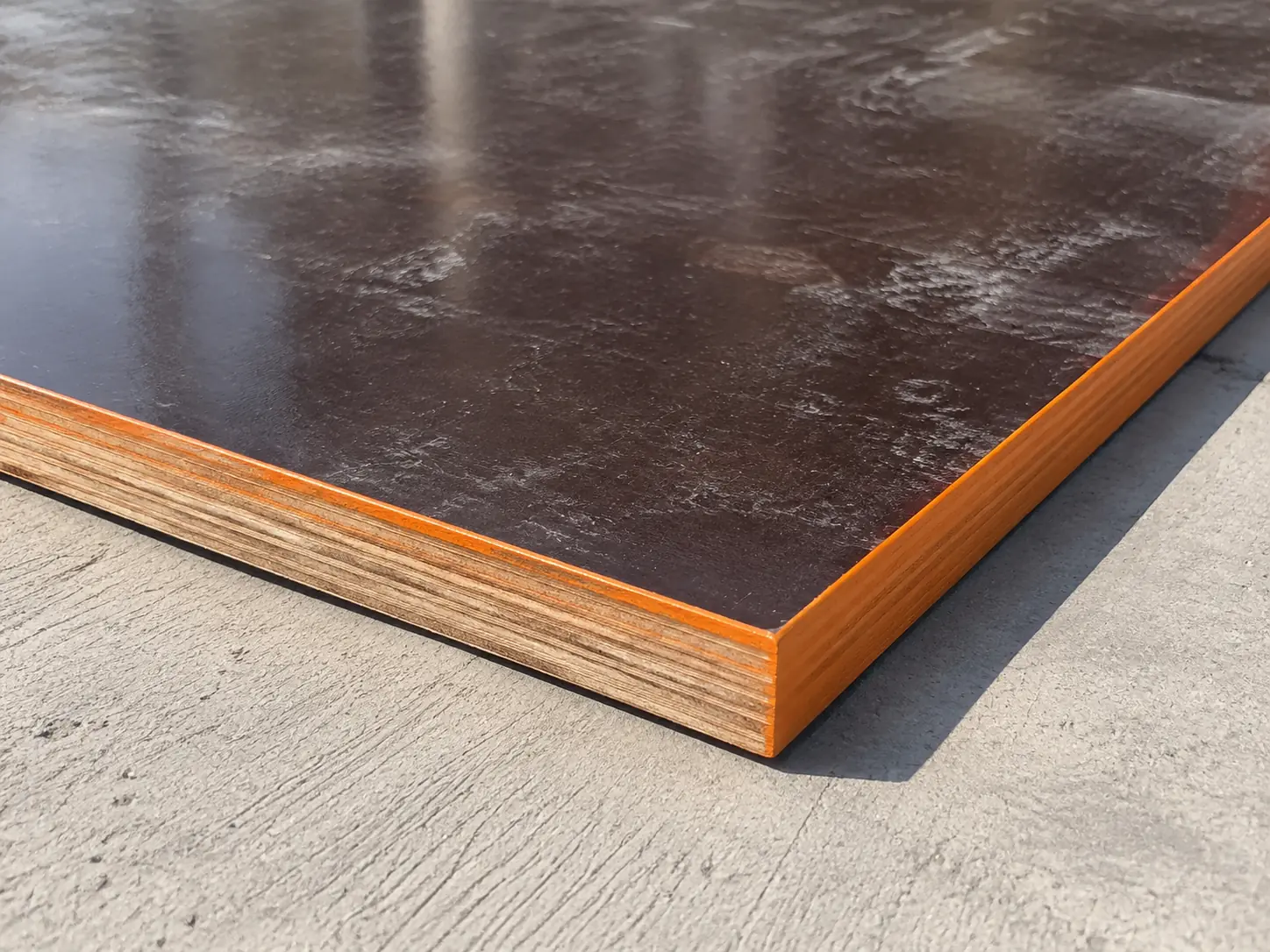
How do you keep the build the same on repeat orders?
We keep the build the same by writing it once and quoting it every time. Each build has a technical sheet with its core, glue, film weight and colour, thickness and tolerance, size and edge sealing; each repeat order names that sheet, and production follows the same sequence at our mills.
| Kept the same | How |
|---|---|
| Core species | Named on the sheet: Acacia or Eucalyptus |
| Glue system | Named on the sheet: MUF or phenolic |
| Film | Weight and colour named on the sheet |
| Thickness | ±0.5 mm tolerance written per order |
| Size | ±2 mm, size named on the sheet |
| Edges | Water-resistant paint on all four edges |
| Process | Veneer intake, drying, lay-up, glue and press, sizing and sanding, film press, edge sealing, marking and packing |
You can check it yourself. Keep one untouched piece from the approved sample and one from each container, labelled with the date and the sheet. Hold the new arrival against them: same film, same edge paint, same thickness on your caliper. A difference you can see is a question to send us before the panels go into service.
Do repeat buyers get free samples?
Yes. Samples are free for repeat buyers and buyers with an order. New buyers also receive free samples and book their own courier, and that courier cost can be credited against a real order. On a repeat order, ask for a sample whenever a line of the build changes.
| When a repeat buyer asks for a sample | Why |
|---|---|
| A new film weight | Face and gloss change |
| A new glue system | Bond and pour count change |
| A new thickness | Calibration and weight change |
| An anti-slip pattern added | Grip and cleaning change |
| A new core species | Weight and container fill change |
A sample on a change does the same job as the first sample: it lets you test the new line before a container is pressed with it. Our note on film-faced samples shows what to test.
How many containers a month can you supply on a call-off?
Our two mills in Chi Linh, Hai Phong can produce up to 150 containers a month. A call-off is planned around that capacity and around production of 15–45 days per order, so the earlier we see your programme, the steadier the containers can follow it.
| Programme | How we plan it |
|---|---|
| One container at a time | Each order on its own deposit and production slot |
| A few containers a month | Orders placed ahead of the site dates, same technical sheet |
| A standing monthly programme | A call-off schedule agreed in writing, each release on the same sheet |
| A change of build mid-programme | New sample, new line on the sheet, then the next release |
Capacity is a ceiling across both mills, not a reserved share for any one buyer. What makes a call-off steady is the forecast: send the expected containers per month and the builds, and we plan production slots against them. Our order process page shows how an order moves through the mills.
From single orders to a call-off plan
Move from single orders to a call-off plan once the first container’s review is written and the build is fixed. A call-off plan lists the builds, the expected containers per month, the ports and the lead times, so each release is an order against a plan rather than a new negotiation.
| In the call-off plan | Example |
|---|---|
| Builds | Technical sheet references for each build |
| Volume | Expected 40HC per month, by build |
| Release | Each release confirmed with its own deposit and production slot |
| Port and Incoterm | FOB Hai Phong, CFR or CIF to each port |
| Review | Site review after each container, recorded against the sheet |
The plan does not change the terms of each release: a 30% deposit, production of 15–45 days and the 70% balance against the scanned bill of lading. What it changes is the planning: we see your programme ahead, and you see when each release will load.
Changing the build on a repeat order
Change a build on a repeat order by writing the change as a new line on the technical sheet, taking a sample of the new build and approving it before production. A change made by e-mail only is the most common reason a repeat container differs from the one before it.
- Name the change. Film weight, glue, thickness, core species or pattern.
- Get the sample. Samples are free for repeat buyers.
- Test it. The same tests as the first sample.
- Update the sheet. A new sheet reference for the new build.
- Order against the new sheet. The old sheet stays valid for the old build.
Some changes move the container plan. A heavier film or a Eucalyptus core adds weight; a thicker panel puts fewer sheets in each pack. We redo the loading plan whenever a change touches weight or thickness.
Mistakes that slow down the second order
The second order slows down when the first one left no record: no technical sheet quoted, no sample kept, no site review written, or a change agreed only by phone. Each missing record turns the repeat order back into a first order.
| Mistake | Effect on the second order | Fix |
|---|---|---|
| No technical sheet on the first order | Nothing to repeat | Write the sheet, then order against it |
| No sample kept | Nothing to hold the new arrival against | Keep one untouched piece per container |
| No site review | Complaints without dates or causes | Record arrival and first-pour checks |
| Change agreed only by message | Two people remember two builds | New line on the sheet |
| No forecast | Production slot chosen late | Send expected containers per month |
None of these costs money to fix; each costs a few minutes at the right moment. Our note on how to check a formwork plywood mill covers the checks that come before the first order.
Starting your first container with us
Start with the build lines and the use: core, glue, film weight and colour, thickness, size, edges, quantities and port. We send free samples cut from that build and the certificate files for it, then a technical sheet and a dated offer. One 40HC, a 30% deposit and 15–45 days of production later, your first container loads at Hai Phong.
| You send | We return |
|---|---|
| Build lines and use | Samples cut from that build |
| Quantities and mix | A loading plan with planning figures |
| Port and Incoterm | A dated offer FOB Hai Phong, CFR or CIF |
| Certificates your market needs | The certificate files before the order is confirmed |
Our mills page describes the two plants, and the buyer FAQ answers the questions that come next. Send your build lines through the specification form or to [email protected].
Questions buyers ask us
What is the minimum first order?
One 40HC. It usually carries one or two products, and three to six can be mixed by agreement.
Can my first 40HC carry several thicknesses?
Yes. A container usually carries one or two products, and three to six products, such as several thicknesses or a film-faced and an anti-slip build, can be mixed by agreement. Each mix changes how full and how heavy the container is.
How long after the deposit is a trial container ready?
Production takes 15–45 days after the 30% deposit, depending on quantity, production conditions and agreement. Loading and the draft documents follow, then the sea days to your port.
How do you keep the build the same on repeat orders?
Every build is written on a technical sheet: core, glue, film weight and colour, thickness and tolerance, size and edge sealing. Each repeat order quotes that sheet, so the panel is pressed to the same lines.
How many containers a month can you supply on a call-off?
Our two mills in Chi Linh, Hai Phong can produce up to 150 containers a month. A call-off is planned around that capacity and the 15–45 days of production per order.
Do repeat buyers get free samples?
Yes. Samples are free for repeat buyers, for example when a film weight changes or a thickness is added.
What should I review after the first container is used on site?
Thickness and edges on arrival, then the face, edges and bond after the first pours, measured against the technical sheet and the untouched sample. Write it down before you order again.
Which payment terms apply to the first container?
A 30% deposit starts production, and the 70% balance is paid against the scanned bill of lading, by T/T or irrevocable L/C at sight.
Which Incoterms do you sell on?
FOB Hai Phong, CFR or CIF to your port.
Can I change the build on a repeat order?
Yes. A change becomes a new line on the technical sheet; for a new film weight, glue or thickness we send a new sample before production.
How many sheets of 18 mm fit in a 40HC?
About 880 sheets of 1220 × 2440 mm with an Acacia core or about 795 with a Eucalyptus core, as planning figures. The packing list made at loading is the number that counts.