
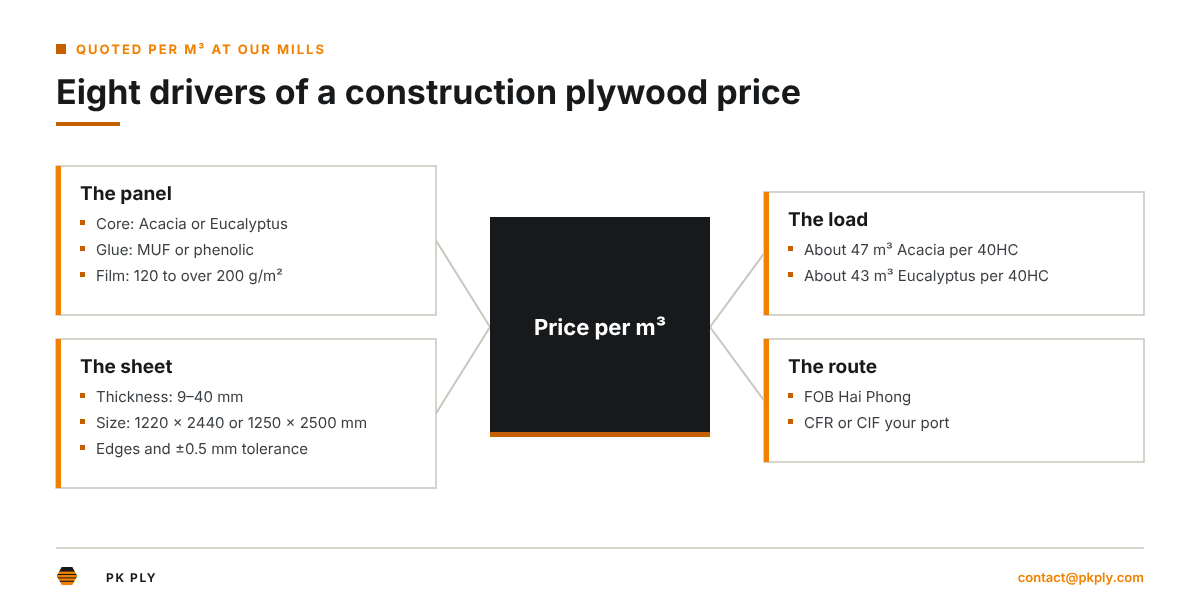
A construction plywood price is set by eight choices made at the press: core species, glue system, film weight, thickness, sheet size, edge sealing, how full the container is and the Incoterm. PK Ply quotes each of them per cubic metre. Comparing two offers by name alone is how a buyer pays less per sheet and more per pour.
What sets a plywood price at a construction plywood mill?
A plywood price at the mill is the sum of what goes into the panel and how it travels: core veneer, glue, film, pressing, edge paint and packing, then the container fill and the Incoterm. For film-faced construction panels, eight choices move it most, and every one of them is written on the order.
Retail shops price plywood per sheet on a shelf. A mill prices construction plywood per cubic metre for a container, because a 40HC is filled by volume and weight, and because the build behind each cubic metre changes from one order to the next. That is why two sheets with the same name and thickness can carry very different prices, and why a price without its build line tells a buyer almost nothing.
| Driver | Options at our mills | What it moves |
|---|---|---|
| Core species | Acacia or Eucalyptus, crosswise veneers | Veneer cost, weight, m³ per 40HC |
| Glue system | Melamine (MUF) or phenolic | Glue cost, pressing, pours |
| Film weight | 120–125 g/m² up to over 200 g/m² | Paper and resin on both faces |
| Thickness | 9–40 mm; formwork mostly 12, 15, 18 and 21 mm | Film and glue lines per m³ |
| Sheet size | 1220 × 2440 mm, 1250 × 2500 mm or cut sizes | Yield, cutting, packing |
| Edges and tolerance | Painted edges, ±0.5 mm | Finishing and sanding |
| Container fill | About 47 m³ Acacia, about 43 m³ Eucalyptus | Freight per m³ and per sheet |
| Incoterm | FOB Hai Phong, CFR or CIF | What freight and insurance the price includes |
The rest of this note goes through each driver in the order a buyer meets it: the build first, then the container, then the route. Our film-faced plywood page lists the builds the drivers apply to.
Why do two film-faced offers with the same name have different prices?
Because the same name can cover two different panels. Core grade, how the core veneers are joined, the glue system, the film weight, edge sealing and tolerance change from one offer to the next, and each line carries its own cost. Two quotes for “18 mm film-faced plywood” are only comparable once both name those lines.
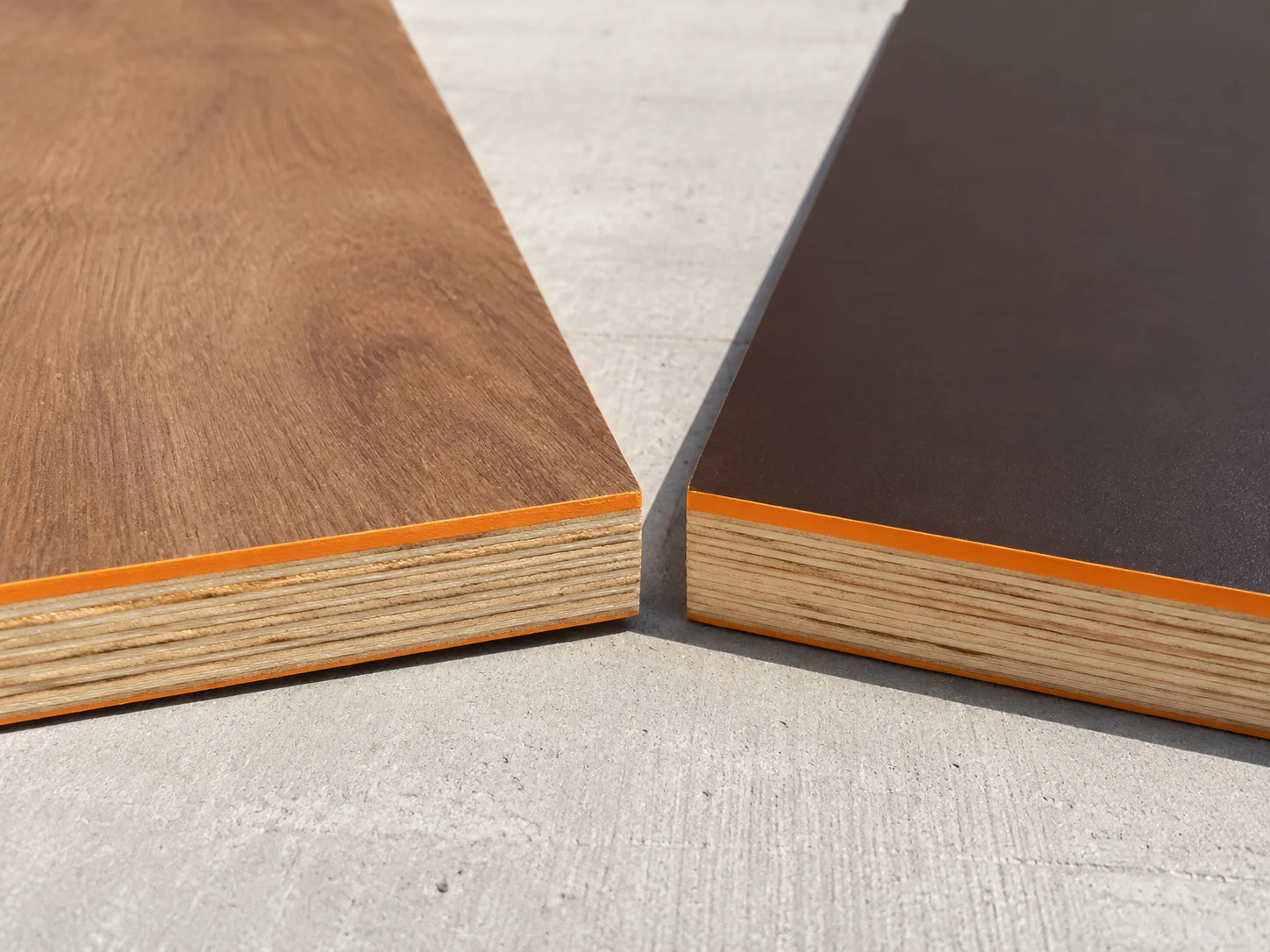
The differences that hide inside one name are mostly invisible on a new sheet. A dark film looks the same over a full core and over a core with gaps. A MUF glue line and a phenolic glue line look the same on a sawn edge. A 120 g/m² film and a 185 g/m² film look almost the same in a photo. They show up on site, in the number of pours before the face wears through or the plies open.
What we see on enquiries is consistent. A buyer sends a competing price per cubic metre for “film-faced plywood 18 mm, brown, WBP”. When we ask for the build, the answers decide the comparison:
- Core grade and joining. Whole core veneers laid edge to edge, or a core with overlaps and gaps that the film bridges.
- Glue system. MUF or phenolic, and how much glue is spread per square metre.
- Film. Weight in g/m², whether both faces are filmed, and the film brand.
- Edges. Painted, and with what.
- Tolerance. Calibrated to ±0.5 mm, or as pressed.
Two offers become comparable when both are written on those five lines plus thickness, size and quantity. Our shuttering ply note shows how each line changes the panel on site.
How much does film weight change the price of a sheet?
Film weight changes the price in proportion to the paper and resin pressed onto both faces: every sheet of 1220 × 2440 mm carries about 5.95 m² of film, so moving from 130 to 185 g/m² adds about 327 g of film per sheet. Heavier film costs more per cubic metre and gives a face that lasts longer.
Film is phenolic-impregnated paper, sold by weight per square metre. Our orders run from 120–125 g/m² on low-cost programmes, through 130–135 g/m², the most common choice now, to 165, 185 or over 200 g/m² for buyers who want a heavy face. Because both faces are filmed, the film per sheet is twice the sheet area times the film weight.
| Film weight | Film per 1220 × 2440 mm sheet, both faces | Typical use |
|---|---|---|
| 120 g/m² | About 714 g | Short programmes, lower-cost orders |
| 130 g/m² | About 774 g | The most common choice on our orders now |
| 165 g/m² | About 982 g | Longer face life on repeated pours |
| 185 g/m² | About 1,101 g | Heavy face for slab and wall programmes |
| 200 g/m² | About 1,191 g | Buyers who specify the heaviest face |
What a heavier film buys is face life. Vibrators, rebar chairs, scrapers and pressure washing wear the film down; a heavier film takes longer to wear through to the veneer. It does not change the glue line under it, so a heavy film on a MUF panel still has the bond life of MUF. A buyer who pays for 185 g/m² film and orders MUF glue for a twenty-pour programme has bought a face that outlives its glue line.
Colour has no cost of its own worth pricing. Black and dark brown are both phenolic films; write the colour your site prefers and the weight beside it.
Does phenolic glue cost more than melamine glue per sheet and per pour?
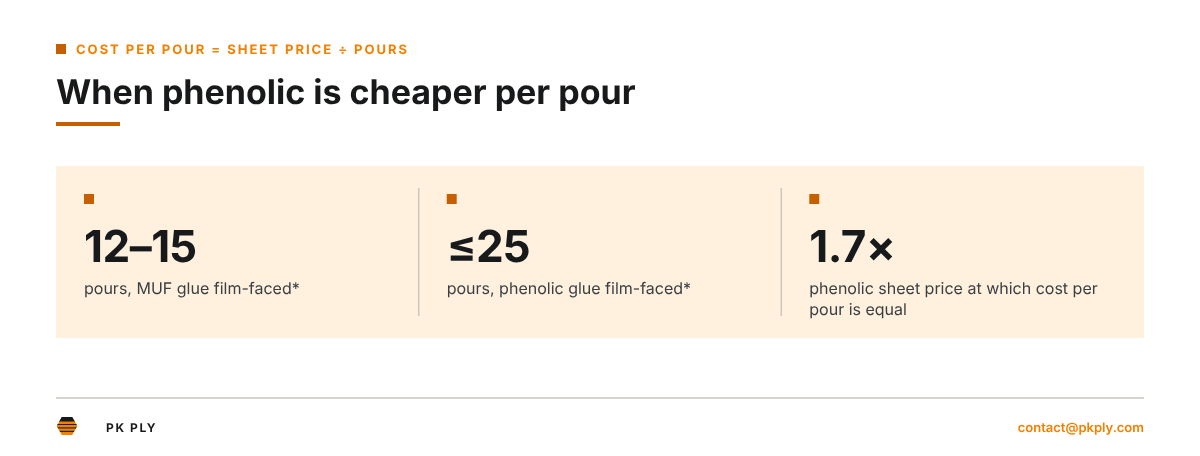
Per sheet, yes: a phenolic glue line costs more to make than a melamine (MUF) one. Per pour, often no: phenolic film-faced panels give up to about 25 pours against about 12–15 for MUF, with proper handling, release agent and edge sealing, so the phenolic sheet can cost more and still cost less each time it is used.
The arithmetic that decides it is the cost per pour, the delivered price of a sheet divided by the pours your site gets from it. It needs no price list to work out where the line falls. If both panels reach their pour counts:
| Comparison | Pours (with proper handling, release agent and edge sealing) | Phenolic stays cheaper per pour while its sheet price is below |
|---|---|---|
| Phenolic against MUF at 15 pours | Up to about 25 against about 15 | About 1.7 times the MUF price |
| Phenolic against MUF at 12 pours | Up to about 25 against about 12 | About 2.1 times the MUF price |
| MUF against budget at 10 pours | About 12 against about 10 | About 1.2 times the budget price |
| MUF against budget at 4 pours | About 12 against about 4 | About 3 times the budget price |
So a phenolic sheet quoted at, say, a third more than the MUF sheet of the same build is the cheaper panel for a programme that will use it twenty times. A MUF sheet is the better buy where the programme ends after a dozen pours, because the extra pours of phenolic would never be used.
Site practice can erase the difference. A panel stripped with a steel bar, stacked wet or left with bare cut edges falls toward the budget range of about 4–10 pours whatever its glue. Price the glue system for the pours your site really gets. Our phenolic film-faced plywood and melamine film-faced plywood pages set the two builds side by side, and the cost per pour note works through a full programme.
Why does an Acacia core container cost differently from a Eucalyptus core container?
Because the container fills differently. An Acacia core is lighter, about 580 kg/m³ in our planning, so a 40HC carries about 47 m³; a Eucalyptus core is denser, about 650 kg/m³, and the weight limit stops the load at about 43 m³. The same freight spread over fewer cubic metres makes each Eucalyptus cubic metre dearer to ship.
The freight on a 40HC is charged per container, not per cubic metre. Spread over 47 m³ of Acacia-core panels, the freight per cubic metre is about 9 per cent lower than over 43 m³ of Eucalyptus-core panels. Per sheet of 18 mm, the gap is a little wider: about 880 Acacia-core sheets against about 795 Eucalyptus-core sheets per container, as planning figures, so freight per sheet is about 10 per cent lower with Acacia.
| 40HC, 18 mm, 1220 × 2440 mm (planning figures) | Acacia core | Eucalyptus core |
|---|---|---|
| Planning density | About 580 kg/m³ | About 650 kg/m³ (measured 650–750) |
| Panels per container | About 47.2 m³ | About 42.6 m³ |
| Sheets per container | 880 sheets (16 × 55) | 795 sheets (15 × 53) |
| Sheet weight | About 31.1 kg | About 34.8 kg |
| Freight per m³ | Lower by about 9 per cent | Base |
The panel price per cubic metre is a separate matter: it follows the veneer, glue and film of the build. A buyer who chooses Eucalyptus for a firmer, heavier sheet pays for it in container fill; a buyer who wants the most square metres per container chooses Acacia. Both are good formwork cores. The planning model stacks packs about 1,000 mm high with a planning payload of 28,000 kg of panels, which the carrier and route confirm; weigh real sheets before final loading.
Is export plywood quoted per sheet or per cubic metre?
Export plywood is quoted per cubic metre, FOB, CFR or CIF, because a container is bought by volume and the sheet count changes with thickness and size. To turn a price per m³ into a raw FOB figure per sheet, multiply it by the sheet volume: 0.0536 m³ for an 18 mm sheet of 1220 × 2440 mm.
Retail buyers think per sheet, and a contractor’s budget is often per square metre of formwork. A mill’s quote per cubic metre carries both once the arithmetic is done, and the arithmetic is the same for every offer:
| Thickness, 1220 × 2440 mm | Sheet volume | Sheets per m³ | Square metres per m³ |
|---|---|---|---|
| 12 mm | 0.0357 m³ | About 28 | About 83.3 |
| 15 mm | 0.0447 m³ | About 22.4 | About 66.7 |
| 18 mm | 0.0536 m³ | About 18.7 | About 55.6 |
| 21 mm | 0.0625 m³ | About 16 | About 47.6 |
Three cautions keep the conversion honest. A per-sheet figure from an FOB price is a raw FOB example, not a sheet price: freight, duty, unloading and local delivery come on top before any sheet reaches a site. A per-sheet comparison between thicknesses misleads, because a 21 mm sheet holds more panel than a 12 mm one. And a quote per sheet from an exporter hides the volume behind it, so ask for the m³ figure too.
The plywood price per cubic metre is therefore the number to compare between mills, the price per sheet is the number to compare with a local merchant, and the price per pour is the number that decides the buy.
What do FOB Hai Phong, CFR and CIF include in a plywood quote?
FOB Hai Phong includes the panels, packing, inland transport to the port, export clearance and loading on board at Hai Phong; the buyer books and pays the ocean freight and insurance. CFR adds ocean freight to the destination port, and CIF adds minimum cargo insurance as well. Import duty, taxes and delivery stay with the buyer.
Incoterms rules are a set of eleven three-letter trade terms reflecting business-to-business practice in contracts for the sale and purchase of goods. We sell construction plywood on three of them, FOB Hai Phong, CFR and CIF, and nothing else.
| Cost line | FOB Hai Phong | CFR destination port | CIF destination port |
|---|---|---|---|
| Panels and packing | Seller | Seller | Seller |
| Inland transport to Hai Phong, export clearance, loading on board | Seller | Seller | Seller |
| Ocean freight to the destination port | Buyer | Seller | Seller |
| Cargo insurance | Buyer | Buyer | Seller |
| Unloading, import clearance, duty, VAT | Buyer | Buyer | Buyer |
| Delivery to the site or warehouse | Buyer | Buyer | Buyer |
Which one to choose depends on who buys freight better. An importer with a forwarder and regular volume often buys FOB and books its own carrier. A buyer with no forwarder, or one comparing several mills, often asks for CFR or CIF, so every offer lands at the same port. Freight moves week by week, so a CFR or CIF price carries a validity date.
Do certificates such as FSC or CE change the price of an order?
They can, but only where they change the build or the paperwork of that order. An FSC order uses certified material for the core, face and back and carries the claim on the invoice; a structural CE order comes with a declaration of performance under our factory production control. Where either changes the cost, it is its own line on the quote.
Certificates are part of how we work, not a surcharge on every order. Our FSC chain of custody certificate SGSHK-COC-370674 covers FSC 100% and FSC Mix plywood. FSC labels products as FSC 100%, FSC Recycled or FSC Mix. When an order is placed as FSC, the certified material runs through the press for that order and the claim appears on the sales documents. The FSC plywood page shows the scope.
CE marking works the same way. Our factory production control certificate 0407-CPR-2146 covers structural plywood of 3.6–30 mm with MUF or phenolic glue under EN 13986. A panel ordered as structural CE falls inside that range and ships with its declaration of performance; the CE marking page shows the certificate.
What adds cost is not the certificate itself but what an order asks of it: a batch test on samples from your run, a laboratory you name, extra marking on every sheet, or a thickness outside a certificate’s scope that needs separate evidence. Each appears on the quote where it applies, so you can see what you pay for.
Thickness: why thin panels cost more per cubic metre
Thin panels cost more per cubic metre because both faces are filmed whatever the thickness: a cubic metre of 12 mm panels carries about 166.7 m² of film, against about 111.1 m² at 18 mm and 95.2 m² at 21 mm. More film, more glue lines and more sheets to press and handle per m³ add up.
| Thickness | Film per m³ of panels (both faces) | Sheets per m³, 1220 × 2440 mm |
|---|---|---|
| 12 mm | About 166.7 m² | About 28 |
| 15 mm | About 133.3 m² | About 22.4 |
| 18 mm | About 111.1 m² | About 18.7 |
| 21 mm | About 95.2 m² | About 16 |
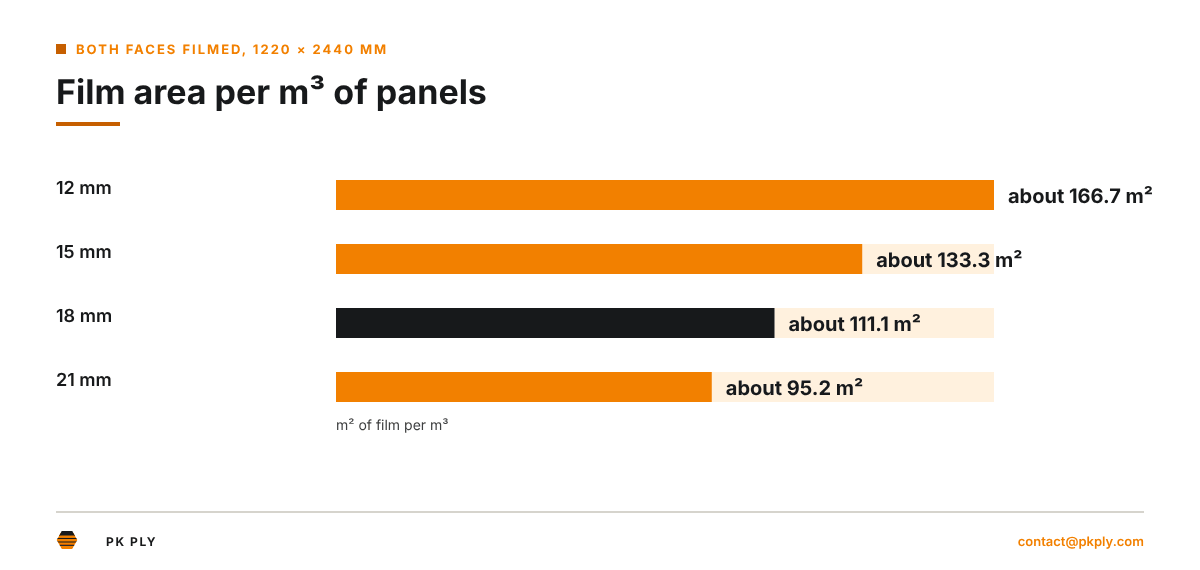
A 12 mm cubic metre carries 1.5 times the film of an 18 mm cubic metre. It also has more sheets to lay up, press, sand, film, paint and pack. Per sheet, though, a 12 mm panel is cheaper than an 18 mm one, because it holds two thirds of the volume. That is why per-sheet and per-m³ prices move in opposite directions as thickness changes, and why a buyer comparing offers across thicknesses should always compare per cubic metre first.
The everyday formwork thicknesses are 12, 15, 18 and 21 mm, and we press the full range from 9–40 mm. For structural CE orders, the CE scope ends at 30 mm; panels above it are supplied as formwork panels without the CE mark.
Sheet size and cutting: 1220 × 2440 mm, 1250 × 2500 mm or a cutting list
The two standard sizes cost much the same per cubic metre; cut sizes cost more. A 1250 × 2500 mm sheet has about 5 per cent more area than 1220 × 2440 mm, so it costs about 5 per cent more per sheet at the same m³ price. A cutting list adds sawing, edge sealing of every cut and packing by size.
| Sheet | Area | Sheets per 40HC at 18 mm, Acacia / Eucalyptus (planning figures) |
|---|---|---|
| 1220 × 2440 mm | 2.98 m² | 880 / 795 |
| 1250 × 2500 mm | 3.125 m² | 848 / 750 |
| Cut to a list | By order | Planned per order |
Cutting changes more than the sawing time. Each cut opens two new edges that need paint before the panel leaves the mill. Offcuts come out of the order’s yield, and mixed sizes need their own packs, which can fill a container less tightly. For frame formwork that needs panels cut to fit its frames, a cutting list is still usually cheaper than cutting on site, where cut edges often go unsealed. Nothing is pressed larger than 1250 × 2500 mm.
Core grade, joining and tolerance: the drivers no photo shows
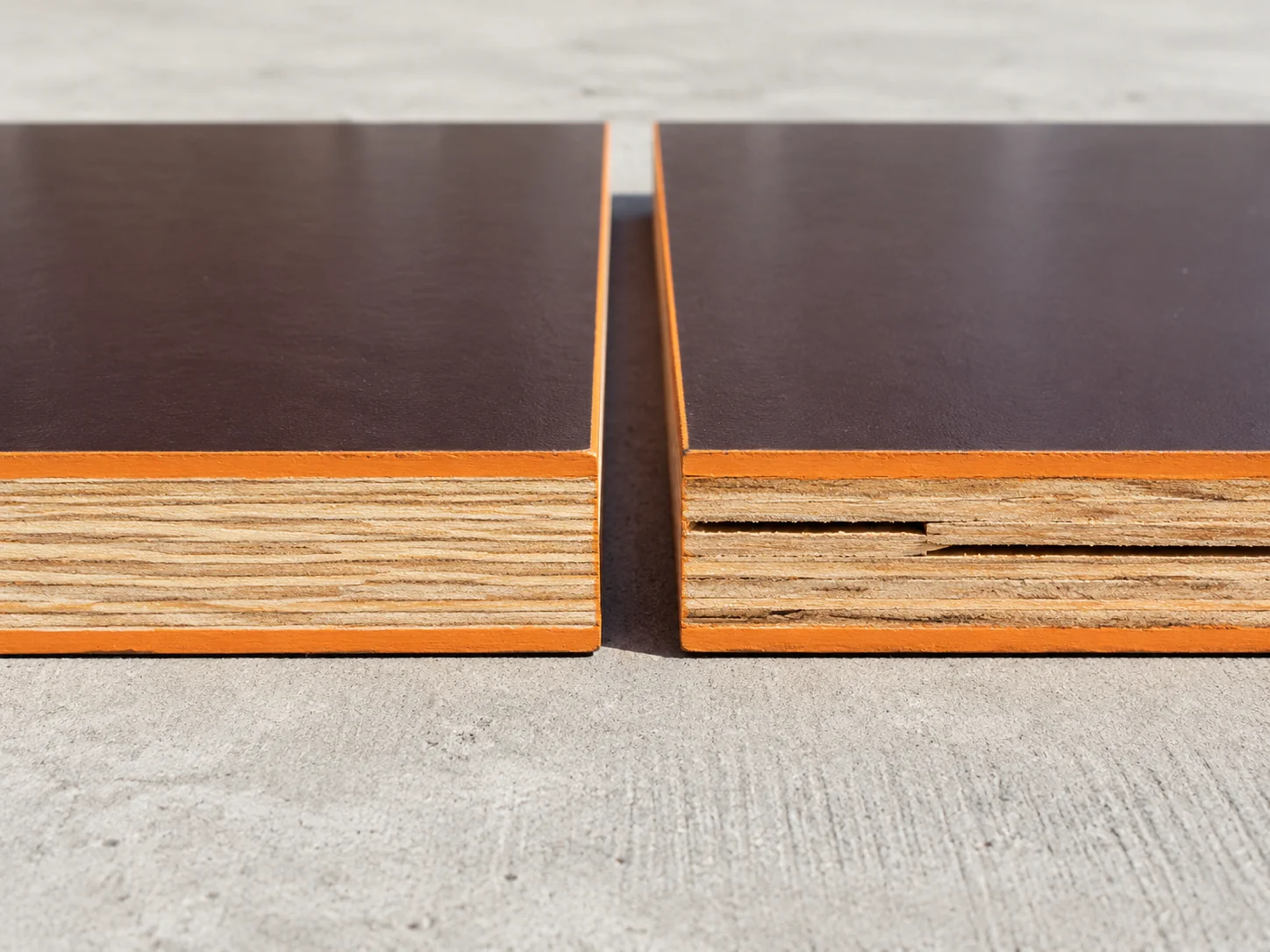
Core grade, the way core veneers are joined and the thickness tolerance are the price drivers a buyer cannot see on a new sheet. A full, evenly laid core, calibrated to ±0.5 mm before the film goes on, costs more to make than a gapped core filmed as pressed, and it shows the difference in flatness and pours.
The core is where budget panels save money. Veneer with gaps, overlaps and broken pieces is cheaper than whole veneer laid edge to edge, and under a film it looks the same on delivery. On site, a gap becomes a soft spot that dents under a vibrator, and an overlap becomes a bump that prints on the concrete. Budget film-faced panels typically give about 4–10 pours for reasons like these, even with proper handling.
Calibration is the other hidden step. Our pressed core panels are trimmed square and sanded to an even thickness before the film press, which is what holds the ±0.5 mm tolerance. Skipping it saves a sanding pass and leaves the thickness variation of the press inside the filmed sheet, where it shows up as steps at every joint of a deck.
When an offer is much lower than others for the same named build, these are the lines to ask about first: core grade, joining, glue spread and whether the panel is calibrated.
Container fill, product mix and order size
A full container of one build is the lowest-cost way to buy, because freight is spread over the most cubic metres and the press runs one configuration. A 40HC usually carries one or two products and up to six by agreement; each product is priced on its own line, and mixing changes how full and how heavy the container can be.
Three parts of the order shape its cost:
- One build or several. Every change of thickness, glue or film is a change at the press. One or two products per container keeps runs long.
- How full the container is. A container that reaches its weight or volume limit spreads freight furthest. Mixing a light Acacia build with a heavy Eucalyptus build moves the limit.
- Repeat or new. A repeat order of a build already on a technical sheet is simpler to schedule than a new configuration.
Our minimum is one 40HC. Production takes 15–45 days after the 30% deposit, depending on quantity, production conditions and agreement, and the 70% balance is paid against the scanned bill of lading by T/T or irrevocable L/C at sight. Those terms do not change with the build; the price per cubic metre does.
Freight, duty and the landed price
The landed price of a container is the FOB price plus ocean freight, insurance, port charges, import duty and VAT where they apply, and delivery to the site. Freight depends on the carrier and the route, which take about 15–25 days to the Middle East and 30–40 days to Northern Europe from Hai Phong; duty depends on the destination’s tariff.
Each line of the landed price has a different owner, and only the first one comes from us:
| Landed-cost line | Who quotes it | What moves it |
|---|---|---|
| FOB Hai Phong panel price | PK Ply | Film weight, core, glue, thickness, quantity |
| Ocean freight | Carrier or forwarder (or us, on CFR/CIF) | Lane, season, container type |
| Marine insurance | Insurer (or us, on CIF) | Cargo value and cover chosen |
| Destination port and clearance | Your forwarder or broker | Port tariff, inspections, document checks |
| Import duty and VAT | Destination customs | Tariff code, origin proof, trade agreement |
| Delivery to site | Local haulier | Distance, unloading method |
Duty follows the destination’s rules, and it is the line of the landed cost a mill cannot quote for you. For the European Union, the EU-Viet Nam Trade Agreement entered into force on 1 August 2020. Preferential duty under it needs proof of Vietnamese origin, which is why EU-bound lots carry a certificate of origin. For the United States, the 2025 scope notice on hardwood and decorative plywood lists Phenolic Film Faced Plyform among the products excluded from the investigations. Whether a given panel matches that exclusion is a ruling for your customs broker. Our import note sets out the papers and duty route by market.
Price per pour: the number to compare
The number that decides a formwork plywood buy is the price per pour: the landed price of a sheet divided by the pours your site gets from it. It puts a budget panel at about 4–10 pours, a MUF panel at about 12–15 and a phenolic panel at up to about 25 on the same scale, with proper handling, release agent and edge sealing.
Working it through takes four steps:
- Start from the m³ price. Take each offer’s price per cubic metre on the same Incoterm.
- Land it. Add freight per m³ for the core’s container fill, duty, port charges and delivery.
- Turn it into a sheet. Multiply by the sheet volume: 0.0536 m³ for 18 mm in 1220 × 2440 mm.
- Divide by pours. Use the pours your site really gets with its handling, release agent and edge sealing.
Two habits make the result trustworthy. Use your own pour history for the divisor where you have it; a site that strips carefully and seals cut edges gets more from every build. And keep the comparison inside one programme: a MUF panel on a twelve-pour job and a phenolic panel on a twenty-five-pour job are both the right buy for their job.
What retail shelves show next to a mill price
Retail shelves price plywood per sheet, with stock, VAT and local delivery inside the number, so a shelf price is not comparable with a mill’s FOB price per cubic metre until freight, duty and local costs are added. Two dated listings show what local buyers paid per sheet in November 2026.
| Market | Panel as listed | Listed price |
|---|---|---|
| United Kingdom | 18 mm softwood shuttering plywood, 2440 × 1220 mm, no film | £26.35 per sheet, listed price checked 12 November 2026 (Builders Merchant) |
| Saudi Arabia | 18 mm film-faced shuttering plywood, 1220 × 2440 mm | SAR 102.64 per sheet including 15% VAT, listed price checked 12 November 2026 (Madar) |
| Our mills | 12–21 mm film-faced, MUF or phenolic, Acacia or Eucalyptus | FOB Hai Phong per m³ for your build, one 40HC minimum |
Each row is a listed price as shown on the day it was checked; shelf prices move with stock, exchange rates and VAT. The UK sheet is a softwood panel without film, the kind that gives one or a few pours; the Saudi sheet is film-faced. A merchant’s price also pays for the stock it holds, the single sheet it sells and the van that delivers it. A container buyer takes those jobs on and pays per cubic metre instead.
How to read a construction plywood quotation line by line
Read a construction plywood quotation from the build down: product and standard, core, glue, film, thickness and tolerance, size, edges, quantity, price per m³ with its Incoterm and port, validity, production time and payment terms. A quote missing any of these lines is a price for an undefined panel.
| Quote line | What a complete quote says | What to ask if it is missing |
|---|---|---|
| Product and standard | Film-faced plywood; CE to EN 13986 if structural | Is this a structural CE panel or a formwork panel? |
| Core | Acacia or Eucalyptus, grade | Which species, and is the core whole or gapped? |
| Glue | MUF or phenolic | Which glue system, and what test evidence? |
| Film | g/m², colour, both faces | What weight, and is the back filmed too? |
| Thickness and tolerance | 18 mm, ±0.5 mm | Is the panel calibrated before filming? |
| Size and edges | 1220 × 2440 mm, painted edges | Are cut sizes and edge paint included? |
| Quantity | m³ and sheets per 40HC | Planning figure or packing list? |
| Price and Incoterm | Per m³, FOB Hai Phong, CFR or CIF named port | What does the price include, and until when? |
| Terms | Production days, deposit, balance | When does production start, and against which document is the balance paid? |
A quote that answers all of these can be laid next to another and compared per cubic metre, then per pour. One that cannot is not yet a price. Our import note covers the documents that follow the quote.
How to get a price for your build
To get a construction plywood price from us, send the build in eight lines: application and pours, core, glue, film weight and colour, thickness, sheet size, edge sealing and quantity, plus the port and the Incoterm you want. We return a technical sheet and a price per cubic metre FOB Hai Phong, CFR or CIF.
| Line | Example for a slab and wall programme |
|---|---|
| Application and pours | Slab decks and walls, about 20 pours |
| Core | Acacia |
| Glue | Phenolic |
| Film | 165 g/m², dark brown, both faces |
| Thickness | 18 mm, ±0.5 mm |
| Sheet size | 1220 × 2440 mm |
| Edges | Water-resistant paint, all four edges |
| Quantity, port, Incoterm | One 40HC, CFR Jebel Ali |
We do not publish a price list, because a list price for film-faced plywood hides the build that sets it; the offer you receive names every line. Samples of the build are free, with new buyers booking their own courier and the courier cost credited against a real order. Send the lines through our specification form or by email to [email protected].
Questions buyers ask us
What is the price of plywood in Vietnam?
There is no single price: Vietnamese construction plywood is quoted per cubic metre FOB for a stated build, and the core, glue, film weight, thickness and container fill move it. We quote FOB Hai Phong, CFR or CIF per m³ for the build you send.
Is plywood priced per sheet or per cubic metre?
Export plywood is priced per cubic metre, because a container is sold by volume; retail shops price per sheet. Multiply the m³ price by the sheet volume, 0.0536 m³ for an 18 mm sheet of 1220 × 2440 mm, to get a raw FOB figure per sheet.
Why is phenolic plywood more expensive than melamine plywood?
Phenolic glue costs more and presses differently, and the panel is built for more wet cycles: up to about 25 pours against about 12–15 for MUF glue, with proper handling, release agent and edge sealing. Per pour, phenolic is often the cheaper panel.
Does film weight change the price?
Yes. A heavier film puts more phenolic-impregnated paper on both faces of every sheet, so it costs more per m³, and it lasts longer under vibrators and cleaning.
Does an Acacia core cost less than Eucalyptus?
Per container, an Acacia core fills about 47 m³ against about 43 m³ for Eucalyptus, so freight per cubic metre is about 9 per cent lower. The panel price itself follows the veneer, glue and film of the build.
What does FOB Hai Phong include?
FOB Hai Phong includes the panels, packing, inland transport to the port, export clearance and loading on board at Hai Phong. Ocean freight, insurance, import duty and delivery are the buyer's under FOB.
Do FSC or CE certificates add to the price?
They can, where FSC-certified material or a CE declaration for a structural order changes the build or the paperwork. Any such cost appears on the quote as its own line.
Why are 12 mm panels dearer per cubic metre than 18 mm?
A 12 mm panel carries 1.5 times more film per m³ than an 18 mm panel, because both faces are filmed whatever the thickness, and thin panels take more pressing and handling per m³.
Do you publish a plywood price list?
No. We quote each build per cubic metre for the order, because a list price for film-faced plywood hides the core, glue and film that set the cost.
Can I mix thicknesses in one container to get one price?
A container usually carries one or two products and up to six by agreement; each product is priced on its own line, and the container price is their sum.
Does the price change with the number of containers?
Order size changes how we plan the press runs, and repeat orders of the same build are simpler to schedule. Quote requests for several containers get one offer per build.
How do I compare two plywood quotes fairly?
Put both on the same eight lines (core, glue, film weight, thickness, size, edges, tolerance, quantity and Incoterm) and compare the delivered cost per pour, not the price per sheet.