
The Vietnam plywood price of a film-faced panel is quoted per cubic metre FOB Hai Phong and follows the build: glue, film weight, core species, thickness and how full the 40HC is. PK Ply quotes each build in writing, with no price list. Two offers with the same name can hide different cores and glues, and the cheaper one often costs more per pour.
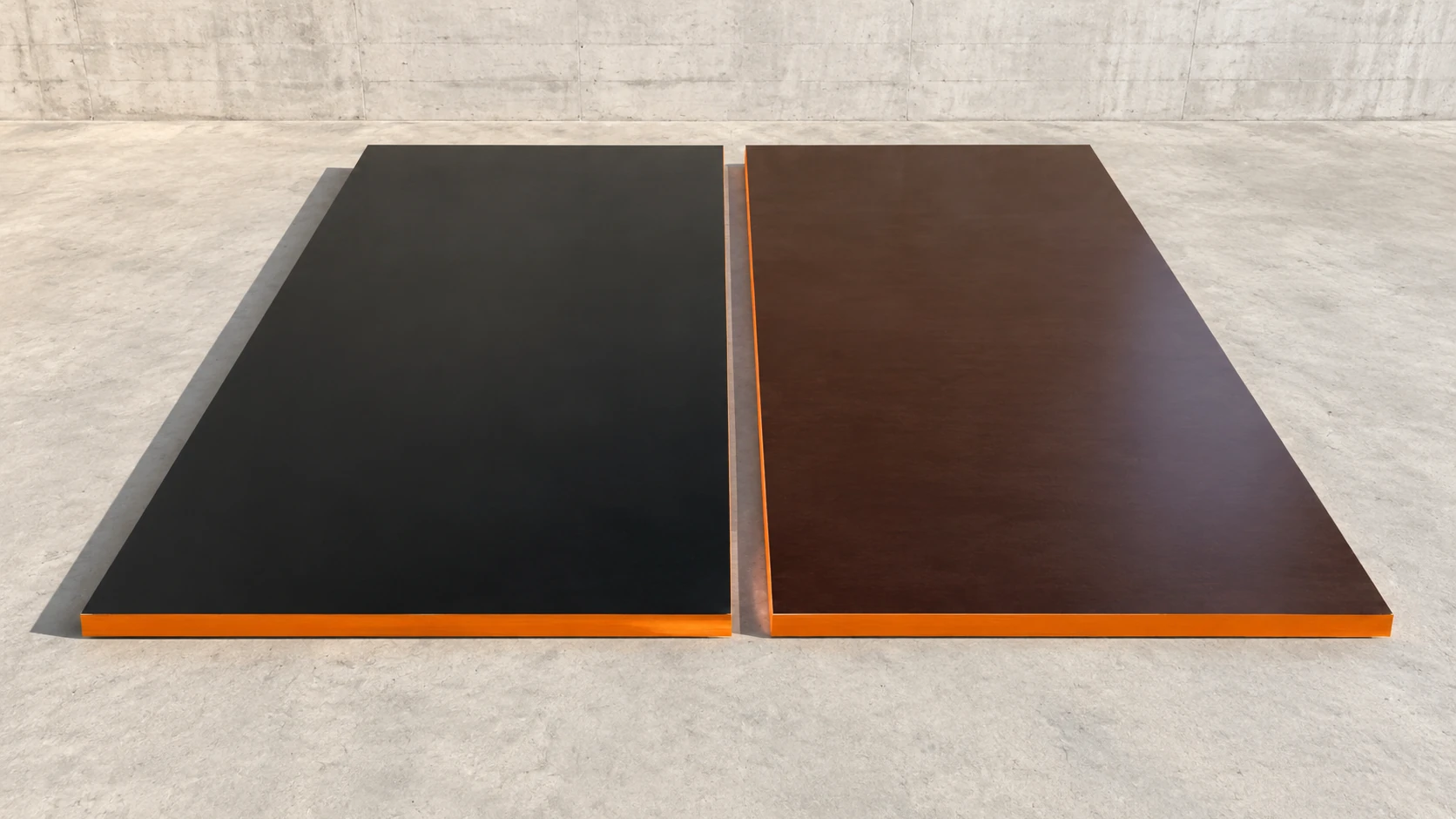
How much does film faced plywood cost?
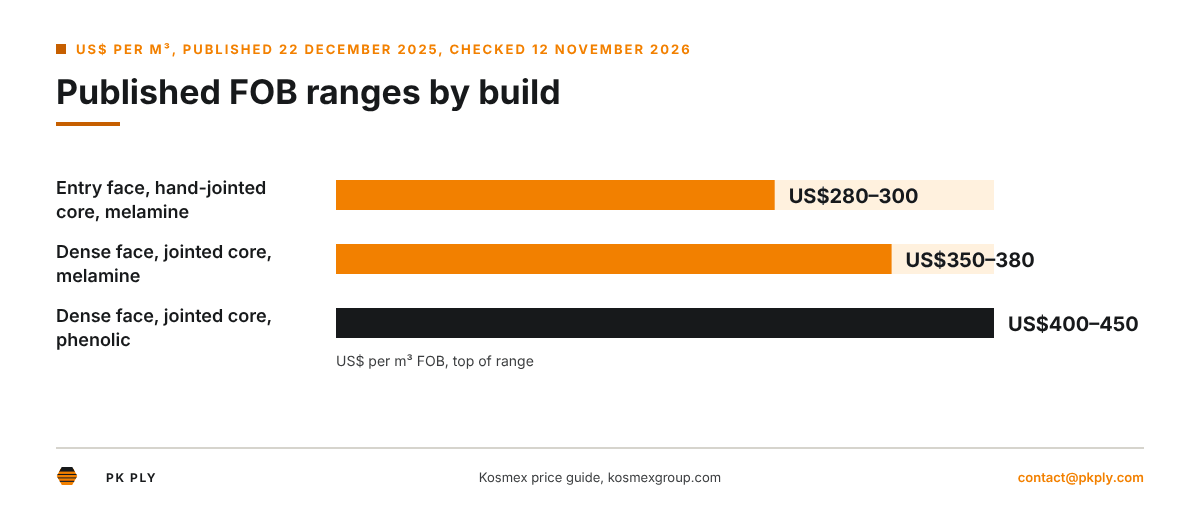
Film-faced plywood from Vietnam is quoted per cubic metre FOB, and the figure follows the build: core, glue, film weight and thickness. Published FOB ranges from Vietnamese mills run from about US$280 per m³ for an entry melamine build to about US$450 per m³ for a phenolic build with a jointed core, before freight.
Those two ends are not two prices for one product. They are two different panels sold under one name. The entry build has a low-density face, a hand-jointed core and melamine glue, and it is sold for short programmes; the top build has a high-density face, a machine-jointed core and phenolic glue, and it is sold for long ones. Between them sit the choices a buyer makes on every order.
Published ranges are dated observations, and we show them with their date and source so you can read them as such:
| Build, as published | Published FOB range, dated |
|---|---|
| Low-density face, hand-jointed core, melamine glue | $280 to $300 per m³ FOB, published range checked 12 November 2026 (Kosmex) |
| High-density face, composer-jointed core, melamine glue | $350 to $380 per m³ FOB, published range checked 12 November 2026 (Kosmex) |
| High-density face, composer-jointed core, phenolic glue | $400 to $450 per m³ FOB, published range checked 12 November 2026 (Kosmex) |
The page that publishes these ranges carries a last-modified date of 22 December 2025 in its page data, so read them as a late-2025 picture.
We do not publish a price list, and the reason is in that table: the spread between its first and last row is a build, not a discount. PK Ply quotes FOB Hai Phong per cubic metre for the build you write down, from our two mills in Chi Linh, Hai Phong. The wider mechanics of plywood pricing in any market are in our construction plywood price drivers note.
What a Vietnam plywood price is built from, FOB Hai Phong
An FOB Hai Phong quote for film-faced plywood is built from six lines: the core species and its jointing, the glue system, the film weight and colour, the thickness and sheet size, the edge sealing and tolerance, and the container fill. Change any line and the price per cubic metre moves.
| Quote line | Our options | Why it moves the price |
|---|---|---|
| Core | Acacia or Eucalyptus hardwood veneers, laid crosswise | Species density sets the m³ per 40HC; core grade sets the labour |
| Glue | Melamine (MUF) or phenolic | Resin cost and the wet cycles the bond survives |
| Film | 120–125 g/m² up to over 200 g/m², black or dark brown | Paper and resin per square metre |
| Thickness and size | 9–40 mm; 1220 × 2440 or 1250 × 2500 mm | Volume per sheet and sheets per pack |
| Edges and tolerance | Water-resistant paint on all four edges; ±0.5 mm thickness | Finishing time and sanding |
| Container | About 47 m³ Acacia or 43 m³ Eucalyptus per 40HC | Fixed costs spread over more or fewer m³ |
Two offers with the same name are often not the same build: core grade, joining, glue system, film weight, edge sealing and tolerance make the difference. That is the whole case for quoting by build. A line that reads “18 mm film-faced, WBP, 1220 × 2440” names a thickness and a promise; the six lines above name a panel that can be checked when it arrives. Our quotation format note turns the six lines into a request you can send.
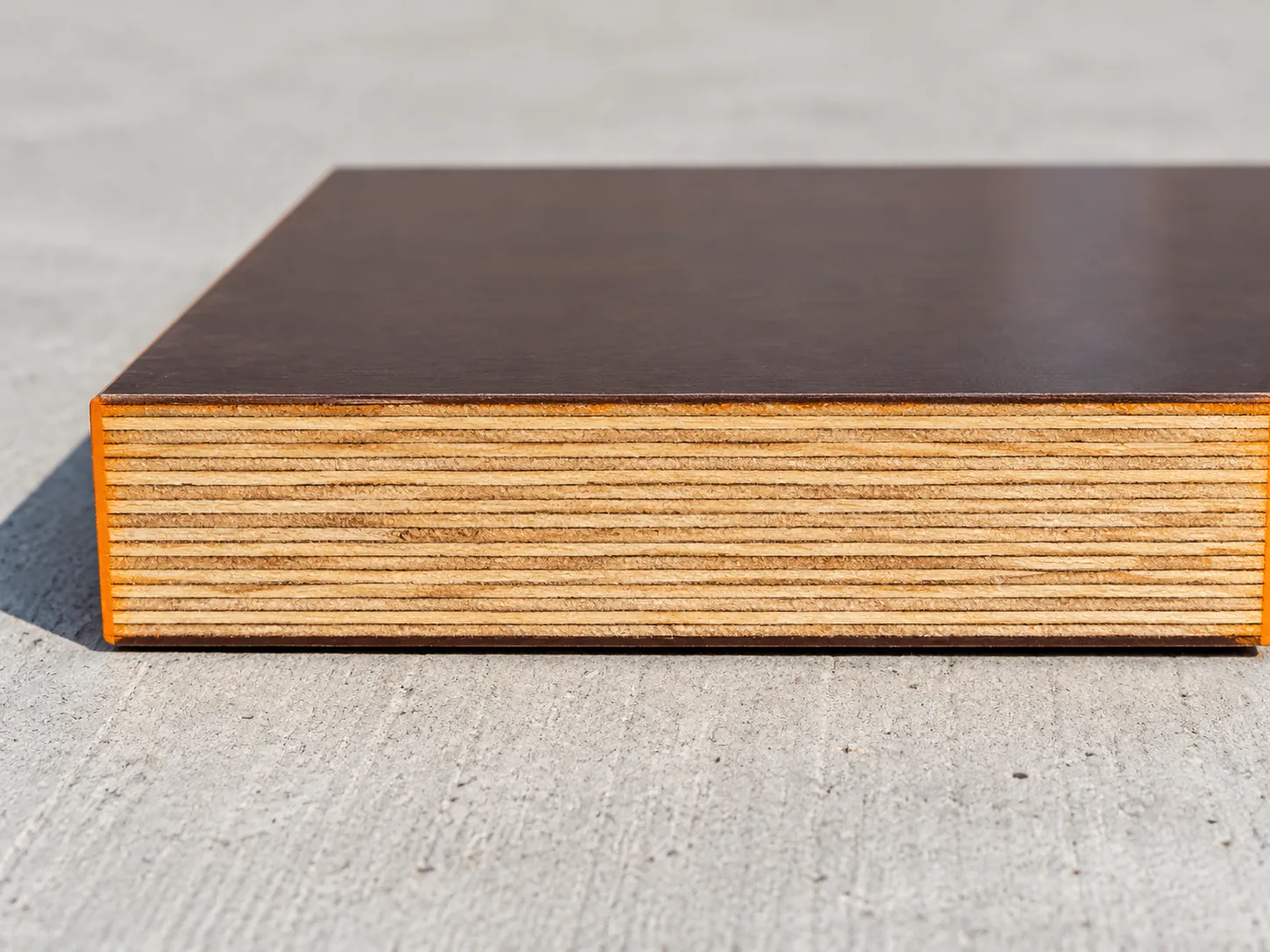
Why does phenolic-glue film-faced plywood cost more than melamine-glue panels?
Phenolic-glue film-faced plywood costs more because the resin costs more and because the bond it makes is the one that survives boiling. With proper handling, release agent on every pour and sealed edges, our phenolic panels give up to about 25 pours, against about 12–15 for our melamine (MUF) panels.
On the published ranges above, the step from a jointed-core melamine build to a jointed-core phenolic build is about US$50 to US$70 per m³. What the extra buys is the pour count. Divide the price by the pours and the order often turns round: the panel that costs more per cubic metre costs less per pour, if the site uses the pours.
| Same jointed core, published FOB range | Price per m³ | Pours with proper handling, release agent and sealed edges | Price per m³ per pour |
|---|---|---|---|
| Melamine (MUF) glue | US$350 to US$380 | About 12–15 | About US$23 to US$32 |
| Phenolic glue | US$400 to US$450 | Up to about 25 | From about US$16 |
That arithmetic uses published ranges and our pour figures, not our price; it shows the method. Budget film-faced plywood typically gives about 4–10 reuses, and reuse is a target for a configuration and site practice, not a fixed property of the sheet. A short programme of eight pours gains nothing from a 25-pour panel, and a long slab programme loses money on a 12-pour one. Our cost-per-pour note works through both cases, and the phenolic film-faced plywood page shows the build.
How does the film weight per square metre change the quote?
Film weight changes the quote because a heavier film carries more resin-impregnated paper on every square metre of both faces. On our orders film runs from 120–125 g/m², with about 130–135 g/m² most common now and 165, 185 or over 200 g/m² for long programmes; each step up adds material cost.
| Film on our orders | How buyers use it | Effect on the quote |
|---|---|---|
| 120–125 g/m² | Lower-cost orders, short programmes | The lightest film line |
| 130–135 g/m² | The most common choice on our orders now | The usual reference |
| 165 or 185 g/m² | Longer face life on repeated pours | Adds film cost on both faces |
| Over 200 g/m² | Heavy face on a phenolic build | The heaviest film line |
The film is priced per square metre of face, but the quote is per cubic metre of panel, so film weight weighs more on a thin panel than on a thick one. A cubic metre of 12 mm panel has about 83 m² of face on each side, against about 56 m² for a cubic metre of 18 mm panel: half again as much film for the same volume of wood. That is why a heavy film quoted on thin sheets moves the price per cubic metre more than on thick ones.
Pair the film with the glue. A heavy film on a MUF glue line still has the bond life of MUF, so a 185 g/m² film is usually ordered on a phenolic build. Write the film weight and the colour on the request; black and dark brown are both phenolic films, and colour is not a grade.
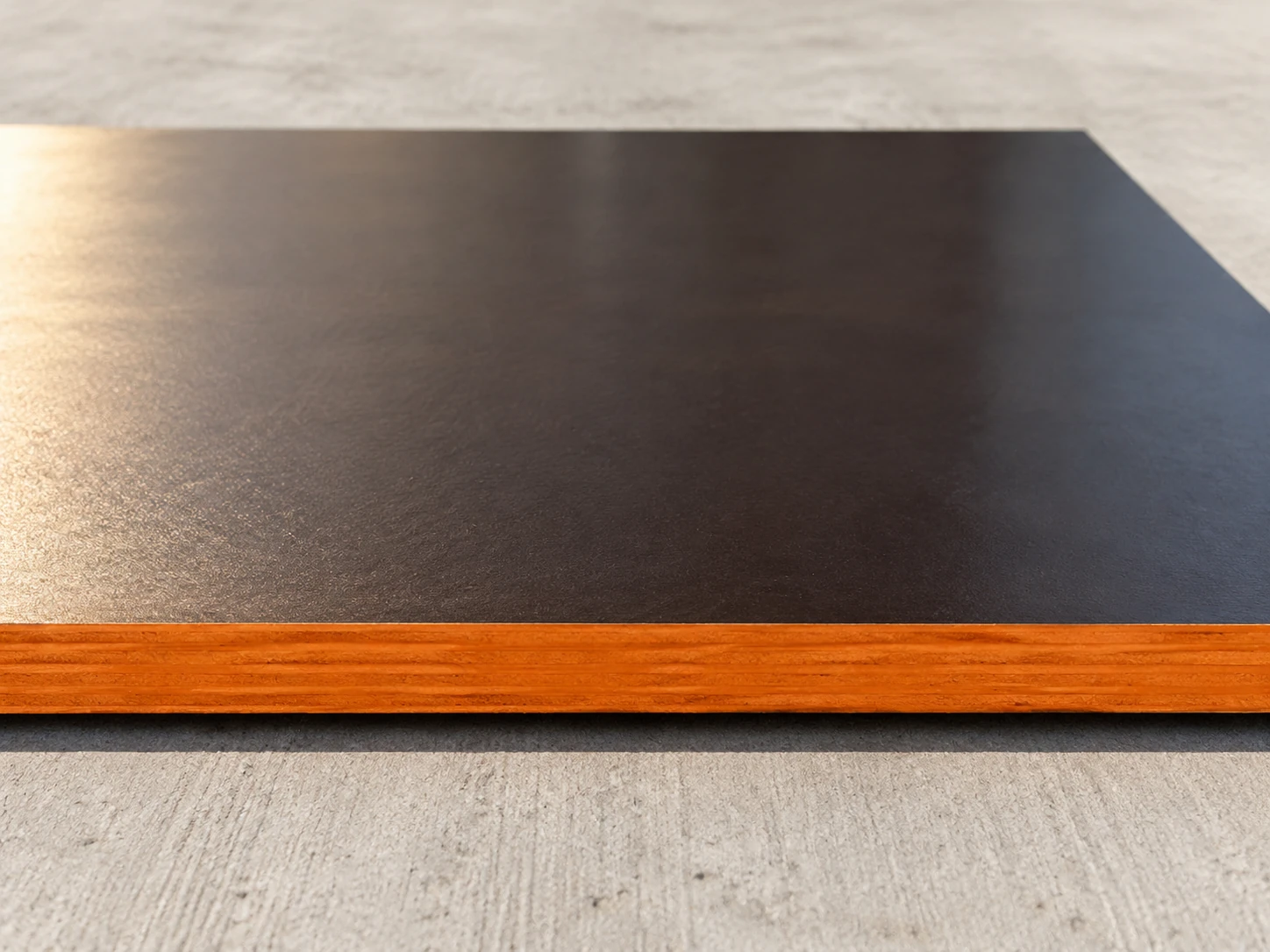
Does an Acacia or Eucalyptus core give more cubic metres per 40HC?
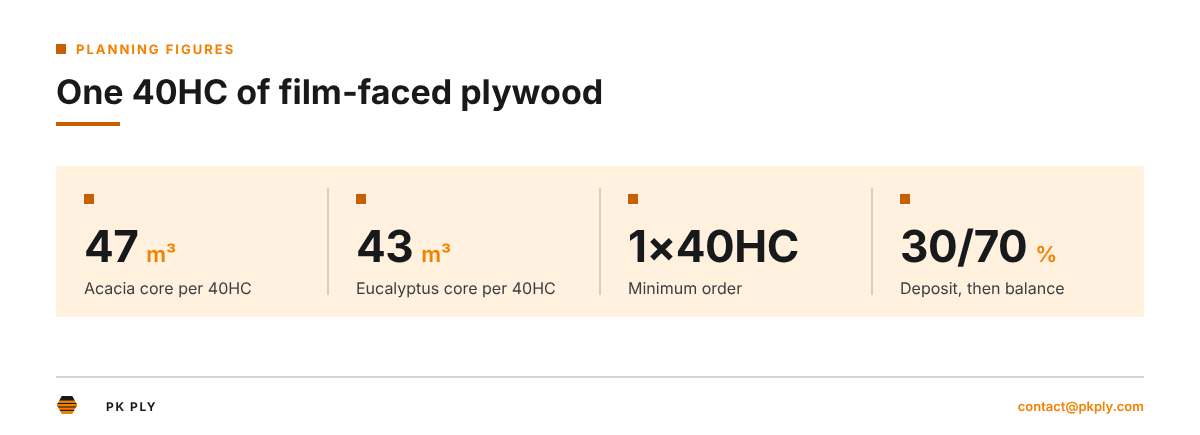
An Acacia core gives more cubic metres per 40HC: about 47 m³ against about 43 m³ for a Eucalyptus core. Eucalyptus is denser, 650 kg/m³ at planning density and measured at 650–750 kg/m³, against 580 kg/m³ for Acacia, so a Eucalyptus container reaches the weight limit before it is full.
| 1220 × 2440 mm, per 40HC (planning figures) | Acacia core, 580 kg/m³ | Eucalyptus core, 650 kg/m³ |
|---|---|---|
| 12 mm | 1,328 sheets, about 47.4 m³ | 1,200 sheets, about 42.9 m³ |
| 15 mm | 1,056 sheets, about 47.2 m³ | 960 sheets, about 42.9 m³ |
| 18 mm | 880 sheets, about 47.2 m³ | 795 sheets, about 42.6 m³ |
| 21 mm | 752 sheets, about 47.0 m³ | 675 sheets, about 42.2 m³ |
These are planning figures from our packing model: packs about 1,000 mm high, 16 packs for Acacia and 15 for Eucalyptus, and a planning payload of 28,000 kg of panels that the carrier and route confirm. Real sheets are weighed before final loading.
Why it matters to the price: the costs of a container that do not depend on volume, such as export clearance, documents and the freight under CFR or CIF, are shared over 47 m³ in one case and 43 m³ in the other. So a Eucalyptus container carries about 9% fewer cubic metres to share them. Eucalyptus is chosen for its density and stiffness, Acacia for a lighter sheet and a fuller container; the quote shows the fill so you can compare per cubic metre landed, not per container.
Price per sheet: converting a cubic-metre quote
To turn a cubic-metre quote into a per-sheet figure, multiply the price per m³ by the sheet volume: about 0.0357 m³ for 12 mm, 0.0447 m³ for 15 mm, 0.0536 m³ for 18 mm and 0.0625 m³ for 21 mm in 1220 × 2440 mm. The result is a raw FOB example, not a sheet price, because freight and duty come on top.
| 1220 × 2440 mm sheet | Volume per sheet | Raw FOB example at the published US$350 per m³ |
|---|---|---|
| 12 mm | 0.0357 m³ | About US$12.50 |
| 15 mm | 0.0447 m³ | About US$15.60 |
| 18 mm | 0.0536 m³ | About US$18.80 |
| 21 mm | 0.0625 m³ | About US$21.90 |
The US$350 figure is the low end of the published jointed-core melamine range in the first table, chosen only to show the arithmetic. A buyer comparing a mill offer with a merchant’s shelf price needs this conversion, because merchants sell per sheet with freight, duty, storage and margin inside. The gap between the two is what an importer’s landed-cost sheet has to explain line by line.
Thickness shows up twice in a per-sheet comparison. A 21 mm sheet holds about 17% more wood than an 18 mm sheet of the same size, so at the same price per cubic metre it costs about 17% more per sheet; and a container holds fewer of them. Price per sheet only means something next to the thickness and the build.
What is included in an FOB Hai Phong quote compared with CFR or CIF?
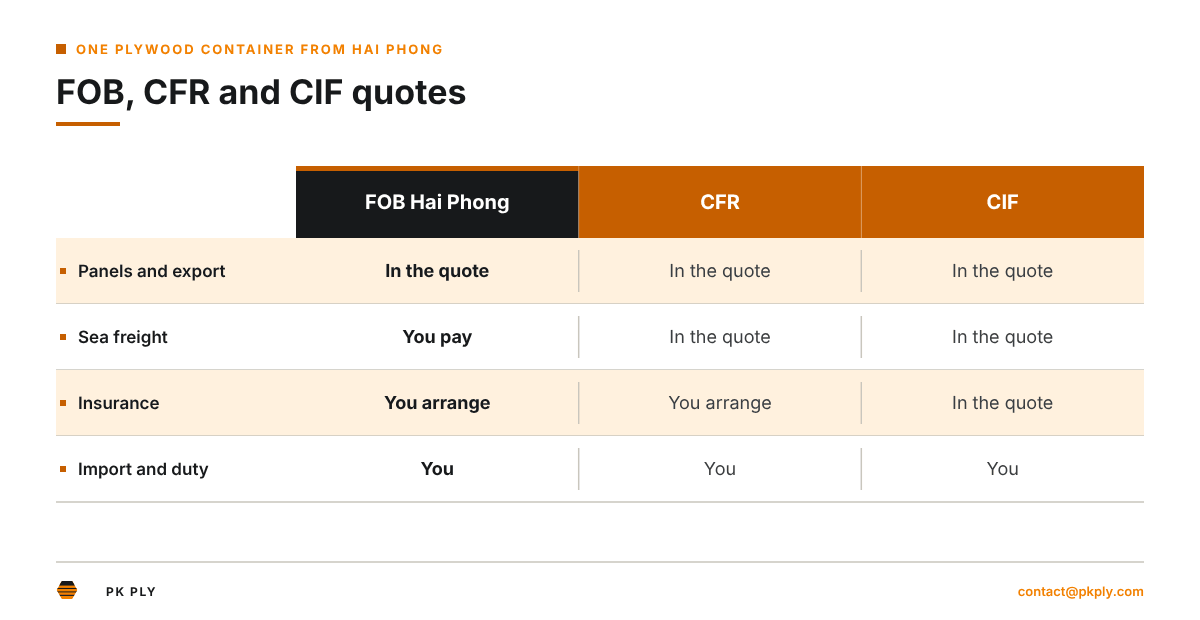
An FOB Hai Phong quote includes the panels, packed, cleared for export and loaded on the vessel at Hai Phong; freight and insurance are yours. A CFR quote adds the sea freight to your port, and a CIF quote adds freight and cargo insurance. Import clearance, duty and delivery stay with you under all three.
Incoterms rules are a set of eleven three-letter trade terms reflecting business-to-business practice in contracts for the sale and purchase of goods. The three we sell on split one container’s costs like this:
| Cost line | FOB Hai Phong | CFR your port | CIF your port |
|---|---|---|---|
| Panels, packing, export clearance | In the quote | In the quote | In the quote |
| Sea freight to your port | You pay | In the quote | In the quote |
| Cargo insurance for the sea leg | You arrange | You arrange | In the quote |
| Import clearance, duty, delivery | You | You | You |
FOB suits a buyer with a forwarder and freight contracts of their own; CFR and CIF suit a buyer who wants one figure to the port. Comparing an FOB offer with a CIF one is comparing two different scopes, so convert both to the same basis before you compare. Typical days at sea from Hai Phong are 30–40 to Northern Europe, 25–35 to the Mediterranean, 15–25 to the Middle East and 20–30 to the US West Coast, varying by carrier and route. A CFR or CIF figure carries the freight of that lane on its date.
Why do you publish only a dated from-US$ line and no price list?
We publish no price list because a list cannot name the build, and the build is the price. A starting figure is only honest with its date and the exact build beside it; until we publish one, every PK Ply figure is a written FOB Hai Phong offer for one build, dated on the day it is sent.
A price list hides the lines that matter. It shows “18 mm film-faced” at one figure and says nothing about the core grade, the glue, the film weight or the edge sealing, which are the lines that decide whether the panel gives 4 pours or 25. A buyer who orders from a list gets the build the seller chose for that price.
Prices also move with the inputs. Veneer, resin and film paper are bought in markets that change month to month, and freight changes week to week, so a figure without a date is a figure that has already aged. A dated offer for a written build is the only number both sides can hold each other to.
Published listings: what they show and what they leave out
Public price listings for Vietnamese plywood show ranges per cubic metre or per sheet, but most do not name the build, the date or whether the panel is film-faced at all. Read a listing only with its date and its product, and compare it with a quote only on the same basis.
| Listing | Product | What it shows, dated |
|---|---|---|
| Film-faced builds by core and glue | Film-faced formwork plywood | $280 to $450 per m³ FOB, published range checked 12 November 2026 (Kosmex) |
| Grade B/C, 18 mm, 4 × 8 ft | Industrial plywood for packing, pallets and other uses, no film | $10 to $10.3 per sheet, listed price checked 12 November 2026 (HG Plywood) |
| Grade A/B, 18 mm, 4 × 8 ft | Same listing, higher face grade | $10.9 to $11.1 per sheet, listed price checked 12 November 2026 (HG Plywood) |
The second and third rows are a warning, not a benchmark. They are industrial grades for packaging, pallets and general use, with no film and no formwork glue line, and the listing says its prices exclude shipping. At about 0.0537 m³ per sheet, US$10 per sheet is about US$186 per m³: a different product at a different price. A buyer who sets a film-faced budget from a commercial-grade list will receive a commercial-grade panel.
The first row is closer to a formwork quote because it names the core and the glue. Even there, film weight, thickness and edge sealing are not stated, which is why a mill offer on a written build is the figure to plan with.
How do I compare two film-faced quotes line by line?
Compare two film-faced quotes only after putting them on the same basis: same Incoterm and port, same thickness and size, and then the build lines side by side, core, jointing, glue, film weight, edges, tolerance and certificates. The lower figure is only lower if every line matches.
- Basis. Convert both offers to the same Incoterm and the same port, per cubic metre.
- Core. Species and jointing: Acacia or Eucalyptus, and whether the core is machine-jointed or hand-laid.
- Glue. MUF or phenolic, with a test report for the bonding class.
- Film. Weight in g/m² and colour, on both faces.
- Edges and tolerance. Paint on all four edges, and the thickness tolerance written on the offer (ours is ±0.5 mm).
- Container. Cubic metres per 40HC and sheets per pack, so the landed cost per m³ can be worked out.
- Papers. FSC claim, CE for structural use, test reports for the configuration.
- Terms. Deposit, balance and production time.
Where one offer leaves a line blank, ask for it before you compare. A blank line is usually the cheaper choice. For the glue line, ask for the bonding class, not the letters WBP. EN 314-2 specifies requirements for bonding classes of veneer plywood according to their end uses. Class 3 is the exterior class a formwork panel needs. Our film-faced plywood page shows the build each of our offers starts from.
Do certificates such as FSC or CE change the price?
Certificates change the price only where they change the material or the paperwork. An FSC order uses certified material for core, face and back and carries the claim on the sales documents; a structural CE order needs a declaration of performance and a panel inside the 3.6–30 mm scope. Plain formwork orders without them are quoted without them.
FSC labels products as FSC 100%, FSC Recycled or FSC Mix. Our chain of custody, SGSHK-COC-370674, covers the manufacture and sale of FSC 100% and FSC Mix plywood, and the claim is confirmed per order. Because the certified material is bought for the order, the order says FSC from the start.
We hold CE marking under EN 13986 through factory production control certificate 0407-CPR-2146, issued for structural plywood. EN 13986 covers characteristics, evaluation of conformity and marking of wood-based panels for use in construction. In the Construction Products Regulation, factory production control is the documented, permanent and internal control of production in a factory. A buyer whose market asks for CE on construction plywood should say so on the request, and the offer will state the declared use. Our CE marking page shows the certificate.
Payment terms, production time and the quote
Our quotes carry one set of terms: a 30% deposit to start production, the 70% balance against the scanned bill of lading by T/T or irrevocable L/C at sight, production in 15–45 days after the deposit, and FOB Hai Phong, CFR or CIF. A quote with different terms is a different quote.
Terms belong in the comparison because they carry money. A lower figure on 100% advance payment and a higher figure on 30/70 against the bill of lading are not ranked by the figure alone: the second leaves 70% of the money with you until the container is on the water. Production time matters the same way; a 15-day slot and a 45-day slot change when the panels reach the site.
Exchange rates and the validity of the offer are written on each offer. Freight under CFR and CIF is the part that changes fastest, so a CFR or CIF figure is valid for a shorter time than an FOB one.
What is the minimum order for one quote?
The minimum order for one quote is one 40HC. A container usually carries one or two products, and three to six can be mixed by agreement, for example two thicknesses of the same build or a film-faced load with some anti-slip panels. Each mix changes how full and how heavy the container can be, so the quote states the fill.
Mixing has a cost logic of its own. Each extra product adds a press set-up and a pack plan, and a mix of Acacia and Eucalyptus cores fills the container to neither 47 nor 43 m³ but somewhere between. So the quote for a mixed container lists each product with its cubic metres and sheets. Samples come before the quote if you want them: they are free, and new buyers book their own courier, with the courier cost credited against a real order.
How to get a dated FOB Hai Phong offer
To get a dated FOB Hai Phong offer, send the build lines with the quantity and the port: core, glue, film weight and colour, thickness, size, edges, pour target, one 40HC or more, and FOB, CFR or CIF. We return a technical sheet and a written figure per cubic metre for that build.
| Line | Example |
|---|---|
| Application and pours | Slab and wall formwork, about 20 pours |
| Core | Acacia, about 47 m³ per 40HC |
| Glue | Phenolic |
| Film | 165 g/m², dark brown, both faces |
| Thickness and size | 18 mm, 1220 × 2440 mm, ±0.5 mm |
| Edges | Water-resistant paint, all four edges |
| Papers | FSC Mix claim; test report for the build |
| Quantity and term | One 40HC, CIF your port |
Our two mills in Chi Linh, Hai Phong load up to 150 containers a month. Send the lines through the specification form or to [email protected], and the offer comes back dated, on your build. Our certification hub holds the certificates behind each build. The papers that travel with the container are listed in our note on the documents with each container.
Questions buyers ask us
What is the price of film-faced plywood from Vietnam?
It is quoted per cubic metre FOB and follows the build. Published FOB ranges from Vietnamese mills run from about US$280 per m³ for an entry melamine build to about US$450 per m³ for a phenolic build with a jointed core, before freight.
Do you publish a price list?
No. Every PK Ply offer is a written FOB Hai Phong figure for one build, because core, glue, film and thickness move the price more than any list could show.
Is Vietnamese plywood priced per sheet or per cubic metre?
Export film-faced plywood is quoted per cubic metre. A per-sheet figure is the m³ price times the sheet volume, about 0.0536 m³ for an 18 mm sheet of 1220 × 2440 mm.
Why does phenolic glue cost more than melamine glue?
The phenolic resin costs more and the bond it gives is the one that survives boiling, which is why the panel gives up to about 25 pours with proper handling. MUF panels give about 12–15 pours with the same care.
Does film weight change the price?
Yes. A heavier film uses more resin-impregnated paper per square metre, so 165, 185 or over 200 g/m² costs more than the 130–135 g/m² most orders use now.
Does the core species change the price per container?
It changes how many cubic metres a 40HC carries: about 47 m³ of Acacia-core panels or about 43 m³ of Eucalyptus-core panels, because Eucalyptus reaches the weight limit first.
What does FOB Hai Phong include?
The panels, packed and cleared for export, loaded on the vessel at Hai Phong. Sea freight and insurance are yours under FOB; CFR adds freight and CIF adds freight and insurance.
What is the minimum order for a quote?
One 40HC, which can carry one or two products and up to six by agreement. We quote on a written build for that container.
What are your payment terms?
A 30% deposit starts production and the 70% balance is paid against the scanned bill of lading, by T/T or by irrevocable L/C at sight.
How long is production after the deposit?
Production takes 15–45 days after the 30% deposit, depending on quantity, production conditions and agreement.
Why is a commercial plywood price lower than a film-faced price?
Commercial and packing plywood has no film, a looser core and an interior glue line, so it is a different product; a published list of commercial grades is not a formwork price.