
Phase 2 formaldehyde is California's emission limit for composite wood: 0.05 ppm for hardwood plywood, the same figure TSCA Title VI set nationally. For formwork, the question is whether a panel falls under either rule at all. PK Ply holds CARB Phase 2 and TSCA documentation for applicable products, so an order can name what it needs.

Does formwork plywood need CARB Phase 2 or TSCA Title VI documentation?
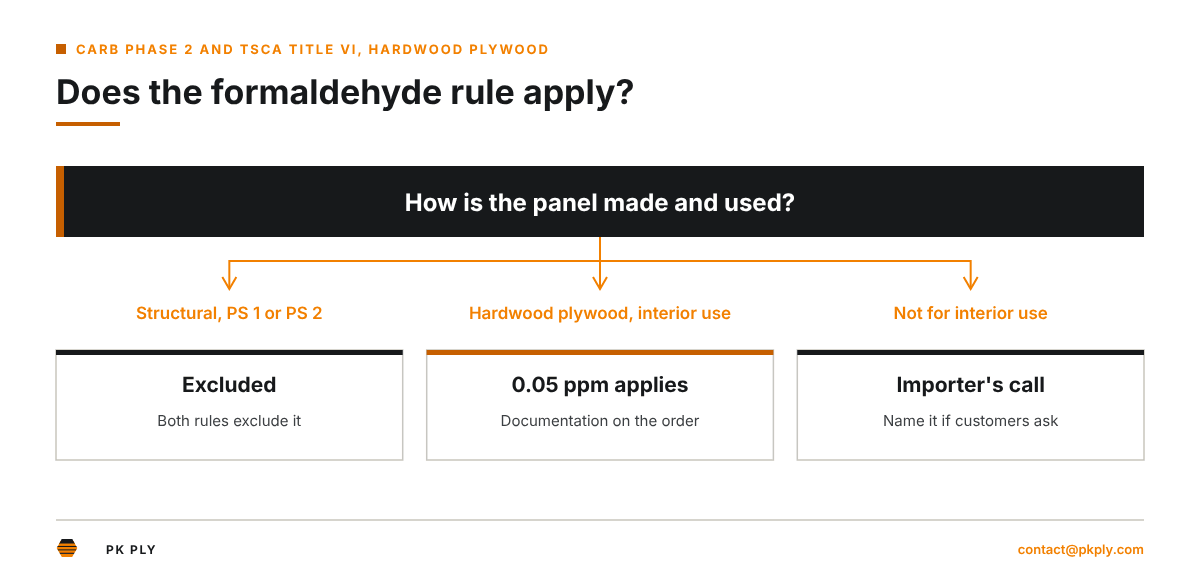
Formwork plywood needs CARB Phase 2 or TSCA Title VI documentation only when it is a regulated composite wood product. Structural plywood made to PS 1 or PS 2 is excluded from both rules, and TSCA covers hardwood plywood intended for interior use. Many US buyers still ask for the documentation, so name it on the order.
That answer has three parts, and each one is a line a buyer can check.
- Is the panel hardwood plywood under the rule? Both rules regulate hardwood plywood, particleboard and medium-density fibreboard, and both exclude structural plywood made to the US structural product standards.
- Is it intended for interior use? The federal definition of hardwood plywood is limited to panels intended for interior use. A formwork panel used on site against wet concrete is a judgement the importer makes on the panel and its end use.
- Where will it be sold? California’s rule applies to products sold, supplied, used or made for sale in California; the federal rule applies across the United States.
Because the answer turns on the use and the buyer’s market, the practical step is simple: if your customers or your own compliance team ask for CARB Phase 2 or TSCA Title VI documentation, write it on the order. We hold CARB Phase 2 and EPA TSCA Title VI documentation for applicable products and orders, made at our two mills in Chi Linh, Hai Phong.
What is Phase 2 formaldehyde?
Phase 2 formaldehyde is the second set of emission limits in California’s airborne toxic control measure for composite wood products, in Title 17 of the California Code of Regulations, section 93120. For hardwood plywood with a veneer core, the Phase 2 limit is 0.05 ppm, in force since 1 January 2010.
The purpose of the California rule is to reduce formaldehyde emissions from composite wood products, and finished goods that contain composite wood products, that are sold, offered for sale, supplied, used, or manufactured for sale in California. The rule set two phases: Phase 1 from 2009 and the stricter Phase 2 from 2010 to 2012, depending on the product.
| Product (17 CCR 93120.2, Table 1) | Phase 1 limit | Phase 2 limit | Phase 2 from |
|---|---|---|---|
| Hardwood plywood, veneer core | 0.08 ppm | 0.05 ppm | 1 January 2010 |
| Hardwood plywood, composite core | 0.08 ppm | 0.05 ppm | 1 July 2012 |
| Particleboard | 0.18 ppm | 0.09 ppm | 1 January 2011 |
| Medium-density fibreboard | 0.21 ppm | 0.11 ppm | 1 January 2011 |
| Thin medium-density fibreboard | 0.21 ppm | 0.13 ppm | 1 January 2012 |
The California Phase 2 table sets 0.05 ppm for hardwood plywood with a veneer core from 1-1-2010. The values are measured on the ASTM E1333 chamber basis. “Phase 2” on a quotation therefore means a panel documented against that table, not a grade of plywood or a glue type.
What is the formaldehyde limit for hardwood plywood under TSCA Title VI?
The TSCA Title VI limit for hardwood plywood with a veneer core or a composite core is 0.05 ppm of formaldehyde, the same figure as CARB Phase 2. The federal rule sits in 40 CFR Part 770 and applies to products sold, supplied, offered for sale or made, including imported, in the United States.
For hardwood plywood made with a veneer core or a composite core, the TSCA Title VI emission standard is 0.05 parts per million (ppm) of formaldehyde. The same section sets 0.11 ppm for medium-density fibreboard, 0.13 ppm for thin medium-density fibreboard and 0.09 ppm for particleboard.
EPA’s final rule implements the Formaldehyde Standards for Composite Wood Products Act, which added Title VI to the Toxic Substances Control Act. The rule covers testing, labelling, chain of custody documentation and third-party certification, as well as the limits themselves. On December 12, 2016, EPA published in the Federal Register a final rule to reduce exposure to formaldehyde emissions from certain wood products produced domestically or imported into the United States.
Is CARB P2 the same as TSCA Title VI for a construction panel?
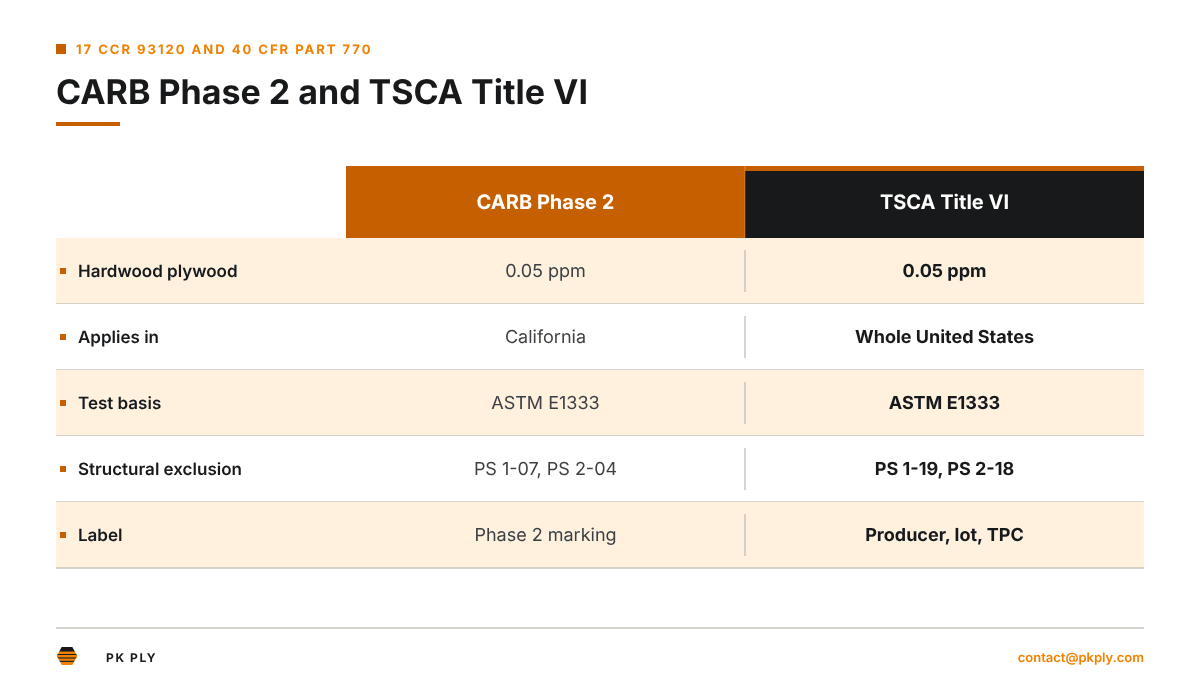
CARB P2 and TSCA Title VI set the same limit for a construction panel made of hardwood plywood, 0.05 ppm, and EPA worked with CARB to keep the national rule consistent with California’s. They differ in where they apply, which standard editions their structural exclusions name, and how the federal rule defines hardwood plywood by interior use.
| Line | CARB Phase 2 | TSCA Title VI |
|---|---|---|
| Legal text | 17 CCR 93120 to 93120.12 | 40 CFR Part 770 |
| Where it applies | Sold, supplied, used or made for sale in California | Sold, supplied, offered for sale or made, including imported, in the United States |
| Hardwood plywood limit | 0.05 ppm | 0.05 ppm |
| Test basis | ASTM E1333 chamber | ASTM E1333 chamber |
| Structural exclusion | Structural plywood to PS 1-07, structural panels to PS 2-04 | Plywood specified in PS 1-19 or PS 2-18 |
| Interior use in the definition | Not in the hardwood plywood definition | Hardwood plywood is a panel intended for interior use |
| Label | Phase 2 compliance marking | Producer, lot, TPC number, “TSCA Title VI certified” |
For a formwork panel shipped to the US, buyers usually ask for both lines on one set of documents, because a panel sold in California also falls under the federal rule. The CARB P2 and TSCA page shows how we handle the documentation.
Where do structural plywood and phenolic plyform sit under the rules?
Structural plywood made to the US structural standards sits outside both formaldehyde rules. Phenolic film-faced plyform is not a category in either rule: it is a term from the US trade case on hardwood plywood, where it names an excluded product. Under CARB and TSCA, a phenolic film-faced panel is judged as hardwood plywood or structural plywood like any other.
Under TSCA Title VI, hardwood plywood means a hardwood or decorative panel that is intended for interior use, and it does not include military-specified plywood, curved plywood, or any plywood specified in PS 1-19 or PS 2-18. The California definition of composite wood products sets the same kind of exclusion with older editions of the standards.
Under the California rule, composite wood products do not include hardboard, structural plywood as specified in PS 1-07, or structural panels as specified in PS 2-04. Both exclusions turn on how the panel is made and stamped, not on its face film.
The trade-case term is a separate matter. The scope of case A-552-851 on hardwood and decorative plywood from Vietnam excludes Phenolic Film Faced Plyform (PFF), also known as Phenolic Surface Film Plywood (PSF), defined as a panel with an Exterior or Exposure 1 bond classification, an opaque phenolic film layer permanently bonded on both the face and back veneers and an opaque, moisture resistant coating applied to the edges. That exclusion decides duty, not formaldehyde. Our US import note reads it against a formwork build.
Is phenolic glue plywood treated differently from melamine glue plywood under US rules?
Phenolic glue plywood is not treated differently from melamine glue plywood under the US limits. Both rules set the limit by product, hardwood plywood at 0.05 ppm, not by resin, and both phenolic and melamine glues are formaldehyde-based. Neither counts as a no-added-formaldehyde resin, which is the class of resin the rules handle with reduced testing.
No-added formaldehyde based resins include, but are not limited to, resins made from soy, polyvinyl acetate, or methylene diisocyanate. The definition covers resins formulated with no added formaldehyde in the resin cross-linking structure. Phenol-formaldehyde and melamine-urea-formaldehyde glues have formaldehyde in that structure, so a panel made with either is certified and tested like any hardwood plywood.
What the glue does change is the panel, not the rule:
| Line | Melamine (MUF) build | Phenolic build |
|---|---|---|
| Formaldehyde rule that applies in scope | Hardwood plywood, 0.05 ppm | Hardwood plywood, 0.05 ppm |
| Resin class under the rules | Formaldehyde-based | Formaldehyde-based |
| Reuse on site, with proper handling, release agent and sealed edges | About 12–15 pours | Up to about 25 pours |
| Typical glue-line colour on a sawn edge | Pale | Dark reddish-brown |
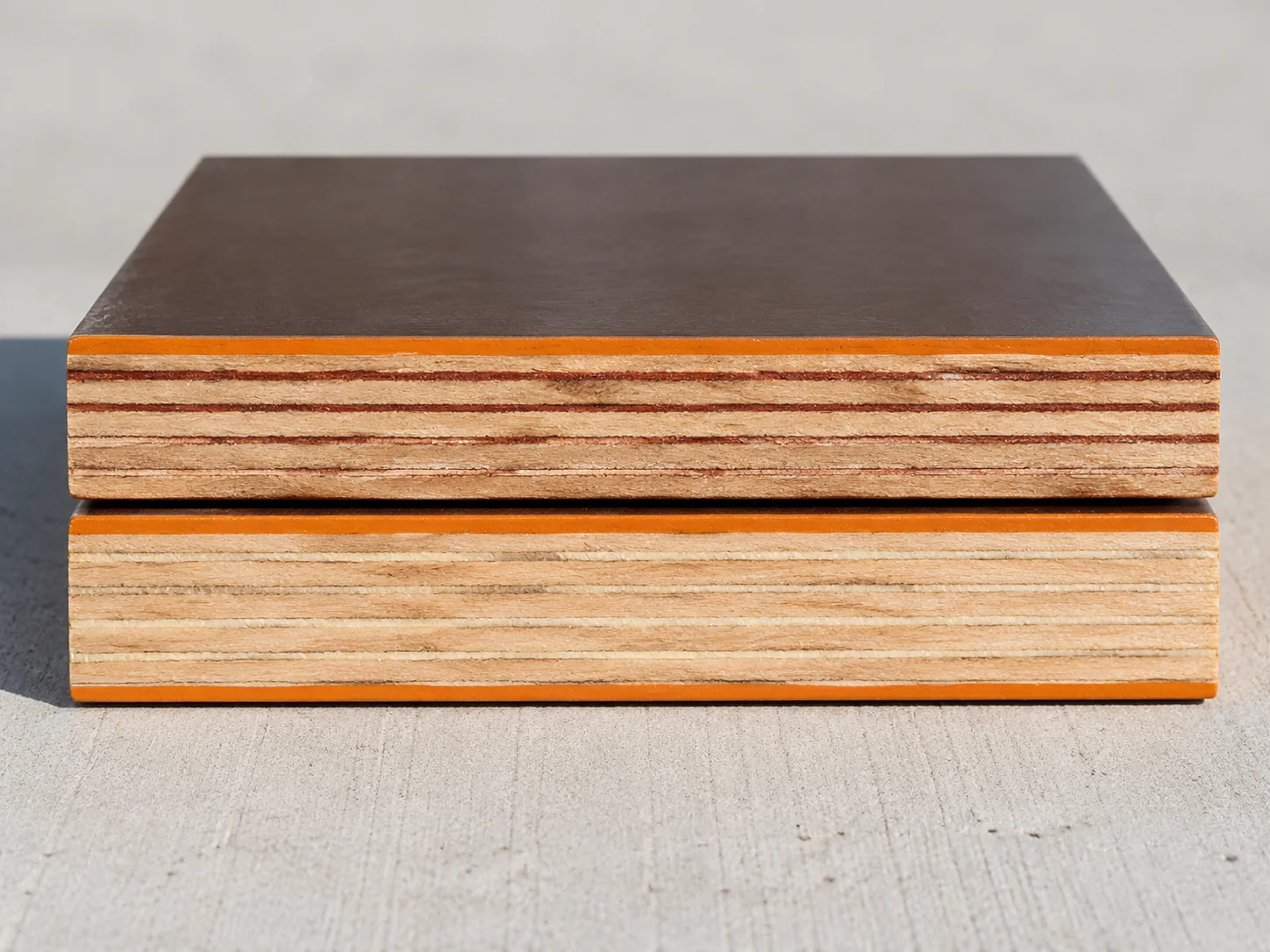
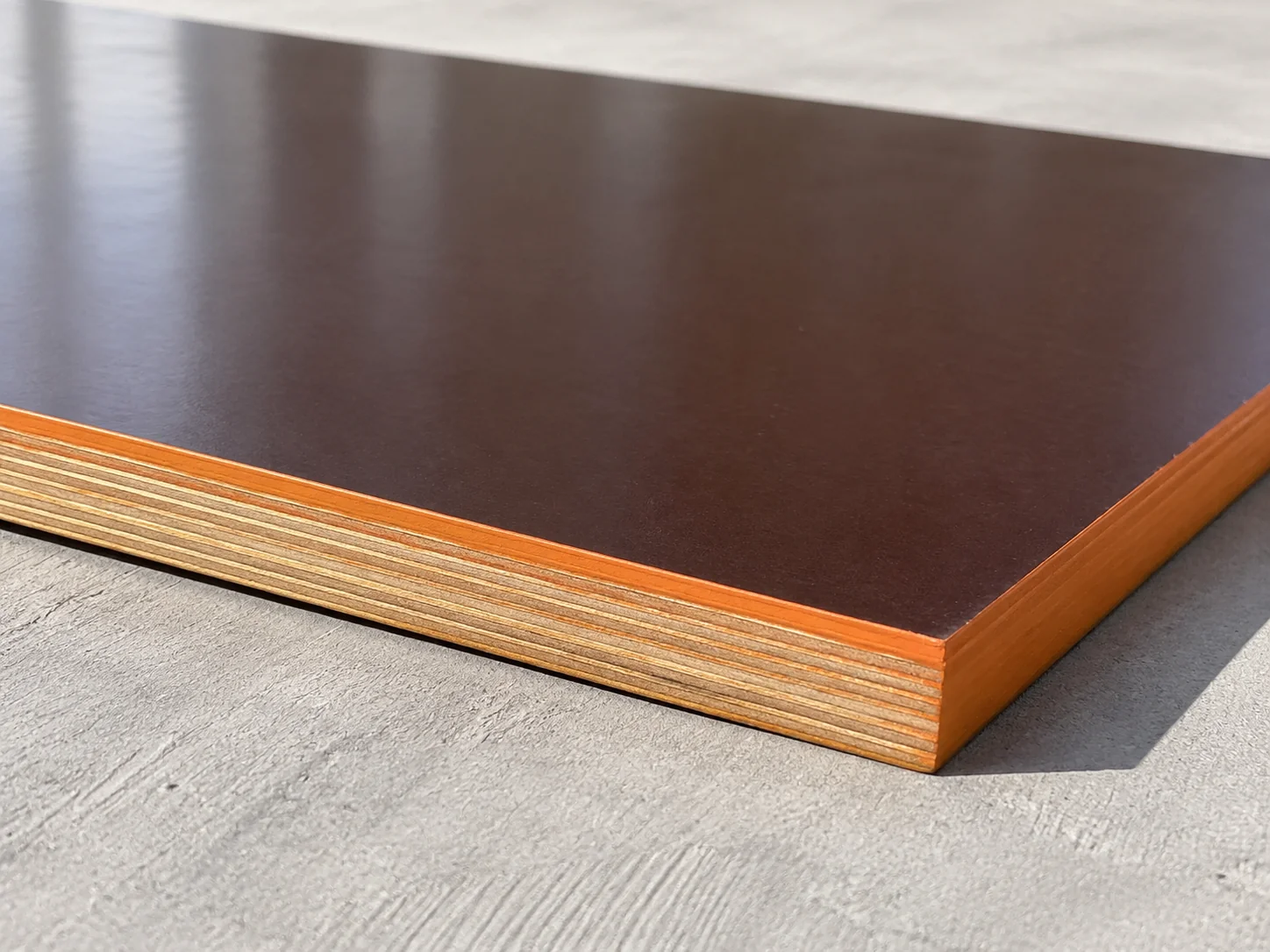
Our film-faced panels are pressed with melamine (MUF) or phenolic glue on Acacia or Eucalyptus cores. Choose the glue for the pours and the exposure; name the formaldehyde documentation separately on the order.
Can an EN 717-1 chamber result in mg/m³ be converted to ppm?
An EN 717-1 chamber result in mg/m³ cannot be converted to a CARB or TSCA ppm value. The European and US chamber methods differ in chamber size, loading, air exchange and conditioning, so the same panel gives figures that do not map one to one. We never convert a European result into a US one.
EN 717-1 is the BSI standard for wood-based panels, determination of formaldehyde release, formaldehyde emission by the chamber method. The US limits are read on the ASTM E1333 basis. Each result is valid for the method that produced it.
Two habits keep the paperwork honest:
- Quote each result with its method. “Not detected at 0.04 mg/m³ by EN 717-1” and “0.05 ppm limit by ASTM E1333” are two statements, never one.
- Use the rule’s own documents for the rule’s market. A US order uses the CARB or TSCA documentation; an EU order uses the European chamber evidence and the REACH limit.
What our SGS 21 mm specimen shows, and what it does not
Our SGS Vietnam report, issued 23 December 2025 on one submitted 21 mm dark-brown phenolic film-faced specimen with an Acacia core, found formaldehyde not detected at the 0.04 mg/m³ reporting limit and passed E1 against ≤0.124 mg/m³ by EN 717-1. It is European chamber evidence for one specimen, not a CARB or TSCA result.
What the report supports:
- E1 PASS for the tested specimen, by the EN 717-1 chamber method.
- Not detected below 0.04 mg/m³, which means below the reporting limit, not zero.
- Bonding quality Class 3 PASS and a density of 642 kg/m³ for the same specimen, from the same report.
What it does not support:
- An E0 claim. No E0 claim is made.
- A ppm figure. The result is never converted to ppm.
- Every panel. It is specimen evidence for one configuration, not a guarantee for every panel.
The SGS specimen note reads the report line by line, and the E1 chamber test page shows the result.
Why does your site not print a CARB certificate number?
We do not print a CARB certificate number on the site because a certificate is checked as a document, with its scope and validity, not as a number on a web page. The certificate, with its identifiers and scope, goes out with the quotation, and the sales documents for your order state which panels it covers.
A number on a page answers the wrong question. What a buyer needs to know is whether the panels on this order are covered: the product type, the thickness range, the certifier and the dates on the document itself. Those are read from the certificate file, sent before the order is confirmed, and matched to the order on the sales documents.
That also keeps one rule simple for both sides. If an order asks for CARB Phase 2 or TSCA Title VI, the documentation for those panels is part of the order’s file set, and the label on the panels follows what that documentation covers.
What does a TSCA Title VI compliant label show?
A TSCA Title VI compliant label shows the panel producer’s name, the lot number, the number of the EPA TSCA Title VI third-party certifier and a statement that the products are TSCA Title VI certified. Panels can be labelled one by one or by bundle, with a method that links each panel to its label.
Panels or bundles of panels that are imported, sold, supplied, or offered for sale in the United States must be labeled with the panel producer’s name, the lot number, the number of the EPA TSCA Title VI TPC, and a statement that the products are TSCA Title VI certified. Where panels are not labelled one by one, a method such as colour-coded edge marking links each panel to the label information.
| Label line | What it tells the buyer |
|---|---|
| Panel producer | Who pressed the panel |
| Lot number | Which production lot it came from |
| TPC number | Which EPA-recognised certifier certifies the producer |
| “TSCA Title VI certified” | The compliance statement |
On a film-faced formwork panel the edges are painted, so the label usually goes on the bundle or on the face before shipping, and the packing list carries the lot.
Who in the supply chain is responsible for TSCA compliance?
Under TSCA Title VI the panel producer is certified through a third-party certifier, and importers, fabricators, distributors and retailers must take reasonable precautions that the products they sell comply. Importers also keep records for three years and make an import certification, so the documentation has to reach them before entry.
Importers, fabricators, distributors, and retailers must take reasonable precautions that the composite wood products they sell, supply, offer for sale, or hold for sale comply with the emission standards and other requirements. In practice that means collecting the producer’s certification documents, matching them to the panels and keeping the records.
| Role | What it does | What it needs from the mill |
|---|---|---|
| Panel producer | Makes and certifies the panels | Its own certification with the certifier |
| Third-party certifier | Tests and certifies the producer | Samples and records |
| Importer | Reasonable precautions, records, import certification | Certificate files, labels, lot numbers |
| Distributor or retailer | Reasonable precautions | Labels and supplier records |
Which thicknesses does our CARB and TSCA documentation cover?
Our CARB Phase 2 and TSCA Title VI documentation covers applicable products up to 21 mm. We press 9–40 mm, and the everyday formwork thicknesses of 12, 15, 18 and 21 mm sit inside that range; panels thicker than 21 mm are not offered as CARB Phase 2 or TSCA Title VI panels.
| Thickness | Everyday formwork use | CARB P2 / TSCA documentation |
|---|---|---|
| 9 mm | Curved and light forms | Applicable products, on request |
| 12 mm | Wall and column forms | Applicable products, on request |
| 15 mm | Wall and slab forms | Applicable products, on request |
| 18 mm | Slab and wall forms | Applicable products, on request |
| 21 mm | Heavy slab and repeated cycles | Applicable products, on request |
| Above 21 mm | Heavy-duty forms | Not offered as CARB P2 / TSCA panels |
Write the thickness and the documentation on the same order line. A mixed container with 21 mm and thicker panels then carries the documentation only for the panels it covers, and the sales documents say which.
How does Phase 2 compare with the EU formaldehyde limits?
Phase 2 and the EU limits are set on different test bases, so they are compared by class, not by number. The US limit for hardwood plywood is 0.05 ppm by the ASTM E1333 chamber; the EU’s E1 class is ≤0.124 mg/m³ by EN 717-1, and REACH entry 77 sets 0.062 mg/m³ for wood-based articles from 6 August 2026.
Regulation (EU) 2023/1464 restricts formaldehyde and formaldehyde releasers by adding entry 77 to Annex XVII of REACH. Its chamber conditions are 23 °C, 45% relative humidity and a loading of 1 m²/m³; other articles have a limit of 0.080 mg/m³, and articles used only outdoors are excluded.
| Market | Rule | Limit for plywood | Unit and basis |
|---|---|---|---|
| California | CARB Phase 2 | 0.05 for hardwood plywood | ppm, ASTM E1333 |
| United States | TSCA Title VI | 0.05 for hardwood plywood | ppm, ASTM E1333 |
| European Union | REACH entry 77, from 6 August 2026 | 0.062 for wood-based articles | mg/m³, Appendix 14 chamber |
| Europe, class | E1 | ≤0.124 | mg/m³, EN 717-1 |
A panel that sells in both markets carries two sets of evidence, one per rule. Our EU import note covers the European side.
What to write on a US formwork order about formaldehyde
On a US formwork order, write the rule, the panels and the market: “CARB Phase 2 and TSCA Title VI documentation for hardwood plywood panels up to 21 mm, labels on bundles”, plus the build, the thickness and the destination state if it is California. That one line makes the documentation part of the order, not an afterthought at entry.
The full set of lines to send:
- Application and use: formwork, and whether any panels go to interior use.
- Build: core species, glue (MUF or phenolic), film weight per face, edge sealing.
- Thickness and size: mm, with the inch size the form system expects.
- Formaldehyde documentation: CARB Phase 2, TSCA Title VI or both, for the panels that need it.
- Labelling: per panel or per bundle.
- Destination: US port, and California if the panels are sold there.
- Quantity and Incoterm: one 40HC minimum, FOB Hai Phong, CFR or CIF.
Common misreadings of Phase 2 formaldehyde
The common misreadings of Phase 2 formaldehyde are that it is a grade of plywood, that phenolic panels are exempt, that “not detected” means zero, that a European mg/m³ result can stand in for a US ppm value, and that every plywood panel falls under the rules. Each one leads to the wrong document on an order.
| Misreading | What the rules say |
|---|---|
| “Phase 2 is a plywood grade” | It is an emission limit table in the California rule |
| “Phenolic plywood is exempt” | Limits are by product; phenolic and melamine glues are both formaldehyde-based |
| “Not detected means zero” | It means below the reporting limit, for us 0.04 mg/m³ on one specimen |
| “E1 equals CARB P2” | Different test bases; never converted |
| “TSCA covers all plywood” | Structural PS 1 and PS 2 plywood is excluded; the federal definition is for interior use |
| “Phenolic film-faced plyform is a TSCA exemption” | It is a trade-case exclusion for duty, not a formaldehyde term |
How to ask for CARB Phase 2 or TSCA documentation with a quote
To ask for CARB Phase 2 or TSCA Title VI documentation, write it on the specification with the panels and thicknesses it should cover. We return the technical sheet, the certificate files and an offer FOB Hai Phong, CFR or CIF, and the sales documents for the order state which panels the documentation covers.
Certificate files reach you before the order is confirmed, so your compliance team can check the document before the 30% deposit. Our phenolic film-faced plywood is the build most US formwork buyers ask about. Send your lines through the specification form or to [email protected].
Questions buyers ask us
What is Phase 2 formaldehyde?
Phase 2 is the second, stricter set of formaldehyde emission limits in California's composite wood rule. For hardwood plywood with a veneer core it is 0.05 ppm, in force since 1 January 2010.
Is CARB Phase 2 the same as TSCA Title VI?
The limits are the same, including 0.05 ppm for hardwood plywood, and EPA built the federal rule to be consistent with California's. CARB applies to products sold, supplied, used or made for sale in California; TSCA Title VI applies across the United States.
Does formwork plywood need CARB Phase 2 documentation?
Only if the panel is a regulated composite wood product. Structural plywood made to PS 1 or PS 2 is excluded, and TSCA covers hardwood plywood intended for interior use, so the importer judges the panel and its use.
Is phenolic plywood exempt from CARB and TSCA?
No. The rules set the limit by product, not by glue, so hardwood plywood with a phenolic glue line meets the same 0.05 ppm limit as one with melamine glue when it is in scope.
Can I convert an E1 result in mg/m³ to ppm?
No. EN 717-1 and the US chamber method are different tests, so a European chamber result is never converted into a CARB or TSCA ppm value.
Why don't you print your CARB certificate number on the website?
The certificate, with its identifiers and scope, goes out with the quotation, and the sales documents for your order state which panels it covers. You check the document itself, not a number on a page.
Which thicknesses does your CARB and TSCA documentation cover?
Applicable products up to 21 mm. Panels thicker than 21 mm are not offered as CARB Phase 2 or TSCA Title VI panels.
What must a TSCA Title VI label show?
The panel producer's name, the lot number, the number of the EPA TSCA Title VI third-party certifier and a statement that the products are TSCA Title VI certified.
Is your film-faced plywood E0?
No E0 claim is made. Our SGS specimen passed E1 with formaldehyde not detected at the 0.04 mg/m³ reporting limit, which means below that limit, not zero.
What is the formaldehyde limit for particleboard and MDF under Phase 2?
0.09 ppm for particleboard, 0.11 ppm for MDF and 0.13 ppm for thin MDF, against 0.05 ppm for hardwood plywood.
Who checks that imported plywood meets TSCA Title VI?
Panels are certified through an EPA-recognised third-party certifier, and importers must take reasonable precautions that what they sell complies and keep the records.
Does the EU have a Phase 2 equivalent?
The EU uses REACH Annex XVII entry 77: from 6 August 2026, 0.062 mg/m³ for furniture and wood-based articles under its chamber conditions. It is a different test basis, so the numbers are not compared directly.