
WBP glue in film-faced plywood
What a WBP bond is and how it is tested.
WBP glue in film-faced plywoodTechnical notes · core and glue
In short
Core and glue decide how many pours a formwork panel gives, more than the film name does. At PK Ply we lay Acacia or Eucalyptus veneer cores and bond them with MUF glue for about 12–15 pours or phenolic glue for up to about 25, with proper handling, release agent and sealed edges.
Film
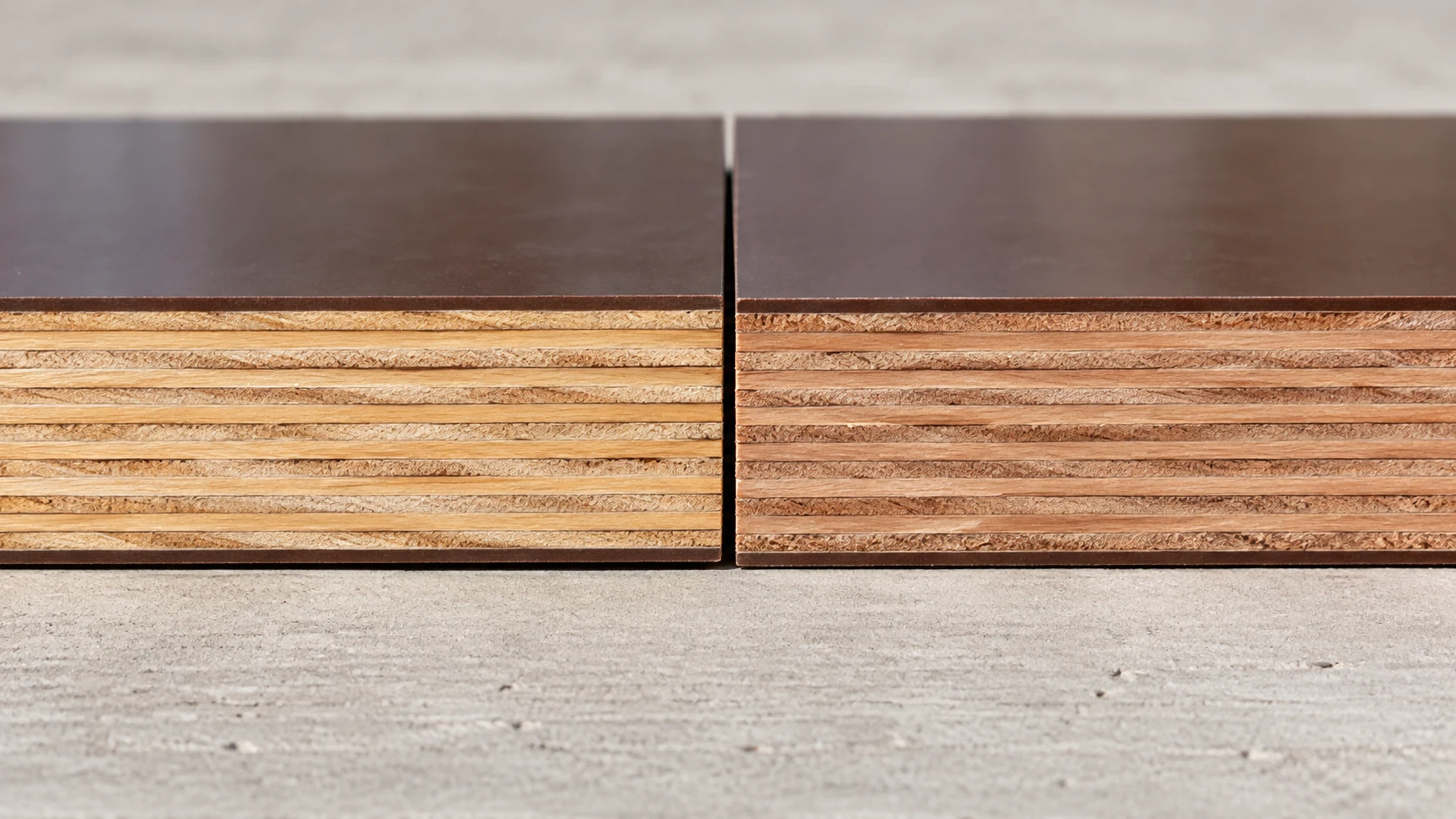
The film follows the core from veneer lay-up to the glue spreader and the hot press, then cuts a finished sheet to show the glue lines.
The short answer
MUF is a melamine-urea glue that resists water well and costs less; phenolic is a WBP glue that holds through boiling and gives more pours. Choose by the number of pours the site really needs.
| Point | MUF glue | Phenolic glue |
|---|---|---|
| Pours, with handling, release agent and sealed edges | About 12–15 | Up to about 25 |
| Bond type | Water-resistant | WBP, boil-resistant |
| Hot press | Per glue system | About 130–145 °C |
| Typical job | Standard slab and wall formwork | High-reuse formwork, system decks |
| Cut-edge colour | Pale glue lines | Dark glue lines |
WBP
Ask for a bonding test to EN 314-2 Class 3 with boiling pretreatments, run on the build you are buying. A sheet stamped WBP proves nothing on its own; the boil test does.
SGS Vietnam tested one 21 mm dark-brown film-faced specimen from our mills, Acacia core, phenolic glue. It passed bonding Class 3 (EN 314-1/314-2) after a 24 h water soak, a boil-dry-boil cycle and 72 h of boiling. Its density was 642 kg/m³.
That result belongs to the specimen tested. For an order we send the test report for the agreed configuration before the order is confirmed.
Core species
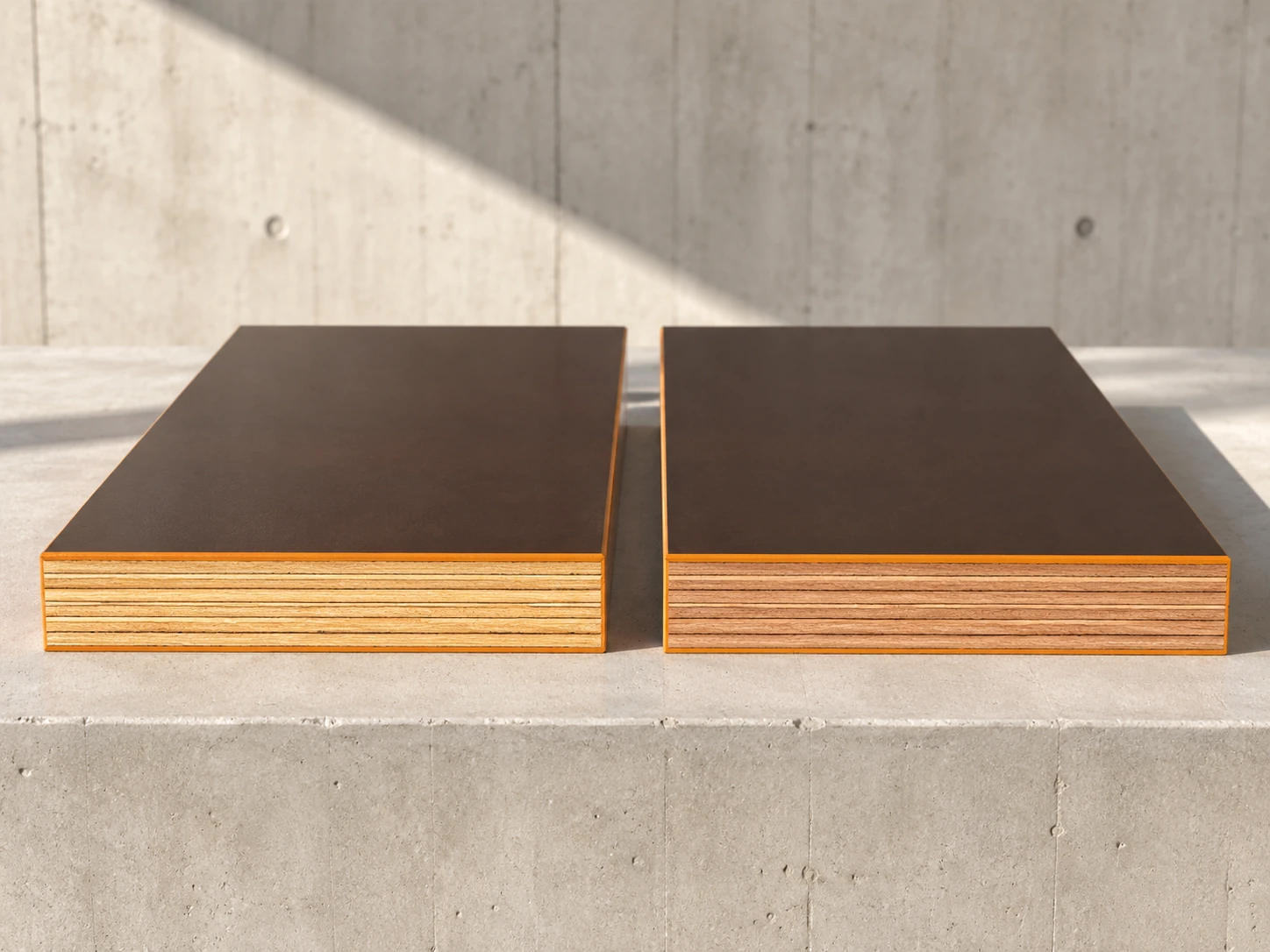
Yes. Eucalyptus is denser, so its sheets weigh more and a 40HC reaches its weight limit sooner: about 43 m³ of Eucalyptus-core panels against about 47 m³ of Acacia-core panels.
| Thickness | Acacia core | Eucalyptus core |
|---|---|---|
| 12 mm | 1,328 sheets (16 × 83), 20.7 kg each | 1,200 sheets (15 × 80), 23.2 kg each |
| 15 mm | 1,056 sheets (16 × 66), 25.9 kg each | 960 sheets (15 × 64), 29.0 kg each |
| 18 mm | 880 sheets (16 × 55), 31.1 kg each | 795 sheets (15 × 53), 34.8 kg each |
| 21 mm | 752 sheets (16 × 47), 36.3 kg each | 675 sheets (15 × 45), 40.6 kg each |
Planning figures from our packing model (580 and 650 kg/m³ reference densities, 28,000 kg planning payload, panels only); real sheets are weighed before final loading.
Phenolic resin
Phenolic glue costs more per sheet, needs hot pressing at about 130–145 °C and leaves dark glue lines on every cut edge. It pays back only when the panels are really reused.
On a job that strikes each panel a handful of times, the extra pours of a phenolic bond are never used, and a MUF panel is the better buy. On system decks and repeated wall pours, the phenolic panel usually costs less per pour.
Neither glue saves a panel from bad site practice. Release agent on every pour and sealed cut edges matter as much as the bond.
Notes
Deeper notes on bonds, cores and the films pressed over them.
What a WBP bond is and how it is tested.
WBP glue in film-faced plywoodDensity, Class 3 bonding and E1 on one specimen.
SGS 21 mm specimen reportWhy jointed core veneers are a risk in formwork.
Finger-jointed cores riskWhere our Acacia and Eucalyptus veneers come from.
Plantation timber for our plywoodFilm brands and what changes with them.
Imported phenolic filmsFrom 120–125 g/m² to over 200 g/m².
Film weight gradesPours by glue, and the site routine behind them.
How many pours per panelThe glue line at our mills.
Glue mixing at our millsCore press, then film press.
Two-stage pressing at our millsFormaldehyde result on our 21 mm specimen.
E1 formaldehyde chamber testBuyer questions
MUF is water-resistant and gives about 12–15 pours on our panels; phenolic is a WBP, boil-resistant bond that gives up to about 25. Both counts assume proper handling, release agent and sealed edges.
Ask for an EN 314-2 Class 3 bonding test with boiling pretreatments on the build you are buying. Our 21 mm phenolic specimen passed Class 3 at SGS Vietnam.
Yes. Our planning figure for an 18 mm 1220 × 2440 mm sheet is 31.1 kg with an Acacia core and 34.8 kg with a Eucalyptus core.
About 47 m³ of Acacia-core panels or about 43 m³ of Eucalyptus-core panels; Eucalyptus loads are limited by weight.
It passed EN 314 bonding Class 3 after a 24 h soak, boil-dry-boil and 72 h boiling, with a density of 642 kg/m³. The result applies to that specimen.
It costs more per sheet, needs hot pressing at about 130–145 °C and leaves dark glue lines on cut edges. It pays back only when panels are reused many times.
Acacia or Eucalyptus hardwood veneers, chosen with the buyer on the order. Acacia loads more volume per 40HC; Eucalyptus gives a denser sheet.
Quotation
Tell us the pours you need, the thickness and the core you prefer. We reply with the glue system we would press and a technical sheet.