
Truck floor plywood is hardwood plywood with a patterned phenolic film on the walking face, a waterproof glue line and sealed edges. Ordered by name alone, a floor can arrive with a thin film or an interior glue and start lifting at the bolt holes. At PK Ply we press hexagon and wire-mesh builds on Acacia or Eucalyptus cores in 9–40 mm, most often 18 and 21 mm.
What plywood is used for truck floors?
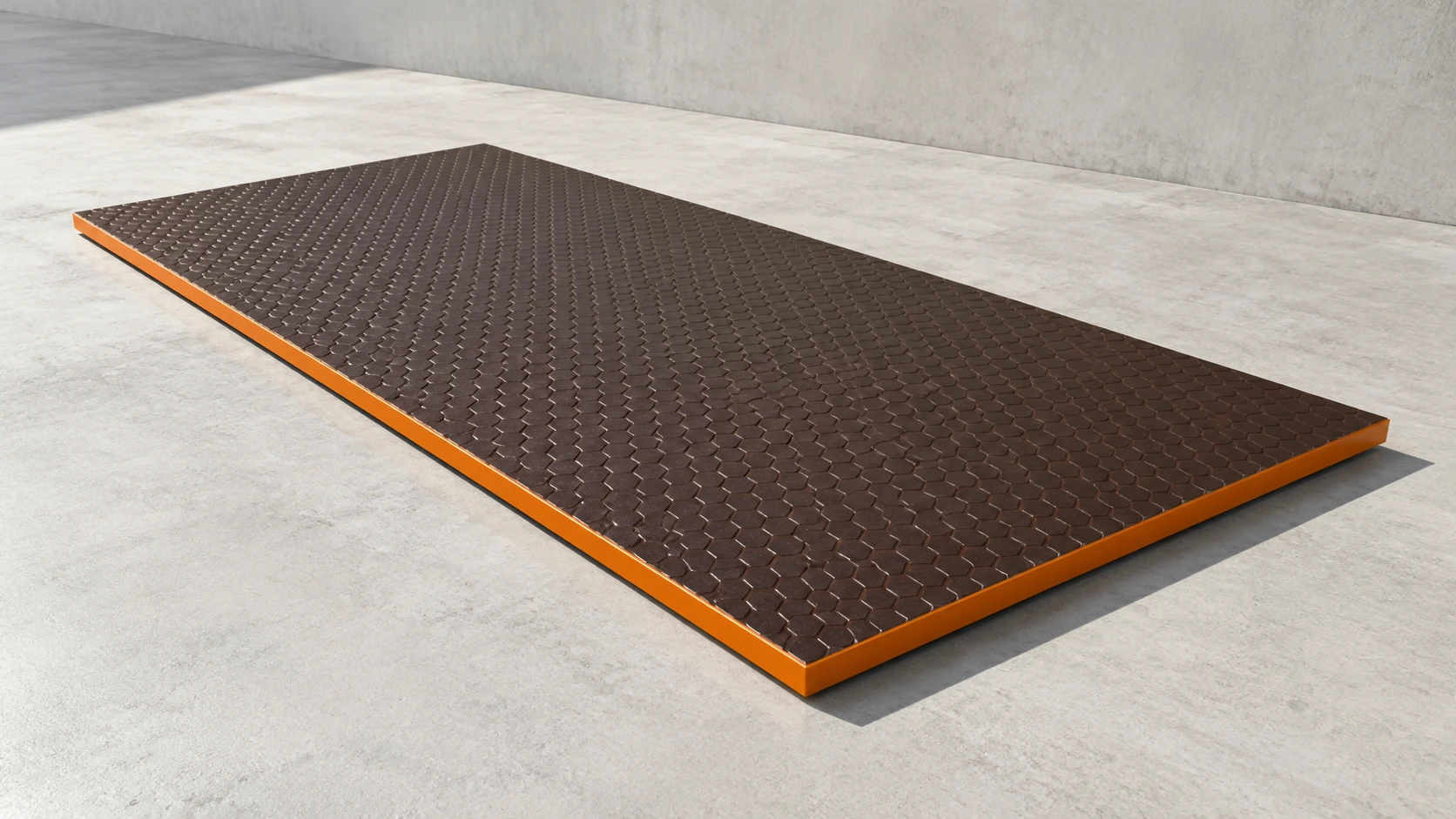
Truck floors are usually built from hardwood plywood with a phenolic film face, a waterproof glue line and sealed edges. On floors that people walk and pallet trucks run on, the top film carries a pressed pattern, hexagon or wire-mesh, for grip. Our version is an Acacia or Eucalyptus core with phenolic glue, 18 or 21 mm thick.
The trade has many names for it. Box-body builders say truck floor plywood or truck flooring plywood. UK fleets say lorry floor plywood, and trailer builders say trailer floor plywood. Distributors list it as phenolic faced ply, hexa ply or anti-slip plywood. Behind each name sits the same idea: a stiff wood panel that carries wheels and loads, keeps its grip when wet and can be bolted to a steel frame without rotting at the bolts.
Plywood holds its place in truck bodies against steel and composite floors for three plain reasons. It is light for its stiffness, so the body loses less payload. It takes bolts and screws anywhere along the cross-members without welding. And a damaged panel is unbolted and replaced in an afternoon. What separates a floor that lasts from one that fails is not the word plywood but four order lines: the face film, the glue, the core and the edges.
| Part of the panel | What a truck floor needs | Our standard anti-slip build |
|---|---|---|
| Top face | Grip when wet, wear resistance under wheels | Patterned phenolic film, hexagon as standard, wire-mesh by order |
| Back face | A flat, sealed face on the cross-members | Smooth phenolic film; patterned by order for reversible floors |
| Glue line | Survives rain, wash-downs and condensation | Phenolic; MUF only for dry, covered floors |
| Core | Stiff, no gaps under a wheel load | Acacia or Eucalyptus hardwood veneers, laid crosswise |
| Edges | Closed end grain | Water-resistant paint on all four edges at the mill |
| Thickness | Set by cross-member spacing and axle load | 18 mm most ordered; 9–40 mm by order, ±0.5 mm |
Our anti-slip plywood page lists the same build as a product specification. This note looks at it from the truck body: which face, which thickness, which glue, and what the body builder does with the panel once it arrives.
Box, curtain-side and flatbed bodies: what each floor asks of the panel
A box body asks for grip and wheel wear. A curtain-side asks for wet side edges to stay sealed. A flatbed asks for a full weather build on both faces and every edge. The same anti-slip panel serves all three; the order changes the glue, the pattern and how the edges are treated.
- Box bodies and box trucks. The floor is under a roof, but doors open in the rain, cargo arrives wet and the floor is washed out. Pallet trucks and roll cages run in lanes from the rear door. Hexagon on phenolic glue is the usual choice; MUF glue is acceptable only where the body is never washed down.
- Curtain-side bodies. Forklifts load from the side, and rain blows under the curtain onto the outer strip of the floor. The long side edges of the outer panels see more water than any other part of the floor. They need sealant where they meet the side rail, on top of the mill’s edge paint.
- Flatbeds and dropside bodies. The floor is open to rain, sun and road spray for its whole life. It takes phenolic glue, and every cut edge and bolt hole is sealed before the panel goes on the frame. The patterned face stops boots and lashings from sliding on wet film.
- Vans and light bodies. Thinner panels, often 9 or 12 mm, cover a steel van floor rather than spanning cross-members. Grip and an easy-clean face matter more here than stiffness.
The body type also decides the sheet size. A box body built to a fixed internal width gains most from panels cut to that width at the mill. A flatbed builder may prefer full sheets and cut the ends to the deck length in the shop.
Hexagon or wire-mesh face for a box truck floor?
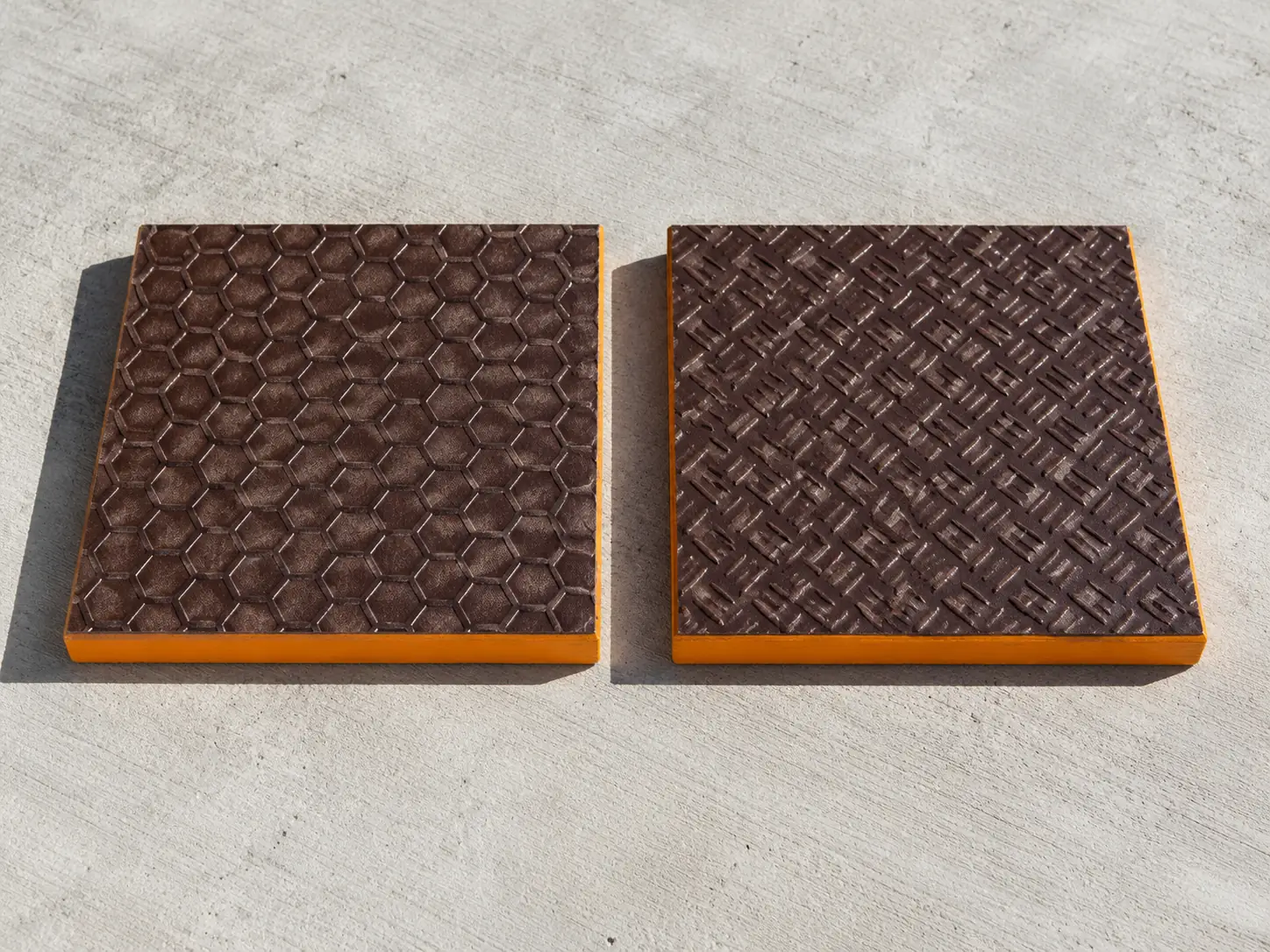
For most box truck floors we recommend the hexagon pattern. Its raised cells grip in every direction, so a boot turning on a wet floor meets the same texture as a load pushed sideways. Water drains between the cells instead of standing on the face. Wire-mesh is the better face where pallets, cages or machines are dragged along the length of the floor.
Both patterns are pressed into the phenolic film by a textured plate in the film press, so the grip is part of the face itself. Nothing is glued or painted on afterwards, which is why a pressed pattern does not flake off in the wheel lanes the way a grit coating can.
| Item | Hexagon face | Wire-mesh face |
|---|---|---|
| Texture | Regular raised cells | Crossed, slightly deeper mesh |
| Grip direction | Even in every direction | Strongest across the mesh lines |
| Typical body | Box bodies, curtain-sides, flatbeds, loading platforms | Bodies where loads are dragged or pushed, ramps |
| Water | Drains between the cells | Drains along the mesh channels |
| Cleaning | Brush and water | Stiff brush or pressure washer; holds more dirt |
| How often ordered | Most ordered pattern | By order |
A third pattern, rice, is a fine, dense grain that is easy to sweep. It suits walkways and covered decks better than a truck floor, because its shallow texture fills with road dirt faster. Whichever face you choose, we press it on a sample piece of your thickness first, so the grip can be judged under a boot before the order is fixed.
What did the pendulum tests on our anti-slip specimens show?
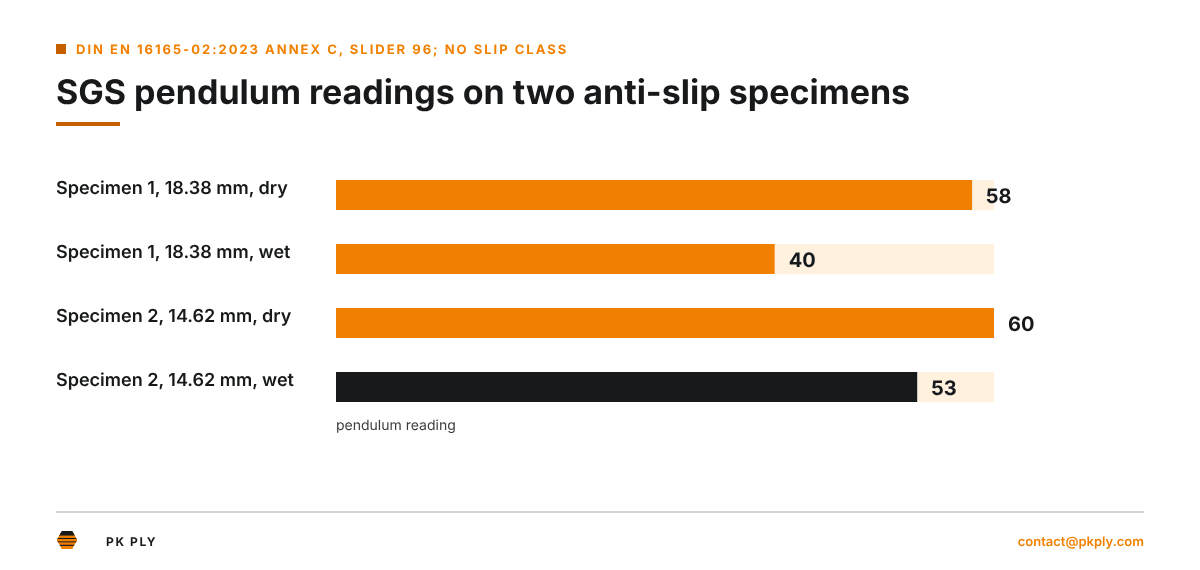
SGS pendulum-tested two anti-slip specimens we submitted, under DIN EN 16165-02:2023 Annex C with slider 96, in reports dated 14 October 2025. The 200 × 145 × 18.38 mm specimen read 58 dry and 40 wet; the 200 × 150 × 14.62 mm specimen read 60 dry and 53 wet. We claim no slip class from these readings.
The pendulum test swings a rubber slider across the surface and records how much friction slows it. The standard behind it covers floors people walk on. BS EN 16165 specifies test methods for determining the slip resistance of surfaces used by pedestrians. The pendulum is one of the methods it describes, beside the ramp tests and the tribometer.
| Specimen | Size tested | Dry reading | Wet reading | Drop when wet |
|---|---|---|---|---|
| Specimen 1 | 200 × 145 × 18.38 mm | 58 | 40 | 18 points |
| Specimen 2 | 200 × 150 × 14.62 mm | 60 | 53 | 7 points |
The useful number for a truck floor is the drop from dry to wet, because rain, wash water and melted snow are what turn a floor slick. The two specimens kept very different shares of their dry grip once wetted. The reports do not tie either reading to a pattern, and neither do we: two specimens are not enough to say that one face grips better than another.
What the results do not say matters as much as what they say. A pendulum value describes a clean specimen on the test day. It is not a rating for every panel we press, and it is not a promise about a floor after months of diesel, mud, grease and wheel wear. If your market or your client needs a slip class, send us the standard and the method, and we arrange a test through SGS on samples cut from your own build.
How our anti-slip truck floor panel is built
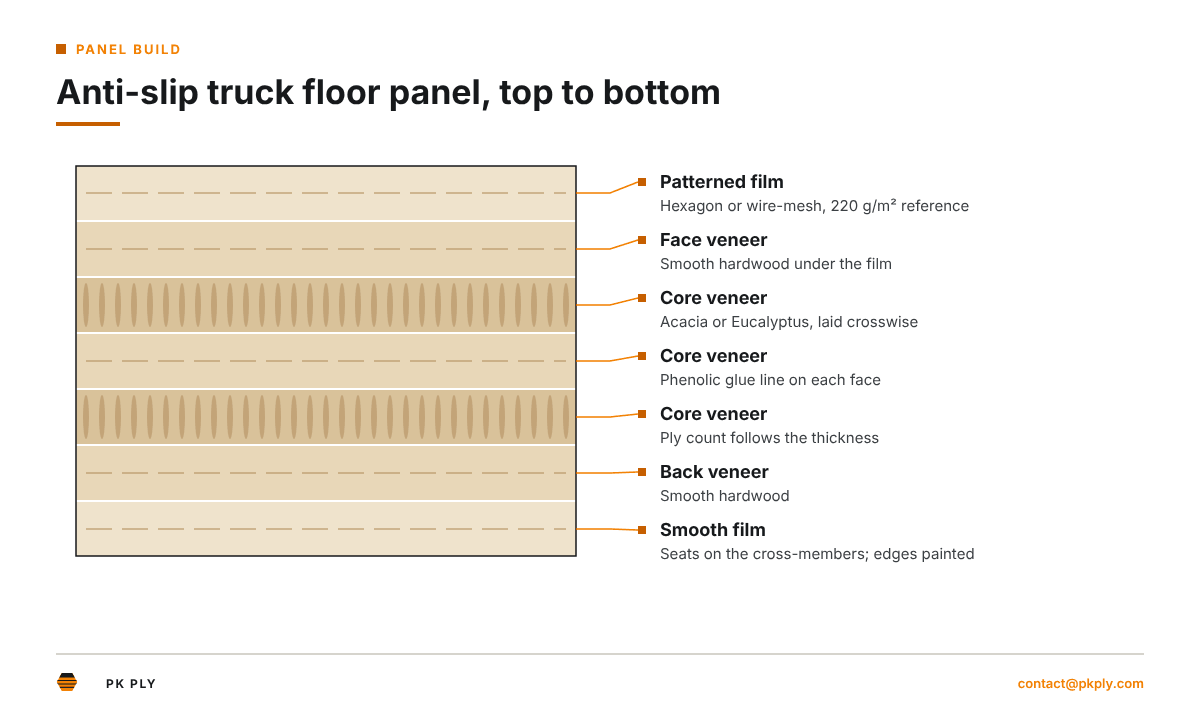
Our anti-slip truck floor panel is built in five parts. From the top: a patterned phenolic film, a smooth hardwood face veneer, and a cross-laid Acacia or Eucalyptus core bonded with phenolic glue. Below the core sit a back veneer and a smooth phenolic film. All four edges carry water-resistant paint.
- The patterned film is phenolic-impregnated paper pressed into the face with a textured plate. Our catalogue reference for anti-slip film is 220 g/m², heavier than the smooth films most formwork orders take, because a floor face meets wheels and boots instead of wet concrete. The film weight is confirmed per order with the duty.
- The face veneer under the film is smooth hardwood. A gap or a patch under a patterned film shows as a soft spot under a wheel and can crack the face over the void.
- The core is full hardwood veneers, each layer at right angles to the next. Cross-laying keeps the panel stiff in both directions, so it spans cross-members whichever way it is laid.
- The glue lines are phenolic for truck floors. MUF is offered only for floors that stay dry.
- The back film is smooth as standard, giving a flat, sealed face on the steel. Both faces can be patterned when the floor is meant to be turned over later.
- The edges are painted on all four sides at the mill, and every edge we cut to your sizes is painted before packing.
Our production runs in eight steps: veneer intake, drying, core lay-up, glue and press, sizing and sanding, film press, edge sealing, then marking and packing. For an anti-slip panel the textured plate goes into the film press at the sixth step, after the core has been pressed and sanded flat. Sample sheets from each run are cut open to check that every core layer is in place, and sample pieces are boiled and checked for open glue lines.
What thicknesses can we press for truck and trailer floors?
We press anti-slip truck and trailer floor plywood in any thickness from 9 mm to 40 mm, on 1220 × 2440 mm or 1250 × 2500 mm sheets. Most orders are 12, 15, 18 or 21 mm. Thickness tolerance is ±0.5 mm and length and width tolerance ±2 mm, and the tolerance for your order is written on its technical sheet.
| Thickness | Typical truck or trailer use | Sheet weight 1220 × 2440 mm, Acacia / Eucalyptus core |
|---|---|---|
| 9 mm | Linings, covers over an existing steel or worn floor | 15.5 kg / 17.4 kg |
| 12 mm | Van floors and light bodies on close supports | 20.7 kg / 23.2 kg |
| 15 mm | Light decks and ramps on close cross-members | 25.9 kg / 29.0 kg |
| 18 mm | Most box-body, curtain-side and trailer floors | 31.1 kg / 34.8 kg |
| 21 mm | Truck floors with wider cross-member spacing or heavier axle loads | 36.3 kg / 40.6 kg |
| Above 21 mm, up to 40 mm | Heavy-duty floors by agreement | Weighed per order |
The weights are density times volume at our planning densities of 580 kg/m³ for Acacia and 650 kg/m³ for Eucalyptus. Real sheets are weighed before final loading, and a body builder who plans payload to the kilogram should weigh a sample panel too. Our plywood sheet weight calculator gives the figure for other thicknesses and the 1250 × 2500 mm sheet.
For CE-marked structural use, the thickness also decides which documents apply. Our CE factory production control covers structural plywood from 3.6–30 mm, so a floor panel ordered with CE documents falls inside that band. A 32 or 40 mm floor is pressed and tested to your order, but it sits outside the CE scope.
What thickness is most common for truck flooring anti-slip plywood?
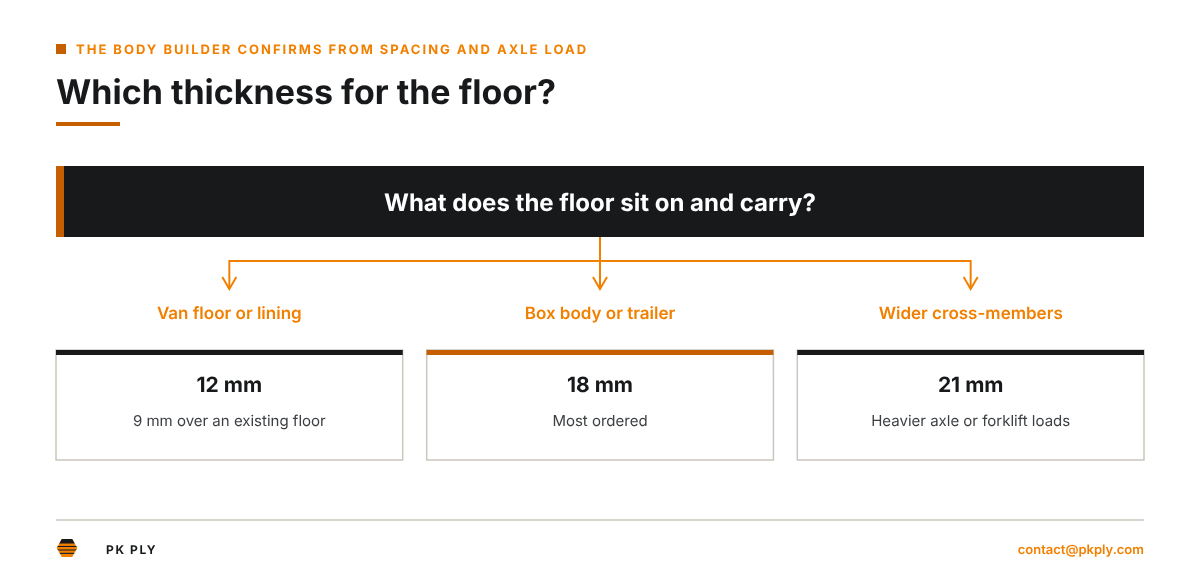
18 mm is the most common thickness for truck flooring anti-slip plywood, and it is our most ordered anti-slip thickness. Floors whose cross-members sit further apart, or that carry heavier axle and forklift loads, move to 21 mm. The body builder sets the final thickness from the cross-member spacing and the axle load.
Thickness buys stiffness between supports. A floor that bends under a forklift wheel works its bolts loose, opens the joints between panels and lets water in at the bolt holes. A thicker panel bends less over the same spacing, so the joints stay tight; it also adds weight that the body carries on every trip. Moving from 18 to 21 mm adds about 5.2 kg per 1220 × 2440 mm Acacia sheet.
Three questions settle the choice for most bodies:
- How far apart are the cross-members? Close spacing keeps 18 mm; wider spacing points to 21 mm.
- What runs on the floor? Boots and roll cages are light; a loaded pallet truck or a forklift puts a heavy point load on one wheel.
- How much payload can the body give up? Each step up in thickness costs weight across the whole floor area.
Send us those three answers with the internal length and width of the body, and we confirm the thickness on the technical sheet before pressing.
Phenolic or MUF glue under a truck floor
Phenolic glue is our standard for truck and trailer floors, because a floor is wetted by rain, washing and condensation for years and the glue line decides whether the plies hold together through it. MUF glue lowers the panel price and is acceptable on covered floors that stay dry, such as a box body that is never washed out.
The plywood standards sort panels by the conditions they serve in. EN 636 specifies requirements for plywood for general purposes or structural application in dry, humid or exterior conditions. An open flatbed or a washed-down box body is exterior service, and the glue line behind that is tested under the bonding standard. EN 314-2 specifies requirements for bonding classes of veneer plywood according to their end uses. Class 3 is the exterior bonding class.
Our phenolic bond has a test behind it. SGS tested one submitted 21 mm dark-brown film-faced specimen with an Acacia core and phenolic glue. Its report, issued 23 December 2025, records bonding quality Class 3 PASS after a 24 h water soak, a boil-dry-boil cycle and 72 h of boiling.
In the EN 717-1 chamber the same specimen’s formaldehyde was not detected at the 0.04 mg/m³ reporting limit, an E1 pass against 0.124 mg/m³; that is an E1 result, not an E0 claim. These are results for the tested specimen; a different thickness or core gets its own test when a project needs one. Our note on the SGS 21 mm phenolic specimen sets out the whole report, and WBP glue in film-faced plywood explains the glue systems.
| Item | Phenolic glue | MUF glue |
|---|---|---|
| Service | Open trailers, flatbeds, washed-down bodies | Covered, dry floors |
| Test behind it | Class 3 PASS on our SGS-tested 21 mm specimen | Not offered for open floors |
| Panel price | Higher | Lower |
| Our advice for truck floors | Standard | Only where the floor never gets wet |
The glue also matters for the same panel in our formwork range: a phenolic film-faced plywood panel gives up to about 25 pours with proper handling, release agent and sealed edges, and the anti-slip floor panel shares that glue line.
Acacia or Eucalyptus core under wheels and pallet trucks
Choose Eucalyptus, the denser core, for truck floors that take forklift wheels or heavy point loads. Choose Acacia, the lighter core, where payload and container volume count more. At our planning densities an 18 mm sheet weighs about 31.1 kg in Acacia and about 34.8 kg in Eucalyptus.
| Item | Acacia core | Eucalyptus core |
|---|---|---|
| Planning density | 580 kg/m³ | 650 kg/m³; measured 650–750 kg/m³ |
| 18 mm sheet, 1220 × 2440 mm | About 31.1 kg | About 34.8 kg |
| 21 mm sheet, 1220 × 2440 mm | About 36.3 kg | About 40.6 kg |
| 18 mm sheet, 1250 × 2500 mm | About 32.6 kg | About 36.6 kg |
| Load per 40HC | About 47 m³ | About 43 m³, weight-capped |
| Where it suits a truck | Vans, light bodies, payload-sensitive trailers | Forklift-loaded box bodies and flatbeds |
The measured density on our SGS 21 mm Acacia specimen was 642 kg/m³, above the Acacia planning figure. That is why we ask a body builder to weigh a real panel before fixing a payload sum. Either core is full hardwood veneer laid crosswise; the denser Eucalyptus holds bolts and screws a little better and feels firmer under a wheel, while Acacia gives more square metres of floor per container.
How should fixing holes in a truck floor be sealed?
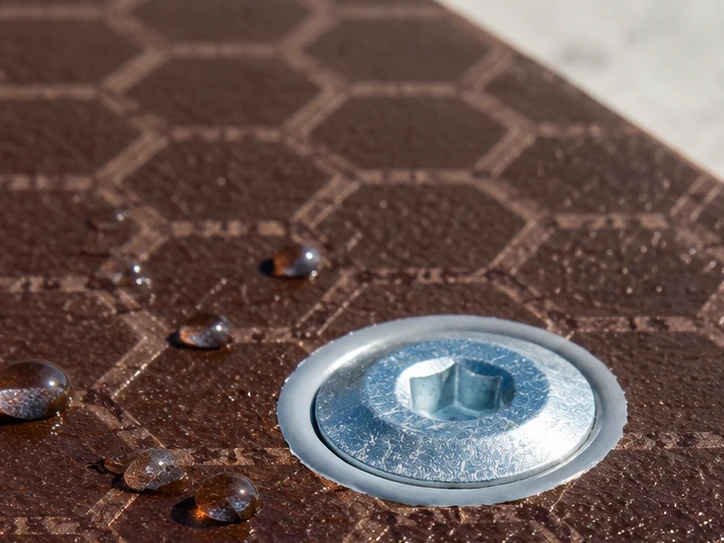
Seal the inside of every drilled hole with edge sealer before the bolt goes in. Then fit the bolt with sealant under its head, and run a bead of sealant where the panel meets the frame. Water follows the bolt: an unsealed hole lets it straight into the end grain of every ply the drill cut.
A bolt hole is a cut edge turned on its side. The film and the edge paint keep water out of the face and the sides; a drill opens the core through its whole thickness. Once water gets in, the core swells around the hole, the bolt loosens, the film lifts in a ring around the bolt head, and the panel starts to fail from that point outwards.
- Lay out the holes on the cross-members and keep them clear of panel joints, so a hole never sits in a sealed edge.
- Drill clean with a sharp bit through the film, so the film does not chip around the hole.
- Seal the hole the same day. Brush or inject edge sealer into the hole so the end grain inside is wetted all round, and let it dry.
- Fit the bolt with sealant under the head or washer, and countersink flush where the floor carries wheels, so the head does not catch a pallet truck.
- Seal the panel to the frame. Run a bead of sealant where the panel meets the side rails and the rear sill. Leave a small sealed joint between panels so water runs off the face.
- Reseal after any repair. A bolt removed to change a panel leaves an open hole in the panels beside it; seal it again before refitting.
The same rule covers every cut made in the body shop. We paint all four edges at the mill and every edge we cut to your sizes. Panels cut to the body width leave only the end cuts and the cut-outs for fittings to seal on site.
Wear lanes: where a truck floor wears first
A truck floor wears first in the wheel lanes from the rear door, at the forklift turning spots and along the side strip where loads are dragged in, while the front corners of a box body barely wear at all. Planning the panel layout and the upkeep around those lanes keeps the same floor in service longer.
- Keep joints out of the lanes. Lay the panels so that joints between sheets fall outside the pallet-truck lanes; a wheel crossing a joint chips the film and opens the edge to water.
- Rotate panels where the frame allows. Swap panels from the wheel lanes with panels from the sides once the pattern in the lanes flattens, to spread the wear.
- Order both faces patterned for bodies that are hard on floors, so a worn panel can be unbolted and turned over.
- Clean the cells, not the film. A stiff brush and water keep the cells open; a steel scraper flattens the pattern. Oil and grease fill the cells and take the grip away, so clean them off the same day.
- Check the bolts in the lanes at each service; a loose bolt lets the panel move and grinds the hole open.
A pressed pattern lasts as long as the film it is pressed into. When the film is worn through in a lane, the panel is turned or replaced, and the body goes back to work on the same frame.
What is the best plywood for a trailer floor?
For most trailer floors we recommend an 18 or 21 mm anti-slip panel with a hexagon face, phenolic glue and a hardwood core, with every edge and bolt hole sealed. It keeps its grip when wet, and a damaged panel is replaced on its own. Smooth film, grit coatings and steel checker plate each trade away one of those points.
| Item | Anti-slip plywood, pressed pattern | Smooth film-faced plywood | Smooth panel with grit coating | Steel checker plate |
|---|---|---|---|---|
| Where the grip is | Moulded into the film | None; slick when wet | In the paint layer | Raised steel pattern |
| Wet grip | Pendulum-tested on two specimens | Low | Good until the coating wears | Low on wet or oily steel |
| Upkeep | Brush and water | Brush and water | Recoat in the wheel tracks | Rust protection |
| Weight, 18 mm | 31.1 kg Acacia or 34.8 kg Eucalyptus per 1220 × 2440 mm sheet | Same | Same plus the coating | Much heavier per square metre |
| Repair | Replace one panel | Replace one panel | Recoat | Cut and weld |
A grit paint can be rolled onto any panel and recoated, but it wears in the wheel tracks first and must be renewed there. A smooth film panel is a good floor only where nobody walks on it wet. Steel checker plate does not rot, but it adds weight, is slippery wet or oily, and is repaired by cutting and welding. Our shuttering ply note covers the smooth film-faced panels that sit beside anti-slip floors in many orders, and the applications overview lists where else our builds are used.
Is anti-slip plywood from Vietnam suitable for trailer and truck floors?
Yes, when the build is specified and documented: phenolic glue, a hardwood core laid crosswise, a patterned phenolic film, painted edges and a stated tolerance. We press that panel at our two mills in Chi Linh, Hai Phong, ship up to 150 containers a month across both mills, and sell FOB Hai Phong, CFR or CIF.
Northern Vietnam has many plywood mills, and they make very different panels: furniture, commercial and packing plywood at one end, budget and premium film-faced panels at the other. Anti-slip floor plywood is a small part of that trade. Before ordering truck floor panels from any Vietnamese mill, check five things:
- Who presses the panel. Ask which mill presses it and whether you can see the film press with a patterned plate on a video call.
- The build in writing. The quote names the core, the glue, the pattern, the film weight, the thickness tolerance and the edge treatment.
- Test evidence with its context. A pendulum or bonding result states the specimen, the method and the date.
- Certificates with numbers. Our FSC chain of custody is SGSHK-COC-370674 and our CE factory production control is 0407-CPR-2146; both can be checked with their issuers.
- A sample of your own build. A sample of your pattern and thickness shows the grip and the edge finish before the container is booked.
For European buyers, the CE route matters. EN 13986 covers characteristics, evaluation of conformity and marking of wood-based panels for use in construction. Ours runs under AVCP System 2+ with notified body 0407, for structural plywood 3.6–30 mm with MUF or phenolic glue. The CE marking page shows the certificate, and our anti-slip panels are made under the same ISO 9001 quality management and run records as our formwork panels.
A container from Hai Phong typically spends 30–40 days at sea to a Northern European port such as Hamburg. The Mediterranean takes 25–35 days and the US East Coast 35–45 days, depending on carrier and route.
Sheet sizes, panels cut to the deck width and 40HC loads
We press truck floor panels on 1220 × 2440 mm and 1250 × 2500 mm sheets, and nothing larger. At the mill we cut them to the deck width or a cutting list and paint every cut edge before packing. A 40HC holds about 880 sheets of 18 mm 1220 × 2440 mm with an Acacia core, as a planning figure.
| Core and thickness, 1220 × 2440 mm | Sheets per pack | Sheets per 40HC | m³ per 40HC |
|---|---|---|---|
| Acacia, 18 mm | 55 sheets | 880 sheets | 47.2 m³ |
| Acacia, 21 mm | 47 sheets | 752 sheets | 47.0 m³ |
| Eucalyptus, 18 mm | 53 sheets | 795 sheets | 42.6 m³ |
| Eucalyptus, 21 mm | 45 sheets | 675 sheets | 42.2 m³ |
Every figure in the table is a planning figure from our packing model. Packs stand about 1,000 mm high, 16 packs with Acacia and 15 with Eucalyptus. The planning payload is 28,000 kg of panels, which the carrier and route confirm. Eucalyptus loads are capped by weight before the container is full. Patterned faces are packed face to back so the cells do not lock into each other in transit, and the final count is the one on the packing list. Our 40HC loading page shows how the packs go in.
Panels cut to the body’s internal width arrive ready to lay, and the body shop only trims the ends. For a run of identical bodies, send the floor drawing with the panel layout, and the cutting list becomes part of the technical sheet that the repeat order is pressed to. Our cut-to-size panels page shows how a cutting list is handled.
What to write on a truck floor plywood order
A truck floor plywood order needs ten lines. They are the body and its use, face pattern, back face, film weight, core, glue, thickness with tolerance, sheet size or cutting list, edges and marking, and quantity with the port. With those lines two offers can be compared panel for panel.
| Line | What to write | Example for an 18 mm box-body floor |
|---|---|---|
| Body and use | Body type, what runs on the floor, wet or dry | Box body, pallet trucks, washed out weekly |
| Face pattern | Hexagon, wire-mesh or rice | Hexagon |
| Back face | Smooth film or patterned | Smooth film |
| Film | Weight in g/m² and colour | 220 g/m² reference, dark brown |
| Core | Acacia or Eucalyptus | Eucalyptus |
| Glue | Phenolic or MUF | Phenolic |
| Thickness | mm and tolerance, with cross-member spacing | 18 mm, ±0.5 mm |
| Size | Sheet size or cutting list | Cut to the body width from 1250 × 2500 mm |
| Edges and marking | Edge paint, stamp on the back, pack labels | Painted all four edges, your stamp on the back |
| Quantity and port | Containers or m³, port of discharge | One 40HC, CIF Hamburg |
The minimum order is one 40HC, and anti-slip and smooth film-faced panels can share it. Production takes 15–45 days after the 30% deposit, and the 70% balance is paid against the scanned bill of lading by T/T or by irrevocable L/C at sight. Samples of your pattern and thickness are free; new buyers book their own courier, and that cost can be credited against a real order.
Send the ten lines through our specification form or by email to [email protected], and we return a technical sheet with an FOB Hai Phong, CFR or CIF price for your floor.
Questions buyers ask us
What is truck floor plywood made of?
Ours is made of Acacia or Eucalyptus hardwood veneers laid crosswise, bonded with phenolic glue, with a patterned phenolic film on the top face, a smooth film on the back and paint on all four edges.
What thickness is truck floor plywood?
Most box-body and trailer floors take 18 mm, and truck floors with wider cross-member spacing take 21 mm. We press any thickness from 9 to 40 mm, and the body builder sets the final figure from the cross-member spacing and the axle load.
Is phenolic faced ply waterproof on an open truck?
The phenolic film and a phenolic glue line keep water out of the face and the bond, and our 21 mm phenolic specimen passed bonding Class 3 in an SGS test. Cut edges, notches and bolt holes stay open to water until they are sealed on site.
Which is better for a box truck floor, hexagon or wire mesh?
Hexagon for most box bodies, because the raised cells grip in every direction and drain water between them. Wire-mesh where pallets, cages or machines are dragged along the length of the floor.
Do you claim a slip class for your anti-slip plywood?
No. Two submitted specimens read 58 dry / 40 wet and 60 dry / 53 wet in SGS pendulum tests, and those readings describe the specimens, not every panel or every floor in service.
How heavy is an 18 mm truck floor sheet?
A 1220 × 2440 mm sheet weighs about 31.1 kg with an Acacia core and about 34.8 kg with a Eucalyptus core, at planning densities of 580 and 650 kg/m³. Weigh real sheets before you plan a body's payload.
Can I order lorry floor plywood cut to the body width?
Yes. We cut panels to the deck width or to a cutting list at the mill and paint every cut edge before packing, so the only site cuts are at the ends and around fittings.
What film weight goes on an anti-slip truck floor?
Our catalogue reference for anti-slip film is 220 g/m², and the film for each order is confirmed against what runs over the floor: wheels, pallets, boots or animals.
Can both faces of a truck floor panel be patterned?
Yes. The standard back is smooth film for seating on the cross-members, and both faces can be patterned when you want a panel that can be turned over once the top wears.
Can anti-slip and smooth film-faced plywood share one container?
Yes. A 40HC usually carries one or two builds, and three to six can be mixed by agreement, so a body shop can take floor panels and smooth wall linings together.
How long does a container take from Hai Phong to Hamburg?
A Northern European port such as Hamburg is typically 30–40 days at sea from Hai Phong, depending on carrier and route; inland delivery after that is booked from the port.
Do you send samples of the truck floor face?
Yes. Samples of the pattern and thickness you want are free; new buyers book their own courier, and that cost can be credited against a real order.